Choosing between discard vs disgard might seem like a small spelling puzzle, but one misplaced letter can make your writing stumble. So, which version is correct? The answer is refreshingly simple: discard is the only accepted spelling. It means to throw something away, get rid of what you no longer need, or reject an idea. Disgard, on the other hand, is a common spelling mistake, not a recognized English word. Although the two look almost identical, they aren’t interchangeable. Let’s clear up the confusion with straightforward explanations, everyday examples, and easy tips to help you spell discard correctly every time.
Discard vs Disgard The Quick Answer
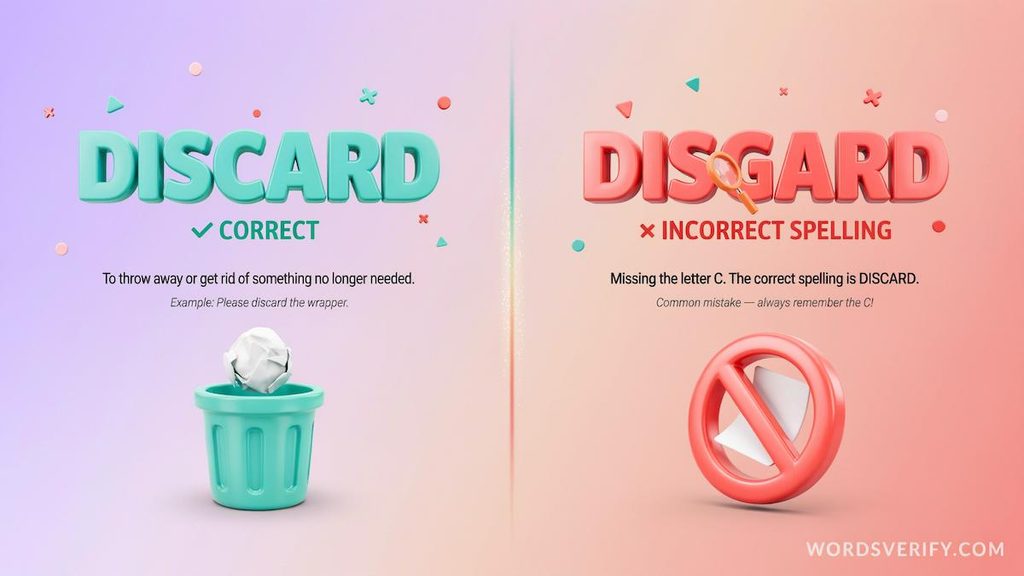
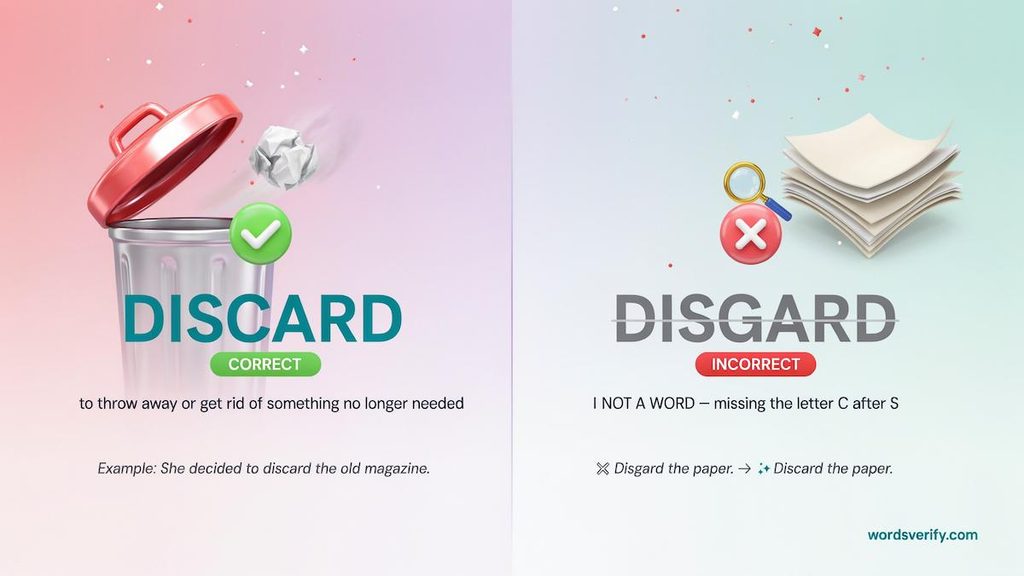
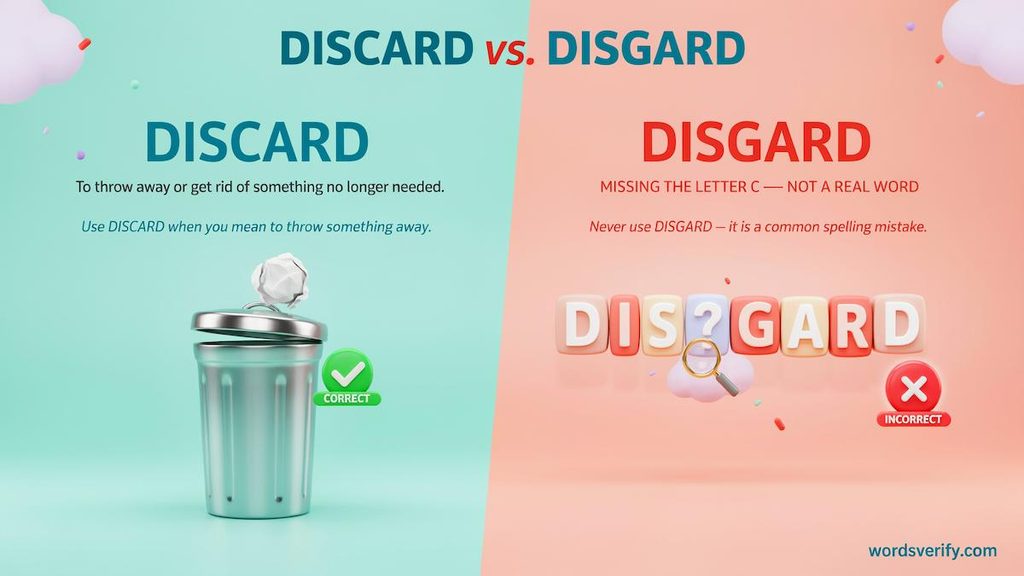
Discard is the correct spelling. Disgard is incorrect and should not appear in standard English writing.
| Word | Correct or incorrect? | Meaning |
|---|---|---|
| Discard | Correct | To throw away, remove, or get rid of something |
| Disgard | Incorrect | A common misspelling of discard |
Use discard when you want to describe throwing something away, rejecting an idea, or removing something you no longer need.
For example:
- Please discard the expired food.
- The editor decided to discard the unnecessary paragraph.
- You should discard any cards you don’t want in the game.
Avoid disgard in emails, school assignments, reports, and other formal or informal writing. It isn’t an accepted alternative spelling.
Learn the difference between confusing more English words
Inversely vs Conversely which one is correct?
What Does Discard Mean?
The word discard means to get rid of something because you no longer want, need, or consider it useful. You can discard a physical object, remove unwanted information, or reject an idea that doesn’t work.
The word has several uses, depending on the situation.
Discard as a Verb
As a verb, discard describes the action of throwing something away, removing it, or deciding not to use it.
For example:
- She discarded the old receipts after checking her expenses.
- The company discarded its outdated equipment.
- We decided to discard the original plan and start again.
- He discarded the damaged papers before submitting the application.
- The player discarded two cards during the game.
In each sentence, something is being removed or rejected because it is no longer wanted or useful.
You don’t have to throw an object into a trash can to discard it. You can also discard an idea, suggestion, method, or plan.
For instance, a writer might discard a paragraph that doesn’t fit the article. A manager might discard a proposal that doesn’t meet the company’s needs. The action is the same: deciding that something should no longer be used or considered.
Discard as a Noun
Discard can also function as a noun. It refers to something that has been thrown away, rejected, or removed.
This use is particularly common in card games, where a discarded card is one that a player has chosen not to keep.
Examples:
- The discarded card went into the discard pile.
- The charity collected clothing discards for recycling.
- The player picked up a card from the discard pile.
- The factory separated useful materials from its discards.
The noun form appears less often in everyday conversation than the verb form, but it’s still useful in the right context.
Is Disgard a Word?
No. Disgard isn’t a standard English word. You won’t find it listed as a recognized spelling in reputable English dictionaries.
People sometimes type it because it looks and sounds similar to discard. The mistake is understandable, but that doesn’t make it correct.
If you see disgard in a message, article, or online post, the writer almost certainly means discard.
Consider these examples:
- Incorrect: Please disgard the damaged documents.
- Correct: Please discard the damaged documents.
- Incorrect: The team decided to disgard the old proposal.
- Correct: The team decided to discard the old proposal.
- Incorrect: You can disgard the packaging after opening the product.
- Correct: You can discard the packaging after opening the product.
The correction is simple: replace the final G with a C.
Learn the difference between confusing more English words
Ironic vs Unironic which one is correct?
Why Do People Confuse Discard vs Disgard?
The spelling mistake usually happens because the two words look similar. In Discard vs Disgard, only one letter separates the correct spelling from the incorrect one, and that small difference can easily go unnoticed when you’re typing quickly. Understanding Discard vs Disgard helps you recognize the correct spelling and avoid this common writing mistake.
Here are a few reasons the confusion occurs.
The Similar Appearance
Both spellings begin with dis and contain almost the same letters. When you read quickly, your brain may recognize the general shape of the word without noticing the incorrect letter.
This is especially common when you’re familiar with a word’s meaning but haven’t paid much attention to its spelling.
The C and G Sound Confusion
The letters C and G can cause spelling mistakes because both can represent consonant sounds. In discard, the C has a hard K sound.
Some writers mistakenly replace it with G, creating disgard. However, the correct spelling always uses C.
Typing Too Quickly
Fast typing can turn a small spelling mistake into an embarrassing one. You might know the correct spelling but still hit the wrong key without noticing.
Autocorrect doesn’t always catch every mistake, either. Some typing tools may leave an unfamiliar misspelling unchanged, especially if the surrounding sentence doesn’t make the error obvious.
Familiarity With the Word
People often remember how a word sounds without remembering every letter. If you’ve heard discard many times but rarely written it, you may hesitate when spelling it.
The best solution is to learn the correct spelling and use it in a few sentences. Repetition makes the right version easier to remember.
Learn the difference between confusing more English words
Rehireable vs Rehirable Which one Is Correct?
Discard in Everyday Writing
You’ll encounter discard in many situations. It works in casual conversations, professional communication, academic writing, technology, and even cooking.
Here are some common examples.
Everyday Conversation
People often use discard when talking about things they no longer need.
- Discard those broken toys before someone gets hurt.
- I decided to discard the old magazines.
- You can discard the empty bottle in the recycling bin.
- She discarded the shoes because they were too small.
In everyday conversation, throw away or get rid of may sound more natural. However, discard is perfectly acceptable, particularly when you want a slightly more formal tone.
Academic Writing
In academic and research settings, discard can describe removing information, rejecting an explanation, or excluding unsuitable material.
Examples:
- The researchers discarded incomplete responses.
- The student discarded the first draft and rewrote the introduction.
- The study excluded records that didn’t meet the selection criteria.
- The researchers discarded the original hypothesis after reviewing the results.
The word is useful because it describes a deliberate decision rather than simply losing something.
Business and Professional Writing
Businesses use discard when discussing outdated materials, unsuccessful plans, and unnecessary processes.
Examples:
- The company decided to discard its outdated policies.
- Please discard the previous version of the report.
- The manager discarded the proposal after reviewing the costs.
- Employees should discard confidential documents according to company policy.
In professional writing, the word can make instructions clear and direct.
Technology and Digital Information
The word also appears in technology. You might see it when working with files, software, settings, or saved changes.
Examples:
- Click the button to discard your changes.
- The application discarded the temporary files.
- You can discard the draft without saving it.
- The system automatically discarded the incomplete data.
If you’ve ever edited a document and selected “Discard Changes,” you’ve already encountered this use.
Learn the difference between confusing more English words
Monkeys vs Monkies which one is correct?
What Does Discard Mean in Cooking?
In cooking, discard means removing an ingredient or portion that you don’t plan to use. Although discard and disregard may look similar, they have different meanings. In this context, discard refers to getting rid of something, while disregard means ignoring it.
One familiar example is sourdough starter. When you maintain a sourdough starter, you typically remove part of it before feeding the remaining mixture with fresh flour and water. That removed portion is called sourdough discard. Understanding discard vs disgard helps you avoid confusing the two words when discussing cooking or everyday activities.
Instead of throwing it away, some people use sourdough discard in pancakes, crackers, muffins, waffles, and other recipes. Its usefulness depends on the starter’s condition and how it has been handled. Remember the difference between discard vs disgard: you discard the unused starter, but you disregard advice or information you choose not to follow.
For example:
- Discard the portion of starter before feeding the remaining mixture.
- Save some sourdough discard to make pancakes.
- Don’t use a starter that shows signs of spoilage.
In this context, discard describes the portion removed from the starter. It doesn’t mean the mixture must always end up in the trash.
Learn the difference between confusing more English words
Choosing vs Chosing which one is correct?
Different Forms of Discard
Like most English verbs, discard changes form depending on the tense and grammatical structure.
| Word form | Usage | Example |
|---|---|---|
| Discard | Base form | Please discard the empty box. |
| Discards | Present tense, third-person singular | She discards unnecessary paperwork. |
| Discarded | Simple past and past participle | He discarded the damaged file. |
| Discarding | Present participle and gerund | They are discarding old equipment. |
| Discardable | Adjective | The packaging is discardable. |
Discard
Use the base form after modal verbs such as can, should, will, and must.
Examples:
- You should discard the expired medicine according to its disposal instructions.
- We can discard the outdated version.
- They must discard the damaged materials.
Discards
Use discards with a singular third-person subject in the simple present tense.
Examples:
- She discards old paperwork every Friday.
- The machine discards defective products.
- He discards unwanted cards during the game.
Discarded
Use discarded when describing an action that happened in the past or when forming a passive construction.
Examples:
- They discarded the old furniture.
- The unused materials were discarded.
- She discarded the first version of her essay.
Discarding
Use discarding when describing an ongoing action or treating the action as a noun.
Examples:
- The workers are discarding damaged products.
- Discarding useful information can create problems.
- He is discarding the files he no longer needs.
Discardable
Discardable is an adjective that describes something that can be discarded.
For example:
- The container is made from discardable material.
- Remove the discardable items before packing.
This form is less common than discard, discarded, and discarding.
Learn the difference between confusing more English words
Salvadoran vs Salvadorian Which one Is Correct?
How Do You Pronounce Discard?
The word discard has two syllables:
dis-card
In American English, the verb is commonly pronounced /dɪˈskɑːrd/.
The stress falls on the second syllable: CARD.
When discard functions as a noun, the stress can shift to the first syllable. This difference is worth remembering if you want to pronounce the word naturally.
The incorrect spelling disgard doesn’t have a standard dictionary pronunciation because it isn’t an accepted English word.
Discard vs Disregard What’s the Difference?
Discard vs disregard look somewhat alike, but they have different meanings. Both can describe rejecting something, yet they aren’t interchangeable in every sentence.
Discard means to throw something away, remove it, or decide not to use it.
Disregard means to ignore something or pay no attention to it.
Compare these examples:
| Discard | Disregard |
|---|---|
| She discarded the old report. | She disregarded the warning. |
| He discarded the broken phone. | He disregarded the instructions. |
| The editor discarded the unnecessary paragraph. | The editor disregarded the reader’s complaint. |
| They discarded the original plan. | They disregarded the advice. |
The difference becomes clearer when you think about the action.
If you discard a document, you remove it or get rid of it. If you disregard a document, you ignore its contents or choose not to consider what it says.
Here are a few more examples:
- Please discard the damaged packaging.
- Please disregard the previous email.
The first sentence asks someone to get rid of the packaging. The second asks someone to ignore an earlier message.
Choosing the right word makes your meaning much clearer.
Learn the difference between confusing more English words
Attend vs Tend which one is correct?
Synonyms and Antonyms of Discard
Learning related words can help you understand discard and use it more naturally.
Synonyms of Discard
A synonym is a word with a similar meaning. Depending on the sentence, you can use several alternatives for discard.
| Synonym | Meaning |
|---|---|
| Throw away | Put something in the trash or get rid of it |
| Dispose of | Get rid of something properly |
| Remove | Take something away |
| Reject | Refuse to accept or consider something |
| Abandon | Give up an idea, plan, or activity |
| Eliminate | Remove something completely |
| Dump | Get rid of something, often carelessly |
| Dismiss | Decide that an idea or suggestion isn’t worth considering |
These words don’t fit every situation equally well. For example, dispose of often sounds more formal than throw away, while reject works particularly well when discussing proposals, applications, or suggestions.
Examples:
- She threw away the empty carton.
- The company disposed of the damaged equipment.
- He rejected the proposed changes.
- The team abandoned its original strategy.
Antonyms of Discard
An antonym is a word with an opposite or contrasting meaning. The best opposite of discard depends on what you’re describing.
| Antonym | Meaning |
|---|---|
| Keep | Continue to have or hold something |
| Retain | Continue to possess or preserve something |
| Save | Keep something for future use |
| Accept | Agree to receive or approve something |
| Preserve | Protect something from damage or loss |
| Maintain | Keep something in its existing condition |
For example, if you discard an old document, you get rid of it. If you retain or preserve it, you keep it.
Similarly, if you discard a proposal, you reject it. If you accept the proposal, you agree to it.
Learn the difference between confusing more English words
Hoodie vs Hoody Which one Is Correct?
Common Mistakes When Using Discard
Even when you know the correct spelling, a few related mistakes can cause confusion.
Writing Disgard Instead of Discard
This is the main spelling error.
Incorrect: The manager decided to disgard the proposal.
Correct: The manager decided to discard the proposal.
Remember that discard always uses C, not G.
Confusing Discard With Disregard
These words have different meanings.
Incorrect: Please discard my previous message if you don’t want to follow it.
Better: Please disregard my previous message if you don’t want to follow it.
The second sentence is more suitable if you want someone to ignore the message rather than delete it.
Using the Wrong Verb Form
The word changes depending on the sentence.
Incorrect: She discard the old documents yesterday.
Correct: She discarded the old documents yesterday.
Because the action happened in the past, the sentence needs discarded.
Assuming Discard Always Means Throwing Something in the Trash
The word has a broader meaning. You can discard an idea, a plan, an option, or a suggestion without physically throwing anything away.
For example:
- The committee discarded the original proposal.
- The writer discarded the first draft.
- The player discarded two cards.
Each sentence describes removing or rejecting something, but none requires a trash can.
Outting vs Outing which one is correct?
How to Remember the Correct Spelling
A simple memory trick can help you avoid writing disgard.
Think of the word as DIS + CARD = DISCARD.
The word card appears at the end of discard. Once you remember that connection, the correct spelling becomes easier to recognize. This simple trick can help you avoid confusion when choosing between discard vs disgard.
You can also connect the word to a familiar situation. In a card game, players discard cards they don’t want to keep. The word contains the same spelling as card, which gives you a useful reminder. When comparing discard vs disgard, remember that discard keeps the C from card.
Here are three more ways to remember it:
- Remember the C: Discard contains C, not G.
- Practice a sentence: “I will discard what I don’t need.”
- Check the spelling before sending important messages or submitting written work.
A little practice can prevent the same mistake from appearing again.
Learn the difference between confusing more English words
Excel vs Excell which one is correct?
practice session Discard vs Disgard
Test your understanding of the correct spelling, meaning and usage of discard. Complete each sentence with the appropriate word or form. Choose from of discard vs disgard
fill in the blanks
1. Please ______ the empty bottles before leaving the room.
2. She decided to ______ the old clothes she no longer wore.
3. The manager ______ the proposal because it exceeded the budget.
4. You should ______ any food that shows signs of spoilage.
5. The player placed his unwanted cards in the ______ pile.
6. He is ______ unnecessary files to free up storage space.
7. The company regularly ______ damaged products during quality checks.
8. The editor asked me to ______ the first paragraph and write a clearer one.
9. The ______ documents were collected for recycling.
10. Please ______ my previous email and follow the updated instructions.
11. The researchers ______ the results that didn’t meet their criteria.
12. She never ______ useful information without reviewing it first.
13. You can ______ the temporary files after completing the project.
14. The factory is ______ defective materials before packaging.
15. The player picked up a card from the ______ pile.
16. We decided to ______ our original plan and try a different approach.
17. The old equipment was ______ because it was no longer safe to use.
18. He ______ the warning and continued driving too fast.
19. ______ unnecessary details can make your writing clearer.
20. The chef removed part of the sourdough starter and saved the ______ for pancakes.
21. The team will ______ the outdated version of the report.
22. She ______ the damaged packaging before storing the remaining supplies.
23. Don’t ______ the safety instructions when using the machine.
24. The company is considering ______ its outdated policies.
25. Instead of keeping the broken chair, we decided to ______ it.
Answers
- Discard
- Discard
- Discarded
- Discard
- Discard
- Discarding
- Discards
- Discard
- Discarded
- Disregard
- Discarded
- Discards
- Discard
- Discarding
- Discard
- Discard
- Discarded
- Disregarded
- Discarding
- Discard
- Discard
- Discarded
- Disregard
- Discarding
- Discard
Here’s a trusted source for clear word meanings:
FAQs
Why is discard spelled with a C instead of a G?
The correct spelling is discard, with a C. The word comes from the combination of the prefix dis- and card, referring originally to removing a card from play. The G in disgard is simply a spelling error.
Can discard be used for people as well as objects?
Yes. You can use discard when someone rejects or abandons a person, although it may sound harsh or insensitive. For example, “He felt discarded after his friends stopped including him.”
Is discard a transitive or intransitive verb?
Discard is generally a transitive verb, meaning it takes a direct object. For example, “Please discard the empty container.” The container is the object being discarded.
Can discard be used in the passive voice?
Yes. You can use discard in the passive voice when the focus is on the item being removed rather than the person performing the action. For example, “The outdated documents were discarded.”
What does discard mean in card games?
In card games, discard means to remove a card from your hand or play because you no longer want or need it. The removed card may be placed in a designated discard pile.
What is the difference between discard and abandon?
Discard usually means getting rid of something or rejecting it. Abandon often means giving up something, leaving it behind, or stopping an activity. For example, you might discard an old document but abandon an unsuccessful project.
Is discard a formal or informal word?
Discard works in both formal and informal English. It’s suitable for everyday conversations, business reports, academic writing, and professional instructions. Its tone is generally more formal than “throw away.”
Can you say “discard of something”?
No. The standard construction is discard something, without the preposition of. For example, say “Discard the unnecessary files,” not “Discard of the unnecessary files.” However, “get rid of the files” is correct.
What is the difference between discard and dispose of?
Both expressions describe getting rid of something, but their grammatical structures differ. Discard takes a direct object, while dispose usually appears as dispose of something. For example, “Discard the packaging” and “Dispose of the packaging” are both correct.
Is discard the same as delete?
Not exactly. Discard means to get rid of or reject something, while delete specifically means to remove digital or written information. You can discard an idea or a physical object, but you generally delete a file or message.
What does “please discard” mean?
“Please discard” is a polite instruction asking someone to throw something away, remove it, or stop using it. For example, “Please discard the previous version of the document” means the earlier version should no longer be used.
What is the origin of the word discard?
Discard dates back to the late 16th century. It originally referred to removing a card from play. The word combines dis-, suggesting removal, with card. Its meaning later expanded to include getting rid of unwanted objects, ideas, and materials.
What is the difference between discard and reject?
Discard generally means removing or getting rid of something. Reject means refusing to accept, approve, or consider something. For example, you discard an old report but reject an unsuitable job application.
What is a good professional alternative to “throw away”?
Depending on the context, you can use discard, dispose of, remove, or eliminate. For example, “Please dispose of the outdated documents according to company policy” sounds more professional than “Please throw away the old papers.”
Can discard describe an idea or opinion?
Yes. Discard can describe rejecting an idea, opinion, suggestion, or belief that you no longer consider useful or valid. For example, “The researchers discarded the original theory after reviewing the evidence.”
Learn the difference between confusing more English words
Studder vs Stutter which one is correct?
Conclusion
When it comes to discard vs disgard, the choice is clear: discard is the correct spelling, while disgard is simply a spelling mistake. Remember, that little C makes all the difference! Use discard when you mean to throw something away, remove something unnecessary, or reject an idea. Whether you’re cleaning out a cupboard, editing an essay, or removing unwanted files, the spelling stays the same. Don’t let one misplaced letter sneak into your writing and create unnecessary confusion. Keep the C in discard, practice using it in sentences, and you’ll have one less spelling mistake to worry about.

Lisa AJS is an experienced blogger and language enthusiast at Words Verify, dedicated to making grammar simple, practical, and enjoyable. She writes engaging content on commonly confused words, grammar mistakes, word meanings, and everyday language challenges.