Have you ever stopped mid sentence, wondering whether it’s feed vs fead? It’s an easy mix-up, but one misplaced vowel can turn a simple word into a spelling headache. Fortunately, the answer is straightforward: feed is the correct modern English spelling, while fead isn’t a standard English word. There’s another detail worth remembering, too. The past tense of feed is fed, not feeded or fead. In this guide, you’ll explore the meaning and usage of feed, learn its different verb forms, and discover how to avoid common spelling and grammar mistakes. By the end, you’ll know exactly which form to use and when.
Feed vs Fead quick answer
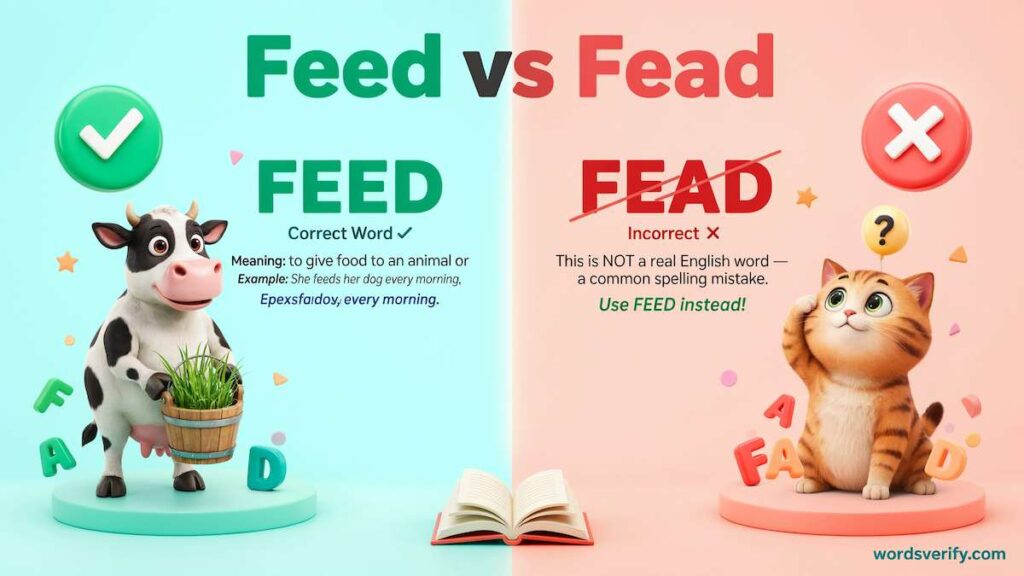
The correct spelling is feed, not fead. Dictionaries recognize feed as a standard English word that functions as both a verb and a noun. You can feed a hungry child, feed your dog, buy animal feed, or scroll through your social media feed.
Fead isn’t a standard spelling of the word. If you use it in an ordinary sentence where you mean feed, readers will probably understand your intention, but the spelling will still be incorrect.
Consider these examples:
| Incorrect spelling | Correct spelling |
|---|---|
| I need to fead the dog. | I need to feed the dog. |
| She will fead the chickens. | She will feed the chickens. |
| Please fead the baby before bedtime. | Please feed the baby before bedtime. |
| I checked my Instagram fead. | I checked my Instagram feed. |
| The farmer bought animal fead. | The farmer bought animal feed. |
The correct spelling stays the same regardless of the situation. Whether you’re discussing animal care, technology, business, or everyday activities, use feed.
Feed vs Fead The Main Difference
The difference between these two spellings comes down to standard English usage. Feed has established meanings and grammatical functions, while fead isn’t an accepted modern alternative.
Here are the main points to remember:
- Feed is a correctly spelled English word that works as a verb and a noun.
- Fead is an incorrect spelling when used instead of feed.
- Fed is the correct past tense and past participle of feed.
- Feeding is the present participle and gerund form of feed.
For example, writing “I fead my cat yesterday” is incorrect. The correct sentence is “I fed my cat yesterday.”
Is Fead a Word?
In modern standard English, fead isn’t an accepted spelling of feed. However, historical English records contain older spelling forms associated with the word, including feade.
This is an important distinction because English spelling has changed considerably over the centuries. Words that once appeared in different forms eventually developed into the spellings we recognize today.
An old spelling doesn’t automatically qualify as a correct modern alternative. Unless you’re discussing a historical text, proper name, or specialized acronym, use feed.
Is Feed a Word?
Absolutely! Feed is a well-established English word with several meanings. It functions as both a verb and a noun.
As a verb, it describes giving food, providing nourishment, or supplying something to another person, animal, or system.
As a noun, it can refer to food given to animals or a stream of information delivered through a digital platform.
For example:
- Verb: We feed the horses every morning.
- Noun: The horses need fresh feed.
- Digital noun: I saw the announcement in my news feed.
The word remains useful because its meaning extends far beyond food and agriculture. Today, you’ll find it in technology, communications, business, and everyday conversations.
Learn the difference between commonly misused words
Discard vs Disgard Which one Is Correct?
What Does Feed Mean?
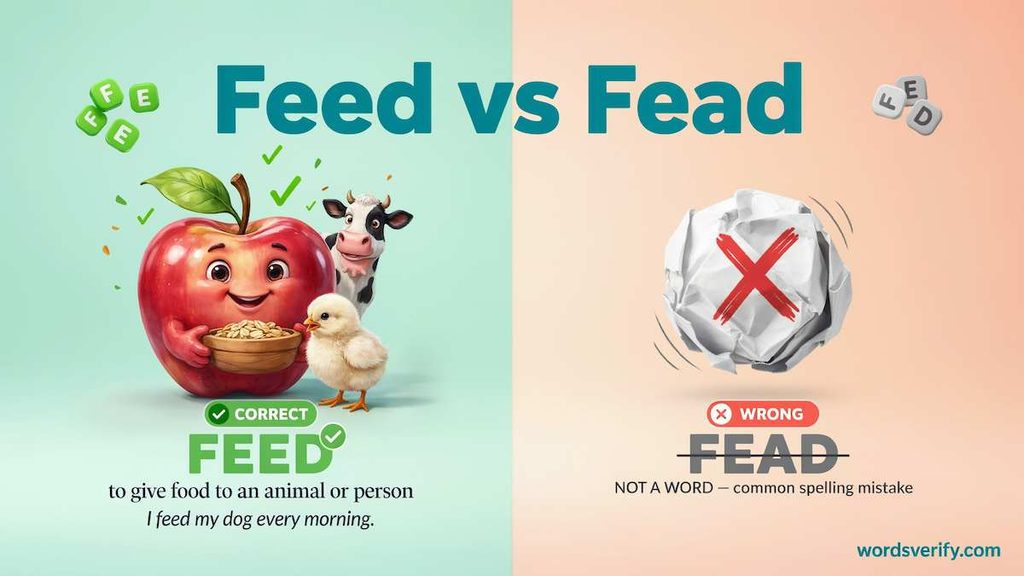
The word feed generally means giving food to someone or something. It can also describe supplying materials, resources, or information that allow a person, machine, or system to function.
Its exact meaning depends on the context.
Feeding a baby involves providing nourishment. Feeding paper into a printer means supplying material for the machine to process. A social media feed, meanwhile, provides a stream of posts and updates.
All these meanings share one basic idea: providing something to a person, animal, or system.
Feed as a Verb
When you use feed as a verb, you’re describing the action of providing food, nourishment, or another necessary supply.
Here are some common situations.
Providing food to people and animals
This is the most familiar meaning. You feed someone when you give them something to eat.
Examples:
- Parents feed their children nutritious meals.
- I feed my dog twice a day.
- The farmer feeds his cattle before sunrise.
- We feed the rescued birds until they recover.
- She feeds her baby before putting him to bed.
Supplying something to a machine
Feed can also describe putting materials into equipment so it can perform a task.
Examples:
- Feed the paper into the printer.
- The machine feeds plastic sheets through the rollers.
- This device feeds water into the cooling system.
- The conveyor belt feeds raw materials into production.
Providing information or data
In technology and communication, feed can describe supplying information to a person, application, or system.
Examples:
- The application feeds live information to the dashboard.
- The website feeds customer data into its reporting system.
- The news service feeds breaking updates to subscribers.
This meaning appears frequently in technical and professional writing.
Feed as a Noun
Although many people first learn feed as an action, it also works as a noun. In this role, it usually refers to food supplied to animals or a stream of information.
Animal feed
In agriculture, feed refers to food given to livestock and other animals. It can include hay, grass, grains, pellets, and specially prepared mixtures.
Examples:
- The farmer purchased enough feed for the winter.
- Chickens need balanced feed to support healthy growth.
- The horses received fresh feed in the morning.
Animal feed plays an important role in livestock management. Farmers choose different mixtures depending on an animal’s species, age, nutritional needs, and purpose.
Social media feed
On digital platforms, a feed is a regularly updated stream of content. It may contain photographs, videos, advertisements, comments, and posts from accounts you follow.
Examples:
- My Instagram feed is full of travel photographs.
- She shared the announcement on her Facebook feed.
- I checked my social media feed during lunch.
News and data feeds
News organizations and digital services also use feeds to distribute information.
An RSS feed, for example, allows users to receive website updates through compatible feed readers. A data feed supplies information to applications, databases, or other systems.
Examples:
- The news feed displayed the latest headlines.
- The company uses a data feed to update product prices.
- I subscribed to an RSS feed for technology news.
The same word can describe animal food, digital content, or information delivery. The surrounding sentence tells you which meaning applies.
Learn the difference between commonly misused words
Inversely vs Conversely which one is correct?
Feed vs Fed What’s the Difference?
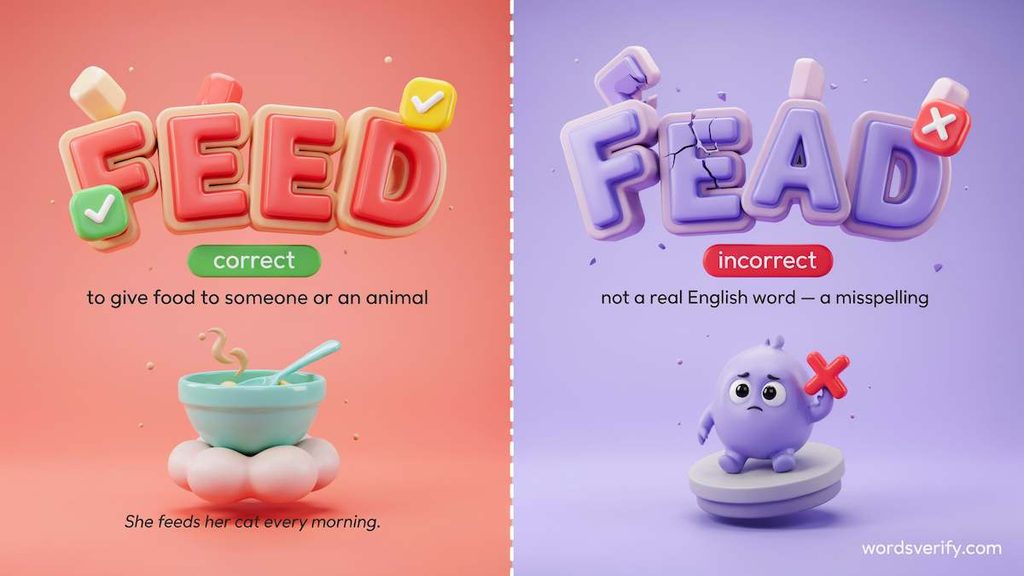
Here’s where things get interesting. Feed and fed are both correct English words, but they serve different grammatical purposes.
Feed is the base form of the verb. Fed is its simple past tense and past participle.
The difference matters because English grammar requires the correct form depending on when an action happens and how the sentence is structured.
| Word | Grammatical form | Example |
|---|---|---|
| Feed | Base form | I feed my dog every morning. |
| Feeds | Third-person singular | She feeds her cat daily. |
| Feeding | Present participle/gerund | He is feeding the chickens. |
| Fed | Simple past tense | I fed the dog yesterday. |
| Fed | Past participle | She has fed the baby. |
Feed in the Present Tense
Use feed when describing a current action, regular habit, or general fact.
Examples:
- I feed my rabbits every evening.
- They feed the livestock before work.
- We feed the children at noon.
- Birds feed on insects and seeds.
Remember that the third-person singular form is feeds.
For example:
- She feeds the dog every morning.
- My father feeds the chickens.
- The machine feeds paper automatically.
The extra S matters. Writing “She feed the dog” creates a subject-verb agreement error.
Fed in the Past Tense
Use fed when the feeding action happened in the past.
Examples:
- I fed the cat before leaving home.
- She fed the children after school.
- They fed the horses yesterday.
- We fed the rescued animals during the storm.
The action has already happened. That’s the main difference.
Compare these sentences:
- Present: I feed my dog every morning.
- Past: I fed my dog this morning.
Both describe the same activity, but their verb forms communicate different time frames.
Fed as a Past Participle
The past participle of feed is also fed. You’ll commonly see it with helping verbs such as has, have, and had.
Examples:
- I have fed the dog already.
- She has fed the baby.
- They have fed all the animals.
- We had fed the livestock before the rain started.
You can also find fed in passive constructions:
- The children were fed before the trip.
- The animals are fed twice a day.
- The rescued birds had been fed earlier.
In these sentences, fed helps describe an action performed on someone or something.
Is It Fead or Fed?
If you’re talking about the past tense of feed, the correct answer is fed.
Fead isn’t the correct past form. It doesn’t matter whether you’re describing feeding a pet, preparing a meal for children, or providing food to livestock.
Consider these examples:
- Incorrect: I fead the dog yesterday.
- Correct: I fed the dog yesterday.
The confusion often occurs because writers assume that changing the vowel in feed should produce its past tense. However, irregular English verbs don’t always follow predictable spelling patterns.
Learn the difference between commonly misused words
Ironic vs Unironic which one is correct?
What Is the Past Tense of Feed?
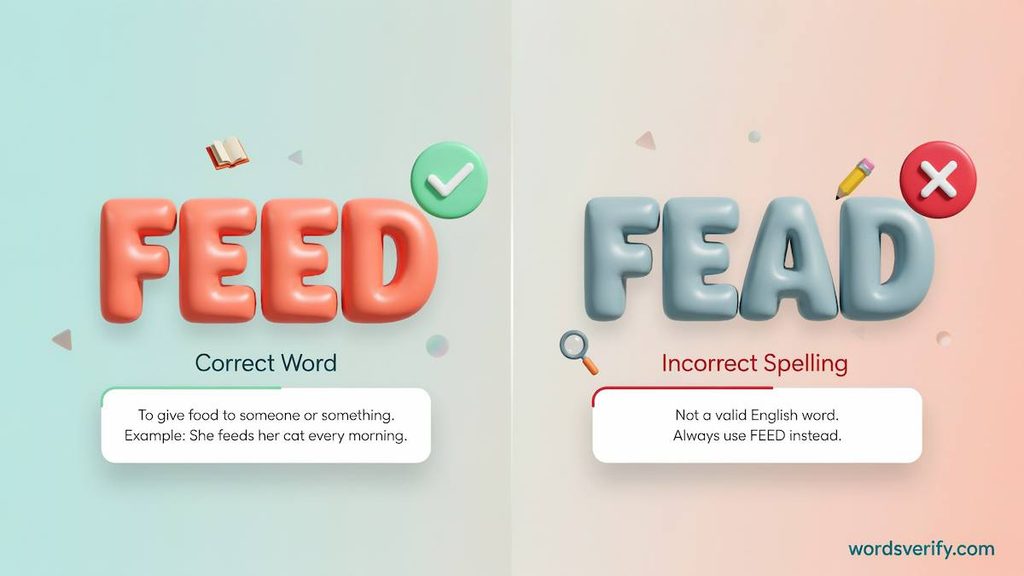
The past tense of feed is fed. Unlike regular English verbs, which generally form their past tense by adding -ed, feed changes its vowel to create a different form.
For example, regular verbs follow patterns such as:
- Walk → walked
- Clean → cleaned
- Play → played
However, feed follows an irregular pattern:
- Feed → fed
- Keep → kept
- Sleep → slept
This explains why feeded and fead aren’t correct substitutes for fed in standard English.
Why Isn’t the Past Tense of Feed Fead?
English contains many irregular verbs that change their internal vowel rather than adding a regular ending. This pattern is known as vowel change or ablaut.
For example:
| Base form | Simple past | Past participle |
|---|---|---|
| Feed | Fed | Fed |
| Meet | Met | Met |
| Keep | Kept | Kept |
| Sleep | Slept | Slept |
| Read | Read | Read |
| Write | Wrote | Written |
| Speak | Spoke | Spoken |
The relationship between feed and fed follows an established historical pattern in English. It’s not a spelling shortcut that writers can change according to preference.
The past tense doesn’t become fead simply because other English words use similar vowel combinations. Each verb has its own established forms.
What Is the Past Participle of Feed?
The past participle of feed is fed. It has the same spelling as the simple past tense, but the two forms don’t always perform the same grammatical job.
The simple past describes a completed action:
- I fed the dog yesterday.
- She fed the children after school.
The past participle usually appears with an auxiliary verb:
- I have fed the dog.
- She has fed the children.
- They had fed the animals before sunset.
You can also use it in passive constructions:
- The animals were fed before the storm.
- The baby was fed an hour ago.
Remember this simple rule: feed, fed, fed. The past tense and past participle share the same spelling.
Learn the difference between commonly misused words
Rehireable vs Rehirable Which one Is Correct?
Feed Verb Forms Explained
Understanding the different forms of feed makes English verb conjugation much easier. Each form has a specific grammatical purpose, and choosing the right one helps your sentences sound natural.
Here’s a complete breakdown of the common verb forms.
| Verb form | Correct spelling | Example |
|---|---|---|
| Base form | Feed | I feed my dog. |
| Third-person singular | Feeds | She feeds her dog. |
| Simple past | Fed | I fed my dog. |
| Past participle | Fed | I have fed my dog. |
| Present participle | Feeding | I am feeding my dog. |
| Gerund | Feeding | Feeding animals takes time. |
Base Form: Feed
The base form is the simplest version of the verb. You use it with subjects such as I, you, we, and they in the simple present.
Examples:
- I feed the chickens every morning.
- You feed the fish twice a day.
- We feed the horses before breakfast.
- They feed the rescued animals regularly.
The base form also follows modal verbs such as can, will, should, and must.
Examples:
- You should feed the dog before leaving.
- We will feed the guests at six.
- She can feed the baby.
- They must feed the animals regularly.
Third-Person Singular: Feeds
Use feeds with singular third-person subjects such as he, she, and it in the simple present tense.
Examples:
- He feeds the cattle every afternoon.
- She feeds her cat before work.
- The machine feeds paper into the printer.
- This application feeds information into the database.
Adding S is a standard English grammar rule for regular verbs in the third-person singular present tense. The correct form is feeds, not feed vs fead.
Present Participle: Feeding
The present participle of feed is feeding. You form it by adding -ing to the base word.
Use it with forms of the verb be to create continuous tenses.
Examples:
- I am feeding the dog.
- She is feeding the baby.
- They are feeding the horses.
- We were feeding the animals when it started raining.
The same form can function as a gerund, which means it acts like a noun.
Examples:
- Feeding the animals is part of my daily routine.
- The children enjoy feeding the ducks.
- Proper feeding supports healthy animal growth.
Simple Past and Past Participle: Fed
Both forms use fed, but their grammatical roles differ.
Examples of the simple past:
- He fed the chickens before breakfast.
- We fed the guests last night.
Examples of the past participle:
- He has fed the chickens.
- We have fed all the guests.
- She had fed the baby before the doctor arrived.
Learning these forms helps prevent common grammar mistakes, especially when writing about actions that happened at different times.
Learn the difference between commonly misused words
Monkeys vs Monkies which one is correct?
How to Use Feed in a Sentence
The best way to understand a word is to see how people use it in everyday situations. Although feed has several meanings, its central idea remains the same: providing food, resources, or information.
Here are some practical examples.
Feed in Sentences About Animals and Pets
Animal care is one of the most common situations where people use feed.
Examples:
- I feed my dog twice a day.
- The farmer feeds his cattle before sunrise.
- She feeds the birds in her garden.
- We need to feed the horses before the visitors arrive.
- The children love to feed the ducks at the park.
- Please feed the cat while I’m away.
- Good animal feeding requires a suitable diet and regular feeding times.
In these examples, feed describes giving food to animals. The word can refer to a single meal or a regular feeding routine.
Feed in Sentences About People and Meals
You can also use feed when talking about providing meals or nourishment to people.
Examples:
- Parents feed their children nutritious meals.
- I’ll feed the baby before bedtime.
- We need to feed everyone before the meeting starts.
- She feeds her family breakfast every morning.
- The volunteers feed hungry people at the community center.
- They fed the guests dinner after the ceremony.
Notice that feed doesn’t always mean placing food directly into someone’s mouth. It can simply mean preparing or providing something to eat.
For example, a restaurant feeds hundreds of customers every day. The restaurant isn’t physically feeding every customer. It’s providing meals.
Feed in Sentences About Technology
Modern technology has given feed another important role. It often describes the movement of data or information between digital systems.
Examples:
- The software feeds customer information into the database.
- The website displays a live news feed.
- The application feeds real-time prices to the dashboard.
- The computer receives data from an external feed.
- The camera provides a live feed of the entrance.
- The system automatically feeds information to connected devices.
These examples show how the original idea of supplying something has expanded into the digital world.
Feed in Sentences About Social Media
A social media feed displays content from accounts, pages, or sources that a user follows. Depending on the platform, it may also include recommended posts and advertisements.
Examples:
- I checked my Instagram feed during lunch.
- Her Facebook feed contains family photographs.
- The new video appeared in my social media feed.
- I want to clean up my news feed.
- The platform updates its content feed throughout the day.
In this context, feed is a noun rather than a verb. It describes the stream of content itself.
Learn the difference between commonly misused words
Salvadoran vs Salvadorian Which one Is Correct?
Examples of Feed and Fed in Different Tenses
Choosing between feed and fed becomes easier when you compare complete sentences. The following examples show how the verb changes according to tense and grammatical structure.
| Tense | Sentence example |
|---|---|
| Simple present | I feed the dog every morning. |
| Simple present, third person | She feeds the dog every morning. |
| Present continuous | I am feeding the dog now. |
| Present perfect | I have fed the dog already. |
| Present perfect continuous | I have been feeding the dog for ten minutes. |
| Simple past | I fed the dog yesterday. |
| Past continuous | I was feeding the dog when you called. |
| Past perfect | I had fed the dog before leaving. |
| Future simple | I will feed the dog tomorrow. |
| Future continuous | I will be feeding the dog at noon. |
| Future perfect | I will have fed the dog by lunchtime. |
A few details deserve attention.
First, fed doesn’t change when you use it with different subjects in the simple past. You can write “I fed,” “she fed,” or “they fed.”
Second, the present participle feeding works with different forms of be. That’s why you see expressions such as am feeding, was feeding, and will be feeding.
Finally, the base form feed follows modal verbs. For example, “You must feed the animals” is correct, not “You must fed the animals.”
Feed vs Fed: A Practical Example
Imagine a family that owns a small farm with chickens, cows, and horses.
Every morning, Sarah follows the same routine. She feeds the chickens first, checks the cows, and then gives the horses their morning food.
Yesterday, however, she woke up late. By the time she reached the barn, her brother had already fed the chickens and cows.
Both forms describe the same activity, but their grammatical roles differ:
- “Sarah feeds the chickens every morning.” This describes a regular habit.
- “Sarah fed the chickens yesterday.” This describes a completed past action.
- “Her brother has fed the cows.” This uses the past participle with has.
- “Sarah is feeding the horses now.” This describes an ongoing action.
The lesson is simple: choose the verb form according to the time and structure of your sentence, not just how the word sounds.
Learn the difference between commonly misused words
Attend vs Tend which one is correct?
Common Mistakes When Using Feed vs Fead, and Fed
Even familiar English words feed vs fead can cause trouble when their spelling and grammatical forms look or sound similar. The confusion surrounding feed, fead, and fed usually comes from two things: choosing the wrong vowel combination and misunderstanding irregular verb forms.
Here are the mistakes worth avoiding.
Using Fead Instead of Feed
This is the main spelling mistake in this comparison. Writers sometimes replace the double E with EA, perhaps because English contains words such as head, bread, and dead.
However, those words don’t establish a spelling rule for feed.
Incorrect: I need to fead my dog before going out.
Correct: I need to feed my dog before going out.
Incorrect: The farmer bought fresh fead for the cattle.
Correct: The farmer bought fresh feed for the cattle.
The easiest solution is to remember the established spelling rather than rely on how similar words look.
Using Feed Instead of Fed
Another common mistake involves using the base form when the sentence requires the simple past tense.
Incorrect: She feed the baby last night.
Correct: She fed the baby last night.
Incorrect: We feed the horses yesterday.
Correct: We fed the horses yesterday.
Look for time expressions such as yesterday, last night, and last week. They often indicate that you need a past-tense verb.
However, don’t assume that every sentence mentioning a past time automatically requires fed. Consider:
“Yesterday, I was feeding the animals when the phone rang.”
Here, was feeding describes an ongoing past action. The correct verb form depends on the sentence structure.
Writing Feeded Instead of Fed
Some writers mistakenly add -ed to feed because they expect it to follow the regular past-tense pattern.
Incorrect: I feeded the chickens this morning.
Correct: I fed the chickens this morning.
Incorrect: She has feeded the dog already.
Correct: She has fed the dog already.
English contains many irregular verbs that don’t follow the usual pattern. Feed belongs to this group, so its past forms must be learned rather than created by adding an ending.
Confusing Feed as a Verb and a Noun
The same spelling can serve different grammatical purposes.
Compare:
- Verb: Farmers feed their animals twice a day.
- Noun: Farmers purchase animal feed for their livestock.
In the first sentence, feed describes an action. In the second, it identifies a product.
The same distinction applies to digital content:
- Verb: The application feeds information into the system.
- Noun: The application displays a personalized news feed.
Understanding the sentence’s meaning helps you identify the correct grammatical role.
Using the Wrong Form After Helping Verbs
Helping verbs can also create confusion.
For example, modal verbs such as can, should, must, and will take the base form.
Correct:
- She can feed the baby.
- You should feed the dog.
- They will feed the animals.
However, has, have, and had require the past participle in perfect tenses.
Correct:
- She has fed the baby.
- We have fed the horses.
- They had fed the chickens.
Incorrect combinations such as “She has feed the baby” or “They should fed the chickens” break standard English grammar rules.
Learn the difference between commonly misused words
Hoodie vs Hoody Which one Is Correct?
Why Do People Spell Feed as Fead?
The spelling mistake isn’t unusual when you consider how complicated English vowel patterns can be. Many words share similar letters but pronounce them differently.
For example:
| Word | Vowel combination | Typical pronunciation |
|---|---|---|
| Feed | EE | Long E |
| Read (present tense) | EA | Long E |
| Head | EA | Short E |
| Bread | EA | Short E |
| Dead | EA | Short E |
| Great | EA | Long A |
The letters EA don’t always produce the same sound. That inconsistency can make English spelling difficult, especially for learners who try to apply one spelling pattern to every similar-sounding word.
Pronunciation Can Contribute to Spelling Confusion
In standard American English, feed is pronounced /fiːd/. It has one syllable, and its vowel sounds like the E in see.
Because read also has a long E pronunciation in the present tense, some writers may assume that other vowel combinations can replace EE without changing the word.
But pronunciation isn’t a reliable way to determine spelling. English contains many words that sound alike or share vowel sounds while using different letter combinations.
The solution is to learn the spelling of individual words rather than guess from pronunciation.
Typing Errors and Autocorrect
Sometimes the mistake has nothing to do with grammar knowledge. A writer may simply press the wrong keys or type quickly without proofreading. This is one reason feed vs fead can become a common spelling mix-up.
Other factors include:
- Unfamiliarity with the word feed.
- Confusion between feed and fed.
- Incorrect spelling habits developed through repeated typing.
- Reliance on automatic correction without checking the final text.
- Limited exposure to written English.
A grammar checker can help identify a misspelling such as fead and clarify the difference in feed vs fead. Still, automated tools aren’t perfect. They may overlook errors or suggest the wrong correction, so always review the context yourself. Understanding feed vs fead will help you catch these mistakes before they appear in your writing.
aren’t perfect. Always check the surrounding sentence to make sure the suggested replacement fits your intended meaning.
Learn the difference between commonly misused words
Outting vs Outing which one is correct?
Feed vs Fead in American and British English
Some English words have different spellings depending on whether you’re writing in American or British English. For example, American writers generally use color, while British writers use colour.
The comparison of feed vs fead doesn’t follow that pattern.
Feed is the standard spelling in both American and British English. Neither variety recognizes fead as an accepted alternative spelling for the ordinary word.
| Word or spelling | American English | British English |
|---|---|---|
| Feed | Correct | Correct |
| Fead | Incorrect | Incorrect |
| Fed | Correct | Correct |
| Feeding | Correct | Correct |
| Feeded | Incorrect as the standard past form | Incorrect as the standard past form |
You can use feed in American school assignments, British business documents, international emails, and everyday conversations without changing its spelling.
For example:
- American English: I feed my dog every morning.
- British English: I feed my dog every morning.
The sentence remains exactly the same.
This is an important distinction for English learners. Not every spelling question involves regional differences. Sometimes one spelling is simply correct everywhere.
Feed in Everyday Writing: Emails, School, Business and Social Media
The word feed appears in many types of writing. Its meaning changes slightly depending on the context, but its spelling remains consistent.
Feed in Emails and Professional Communication
In professional communication, feed often describes supplying information, resources, or materials.
Examples:
- Please feed the updated figures into the reporting system.
- The application receives a daily data feed.
- We need to feed the latest customer information into the database.
- The system automatically feeds new orders to the warehouse.
When writing an email, using the correct spelling helps maintain clarity and professionalism. A small error such as fead can distract readers from your message.
Feed in Academic and School Writing
Students may encounter feed in biology, agriculture, nutrition, and technology.
Examples:
- Animals need food to survive and grow.
- Farmers provide balanced feed to livestock.
- Plants rely on nutrients to support their growth.
- Digital systems use data feeds to exchange information.
In academic writing, distinguish between feed as an action and feed as a noun. For example, “Farmers feed their cattle” describes an activity, while “Cattle feed contains essential nutrients” identifies a substance.
Feed in News Articles and Journalism
News organizations frequently use the word in connection with information distribution.
Examples:
- The news feed displayed the latest reports.
- The broadcaster provided a live feed from the event.
- Readers received breaking news through an online content feed.
A live feed can refer to continuously transmitted video, audio, or other information. The term is common in journalism, sports coverage, and online broadcasting.
Feed in Social Media and Digital Platforms
Social media has made feed one of the most recognizable digital terms.
An Instagram feed, Facebook feed, or other social media feed displays content that users can browse. Depending on the platform, this content may include:
- Photographs and videos.
- Posts from followed accounts.
- Suggested content.
- Advertisements.
- News and announcements.
- Updates from groups and communities.
For example:
“I saw your new photograph in my Instagram feed.”
Here, feed is a noun. It refers to the collection or stream of content rather than the action of providing food.
Feed in Business and Technical Writing
Businesses use feed when discussing information exchange, automated processes, and supply systems.
Examples:
- The retailer receives a product data feed from its suppliers.
- The software feeds sales information into a reporting tool.
- The factory uses a conveyor system to feed materials into production.
- The website updates its product listings through an automated feed.
These uses show why feed remains useful beyond its original connection with food and nourishment.
Learn the difference between commonly misused words
Excel vs Excell which one is correct?
How to Remember the Correct Spelling of Feed
A simple memory trick can help you avoid the fead spelling mistake and understand the difference in feed vs fead. Think of the relationship between feed and food. Both words relate to nourishment and providing something to eat. Remembering this connection makes the correct double-E spelling easier to recall.
Here are a few additional ways to remember the correct spelling in feed vs fead:
- Remember the double E. The correct spelling contains two E’s, not EA.
- Connect it with food. You feed someone food. Both words have a clear connection in meaning.
- Learn the irregular forms together. Remember the sequence feed, fed, fed rather than trying to invent the past tense.
- Practice with complete sentences. Write “I feed my dog” and “I fed my dog yesterday” to understand the difference.
- Proofread carefully. When you see fead, check whether you intended to write feed. This quick habit will help you avoid the common feed vs fead spelling mistake.
A useful reminder is:
Feed today, fed yesterday.
This short phrase reinforces both the spelling and the difference between the present and past forms.
practice session Feed vs Fead
Test your understanding of Feed vs Fead and related word forms with these practice sentences. Fill in each blank with the correct word. The exercises cover spelling, verb forms, meanings, and everyday usage.
- I always ______ my dog before leaving for work.
- She ______ the stray kittens yesterday.
- Farmers use fresh grass to ______ their cattle.
- Have you ______ the fish this morning?
- The baby needs to be ______ every few hours.
- My grandfather used to ______ the chickens every day.
- We ______ the birds in the park last weekend.
- The social media ______ is full of interesting updates.
- He will ______ the horses after breakfast.
- She is ______ her cat while watching television.
- The farmer has ______ the animals already.
- Please don’t forget to ______ the rabbits.
- The children ______ the ducks during their school trip.
- I haven’t ______ my pet today.
- Fresh vegetables help ______ the family.
- The news ______ keeps me updated throughout the day.
- They were ______ the animals when the storm began.
- Who ______ the baby while you were away?
- The machine automatically ______ paper into the printer.
- She has been ______ the birds every morning.
- Yesterday, we ______ the goats before sunset.
- The correct past tense of feed is ______.
- The word ______ is the standard modern English spelling.
- He needs to ______ the information into the computer.
- By the time we arrived, the farmer had already ______ the horses.
Answers
- feed
- fed
- feed
- fed
- fed
- feed
- fed
- feed
- feed
- feeding
- fed
- feed
- fed
- fed
- feed
- feed
- feeding
- fed
- feeds
- feeding
- fed
- fed
- feed
- feed
- fed
Here’s a trusted source for clear word meanings:
FAQs
Is it fead vs feed?
Feed is the correct modern English spelling. Fead is not a standard alternative, so use feed when referring to giving food, supplying information, or providing content.
Is fead a word in English?
Fead is not recognized as a standard modern English word with the meaning of feed. It may appear as a name or in historical contexts, but it shouldn’t replace feed in everyday writing.
What does fead stand for?
Fead has no widely accepted standard abbreviation or meaning in modern English. It is generally a misspelling when someone intends to write feed.
What is the difference between feed and fed?
Feed is the base form of the verb, while fed is its simple past tense and past participle. For example, “I feed the dog every morning” becomes “I fed the dog yesterday.”
What are the three forms of feed?
The three principal forms are feed – fed – fed. Feed is the base form, fed is the past tense, and fed is also the past participle.
What is the second form of feed?
The second form of feed is fed. Use it when describing an action completed in the past, as in “She fed the chickens before breakfast.”
What is the V3 form of the verb feed?
The V3 form, or past participle, is fed. It commonly appears with helping verbs such as has, have, and had: “They have fed the animals.”
Is it “have feed” or “have fed”?
The correct phrase is “have fed.” The present perfect tense requires the past participle, so you should write “I have fed the cat,” not “I have feed the cat.”
What does feed mean as a noun?
As a noun, feed can mean food given to animals, a supply of information, or a stream of regularly updated content. For example, a social media feed displays posts and updates.
What does feed mean in slang?
In informal language, feed can mean giving someone information, attention, or something they want. Its exact meaning depends on the conversation. In gaming, it can also describe repeatedly giving opponents an advantage, especially through careless play.
What does “I feed you” mean?
The phrase “I feed you” usually means that the speaker provides you with food. Depending on the context, it can also mean supplying you with information, ideas, or other things you need.
What is another word for feed?
Possible synonyms include nourish, provide, supply, sustain, and nurture. The best choice depends on the meaning. Nourish works for providing food, while supply or provide may fit when discussing information or resources.
What is the opposite of feed?
There isn’t one universal opposite of feed. Depending on the context, possible opposites include starve, deprive, withhold, or remove. For example, starve is the opposite of feeding someone, while withhold can mean refusing to provide information or resources.
What does fed mean in slang?
In American slang, “the feds” commonly refers to federal law enforcement agencies or federal government investigators. This meaning is different from fed as the past tense of feed.
What does feed mean in the Bible?
In biblical language, feed often means providing food, caring for, or spiritually nurturing someone. It can describe literal nourishment as well as guidance and care for a community or group of people.
What is the difference between a feed and a social media feed?
A feed can refer to any supply of food or information. A social media feed is a continuously updated stream of posts, photos, videos, and other content displayed on a platform.
Is “feeded” ever correct?
No. Feeded is not the standard past-tense form of feed. Because feed is an irregular verb, its correct forms are feed, fed, and fed.
Conclusion
Now that you’ve explored feed vs fead, there’s no reason to let this spelling mix-up trip you up again. Feed is the correct modern English spelling, while fead isn’t a standard alternative. Keep one more detail in mind: the past tense and past participle of feed are fed, not feeded. Whether you’re writing about feeding a pet, sharing information, or checking your social media feed, choosing the right form is simple once you know the rules. A little attention to spelling goes a long way toward clearer, more confident writing. After all, your sentences need good grammar, not a generous serving of spelling mistakes!

Lisa AJS is an experienced blogger and language enthusiast at Words Verify, dedicated to making grammar simple, practical, and enjoyable. She writes engaging content on commonly confused words, grammar mistakes, word meanings, and everyday language challenges.