
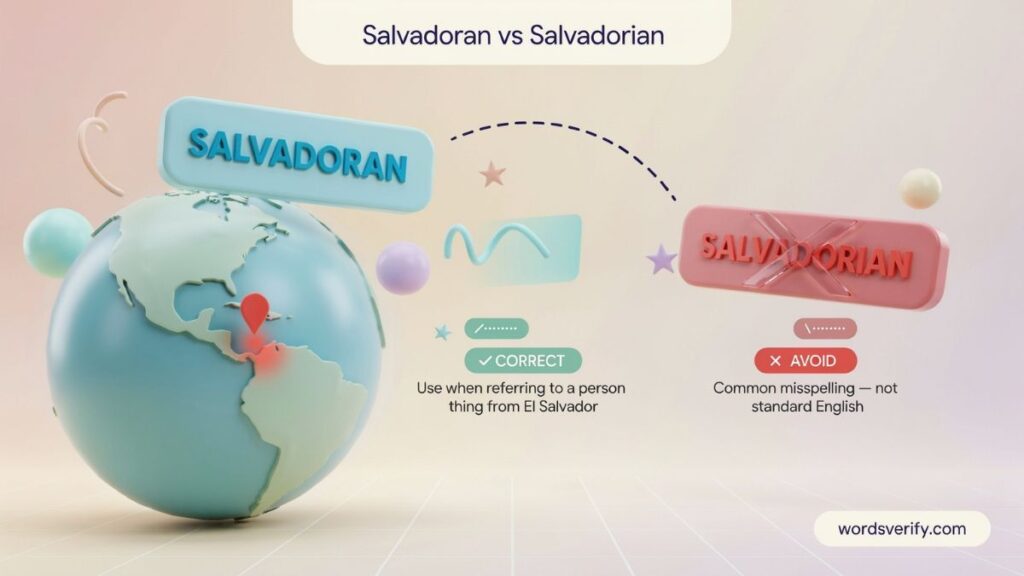
Salvadoran vs Salvadorian? It’s amazing how one extra letter can cause so much spelling confusion! Both forms describe someone or something connected to El Salvador, but one is more widely preferred in standard English. So, which spelling should you use in your writing? Whether you’re discussing Salvadoran people, delicious pupusas, rich cultural traditions, or the country’s history, choosing the right form helps keep your message clear and accurate. Let’s explore the difference between Salvadoran vs Salvadorian, understand why both spellings exist, and discover which one is the best choice for everyday writing.
Salvadoran vs Salvadorian Quick Answer
Salvadoran is the preferred spelling in standard English. It refers to a person from El Salvador or something associated with the country. Salvadorian is an alternative form that also appears in English, although writers generally prefer Salvadoran.
Here are a few examples:
- She is Salvadoran and grew up in San Salvador.
- Salvadoran food is popular for its traditional dishes, including pupusas.
- He comes from a Salvadorian family.
- The restaurant serves Salvadorian cuisine.
Both forms communicate essentially the same meaning. They don’t identify two different nationalities or cultural groups.
| Feature | Salvadoran | Salvadorian |
|---|---|---|
| Meaning | From or associated with El Salvador | From or associated with El Salvador |
| Word type | Noun and adjective | Noun and adjective |
| General usage | Preferred form | Alternative form |
| Formal writing | Recommended | Less preferred |
| Capitalization | Capitalized | Capitalized |
| Singular | Salvadoran | Salvadorian |
| Plural | Salvadorans | Salvadorians |
If you’re unsure which spelling to choose, Salvadoran is the safest option for school assignments, professional documents, news articles, and everyday American English.
Learn the difference between more words people mix up
Attend vs Tend which one is correct?
What Does Salvadoran Mean?
Salvadoran describes a person, group, or thing connected to El Salvador, a country in Central America. The country borders Guatemala, Honduras, and the Pacific Ocean. Its capital is San Salvador.
As a noun, Salvadoran identifies someone from El Salvador. As an adjective, it describes something related to the country’s people, history, culture, or traditions.
The word has several common uses:
- Nationality: A person who holds citizenship in El Salvador or comes from the country.
- Heritage: Someone with family roots or cultural connections to El Salvador.
- Culture: Traditions, music, celebrations, customs, and artistic practices associated with the country.
- Food: Dishes and cooking traditions connected to Salvadoran cuisine.
- History: Historical events, political developments, and experiences involving El Salvador.
Consider these examples:
- My neighbor is Salvadoran and speaks Spanish at home.
- Salvadoran culture includes a rich tradition of music, dance, and handmade crafts.
- Pupusas are among the best-known examples of traditional Salvadoran food.
- The museum displayed photographs documenting Salvadoran history.
Notice how the word changes its grammatical role depending on the sentence. In the first example, it identifies a person. In the remaining examples, it describes something associated with El Salvador.
Capitalization also matters. Salvadoran is a proper demonym, so it begins with a capital letter. The same rule applies to nationality terms such as American, Canadian, Mexican, Guatemalan, and Honduran.
What Does Salvadorian Mean?
Salvadorian is an alternative English demonym for someone or something associated with El Salvador. Its meaning is generally the same as Salvadoran.
The difference lies mainly in spelling and usage preference rather than meaning. Some English speakers use Salvadorian because its ending resembles familiar nationality words such as Ecuadorian, Italian, and Canadian.
For example:
- He comes from a Salvadorian family.
- They organized a festival celebrating Salvadorian culture.
- The restaurant specializes in Salvadorian cuisine.
These sentences communicate the intended meaning. However, Salvadoran remains the more widely preferred form in standard English.
Is Salvadorian a Real Word?
Yes. Salvadorian is a recognized English word, not simply a random spelling mistake. It appears in English-language publications and terminology references as an alternative to Salvadoran.
However, recognizing a word and recommending it as the preferred spelling are two different things. A dictionary or terminology database may list several accepted forms while identifying one as the preferred term.
That’s why Salvadorian can be understandable and recognizable without becoming the best choice for every writing situation.
If you’re preparing an academic paper, news report, educational article, or professional document, Salvadoran is generally the better option.
Learn the difference between more words people mix up
Hoodie vs Hoody Which one Is Correct?
Salvadoran vs Salvadorian Key Differences
At first glance, Salvadoran vs Salvadorian look almost identical. Both contain the same root, refer to the same country, and function as nouns and adjectives. The extra letter i creates the main spelling difference.
However, their usage isn’t identical in every context. Salvadoran has stronger recognition as the preferred English demonym, while Salvadorian remains an alternative that readers can understand.
The Canadian government’s TERMIUM Plus terminology database recognizes Salvadoran, Salvadorian, and Salvadorean as English terms for someone native to or residing in El Salvador. This shows that the alternative spellings aren’t automatically mistakes simply because one form is more widely preferred.
Here’s a closer comparison:
| Comparison point | Salvadoran | Salvadorian |
|---|---|---|
| Spelling | Salvadoran | Salvadorian |
| Extra letter | No additional i | Includes an i |
| Meaning | Connected to El Salvador | Connected to El Salvador |
| Grammar | Noun and adjective | Noun and adjective |
| Plural | Salvadorans | Salvadorians |
| General preference | Preferred | Alternative |
| Formal writing | Recommended | Less preferred |
Salvadoran vs Salvadorian Meaning
Do the two words have different meanings? Generally, no.
Both describe a person who comes from El Salvador or has a connection to the country. They can also describe cultural practices, food, traditions, and other national characteristics.
For example:
- A Salvadoran family lives next door.
- A Salvadorian family lives next door.
- We attended a celebration of Salvadoran culture.
- We attended a celebration of Salvadorian culture.
The meaning remains essentially the same in each pair.
One important detail concerns citizenship. A Salvadoran person may be a citizen of El Salvador, but someone with Salvadoran ancestry might live in another country and hold a different nationality. The word can describe heritage as well as national origin, depending on the context.
Salvadoran vs Salvadorian Spelling
The difference comes down to one letter.
- Salvadoran uses the ending -an.
- Salvadorian includes an additional i before the ending.
English uses several common endings to form nationality names. For example, someone from Honduras is Honduran, while someone from Ecuador is Ecuadorian. These patterns help explain why English speakers recognize both Salvadoran vs Salvadorian.
Still, English demonyms don’t follow one universal spelling formula. You can’t simply add -an or -ian to every country name and expect the result to be correct.
For standard English writing, Salvadoran is the practical choice.
Learn the difference between more words people mix up
Outting vs Outing which one is correct?
Origin and Etymology of Salvadoran vs Salvadorian
The story behind these spellings starts with the country’s name. El Salvador provides the foundation for the English demonym, while the different endings reflect the flexibility of English nationality terms.
Where Does the Word Salvadoran Come From?
The word Salvadoran comes from Salvador, the principal name within El Salvador. The Spanish word salvador means savior or one who saves. The country’s name is commonly translated as The Savior.
English uses the root Salvador to form the demonym Salvadoran. The ending turns the place name into a word that identifies a person or describes something connected to that place.
This pattern appears in other English nationality names:
| Country | Demonym |
|---|---|
| Honduras | Honduran |
| Guatemala | Guatemalan |
| Mexico | Mexican |
| Nicaragua | Nicaraguan |
| Colombia | Colombian |
| Ecuador | Ecuadorian |
| Italy | Italian |
| El Salvador | Salvadoran |
These examples demonstrate how English uses different suffixes to create nationality names. The endings aren’t interchangeable in every case. Familiar usage determines which form becomes established.
How Did Salvadorian Develop?
Salvadorian follows another familiar English word-formation pattern. The ending -ian appears in nationality adjectives and nouns such as Ecuadorian, Canadian, and Australian.
Because English speakers already recognize this pattern, Salvadorian looks natural to many readers. Someone unfamiliar with the preferred demonym might reasonably assume that adding an i creates the correct nationality term.
However, a familiar-looking suffix doesn’t automatically make a word the most widely preferred form. Language develops through common usage, historical conventions, and editorial choices.
Salvadorian has a place in English-language writing, but Salvadoran remains the better default for general use.
It’s also important not to invent an exact historical date for either spelling without reliable evidence. The safest explanation is that both forms developed within English demonym usage, with Salvadoran becoming the more widely preferred form.
Learn the difference between more words people mix up
Excel vs Excell which one is correct?
Is Salvadoran vs Salvadorian More Common?
When comparing the two forms, Salvadoran is generally the more familiar and preferred spelling in standard English. You can see this preference in international reference materials and country-name resources.
For example, the CIA World Factbook uses Salvadoran for the nationality noun and adjective. Its country information also uses Salvadorans as the plural form.
Oxford Learner’s Dictionaries provides an entry for Salvadoran and includes Salvadorean as a related alternative.
Nevertheless, Salvadorian appears in established publications. Its use isn’t limited to casual conversations or social media.
The distinction is therefore about preference, not whether readers can understand the alternative.
What Do Dictionaries Say About Salvadoran vs Salvadorian?
Different reference works may present these words differently. Some identify Salvadoran as the main entry, while others list additional forms as alternatives.
| Reference | What it shows |
|---|---|
| Oxford Learner’s Dictionaries | Provides Salvadoran as an entry and identifies Salvadorean as an alternative |
| TERMIUM Plus | Recognizes Salvadoran, Salvadorian, and Salvadorean |
| CIA World Factbook | Uses Salvadoran as the nationality noun and adjective |
| Dictionary.com | Includes Salvadorian in its English vocabulary |
These references serve different purposes. A learner’s dictionary helps readers understand everyday English. A government terminology database records accepted terminology. A national reference work identifies the nationality name used in its country information.
Taken together, they support a practical conclusion: Salvadoran is the strongest general-purpose choice, but Salvadorian is a recognized English alternative.
What About Salvadoran or Salvadorian Reddit Discussions?
Online discussions often reveal why people become confused about this spelling. Someone might see Salvadoran in a newspaper, Salvadorian in a family description, and Salvadorean on another website.
That variation can make all three forms appear equally common.
However, Reddit discussions and other social media posts reflect individual writing habits. They don’t establish an official spelling rule or prove that one nationality term is universally preferred.
When checking a spelling question, prioritize established dictionaries, government terminology databases, recognized style guides, and reputable publications.
Reddit can help you understand how people use a word in conversation. It shouldn’t replace a dictionary when you’re checking standard English spelling.
Learn the difference between more words people mix up
Studder vs Stutter which one is correct?
American English vs British English Is There a Difference?
Some spelling differences follow recognizable American and British conventions. For example, American English uses color, while British English generally uses colour. Similarly, organize and organise reflect different regional preferences.
Salvadoran and Salvadorian don’t follow that straightforward pattern.
It’s inaccurate to claim that Americans must write Salvadoran while British writers must use Salvadorian. Both forms appear in English-language publications, and the difference doesn’t represent a universal national spelling rule.
Which Spelling Should American English Users Choose?
American English writers should generally use Salvadoran.
It’s a familiar form in American news reporting, educational writing, government references, and discussions about El Salvador.
For example:
- The Salvadoran government announced a new policy.
- A Salvadoran student received an academic award.
- The documentary explores Salvadoran immigration.
- The restaurant serves traditional Salvadoran food.
These examples sound natural and follow the preferred general spelling.
Which Spelling Should British English Users Choose?
British writers can also use Salvadoran. The alternative Salvadorian appears in English-language publications, but that doesn’t mean it’s compulsory or universally preferred in British English.
When writing for a British publication, follow its house style. If the publication uses Salvadorian consistently, maintain that choice throughout the article.
However, when no specific editorial rule exists, Salvadoran remains a sensible default.
What About International Writing?
International writing benefits from consistency and familiar terminology.
If you’re writing for readers across several English-speaking countries, choose Salvadoran unless your publication or source material requires another form.
Avoid switching between Salvadoran, Salvadorian, and Salvadorean without a clear reason. Such changes can make readers wonder whether you’re referring to different groups.
A consistent spelling makes your writing easier to follow.
Learn the difference between more words people mix up
Accross vs Across Which one Is Correct?
When Should You Use Salvadoran?
The simplest answer is to use Salvadoran whenever you need a reliable, widely recognized English form.
It works as both a noun and an adjective, so you don’t need separate words for people and cultural subjects.
Here are the main situations where Salvadoran fits naturally.
Salvadoran in Academic and Formal Writing
Academic writing requires accurate terminology and consistency. When discussing El Salvador’s history, society, politics, or population, Salvadoran is an appropriate choice.
Examples:
- The study examines Salvadoran migration patterns.
- Salvadoran communities have contributed to the cultural diversity of several American cities.
- Researchers analyzed Salvadoran literature and historical documents.
- The report discusses Salvadoran national identity.
If your university follows a specific style guide, check its nationality terminology before submitting your work.
Salvadoran in News Writing
News articles frequently use nationality adjectives to identify people, organizations, and government institutions.
Examples:
- Salvadoran officials discussed the proposed legislation.
- The report examined the experiences of Salvadoran immigrants.
- Salvadoran athletes competed in the international tournament.
- The journalist interviewed Salvadoran residents about the new development.
The shorter spelling also keeps headlines and sentences clean.
Salvadoran in Travel Writing
Travel writers often use Salvadoran when describing a country’s attractions, traditions, and local experiences.
For example:
- Visitors can explore Salvadoran beaches along the Pacific coast.
- Traditional Salvadoran markets offer local crafts and fresh produce.
- Salvadoran festivals showcase music, food, and community traditions.
- Travelers can learn about the country’s history in San Salvador.
One useful distinction: Salvadoran describes the connection to the country, while El Salvador remains the country’s name. Don’t shorten the country’s name to just Salvador when referring to the modern nation.
Salvadoran in Social Media and Everyday Conversations
Informal writing doesn’t require a complicated rule. Salvadoran works naturally in messages, captions, comments, and everyday conversations.
For example:
- My grandmother makes the best Salvadoran pupusas.
- I’m learning more about Salvadoran history.
- Our neighborhood has a wonderful Salvadoran restaurant.
- We celebrated Salvadoran Independence Day with friends.
The alternative Salvadorian can also appear in informal writing. However, choosing Salvadoran helps maintain consistency with standard reference usage.
A Practical Editing Example
Imagine you’re preparing a travel article about a visit to El Salvador. Your first draft includes the following sentences:
“The Salvadorian restaurant served traditional pupusas. The Salvadoran chef explained the recipe. Later, we visited a museum dedicated to Salvadorian history.”
Nothing in these sentences prevents readers from understanding the meaning. However, the inconsistent spelling looks unnecessary.
A cleaner version would read:
“The Salvadoran restaurant served traditional pupusas. The Salvadoran chef explained the recipe. Later, we visited a museum dedicated to Salvadoran history.”
This small editing decision makes the paragraph more consistent without changing its meaning.
Learn the difference between more words people mix up
Sponsor vs Sponser Which one Is Correct?
Salvadoran vs Salvadorean Are They the Same?
The Salvadoran vs. Salvadorean comparison introduces a third spelling that many writers overlook.
Salvadorean is another recognized English form for someone native to or associated with El Salvador. It carries essentially the same meaning as Salvadoran and Salvadorian.
The Canadian government’s TERMIUM Plus database recognizes all three forms. The main differences involve spelling and editorial preference.
| Word | Status | General recommendation |
|---|---|---|
| Salvadoran | Preferred general form | Use by default |
| Salvadorian | Recognized alternative | Use when required by a source or established preference |
| Salvadorean | Recognized alternative | Use when required by a source or established preference |
Is Salvadorean a Word?
Yes. Salvadorean is an accepted English spelling variant.
It isn’t simply a misspelling of Salvadoran. Its recognition in terminology references confirms that it has a place in English usage.
However, it appears less often as the default nationality term in many modern English reference materials.
For example:
- The Salvadoran community organized a cultural festival.
- The Salvadorean community organized a cultural festival.
Both sentences communicate the same general idea.
Salvadoran vs Salvadorean Difference
The two spellings don’t generally carry separate meanings. Both identify a connection to El Salvador.
The difference is mainly editorial preference and spelling convention.
If you’re writing a professional article, Salvadoran is the most practical option. If you’re quoting a publication, reproducing a historical document, or following a source’s preferred terminology, preserve its spelling.
Salvadorian vs Salvadorean Difference
Salvadorian and Salvadorean are also alternative English forms.
Neither introduces a separate nationality or cultural identity. Both refer to someone or something associated with El Salvador.
For general writing, Salvadoran remains the easiest choice because it is the established default in several widely used reference sources.
Chalet vs Château which one is corrcet?
Salvadoran in Everyday Sentences
Understanding a word becomes easier when you see how people use it in different situations. Salvadoran works in discussions about individuals, food, family heritage, history, and national culture.
Here are practical examples.
Salvadoran People
Use Salvadoran as a noun when identifying someone from El Salvador.
Examples:
- A Salvadoran won the international cooking competition.
- Several Salvadorans attended the cultural celebration.
- My new colleague is Salvadoran.
- The organization supports Salvadoran families living abroad.
The plural form is Salvadorans, not Salvadoranes. If you use the alternative Salvadorian, its plural is Salvadorians.
Salvadoran Food
Salvadoran cuisine is an important part of the country’s cultural identity. Its dishes often feature corn, beans, cheese, meat, vegetables, and locally available ingredients.
Some well-known examples include:
- Pupusas: Thick corn or rice flour cakes filled with ingredients such as cheese, beans, or pork. They’re commonly served with curtido, a cabbage slaw, and tomato salsa.
- Yuca frita: Fried cassava traditionally served with cabbage salad and pork.
- Salvadoran tamales: Corn-based preparations wrapped in banana leaves and filled with ingredients such as chicken or pork.
- Sopa de pata: A traditional soup prepared with beef feet, vegetables, and other ingredients.
- Pastelitos: Small fried pastries commonly filled with seasoned meat or vegetables.
Example sentences:
- Pupusas are a popular Salvadoran dish.
- We tried several traditional Salvadoran recipes.
- Salvadoran food often combines corn, beans, cheese, and fresh vegetables.
Notice that Salvadoran describes the cuisine. You don’t need to change it to Salvadorian simply because you’re discussing food rather than people.
Salvadoran Culture and Traditions
Salvadoran culture reflects Indigenous heritage, Spanish colonial influences, religious traditions, and modern Central American life.
Music, dance, festivals, food, and family celebrations all contribute to the country’s cultural identity.
For example:
- Salvadoran traditions include celebrations connected to religious and national holidays.
- The exhibition explored Salvadoran art and traditional crafts.
- Salvadoran music reflects different cultural influences.
Salvadoran History and Politics
The adjective also works when discussing the country’s historical and political development.
Examples:
- The book examines Salvadoran history during the civil war.
- The documentary explores Salvadoran political movements.
- Researchers studied Salvadoran migration during the twentieth century.
El Salvador experienced a civil war from 1980 to 1992. The Chapultepec Peace Accords, signed in January 1992, formally brought the conflict to an end. This historical context frequently appears in discussions of Salvadoran communities and migration.
Salvadoran Language
The phrase Salvadoran language can create confusion because Salvadoran isn’t the name of a separate language.
Spanish is the official language of El Salvador. The country also has Indigenous linguistic heritage, including Nawat, associated with the Nahua-Pipil people.
Salvadoran Spanish refers to the variety of Spanish spoken in El Salvador. It has distinctive vocabulary, expressions, pronunciation patterns, and regional features.
For example, vos is commonly used as an informal second-person singular pronoun in Salvadoran Spanish.
Therefore, these expressions have different meanings:
- Salvadoran: A person or something connected to El Salvador.
- Salvadoran Spanish: The variety of Spanish spoken in El Salvador.
- Spanish: The language spoken in Spain and many Latin American countries.
Learn the difference between more words people mix up
Reins vs Reigns which one is correct?
What Do You Call Someone From El Salvador?
The standard English answer is a Salvadoran.
A person from El Salvador can be called a Salvadoran regardless of whether they live in the country or abroad. The term can also describe someone with Salvadoran family heritage, depending on the context.
For example:
- She is a Salvadoran who lives in California.
- He is a Salvadoran citizen.
- They are Salvadorans living in Canada.
El Salvador has a population of approximately 6.3 million people and its capital is San Salvador.
The word also appears in discussions about Salvadoran Americans, immigrant communities, and people with family connections to El Salvador.
What Is the Spanish Word for Salvadoran?
Spanish uses salvadoreño for a masculine noun or adjective and salvadoreña for a feminine noun or adjective.
These are the standard Spanish demonyms for people from El Salvador.
| English | Spanish |
|---|---|
| Salvadoran man | Salvadoreño |
| Salvadoran woman | Salvadoreña |
| Salvadoran people | Salvadoreños |
| Salvadoran culture | Cultura salvadoreña |
| Salvadoran food | Comida salvadoreña |
For example:
- Él es salvadoreño. (He is Salvadoran.)
- Ella es salvadoreña. (She is Salvadoran.)
- La comida salvadoreña es deliciosa. (Salvadoran food is delicious.)
The Spanish forms follow grammatical gender and number rules. English generally uses Salvadoran for people of all genders
Is Salvadoran a Nationality, Ethnicity or Language?
This question deserves attention because nationality, ethnicity, and language describe different things.
Salvadoran primarily identifies nationality or national origin. It can also describe cultural heritage, but it doesn’t automatically identify someone’s ethnicity or the language they speak.
Here’s how the terms differ:
| Term | Meaning | Example |
|---|---|---|
| Nationality | Legal or national connection to a country | Salvadoran citizen |
| Ethnicity | Shared ancestry, cultural background, or heritage | Indigenous Salvadoran heritage |
| Language | A system of communication | Spanish |
| Demonym | A word identifying people from a place | Salvadoran |
Someone born in El Salvador may identify as Salvadoran by nationality. That person might also have Indigenous, European, African, mixed, or other ancestry.
Similarly, someone born in the United States to Salvadoran parents might identify as Salvadoran American because of their family background and cultural connections.
These identities can overlap. They aren’t interchangeable.
Is a Salvadoran Hispanic or Latino?
Yes, Salvadorans are generally considered Hispanic and Latino in common American usage, but these labels don’t mean exactly the same thing.
Hispanic generally describes a connection to Spanish-speaking countries or cultures. Latino generally refers to people with origins in Latin America.
El Salvador is a Spanish-speaking country in Latin America. Therefore, Salvadorans commonly fit both descriptions.
However, individual identity is personal. Someone may identify as Salvadoran, Hispanic, Latino, Salvadoran American, or several of these at once.
Consider these examples:
- A Salvadoran immigrant living in Texas may identify as Hispanic and Latino.
- A second-generation Salvadoran American may identify with both American and Salvadoran heritage.
- Someone with Salvadoran ancestry may prefer to describe themselves by their family background rather than a broader regional label.
The important point is that Salvadoran nationality doesn’t tell you everything about someone’s ethnicity, ancestry, or personal identity.
Pronunciation and Plural Forms
Spelling isn’t the only detail worth understanding. Pronunciation and plural forms can also help you use these words correctly.
How Do You Pronounce Salvadoran?
The preferred pronunciation of Salvadoran is commonly represented as:
SAL-vuh-DOR-uhn
The stress falls on the third syllable, which carries the strongest emphasis.
How Do You Pronounce Salvadorian?
Salvadorian generally has an additional syllable in its pronunciation.
A common pronunciation is:
sal-vuh-DOR-ee-uhn
The exact sound can vary slightly by accent and speaker.
The difference in pronunciation reflects the additional i in the spelling. However, pronunciation alone doesn’t determine which form a writer should choose.
What Is the Plural of Salvadoran?
The plural of Salvadoran is Salvadorans.
Simply add s to the end of the singular word.
Examples:
- One Salvadoran attended the meeting.
- Several Salvadorans attended the meeting.
- The organization provides services to Salvadorans living abroad.
What Is the Plural of Salvadorian?
The plural of Salvadorian is Salvadorians.
Examples:
- Several Salvadorians participated in the event.
- The neighborhood has a large Salvadorian community.
- Salvadorians living overseas maintain connections with their heritage.
Both plural forms are understandable. However, Salvadorans is the preferred form when using standard Salvadoran spelling.
both Quick Comparison Table
Here’s a final reference table to help you remember the main differences.
| Word or phrase | Meaning | Recommendation |
|---|---|---|
| Salvadoran | Person or thing connected to El Salvador | Preferred |
| Salvadorian | Alternative English demonym | Recognized alternative |
| Salvadorean | Alternative English demonym | Recognized alternative |
| Salvadorans | Plural of Salvadoran | Preferred plural |
| Salvadorians | Plural of Salvadorian | Alternative plural |
| Salvadoreños | Spanish masculine plural | Correct Spanish form |
| Salvadoreña | Spanish feminine singular | Correct Spanish form |
| Salvadoran Spanish | Spanish spoken in El Salvador | Correct expression |
Practice Session Salvadoran vs Salvadorian
Ready to put your spelling knowledge to the test? Complete these sentences by choosing the correct form: Salvadoran vs Salvadorian or Salvadorean. Pay attention to the context, capitalization, and meaning. Remember, Salvadoran is the preferred spelling in standard English, while the other two are recognized alternatives.
Fill in the blanks
- My neighbor is __________ and grew up in San Salvador.
- __________ cuisine is famous for dishes such as pupusas.
- The festival celebrates __________ music, food, and traditions.
- She is proud of her __________ heritage.
- Many __________ communities live throughout the United States.
- We enjoyed a delicious __________ meal at the family gathering.
- The museum features __________ art and historical exhibits.
- He recently learned about __________ history in school.
- My friend identifies as __________ American.
- The documentary explores the lives of __________ families.
- Pupusas are a popular __________ dish.
- She introduced me to several __________ writers.
- The book discusses __________ culture and traditions.
- My teacher invited a __________ guest speaker to class.
- The restaurant serves authentic __________ food.
- They organized an event celebrating __________ independence.
- The article highlights the achievements of __________ athletes.
- He is researching __________ literature for his assignment.
- Our new colleague is __________ and speaks Spanish.
- The exhibition displays traditional __________ crafts.
- Many __________ families preserve their cultural traditions.
- She wrote a report about __________ communities abroad.
- The documentary focuses on __________ identity and heritage.
- We learned about the history of __________ immigrants.
- When writing formally, __________ is generally the preferred spelling.
Answers
- Salvadoran
- Salvadoran
- Salvadoran
- Salvadoran
- Salvadoran
- Salvadoran
- Salvadoran
- Salvadoran
- Salvadoran
- Salvadoran
- Salvadoran
- Salvadoran
- Salvadoran
- Salvadoran
- Salvadoran
- Salvadoran
- Salvadoran
- Salvadoran
- Salvadoran
- Salvadoran
- Salvadoran
- Salvadoran
- Salvadoran
- Salvadoran
- Salvadoran
Here’s a trusted source for clear word meanings:
FAQs
Is Salvadoran an adjective or a noun?
Salvadoran works as both a noun and an adjective. You can use it to describe a person, a cultural tradition, food, or anything associated with El Salvador.
What is the plural of Salvadoran?
The plural is Salvadorans. For example, “Many Salvadorans celebrate their cultural traditions with pride.”
Is Salvadorean another correct spelling?
Yes. Salvadorean is a recognized alternative spelling, although Salvadoran is more widely preferred in modern English.
Should Salvadoran be capitalized?
Yes. Salvadoran is a proper demonym, so it always begins with a capital letter, whether it appears at the beginning or in the middle of a sentence.
How do you pronounce Salvadoran?
Salvadoran is commonly pronounced SAL-vuh-DOR-uhn. The pronunciation may vary slightly depending on the speaker’s accent.
How do you pronounce Salvadorian?
Salvadorian is commonly pronounced sal-vuh-DOR-ee-uhn. The extra syllable helps distinguish it from Salvadoran when spoken.
Is Salvadoran Spanish different from Mexican Spanish?
Yes. Salvadoran Spanish has its own vocabulary, expressions, pronunciation, and regional features. Mexican Spanish also varies by region, so the two varieties aren’t identical.
What is the difference between Salvadoran and Salvadoran Spanish?
Salvadoran describes a person or something connected to El Salvador. Salvadoran Spanish refers specifically to the variety of Spanish spoken there.
What is the Spanish word for Salvadoran?
The Spanish demonym is salvadoreño for a man or masculine noun and salvadoreña for a woman or feminine noun. The plural forms are salvadoreños and salvadoreñas.
Can Salvadoran describe food and culture?
Absolutely. You can use Salvadoran to describe traditional dishes, music, art, customs, literature, and other cultural features associated with El Salvador.
Is Salvadoran the same as Hispanic?
No. Salvadoran identifies a connection to El Salvador, while Hispanic generally refers to a connection with Spanish-speaking countries or cultures. The terms describe different things.
Is Salvadoran the same as Latino?
No. Salvadoran refers specifically to El Salvador, while Latino generally describes people with Latin American origins. Someone can be both Salvadoran and Latino.
Why do some people write Salvadorian instead of Salvadoran?
Salvadorian developed as an alternative English spelling. English demonyms often use different endings, such as -an and -ian, which helps explain why both forms appear.
Which spelling should I use in formal writing?
Use Salvadoran. It is the more widely preferred form in standard English and is a reliable choice for academic papers, professional documents, and everyday writing.
Is there a difference between Salvadoran and Salvadorean?
Both forms refer to people or things connected to El Salvador. However, Salvadoran is the more common modern spelling, while Salvadorean is a less frequently used alternative.
Conclusion
The difference between Salvadoran vs Salvadorian may come down to just one letter, but that little detail can cause plenty of confusion. Both spellings refer to people and things associated with El Salvador, and both are recognized in English. However, Salvadoran is the preferred and more widely used form, making it the best choice for most writing. Salvadorian is an accepted alternative, not a spelling mistake. Whether you’re discussing the country’s people, food, culture, or history, choose your wording with care and stay consistent. With that spelling mystery solved, you can stop second-guessing the extra “i” and get back to writing with confidence!

Lisa AJS is an experienced blogger and language enthusiast at Words Verify, dedicated to making grammar simple, practical, and enjoyable. She writes engaging content on commonly confused words, grammar mistakes, word meanings, and everyday language challenges.