Monkeys may be experts at swinging through trees, stealing snacks, and causing mischief, but their plural spelling can leave writers scratching their heads. Is it monkeys vs monkies? That tiny difference between Y and IE creates surprisingly common confusion. Fortunately, the answer is simple once you understand the English pluralization rule. You don’t have to remember countless grammar rules or let this tiny spelling challenge leave you scratching your head. In this article, you’ll discover the correct plural of monkey, learn why the alternative spelling is incorrect, and explore easy examples to help you remember the rule with confidence.
Monkeys vs Monkies Quick Answer
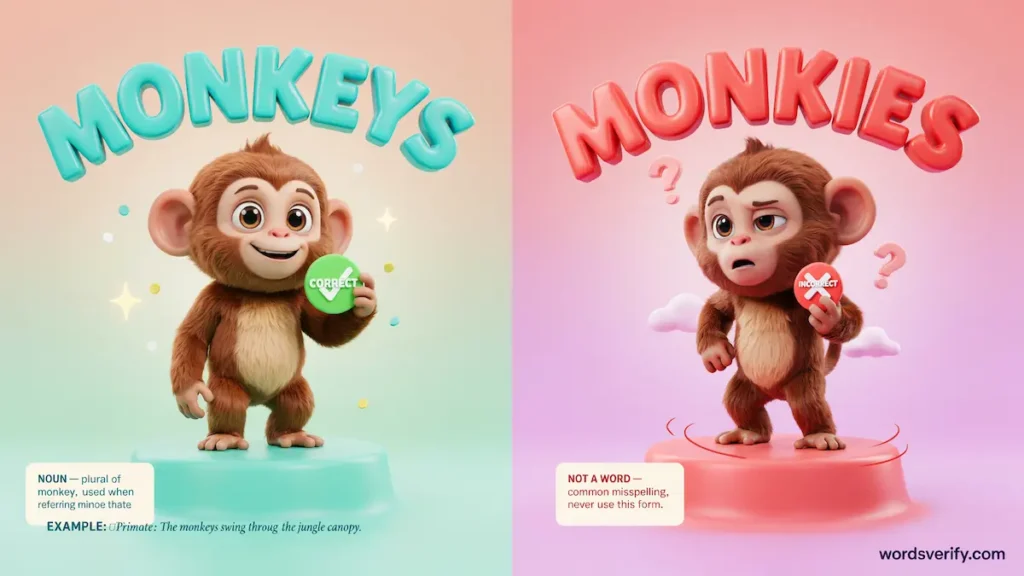
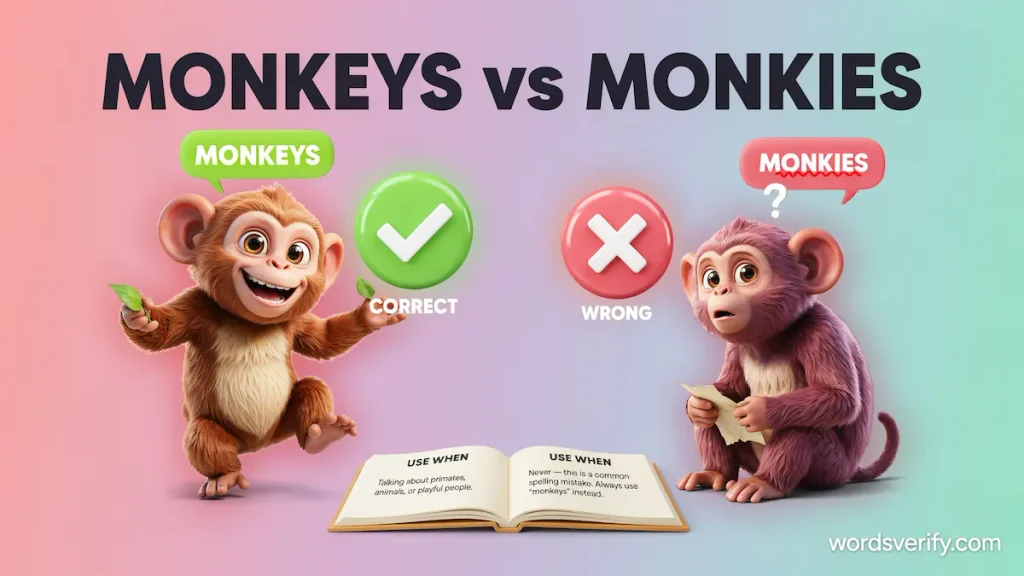
“Monkeys” is the correct plural of “monkey.” The spelling “monkies” is incorrect in standard English.
The word follows the vowel + Y spelling rule. When a noun ends in a vowel followed by Y, you generally form its plural by adding S without changing the Y.
For example:
- One monkey → Two monkeys
- One donkey → Three donkeys
- One boy → Four boys
- One toy → Five toys
- One key → Six keys
However, words ending in a consonant followed by Y follow a different pattern. You generally change the Y to I and add ES.
For example:
- One baby → Two babies
- One city → Three cities
- One party → Four parties
- One puppy → Five puppies
Here’s a quick comparison:
| Singular | Correct plural | Incorrect plural |
|---|---|---|
| Monkey | Monkeys | Monkies |
| Donkey | Donkeys | Donkies |
| Boy | Boys | Boies |
| Toy | Toys | Toies |
| Baby | Babies | Babys |
| City | Cities | Citys |
The easiest way to remember the difference is this: when a vowel comes before Y, add S. When a consonant comes before Y, generally change Y to I and add ES.
Monkeys vs Monkies Understanding the Difference
Only one of these spellings is correct in standard English. “Monkeys” is the accepted plural, while “monkies” is a common spelling mistake. This is the main distinction in monkeys vs monkies, and understanding it helps you avoid a frequent spelling error.
The confusion comes from two different pluralization patterns. Many English learners know that words such as baby and city change their final Y to IES. They then apply the same rule to monkey without checking the letter immediately before Y. However, English spelling rules depend on the letters at the end of a word, not simply its final letter. Once you understand this difference, monkeys vs monkies becomes much easier to remember.
Look closely at the spelling of monkey:
M-O-N-K-E-Y
The letter immediately before Y is E. Since E is a vowel, the word follows the vowel + Y pattern.
Therefore:
- Monkey + S = Monkeys (correct)
- Monkey + IES = Monkies (incorrect)
The same pattern appears in words such as donkey, turkey, and chimney.
Why Does Monkies Look Correct?
The spelling “monkies” looks convincing because it resembles several correctly formed English plurals.
Consider these examples:
- Baby becomes babies.
- Lady becomes ladies.
- Family becomes families.
- Country becomes countries.
- Story becomes stories.
Each word has a consonant immediately before its final Y. That’s why the Y changes to I before adding ES.
Monkey also ends in Y, but the letter before it is a vowel. That small difference changes the entire spelling pattern.
Think of the final Y as a little checkpoint. Before changing it, look one letter to the left. That simple habit can prevent plenty of spelling mistakes.
Learn the difference between tricky more English words
Salvadoran vs Salvadorian Which one Is Correct?
Why Is the Plural of Monkey Monkeys Instead of Monkies?
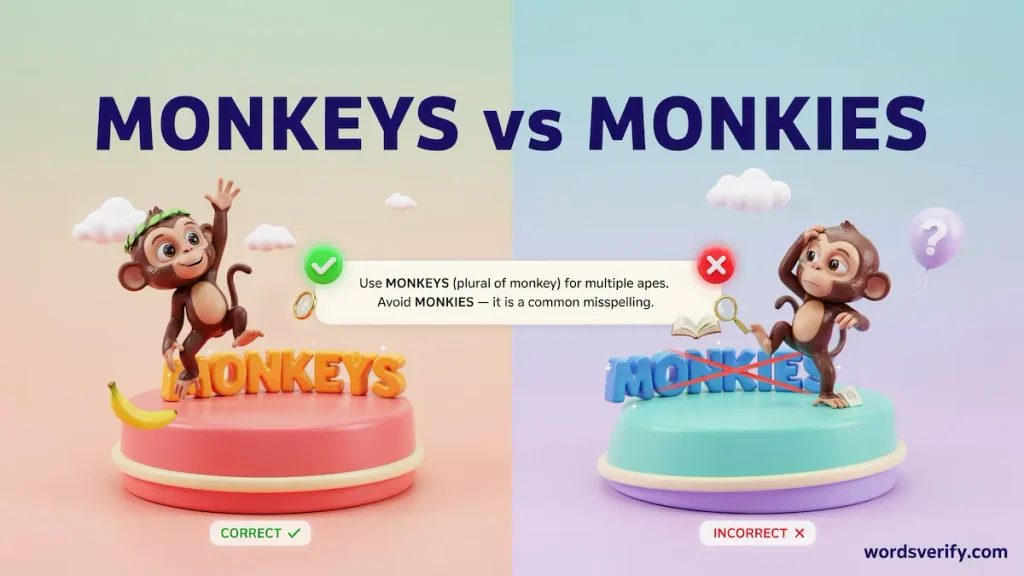
The reason monkeys keeps its Y comes from a basic English spelling rule. Nouns ending in a vowel followed by Y generally form their plurals by adding S. This simple pattern explains the difference in monkeys vs monkies and helps prevent common spelling mistakes.
This pattern applies to many everyday words, whether they refer to animals, people, objects, or places.
The plural of monkey follows the same pattern as boy, toy, and key. None of these words needs an I or an additional E to form its plural. Remembering this rule makes monkeys vs monkies much easier to understand and apply correctly in your writing.
The Vowel + Y Rule
English has five commonly taught vowel letters: A, E, I, O, and U. When one of these letters appears immediately before the final Y in a noun, you normally keep the Y and add S.
The pattern looks like this:
Vowel + Y + S = Regular plural
For example:
| Singular | Plural |
|---|---|
| Monkey | Monkeys |
| Boy | Boys |
| Toy | Toys |
| Key | Keys |
| Day | Days |
| Donkey | Donkeys |
| Turkey | Turkeys |
| Chimney | Chimneys |
Notice that the final Y stays exactly where it is in every example.
This explains why adding S to monkey is grammatically correct. The E before Y places the word in the vowel + Y group.
You can find the same pattern in plenty of other nouns. Once you recognize it, you won’t need to memorize each plural separately.
When Do You Change Y to I and Add ES?
Now consider the opposite pattern. When a noun ends in a consonant followed by Y, you generally replace the Y with I and add ES.
This is known as the consonant + Y rule.
For example:
- Baby → Babies
- City → Cities
- Party → Parties
- Lady → Ladies
- Puppy → Puppies
- Story → Stories
- Country → Countries
- Family → Families
In each word, a consonant appears immediately before Y.
Take baby, for instance. The letter B is a consonant, so its plural becomes babies rather than babys. Similarly, city becomes cities because T is a consonant.
Compare the two patterns:
| Vowel before Y | Plural | Consonant before Y | Plural |
|---|---|---|---|
| Monkey | Monkeys | Baby | Babies |
| Donkey | Donkeys | City | Cities |
| Boy | Boys | Party | Parties |
| Toy | Toys | Puppy | Puppies |
| Key | Keys | Story | Stories |
| Day | Days | Lady | Ladies |
There’s no need to memorize every word individually. Once you understand the letter pattern, you can apply the rule to many unfamiliar nouns.
Keep in mind that English has exceptions and special conventions for certain words, especially proper names and borrowed terms. However, the standard plural of monkey follows the regular vowel + Y pattern.
How to Remember the Correct Spelling
If you still find yourself confusing the two spellings, use a simple memory trick: check the letter immediately before Y.
Follow these steps:
- Find the final Y in the singular noun.
- Look at the letter immediately before it.
- If that letter is a vowel, generally add S.
- If it’s a consonant, generally change Y to I and add ES.
Try the method with these words:
- Monkey: E is a vowel, so the plural is monkeys.
- Donkey: E is a vowel, so the plural is donkeys.
- Baby: B is a consonant, so the plural is babies.
- City: T is a consonant, so the plural is cities.
- Toy: O is a vowel, so the plural is toys.
A quick spelling check is often all you need. Instead of asking whether a word ends in Y, ask whether it ends in vowel + Y or consonant + Y.
Learn the difference between tricky more English words
Attend vs Tend which one is correct?
What Does Monkey Mean?
Before exploring the word further, it helps to understand what it actually means. “Monkey” is a noun that refers to a type of primate. Monkeys belong to the order Primates, which also includes apes, lemurs, and humans.
They live in different parts of the world, particularly tropical and subtropical regions of Africa, Asia, and Central and South America. Depending on the species, monkeys may inhabit forests, grasslands, mountains, or areas near rivers.
Most monkeys have long tails, flexible limbs, and hands that help them grasp branches and objects. Their diets also vary. Some mainly eat fruit and leaves, while others consume insects, seeds, eggs, and small animals.
Here are a few well-known examples:
- Capuchin monkeys: These small New World monkeys are known for their intelligence, dexterity, and ability to use simple tools.
- Rhesus macaques: Native to parts of Asia, these Old World monkeys adapt to different environments, including forests and urban areas.
- Howler monkeys: These New World monkeys are famous for their loud calls, which can travel considerable distances through forests.
- Japanese macaques: Also called snow monkeys, these animals live in Japan’s colder regions. Some are famous for bathing in natural hot springs during winter.
Are Monkeys and Apes the Same?
No. Although monkeys and apes belong to the same broader primate order, they’re different groups.
One familiar distinction in the monkeys vs monkies discussion is that most monkeys have tails, while apes don’t. However, this isn’t a perfect rule because some monkeys, including Barbary macaques, naturally lack tails. Understanding the difference between monkeys and apes also adds useful context to the monkeys vs monkies topic, even though the two spellings are a separate grammar issue.
Other differences include:
| Feature | Monkeys | Apes |
|---|---|---|
| Tail | Usually have tails | No tails |
| Body structure | Varies by species; many have narrower chests | Generally broader-chested |
| Movement | Many climb and move on four limbs | Some use arm-swinging movement |
| Examples | Macaques, capuchins, baboons | Gorillas, chimpanzees, gibbons, orangutans |
This distinction is useful when discussing animals, but it doesn’t affect the spelling. Whether you’re referring to capuchins, macaques, or another type of monkey, the plural remains monkeys.
Learn the difference between tricky more English words
Hoodie vs Hoody Which one Is Correct?
What Is the Origin of the Word Monkey?
The word “monkey” has an interesting history, although its exact origin remains uncertain.
English adopted the word during the late Middle English period. Historical records show that it was in use by the 16th century. Some explanations connect it to older European forms, including the Germanic name “Moneke,” which appeared in medieval animal stories.
However, linguists haven’t established one universally accepted explanation for its deeper origin.
It’s also important to distinguish the history of the singular noun from its modern plural. The spelling of monkeys follows a regular English grammatical pattern. It doesn’t require a special historical change.
This distinction matters because people sometimes assume that unusual animal names must have unusual plural forms. English certainly has irregular animal plurals, such as mice and geese, but monkey isn’t one of them.
Monkey is a regular noun, so its plural follows an established spelling rule.
Is Monkies Ever a Correct Word?
In standard English, “monkies” isn’t the correct plural of monkey. Dictionaries recognize monkey as the singular noun and monkeys as its standard plural.
That doesn’t mean you’ll never encounter the spelling “monkies.” It may appear in informal online writing, usernames, fictional names, jokes, merchandise, or deliberately playful expressions.
For example, someone might use “Monkies” as the name of a fictional group or social media account. A business could also choose it as a creative brand name.
However, these uses don’t make it an accepted grammatical plural.
Learn the difference between tricky more English words
Outting vs Outing which one is correct?
Is Monkies a Real English Word?
The answer depends on what you mean by “real.”
If you’re asking whether monkies is the accepted dictionary plural of monkey, the answer is no. If you’re asking whether people have written or used that combination of letters, certainly.
A spelling can appear in everyday communication without being grammatically correct. People make typing mistakes, invent playful expressions, and create unusual names all the time.
Consider these examples:
- “The monkies are eating bananas.” This is a spelling error in ordinary writing.
- “The monkeys are eating bananas.” This is grammatically correct.
- “Welcome to Monkies World!” This could be the name of a fictional business or entertainment brand.
The context determines whether a nonstandard spelling is an intentional name or simply a mistake.
What About Monkeys vs Monkies Memes and Reddit Discussions?
The phrase “monkeys vs monkies” can also appear in memes, Reddit discussions, and online spelling debates.
These conversations often focus on why a word ending in Y doesn’t always change to IES when it becomes plural. People notice the difference between monkey and baby and wonder why English treats them differently.
Online discussions can help explain where the confusion comes from. However, a Reddit comment or popular meme isn’t an authoritative grammar reference.
For standard writing, the correct spelling remains monkeys.
Is the Spelling Monkeys the Same in American and British English?
Yes. American English and British English both use “monkeys” as the correct plural of monkey.
Unlike words such as color and colour or center and centre, this noun doesn’t have competing regional spellings.
The same applies to its singular form and possessive variations.
| Form | American English | British English |
|---|---|---|
| Singular | Monkey | Monkey |
| Plural | Monkeys | Monkeys |
| Singular possessive | Monkey’s | Monkey’s |
| Plural possessive | Monkeys’ | Monkeys’ |
Whether you’re writing an American school assignment, a British wildlife report, or an international article, use monkeys.
The vowel + Y plural rule works in both varieties of English. There’s no need to change the spelling for a British or American audience.
Learn the difference between tricky more English words
Excel vs Excell which one is correct?
How to Use Monkeys in a Sentence
Knowing the correct spelling is one thing. Using the word naturally in a sentence is another.
“Monkeys” usually functions as a plural noun when you’re talking about two or more animals. It can appear as the subject or object of a sentence, and it can also follow prepositions.
Here are examples from different situations.
Monkeys in Everyday Sentences
These examples show how to use the plural in ordinary conversation and writing:
- The monkeys climbed the trees while visitors watched from a distance.
- Several monkeys gathered near the river to find food.
- We saw a group of monkeys playing at the zoo.
- The monkeys moved quickly through the forest canopy.
- Children enjoyed watching the monkeys swing between branches.
- Some monkeys use their hands to search for food.
- The monkeys became active shortly after sunrise.
- Tourists were asked not to feed the monkeys.
Notice that the plural noun takes plural verbs in these sentences. For example, you write “the monkeys are climbing,” not “the monkeys is climbing.”
Monkeys in Scientific and Educational Writing
In scientific writing, monkeys often appear in discussions about animal behavior, evolution, habitats, and conservation.
Researchers may study their communication, social structures, feeding habits, and interactions with their surroundings.
Consider these examples:
- Monkeys communicate through vocalizations, facial expressions, and body movements.
- Some monkey species live in large social groups.
- Many monkeys depend on forests for food and shelter.
- Researchers observe monkeys to understand their social behavior.
- Habitat loss threatens several monkey populations around the world.
These sentences use the same plural spelling as everyday writing. Scientific terminology doesn’t change the basic spelling of the noun.
Monkeys in Informal Expressions
The word also appears in casual expressions and playful language.
For example, someone might call energetic children “little monkeys” when they’re climbing furniture, running around, or getting into harmless trouble.
Other common expressions include:
- Cheeky monkeys: A playful way to describe mischievous people.
- Monkey business: Silly, dishonest, or suspicious activity, depending on the context.
- More fun than a barrel of monkeys: An informal expression describing something very entertaining.
- Monkey around: To behave playfully or waste time instead of concentrating.
These expressions show how the word has developed meanings beyond the animal itself.
However, the plural spelling doesn’t change in informal language. You still write monkeys, even when using the word humorously.
Learn the difference between tricky more English words
Studder vs Stutter which one is correct?
Monkey, Monkeys and Monkey’s Understanding the Different Forms
One common grammar problem involves confusing a plural noun with a possessive noun.
The words monkey, monkeys, and monkey’s look similar, but they perform different jobs in a sentence. Adding an apostrophe can change the meaning entirely.
Here’s a quick comparison:
| Word form | Grammatical use | Example |
|---|---|---|
| Monkey | Singular noun | The monkey is sleeping. |
| Monkeys | Plural noun | The monkeys are sleeping. |
| Monkey’s | Singular possessive | The monkey’s tail is long. |
| Monkeys’ | Plural possessive | The monkeys’ enclosure is large. |
The key is to understand whether you’re talking about one animal, several animals, or something that belongs to them.
When to Use Monkey’s
Use “monkey’s” when something belongs to one monkey.
The apostrophe comes before the S because the noun is singular.
Examples:
- The monkey’s tail helped it balance.
- The monkey’s favorite food was fruit.
- We observed the monkey’s behavior.
- The monkey’s enclosure was recently renovated.
In each sentence, the apostrophe shows possession by one animal.
When to Use Monkeys’
Use “monkeys'” when something belongs to multiple monkeys.
Because the plural noun already ends in S, you place the apostrophe after the final letter.
Examples:
- The monkeys’ habitat includes several tall trees.
- The monkeys’ food was placed in separate containers.
- Researchers studied the monkeys’ social behavior.
- The monkeys’ enclosure needed repairs.
The apostrophe doesn’t create another plural. It simply indicates ownership or association.
What Is the Plural Possessive of Monkey?
The plural possessive of monkey is “monkeys’.”
For example:
- Singular: The monkey’s food was fresh.
- Plural: The monkeys’ food was fresh.
The first sentence refers to one monkey. The second refers to multiple monkeys.
This distinction also explains how to write the plural possessive correctly. Don’t write “monkies'” because the underlying plural spelling is already incorrect.
Learn the difference between tricky more English words
Choosing vs Chosing which one is correct?
Monkey vs Donkey Why Are Their Plurals Monkeys and Donkeys?
Monkey and donkey are useful examples when learning English pluralization because both words end in vowel + Y.
Their plural forms follow the same pattern:
- Monkey → Monkeys
- Donkey → Donkeys
In both words, E appears immediately before Y. Since E is a vowel, you keep the Y and add S.
The same rule applies to other words:
| Singular | Plural | Rule |
|---|---|---|
| Monkey | Monkeys | Add S |
| Donkey | Donkeys | Add S |
| Turkey | Turkeys | Add S |
| Chimney | Chimneys | Add S |
| Journey | Journeys | Add S |
| Key | Keys | Add S |
| Toy | Toys | Add S |
The important point is that the spelling pattern depends on the final letters, not the meaning of the noun.
A monkey is an animal, a donkey is another animal, and a key is an object. Yet all three follow the same vowel + Y plural rule.
Why Do People Confuse Monkey and Donkey Plurals?
The confusion usually comes from remembering the consonant + Y rule but forgetting when to apply it.
Someone who knows that baby becomes babies might assume that monkey should become monkies. The mistake becomes understandable when you consider how frequently English uses the IES ending.
However, compare the final letters:
- Monkey ends in EY.
- Donkey ends in EY.
- Baby ends in BY.
- City ends in TY.
The first two have vowels before Y, while the last two have consonants.
That’s the difference that determines their standard plural spelling.
Learn the difference between tricky more English words
Accross vs Across Which one Is Correct?
Common Spelling and Grammar Mistakes with Monkeys
Even though the monkey plural spelling rule is straightforward, several related mistakes can appear in everyday writing.
Some involve the wrong plural ending. Others come from confusing possessive forms or using the wrong verb with a plural noun.
Here are the mistakes worth avoiding.
Using Monkies Instead of Monkeys
Incorrect: The monkies climbed the trees.
Correct: The monkeys climbed the trees.
The mistake happens when writers apply the consonant + Y rule to a word ending in vowel + Y.
Remember that monkey takes S without changing its final Y.
Confusing Monkeys and Monkey’s
Incorrect: Three monkey’s were sitting on the wall.
Correct: Three monkeys were sitting on the wall.
The apostrophe indicates possession, not plurality. When you’re simply talking about more than one animal, you don’t need it.
Using Monkey’s Instead of Monkeys’
The sentence “The monkey’s habitat covered several acres” is correct if you’re talking about one monkey.
However, if the habitat belongs to multiple monkeys, the correct form is:
“The monkeys’ habitat covered several acres.”
Always check how many animals the sentence refers to before placing the apostrophe.
Using a Singular Verb with Monkeys
Incorrect: The monkeys is eating bananas.
Correct: The monkeys are eating bananas.
Monkeys is a plural noun, so it generally takes plural verbs.
More examples:
| Incorrect | Correct |
|---|---|
| The monkeys is sleeping. | The monkeys are sleeping. |
| A group of monkeys are climbing. | A group of monkeys is climbing. |
| The monkeys has escaped. | The monkeys have escaped. |
| These monkeys was hungry. | These monkeys were hungry. |
Notice the second example. The subject is “a group,” which is singular. Therefore, the verb is “is” in standard American English.
Changing Y to IES in Every Word Ending in Y
Incorrect: The donkies walked across the field.
Correct: The donkeys walked across the field.
Not every noun ending in Y changes its final letter. The vowel or consonant immediately before Y determines the usual plural pattern.
This is one of the most useful English spelling rules to understand because it applies to hundreds of everyday words.
Monkeys vs Monkies Comparison of Common Word Forms
The following table brings together the most important spellings and related grammatical forms.
| Word or form | Correct? | Explanation |
|---|---|---|
| Monkey | Yes | Singular noun |
| Monkeys | Yes | Standard plural |
| Monkies | No | Common misspelling |
| Monkey’s | Yes | Singular possessive |
| Monkeys’ | Yes | Plural possessive |
| Monkeyes | No | Incorrect plural |
| Monkees | Yes | A proper name, not the standard plural |
One interesting detail is that “The Monkees” is also the name of a well-known American pop-rock band from the 1960s. Its spelling is intentional and shouldn’t be confused with the ordinary plural of monkey.
For everyday writing, the choice is simple: use monkeys when referring to more than one monkey.
Learn the difference between tricky more English words
Sponsor vs Sponser Which one Is Correct?
Practice Session Monkeys vs Monkies
Test your understanding of the correct plural spelling of monkey and the grammar rules behind it. Complete each sentence with the correct word or form. Remember, the letter Y doesn’t always need to pack its bags!
Fill in the Blanks
- We saw several playful ______ swinging from the trees.
- The little ______ was eating a banana.
- A group of ______ gathered near the river.
- The zookeeper prepared food for the hungry ______.
- The ______ climbed to the highest branch.
- Two ______ chased each other around the enclosure.
- The baby ______ stayed close to its mother.
- Many ______ live in forests and grasslands.
- The ______ long tail helped it balance.
- The children watched the ______ at the zoo.
- A ______ can use its hands to grab food.
- The ______ made loud noises in the trees.
- Several ______ rested in the shade.
- The ______ favorite food was ripe fruit.
- We counted five ______ near the feeding area.
- The ______ were jumping from branch to branch.
- A ______ is a type of primate.
- The keeper checked the ______ enclosure.
- Three ______ were sitting on a wooden platform.
- The ______ playful behavior entertained the visitors.
- The word monkey becomes ______ when you mean more than one.
- Unlike baby, the word monkey does not become ______.
- A donkey becomes ______ in the plural.
- The plural of turkey is ______.
- Both American and British English use the spelling ______.
Answers
- Monkeys
- Monkey
- Monkeys
- Monkeys
- Monkey
- Monkeys
- Monkey
- Monkeys
- Monkey’s
- Monkeys
- Monkey
- Monkey
- Monkeys
- Monkey’s
- Monkeys
- Monkeys
- Monkey
- Monkey’s
- Monkeys
- Monkey’s
- Monkeys
- Monkies (incorrect spelling)
- Donkeys
- Turkeys
- Monkey
Here’s a trusted source for clear word meanings:
FAQs
Why does the word monkey end in Y?
The word monkey ends in a vowel (E) followed by Y. English grammar generally keeps the Y in this pattern and adds S to form the plural: monkey becomes monkeys.
Is monkey a regular or irregular noun?
Monkey is a regular noun. It follows the standard pluralization rule for nouns ending in a vowel plus Y. Simply add S to make monkeys.
Do all monkeys have tails?
No. Most monkeys have tails, but some species, such as Barbary macaques, naturally lack them. Apes, including gorillas and chimpanzees, do not have tails.
Are monkeys and apes the same animals?
No. Both belong to the primate family, but they are different groups. Monkeys generally have tails, while apes do not. Apes also tend to have larger bodies and more flexible shoulders.
What is the difference between a monkey and a chimpanzee?
A chimpanzee is an ape, not a monkey. Chimps have no tails, larger brains relative to body size, and different skeletal features. Monkeys usually have tails and belong to either the Old World or New World monkey groups.
What is a baby monkey called?
A baby monkey is called an infant. You may also hear people casually call one a baby monkey, which is perfectly clear in everyday conversation.
What is the scientific name for monkeys?
There isn’t one scientific name for all monkeys. Monkeys belong to several different families and genera within the primate order. Their scientific names depend on the particular species.
How intelligent are monkeys?
Monkeys can solve problems, recognize individuals, learn from experience, communicate through sounds and gestures, and use tools in some species. Their abilities vary depending on the species and environment.
What do monkeys eat?
Most monkeys are omnivores. Their diets may include fruit, leaves, seeds, flowers, insects, eggs, and small animals. The exact menu depends on the species and its habitat.
How do you pronounce monkeys?
Monkeys is pronounced MUNG-keez, with the first syllable sounding like “monk” and the ending sounding like “keys.” The singular form, monkey, is pronounced MUNG-kee.
Is monkies ever acceptable in writing?
Monkies isn’t an accepted standard plural of monkey. You might encounter it in usernames, fictional names, jokes, or playful writing, but use monkeys in formal, academic, and everyday writing.
Do American and British English spell monkeys differently?
No. Both American and British English use monkeys as the standard plural. Unlike words such as color and colour, this spelling doesn’t change between the two varieties.
What is the difference between monkeys and monkey’s?
Monkeys is the plural form, referring to more than one monkey. Monkey’s is the singular possessive form, showing that something belongs to one monkey. For example, “The monkeys climbed the trees” and “The monkey’s tail was long.”
Is monkeys’ also correct?
Yes. Monkeys’ is the plural possessive form. It shows that something belongs to multiple monkeys. For example, “The monkeys’ enclosure was cleaned in the morning.”
What is the plural of monkey in a sentence?
Here are two examples:
- The monkeys swung from branch to branch.
- Several monkeys gathered near the water.
Both sentences use monkeys correctly to describe more than one animal.
What other words follow the same plural rule as monkey?
Many nouns ending in a vowel followed by Y form their plurals by adding S. Examples include:
- Donkey → donkeys
- Turkey → turkeys
- Journey → journeys
- Valley → valleys
- Chimney → chimneys
- Boy → boys
- Toy → toys
Why do people mistakenly write monkies?
Writers often confuse the plural rule for monkey with the rule for nouns ending in a consonant followed by Y. Words such as baby and city change Y to I before adding ES. Monkey doesn’t follow that pattern because a vowel comes before its final Y.
Learn the difference between tricky more English words
Chalet vs Château which one is corrcet?
Conclusion
The spelling mystery behind monkeys vs monkies is easier to solve than a monkey stealing a banana. Monkeys is the correct plural, while monkies is a common misspelling that doesn’t belong in standard English. Just remember the simple rule: when a noun ends in a vowel followed by Y, keep the Y and add S. No letter swapping, no extra ES, and no grammar gymnastics required! Once you understand this pattern, you’ll avoid the mistake with ease. So, the next time you write about a mischievous group of monkeys, let your spelling swing in the right direction!

Lisa AJS is an experienced blogger and language enthusiast at Words Verify, dedicated to making grammar simple, practical, and enjoyable. She writes engaging content on commonly confused words, grammar mistakes, word meanings, and everyday language challenges.