
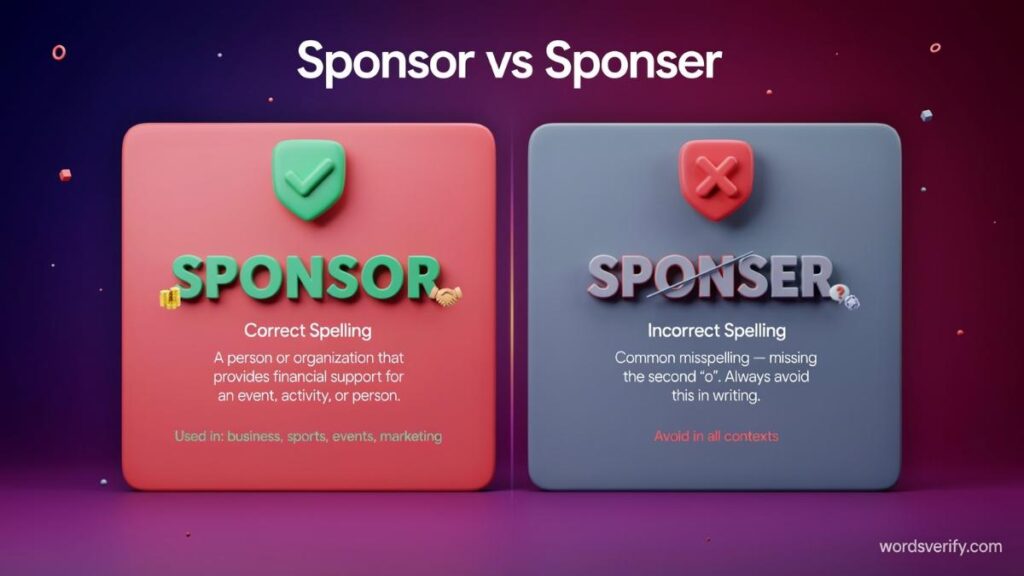
Is it “sponsor” vs “sponser”? One small letter can turn a simple word into a surprisingly common spelling mistake. If you’ve ever hesitated between the two, you’re certainly not alone. The confusion makes sense because the final syllable can sound like “ser,” tempting you to spell it with an e. However, pronunciation doesn’t always tell the whole story. In Sponsor vs Sponser, only one spelling is correct in standard English: sponsor. Let’s clear up the confusion, explore the word’s meaning and usage, and look at practical examples that will help you spell it correctly with confidence.
Quick Answer Is It Sponsor vs Sponser?
Sponsor is the correct spelling in standard English. Sponser is a common spelling mistake and isn’t an accepted alternative in American or British English.
The difference is simple:
- Sponsor: Correct spelling.
- Sponser: Incorrect spelling.
The word sponsor works as both a noun and a verb. As a noun, it describes a person, company, or organization that provides support. As a verb, it means to give financial assistance, resources, or other backing to someone or something.
Consider these examples:
| Correct sentence | Incorrect sentence |
|---|---|
| The company will sponsor the local football team. | The company will sponser the local football team. |
| She found a sponsor for her charity event. | She found a sponser for her charity event. |
| The athlete received sponsorship from a sports brand. | The athlete received sponsership from a sports brand. |
The mistake can also affect related words, such as sponsored and sponsoring. Remember one simple rule: sponsor ends in “-or,” not “-er.”
Chalet vs Château which one is corrcet?
What Does Sponsor Mean?
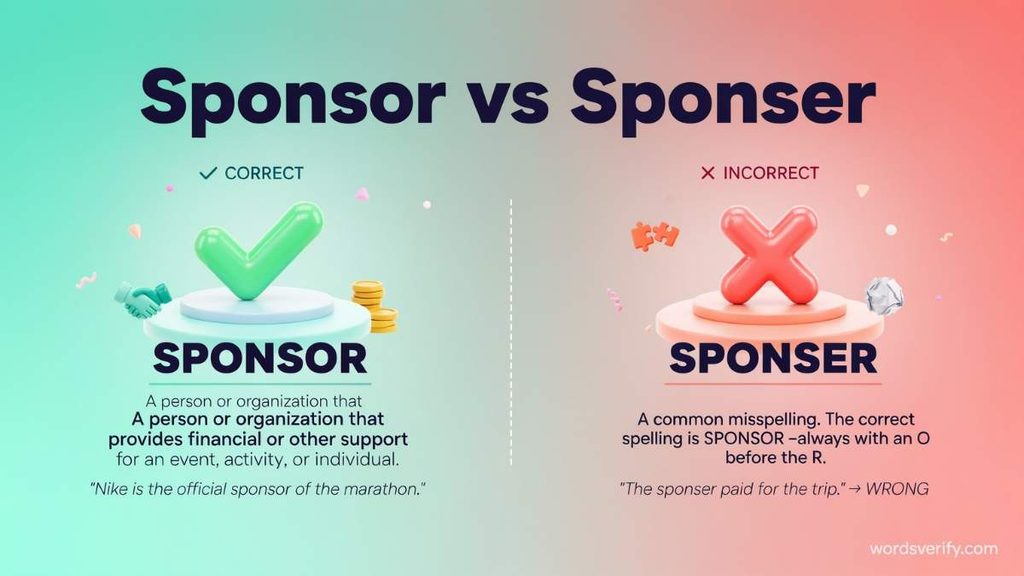
A sponsor is a person, business, or organization that provides financial assistance, resources, services, or other forms of support to someone or something. This support may help fund an event, pay for a student’s education, provide equipment to an athlete, or make a community project possible.
Sponsorship doesn’t always involve money. A company might provide free products, professional services, equipment, or access to facilities instead of direct financial assistance.
For example, a sportswear company might sponsor an athlete by providing clothing, footwear, and money. A local business might support a community festival by covering some of its expenses. In another situation, an experienced member of a recovery program might guide someone who is working toward recovery.
Although these situations look different, they share one central idea: someone provides support to another person or activity.
Sponsor Definition and Meaning in Different Contexts
The meaning of sponsor can change slightly depending on the situation. However, the basic idea of providing support remains the same.
| Context | Meaning | Example |
|---|---|---|
| Business | A company that provides money or resources to support an activity | A technology company sponsors a conference. |
| Sports | A person or organization that supports an athlete or team | A sports brand sponsors a professional runner. |
| Education | Someone who helps fund a student’s education or academic program | A foundation sponsors scholarships. |
| Events | A business or organization that helps fund an event | A bank sponsors a music festival. |
| Recovery | An experienced member who guides another person through a recovery program | He found a sponsor through Alcoholics Anonymous. |
| Immigration | An eligible person or organization that undertakes a formal sponsorship role | A qualifying family member sponsors a relative’s immigration application. |
These examples show why context matters. A sponsor at a football tournament may provide money, while a recovery sponsor offers personal guidance. The word stays the same even when the responsibilities differ.
Sponsor as a Noun
When you use sponsor as a noun, you’re talking about the person or organization providing support.
A sponsor may offer money, equipment, services, professional guidance, or other resources. In business arrangements, the sponsor may receive benefits such as brand exposure, advertising opportunities, or public recognition.
Imagine a local company agrees to fund a children’s sports tournament. The organizers display its logo on banners, uniforms, and promotional materials. In this situation, the company is the tournament’s sponsor.
Here are some more examples:
- The university thanked its sponsors for funding the annual science exhibition.
- A local restaurant became the main sponsor of the charity run.
- The young athlete received help from a private sponsor.
- Several corporate sponsors supported the music festival.
- Her recovery sponsor encouraged her to remain committed to the program.
In each sentence, sponsor identifies someone who provides assistance.
Sponsor as a Verb
Sponsor also works as a verb. In this form, it describes the action of providing financial assistance, resources, or other support.
You can sponsor a person, team, event, organization, project, or program. The kind of support depends on the situation and the agreement between the parties.
For example, a company might sponsor a sporting competition by paying for venue expenses. A nonprofit organization might sponsor an educational program by providing funding and learning materials.
Consider these sentences:
- The clothing brand will sponsor three professional athletes.
- Our company sponsors an annual community fundraiser.
- A charitable foundation sponsored the research project.
- The university is sponsoring a student exchange program.
- The local business agreed to sponsor the youth football team.
The distinction is easy to remember: a sponsor is the person or organization, while to sponsor describes the action of providing support.
Learn how to use confusing more words correctly
Reins vs Reigns which one is correct?
Why Do People Spell Sponsor as Sponser?
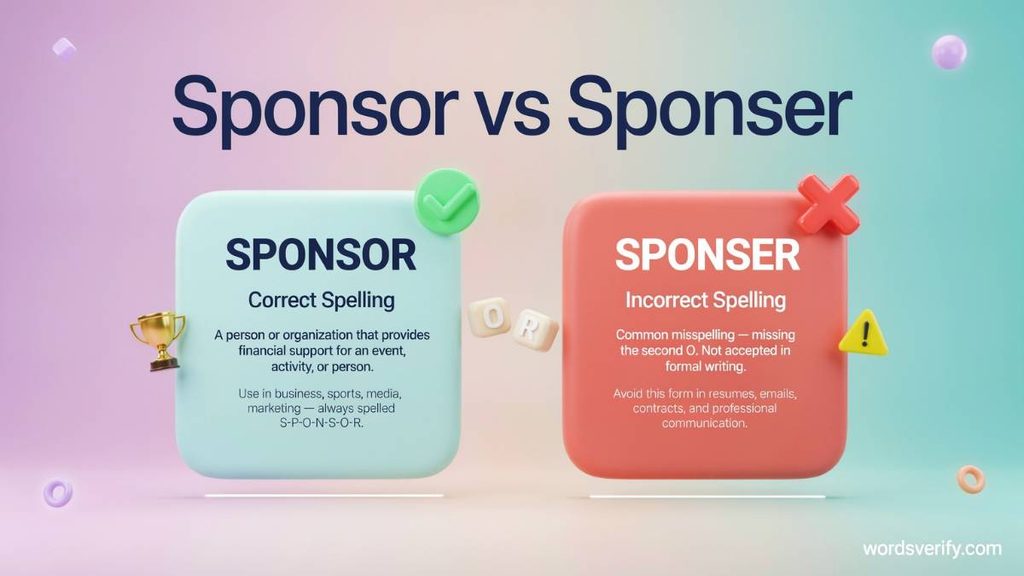
English spelling doesn’t always follow pronunciation. That’s one reason even experienced writers sometimes make mistakes.
The confusion between sponsor vs sponser often comes from the final unstressed vowel. When people pronounce the word, the ending may not sound especially clear. Some writers then associate it with familiar words such as teacher, worker, or manager and mistakenly choose “-er.”
Several things can contribute to this error:
- Unclear vowel sounds: The final vowel is unstressed, which can make its spelling less obvious.
- Familiar spelling patterns: English contains many words ending in “-er,” so writers may automatically choose that ending.
- Typing mistakes: Fast typing can lead to the wrong final vowel without the writer noticing.
- Autocorrect habits: Some people overlook spelling suggestions or fail to check their writing after typing.
- Limited exposure: Someone who rarely sees the word in writing may remember its pronunciation but forget its spelling.
This explains why sponser sometimes appears in emails, online posts, advertisements, and informal messages.
However, pronunciation doesn’t determine the accepted spelling. The same issue affects many commonly misspelled English words. A word may sound one way but follow a different spelling pattern.
Learn how to use confusing more words correctly
Stellar vs Steller which one is correct?
Origin and History of the Word Sponsor
The word sponsor has a long history that goes back to Latin. Its original meaning centered on making a promise or accepting responsibility.
It comes from the Latin noun sponsor, meaning a guarantor or someone who promises to do something. The word is related to the Latin verb spondēre, which means “to promise” or “to pledge.”
Over time, sponsor developed into a broader term for someone who supports, backs, or takes responsibility for another person or activity.
Today, the word appears in many areas of life:
- Business: Companies provide financial backing for projects and promotional activities.
- Sports: Brands support athletes, teams, and competitions.
- Education: Organizations help fund scholarships and academic programs.
- Community activities: Individuals and businesses support charities and local events.
- Personal development: Experienced individuals guide others through structured support programs.
Although the word’s meaning has expanded over the centuries, its spelling remains sponsor. Its Latin origin also helps explain why it ends in “-or” rather than “-er.”
How to Pronounce Sponsor
Knowing how to pronounce sponsor can help you recognize the word, but pronunciation alone won’t always tell you how to spell it.
In American English, sponsor has two syllables, with the main stress on the first syllable.
- IPA: /ˈspɑːn.sɚ/
- Syllables: Two.
- Stress: First syllable.
Start with the consonant blend “sp.” Give the first syllable the strongest emphasis and pronounce the second syllable more lightly.
The ending may sound similar to the final syllable in words such as actor or doctor. However, that doesn’t mean you should write “-er.”
Remember that pronunciation and spelling serve different purposes. Even when a word’s ending sounds familiar, its established written form remains unchanged.
Learn how to use confusing more words correctly
Cheer vs Chear Which one Is Correct?
Word Forms of Sponsor and Their Correct Spellings
Learning the related forms of sponsor makes the spelling easier to remember. These words appear regularly in business communication, academic writing, advertising, and everyday conversation.
| Word form | Grammatical role | Meaning |
|---|---|---|
| Sponsor | Noun or verb | A person providing support or the act of providing it |
| Sponsors | Plural noun or verb | More than one sponsor or the action performed by a singular subject |
| Sponsored | Past tense or past participle | Provided support |
| Sponsoring | Present participle or gerund | Providing support |
| Sponsorship | Noun | The arrangement or relationship involving support |
Sponsor
Sponsor is the base form. You can use it as either a noun or a verb.
Examples:
- The company wants to sponsor a local event.
- We need a sponsor for the school project.
- Several organizations sponsor community programs.
Sponsors
Sponsors is the plural form of the noun sponsor. Use it when referring to two or more people or organizations that provide support.
Examples:
- The organizers thanked all the sponsors.
- Several sponsors contributed money to the festival.
- Corporate sponsors helped fund the research conference.
Sponsors also works as a verb when the subject is singular and in the third person.
Examples:
- The company sponsors a yearly scholarship.
- She sponsors a local children’s program.
Sponsored
Sponsored is the correct past-tense and past-participle form of sponsor.
Notice that the final consonant doubles before adding “-ed.” This follows the English spelling rule for certain words ending in a consonant after a stressed vowel.
Examples:
- The company sponsored a charity concert last month.
- A local foundation sponsored the student’s education.
- The organization has sponsored several community projects.
- The sporting event was sponsored by a major clothing brand.
Never write “sponsered.” The correct form retains the original spelling and adds “-ed.”
Sponsoring
Sponsoring is the present participle and gerund form of sponsor.
To create it, add “-ing” without changing the final consonant.
Examples:
- The company is sponsoring a new television program.
- Sponsoring local athletes helps businesses build community connections.
- They are sponsoring an educational campaign.
- The organization enjoys sponsoring charitable activities.
The spelling “sponsering” is incorrect.
Sponsorship
Sponsorship is a noun that describes the arrangement, relationship, or support provided by a sponsor.
It often refers to an agreement in which one party offers financial or material assistance in exchange for certain benefits. Those benefits might include advertising, brand recognition, or access to an audience.
For example, a sportswear company might enter a sponsorship agreement with a professional athlete. The company provides money and equipment, while the athlete may agree to wear its products and participate in promotional activities.
Examples:
- The festival secured sponsorship from three local companies.
- Her scholarship depends on a private sponsorship arrangement.
- The organization is looking for new sponsorship opportunities.
- The team signed a sponsorship agreement with a sports brand.
The distinction is straightforward:
- Sponsor: The person or organization providing support.
- Sponsorship: The support arrangement or relationship.
- Sponsoring: The act of providing support.
Learn how to use confusing more words correctly
Suit vs Suite which one is correct?
Is Sponser Ever Correct in American or British English?
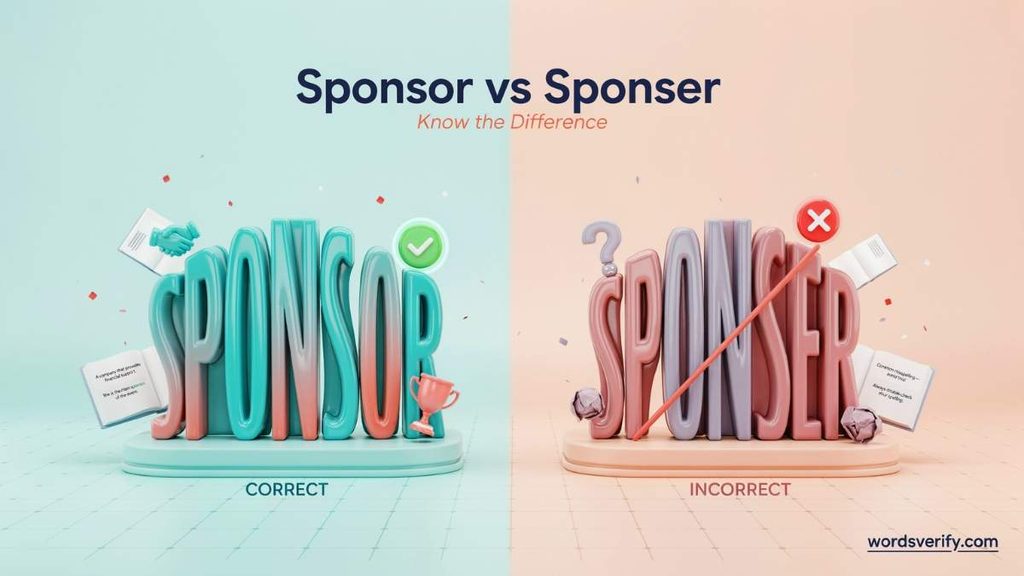
No. Sponser isn’t a standard English spelling in either American or British English.
The correct spelling is sponsor in both varieties. You don’t need to change the final letters when writing for an American, British, Canadian, or Australian audience.
Some English words have different regional spellings. For example, Americans generally write “color,” while British writers use “colour.” Similarly, “organize” and “organise” reflect different spelling conventions.
Sponsor doesn’t follow that pattern.
| English variety | Correct spelling | Incorrect spelling |
|---|---|---|
| American English | Sponsor | Sponser |
| British English | Sponsor | Sponser |
| Canadian English | Sponsor | Sponser |
| Australian English | Sponsor | Sponser |
Therefore, if you’re wondering whether the correct spelling changes depending on your audience, the answer is no. Use sponsor regardless of the regional variety.
Learn how to use confusing more words correctly
Busing vs Bussing Which one Is Correct?
Sponsor vs Sponsorer Is Sponsorer a Word?
The Sponsor vs sponsorer may look interchangeable, but they don’t have the same standing in everyday English.
Sponsor is the established and widely accepted term for a person, business, or organization that provides support.
Sponsorer is a rare word formed by adding the agent suffix “-er” to sponsor. It may appear in some contexts, but it isn’t the usual or preferred choice in standard business, academic, or everyday writing.
For example:
- Natural: The company is the main sponsor of the event.
- Awkward: The company is the main sponsorer of the event.
The first sentence sounds more natural because sponsor already identifies the person or organization providing support.
There’s little reason to choose sponsorer when sponsor communicates the meaning clearly.
Use sponsor as the noun for the person or organization providing support. Choose sponsorship when discussing the arrangement itself.
Learn how to use confusing more words correctly
Sentence vs Sentance which one is correct?
Different Types of Sponsors
Not all sponsors provide the same kind of assistance. Some contribute money, while others offer products, services, equipment, or professional guidance. Understanding these different forms of support helps clarify how sponsorship works in real situations. The topic of Sponsor vs Sponser also highlights why using the correct spelling matters when discussing sponsorship, its types, and its benefits. By exploring Sponsor vs Sponser, you can better understand the word’s meaning and recognize its correct usage in different contexts.
Corporate and Business Sponsors
A corporate sponsor is a company that provides financial or material support to an organization, event, individual, or project. Understanding the difference in Sponsor vs Sponser helps you use the correct spelling when discussing business partnerships and sponsorship arrangements.
Businesses often enter these arrangements to increase brand visibility, connect with potential customers, and build relationships with their communities. In the context of Sponsor vs Sponser, the word sponsor refers to a business that provides support in exchange for agreed benefits.
For example, a technology company might sponsor an industry conference. In return, the event organizers could display its logo, provide exhibition space, or mention the company in promotional materials. This practical example also shows how Sponsor vs Sponser applies to everyday business communication.
Common examples include:
- Technology companies sponsoring industry conferences.
- Clothing brands supporting fashion events.
- Banks funding community development programs.
- Food companies supporting public festivals.
Event Sponsors
An event sponsor provides funding, products, or services to help organize an event.
Events can be expensive. Organizers must often cover venue rental, equipment, advertising, transportation, security, and other operating costs.
A financial sponsor can help cover these expenses. Other sponsors may contribute refreshments, technical equipment, printing services, or promotional materials.
For example, a local business might sponsor a charity marathon by paying for participant T-shirts and event banners.
Depending on the agreement, the business may receive:
- Its logo on event materials.
- Recognition during announcements.
- Promotional space at the venue.
- Mentions on the event’s social media accounts.
Sports Sponsors
Sports sponsorship is one of the most visible forms of brand sponsorship.
Companies provide financial backing, equipment, clothing, or other resources to athletes, teams, clubs, and sporting competitions.
In return, they may receive advertising opportunities and brand exposure.
For example, a shoe manufacturer might sponsor a professional runner by providing footwear and financial assistance. A company could also sponsor a football team and display its logo on the team’s uniforms.
Sports sponsorship can help athletes manage training and competition expenses while giving brands access to sports audiences.
Educational Sponsors
Educational sponsors support students, schools, research projects, or academic programs.
Their contributions may include tuition assistance, scholarships, learning materials, technology, or funding for educational activities.
For instance, a charitable foundation might sponsor a scholarship for students who demonstrate academic ability but need financial assistance.
Educational sponsorship can also support:
- School improvement projects.
- University research programs.
- Student exchange opportunities.
- Vocational training.
- Educational technology initiatives.
Personal and Recovery Sponsors
The word sponsor also has an important meaning in personal support and recovery programs. Understanding Sponsor vs Sponser helps clarify the correct spelling when discussing these relationships and their purpose.
In Alcoholics Anonymous (AA), a sponsor is an experienced member who offers guidance and support to someone working through recovery. The sponsor shares personal experiences, discusses recovery principles, and helps the newer member navigate the program. This is another practical example of Sponsor vs Sponser in everyday English.
This relationship differs from commercial sponsorship because it generally doesn’t involve business payments or advertising agreements. The person receiving guidance is called the sponsee.
For example:
“After joining the recovery program, Daniel found a sponsor who helped him understand the steps and stay committed to his recovery.”
Here, sponsor refers to someone who provides personal guidance rather than financial assistance.
Learn how to use confusing more words correctly
Training vs Trainning which one is correct?
Sponsor in a Sentence Examples of Correct Usage
The easiest way to understand a word is to see how people use it in everyday situations. These examples help clarify Sponsor vs Sponser by showing how the correct spelling, sponsor, works in different contexts, from business partnerships and charity events to sports and personal support.
Sponsor in Business and Marketing
Businesses frequently sponsor events, campaigns, and projects to increase brand awareness and build relationships with customers.
Examples:
- The technology company agreed to sponsor the annual business conference.
- A well-known clothing brand sponsors several professional athletes.
- The company is looking for a sponsor to support its new product launch.
- Our official sponsor provided equipment for the promotional campaign.
- The business sponsored a local advertising event to reach new customers.
Sponsor in Education
Educational sponsorship helps students and institutions access resources they might otherwise struggle to afford.
Examples:
- A charitable foundation sponsors students from low-income families.
- The university received funding from several educational sponsors.
- The organization sponsored a research project at the local college.
- Her tuition was covered through a scholarship sponsored by a private company.
- The program sponsors students who want to pursue technical training.
Sponsor in Sports
Sports sponsorship provides financial backing, equipment, and other resources to athletes and teams.
Examples:
- A sportswear company sponsors the national football team.
- The athlete signed a sponsorship agreement with a fitness brand.
- Several businesses sponsor the annual basketball tournament.
- The local club needs a financial sponsor for its upcoming season.
- The official sponsor displayed its logo beside the playing field.
Sponsor in Events and Community Programs
Community events often depend on sponsors to cover expenses and provide necessary resources.
Examples:
- A local restaurant sponsored the neighborhood food festival.
- The charity event received support from five corporate sponsors.
- The organization is seeking sponsors for its annual fundraising campaign.
- A construction company sponsored the community development project.
- The festival organizers thanked every business that helped sponsor the event.
Sponsor in Personal Support and Recovery
In recovery programs, sponsor describes a person who provides guidance rather than commercial funding.
Examples:
- She asked an experienced member to become her recovery sponsor.
- His sponsor encouraged him to attend regular meetings.
- Finding a supportive sponsor helped her understand the recovery process.
- A sponsor can share personal experiences and offer guidance.
- The new member contacted his sponsor when he needed encouragement.
These examples show that sponsor works in many different situations without changing its spelling.
Learn how to use confusing more words correctly
Phenix vs Phoenix Which one Is Correct?
Sponsor vs Donor vs Supporter What’s the Difference?
Sponsor, donor, and supporter all describe people or organizations that help others. However, each word carries a slightly different meaning.
A donor generally gives money, goods, or other resources. A sponsor may provide similar assistance but often receives agreed promotional or organizational benefits. A supporter is a broader term for anyone who backs a person, organization, or cause.
| Word | Meaning | Example |
|---|---|---|
| Sponsor | Provides support, often under an arrangement involving recognition or other benefits | A company sponsors a music festival. |
| Donor | Gives money, goods, or resources, usually as a contribution | A donor gives $5,000 to a charity. |
| Supporter | Backs or encourages a person, cause, or organization | A supporter volunteers at a community event. |
When Should You Use Sponsor?
Use sponsor when someone provides financial or other support under a sponsorship arrangement.
Example: A local company sponsors a youth football tournament and receives its logo placement on the team’s uniforms.
When Should You Use Donor?
Use donor when someone gives money, goods, or resources to support a cause or organization.
Example: An individual donates $1,000 to a hospital’s fundraising campaign.
When Should You Use Supporter?
Use supporter when someone generally encourages, helps, or stands behind a person or cause.
Example: Hundreds of supporters attended the charity event to raise awareness.
A sponsor can also be a donor or supporter in a broader sense. However, the words aren’t interchangeable in every situation. The surrounding context determines which one fits best.
Learn how to use confusing more words correctly
Chef vs Cheff which one is correct?
Sponsor vs Sponsorship vs Sponsoring What’s the Difference?
These three words share the same root but serve different grammatical purposes. Choosing the correct form makes your writing clearer.
| Word | Grammatical role | Example |
|---|---|---|
| Sponsor | Noun or verb | The company will sponsor the event. |
| Sponsorship | Noun | The event received corporate sponsorship. |
| Sponsoring | Present participle or gerund | The company is sponsoring the event. |
Here’s another way to understand the difference:
- Sponsor: The person or company providing support.
- Sponsorship: The arrangement through which support is provided.
- Sponsoring: The action of providing support.
For example:
“The business became the official sponsor of the festival. Its sponsorship covered several event expenses. The company is also sponsoring a children’s educational program.”
Each form serves a different purpose, but all follow the correct spelling pattern.
What Is the Difference Between a Sponsor and a Sponsee?
A sponsor provides support or guidance, while a sponsee receives it.
The term sponsee commonly appears in recovery programs and other mentoring relationships. It identifies the person receiving guidance from a sponsor.
For example, in a recovery program, an experienced member may act as a sponsor and help a newer member understand the program. The newer member is the sponsee.
| Term | Role |
|---|---|
| Sponsor | Provides support or guidance |
| Sponsee | Receives support or guidance |
Don’t confuse sponsee with sponser. Sponsee is a legitimate English word, while sponser is a misspelling of sponsor.
Common Sponsor Spelling and Usage Mistakes
Even though Sponsor vs Sponser , sponsor is a relatively simple word, several related spelling and grammar mistakes appear in everyday writing.
Knowing these errors makes it easier to avoid them.
Writing Sponser Instead of Sponsor
This is the main spelling mistake discussed in this article.
Incorrect: The company will sponser the competition.
Correct: The company will sponsor the competition.
Always use “-or” at the end.
Writing Sponsered Instead of Sponsored
Some writers carry the incorrect “-er” ending into the past-tense form.
Incorrect: The concert was sponsered by a local business.
Correct: The concert was sponsored by a local business.
Remember that the correct base word is sponsor, and its past-tense form is sponsored.
Writing Sponsering Instead of Sponsoring
The same problem appears when adding “-ing.”
Incorrect: The organization is sponsering a school program.
Correct: The organization is sponsoring a school program.
The correct spelling retains the original “-or” ending.
Confusing Sponsor With Sponsorship
These words are related but have different grammatical functions.
Incorrect: The company received a new sponsor agreement.
Correct: The company received a new sponsorship agreement.
Use sponsor for the person or organization providing support. Use sponsorship when referring to the arrangement.
Using Sponsor When Donor Is More Appropriate
Not every person who provides financial assistance is necessarily a sponsor.
For example, someone who makes an anonymous donation to a charity is more accurately described as a donor. Calling that person a sponsor could suggest a formal arrangement that doesn’t exist.
Choose the word that accurately describes the relationship.
Using Sponsorer Instead of Sponsor
Although sponsorer occasionally appears in English, sponsor is the natural and established choice in most situations.
Awkward: The sponsorer provided financial assistance.
Better: The sponsor provided financial assistance.
These small corrections improve clarity and make your writing sound more natural.
Easy Tricks to Remember the Correct Spelling of Sponsor
Remembering the correct spelling doesn’t require complicated grammar rules. A few simple techniques can help you avoid this mistake.
Remember the “-or” Ending
Think of familiar words such as:
- Actor
- Doctor
- Author
- Director
- Sponsor
All these words end in “-or.” Connecting sponsor with familiar words makes its spelling easier to remember.
Connect Sponsor With Sponsorship
The word sponsorship contains the same spelling pattern as sponsor.
Think of the two together:
Sponsor → Sponsorship
Both use the “-sor” ending, not “-ser.” Learning related words as a group can help reinforce their spelling.
Use a Simple Memory Sentence
Try this sentence:
“A sponsor supports a special project.”
The repeated initial sound makes the sentence easy to remember. More importantly, it reinforces the correct spelling of sponsor.
Practice With Short Sentences
Writing the word in context helps you remember it more effectively than memorizing individual letters.
Try these examples:
- We need a sponsor for the event.
- The company sponsors local athletes.
- The school received corporate sponsorship.
- The festival was sponsored by a local business.
Read them aloud and pay attention to the written forms.
Check the Ending Before Publishing
Whenever you use sponsor in an email, article, proposal, or business document, take a moment to check the final letters.
A quick proofreading check can prevent a small spelling mistake from appearing in an otherwise professional document.
Practice session Sponsor vs Sponser?
Test your understanding of the correct spelling, meaning, and usage of “Sponsor vs Sponser .” Complete each sentence with the appropriate word or form.
- The local company agreed to __________ the school sports event.
- A generous __________ paid for the team’s new uniforms.
- Several businesses became official __________ of the music festival.
- The charity event was __________ by a well-known organization.
- The company is __________ a scholarship program for students.
- The organizers thanked every __________ for their generous support.
- Our school needs a __________ for its annual science competition.
- The organization received financial support through corporate __________.
- A local business will __________ the community football team.
- The event was __________ by several international brands.
- The foundation is __________ educational programs for children.
- Every __________ received recognition during the closing ceremony.
- The company offered to become the main __________ of the tournament.
- The athlete thanked her __________ for providing equipment and training.
- The charity is looking for businesses willing to __________ its next campaign.
- The festival attracted more than twenty __________ this year.
- The organization announced a new __________ agreement with a local company.
- A __________ can provide products, services, equipment, or financial assistance.
- The annual concert was __________ by a popular technology company.
- The business hopes to increase its visibility through event __________.
- The organizers are currently seeking a __________ for their fundraising project.
- The company has been __________ local sporting events for several years.
- The __________ provided the team with new equipment and uniforms.
- A written agreement explains the responsibilities of each __________.
- Remember that “sponsor” is correct, while “__________” is a common misspelling.
Answers
- Sponsor
- Sponsor
- Sponsors
- Sponsored
- Sponsoring
- Sponsor
- Sponsor
- Sponsorship
- Sponsor
- Sponsored
- Sponsoring
- Sponsor
- Sponsor
- Sponsor
- Sponsor
- Sponsors
- Sponsorship
- Sponsor
- Sponsored
- Sponsorship
- Sponsor
- Sponsoring
- Sponsor
- Sponsor
- Sponser
Here’s a trusted source for clear word meanings:
FAQs
What is the difference between sponsor vs sponsored?
Sponsor is a noun or verb. It refers to a person or organization that provides support, funding, or assistance. Sponsored is the past tense and past participle of the verb sponsor. For example, “The company sponsors the event” and “The company sponsored the event last year.”
What does it mean to sponsor someone?
To sponsor someone means to provide financial support, resources, or assistance to help them achieve a goal or take part in an activity. For example, a business might sponsor an athlete by paying for training and equipment.
Who is called a sponsor?
A sponsor is a person, company, or organization that supports another person, project, event, or cause. This support may involve money, products, services, or other resources.
What does sponsor mean in slang?
In informal conversation, sponsor can refer to someone who pays for another person’s expenses or provides financial support. The exact meaning depends on the context. It can also refer to a person who supports someone’s lifestyle or activities.
What do you call a person who has a sponsor?
The person receiving support is generally called a sponsee. Depending on the situation, they may also be called a sponsored person, beneficiary, athlete, or recipient.
What is a sponsor in simple terms?
A sponsor is someone who provides money, resources, or support to another person, event, organization, or project. For example, a company that pays for a sports team’s uniforms is its sponsor.
What is a sponsor in English?
In English, sponsor means a person or organization that supports someone or something, often by providing financial help. It can also function as a verb, meaning to give that support.
What is the adjective form of sponsor?
The most common adjective form is sponsored, as in “a sponsored event” or “a sponsored athlete.” The word sponsoring can also describe an organization or person providing support, as in “the sponsoring company.”
What is the opposite of a sponsor?
There isn’t one exact opposite of sponsor. Depending on the context, possible contrasts include recipient, beneficiary, or sponsee. These words describe the person or group receiving support rather than providing it.
What is the noun form of sponsor?
Sponsor is already a noun. It can also function as a verb. The related noun sponsorship refers to the act or arrangement of providing support.
What do you call someone you’re sponsoring?
The person receiving your support is called your sponsee. In some settings, they may also be described as a beneficiary or sponsored participant.
What are the four types of sponsorships?
Four common types of sponsorship include:
- Financial sponsorship: Providing money to support an event, person, or organization.
- In-kind sponsorship: Supplying products, equipment, or services instead of cash.
- Media sponsorship: Offering advertising, publicity, or promotional coverage.
- Event sponsorship: Supporting an event in exchange for brand exposure or other benefits.
What does sponsored mean?
Sponsored means supported financially or through resources by a person, company, or organization. For example, “The sponsored athlete received new equipment from a sports brand.”
What is another way to say “sponsored by”?
You can replace sponsored by with phrases such as supported by, funded by, backed by, financed by, or made possible by. Choose the phrase that best describes the type of support provided.
What is the difference between sponsor and sponsorship?
A sponsor is the person or organization providing support. Sponsorship is the arrangement or activity through which that support is provided. For example, a company is the sponsor, while its financial support of a sports event is the sponsorship.
Can sponsor be used as both a noun and a verb?
Yes. As a noun, sponsor identifies the person or organization providing support. As a verb, it describes the act of providing that support. For example, “The company is the sponsor” and “The company will sponsor the competition.”
conclusion
The spelling confusion between “sponsor” vs “sponser” is easy to understand, but the correct choice is simple: sponsor is the only standard spelling. Whether you’re referring to a company funding an event, someone offering guidance, or an organization providing financial support, this is the word you need. “Sponser” may sound right, but that extra “e” doesn’t belong. Remember the correct spelling, and you won’t let a tiny letter turn into a big writing mistake. With the examples and tips from this guide, you’re ready to use “sponsor” correctly and confidently.

Lisa AJS is an experienced blogger and language enthusiast at Words Verify, dedicated to making grammar simple, practical, and enjoyable. She writes engaging content on commonly confused words, grammar mistakes, word meanings, and everyday language challenges.