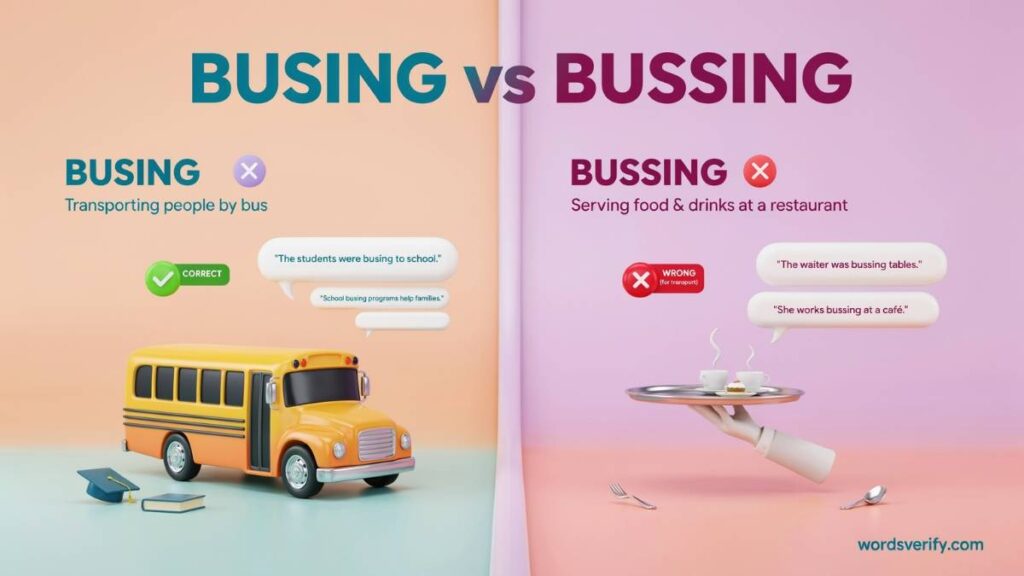
Ever paused mid sentence, wondering whether one little letter could turn your perfectly good writing into a grammar mistake? The busing vs bussing dilemma can leave even confident writers scratching their heads. Fortunately, both spellings are correct, but their meanings and common uses can differ. Busing usually refers to transporting people by bus, while bussing often describes clearing and preparing restaurant tables. Mix them up, and you might leave readers guessing whether you’re arranging school transportation or cleaning up after dinner! Understanding the difference between busing vs bussing will help you avoid common spelling mistakes and write with greater clarity and confidence.
Busing vs Bussing The Quick Answer
Both busing and bussing are recognized English spellings. The best choice depends on the meaning, context, and spelling convention you follow.
- Busing: Commonly refers to transporting people by bus, particularly in American English.
- Bussing: Often refers to clearing used dishes, wiping tables, and preparing restaurant tables for the next customers. It can also refer to transportation by bus.
- Bused and bussed: Both appear as past-tense and past-participle forms, depending on the context and spelling preference.
For example, a school district might be busing students to another campus, while a restaurant employee might be bussing tables after dinner. Both sentences are understandable and grammatically sound.
| Word or phrase | Meaning | Example |
|---|---|---|
| Busing | Transporting people by bus | The district is busing students to the new school. |
| Bussing | Clearing restaurant tables or transporting people by bus | She is bussing tables after lunch. |
| Bused | Transported by bus | The district bused students to the event. |
| Bussed | Transported by bus or cleared tables, depending on context | The staff bussed the tables before closing. |
The simplest approach is to consider what you’re describing. If you’re writing about transportation, busing is a common choice. For restaurant work, bussing is familiar, although busing tables is also correct.
Avoid everyday grammar mistakes with simple tips
Sentence vs Sentance which one is correct?
What Is the Difference Between Busing and Bussing?
The main difference lies in spelling and common usage. Both forms can refer to transportation, but bussing is particularly familiar in restaurant language.
What Does Busing Mean?
Busing generally refers to transporting people by bus. The word comes from the verb bus, which means to carry passengers in a bus.
You’ll often see it in school transportation policies, public transit reports, travel arrangements, and discussions about education.
For example:
- The school district is busing children to a temporary campus.
- The company is busing employees to the conference center.
- The city expanded busing services for residents attending the festival.
- The school board reviewed its student busing program.
In each sentence, busing describes transportation. It doesn’t necessarily involve a school bus. A charter bus or another passenger vehicle can serve the same purpose.
What Does Bussing Mean?
Bussing often refers to clearing and preparing restaurant tables. The work typically involves collecting used plates, glasses, and utensils, wiping down surfaces, and getting tables ready for the next guests.
A person who performs these duties is called a busser. The older term busboy is also used, although busser and busperson are more inclusive job titles.
For example:
- The new employee is bussing tables during the lunch rush.
- He finished bussing the dining area before the restaurant closed.
- Bussing tables helps keep the restaurant clean and ready for incoming guests.
- The manager hired another busser for the weekend shift.
Bussing isn’t limited to restaurant work, however. It can also describe transporting passengers by bus. That’s why context matters more than the spelling alone.
Why Do Busing and Bussing Have Different Spellings?
The difference becomes clearer when you look at the base words.
The verb bus commonly becomes busing when you add the suffix -ing. The verb buss, a less common word meaning to kiss, becomes bussing. Restaurant usage also recognizes bussing as a spelling for clearing tables.
As a result, the double-S spelling has become familiar in hospitality settings, even though busing tables is also accepted.
English spelling rules can explain much of this variation, but they don’t always tell the whole story. Established usage matters, too.
Avoid everyday grammar mistakes with simple tips
Training vs Trainning which one is correct?
When to Use Busing
Busing is a common choice when describing transportation by bus, especially in American English. You’ll find it in school district documents, transportation reports, news articles, and discussions of public policy.
Busing in School Transportation
Schools use busing to transport students between their homes, classrooms, athletic events, and educational activities. A district may operate its own fleet or hire a transportation company.
Consider this example:
The district is busing students to another campus while construction continues at their regular school.
Here, busing describes an ongoing transportation arrangement. It doesn’t tell you how far the students travel or what kind of bus the district uses.
Other examples include:
- The school is busing students to the science museum.
- Parents asked the district to improve busing services.
- The district is busing children from several neighborhoods.
- The team was bused to the championship venue.
The last example uses bused, a common American spelling of the past tense.
Busing in Education and School Desegregation
Busing also has an important place in American history. In education, the term can refer to transporting students to schools outside their immediate neighborhoods as part of efforts to achieve racial integration.
During the mid-20th century, court decisions and legal challenges shaped school desegregation efforts across the United States. In some districts, transportation plans became part of court-ordered measures intended to address segregated school systems.
One important case was Swann v. Charlotte-Mecklenburg Board of Education in 1971. The U.S. Supreme Court upheld the use of busing as one possible tool for implementing school desegregation remedies.
This historical meaning differs from ordinary school transportation. A district that buses students to a field trip uses busing in its general transportation sense. Discussions of school desegregation busing, however, concern transportation as part of a broader legal and educational policy.
The phrase forced busing has also appeared in political debates. Because it carries historical and political associations, writers should explain the specific policy or event rather than use the phrase as a vague label.
Busing in Public and Private Transportation
Busing isn’t limited to schools. Businesses, event organizers, tour companies, and public agencies may arrange bus transportation to move groups of people efficiently.
For example:
- The conference organizers are busing attendees from the hotel to the venue.
- The city arranged busing for residents during the road closure.
- The company provided busing between its parking lot and headquarters.
- The tour operator bused visitors to the national park.
In each case, the word describes a transportation service rather than the vehicle itself.
Avoid everyday grammar mistakes with simple tips
Phenix vs Phoenix Which one Is Correct?
When to Use Bussing
Bussing is a suitable choice when it matches the intended meaning and the spelling convention you’re following. It’s particularly familiar in restaurant settings, although busing is also acceptable when referring to table clearing.
Bussing Tables in Restaurants
In restaurant terminology, bussing means clearing and preparing dining tables. The work may include collecting used plates, removing glasses and utensils, wiping surfaces, and resetting tables for new guests.
A busser often works alongside servers, hosts, bartenders, and kitchen staff. The exact duties depend on the restaurant.
A busser might:
- Remove used plates and silverware after guests finish eating.
- Collect glasses and other dining items.
- Wipe tables and check for crumbs or spills.
- Replace napkins, utensils, or other table settings when needed.
- Help keep the dining area clean and organized during busy periods.
These tasks help restaurants serve customers efficiently. While servers focus on taking orders and assisting diners, bussers help keep tables ready for incoming guests.
For example, consider this sentence:
The restaurant is bussing tables quickly so the next group doesn’t have to wait.
Here, bussing describes clearing tables, not transporting people.
Busing Tables vs. Bussing Tables
Both expressions appear in American English.
- Bussing tables is a familiar spelling in restaurant job descriptions and everyday conversation.
- Busing tables is also used and isn’t inherently incorrect.
The distinction isn’t as strict as some explanations suggest. Someone who writes busing tables hasn’t necessarily made a spelling mistake. Bussing is simply another established choice in this setting.
If you’re preparing a restaurant handbook, job advertisement, or training guide, choose one spelling and use it consistently. When your employer or publication has a style guide, follow its preference.
What Is a Busser?
A busser is a restaurant employee who helps clear and reset tables. Depending on the workplace, the role may also involve refilling water, organizing dining supplies, and assisting servers.
The term busboy has traditionally described someone who performs these duties. However, busser and busperson are often preferred because they don’t assume the employee’s gender.
A busser and a restaurant server have different primary responsibilities.
| Role | Main responsibilities |
|---|---|
| Busser | Clears dishes, wipes tables, and prepares tables for new guests. |
| Restaurant server | Takes orders, serves food and drinks, and assists guests during their meal. |
| Host | Greets guests, manages seating, and helps coordinate table availability. |
These duties sometimes overlap in smaller restaurants. In a busy dining room, however, dedicated bussers help servers focus on customers while keeping tables ready for the next seating.
Avoid everyday grammar mistakes with simple tips
Chef vs Cheff which one is correct?
Busing vs Bussing Grammar Rules
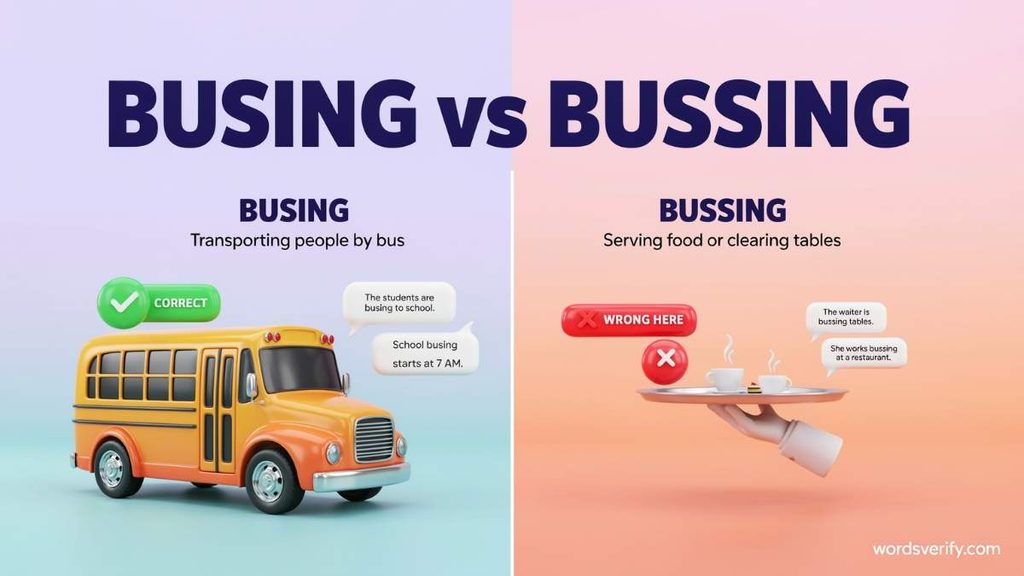
Understanding the base verbs makes it easier to form the correct tense and recognize each word’s role in a sentence.
Busing and Bussing as Present Participles
A present participle is a verb form ending in -ing. It can appear in progressive verb constructions or function as a noun.
For the transportation verb bus, the common form is busing.
- The district is busing students to the new school.
- The company is busing its employees to the airport.
The spelling bussing also appears in established usage, especially in the phrase bussing tables.
- The staff is bussing tables before the dinner rush.
- She is bussing the last table in the dining room.
In these sentences, the -ing form describes an activity that’s happening at the moment.
Busing and Bussing as Gerunds
A gerund is an -ing verb form that functions as a noun. You can often recognize it when it names an activity rather than describing an action in progress.
Examples include:
- Busing students requires careful scheduling.
- The district discussed busing children from rural areas.
- Bussing tables is part of the restaurant’s closing routine.
- The manager assigned bussing duties to the evening team.
In the first sentence, busing names the activity of transporting students. In the third, bussing names the work of clearing tables.
What Is the Past Tense of Bus?
Bused is a common American English past-tense form when the verb means transporting people by bus. Bussed also appears as a variant.
For example:
- The district bused students to the museum.
- The organizers bused visitors between the two locations.
- The company has bused employees to the site for several years.
Bused is a useful default for transportation writing in American English.
What Is the Past Tense of Buss?
The verb buss means to kiss, although it’s less common than kiss in modern everyday English. Its past-tense form is bussed, and its present participle is bussing.
For example:
- In the old story, the prince bussed the princess on the cheek.
- The character was bussing a loved one goodbye.
These examples use the older verb meaning “to kiss.” They shouldn’t be confused with restaurant table clearing or transportation by bus.
Because bussed can also appear as a variant of bus in transportation and restaurant contexts, readers must use the surrounding sentence to identify the intended meaning.
Bus Verb Conjugation A Practical Table
| Verb form | Transportation meaning | Restaurant table-clearing meaning |
|---|---|---|
| Base form | Bus | Bus |
| Third-person singular | Buses | Buses |
| Present participle | Busing | Bussing or busing |
| Past tense | Bused or bussed | Bussed or bused |
| Past participle | Bused or bussed | Bussed or bused |
These forms reflect common usage, not a claim that every spelling is equally preferred in every context. For polished American English, busing and bused are useful defaults for transportation, while bussing and bussed are familiar in restaurant settings.
Avoid everyday grammar mistakes with simple tips
Shakey vs Shaky which one is correct?
Why Are Busing vs Bussing Spelled Differently?
The answer involves English spelling conventions, different base verbs, and established usage.
The Single-S vs. Double-S Rule
English often doubles a final consonant when adding a suffix that begins with a vowel, such as -ing or -ed. This commonly happens with short words that end in a consonant after a single vowel.
For example:
- Run becomes running.
- Stop becomes stopping.
- Plan becomes planned.
However, the rule has conditions and exceptions. You can’t apply it mechanically to every word ending in a consonant.
The verb bus is commonly written busing in American English when it means transporting people. Meanwhile, buss is a separate verb, so its form becomes bussing.
Restaurant usage also recognizes bussing as a spelling for clearing tables. This established convention means that the spelling can’t be explained solely by the most basic consonant-doubling rule.
Why English Spelling Isn’t Always Predictable
English contains spelling variations that reflect word history, pronunciation, regional preferences, and editorial choices.
Consider traveling and travelling. American English generally favors traveling, while British English often uses travelling. Both are recognized spellings, but regional convention influences which one readers expect.
The busing vs bussing pair works somewhat differently because the forms have overlapping modern uses and distinct spelling traditions. Still, the general lesson remains the same: spelling rules help, but established usage matters, too.
A grammar checker may flag one form depending on its dictionary settings. That doesn’t automatically make the word wrong. Check the intended meaning and the reference standard before changing it.
Avoid everyday grammar mistakes with simple tips
Natzi vs Nazi which one is correct?
Busing vs Bussing in American and British English
Regional spelling preferences can affect which form looks most natural. However, neither spelling belongs exclusively to one side of the Atlantic.
in American English
In American English, busing is a common spelling for transporting people by bus. It’s widely used in school transportation, news reporting, and discussions of public transit.
Bussing is also familiar, particularly in restaurant contexts such as bussing tables. Both forms can appear in American writing, so meaning and editorial preference remain important.
For example:
- The district is busing students to three nearby schools.
- The restaurant employee is responsible for bussing tables and maintaining a clean dining area.
These are natural choices, but they don’t establish an absolute division between the two spellings.
in British English
British English has its own spelling conventions, but there isn’t a simple rule that makes bussing exclusively British or busing exclusively American.
British writers may also use different terminology for certain activities. For example, clearing tables is a straightforward description of restaurant work, while busser may be less familiar to some British readers than it is to Americans.
If you’re writing for a British audience, consider the vocabulary your readers are likely to recognize. For an international audience, a phrase such as clearing and resetting tables can make the meaning clear regardless of spelling preferences.
Is There a Universal Spelling Rule?
There isn’t a universal rule that assigns busing exclusively to transportation and bussing exclusively to restaurant work.
A practical approach is to:
- Choose the spelling that matches your intended meaning.
- Check a reputable dictionary if you’re unsure.
- Follow the relevant publication or workplace style guide.
- Keep the spelling consistent throughout your document.
This approach is more reliable than assuming every context requires a different spelling.
Avoid everyday grammar mistakes with simple tips
Enrol vs Enroll which one is correct?
Busing vs Bussing Examples in Sentences
Examples make the distinction easier to remember because they show how the words work in everyday writing.
Busing in a Sentence
Here are several examples of busing in transportation contexts.
- The school district is busing students to the temporary campus.
- The organizers arranged busing between the hotel and the conference center.
- Parents asked the school board to review its busing policy.
- The city considered busing residents during the planned road closure.
- School desegregation busing became a major issue in American education history.
- The company provides busing for employees who work late shifts.
- The district has been busing children from rural areas for years.
In these examples, busing refers to transporting people by bus. The word can describe a routine service, a temporary arrangement, or a public policy.
Bussing in a Sentence
The following examples show bussing in restaurant settings.
- The restaurant hired another employee for bussing tables.
- She spent the afternoon bussing tables in the busy dining room.
- Bussing tables helps the restaurant prepare for the next group of guests.
- The supervisor assigned bussing duties to the closing team.
- He finished bussing the last table before clocking out.
- The restaurant’s job advertisement listed bussing tables among the employee’s duties.
In each sentence, bussing describes clearing or preparing dining tables.
Side-by-Side Comparison
| Sentence | Intended meaning | Explanation |
|---|---|---|
| The district is busing students. | Transportation | Busing is a common spelling for transporting students by bus. |
| The employee is bussing tables. | Restaurant work | Bussing is a familiar spelling for clearing tables. |
| The district is bussing students. | Transportation | This spelling also appears in transportation usage. |
| The employee is busing tables. | Restaurant work | This spelling also occurs in restaurant contexts. |
| The district bused the students. | Past transportation | Bused is a common American spelling. |
| The employee bussed the tables. | Past restaurant work | Bussed is a familiar past-tense form for clearing tables. |
These examples show why a strict rule separating transportation from restaurant work would be misleading. Common preferences are useful, but they aren’t absolute.
Avoid everyday grammar mistakes with simple tips
Suing vs Sueing which one is correct?
Common Mistakes With Busing and Bussing
Most mistakes come from treating a spelling preference as a strict grammar rule.
Assuming Bussing Is Always Wrong
Bussing is a recognized spelling. It’s common in restaurant language and can also appear in transportation contexts.
Changing every instance of bussing to busing without checking the sentence may replace a spelling that fits the writer’s intended convention.
Assuming Busing Only Refers to Schools
Although busing often appears in discussions of school transportation, it can describe transporting employees, tourists, event attendees, and other groups.
For example, “The hotel is busing guests to the airport” is a perfectly understandable sentence.
Treating Bussing as a Restaurant-Only Word
The restaurant meaning is common, but it isn’t the only possible meaning. Writers also use bussing as a spelling variant of the transportation verb bus.
Context resolves most potential confusion. If a sentence mentions students, a school district, or a transportation service, readers will usually understand the intended meaning.
Mixing Spellings Without a Reason
Switching between busing vs bussing in the same document can distract readers, especially when both instances describe the same activity.
Imagine a school report that uses busing policy in one paragraph and bussing policy in the next without explaining the change. Even if both forms are acceptable, the inconsistency can look like an editing mistake.
A simple proofreading tip can help: search your document for bus, bused, bussed, busing, and bussing. Review each instance in context rather than relying entirely on a grammar checker.
Confusing Bussing With Bussin’
The slang term bussin’ has a different meaning from the standard forms busing vs bussing. Using the wrong form can make a sentence sound as though it belongs to a completely different conversation.
Avoid everyday grammar mistakes with simple tips
Whiny vs Whiney difference and correct usage
Bussin’ vs Bussing What Does the Slang Mean?
In informal American English, bussin’ is slang used to describe something exceptionally good, especially food. Someone might call a meal bussin’ to express enthusiasm about its taste.
For example:
- “These tacos are bussin’!”
- “That homemade mac and cheese is bussin’.”
The expression is informal and appears frequently in social media conversations and internet culture. It’s particularly associated with enthusiastic praise for food, although people sometimes use it more broadly.
The distinction is straightforward:
| Term | Meaning | Example |
|---|---|---|
| Busing | Transporting people by bus | The district is busing students to school. |
| Bussing | Clearing tables or, in some contexts, transporting people | The employee is bussing tables. |
| Bussin’ | Informal slang meaning exceptionally good | This pizza is bussin’! |
The apostrophe in bussin’ represents the omitted final g in an informal spelling. However, the slang expression has developed its own meaning.
Don’t substitute bussin’ for bussing in a restaurant job description. “Responsible for bussin’ tables” might work in a deliberately casual social media post, but it isn’t the best choice for a professional document.
Avoid everyday grammar mistakes with simple tips
Pricy vs Pricey which one is correct?
Pronunciation Guide
When busing vs bussing refer to the same verb, they’re generally pronounced alike in American English. The spelling difference doesn’t normally create a different pronunciation.
Both forms have two syllables, with the first syllable receiving the main stress.
The slang word bussin’ is also generally pronounced similarly to bussing in casual speech. Its spelling signals informal usage rather than a completely different sound.
One important distinction remains: buss can mean “kiss,” but many speakers use kiss instead in everyday conversation. The intended meaning should be clear from context, not inferred from pronunciation alone.
Word Origin and History
The history of these spellings helps explain why English recognizes forms that look so similar.
Where Does the Word Bus Come From?
The word bus developed as a shortened form of omnibus, a term used for a vehicle that carried passengers. The Latin word omnibus means “for all.”
Public omnibus services became prominent in 19th-century Europe, and the shortened word bus eventually became standard English vocabulary for a passenger vehicle.
From this noun, English developed the verb to bus, meaning to carry people by bus. Its related forms include buses, bused, and busing.
How Did Bussing Develop?
The verb buss, meaning to kiss, has a separate history. It’s an older English word, and its forms include bussed and bussing.
The restaurant use of bussing is also established in modern English. Although the exact historical development of restaurant-specific spelling preferences shouldn’t be reduced to a single rule, the form is now familiar in hospitality language.
The important point is that similar-looking words can have different origins and overlapping modern uses. Word history helps explain the variation, while contemporary dictionaries and established usage help writers decide which forms suit their sentences.
Avoid everyday grammar mistakes with simple tips
Journeys vs Journies Which one Is Correct?
practics session Busing vs Bussing
Complete these sentences by choosing the correct word or spelling for each blank. The answers are provided in a separate section below, so you can review your practice without taking a quiz.
1. The school district is ______ students to a nearby campus.
2. The restaurant staff is ______ tables after the lunch rush.
3. The school ______ students to the science museum yesterday.
4. A restaurant employee who clears and resets tables is called a ______.
5. The manager assigned ______ duties to the evening staff.
6. The company arranged ______ to transport employees to the conference.
7. The restaurant hired another ______ to help during busy hours.
8. Both ______ and bussing are recognized spellings in English.
9. The students were ______ to the sports event by bus.
10. The employee finished ______ the tables before closing time.
11. The school board reviewed its student ______ policy.
12. In restaurant terminology, ______ means clearing and preparing tables.
13. The organizers provided ______ between the hotel and the event venue.
14. The older verb “buss” means to ______.
15. The slang expression “bussin’” often describes food that tastes ______.
16. The restaurant employee collected the plates while ______ tables.
17. The school district ______ children to the new campus last week.
18. A ______ usually takes orders and serves food to restaurant guests.
19. A ______ primarily clears dishes and prepares tables for new customers.
20. The manager asked the staff to keep the spelling ______ throughout the handbook.
21. The word “omnibus,” from which “bus” developed, comes from Latin and means “______.”
22. The transportation company is ______ passengers to the airport.
23. The restaurant employee ______ the tables after the guests left. (bussed / bussin’)
24. The term ______ is often preferred over “busboy” because it is gender-neutral.
25. When choosing between busing vs bussing, the writer should consider the ______ and the preferred spelling convention.
Answers
- Busing
- Bussing
- Bused
- Busser
- Bussing
- Busing
- Busser
- Busing
- Bused
- Bussing
- Busing
- Bussing
- Busing
- Kiss
- Exceptionally good
- Bussing
- Bused
- Server
- Busser
- Consistent
- For all
- Busing
- Bussed
- Busser
- Context
Here’s a trusted source for clear word meanings:
FAQs
What is the difference between busing, bussing, and bussin’?
Busing commonly refers to transporting people by bus, while bussing often describes clearing and preparing restaurant tables. Bussin’ is informal slang used to describe something exceptionally good, especially food. Although these terms look similar, they have different meanings and uses.
Is it bused or bussed?
Both spellings are correct in established usage. Bused is common in American English when referring to transportation by bus, while bussed frequently appears in restaurant contexts. The appropriate spelling depends on the meaning and the style guide you follow.
What does a busser do in a restaurant?
A busser clears used plates, collects glasses and utensils, wipes tables, and prepares dining areas for incoming guests. Depending on the restaurant, the job may also involve refilling water, restocking supplies, and helping servers maintain an organized dining room.
Why is the job called bussing tables?
The expression comes from the restaurant use of the verb bus, which means clearing and resetting tables. Bussing tables involves removing used dishes, cleaning surfaces, and preparing the dining area for the next guests.
Is a busser the same as a server?
No. A server takes orders, delivers food and drinks, and assists guests throughout their meals. A busser primarily clears dishes and prepares tables for new customers. Although their duties may overlap in some restaurants, they generally have different responsibilities.
What is the modern term for a busboy?
Busser is a widely used, gender-neutral alternative to busboy. Other options include busperson and dining room attendant. These terms describe employees who help clear tables, maintain cleanliness, and prepare the dining area for service.
Can women work as bussers?
Absolutely. Bussing is not a gender-specific job. People of any gender can work as bussers, and the term busser is suitable for everyone. It is often preferred over busboy because it describes the role without referring to the employee’s gender.
Do bussers receive tips?
Some restaurants include bussers in tip-sharing or tip-out arrangements, allowing them to receive a portion of the tips collected by servers. Policies vary by workplace, and local employment laws may affect how tips are distributed.
What is a more professional title for a busser?
Dining room attendant, busperson, and restaurant support staff are possible alternatives. Dining room attendant may suit a formal job description, while busser remains a familiar and straightforward title in American restaurants.
Is being a busser considered blue-collar work?
Bussing is generally classified as restaurant or service-sector work rather than traditional blue-collar employment associated with industrial or skilled trades. However, it is physically demanding and involves hands-on tasks, including carrying dishes, standing for long periods, and keeping dining areas clean.
What do British people call a bus?
British English uses the word bus, just as American English does. Both varieties use it for a road vehicle that carries passengers. Some transportation terms differ between the countries, but bus is standard in both.
Does bussing ever mean kissing?
Yes. The older English verb buss means to kiss. Its forms include bussed and bussing. However, the word is less common in everyday conversation than kiss, and its meaning depends on context. In a restaurant, bussing usually refers to clearing tables.
What does “bassboy” mean?
Bassboy has no single, widely established meaning in standard English. It may be a nickname, username, personal name, or misspelling of another word. The context in which it appears usually provides the best clue to its intended meaning.
What does “bush boy” mean?
Bush boy can describe a boy who lives in or spends time in a bush or wilderness area. The expression may also have regional or cultural meanings, so its precise interpretation depends on the surrounding context.
What does “bass” mean in slang?
Bass can refer to low-pitched sounds, deep musical tones, or a type of fish. In music-related conversations, it often describes the low-frequency sounds heard in a song. It is not a standard substitute for busing, bussing, or bussin’.
Is bussing always related to restaurant work?
No. Bussing is especially familiar in restaurant settings, where it means clearing and preparing tables. However, it can also appear as a spelling variant of busing, which means transporting people by bus. The context helps readers identify the intended meaning.
How can I remember when to use busing or bussing?
Start by identifying what you’re describing. Busing is a common American English choice for transporting people by bus, while bussing is familiar in restaurant settings. Because the spellings can overlap, check your preferred dictionary or style guide and use your chosen form consistently.
Conclusion
So, should you write busing vs bussing? Fortunately, both spellings are correct, so there’s no need to let one extra S turn a simple sentence into a grammar mystery! Busing commonly refers to transporting people by bus, while bussing often describes clearing and preparing restaurant tables. However, the meanings can overlap, making context your best guide. Don’t confuse either spelling with bussin’, an informal slang term used to describe something exceptionally good. When in doubt, check the intended meaning, follow your preferred style guide, and stay consistent. After all, good grammar is about making your message clear, not giving every letter a starring role!

Lisa AJS is an experienced blogger and language enthusiast at Words Verify, dedicated to making grammar simple, practical, and enjoyable. She writes engaging content on commonly confused words, grammar mistakes, word meanings, and everyday language challenges.