Have you ever confused a business suit with a hotel suite? Unless you plan to wear a jacket to bed, you might want to double check your spelling! The difference between suit vs suite often trips up English learners because these words look nearly identical and can sound the same. However, their meanings couldn’t be more different. One helps you dress to impress, while the other gives you space to unwind. Understanding when to use each word doesn’t have to be complicated. With simple explanations, practical examples, and easy grammar tips, you’ll learn to avoid common spelling mistakes and use both words with confidence.
Suit vs Suite What’s the Difference?
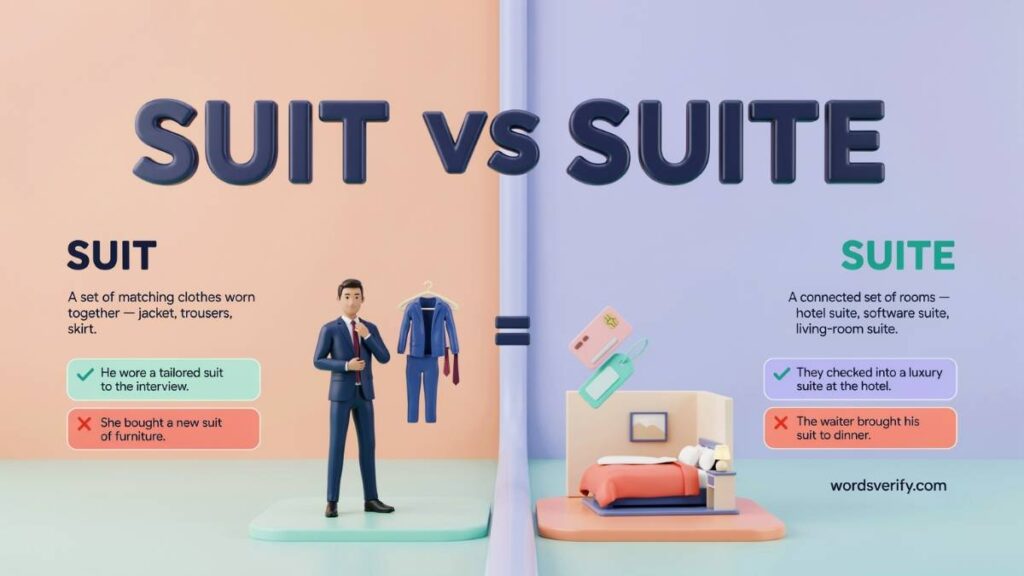
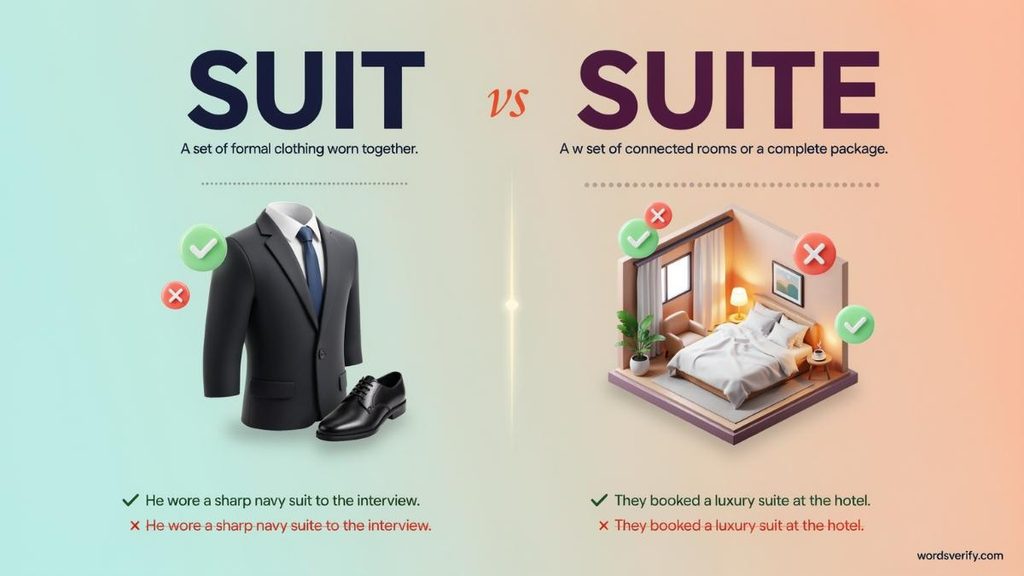
The main difference between suit and suite lies in their meanings and grammatical uses. Although both words can describe groups or arrangements in certain contexts, they aren’t interchangeable.
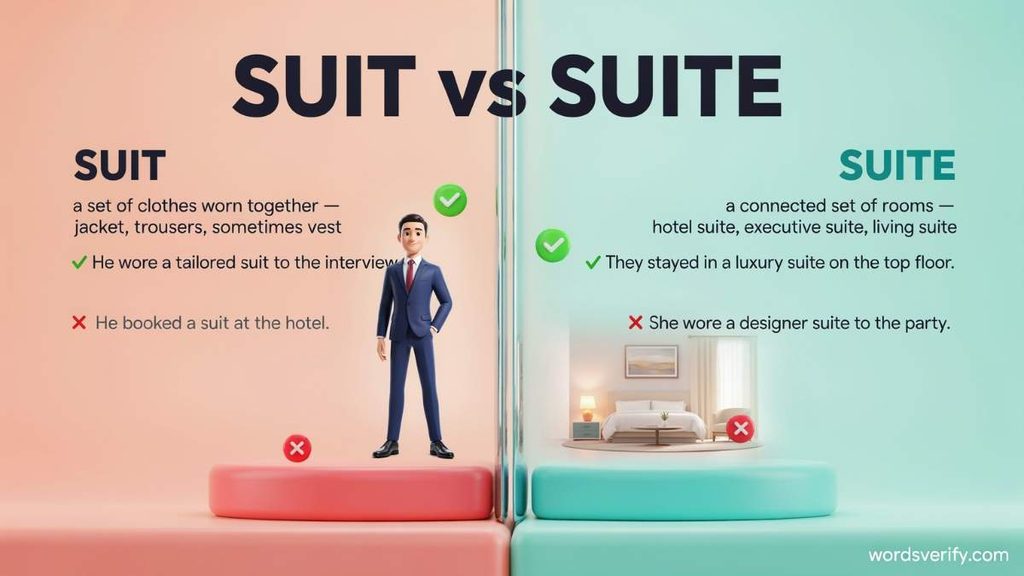
Suit is a noun and a verb. As a noun, it can refer to a set of matching clothes, a legal proceeding, or one of the four categories of playing cards. As a verb, it means to be appropriate, convenient, or well matched to someone or something.
Suite is a noun that usually refers to a group of connected rooms or a collection of related things. Common examples include hotel suites, office suites, software suites, and musical suites.
Consider these examples:
- He wore a navy suit to the job interview.
- This schedule suits my needs.
- We booked a hotel suite overlooking the ocean.
- The business uses a suite of productivity applications.
The first two sentences use suit to describe clothing and suitability. The other two use suite to describe accommodation and a collection of related programs.
Quick Comparison
| Feature | Suit | Suite |
|---|---|---|
| Part of speech | Noun and verb | Noun |
| Main meaning | Clothing, legal action, card category, or suitability | Connected rooms or a collection of related items |
| Clothing | A matching set of garments | Not the standard term for clothing |
| Hotels | Not the usual term for accommodation | A group of rooms or a larger accommodation unit |
| Business | Business suit; suit your needs | Office suite; software suite |
| Law | A legal suit or lawsuit | Not the standard term for a lawsuit |
| Playing cards | One of the four card categories | Not used for a card category |
| Plural | Suits | Suites |
| Example | That jacket suits you. | Their hotel suite has two bedrooms. |
Neither word is a more formal version of the other. The correct choice depends on what you want to say, not how professional you want to sound.
Avoid everyday grammar mistakes with simple tips
Busing vs Bussing Which one Is Correct?
What Does Suit Mean?
The word suit has several meanings in English. It can refer to formal clothing, a legal case, a category of playing cards, or something that fits a person’s needs. It can also work as a verb when you want to explain that something is appropriate or convenient.
The easiest way to understand its meaning is to look at the surrounding words. A sentence about a jacket will probably use suit to mean clothing, while a sentence about a meeting time will use it to describe suitability.
Suit as a Noun
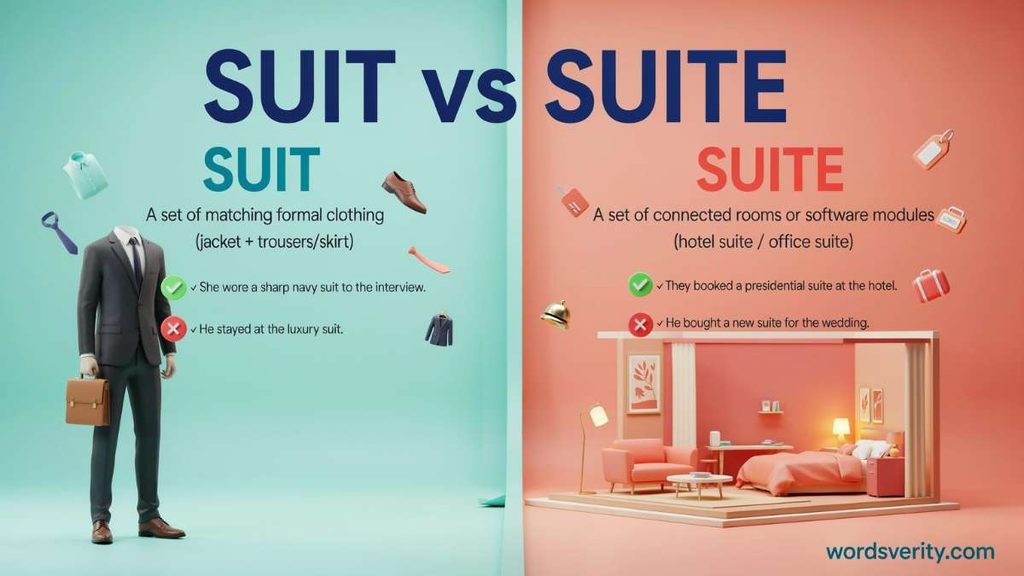
As a noun, suit commonly refers to a matching set of clothes. A traditional suit usually consists of a jacket and matching trousers, although a women’s suit may include a skirt instead. People often wear suits to business meetings, job interviews, weddings, and other formal occasions.
The word also appears in the names of specialized clothing, including swimsuits, spacesuits, diving suits, and protective suits.
Here are a few examples:
- He bought a tailored suit for his first job interview.
- She wore a black formal suit to the wedding.
- The workers put on protective suits before entering the facility.
- His new men’s suit included a matching jacket and trousers.
- She chose a women’s suit with a fitted jacket and skirt.
However, clothing isn’t the only meaning of suit. In law, a suit refers to a legal proceeding brought before a court. Someone might file a civil suit to seek compensation for a contract dispute or another legal matter.
In card games, a suit is one of the four categories in a standard deck: hearts, diamonds, clubs, and spades. Each suit contains 13 cards in a traditional 52-card deck.
For example:
- The company filed a suit against its former business partner.
- The lawyer prepared documents for the civil suit.
- Hearts is my favorite suit in a deck of cards.
- She played a card from the spade suit.
The context makes each meaning clear. When the conversation involves clothing, suit refers to garments. When it turns to a courtroom, it may refer to legal action. In a card game, it identifies a particular category of cards.
Suit as a Verb
The word suit also works as a verb. It means to be appropriate, convenient, pleasing, or well matched to a person, purpose, or situation.
When you say, “This schedule suits my needs,” you’re explaining that the schedule works well for you. You’re not talking about clothing or a legal case.
Here are some common examples:
- The new position suits her personality.
- This laptop suits your needs for everyday office work.
- Would Friday morning suit you?
- The lightweight material suits outdoor activities.
- A quiet restaurant would suit his preferences.
The phrase “That suits me” is especially common in everyday conversation. You might use it when agreeing to a suggested time, location, or arrangement.
For example:
“Can we meet at 10 a.m.?”
“That suits me perfectly.”
Notice the spelling. You write suits, not suites, when using the verb. The extra letter changes the word into a noun with a different meaning.
Common Expressions With Suit
Several familiar expressions use suit in ways that go beyond clothing.
| Expression | Meaning | Example |
|---|---|---|
| Suit yourself | Do what you prefer | If you don’t want to join us, suit yourself. |
| Follow suit | Do what someone else has done | Other departments followed suit after the manager changed the policy. |
| Suit someone down to the ground | Suit someone extremely well, especially in British English | The new role suits her down to the ground. |
| In a suit and tie | Wearing formal business clothing | He arrived at the interview in a suit and tie. |
| Suit your needs | Meet your requirements | Choose a plan that suits your needs. |
Learning these expressions in context can help you understand the word more naturally than memorizing a single dictionary definition.
Avoid everyday grammar mistakes with simple tips
Sentence vs Sentance which one is correct?
What Does Suite Mean?
The word suite refers to a group of connected rooms or a collection of related items. The items may work together, belong together, or form parts of a larger whole.
Its precise meaning depends on the context. In a hotel, a suite is a type of accommodation and In technology, it is a collection of related applications. In music, it refers to a group of pieces or movements arranged as a larger work.
Despite these different uses, the central idea remains the same: several connected or related parts form a larger unit.
Suite in Hotels and Buildings
A hotel suite usually offers more space or a different layout than a standard hotel room. It may contain a bedroom and a separate living area. Some suites include multiple bedrooms, dining spaces, or additional bathrooms.
However, not every suite has the same layout. Hotels offer different room categories, and the word suite alone doesn’t guarantee a particular size, view, or set of amenities.
Common examples include:
- Hotel suite: An accommodation unit that may include separate living and sleeping areas.
- Luxury suite: A higher-end accommodation category with amenities that vary by property.
- Honeymoon suite: A room or suite marketed toward couples celebrating a honeymoon.
- Executive suite: A premium hotel accommodation or a designated group of executive offices, depending on context.
- Office suite: A group of offices or a designated office space within a building.
Consider these sentences:
- We booked a hotel suite overlooking the ocean.
- The honeymoon suite included a spacious bedroom and sitting area.
- The accountant works in Suite 305.
- The company’s executive suite occupies the top floor.
In building addresses, suite often identifies a particular office or commercial space. If a business operates in Suite 305, the number helps visitors find the correct location within the building.
That’s why hotel suite and office suite are standard expressions. Writing hotel suit or office suit would usually be a spelling mistake when referring to accommodation or office space.
Suite in Furniture and Interior Design
In furniture terminology, a bedroom suite is a coordinated collection of bedroom furniture. Depending on the set, it may include a bed frame, dresser, nightstands, wardrobe, or other matching pieces.
A suite of furniture can also describe a coordinated collection designed for a particular room or purpose. The pieces don’t have to be identical, but they’re generally intended to work together.
Examples include:
- They purchased a bedroom suite with a matching dresser and nightstands.
- The showroom displayed a modern furniture suite for the living room.
- The bathroom suite included a sink, toilet, and bathtub.
Terminology can vary by region, especially when describing furniture and bathroom fixtures. However, bedroom suite is a standard expression in American English.
The distinction is straightforward: a suit generally refers to clothing, while a suite describes a collection of related items.
Suite in Software and Technology
A software suite is a collection of related computer programs or applications. These applications may share a common interface, exchange information, or help users complete connected tasks.
For instance, an office productivity suite might contain programs for writing documents, creating spreadsheets, preparing presentations, and managing email.
Microsoft Office is a familiar example of an office software suite. Its applications have traditionally included Word, Excel, and PowerPoint, although available products and subscription packages can change over time.
Software suites serve many purposes:
- Office productivity: Programs for documents, spreadsheets, and presentations.
- Graphic design: Tools for image editing, illustration, and page layout.
- Security: Programs that help protect devices and networks.
- Business management: Applications for accounting, customer management, and reporting.
For example, a company might use a suite of productivity applications to prepare reports, organize documents, and manage its accounts.
Here, suite describes the collection as a whole. Each application performs a particular task, but the related programs provide a broader set of tools.
That’s why software suite is correct rather than software suit. In this expression, suite refers to a collection of related applications.
Suite in Music
In music, a musical suite is a collection of related movements or pieces arranged as a larger work. Classical suites often contain contrasting movements, sometimes based on dance forms, although their structure varies according to the composer and period.
A suite may feature an orchestra, a smaller ensemble, or another musical arrangement. Composers have also created suites from music written for ballets, plays, and films.
For example:
- The orchestra performed a suite of instrumental pieces.
- The composer arranged several movements into a musical suite.
- The concert featured a suite drawn from the film’s score.
A suite of music isn’t simply any random playlist. In the traditional classical sense, the pieces form a deliberate musical collection. Modern usage can be broader, but the idea of related pieces remains central.
Suite in a Sentence with More Examples
These sentences show how suite works in different settings.
- The hotel suite had a bedroom, a living room, and two bathrooms.
- The company moved its offices to Suite 420.
- Our team uses a software suite to organize projects.
- The orchestra performed a suite from the ballet.
- They bought a bedroom suite for their new home.
- The luxury suite offered a view of the city skyline.
- The designer used a suite of tools to edit the images.
- The executive suite contains several private offices.
- The bathroom suite included a sink and a bathtub.
- The composer wrote a suite of musical pieces for the production.
The surrounding words help reveal the meaning. Hotel and bedroom point toward accommodation or furniture. Software and tools suggest applications. Orchestra and composer indicate music.
Avoid everyday grammar mistakes with simple tips
Training vs Trainning which one is correct?
Suit vs Suite Pronunciation
The pronunciation of suit vs suite can be confusing because the words may sound alike, depending on the speaker’s accent.
In American English, suit is generally pronounced /suːt/, rhyming with boot. Suite is commonly pronounced /swiːt/, rhyming with sweet. However, some speakers pronounce suite as /suːt/, making it sound exactly like suit.
| Word | Common American pronunciation | Rhymes with |
|---|---|---|
| Suit | /suːt/ | Boot, fruit |
| Suite | /swiːt/ | Sweet, meet |
both Are Homophones?
The term homophones describes words that sound alike but have different meanings, such as right and write.
For speakers who pronounce both suit and suite as /suːt/, the words are homophones. For speakers who pronounce suite as /swiːt/, the words sound different.
This variation explains why pronunciation alone isn’t always enough to identify the correct spelling. Context often provides a more reliable guide.
Why Is Suite Pronounced Like Sweet?
The spelling of suite can mislead English learners because the letters don’t produce the sound they might expect. In the common American pronunciation /swiːt/, the opening sound includes /sw/, while the ending rhymes with sweet.
English pronunciation doesn’t always follow predictable spelling patterns. Some words retain unusual sound patterns because of their history, and suite is one example.
How to Practice Suit and Suite Pronunciation
Try reading these sentences aloud:
- He bought a new suit.
- They booked a hotel suite.
- This time will suit us.
- The company purchased a software suite.
If you pronounce suite differently from suit, the first two sentences may sound distinct. If you pronounce them alike, the surrounding words still make the meaning clear.
Avoid everyday grammar mistakes with simple tips
Phenix vs Phoenix Which one Is Correct?
Suit vs Suite Side-by-Side Examples
Comparing similar phrases is one of the easiest ways to understand the difference between these words.
| Phrase | Correct word | Why |
|---|---|---|
| Business suit | Suit | Refers to formal clothing |
| Hotel suite | Suite | Refers to an accommodation unit |
| Suit your needs | Suit | Uses suit as a verb meaning to be appropriate |
| Suite of rooms | Suite | Refers to a group of connected rooms |
| Legal suit | Suit | Refers to a legal proceeding |
| Suit of cards | Suit | Refers to a card category |
| Software suite | Suite | Refers to a collection of applications |
| Bedroom suite | Suite | Refers to coordinated bedroom furniture |
| Musical suite | Suite | Refers to a collection of musical pieces |
| Office suite | Suite | Refers to office space or a collection of office applications |
in a Sentence
Consider these contrasting examples.
Correct: This jacket suits you.
Incorrect: This jacket suites you.
The first sentence uses suits as a verb. It means the jacket looks good on you or matches your appearance.
Correct: We reserved a hotel suite.
Incorrect: We reserved a hotel suit.
The correct word is suite because the sentence refers to accommodation.
Now compare two phrases used in business settings:
- He wore a business suit to meet the client.
- The company rented an office suite downtown.
Both phrases are correct. The first refers to clothing, while the second describes office space.
The difference isn’t a matter of style. Each word has its own meaning and grammatical role.
Avoid everyday grammar mistakes with simple tips
Chef vs Cheff which one is correct?
Common Mistakes When Using Suit vs Suite
Even experienced writers sometimes mix up these words, especially when typing quickly. Fortunately, most errors become easy to spot once you recognize the context.
Using Suit Instead of Suite
Writers sometimes omit the extra e when referring to hotel accommodation, office space, or software.
Incorrect: We booked a luxury suit for our vacation.
Correct: We booked a luxury suite for our vacation.
Incorrect: The company moved into a new office suit.
Correct: The company moved into a new office suite.
Incorrect: The team installed a new productivity suit.
Correct: The team installed a new productivity suite.
In each corrected sentence, suite refers to a collection or designated space rather than clothing or suitability.
Using Suite Instead of Suit
The opposite mistake happens when writers add an unnecessary e.
Incorrect: He wore a gray suite to the interview.
Correct: He wore a gray suit to the interview.
Incorrect: This color suites you.
Correct: This color suits you.
Incorrect: The company filed a suite against its former partner.
Correct: The company filed a suit against its former partner.
In legal writing, lawsuit is also a common and clear alternative.
Confusing Software and Clothing Contexts
Business language can make the distinction tricky because both words appear in professional settings.
A business suit is formal clothing. A business software suite is a group of applications used for work. An office suite may refer to a physical group of offices or, in another context, a collection of office applications.
The surrounding words determine the intended meaning.
Assuming Both Words Are Interchangeable
Although suit vs suite look similar, they aren’t alternative spellings of the same word. Replacing one with the other can change the meaning or make a sentence incorrect.
For example, “This arrangement suits us” means the arrangement works well for us. “This arrangement suites us” isn’t standard English.
The same rule applies to hotel suite, bedroom suite, and software suite. These established expressions use suite.
Avoid everyday grammar mistakes with simple tips
Shakey vs Shaky which one is correct?
Suit vs Suite Grammar Rules to Remember
Understanding the grammar of suit and suite helps you avoid mistakes even when the meaning isn’t immediately obvious.
Suit as a Noun and Verb
As a noun, suit can be singular or plural.
- Singular: He bought a suit.
- Plural: They bought two suits.
As a verb, it changes according to the subject and tense.
- Present: This option suits me.
- Present with a plural subject: These options suit me.
- Past: The earlier time suited everyone.
- Future: The new schedule will suit our team.
The verb suit doesn’t become suite in any of these forms.
Suite as a Noun
Suite is ordinarily a noun in standard English. Its plural form is suites.
- Singular: We booked a suite.
- Plural: We booked three suites.
You can also use suite as part of a compound noun, including hotel suite, office suite, and software suite.
both in Plural Forms
| Singular | Plural | Example |
|---|---|---|
| Suit | Suits | The store sells formal suits. |
| Suite | Suites | The hotel has 12 luxury suites. |
Both words form their plurals by adding s. The difference lies in the spelling of the singular form, which remains important when writing.
Avoid everyday grammar mistakes with simple tips
Enrol vs Enroll which one is correct?
Easy Ways to Remember Suit vs Suite
If you regularly confuse these words, a simple memory trick can save you time.
Connect Suit With Clothing and Suitability
Think of a suit hanging in a closet. You can also remember the verb through the phrase “That suits me.”
Examples:
- He bought a new suit.
- The plan suits our budget.
- The meeting time suits everyone.
All three sentences use suit correctly.
Connect Suite With Sets and Spaces
Think of a suite as a set of connected rooms or related items. A hotel suite contains accommodation space, while a software suite contains related programs.
Examples:
- A hotel suite may contain separate living and sleeping areas.
- A bedroom suite contains coordinated furniture.
- A software suite contains related applications.
Use the Sentence Test
When you’re unsure whether to use suit or suite, ask yourself what the word describes.
- Does it refer to clothing, legal action, a card category, or something appropriate? Use suit.
- Does it refer to connected rooms or a collection of related items? Use suite.
- Does it function as a verb meaning “to be appropriate”? Use suit.
A useful reminder is: Wear a suit to your hotel suite. This short sentence uses both words correctly and gives you an easy way to remember the difference.
Avoid everyday grammar mistakes with simple tips
Suing vs Sueing which one is correct?
practice session Suit vs Suite
Complete these sentences by choosing the correct word: suit vs suite. The practice includes clothing, hotels, grammar, common expressions, business, and everyday English.
- He bought a navy blue ______ for his job interview.
- We booked a luxury hotel ______ for our anniversary.
- This meeting time doesn’t ______ my schedule.
- The company moved its office to ______ 305.
- You should wear a formal ______ to the wedding.
- This software ______ includes tools for documents and spreadsheets.
- If you don’t want to join us, ______ yourself.
- The lawyer filed a legal ______ against the company.
- That color really ______ you.
- The orchestra performed a musical ______.
- She purchased a bedroom ______ with a matching dresser.
- Friday afternoon would ______ me better.
- Hearts is my favorite card ______.
- The business uses a ______ of productivity applications.
- The new position ______ his skills and experience.
- Several competitors decided to follow ______ after the company lowered its prices.
- The hotel ______ has a separate living room.
- Public speaking is her strong ______.
- Does this arrangement ______ your needs?
- The executive ______ occupies the top floor of the building.
- He wore his best ______ to the business meeting.
- The bathroom ______ includes a sink, bathtub, and toilet.
- The manager’s proposal didn’t ______ everyone.
- The company purchased a new office software ______.
- The defendant faced a civil ______ in court.
Answers
- suit
- suite
- suit
- Suite
- suit
- suite
- suit
- suit
- suits
- suite
- suite
- suit
- suit
- suite
- suits
- suit
- suite
- suit
- suit
- suite
- suit
- suite
- suit
- suite
- suit
Here’s a trusted source for clear word meanings:
FAQs
Is it “suit you” or “suite you”?
“Suit you” is correct. It means something is appropriate for you, matches your preferences, or complements your appearance.
Example: This color suits you perfectly.
Is it “suit yourself” or “suite yourself”?
“Suit yourself” is the correct expression. It means you can do whatever you prefer, often when someone disagrees with a suggestion or chooses not to participate.
Example: If you don’t want to come with us, suit yourself!
Is it “suit” vs “suite” in an address?
Use “suite” when referring to a designated office or business space within a building. For example, “Suite 204” identifies a particular space. For residential addresses, use “apartment,” “apt.,” or “unit,” depending on the property’s official address.
Is it “suit your needs” or “suite your needs”?
“Suit your needs” is correct. Here, “suit” is a verb meaning to meet your requirements or preferences.
Example: Choose a computer that suits your needs and budget.
Should I say “suit me” or “suite me”?
“Suit me” is correct. It means something is convenient, appropriate, or acceptable to you.
Example: Meeting after lunch would suit me better.
What does “I suit you” mean?
“I suit you” means the speaker may be a good match for you or fit your preferences. Depending on the context, it can refer to compatibility, appearance, or a relationship. In everyday conversation, “I think we’re a good match” often sounds more natural when discussing a relationship.
Is it “my strong suit” or “my strong suite”?
“My strong suit” is correct. It refers to your strongest skill, quality, or area of expertise.
Example: Explaining complicated ideas clearly is my strong suit.
The expression comes from card games, where a suit is one of the four categories of cards.
When should you say “suit yourself”?
Use “suit yourself” when telling someone to make their own choice or do what they prefer. Depending on your tone, it can sound friendly, playful, indifferent, or slightly annoyed.
Example: You’d rather stay home? Suit yourself!
When should you use suit and suite?
Use “suit” for clothing, legal proceedings, card categories, or something appropriate. Use “suite” for connected rooms or collections of related items.
Examples:
- He wore a business suit to the interview.
- We booked a hotel suite for our vacation.
- The new schedule suits everyone.
- The company purchased a software suite.
Is it pronounced “suite” vs “suit”?
Both pronunciations occur. In American English, “suit” generally rhymes with “boot,” while “suite” commonly rhymes with “sweet.” Some speakers pronounce both words alike, so context can help you identify the correct spelling.
Should I use “unit” or “apt.” in an address?
Use “apt.” as an abbreviation for “apartment” when the address refers to an apartment within a building. Use “unit” when that is the property’s designated term and Use “suite” for an office or other space identified by a suite number. When in doubt, follow the address format provided by the property or recipient.
What is an example of a suite?
A hotel suite with a separate bedroom and living room is a common example. Other examples include an office suite, a software suite, a bedroom furniture suite, and a musical suite.
In each case, “suite” describes connected rooms or a collection of related items.
Is it “best suit” or “best suite”?
Both phrases are correct, but they have different meanings.
- “Best suit” can refer to the most suitable outfit or the best suit for a particular occasion.
- “Best suite” can refer to the most desirable hotel accommodation, office space, or collection of related items.
Example: Choose the suit that fits you best, or book the best suite your budget allows.
Does “suit” have two meanings?
“Suit” has more than two meanings. As a noun, it can refer to matching clothes, a legal proceeding, or a category of playing cards. As a verb, it means to be appropriate, convenient, or pleasing.
Examples: He wore a suit to work. The meeting time suits everyone.
Is it “legal suite” or “legal suit”?
“Legal suit” is correct when referring to a legal proceeding. You can also use “lawsuit,” a common term for a legal action brought before a court.
Example: The company filed a legal suit over the disputed contract.
Do you “follow suit” or “follow suite”?
“Follow suit” is the correct expression. It means to copy someone else’s action or do the same thing another person has done.
Example: One store lowered its prices, and several competitors followed suit.
What are the two meanings of “suit”?
Two common meanings of “suit” are a set of matching clothes and something that is appropriate or convenient. However, the word also refers to legal proceedings and categories of playing cards.
Examples: He wore a suit to work. The meeting time suits everyone.
Is it “does it suit me” or “does it suits me”?
“Does it suit me?” is correct. When you use “does,” the main verb stays in its base form, so you write “suit,” not “suits.”
Compare these examples:
- Does this jacket suit me?
- This jacket suits me.
Both sentences are correct because their grammatical structures differ.
What does “suit” mean in slang?
In informal conversation, “suit” can refer to a businessperson, executive, or authority figure, particularly someone associated with corporate culture. The term can sound dismissive or critical, depending on the context.
Example: The creative team had to convince the suits to approve the project.
Here, “the suits” refers to the people in charge, not a row of jackets hanging in a closet.
Avoid everyday grammar mistakes with simple tips
Whiny vs Whiney difference and correct usage
Conclusion
The difference between suit vs suite may come down to one extra letter, but using the wrong word can leave your readers scratching their heads! A suit helps you dress to impress, while a suite gives you room to relax. You can wear a business suit, book a hotel suite, or choose an option that suits your needs. Once you understand their meanings and uses, avoiding this common English mistake becomes much easier. Remember, context is your best guide when two words look alike or sound the same. Master this simple distinction, and your writing will stay sharp, clear, and professional. After all, your grammar deserves a perfect fit!

Lisa AJS is an experienced blogger and language enthusiast at Words Verify, dedicated to making grammar simple, practical, and enjoyable. She writes engaging content on commonly confused words, grammar mistakes, word meanings, and everyday language challenges.