
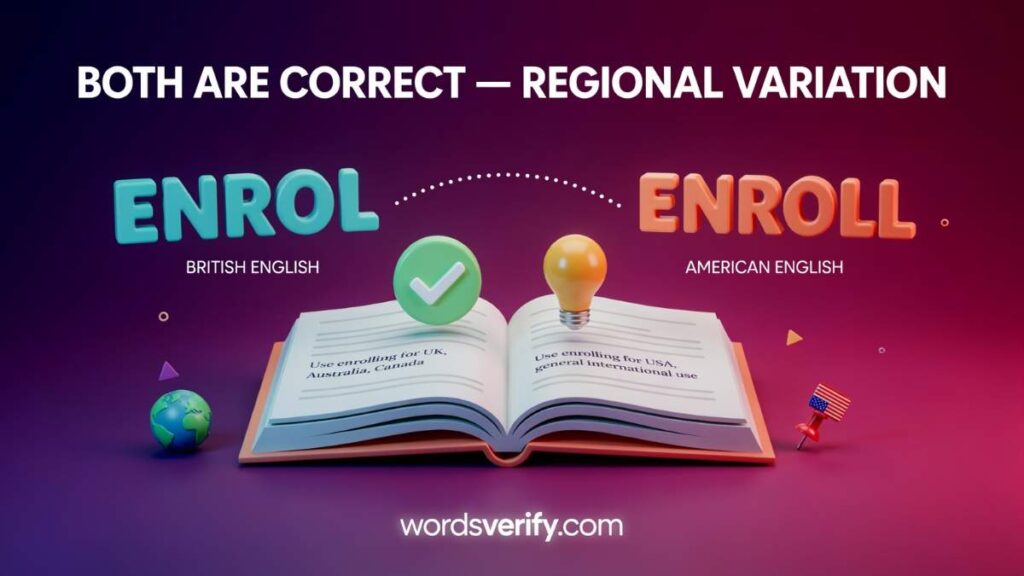
Have you ever paused mid-sentence, wondering whether a word needs one “l” or two? The difference between enrol vs enroll can leave even confident writers scratching their heads. Here’s the twist: both spellings are correct! The choice simply depends on which version of English you’re using. British English favors enrol, while American English prefers enroll. Although one extra letter may seem like a tiny detail, using the wrong form for your audience can make your writing look inconsistent. Let’s clear up the confusion, explore the spelling rules, and discover when to use each form with confidence.
Enrol vs Enroll The Quick Answer
Both enrol vs enroll are correct spellings of the same verb. The difference comes down to regional spelling conventions.
- Enrol: The preferred spelling in British English, Australian English, and New Zealand English.
- Enroll: The standard spelling in American English.
For example:
- British English: She plans to enrol in a university course.
- American English: She plans to enroll in a university course.
Both sentences are grammatically correct. They communicate exactly the same idea.
The same regional difference appears in the related noun forms: British English generally uses enrolment, while American English uses enrollment.
| Word | British English | American English |
|---|---|---|
| Base verb | Enrol | Enroll |
| Present participle | Enrolling | Enrolling |
| Past tense | Enrolled | Enrolled |
| Noun | Enrolment | Enrollment |
| Third-person singular | Enrols | Enrolls |
One important detail: both varieties use enrolled and enrolling. The spelling difference disappears in these forms because both versions double the final “l” before adding the suffix.
Learn the difference between tricky more English words
Suing vs Sueing which one is correct?
What Does Enrol Mean?

Enrol is a verb that means to officially register or become a member of a school, course, program, organization, or activity.
When you enrol somewhere, you complete the necessary steps to join it. These steps might include filling out an application, providing personal information, submitting documents, or paying a registration fee.
The word commonly appears in education, training, professional development, and membership settings.
For example:
- She decided to enrol in a nursing program after finishing high school.
- Parents must enrol their children before the new school year begins.
- I want to enrol in an online writing course.
- He plans to enrol at a university in London.
- You can enrol in the workshop through the college office.
In each sentence, enrol describes the process of officially joining something.
Enrol in Education
Education is one of the most common contexts in which you’ll see this spelling. Students enrol in schools, colleges, universities, and training programs.
For example:
- My younger brother will enrol in college next September.
- The school allows parents to enrol their children online.
- Several students want to enrol in the advanced mathematics course.
- She enrolled in a language class to improve her English.
Although enrol is the British spelling, you may also see it in Australian and New Zealand educational documents.
Enrol in Courses and Training Programs
You can also use enrol when joining a short course, professional workshop, or online training program.
For example:
- I plan to enrol in a digital marketing course this summer.
- Employees can enrol in the company’s leadership training program.
- He enrolled in a first-aid course before starting his new job.
- You must enrol before the registration deadline.
The word doesn’t apply only to formal education. Any organized program with an official registration process can involve enrolment.
Enrol in Memberships and Activities
The verb also works when someone joins an organization, club, or organized activity.
For example:
- She decided to enrol in a local fitness program.
- New members can enrol through the club’s website.
- He enrolled in a community volunteer program.
- The organization allows people to enrol throughout the year.
In all these examples, enrol suggests a formal step toward becoming part of something.
Learn the difference between tricky more English words
Whiny vs Whiney difference and correct usage
What Does Enroll Mean?

Enroll has exactly the same meaning as enrol. It means to register officially or become a member of a school, course, program, organization, or activity.
The only difference is the spelling. American English uses the double “l” in the base form.
For example:
- She wants to enroll in a business administration program.
- Parents can enroll their children before the school year starts.
- I decided to enroll in an online photography course.
- He plans to enroll at a university in California.
- Students must enroll before attending the training sessions.
These sentences follow standard American spelling conventions.
Enroll in Schools and Universities
In the United States, enroll is the usual spelling in school applications, university documents, and educational announcements.
For example:
- My daughter will enroll in kindergarten next year.
- The university encourages international students to enroll early.
- He enrolled in a computer science degree program.
- Students can enroll in classes through the college portal.
You’ll also find this spelling in American school district websites, admission forms, and academic records.
Enroll in Online Courses
Online learning platforms often use enroll when describing the process of joining a course. The word is particularly common in American educational and training materials.
For example:
- You can enroll in the course with a few simple steps.
- She enrolled in an online English class last month.
- The platform allows users to enroll in free courses.
- Employees must enroll in the training program before the deadline.
Here, enroll describes the act of registering, not simply browsing or viewing a course.
Enroll in Programs and Organizations
American English also uses enroll for memberships, activities, and organized programs.
For example:
- He decided to enroll in a community fitness program.
- New members can enroll through the organization’s website.
- The company allows employees to enroll in its health benefits program.
- She enrolled in a volunteer program during the summer.
Whether you’re joining a university or signing up for a professional program, enroll is the standard American form.
Learn the difference between tricky more English words
Pricy vs Pricey which one is correct?
What Is the Difference Between Enrol vs Enroll?
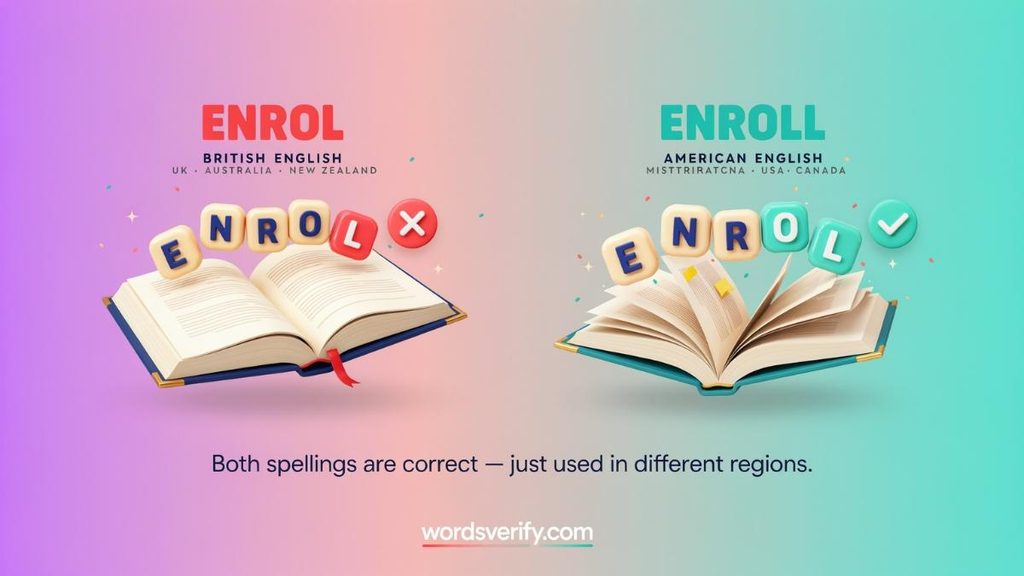
The difference between enrol vs enroll is regional spelling, not meaning or grammar.
British English generally uses enrol, while American English uses enroll. Both words describe the same action: officially registering or joining something.
Consider these examples:
- British English: I will enrol in the course tomorrow.
- American English: I will enroll in the course tomorrow.
Neither sentence is incorrect. Each follows the spelling convention of its variety of English.
Here are the main differences:
| Feature | Enrol | Enroll |
|---|---|---|
| Main use | British English | American English |
| Meaning | Officially register or join | Officially register or join |
| Base form | Enrol | Enroll |
| Past tense | Enrolled | Enrolled |
| Present participle | Enrolling | Enrolling |
| Related noun | Enrolment | Enrollment |
| Common regions | UK, Australia, New Zealand | United States |
The extra “l” doesn’t change pronunciation or meaning in any significant way. The choice simply depends on the spelling system you’re following.
Learn the difference between tricky more English words
Fliers vs Flyers which one is correct?
Enrol vs Enroll Which Spelling Should You Use?
The best spelling depends on your audience and the type of English you use.
If you’re writing for a British, Australian, or New Zealand audience, choose enrol. If your readers are primarily American, use enroll.
Here’s a simple guide:
| Writing context | Preferred spelling |
|---|---|
| British school application | Enrol |
| American university application | Enroll |
| Australian training program | Enrol |
| New Zealand education website | Enrol |
| American online course | Enroll |
| British membership form | Enrol |
| US company benefits document | Enroll |
Consistency matters more than choosing one version for every situation. If you’re preparing a document for an American organization, use American spelling throughout. For a British institution, follow British conventions.
You should also pay attention to the spelling used by the organization you’re writing to. Universities, employers, and government departments often follow their own official style guides.
Is both Correct in British English?
Enrol is the standard British English spelling.
You’ll commonly find it in British school documents, university admission information, course descriptions, and official registration forms.
For example:
- Students can enrol in the program online.
- You must enrol before the beginning of the academic year.
- She enrolled at a university in Manchester.
The related noun is enrolment. For example, a British university might publish an enrolment guide for new students.
Is both Correct in American English?
Enroll is the standard American English spelling.
American schools, colleges, universities, and businesses generally use this form in their official documents.
For example:
- Students can enroll in classes through the online portal.
- Parents must enroll their children before August.
- She enrolled in a graduate program last year.
The related noun is enrollment. You’ll see it in expressions such as student enrollment, enrollment period, and enrollment form.
What About Canadian English?
Canadian English can use both forms, depending on the publication, institution, or style guide.
Some Canadian organizations follow British-style spelling and use enrol and enrolment. Others use enroll and enrollment.
If you’re writing for a Canadian school, company, or government organization, check its preferred spelling rather than assuming one form is universal.
Learn the difference between tricky more English words
Mentioned vs Mentionned Which one Is Correct?
Enrolled vs Enrolling Understanding the Word Forms
Although the base forms differ, both British and American English follow the same spelling pattern when forming the past tense and present participle.
This is where many writers get confused. They may assume that British English keeps one “l” in every form. However, that’s not how the word works.
Both varieties use:
- Enrolled — past tense and past participle.
- Enrolling — present participle and gerund.
- Enrols or enrolls — third-person singular present tense, depending on the regional base spelling.
Enrolled
Enrolled is the past tense and past participle of both enrol vs enroll.
For example:
- She enrolled in a university course last year.
- He has enrolled in three online classes.
- More than 200 students enrolled in the program.
- I enrolled at the college after completing high school.
Notice that enrolled has two “l” letters in both British and American English.
Enrolling
Enrolling is the present participle of both forms. It can describe an action happening now or work as part of a longer verb phrase.
For example:
- She is enrolling in a new course this week.
- The school is enrolling students for the next academic year.
- We are enrolling new members throughout the summer.
- He is enrolling in a professional training program.
Again, both varieties use the double “l.”
Enrolment vs Enrollment
The related noun follows the same regional spelling distinction as the base verb.
- Enrolment: British English, Australian English, and New Zealand English.
- Enrollment: American English.
Both nouns refer to the process of registering or the number of people who have registered.
For example:
- British English: Student enrolment increased this year.
- American English: Student enrollment increased this year.
You may also see the words in phrases such as:
- School enrolment or school enrollment.
- University enrolment or university enrollment.
- Online enrolment or online enrollment.
- Enrolment form or enrollment form.
- Enrolment period or enrollment period.
The spelling changes, but the meaning stays the same.
Learn the difference between tricky more English words
Journeys vs Journies Which one Is Correct?
Common Mistakes When Using Enrol vs Enroll
The difference between these words is straightforward, but a few spelling and grammar mistakes can cause confusion.
Here are some common problems to watch for.
Mixing British and American Spellings
One frequent mistake is using enrol in one part of a document and enrollment in another without a reason.
For example:
Incorrectly inconsistent: Students can enrol online during the enrollment period.
More consistent British English: Students can enrol online during the enrolment period.
More consistent American English: Students can enroll online during the enrollment period.
Both corrected versions work. The important thing is to follow one spelling convention throughout the document.
Writing Enroled Instead of Enrolled
Another common mistake is writing enroled with one “l” in the past tense.
The correct spelling is enrolled in both British and American English.
For example:
- Incorrect: She enroled in the course last week.
- Correct: She enrolled in the course last week.
Even though British English uses enrol in its base form, the past tense still doubles the final “l.”
Writing Enroling Instead of Enrolling
The same rule applies to the present participle.
The correct form is enrolling, with two “l” letters.
For example:
- Incorrect: He is enroling in a training program.
- Correct: He is enrolling in a training program.
Remember that both regional varieties use enrolling.
Using the Wrong Noun Form
Writers sometimes use enrolment in American English or enrollment in British English without checking the intended style.
These forms aren’t inherently wrong, but they may look inconsistent in a document written for a particular audience.
Use enrolment for standard British spelling and enrollment for standard American spelling.
How to Remember the Difference
A simple way to remember the distinction is to connect each spelling with its regional variety.
- Enrol: Think of British English. It uses one “l” in the base form.
- Enroll: Think of American English. It uses two “l” letters in the base form.
You can also remember the related nouns:
- British English: enrol and enrolment.
- American English: enroll and enrollment.
Don’t let the past tense confuse you. Both varieties use enrolled and enrolling.
If you’re unsure which form to choose, think about your readers first. Their preferred spelling convention will usually give you the answer.
Learn the difference between tricky more English words
Developed vs Developped which one is correct?
Pronunciation of Enrol and Enroll
Enrol and enroll have the same basic pronunciation, although the vowel sound can vary slightly between regional accents.
In American English, the word is commonly pronounced:
– Enroll: /ɪnˈroʊl/
In British English, the pronunciation is commonly represented as:
– Enrol: /ɪnˈrəʊl/
The main difference comes from the way American and British speakers pronounce the vowel in the second syllable.
Both words have two syllables, with the stress falling on the second syllable:
en-ROLL
The spelling difference doesn’t create a meaningful difference in how the words are used or understood.
History and Origin of Enrol and Enroll
The words enrol and enroll share the same historical origin. Both developed from older forms connected with the idea of recording someone’s name on a written list or official record.
The word is related to the Old French rolle, meaning a roll or written list. Over time, the verb came to describe the act of entering someone’s name into an official record.
That original idea still appears in the modern meaning. When you enrol or enroll in a course, your name is added to the institution’s list of registered participants.
The spelling difference developed through regional English conventions. American English generally adopted the double “l” in the base form, while British English retained the single “l.”
Today, both spellings remain correct in their respective varieties.
Learn the difference between tricky more English words
Realist vs Realest which one is correct?
Enrol vs Enroll in Everyday Situations
The words appear in several areas of everyday life. Understanding these contexts makes it easier to use them naturally.
Schools and Universities
Schools and universities use these words when students register for classes or academic programs.
British English:
- New students must enrol before the academic year begins.
- The university has opened enrolment for postgraduate courses.
American English:
- New students must enroll before the academic year begins.
- The university has opened enrollment for postgraduate courses.
Online Learning
Online education platforms use the verb when someone officially joins a course.
British English:
– You can enrol in the course through the learning platform.
American English:
– You can enroll in the course through the learning platform.
Workplace Training
Companies may ask employees to enrol or enroll in professional development programs.
British English:
– Employees can enrol in the leadership workshop.
American English:
– Employees can enroll in the leadership workshop.
Health and Employee Benefits
In the United States, enroll is also common in documents about employee benefits and health insurance plans.
For example:
– Employees can enroll in the company’s health insurance plan during the annual enrollment period.
A British organization may use different terminology or follow its own spelling conventions.
Clubs and Memberships
You can also use the word when someone joins an organized club or membership program.
British English:
– She decided to enrol in a local sports club.
American English:
– She decided to enroll in a local sports club.
The spelling changes according to the audience, but the meaning remains identical.
A Practical Example
Imagine a university that offers an online business course to students in several countries.
Its British website uses the following sentence:
“Students can enrol in the course before the September deadline.”
However, the American version of the website uses:
“Students can enroll in the course before the September deadline.”
Both versions provide the same information. Neither changes the registration process, course requirements, or meaning of the sentence.
The university simply adjusts the spelling to suit its readers.
This is a useful example of why regional spelling matters. A small difference can make writing feel more familiar and natural to a particular audience.
Learn the difference between tricky more English words
Unphased vs Unfazed which one is correct?
Related Words Register, Sign Up and Enroll
Although enrol vs enroll have clear meanings, you may come across other words that describe similar actions.
They aren’t always interchangeable, so it’s helpful to understand the differences.
Register
Register means to record someone’s name or details officially. It can describe joining a course, event, organization, or service.
For example:
- You must register for the workshop before Friday.
- She registered for the university entrance examination.
Register has a broader meaning than enroll. You can register for a one-time event, while enroll often suggests joining a course, program, or institution.
Sign Up
Sign up is a more conversational expression. It means to agree to join something or provide your details to participate.
For example:
- I want to sign up for an online writing class.
- She signed up for the weekend workshop.
In everyday conversation, people often use sign up instead of enroll. However, formal documents may prefer enroll or register.
Admit
Admit means to allow someone to enter a school, university, organization, or place.
For example:
– The university admitted 500 new students this year.
Being admitted and enrolling aren’t exactly the same. A university may accept your application first, but you still need to complete the enrollment process before officially joining.
Learn the difference between tricky more English words
Signer vs Signor which one is correct?
Practice Session Enrol vs Enroll
Complete the following sentences by filling in each blank with the correct word or form. Pay attention to British and American spelling, verb forms, and related words.
Fill in the Blanks
1. Students in the UK can ______ in a university course before the academic year begins.
2. American students must ______ in their classes before the registration deadline.
3. She ______ in an online English course last month.
4. The school is currently ______ new students for the next academic year.
5. The British spelling of the noun is ______.
6. The American spelling of the noun is ______.
7. My brother plans to ______ in a computer science program at a US university.
8. Parents must ______ their children before the school year starts. (British English)
9. He is ______ in a professional training course this week.
10. More than 300 students ______ in the college’s summer program last year.
11. The university has opened its ______ period for new students. (American English)
12. Australian schools generally use the spelling ______.
13. The correct past tense of enroll is ______.
14. She decided to ______ in a local fitness program. (American English)
15. The company allows employees to ______ in its leadership training program. (British English)
16. Students can ______ for the workshop through the college website. (American English)
17. The university admitted several students, but they still need to complete their ______.
18. He wants to ______ in a language course before moving abroad. (British English)
19. The correct present participle of enrol is ______.
20. The school recorded an increase in student ______ this year. (British English)
21. New members can ______ in the community program throughout the summer. (American English)
22. She has already ______ in three online courses.
23. The university’s ______ figures increased compared with last year. (American English)
24. If a student decides to leave a course, they may ______ from it.
25. Both British and American English use the spelling ______ for the past tense of enrol or enroll.
Answers
- enrol
- enroll
- enrolled
- enrolling
- enrolment
- enrollment
- enroll
- enrol
- enrolling
- enrolled
- enrollment
- enrol
- enrolled
- enroll
- enrol
- enroll
- enrollment
- enrol
- enrolling
- enrolment
- enroll
- enrolled
- enrollment
- withdraw
- enrolled
Here’s a trusted source for clear word meanings:
FAQs
Are Enrol vs Enroll the Same Word?
Yes. Enrol vs enroll have the same meaning: to officially register or join a school, course, program, or organization. The difference is purely regional. British English uses enrol, while American English prefers enroll.
Is It “Enrol Now” or “Enroll Now”?
Both phrases are correct. Use “Enrol Now” when writing for a British, Australian, or New Zealand audience. Choose “Enroll Now” for American readers. Both encourage people to register for a course, program, or activity.
What Does “Enrol Now” Mean?
“Enrol now” means to register or sign up for something without delay. You’ll often see this phrase on university websites, online learning platforms, training advertisements, and application pages.
Is Enrol Spelled With One L or Two?
The spelling depends on the variety of English. British English uses enrol with one “l,” while American English uses enroll with two. However, both varieties spell the past tense and present participle as enrolled and enrolling.
How Do Americans Spell Enrol?
Americans spell the word enroll, with two “l” letters. This is the standard spelling in the United States. Its related noun is enrollment, rather than the British spelling enrolment.
What Is Another Word for Enroll?
Depending on the situation, you can use register, sign up, join, or subscribe. For example, you might register for a workshop, sign up for a class, or join a membership program. The best alternative depends on what you’re joining.
Should You Say “Enroll In” or “Enroll On” a Course?
“Enroll in a course” is the most widely used expression, particularly in American English. British English also commonly uses “enrol on a course.” Both are understood, but the preferred preposition varies by regional usage.
How Do You Use Enroll in a Sentence?
Use enroll when someone officially registers for a school, course, program, or organization.
For example: “She plans to enroll in a business course next semester.”
In British English, the same sentence would use enrol instead of enroll.
What Is the Opposite of Enrol?
There isn’t one exact opposite in every situation. However, words such as withdraw, leave, cancel, and unenroll can express the opposite action. For example, a student who withdraws from a course chooses to stop participating.
Is It “Enrol In” or “Enrol To”?
“Enrol in” is generally used when referring to joining a course, program, or activity. For example: “He decided to enrol in a language course.” You can use “enrol at” when referring to an institution, as in “She enrolled at the university.”
What Spelling Do Australians Use: Enrol or Enroll?
Australian English generally uses enrol, with one “l.” The related noun is enrolment. These spellings follow the British English convention.
Is Enrol a Verb or a Noun?
Enrol is a verb. It describes the action of officially registering or joining something. Its related noun is enrolment, which refers to the registration process or the number of people registered.
Can You Enroll Someone Else in a Course?
Yes. You can use enroll when registering another person for a course, school, or program. For example: “The parents enrolled their daughter in a local school.” The same usage applies to the British spelling, enrol.
What Is the Difference Between Enrolling and Registering?
Both words describe the process of signing up, but they aren’t always interchangeable. Enrolling usually refers to officially joining a course, school, program, or organization. Registering has a broader meaning and can also refer to signing up for an event, appointment, or service.
Is Unenroll a Correct Word?
Yes. Unenroll is an accepted American English spelling that means to remove someone from a course, program, or registration. British English commonly uses unenrol. Both forms describe the process of ending an enrollment.
conclusion
So, is it enrol vs enroll? The answer is simpler than it looks. Both spellings are correct, and neither one needs a grammar rescue! British, Australian, and New Zealand English generally favor enrol, while American English prefers enroll. The only difference is regional spelling, not meaning. Remember to choose the form that suits your audience and use it consistently throughout your writing. Once you understand this simple rule, there’s no reason to let one extra “l” cause another spelling dilemma. Whether you enrol or enroll, you’re saying the same thing: officially joining a course, school, or program.

Lisa AJS is an experienced blogger and language enthusiast at Words Verify, dedicated to making grammar simple, practical, and enjoyable. She writes engaging content on commonly confused words, grammar mistakes, word meanings, and everyday language challenges.