
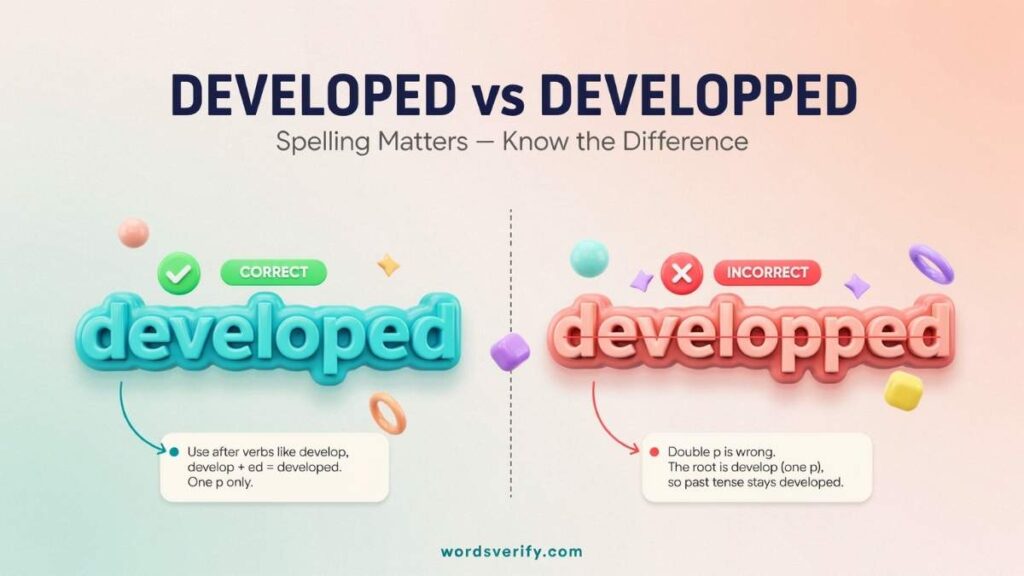
Have you ever written “developped” and wondered whether you got the spelling right? You’re not alone! The confusion between developed vs developped catches many writers off guard. After all, English words like “stopped” and “planned” double their final consonants before adding “-ed,” making an extra “p” seem perfectly reasonable. But English spelling has a few surprises up its sleeve! The correct spelling is “developed,” with just one “p.” So, how can you remember the difference without second-guessing yourself every time? Let’s explore the spelling rule, clear up common mistakes, and look at practical examples that make the answer easy to remember.
Developed vs Developped The Quick Answer
Developed is correct. Developped is incorrect in standard English. Both the past tense and past participle of “develop” use the spelling “developed.”
| Spelling | Correct? | Explanation |
|---|---|---|
| Developed | Yes | The past tense and past participle of “develop”; it can also describe something that has grown or improved. |
| Developped | No | An incorrect spelling caused by doubling the final “p.” |
Consider these examples:
- Correct: The company developed a new product.
- Incorrect: The company developped a new product.
- Correct: She has developed excellent communication skills.
- Incorrect: She has developped excellent communication skills.
The difference isn’t about meaning, pronunciation, or regional preference. It comes down to spelling.
Learn the difference between tricky more English words
Realist vs Realest which one is correct?
What Does Developed Mean?
The word “developed” has several meanings, depending on how you use it. It can describe something that grew over time, an idea that someone created, a skill that improved, or a system that reached an advanced stage.
Developed Means Grown or Improved
People often use “developed” to describe changes in skills, habits, relationships, and abilities.
For example:
- She developed an interest in photography during college.
- The children developed stronger reading skills throughout the school year.
- He developed a habit of exercising every morning.
- Their friendship developed gradually over several years.
In each sentence, something changed or grew. The word describes a process that took place in the past.
Developed Means Created or Designed
Businesses, researchers, engineers, and creative professionals use “developed” when they create something or turn an idea into a more complete form.
Examples include:
- The engineers developed a more efficient engine.
- The research team developed a new testing method.
- The company developed an application for managing customer orders.
- The author developed a believable main character.
Here, “developed” emphasizes the work involved in bringing something into existence or making it more complete.
Developed Means Advanced or Well Established
As an adjective, “developed” can describe something that has reached a particular level of growth, sophistication, or advancement.
For instance:
- The city has a well-developed public transportation network.
- She has highly developed problem-solving skills.
- The organization uses a developed system for tracking expenses.
The phrase “developed country” is another familiar example. It generally describes a country with a relatively advanced economy and infrastructure. However, the exact classification depends on the organization and the criteria it uses.
Keep in mind that developed doesn’t mean perfect. A developed system, skill, or economy can still have weaknesses and room for improvement.
Developed in Photography and Technical Fields
The word also appears in specialized settings.
In traditional photography, a photographer develops film through a chemical process that reveals the captured images. In science and technology, teams develop procedures, models, testing methods, and new materials.
Examples include:
- The photographer developed the film in a darkroom.
- Scientists developed a model to study climate patterns.
- The laboratory developed a reliable testing procedure.
Across these contexts, the central idea remains similar: something takes shape, becomes visible, or reaches a more complete state.
Learn the difference between tricky more English words
Unphased vs Unfazed which one is correct?
Why Is Developed Correct and Developped Incorrect?
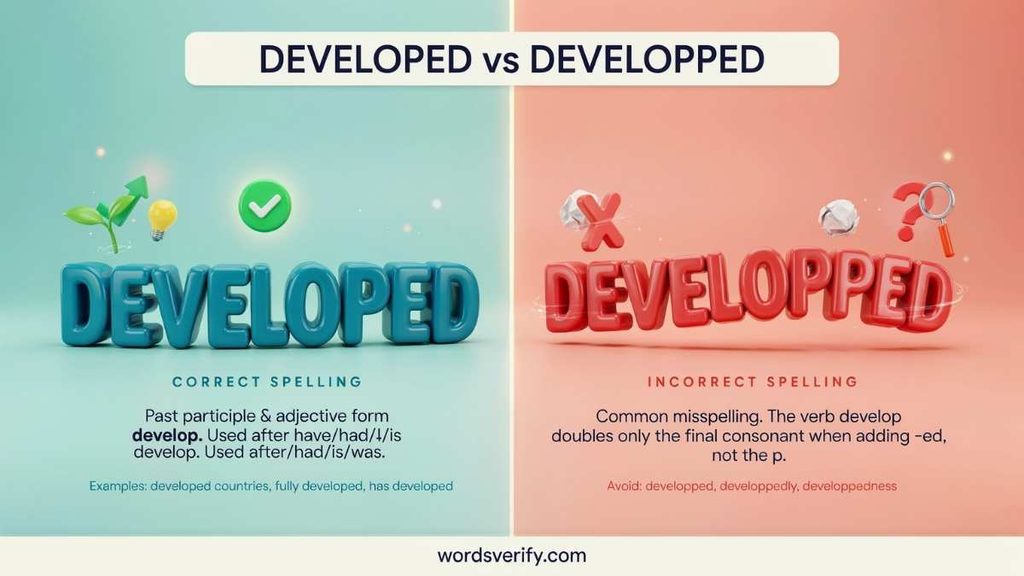
The answer comes down to English spelling rules. The verb “develop” forms its past tense by adding “-ed” directly to the base word. You don’t need to remove a letter, double a consonant, or change a vowel.
The word formation is simple:
Develop + ed = Developed
The final “p” stays where it is. Adding another “p” produces “developped,” which isn’t the standard spelling of this verb.
The Rule for Adding -Ed to Develop
Regular English verbs generally form their simple past tense and past participle by adding “-ed” or, in some cases, just “-d.” The exact spelling depends on how the verb ends.
Compare these examples:
| Base verb | Past tense | Spelling pattern |
|---|---|---|
| Help | Helped | Add “-ed” |
| Jump | Jumped | Add “-ed” |
| Clean | Cleaned | Add “-ed” |
| Develop | Developed | Add “-ed” |
| Stop | Stopped | Double the final consonant |
| Plan | Planned | Double the final consonant |
Why do “stopped” and “planned” double their final consonants while “developed” doesn’t? This is a common question when comparing developed vs developped.
English often doubles the final consonant of a one-syllable verb when the word ends in a single consonant preceded by a single short vowel. That’s why “stop” becomes “stopped” and “plan” becomes “planned.”
For longer verbs, stress and word structure also matter. A final consonant often doubles when the final syllable carries the main stress and follows a short vowel, as in “prefer” becoming “preferred.” There are exceptions, so no single rule explains every English verb.
The important point in the developed vs developped spelling difference is that “develop” doesn’t double its final “p.” Its standard past-tense form is “developed,” while “developped” is incorrect in standard English.
Why Doesn’t Developed Have a Double P?
The word “develop” has three syllables, and the main stress falls on the second syllable. Its final syllable is unstressed, so the usual consonant-doubling pattern doesn’t apply.
Compare these examples:
- Develop → developed
- Occur → occurred
- Prefer → preferred
In “occur” and “prefer,” the final syllable carries the main stress, so the final consonant doubles before “-ed.” In “develop,” the stress falls earlier in the word, and the spelling stays the same.
Stress is useful when learning English spelling, but it isn’t the only factor. Established spelling conventions also matter, which is why checking a dictionary can help when you’re unsure.
Why Do People Spell Developed With Two P’s?
The misspelling “developped” often occurs because writers apply a familiar rule to the wrong word.
Someone who knows that “stop” becomes “stopped” might assume that “develop” should become “developped.” Both verbs end in “p,” but their spelling patterns differ.
Other reasons include:
- Visual confusion: Writers remember doubled consonants in words ending in “-ed” and repeat the pattern.
- Typing errors: An extra letter can slip in when someone types quickly.
- Repeated exposure: Seeing an incorrect spelling online can make it look familiar.
- Uncertainty about spelling rules: English has several consonant-doubling patterns, which can be confusing.
None of these reasons makes “developped” correct. A spelling can look familiar without being accurate.
Learn the difference between tricky more English words
Signer vs Signor which one is correct?
Developed vs Developped Key Differences
The difference in between Developed vs Developped is straightforward once you know what to look for. “Developed” belongs in standard written English, while “developped” doesn’t.
| Feature | Developed | Developped |
|---|---|---|
| Standard English spelling | Correct | Incorrect |
| Base word | Develop | Intended to be develop |
| Past tense | Yes | No |
| Past participle | Yes | No |
| Can function as an adjective | Yes | Not as a standard spelling |
| American English | Correct | Incorrect |
| British English | Correct | Incorrect |
| Australian English | Correct | Incorrect |
| Canadian English | Correct | Incorrect |
| Suitable for formal writing | Yes | No, unless reproducing an exact name or quotation |
Is Developped Ever Correct?
In ordinary English writing, “developped” isn’t the accepted spelling of the verb “develop.”
You might encounter the same letter sequence in a username, brand name, fictional term, or quotation that preserves an original spelling error. Such special cases don’t make it a standard English verb form.
For school assignments, business reports, résumés, and professional emails, use “developed.” If you’re reproducing a name or quoting a source exactly, preserve the original wording when necessary.
Learn the difference between tricky more English words
Macaroon vs Macaron which one is correct?
Developed in American, British, Australian and Canadian English
English has several regional spelling conventions. American English generally uses “color,” for example, while British English usually uses “colour.” Australian and Canadian English also follow their own spelling preferences in certain cases.
However, “developed” is the standard spelling in all four varieties.
American English
American English uses “developed” for both the simple past tense and the past participle.
Examples:
- The school developed a new reading program.
- The company has developed a useful software tool.
- She developed a strong interest in biology.
“Developped” isn’t the standard American spelling.
British English
British English follows the same spelling convention.
Examples:
- The council developed a plan to improve public transport.
- The researcher developed a new approach to the problem.
- The business has developed a strong reputation.
The spelling doesn’t change to “developped” just because a writer uses British English.
Australian English
Australian English also uses “developed.”
Examples:
- The organization developed a new training course.
- The students developed their research skills.
- The community has developed a stronger local network.
If you’re writing for an Australian audience, use “developed” in schoolwork, professional communication, and published material.
Canadian English
Canadian English uses “developed” as well.
Examples:
- The team developed a new approach.
- The university developed a research partnership.
- The company has developed a more efficient process.
Canadian spelling sometimes combines British and American conventions, but the spelling of this word remains the same.
Learn the difference between tricky more English words
Withdraw vs Withdrawal which one is correct?
Developed vs Developing vs. Development
“Developed,” “developing,” and “development” share the same root, but they perform different jobs in a sentence. Understanding these differences helps you avoid both spelling and grammar mistakes.
| Word | Grammatical role | Meaning | Example |
|---|---|---|---|
| Develop | Base verb | To grow, create, or improve | We develop new ideas. |
| Develops | Present-tense verb | Describes an action with a singular third-person subject | She develops training materials. |
| Developed | Past tense, past participle, or adjective | Grew, created, improved, or advanced | They developed a new system. |
| Developing | Present participle or gerund | An ongoing process or the activity of developing | They are developing a new system. |
| Development | Noun | The process or result of developing | The development took months. |
| Developer | Noun | A person or organization that develops something | The developer designed the application. |
| Developmental | Adjective | Relating to growth or development | The study examined developmental changes. |
| Underdeveloped | Adjective | Not sufficiently developed | The area has underdeveloped infrastructure. |
Developed vs Developing
The main difference is how the sentence presents the action.
“Developed” often describes a completed past action or an existing condition. “Developing” commonly describes an ongoing action or process.
Compare these sentences:
- The team developed a new website last month.
- The team is developing a new website this month.
The first reports a past event. The second tells you that the work is still underway.
“Developing” can also function as a gerund, as in “Developing new skills takes practice.” Its grammatical role depends on the sentence.
Developed vs Development
“Developed” is a verb form or adjective, while “development” is a noun.
Consider the difference:
- The company developed a new product.
- The development of the new product took six months.
In the first sentence, “developed” describes what the company did. In the second, “development” names the process.
A simple test can help: if you’re describing an action, “developed” may fit. If you’re naming the process itself, “development” is often the better choice.
Developed vs Well-Developed
The phrase “well-developed” emphasizes a strong degree of growth, refinement, or completeness.
For example:
- She developed her communication skills through regular practice.
- She has well-developed communication skills.
The first sentence describes an action. The second describes the level of skill she has achieved.
Similarly, a developed plan has taken shape, while a well-developed plan suggests that someone has worked through its details carefully.
Learn the difference between tricky more English words
Duchess vs Dutchess Which one Is Correct?
Developed as a Verb and an Adjective
One reason “developed” appears in so many contexts is that it can serve different grammatical functions.
Developed as the Past Tense of Develop
The past tense describes an action or change that occurred in the past.
Examples:
- The company developed its first product in 2022.
- She developed an interest in history at school.
- The researchers developed a new technique during the study.
“Develop” is a regular verb, so its past tense follows the usual “-ed” pattern.
Developed as a Past Participle
The past participle of “develop” is also “developed.” It commonly appears with auxiliary verbs such as “has,” “have,” and “had.”
Examples:
- They have developed a more effective method.
- She had developed the proposal before the meeting.
- The team has developed several useful tools.
The past participle also appears in passive constructions:
- The software was developed by a small team.
- The training program was developed for new employees.
In these sentences, “developed” works with a form of “be” to describe an action performed on the subject.
Developed as an Adjective
An adjective describes a person, place, thing, or quality. “Developed” can describe something that has reached a certain level of growth or advancement.
Examples:
- The region has a developed road network.
- He has highly developed analytical skills.
- The business operates in a well-developed market.
Context helps you identify the grammatical role. In “They developed the system,” the word functions as a verb. In “The system is highly developed,” it describes the system’s condition.
How to Pronounce Developed
The pronunciation of “developed” doesn’t change when you compare it with the incorrect spelling “developped.” The issue is the written form, not a difference in sound. Understanding the developed vs developped pronunciation and spelling helps you recognize why only one form is correct in standard English.
In standard American English, “developed” has three syllables, with the main stress on the second syllable. Its final “-ed” sounds like “t” because the verb ends in the voiceless consonant “p.”
Compare these examples:
- Helped ends with a “t” sound.
- Jumped ends with a “t” sound.
- Developed ends with a “t” sound.
Compare those with “played,” where “-ed” sounds like “d,” and “wanted,” where “-ed” forms an extra syllable.
The spelling “developped” doesn’t represent a separate standard pronunciation. Doubling the “p” doesn’t create a new syllable or change the accepted spoken form.
Learn the difference between tricky more English words
Written vs Writen Which one Is Correct?
Developed Synonyms and Similar Words
The best synonym for “developed” depends on what you mean. A product can be created, a skill can be improved, and an idea can evolve. These words overlap in meaning, but they aren’t interchangeable in every sentence. Understanding developed vs developped also helps you use the correct spelling when exploring synonyms and related word forms.
| Intended meaning | Possible synonyms | Example |
|---|---|---|
| Created something | Created, designed, produced, built, formed | The team developed a new app. |
| Improved something | Improved, refined, enhanced, strengthened | She developed her writing skills. |
| Grew or changed | Evolved, matured, progressed, expanded | The idea developed over time. |
| Became more advanced | Advanced, modernized, established | The city developed its infrastructure. |
| Cultivated a quality | Cultivated, strengthened, nurtured | He developed a habit of reading. |
Choosing the Right Synonym
Take the sentence “The business developed a new strategy.”
You could replace “developed” with “created” or “formulated” because both convey the idea of bringing a strategy into existence.
However, “The child’s language skills developed” doesn’t necessarily mean someone created those skills. In this context, “grew” or “improved” may fit better.
Always consider the intended meaning before replacing a word. A synonym should preserve the message, not simply make the sentence look different.
Learn the difference between tricky more English words
Icycle vs Icicle Which one Is Correct?
Common Mistakes When Spelling Developed
Even experienced writers make spelling mistakes. Fortunately, most errors involving “developed” are easy to correct once you recognize the pattern. Understanding developed vs developped helps you avoid this common spelling mistake and remember the correct form in everyday and professional writing.
Adding Two P’s Before -Ed
This is the most direct error.
- Incorrect: The team developped a new strategy.
- Correct: The team developed a new strategy.
Remember that the base word already ends in one “p.” You don’t need another one.
Assuming British English Uses Developped
Some English words have different American and British spellings, but “developed” isn’t one of them.
- Incorrect: The organization developped a new policy.
- Correct: The organization developed a new policy.
The same correction applies in American, British, Australian, and Canadian English.
Confusing Developed With Developing
Writers sometimes choose the wrong verb form when describing ongoing work.
- Incorrect: The engineers developed a new system right now.
- Correct: The engineers are developing a new system right now.
- Correct for a past event: The engineers developed a new system last year.
The right choice depends on the time frame and sentence structure.
Using Developed When Development Is Needed
Another common mistake involves confusing a verb form with a noun.
- Incorrect: The developed of the project took months.
- Correct: The development of the project took months.
Here, “development” names the process. Neither “developed” nor “developped” fits that grammatical role.
Trusting Spellcheck Without Reviewing the Sentence
Spelling and grammar tools can catch many errors, but they aren’t a substitute for understanding the word.
A spellchecker might flag “developped,” yet it may not catch a sentence that uses “developed” in the wrong tense or grammatical role.
For reliable writing, check both spelling and sentence structure. Read the sentence once for meaning and again for accuracy.
Learn the difference between tricky more English words
Excelerate vs Accelerate Which one Is Correct?
An Example Correcting Developed in a Work Report
Imagine a project manager preparing a report for a software company. The draft contains this sentence:
“The team developped a new customer dashboard and is testing it with selected users.”
The spelling error is easy to spot once you understand the developed vs developped difference. However, the sentence also raises a useful question about tense.
If the team has completed the development and testing is underway, the corrected sentence is:
“The team developed a new customer dashboard and is testing it with selected users.”
This version uses “developed” for the completed development work and “is testing” for the current activity.
Now consider a different situation in which development is still underway:
“The team is developing a new customer dashboard and plans to test it with selected users.”
Here, “developing” is the appropriate form because the action hasn’t finished.
This example illustrates two separate skills: choosing the correct spelling of developed and selecting the verb form that matches the intended meaning. Good editing requires both.
Learn the difference between tricky more English words
Rug vs Rag What’s the Difference?
How to Remember the Spelling of Developed
If you repeatedly confuse “developed” and “developped,” a few simple habits can make the correct spelling easier to recall.
Start With the Base Word
Write the base verb first:
Develop → Developed
Then check the ending. The original “p” remains, and you add “-ed.”
Compare It With Similar Verbs
Practice the correct patterns side by side:
- Help → helped
- Jump → jumped
- Develop → developed
- Stop → stopped
- Plan → planned
This comparison shows why you shouldn’t double a consonant automatically. Some verbs require doubling; others don’t.
Use the Word in a Sentence
Choose a sentence that makes sense in your daily life:
- I developed a better study routine.
- Our team developed a new plan.
- She has developed excellent research skills.
Writing the word in context reinforces its spelling and meaning at the same time.
Check a Reliable Dictionary
When you’re unsure about a spelling, consult a trusted dictionary rather than relying on how familiar the word looks. A dictionary can help you confirm the accepted spelling, definition, and pronunciation.
This habit is useful for many commonly misspelled English words, not just “developed.”
practice session Developed vs Developped
Complete these sentences to practice the correct spelling, meaning, and usage of “Developed vs Developped” and related word forms. The answer session is included below, so you can check your work after finishing.
fill in the blanks
1. The company ______ a new app to help customers manage their finances.
2. She has ______ excellent writing skills through daily practice.
3. The correct past tense of “develop” is ______.
4. The team is ______ a new strategy for the upcoming project.
5. The scientist ______ a theory to explain the unusual results.
6. The photographer ______ the film in a darkroom.
7. The country has a highly ______ transportation system.
8. The students ______ a creative solution to the problem.
9. The new software was ______ by a team of experienced programmers.
10. The business ______ rapidly over the past five years.
11. Which spelling is correct: “developed” or “______”?
12. The young artist is ______ her own painting style.
13. The noun form of “develop” is ______.
14. The idea ______ into a successful business.
15. The engineers have ______ a more efficient machine.
16. The teacher helped students ______ their critical-thinking skills.
17. The project is still in the ______ stage.
18. The team ______ a detailed plan before starting the work.
19. The company has a well-______ training program.
20. The correct spelling is “developing,” not “______.”
21. The researcher ______ a new method for testing the theory.
22. The city has ______ into a major business center.
23. The past participle of “develop” is ______.
24. The app was ______ for people who need help organizing their schedules.
25. Remember, “develop” becomes “developed” with one ______.
Answers
- developed
- developed
- developed
- developing
- developed
- developed
- developed
- developed
- developed
- developed
- developped
- developing
- development
- developed
- developed
- develop
- development
- developed
- developed
- developping
- developed
- developed
- developed
- developed
- p
Here’s a trusted source for clear word meanings:
FAQs
Why is “developed” spelled with one “p”?
“Developed” has one “p” because the verb “develop” does not double its final consonant when forming the past tense. Simply add “-ed” to get the correct spelling: “developed.”
Is “developped” ever considered correct?
No. “Developped” is a misspelling in standard English. American, British, Australian, and Canadian English all use “developed.” The extra “p” isn’t a regional spelling variation.
What is the easiest way to remember how to spell “developed”?
Remember this simple pattern: develop, developed, developing. All three forms contain just one “p.” Practicing them together can help you avoid adding an unnecessary letter.
Is “develop” a regular or irregular verb?
“Develop” is a regular verb. It forms its past tense and past participle by adding “-ed,” just as “help” becomes “helped” and “work” becomes “worked.”
Can “developed” describe someone’s skills or abilities?
Yes. “Developed” can describe skills or abilities that have improved through practice, education, or experience. For example, “She developed excellent communication skills during her internship.”
What is the difference between “developed” and “well-developed”?
“Developed” means something has grown, improved, or reached a particular stage. “Well-developed” emphasizes that something is advanced, detailed, or fully formed. For example, “He developed a plan” describes the action, while “He presented a well-developed plan” highlights the plan’s quality.
Can “developed” be used as an adjective?
Yes. “Developed” can describe something that has reached an advanced stage or undergone significant improvement. For example, “The country has a highly developed transportation system.”
What does “developed” mean in photography?
In photography, “developed” refers to processing photographic film to produce visible images. For example, “The photographer developed the film in a darkroom.”
Is “developed” suitable for formal and academic writing?
Yes. “Developed” is appropriate for academic papers, business reports, professional documents, and everyday writing. You can use it to describe research, theories, strategies, technologies, and skills.
What common mistakes do writers make with “developed”?
The most common mistake is writing “developped” with two p’s. Writers also sometimes confuse “developed” with “developing” or “development.” The correct form depends on whether you’re describing a completed action, an ongoing process, or the process itself as a noun.
How is “developed” used in business writing?
In business writing, “developed” often describes something created, improved, or introduced. For example, “The company developed a new marketing strategy to attract more customers.”
What is the difference between “developed” and “created”?
“Created” emphasizes bringing something into existence. “Developed” can also mean creating something new, but it often suggests further work, improvement, or refinement. For example, a team might create an idea and then develop it into a complete product.
Can “developed” describe an idea or theory?
Yes. “Developed” can describe an idea or theory that has been expanded, refined, or supported with additional reasoning. For example, “The researcher developed a new theory based on the study’s findings.”
Which prepositions commonly follow “developed”?
The correct preposition depends on the meaning. Common combinations include:
- Developed by: “The app was developed by a small team.”
- Developed for: “The software was developed for teachers.”
- Developed into: “The initial idea developed into a successful business.”
How can you check whether “developed” is spelled and used correctly?
First, check the spelling: “developed” has one “p.” Then make sure it fits the sentence. Use “developed” for a past action or as a past participle, and use “developing” for an ongoing process. When in doubt, consult a reliable dictionary or spell-checking tool.
Conclusion
The confusion between developed vs developped may seem like a small spelling slip, but that extra “p” can turn a correct sentence into an unnecessary grammar puzzle! The good news is that the rule is simple: “developed” is the correct spelling in standard English, while “developped” is a misspelling. Whether you’re describing a new skill, an improved product, or a growing business, stick with one “p” and leave the extra letter behind. Unlike “stopped” and “planned,” “develop” doesn’t double its final consonant before adding “-ed.” Remember this simple distinction, practice with everyday examples, and check your spelling when in doubt. Your writing will improve, and that pesky extra “p” can finally retire!

Lisa AJS is an experienced blogger and language enthusiast at Words Verify, dedicated to making grammar simple, practical, and enjoyable. She writes engaging content on commonly confused words, grammar mistakes, word meanings, and everyday language challenges.