
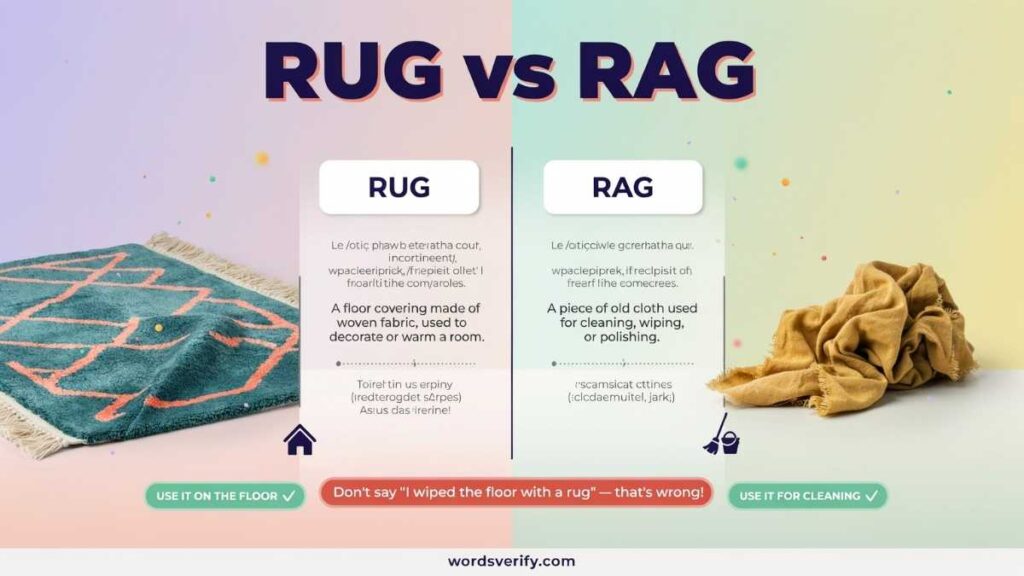
Have you ever mixed up a rug vs rag? You wouldn’t want to wipe the floor with your living room decoration or welcome guests with a cleaning cloth under their feet! Although these two words look and sound similar, they serve very different purposes. A rug adds warmth, comfort, and style to your floor, while a rag helps tackle dust, spills, and stubborn messes. Understanding the difference between rug vs rag is easier than you might think. In this guide, you’ll learn their meanings, explore everyday examples, and discover simple tips to use each word correctly without making a messy grammar mistake.
Rug vs Rag The Quick Answer
A rug is a piece of material designed to cover part of a floor. People use rugs to add warmth, make a room more comfortable, protect flooring, or improve a space’s appearance.
A rag is usually a piece of cloth used for cleaning or wiping. It may come from an old shirt, a worn-out towel, or another piece of fabric that someone no longer needs for its original purpose.
Here’s a simple way to remember the difference:
- Rug: Something you place on the floor as a covering.
- Rag: Something you often use to clean or wipe a surface.
For example, you might place a rug beside your bed and keep a rag under the kitchen sink. Both can be made from fabric, but they serve different purposes.
Learn the difference between tricky more English words
Envision vs Invision which one is correct?
What Does Rug Mean?
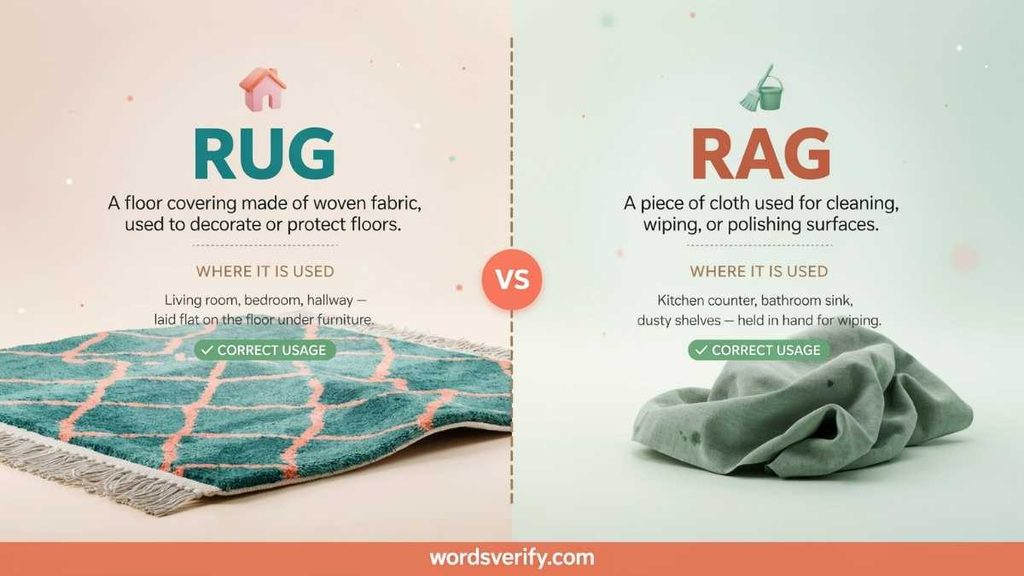
A rug is a floor covering that usually occupies a particular area rather than covering an entire room. It can be decorative, practical, or both.
Think about a living room with a sofa, a coffee table, and a few chairs. An area rug beneath the furniture can bring everything together and make the room feel more inviting. In a bedroom, a soft rug beside the bed gives your feet a comfortable place to land when you wake up.
Rugs come in different shapes, sizes, textures, and materials. Some are thick and fluffy, while others have a flat, tightly woven surface. You can find inexpensive synthetic rugs for everyday use and handmade rugs that require considerable time and skill to produce.
Beyond appearance, rugs can serve several practical purposes. They may help protect floors from scratches, soften footsteps, and make hard surfaces more comfortable. However, a loose rug can slide on smooth flooring, so a suitable nonslip backing or rug pad can help prevent accidents.
Common Types of Rugs
Rugs come in many varieties, and each type suits a different setting.
- Area rugs: These cover a specific section of a room. People often place them beneath coffee tables, dining tables, or seating arrangements.
- Entryway rugs: These sit near doors and help catch dirt, dust, and moisture brought in on shoes.
- Bedroom rugs: These add comfort and decoration beside or beneath a bed.
- Bathroom rugs: These provide a softer surface near a shower, bathtub, or sink. Absorbency and slip resistance are important considerations.
- Kitchen rugs: These can make standing near a sink or counter more comfortable. Washable materials are often practical in areas where spills happen.
- Handmade rugs: Artisans create these using methods such as weaving, knotting, braiding, or hooking. Their value depends on factors such as materials, craftsmanship, age, and design.
Examples of Rug in Everyday Sentences
Here are ten natural examples that show how to use the word correctly.
- She placed a soft rug beside her bed.
- An area rug made the living room feel cozier.
- We bought a washable rug for the kitchen.
- The children sat on the rug while playing.
- He rolled up the rug before cleaning the floor.
- The colorful rug matches the curtains.
- Our dog likes sleeping on the rug near the window.
- They moved the rug to make room for the new sofa.
- A thick rug softened the sound of footsteps.
- The decorative rug became the focal point of the room.
In each sentence, the word refers to a floor covering, not a piece of cloth used for cleaning.
Does Rug Have Other Meanings?
Yes. Although rug most commonly refers to a floor covering, it has other meanings in particular contexts.
In informal English, a rug can refer to a toupee or hairpiece. For example, someone might use the expression “wearing a rug” when talking about a person who wears a hairpiece. This usage can sound dated or teasing, so it isn’t suitable for every conversation.
Still, when people discuss furniture, flooring, or home decoration, the usual meaning of rug is a floor covering.
Learn the difference between tricky more English words
Bougie vs Boujee which one is correct?
What Does Rag Mean?
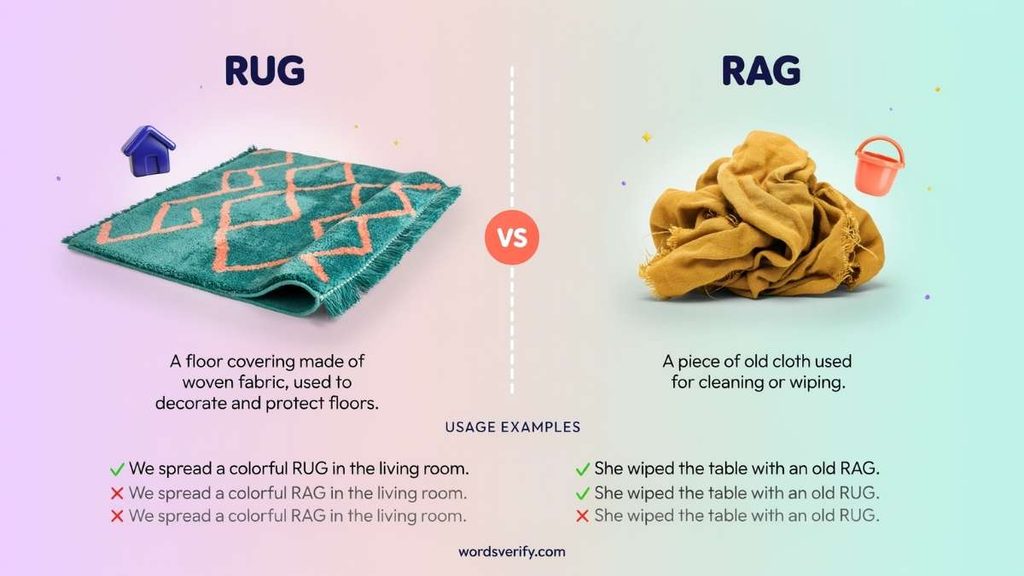
A rag is a piece of cloth, often an old or unwanted one, that someone uses for cleaning, wiping, polishing, or other practical tasks.
For example, an old cotton shirt may no longer be suitable for wearing. Instead of throwing it away, you could cut it into smaller pieces and use them to clean shelves, wipe tools, or handle everyday messes.
A rag doesn’t have to be filthy or badly torn. The word often describes how someone uses the cloth rather than its exact condition. A clean piece of fabric used to wipe a countertop can still be called a rag.
Rags are common in kitchens, garages, workshops, and industrial settings. Their usefulness depends on the material. Cotton can absorb moisture, while some synthetic fabrics work well for removing dust or cleaning delicate surfaces.
Common Types of Rags
Different rags suit different jobs.
- Cleaning rags: These help wipe counters, appliances, tools, and other surfaces.
- Dust rags: People use these to remove dust from furniture, shelves, and household objects. A slightly damp cloth can help trap dust instead of spreading it around.
- Polishing rags: These are used to polish suitable surfaces, including certain metals and finished materials. The cloth should match the task to avoid scratches.
- Cotton rags: These are often made from old cotton clothing or other cotton textiles. They can be absorbent and easy to cut into useful sizes.
- Industrial wiping rags: Workers use these in garages, factories, workshops, and maintenance facilities. Some require special handling when contaminated with oil, chemicals, or other hazardous substances.
- Recycled fabric rags: Old towels, sheets, and clothes can become useful cleaning materials rather than going straight into the trash.
Examples of Rag in Everyday Sentences
These examples show how people commonly use the word.
- He used an old rag to wipe the table.
- Grab a cleaning rag to remove the spill.
- She kept a cotton rag in the garage.
- The mechanic cleaned the tool with a rag.
- I turned an old cloth into a cleaning rag.
- He used a damp rag to remove the dust.
- She wiped the window frame with a rag.
- The worker placed the used rags in a designated container.
- We keep a few rags for messy household jobs.
- He used a suitable cloth to polish the metal surface.
The last example uses cloth rather than rag because the broader term can sound more natural when describing material selected for a particular purpose.
What Are the Other Meanings of Rag?
The word rag has several established meanings beyond a piece of cleaning cloth.
- A newspaper: In informal or historical usage, rag can refer to a newspaper, sometimes in a dismissive way. For example, someone might call a publication a rag to suggest that they consider it unreliable.
- Teasing or criticism: The expression “rag on someone” means to tease, criticize, or give someone a hard time. For example, “His friends kept ragging on him about his bright orange shoes.”
- A prank or joke: In some varieties of English, rag can refer to teasing or a practical joke.
Context tells you which meaning applies. A sentence about someone ragging on a friend has nothing to do with a cleaning cloth.
Learn the difference between tricky more English words
Excel vs Accel which one is correct?
Rug vs Rag The Main Differences
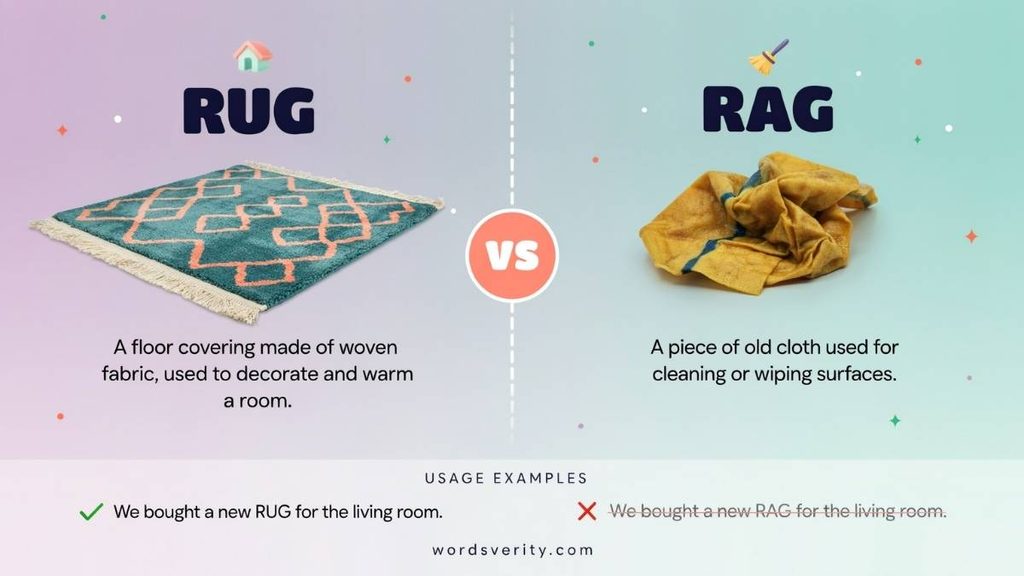
The easiest way to understand these words is to compare their purposes, materials, construction, and everyday uses.
| Feature | Rug | Rag |
|---|---|---|
| Meaning | A floor covering | A piece of cloth, often used for cleaning |
| Main purpose | Decoration, comfort, warmth, or floor protection | Wiping, cleaning, polishing, or absorbing spills |
| Typical location | Living rooms, bedrooms, kitchens, and entryways | Kitchens, garages, workshops, and utility rooms |
| Materials | Wool, cotton, jute, nylon, polyester, and other fibers | Cotton, microfiber, recycled fabric, and other suitable textiles |
| Construction | Usually made or finished as a floor covering | May be a cut piece of fabric or a repurposed garment |
| Condition | Can be new, old, decorative, or worn | Often old or repurposed, but may be clean and new |
| Example | She bought a rug for the bedroom. | He used a rag to clean the table. |
Meaning and Purpose
The biggest difference between a rug vs rag is what each one is meant to do.
A rug covers part of a floor. It may make a room look better, provide a softer surface, or protect the flooring beneath it.
A rag usually helps someone clean or wipe a surface.
Compare these sentences:
- She bought a rug for the bedroom.
- She used a rag to clean the bedroom window.
The first sentence describes a floor covering. The second describes a piece of cloth used for cleaning.
Replacing one word with the other changes the meaning. A rag lying on the floor doesn’t automatically become a rug, and a rug doesn’t become a rag simply because someone uses it to wipe something.
Size, Shape, and Construction
Rugs are generally made as finished floor coverings. They often have defined dimensions, finished edges, and a construction designed to withstand foot traffic.
Rags can come in almost any shape or size. Someone might cut an old T-shirt into small squares and use each piece as a cleaning rag. Another person might use a larger piece of fabric to wipe down equipment.
However, size alone doesn’t determine which word you should use. A small decorative rug is still a rug, while a large piece of cleaning cloth can still be a rag.
Material and Condition
Both rugs and rags can contain textile fibers, but their construction and intended uses differ.
Rugs may be made from wool, cotton, jute, nylon, polyester, or other materials. Some have a thick pile, while others feature a flat-woven surface.
Rags may come from old clothes, towels, sheets, or specially manufactured cleaning textiles. Their absorbency, durability, and tendency to leave lint can affect how well they perform.
One common misconception deserves attention: a rug isn’t necessarily expensive, and a rag isn’t necessarily dirty. A basic rug can be inexpensive, while a clean, purpose-made wiping cloth can be valuable in a professional setting.
Location and Everyday Use
Rugs usually appear on floors in homes, offices, hotels, and shops. Some are designed for outdoor spaces, such as patios and porches.
Rags are more common in places where people clean or handle materials. Kitchens, garages, workshops, and utility rooms are familiar examples.
Imagine you’re working in the kitchen. You might place a rug or mat near the sink to make standing more comfortable. If water splashes onto the counter, however, you’ll probably reach for a rag.
The setting stays the same. The purpose of the object determines the word.
Value and Practical Function
Rugs can have decorative, practical, or artistic value. A handmade wool rug may take considerable skill and time to produce, while a basic synthetic rug offers an affordable way to cover a section of flooring.
Rags usually serve a more practical purpose. Their value comes from how well they clean, absorb, or polish. Reusing old fabric as a rag can also reduce waste.
Neither word automatically describes quality. The context tells you whether someone means a decorative floor covering, a useful cleaning material, or something else.
Learn the difference between tricky more English words
Bellies vs Bellys Which one Is Correct?
Rug vs Rag Pronunciation
Rug and rag differ mainly in their vowel sounds. Both words begin with the letter r and end with a hard g sound, but the vowel in the middle changes.
How to Pronounce Rug
In American English, rug is pronounced /rʌɡ/.
The vowel sound is the same general sound you hear in words such as cup, sun, and luck.
To pronounce rug correctly:
- Start with the American English r sound.
- Use the short vowel sound in cup.
- Finish with a hard g sound.
Example: “The dog is sleeping on the rug.”
How to Pronounce Rag
In American English, rag is pronounced /ræɡ/.
The vowel sound is the same one you hear in cat, map, and bag.
To pronounce rag correctly:
- Start with the American English r sound.
- Use the short vowel sound in cat.
- Finish with a hard g sound.
Example: “He used a rag to clean the bag.”
The Difference Between Rug and Rag Pronunciation
| Word | Pronunciation (IPA) | Vowel sound | Rhyming word |
|---|---|---|---|
| Rug | /rʌɡ/ | The vowel in cup | Bug |
| Rag | /ræɡ/ | The vowel in cat | Bag |
The spelling difference is small, but the vowel changes how each word sounds.
Try reading these sentences aloud:
- The rug is red.
- The rag is wet.
- Put the rug on the floor.
- Use the rag to clean the door.
Don’t stretch either vowel. Start slowly, then repeat the sentences at a natural speaking speed. Practicing the words in complete sentences can make the distinction easier to remember.
Learn the difference between tricky more English words
Bearer vs Barer which one is correct?
Rug and Rag Grammar
Understanding how these words work in a sentence helps you use them naturally.
Parts of Speech
Both rug vs rag commonly function as nouns. A noun names a person, place, thing, or idea.
Examples:
- The rug needs cleaning.
- The rag is in the drawer.
However, rag can also function as a verb. In informal English, it can mean to tease or criticize someone persistently.
For example: “His teammates kept ragging on him about the missed shot.”
Here, ragging describes an action rather than a physical object.
Singular and Plural Forms
Both words form their regular plurals by adding s.
| Singular | Plural | Example |
|---|---|---|
| Rug | Rugs | The store sells rugs in several sizes. |
| Rag | Rags | She washed the cleaning rags. |
The spelling stays straightforward. You don’t need to change the vowel or add an unusual ending.
Articles and Determiners
Because rug vs rag are countable nouns when they refer to individual objects, they can take articles such as a and the.
Examples:
- A rug covered part of the floor.
- The rug needs vacuuming.
- I found a rag under the sink.
- The rag is ready to use.
- These rugs match the furniture.
- Those rags belong in the laundry basket.
Use a when introducing a singular countable object. Use the when you’re referring to a particular object that the reader or listener can identify.
Possessive Forms
Possessive forms show ownership or association.
- The rug’s color matches the curtains.
- The rag’s texture makes it suitable for polishing.
- The rugs’ designs differ from one another.
- The rags’ absorbency depends on their materials.
For a singular noun, add ‘s. For a regular plural noun ending in s, add an apostrophe after the final s.
Common Sentence Patterns
A few simple patterns can help you use both words correctly.
- Rug + action: “The rug covers the wooden floor.”
- Place + a rug: “They placed a rug beneath the dining table.”
- Clean something with a rag: “He cleaned the shelf with a rag.”
- Use a rag for a task: “She uses a cotton rag for polishing.”
- Turn fabric into rags: “We cut the old sheets into rags.”
These patterns are especially useful for English learners because they connect each word with its usual purpose.
Rug vs Carpet What’s the Difference?
A rug typically covers a particular section of a floor and can often be moved independently. A carpet, especially wall-to-wall carpet, usually covers most or all of a room’s floor.
For example:
- “We bought a rug for the living room.”
- “The hotel installed new carpet in the hallway.”
The distinction isn’t absolute. People sometimes use carpet as a broad term for floor coverings, and a large rug can look similar to a small carpet.
In everyday American English, however, area rug usually describes a movable floor covering, while wall-to-wall carpet describes flooring that extends across a room.
Rug vs Mat How Are They Different?
A mat is often smaller or designed for a particular task. A doormat helps remove dirt from shoes, a bath mat provides a surface near a bathtub, and an exercise mat cushions the body during workouts.
Rugs tend to emphasize floor coverage, decoration, or comfort, although some also serve practical purposes.
A thick decorative mat may resemble a small rug. In that situation, the object’s intended use and the way people commonly describe it can help you choose the more natural term.
Rag vs Cloth What’s the Difference?
Cloth is a broad term for fabric or a piece of material. It can refer to fabric used for clothing, curtains, upholstery, or other purposes.
A rag usually refers to a piece of cloth used for cleaning or one that someone considers old, worn, or unwanted.
Compare these examples:
- She bought cloth to make curtains.
- He used a rag to wipe the workbench.
A rag is made from cloth or another suitable textile material, but not every piece of cloth is a rag.
The same distinction applies to towels. A towel is designed mainly to absorb moisture or dry people and surfaces, while a rag often serves general cleaning purposes. An old towel can eventually become a collection of cleaning rags.
Learn the difference between tricky more English words
Panel vs Pannel which one is correct?
What Is a Rag Rug?
A rag rug is a floor covering made from strips or pieces of fabric, often recycled textiles such as old clothing, sheets, or towels.
This term provides an interesting connection between rug vs rag. Although the words have different meanings, rags can become the material used to make a rug.
People have reused leftover fabric to create practical floor coverings for generations. Depending on the method, they may braid, weave, crochet, or hook fabric strips into a finished rug.
For example, someone might cut old cotton shirts into strips and weave them into a colorful floor covering. Before construction, those strips are fabric scraps. Once woven into a finished floor covering, the result is a rag rug.
What Is a Rag Rug Made Of?
Common materials include:
- Old cotton shirts and dresses.
- Worn bed sheets.
- Fabric remnants from sewing projects.
- Recycled cotton or other suitable textiles.
- Strips of old towels, depending on the rug-making method.
The final appearance depends on the materials and technique. A braided rag rug may have a rounded, rope-like texture, while a woven rag rug can have a flatter surface with visible strips of contrasting fabric.
Can You Make a Rug From Old Rags?
Yes. Suitable fabric scraps, old clothing, and worn sheets can be turned into a rag rug.
The important distinction is between the material and the finished object. Before construction, the pieces may be called rags or fabric scraps. After someone braids or weaves them into a floor covering, the finished product is a rug.
When making a rag rug, choose suitable fabric, remove buttons and other hard pieces, and make sure the finished rug lies flat. A nonslip backing or rug pad can also help prevent movement on smooth flooring.
Learn the difference between tricky more English words
Dysregulated vs Disregulated which one is correct?
Common Mistakes When Using Rug vs Rag
Even though these words have different meanings, their similar spelling can cause confusion, especially for people learning English.
Treating Rug vs Rag as Synonyms
The most common mistake is using one word when the other better matches the intended meaning.
Less natural for a decorative floor covering: “She bought a new rag for the living room floor.”
Better: “She bought a new rug for the living room floor.”
The first sentence could make sense if someone intended to use a piece of cloth temporarily, but it doesn’t naturally describe a decorative floor covering.
Likewise, “He wiped the table with a rug” sounds unusual if he means a small cleaning cloth.
Better: “He wiped the table with a rag.”
Assuming Every Rag Is Dirty
A rag is often old or used, but it doesn’t have to be filthy. Some cleaning rags are washed after each use, while others are made from new fabric selected for a particular job.
For example, a clean microfiber cloth may work well for cleaning delicate surfaces. Depending on the context, cloth may sound more natural than rag.
The key is to consider both the material and its intended use.
Confusing a Rug With a Carpet
A rug and a carpet can overlap in meaning, but the terms aren’t always interchangeable.
If you’re describing a movable floor covering beneath a coffee table, rug or area rug is usually the clearer choice in American English. If you’re describing material installed across most or all of a room, carpet is generally more natural.
Relying Only on Autocorrect
Spell-checking tools can catch many spelling mistakes, but they may not recognize a correctly spelled word used in the wrong context.
Both rug vs rag are valid words. A spell-checker may accept either one even when the sentence calls for the other.
To avoid this problem, reread your sentence and ask yourself what object or action you actually mean.
Learning the Words Without Context
Memorizing definitions is helpful, but examples make meanings easier to remember.
Picture a rug beside your bed and a rag in your cleaning cupboard. These familiar images connect each word with its purpose.
Practicing the words in several different sentences can also help you recall them naturally during conversation.
Learn the difference between tricky more English words
Mobil vs Mobile which one is correct?
Rug vs Rag More Examples in Everyday English
The following pairs show how changing one vowel changes the meaning.
| Rug sentence | Rag sentence |
|---|---|
| She placed a rug beside the bed. | She placed a rag beside the cleaning supplies. |
| The rug protects the floor beneath the table. | The rag removes dust from the table. |
| We bought a colorful rug for the living room. | We bought reusable rags for the garage. |
| He rolled up the rug before moving furniture. | He picked up a rag before cleaning the furniture. |
| The dog sleeps on the rug. | The mechanic keeps a rag near the tools. |
Here are a few more examples that show the words in different situations.
- Home decoration: “The decorative rug brightens the room.”
- Household cleaning: “She used an old rag to wipe away the spilled juice.”
- Recycling: “My grandmother made a colorful rag rug from fabric scraps.”
- Shopping: “The store sells wool rugs in several sizes.”
- Workshop maintenance: “The technician used a lint-free cloth to clean the delicate component.”
Notice that the last sentence uses cloth rather than rag. That choice may be more suitable when a job requires a particular material or a clean, lint-free surface.
Simple Tips for Remembering Rug vs Rag
If you often mix up these words, a few straightforward techniques can help.
- Connect each word with a familiar object. Picture a rug covering the floor and a rag wiping a counter.
- Focus on the vowel sound. Rug has the vowel sound in cup, while rag has the vowel sound in cat.
- Think about the purpose. Ask whether you’re describing a floor covering or a piece of cloth used for cleaning.
- Practice contrasting sentences. Try saying, “The rug is under the table. The rag is beside the sink.”
- Remember the term rag rug. A rag rug is a floor covering made from fabric scraps. This expression connects the words without making them synonyms.
For English learners, the best approach combines definitions, pronunciation practice, and real-life examples. Repeating words in meaningful situations is often more helpful than memorizing their spelling alone.
Learn the difference between tricky more English words
Gummy vs Gummie Which one Is Correct?
Practice Session Rug vs Rag
Fill in each blank with the correct word: rug ovs rag Pay attention to the meaning of each sentence to choose the right answer.
Fill in the blanks
1. We placed a soft ______ in front of the sofa to make the living room feel cozy.
2. Please use a clean ______ to wipe the spilled milk from the table.
3. The colorful ______ added warmth and style to the bedroom floor.
4. Dad grabbed an old ______ to clean the grease off his hands.
5. She bought a beautiful wool ______ for her new apartment.
6. Use a dry ______ to remove the dust from the wooden shelf.
7. The puppy curled up on the fluffy ______ beside the fireplace.
8. I need a clean ______ to polish the windows.
9. They placed a large ______ under the dining table.
10. The mechanic used a ______ to wipe oil from the tools.
11. My grandmother made a handmade ______ from leftover fabric.
12. Please keep a cleaning ______ near the sink for small spills.
13. The soft ______ felt comfortable beneath our feet.
14. He used an old cotton ______ to clean his bicycle.
15. We chose a patterned ______ to brighten the hallway.
16. She dipped the ______ in water and wiped the muddy shoes.
17. The hotel room had a thick ______ beside each bed.
18. I used a clean ______ to remove the paint from my hands.
19. The cat scratched the corner of the living room ______.
20. The painter kept an old ______ nearby to clean his brushes.
21. A small ______ near the entrance helps keep the floor clean and welcoming.
22. She folded the damp ______ and left it beside the washing machine.
23. The family placed a decorative ______ beneath the coffee table.
24. The worker grabbed a cotton ______ to wipe dust from the equipment.
25. Before guests arrived, we straightened the ______ and vacuumed the living room floor.
Answers
- rug
- rag
- rug
- rag
- rug
- rag
- rug
- rag
- rug
- rag
- rug
- rag
- rug
- rag
- rug
- rag
- rug
- rag
- rug
- rag
- rug
- rag
- rug
- rag
- rug
Here’s a trusted source for clear word meanings:
FAQs
What materials are commonly used to make rugs?
Rugs can be made from wool, cotton, silk, jute, polyester, nylon, and other natural or synthetic fibers. The best material depends on the rug’s purpose, durability, texture, and location in the home.
Can you make a rug out of old clothes?
Yes! You can turn old T-shirts, jeans, towels, and other fabric scraps into a homemade rug. Cutting or tearing the fabric into strips and weaving, braiding, or knotting them together creates a practical way to reuse unwanted clothing.
What is the difference between a washcloth and a rag?
A washcloth is usually a small, soft cloth designed for washing your body or face. A rag is a broader term for a piece of fabric used for cleaning, wiping, polishing, or other household tasks.
Why do people use rugs instead of wall-to-wall carpeting?
Rugs offer flexibility because you can move them, replace them, or use them to define specific areas. Wall-to-wall carpeting covers most or all of a room’s floor, while rugs let you change your decor without replacing the entire floor covering.
How do you clean a rug without damaging it?
Check the care label first, then vacuum or shake out loose dirt. Blot spills with a clean cloth instead of rubbing them, and use a cleaner suitable for the rug’s material. Delicate wool, silk, and antique rugs may require professional cleaning.
What is the difference between a throw rug and an area rug?
A throw rug is generally a small rug placed beside a bed, near a doorway, or in another limited space. An area rug is usually larger and helps define a section of a room, such as a seating or dining area. However, the terms can overlap.
Can a rag be used for purposes other than cleaning?
Yes. People use rags for painting, polishing furniture, applying stains, crafting, and handling small household repairs. Some fabric scraps also serve as stuffing, padding, or material for homemade projects.
What does it mean to be dressed in rags?
The expression “dressed in rags” describes someone wearing old, torn, or badly worn clothing. It often suggests poverty, hardship, or neglect, although writers may also use it to describe a character’s appearance.
What is the difference between a rug pad and a rug?
A rug is the decorative or functional floor covering itself. A rug pad sits underneath it to provide cushioning, reduce slipping, protect the floor, and help the rug stay in place.
How can you reuse old rags around the house?
Old rags can become cleaning cloths, dusters, shoe-polishing cloths, or materials for craft projects. Choose clean, absorbent fabric for household tasks, and avoid reusing cloths contaminated with hazardous chemicals or flammable substances.
What should you consider when choosing a rug for a small room?
Choose a size that suits the room’s layout and furniture. A rug that extends beneath key furniture pieces can make the space feel more connected, while a very small rug may make the room appear visually cluttered. Color, pattern, and texture also affect the overall look.
Learn the difference between tricky more English words
Flys vs Flies which one is correct?
Conclusion
Knowing the difference between rug vs rag can save you from some funny mix-ups! A rug brings comfort, warmth, and style to your floor, while a rag comes to the rescue when dust, spills, and messes appear. Although these words look similar, they serve very different purposes. You wouldn’t want to wipe up spilled juice with your favorite living room rug or roll out a cleaning rag to welcome your guests! The trick is simple: remember what each word does, and you’ll use it correctly every time. With a little practice, you can avoid common vocabulary mistakes, write with confidence, and keep your words as tidy as your floors.

Lisa AJS is an experienced blogger and language enthusiast at Words Verify, dedicated to making grammar simple, practical, and enjoyable. She writes engaging content on commonly confused words, grammar mistakes, word meanings, and everyday language challenges.