
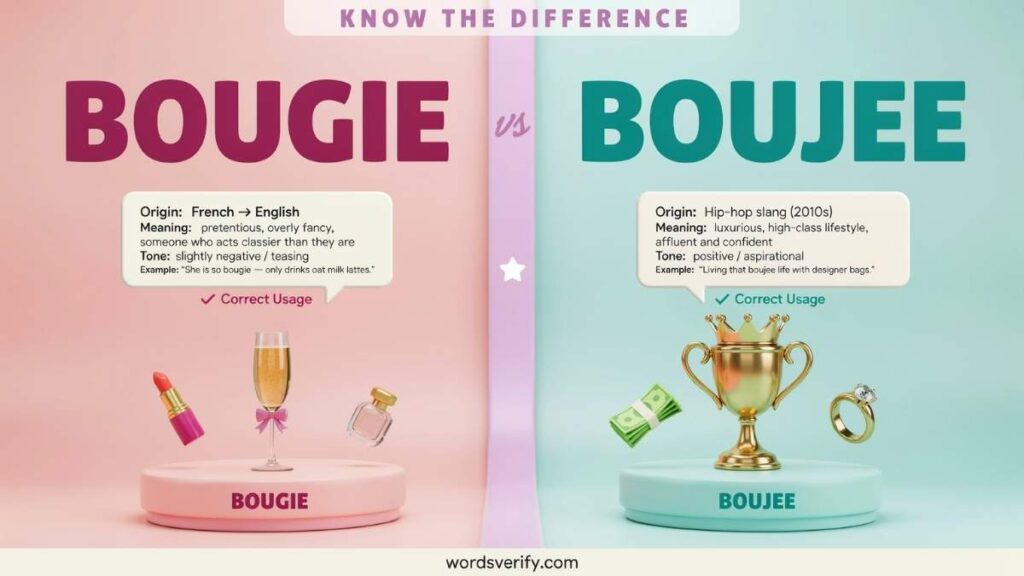
Ever described a fancy restaurant as bougie, only to see someone spell it boujee and wonder if your vocabulary missed a fashion upgrade? You’re not alone! The confusion over bougie vs boujee is surprisingly common because both words describe luxury, expensive tastes, and stylish lifestyles. However, their spelling, tone, and cultural associations add a little twist. Bougie can suggest pretentiousness, while boujee often sounds playful, trendy, or glamorous. So, which spelling should you use? Before your coffee order becomes a vocabulary lesson, let’s explore their meanings, origins, pronunciation, and everyday usage to help you choose the right word with confidence.
Bougie vs Boujee Quick Answer
Both bougie and boujee are used in everyday English, but they have slightly different cultural associations.
- Bougie: The established spelling associated with bourgeois. In slang, it describes someone or something connected to luxury, expensive tastes, or upper-class habits. Depending on the context, it can sound admiring, humorous, or critical.
- Boujee: A popular slang spelling associated with the same word family. It often describes a glamorous lifestyle, fashionable tastes, or an enjoyable luxury.
- Which should you use? Bougie works well in general informal writing. Boujee fits casual conversations, social media captions, and situations where you want a more playful slang tone.
For example:
- That restaurant is too bougie for my budget.
- We’re feeling boujee tonight, so let’s order dessert.
Both sentences describe an interest in luxury. The first hints at expense, while the second sounds lighthearted and indulgent.
Bougie vs Boujee What’s the Difference?
The main difference between bougie and boujee lies in spelling, tone, and cultural association rather than a strict difference in meaning.
| Feature | Bougie | Boujee |
|---|---|---|
| Meaning | Associated with luxury, expensive tastes, or pretentiousness | Associated with luxury, fashionable tastes, or an upscale lifestyle |
| Spelling | Established spelling | Popular slang spelling |
| Tone | Can be humorous, admiring, or critical | Often playful, stylish, or aspirational |
| Cultural association | General informal English | Hip-hop, popular culture, and social media |
| Example | That coffee machine is so bougie. | This hotel feels incredibly boujee. |
| Formality | Informal | Informal |
These differences aren’t strict rules. Someone might use bougie as a compliment or boujee sarcastically. The surrounding sentence and the speaker’s tone often determine the intended meaning.
Learn the difference between tricky more English words
Excel vs Accel which one is correct?
What Does Bougie Mean?
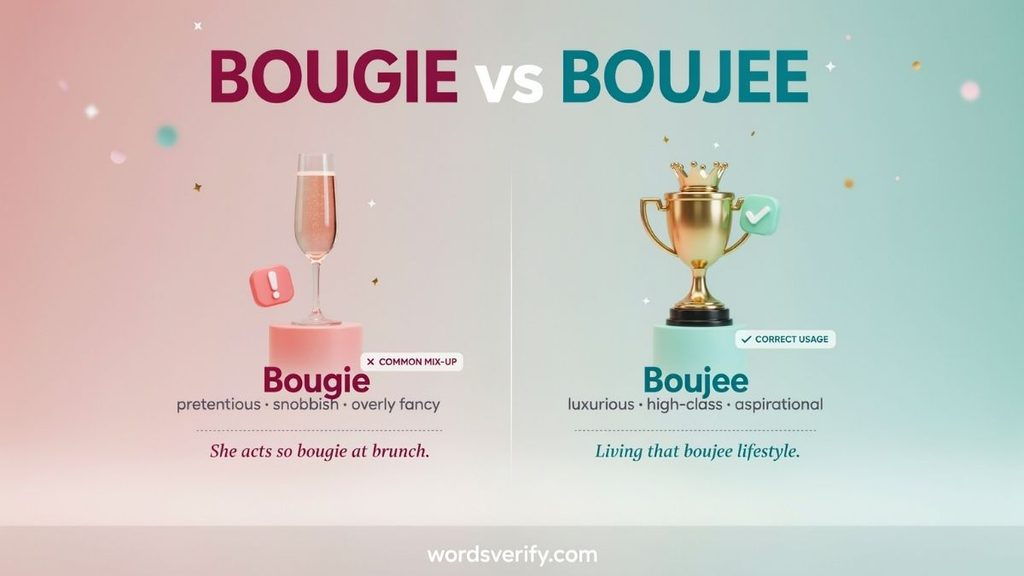
Bougie describes someone or something associated with luxury, expensive preferences, social status, or an upper-class lifestyle. In everyday conversation, people often use it to describe a person who enjoys upscale experiences or seems overly concerned with appearing sophisticated.
Imagine a friend who refuses to drink ordinary coffee because it isn’t made with freshly ground specialty beans. You might jokingly call that friend bougie. The comment could express affection, mild criticism, or simple amusement.
The word can describe people, places, products, and activities.
Examples include:
- That restaurant is a little too bougie for a casual dinner.
- She bought a bougie candle that costs more than my lunch.
- Our neighborhood has become pretty bougie.
- He’s acting bougie because he ordered sparkling water.
- They booked a bougie hotel for their anniversary.
In each example, the word suggests expensive tastes, upscale surroundings, or a desire for a more refined experience.
What Does Bougie Mean in Everyday Conversation?
The word often describes everyday choices that feel unusually fancy or expensive. It might refer to a premium coffee order, designer clothing, an elaborate skincare routine, or a restaurant with an impressive menu.
However, bougie doesn’t always mean something is genuinely luxurious. Sometimes, it simply describes the impression a person or place creates.
For example, someone might say, “I can’t afford a five-star hotel, but I like to feel bougie on vacation.” The speaker isn’t claiming to be wealthy. They’re describing a preference for comfort and a little indulgence.
People commonly use bougie to describe:
- Expensive or upscale products.
- Fashionable restaurants and stylish surroundings.
- A preference for premium services or experiences.
- Behavior that seems pretentious or status-conscious.
- Small luxuries that make an ordinary day feel special.
What Does It Mean to Be a Bougie Person?
A bougie person enjoys luxury, has expensive tastes, or prefers experiences associated with a higher social class. The expression can also suggest that someone places too much importance on appearances or status.
Consider two people choosing a restaurant. One selects an expensive place because they appreciate the food. The other refuses to eat anywhere that doesn’t impress their friends.
Both might be called bougie, but the implication differs. The first simply enjoys fine dining. The second may seem overly concerned with social status.
That distinction explains why the word can sound affectionate among friends but insulting during an argument.
What Is a Bougie Lifestyle?
A bougie lifestyle centers on comfort, style, luxury, and experiences associated with wealth or social status. It might include designer clothing, premium coffee, elegant home decor, boutique hotels, or fine dining.
However, you don’t need a huge budget to enjoy a few luxuries. For one person, a bougie weekend might mean staying at a luxury resort. For another, it might mean buying fresh flowers, preparing a delicious brunch, and enjoying a quiet evening at home.
Common examples include:
- Choosing a boutique hotel instead of a basic room.
- Buying specialty coffee rather than instant coffee.
- Decorating a home with carefully chosen furniture and artwork.
- Booking a fine-dining experience for a special occasion.
- Treating yourself to premium skincare or a designer accessory.
These choices don’t automatically make someone pretentious. The word becomes more critical when a person uses their preferences to look down on others.
Learn the difference between tricky more English words
Bellies vs Bellys Which one Is Correct?
What Does Boujee Mean?
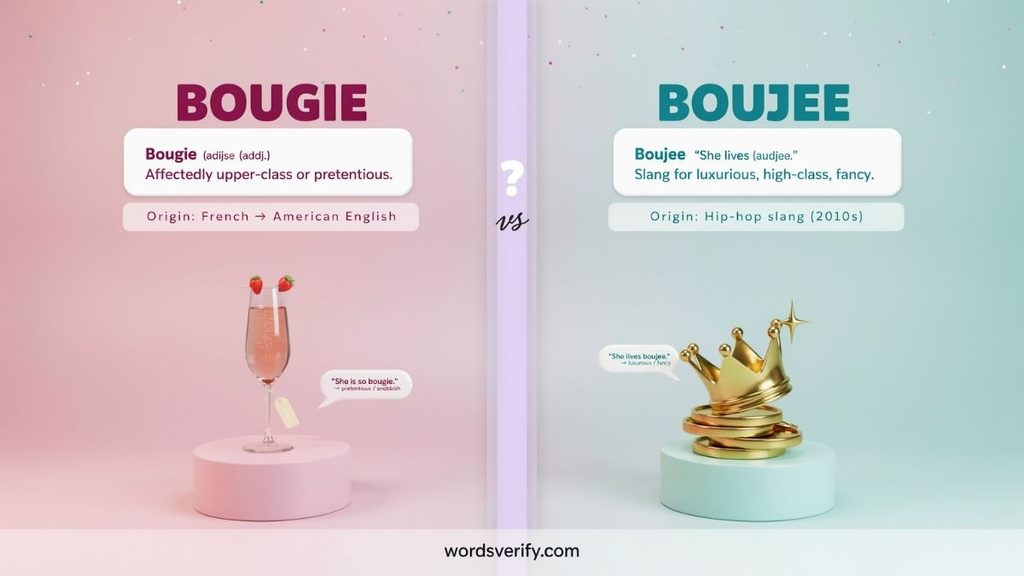
Boujee has a meaning closely related to bougie. It describes someone or something associated with luxury, expensive tastes, glamour, or an upscale lifestyle.
The spelling is especially recognizable in contemporary slang, hip-hop, and social media. People often use it to describe experiences that feel stylish, indulgent, or glamorous.
For example:
- We’re having a boujee brunch this weekend.
- That outfit looks boujee enough for a special event.
- I treated myself to a boujee spa day.
- This little apartment looks boujee for the price.
- We’re planning a boujee night out.
The word often appears in playful expressions. You don’t need to own a mansion or drive an expensive sports car to call yourself boujee. Sometimes, ordering a fancy drink is enough.
What Does Boujee Mean in Slang?
In everyday slang, boujee often describes enjoying the finer things in life. It can make an ordinary activity sound glamorous or more indulgent than usual.
Compare these two statements:
- I’m making breakfast tomorrow.
- I’m making a boujee breakfast tomorrow.
The second suggests something more elaborate: perhaps fresh pastries, specialty coffee, fresh fruit, and a carefully arranged plate.
The meal doesn’t have to cost a fortune. The word adds a sense of style and indulgence.
People commonly use boujee when talking about:
- Food, such as elaborate desserts or gourmet brunches.
- Fashion, including designer clothing and stylish accessories.
- Travel, such as luxury resorts and boutique hotels.
- Beauty routines, including spa treatments and premium skincare.
- Entertainment, such as fashionable parties and exclusive events.
What Is a Boujee Aesthetic?
A boujee aesthetic is a visual style associated with luxury, elegance, and carefully chosen details. It might include neutral colors, soft lighting, elegant furniture, polished outfits, and beautifully presented food.
A boujee aesthetic doesn’t necessarily mean something costs a fortune. A well-designed room can look luxurious without expensive materials. Similarly, an expensive outfit may not look particularly elegant.
The term describes the overall impression rather than a guaranteed level of quality or wealth.
Learn the difference between tricky more English words
Bearer vs Barer which one is correct?
Are Bougie vs Boujee Interchangeable?
Yes, people often use the two spellings interchangeably when describing luxury, expensive tastes, or an upscale lifestyle. However, their tone and cultural associations can differ.
Consider these examples:
- We found a bougie restaurant downtown.
- We found a boujee restaurant downtown.
Both sentences suggest that the restaurant feels upscale. The second may sound more playful or slang-heavy, but the basic meaning remains similar.
Now consider this sentence: “He’s acting bougie because he refuses to shop anywhere ordinary.”
Here, bougie suggests snobbery or an exaggerated concern with status. Replacing it with boujee would still work, although the sentence might sound more teasing.
When choosing between the two spellings, consider your audience and the impression you want to create. If neither word communicates your meaning clearly, alternatives such as upscale, luxurious, or pretentious may work better.
Learn the difference between tricky more English words
Panel vs Pannel which one is correct?
The Origin of Bougie vs Boujee
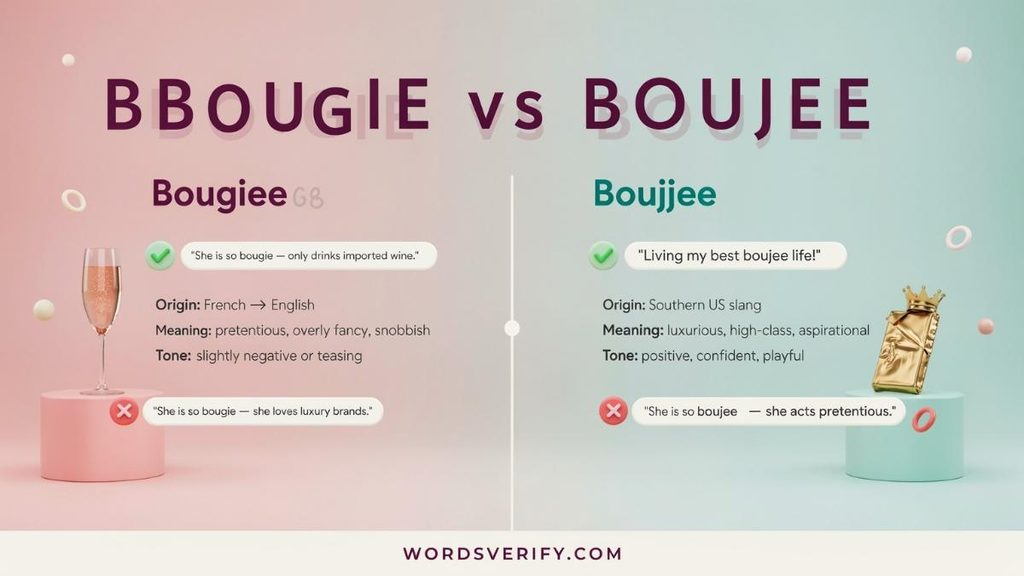
Both words connect to bourgeois, a term that entered English from French. Understanding this relationship helps explain why the words carry associations with social class, money, and status.
However, the words didn’t develop in exactly the same way. Bougie has a more direct connection to bourgeois, while boujee represents a slang spelling associated with the same word family.
What Does Bourgeois Mean?
The French word bourgeois historically referred to a member of the middle class, particularly an urban social class. Over time, it developed additional meanings related to property, social position, conventional values, and material comfort.
In English, bourgeois can describe the middle class or attitudes associated with that class. It also appears in historical and political discussions.
In everyday conversation, people sometimes use bourgeois critically to describe someone who seems conventional, materialistic, or overly concerned with status.
Bougie is a more casual term. Calling a restaurant bougie doesn’t mean the restaurant belongs to a particular economic class. It simply suggests that the place feels luxurious, expensive, or associated with elevated social status.
What Does Bourgeoisie Mean?
The bourgeoisie refers to a social class historically associated with property, commerce, and ownership of capital. Its precise meaning depends on the historical or political context.
The term is especially important in discussions of European social history and Marxist theory, where it refers to the capitalist class that owns the means of production.
This differs from the casual meaning of bougie. Calling a restaurant bougie doesn’t make a statement about who owns capital or how society is organized. It describes an impression of luxury, expense, or status.
Although bourgeois, bourgeoisie, and bougie share a linguistic connection, they aren’t interchangeable in every sentence.
How Did Bougie Develop Its Modern Meaning?
Over time, bougie shifted from a word associated with social class to a casual way of describing tastes, preferences, and behavior.
Instead of discussing class in a historical or political sense, speakers began using it for people who preferred expensive products, refined surroundings, or upper-class habits.
Today, someone might describe their coffee order as bougie without suggesting that they belong to the upper class. The word can be playful and self-aware.
How Did Boujee Become Popular?
The spelling boujee became widely recognizable through hip-hop and popular culture. The 2016 song “Bad and Boujee” by Migos featuring Lil Uzi Vert helped bring the term to a much wider audience.
The song’s title connects attractiveness and status with a fashionable, aspirational lifestyle. Its popularity helped spread the spelling beyond music and into memes, social media captions, and everyday conversations.
However, it’s more accurate to say that the song helped popularize the term than to claim that the group invented it. A song can make a word famous without being the first place anyone used it.
Learn the difference between tricky more English words
Dysregulated vs Disregulated which one is correct?
How to Pronounce Bougie vs Boujee
Bougie and boujee usually have the same or a very similar pronunciation in American slang.
A common pronunciation is “BOO-zhee.” Both words typically have two syllables, with the stress on the first.
To pronounce bougie, begin with the sound in “boo.” Then finish with the sound heard in the middle of “vision.” The final sound isn’t a hard g.
Boujee usually follows the same pronunciation. Although the spelling changes from gie to jee, the spoken sound generally remains the same.
Common mistakes include:
- Pronouncing the g as a hard g.
- Assuming the different spellings must have completely different sounds.
- Putting the stress on the second syllable.
Pronunciation can vary slightly by speaker, but most casual uses don’t require separate pronunciations for the two spellings.
Learn the difference between tricky more English words
Mobil vs Mobile which one is correct?
Bougie and Boujee Examples in Everyday English
Examples help show how the words work in real conversations. The following sentences cover food, fashion, travel, home decor, and everyday indulgences.
Bougie in a Sentence
- That restaurant is too bougie for a casual Tuesday night.
- My brother bought a bougie coffee machine that costs more than his old laptop.
- She loves bougie skincare products, even though a simple moisturizer works just fine.
- Our hotel was surprisingly bougie for such a small town.
- He’s acting bougie because he refuses to wear anything without a designer label.
- This neighborhood has become so bougie that the old corner store is now a gourmet market.
- We had a bougie dinner with fancy appetizers and an elaborate dessert.
- Her living room looks bougie, thanks to the elegant furniture and soft lighting.
- I felt bougie ordering sparkling water at a fast-food restaurant.
- They planned a bougie weekend filled with spa treatments and fine dining.
These examples show that bougie can describe luxury neutrally or humorously. It can also criticize someone who seems overly concerned with expensive tastes.
Boujee in a Sentence
- We’re having a boujee brunch with pastries, fresh fruit, and specialty coffee.
- That outfit looks boujee enough for a red-carpet event.
- She booked a boujee hotel for her birthday weekend.
- This dessert looks so boujee that I almost don’t want to eat it.
- I’m feeling boujee today, so I’m ordering the expensive coffee.
- Their vacation photos have a serious boujee aesthetic.
- He gave his apartment a boujee makeover with new lighting and elegant decor.
- Let’s have a boujee night out and try that new rooftop restaurant.
- My everyday lunch suddenly feels boujee when I put it on a fancy plate.
- They chose a boujee resort for their anniversary.
These examples emphasize indulgence, glamour, and playful enjoyment. They also show that something doesn’t need to be expensive to feel boujee.
Bougie vs Boujee in Similar Situations
| Situation | Bougie example | Boujee example |
|---|---|---|
| Coffee | That’s a bougie coffee order. | My coffee order is getting boujee. |
| Restaurants | The restaurant feels a little bougie. | We’re trying a boujee restaurant tonight. |
| Clothing | He has bougie taste in clothes. | That outfit looks boujee. |
| Travel | They booked a bougie hotel. | We’re planning a boujee vacation. |
| Home decor | Her apartment looks bougie. | She created a boujee aesthetic. |
| Spending | That was a bougie purchase. | I’m feeling boujee after payday. |
The examples are similar because the words often overlap. The main difference comes from the tone you want to create.
Learn the difference between tricky more English words
Gummy vs Gummie Which one Is Correct?
Bougie Restaurants and Boujee Food
Food is one of the easiest ways to understand both words. People often use bougie and boujee to describe dining experiences that feel upscale, elaborate, or unusually expensive.
What Does Bougie Restaurant Mean?
A bougie restaurant is a place that feels luxurious, fashionable, expensive, or associated with high social status.
It might offer fine dining, elaborate presentation, premium ingredients, a carefully designed interior, or formal service. However, the label is subjective. A small restaurant serving beautifully prepared food might seem bougie to one person but perfectly ordinary to another.
For example:
- That bougie restaurant charges extra for sparkling water.
- We found a bougie little café with handmade pastries.
- The restaurant is expensive, but the food and service are excellent.
The term describes the overall impression rather than proving that the restaurant serves better food than less expensive places.
What Does Boujee Food Mean?
Boujee food usually refers to dishes that look or feel luxurious, fashionable, or indulgent. Examples include elaborate desserts, premium ingredients, beautifully presented brunches, and expensive tasting menus.
A dish doesn’t have to cost much to feel boujee. Fresh berries served with homemade whipped cream might feel special because someone took the time to present them beautifully.
Likewise, an expensive dish isn’t automatically boujee. Price, presentation, atmosphere, and personal expectations all influence the impression.
Learn the difference between tricky more English words
Flys vs Flies which one is correct?
Bougie vs. Fancy vs Classy vs. Luxurious
These words overlap, but each emphasizes something different. Choosing the right one helps you express exactly what you mean.
| Word | Main meaning | Example |
|---|---|---|
| Bougie | Luxury, expensive tastes, or perceived pretentiousness | He has a bougie taste in coffee. |
| Boujee | A stylish or indulgent lifestyle, often expressed playfully | We’re having a boujee night out. |
| Fancy | Something elaborate, special, or more sophisticated than usual | Let’s make a fancy dinner. |
| Classy | Elegance, good taste, or dignified behavior | She handled the situation in a classy way. |
| Luxurious | Comfort, quality, expense, or indulgence | The hotel has luxurious rooms. |
| Upscale | A high-end market position or refined setting | They opened an upscale restaurant. |
| Pretentious | Trying to appear more important or sophisticated than you are | His comments sounded pretentious. |
| Snobby | Looking down on others because of perceived differences in status or taste | She sounded snobby when she criticized their clothes. |
Bougie vs Fancy
Fancy is generally broader and more neutral. You can have a fancy dinner, wear a fancy dress, or attend a fancy event without suggesting anything about your social attitudes.
Bougie adds a social dimension. It can suggest that something reflects expensive tastes or a desire to appear sophisticated.
Boujee vs Luxurious
Luxurious directly describes comfort, quality, or indulgence. Boujee is more casual and often adds a playful attitude.
A hotel can be luxurious because it has spacious suites and excellent service. Someone might call the same hotel boujee because its decor, clientele, and prices create an upscale impression.
Bougie vs Classy
Classy usually emphasizes elegance, taste, or dignified behavior. Bougie emphasizes luxury, status, or expensive preferences.
A person can be classy without spending much money. Similarly, someone can have expensive tastes without behaving in a classy way.
Boujee vs. Pretentious
Boujee doesn’t automatically mean pretentious. A person can enjoy luxury without looking down on anyone.
Pretentious is more clearly critical. It describes behavior that tries too hard to impress or suggests a level of sophistication that feels exaggerated or insincere.
Learn the difference between tricky more English words
Envision vs Invision which one is correct?
Common Mistakes When Using Bougie vs Boujee
Although these words are easy to use, a few common mistakes can make your meaning unclear.
Assuming Bougie and Boujee Have Completely Different Meanings
The spellings don’t establish two separate definitions. Both words can describe luxury, fashionable tastes, and an upscale lifestyle.
If you want to distinguish them, focus on tone and context rather than inventing a strict rule.
Treating Bougie as Always Negative
Calling something bougie doesn’t necessarily insult it.
For example, “I love this bougie little café” expresses enjoyment. In contrast, “He’s too bougie to eat with us” suggests that someone may be acting superior.
The same word can praise a place and criticize a person’s behavior.
Treating Boujee as Always Positive
Although boujee often sounds playful or admiring, speakers can use it sarcastically.
For example, “Look at you with your boujee bottled water!” might express friendly teasing rather than genuine admiration.
Confusing Bougie With Bourgeois
The words share a linguistic connection, but bourgeois has established meanings related to social class, history, and politics.
Use bougie when discussing informal slang about expensive tastes. Use bourgeois when its more specific meaning fits the context.
Assuming Bougie Means Rich
A bougie person doesn’t necessarily have a high income. The word describes tastes, attitudes, or impressions rather than a person’s financial status.
Someone might enjoy premium coffee while saving money everywhere else. Another person might own expensive possessions without caring about luxury or social status.
Overusing the Words in Formal Writing
Both terms belong primarily to informal English. In a business report, academic essay, or formal analysis, words such as upscale, luxurious, status-conscious, or pretentious may communicate the intended meaning more precisely.
You can still use bougie vs boujee in formal writing when you’re directly discussing slang, music, or popular culture.
Learn the difference between tricky more English words
Bespectacled vs Bespeckled What’s the Difference?
Bougie vs Boujee in American, British and Other English Varieties
Both spellings circulate beyond the United States, but their popularity and associations may differ across communities.
American English
In American English, both words appear in casual conversations, entertainment, and social media. Bougie has broad informal usage, while boujee is particularly recognizable through hip-hop and contemporary popular culture.
Their meaning often depends on tone, social context, and the speaker’s relationship with the person being described.
British English
British English speakers may recognize both terms through music, television, and online culture. However, usage can vary by age, community, and setting.
It’s more accurate to describe them as informal slang understood in many contexts than to claim that one spelling is universally preferred throughout Britain.
Canadian and Australian English
Both terms can appear in Canadian and Australian conversations, especially in online settings influenced by American popular culture. Still, their frequency and local associations can vary.
There isn’t a reliable universal rule that assigns bougie to one country and boujee to another. The audience and context provide better guidance than nationality alone.
Bougie and Boujee in African American English and Hip-Hop Culture
The popularity of boujee deserves attention because it connects to African American English, hip-hop culture, and broader patterns of slang development.
African American English, also called African American Vernacular English (AAVE), is a systematic variety of English with its own grammatical, pronunciation, and vocabulary patterns. It’s not simply a collection of slang words.
Terms can develop, spread, and change meaning within particular communities before reaching wider audiences. Music, entertainment, and social media often help carry expressions across communities.
The popularity of boujee illustrates this process. Hip-hop brought the spelling to a wider audience, while memes and everyday conversation expanded the range of situations in which people use it.
However, it’s important not to reduce the term to a single song or assume that everyone who uses it shares the same cultural background. Language spreads in complex ways, and individual speakers use slang for different reasons.
practice session bougie vs boujee
Complete the sentences by choosing the correct word bougie, boujee, or another suitable word related to the topic
fill in the blanks
- The restaurant had elegant decor and expensive dishes, so everyone called it ______.
- We’re planning a ______ weekend at a luxury resort.
- The word ______ is closely associated with the French word bourgeois.
- She loves designer handbags and upscale restaurants. Her friends jokingly call her ______.
- That coffee machine is so ______; it costs more than my laptop!
- The spelling ______ became widely recognized through hip-hop and social media.
- We booked a ______ hotel for our anniversary because we wanted something special.
- Someone who acts superior because of their expensive tastes may be described as ______.
- The phrase “Bad and ______” became widely known through a hit song by Migos.
- A person can enjoy luxury without being ______.
- The word ______ can describe someone who enjoys expensive things or seems pretentious.
- Our brunch was so ______ that even the pancakes looked ready for a magazine cover.
- The word ______ often sounds playful or fashionable in contemporary slang.
- A person who prefers elegant furniture and premium products may have ______ tastes.
- The adjective ______ can describe a high-end restaurant or an expensive lifestyle.
- Bougie and boujee generally have similar meanings, but their tone and cultural ______ can differ.
- If you want a more formal alternative to boujee, you could use the word ______.
- The word bourgeois has historical connections to social ______.
- Calling someone bougie can be affectionate, humorous, or ______, depending on the context.
- A stylish room with elegant decor and soft lighting might have a ______ aesthetic.
- The word ______ is often used to describe something luxurious or indulgent in a playful way.
- Bougie and boujee are generally considered ______ expressions rather than formal academic terms.
- The pronunciation of bougie and boujee is usually very ______ in American English.
- A person who enjoys fancy experiences but doesn’t look down on others isn’t necessarily ______.
- Before choosing between bougie and boujee, consider your audience, meaning, and intended ______.
Answers
- Bougie
- Boujee
- Bougie
- Bougie
- Bougie
- Boujee
- Boujee
- Pretentious
- Boujee
- Wealthy
- Bougie
- Boujee
- Boujee
- Upscale
- Bougie
- Associations
- Luxurious
- Class
- Critical
- Boujee
- Boujee
- Informal
- Similar
- Pretentious
- Tone
Here’s a trusted source for clear word meanings:
FAQs
Does bougie mean fancy?
Yes. Bougie describes something fancy, upscale, or associated with expensive tastes. For example, a stylish restaurant with elegant decor and an expensive menu might be called bougie.
Are bougie and boujee listed in Urban Dictionary?
Both spellings may appear in Urban Dictionary’s user-submitted slang entries. However, these definitions aren’t official language rules, and meanings can vary depending on the contributor and context.
What is bougie in Gen Z slang?
In Gen Z conversations, bougie often describes someone who enjoys luxury, expensive products, or upscale experiences. It can be used as a compliment, a playful tease, or a criticism of someone who seems pretentious.
What does “so boujee” mean?
“So boujee” means very fancy, glamorous, or luxurious. For example, saying “Your birthday dinner was so boujee!” suggests that the meal felt stylish, indulgent, or unusually upscale.
Is it bougie vs boujee?
Both spellings are used in modern informal English. Bougie is the established spelling associated with bourgeois, while boujee is a popular slang variant often linked to hip-hop and contemporary popular culture.
Is saying bougie offensive?
Not necessarily. Calling something bougie can be a lighthearted way to describe luxury or expensive tastes. However, the word may sound insulting when it’s used to suggest that someone is snobbish, pretentious, or looks down on others.
Why do people say boujee?
People use boujee to describe fashionable tastes, luxurious experiences, and a glamorous lifestyle. Its popularity in hip-hop and social media has helped make it a familiar expression in everyday conversations.
What’s a better word for boujee?
The best alternative depends on the meaning you’re trying to express.
- Fancy — elaborate, stylish, or special.
- Upscale — associated with high-end products or places.
- Luxurious — offering comfort, quality, or indulgence.
- Glamorous — attractive, fashionable, or exciting.
- Sophisticated — refined or showing good taste.
- Pretentious — trying too hard to appear important or sophisticated.
What does bougie mean when describing a girl?
Calling a girl bougie usually means she enjoys expensive things, stylish surroundings, or upscale experiences. It doesn’t necessarily mean she’s wealthy. Depending on the situation, the word can sound affectionate, teasing, or critical.
How can you tell if someone is bougie?
Someone might be described as bougie if they prefer designer clothing, upscale restaurants, premium products, or luxurious experiences. However, enjoying nice things doesn’t automatically make someone pretentious. Their attitude toward other people matters, too.
What makes someone boujee?
A person may seem boujee because they enjoy fashionable outfits, elegant dining, luxury travel, or other indulgences. The term usually reflects their tastes and personal style rather than their actual income.
What does it mean to act boujee?
To act boujee means to behave in a way that seems fancy, luxurious, or focused on status. For example, refusing to drink ordinary coffee because it isn’t from an expensive café might earn someone a playful boujee label.
Can a guy be boujee?
Absolutely. Boujee isn’t limited to any gender. A guy who enjoys designer sneakers, luxury watches, stylish outfits, or upscale restaurants can be described as boujee.
What do Gen Z call pretty girls?
Gen Z uses expressions such as “gorgeous,” “stunning,” “baddie,” and “it girl.” Each has a slightly different meaning. Baddie often suggests confidence and fashionable style, while it girl usually describes someone with distinctive appeal and social influence.
When did people start saying boujee?
The word family traces back to bourgeois, but the modern slang developed over time. The spelling boujee became more widely recognized through hip-hop culture, particularly after Migos released “Bad and Boujee,” featuring Lil Uzi Vert, in 2016.
Does boujee always mean rich?
No. Boujee describes a taste for luxury or an upscale image, not necessarily a person’s financial status. Someone can enjoy fancy experiences on a tight budget, while a wealthy person may prefer a simple lifestyle.
Can bougie describe places and things?
Yes. Bougie can describe restaurants, hotels, clothing, home decor, coffee orders, and even weekend plans. For example, “This café is surprisingly bougie” suggests that it feels stylish, upscale, or expensive.
Is bougie more negative than boujee?
Not always. Bougie can suggest pretentiousness, while boujee often sounds playful or aspirational. However, either word can express admiration, humor, or criticism depending on the speaker’s tone and the context.
Can you use bougie vs boujee in professional writing?
You can use either word when discussing slang, music, or popular culture. In formal reports, academic papers, or business documents, alternatives such as upscale, luxurious, or pretentious may communicate your meaning more precisely.
What’s the difference between a bougie lifestyle and a boujee aesthetic?
A bougie lifestyle describes habits and preferences associated with luxury, such as fine dining or premium products. A boujee aesthetic focuses more on appearance and atmosphere, including elegant decor, fashionable outfits, and polished presentation.
conclusion
So, should you write bougie vs boujee? Both spellings appear in modern English, and each has its own style. Bougie is the established spelling associated with bourgeois, while boujee is a popular slang variant often linked to glamour, luxury, and fashionable tastes. Depending on the context, either word can express admiration, playful humor, or a hint of pretentiousness.
Remember, enjoying fancy coffee doesn’t make you a millionaire, and ordering an expensive dessert doesn’t automatically make you bougie! The key is understanding your audience, choosing the spelling that suits your tone, and using each word naturally. Once you know the difference, you can describe the finer things in life without turning a simple spelling choice into a first-class grammar emergency.

Lisa AJS is an experienced blogger and language enthusiast at Words Verify, dedicated to making grammar simple, practical, and enjoyable. She writes engaging content on commonly confused words, grammar mistakes, word meanings, and everyday language challenges.