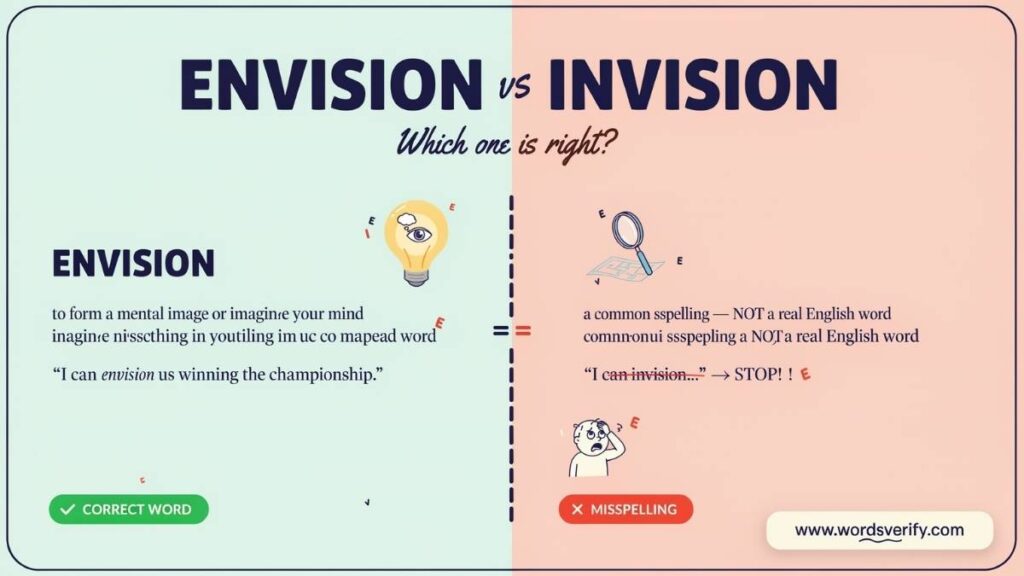
Have you ever known exactly what you wanted to say but suddenly questioned how to spell it? The confusion between envision vs invision can leave even confident writers second-guessing themselves. These two spellings look nearly identical, but there’s an important difference: envision is the standard English word for imagining a future, possibility, or outcome. Invision, on the other hand, is generally considered a misspelling when used with this meaning, although it may appear in proper names. In this guide, you’ll discover the correct spelling, understand each term, and explore clear examples to help you write with confidence.
Envision vs Invision The Main Difference
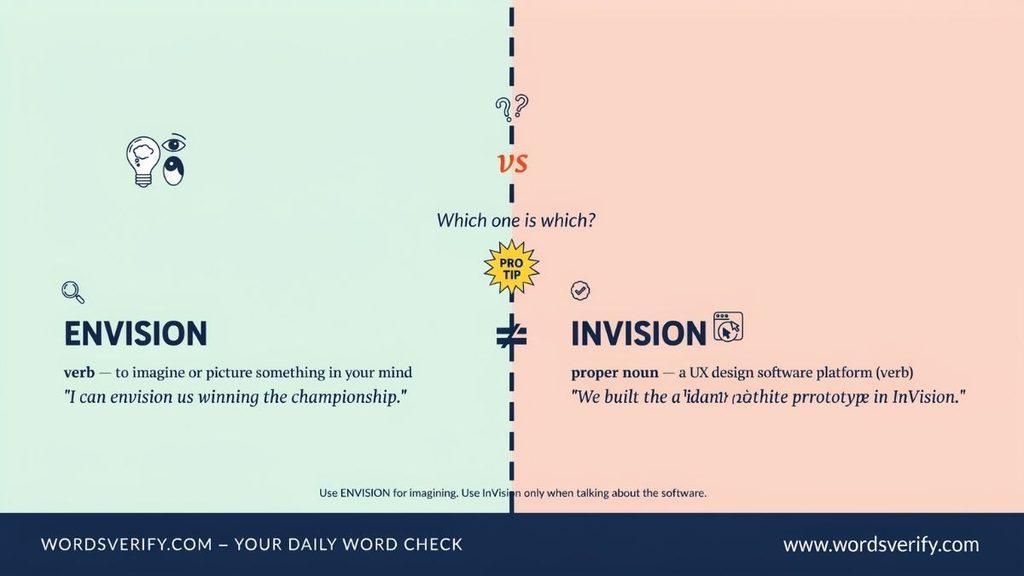
The main difference between envision vs invision comes down to meaning and context. Use envision when you want to express the idea of imagining something. Use InVision when referring to a specific name that officially uses that spelling.
Although the words look similar, they don’t serve the same purpose in standard English.
| Feature | Envision | Invision |
|---|---|---|
| Standard spelling of the verb meaning imagine | Yes | No |
| Meaning | To imagine or picture something mentally | Depends on the specific name or context |
| Part of speech | Verb | Often a proper noun when used as a name |
| Use in formal writing | Correct | Appropriate when referring to a specific name |
| Example | We envision a better future. | The article discusses InVision’s former design tools. |
The simplest rule is this: if you’re describing a goal, possibility, plan, or future outcome, choose envision.
For example:
- Correct: They envision a successful business that serves customers worldwide.
- Incorrect: They invision a successful business that serves customers worldwide.
- Correct in a naming context: The report refers to InVision, the former digital design software company.
The final example uses a proper name rather than an ordinary English verb. A name’s spelling doesn’t automatically make it a standard alternative to another word.
Bespectacled vs Bespeckled What’s the Difference?
Envision Meaning and Definition
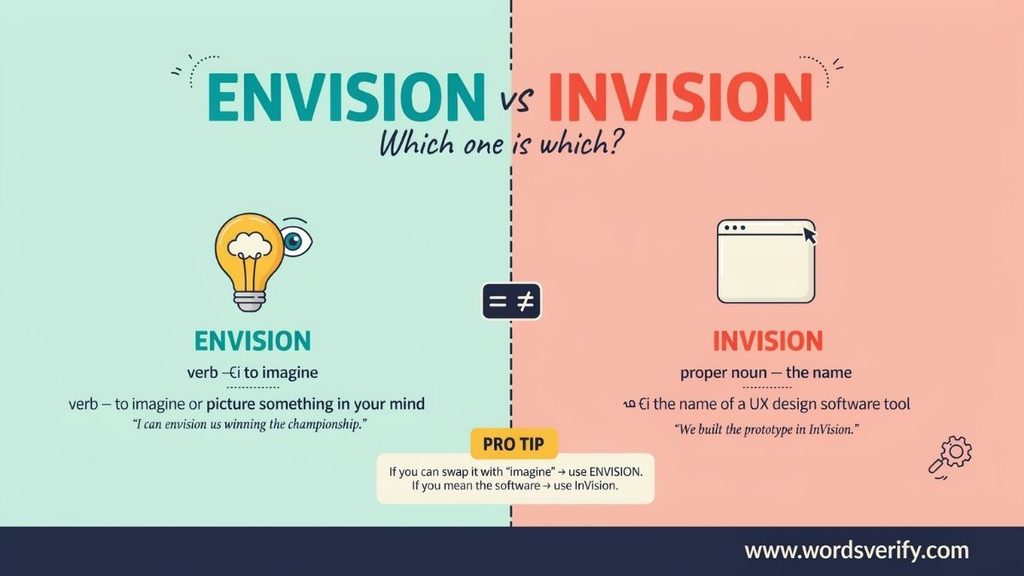
The Envision means to imagine or form a mental picture of something, especially a possible future event, situation, or result.
When you envision something, you mentally consider what it could look like or how it might develop. You don’t need to see it in front of you. Your mind creates the picture.
A student might envision graduating with honors. An entrepreneur might envision opening a second store. An architect might envision how an unfinished building will look once construction ends.
In each case, the person imagines a possible outcome before it becomes reality.
What Does Envision Mean in English?
The word has several closely related meanings:
- To imagine something that might happen.
- To picture a future situation in your mind.
- To form a mental image of a person, place, object, or idea.
- To consider a possible plan or outcome.
- To imagine what something could become.
Envision often appears in conversations about the future, but it isn’t limited to distant ambitions. You can envision the layout of a new room, the result of a difficult decision, or the way a presentation might look after you revise it.
Consider this sentence: She envisions a peaceful home surrounded by trees.
The sentence describes what she imagines. It doesn’t mean she already owns that home or knows that the situation will happen.
That distinction matters because envisioning describes an idea or possibility, not a guaranteed result.
Is Envision a Word?
Yes. Envision is a standard English verb used in everyday conversation, literature, education, business, and professional communication.
Here are a few examples:
- I envision a future filled with new opportunities.
- The team envisions a more affordable product.
- Can you envision how the room will look after the renovation?
- She envisioned a different outcome for the project.
The word is especially useful when you want to describe an idea that hasn’t become reality yet.
Is Envision a Verb?
Yes. Envision is a verb because it describes the mental act of imagining or picturing something.
It usually takes a direct object, which identifies what someone imagines.
- They envision a better solution.
- He envisions a career in medicine.
- We envision future growth.
In these sentences, a better solution, a career in medicine, and future growth are the things being imagined.
You can also use envision with an -ing form:
- I envision working with a talented team.
- She envisions building a business of her own.
These constructions describe an imagined action or future possibility.
How Do You Pronounce Envision?
In American English, envision is pronounced /ɪnˈvɪʒ.ən/. The stress falls on the second syllable, and the middle consonant has the same sound you hear in the word vision.
Pronunciation can help you recognize the word when someone says it aloud. However, sound alone won’t always tell you how to spell a word correctly. Learning the meaning and spelling together is a more reliable approach.
Visible vs Visable Which one Is Correct?
Invision Correct or Incorrect Spelling?
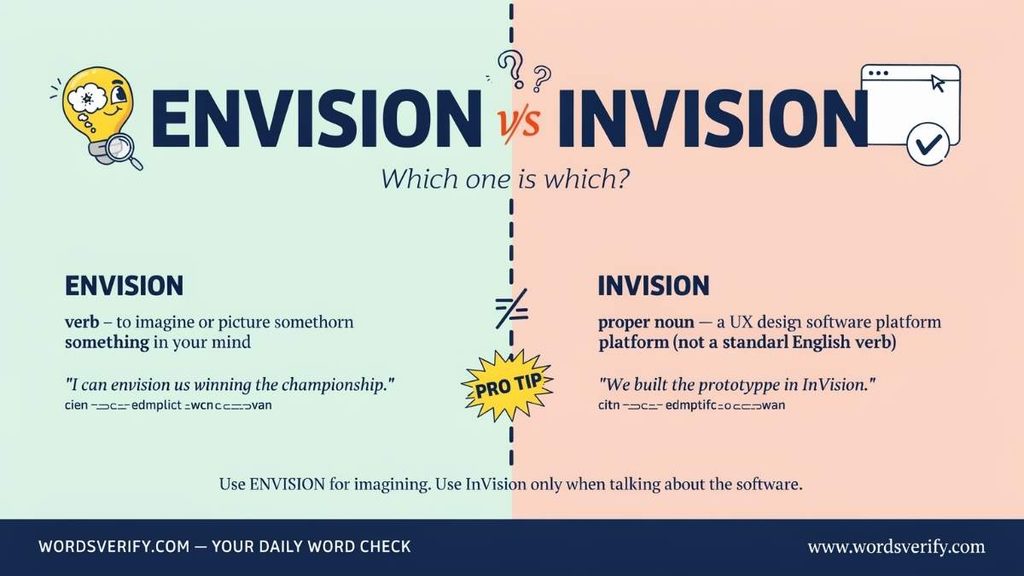
The answer depends on how you intend to use the word. If you’re trying to write the verb that means imagine, then invision is a misspelling in standard English. If you’re referring to an established name, the spelling may be intentional.
This distinction prevents a common mistake: treating every unfamiliar spelling as invalid regardless of context.
Is Invision a Real Word?
Invision is not the standard English spelling of the verb envision. You shouldn’t write I invision a better future when you mean that you imagine one.
However, InVision was the name of a digital product design and prototyping software company. The company announced that its services would shut down on December 31, 2024. Its name may still appear in historical discussions, software documentation, and articles about digital product design.
Here are three examples that show the distinction:
- Incorrect ordinary usage: I invision a more peaceful world.
- Correct ordinary usage: I envision a more peaceful world.
- Correct historical reference: The design team previously used InVision for prototyping.
In the third sentence, InVision refers to a named software product rather than serving as a substitute for envision.
Why Is Invision Considered a Misspelling?
English spelling can be frustrating because similar sounds don’t always correspond to the same letters. In this case, writers sometimes replace the opening e in envision with an i, producing a familiar-looking but nonstandard spelling.
The mistake can happen when someone types quickly, relies on memory, or encounters the word mainly in conversation. Seeing a name such as InVision can also make the alternative spelling seem plausible.
Still, standard English uses envision for the meaning to imagine or picture something mentally. When that’s what you intend, choose the established spelling.
Heros vs Heroes Which one Is Correct?
Envision Verb Forms Envisioned, Envisions, and Envisioning
Knowing the correct spelling of envision is only the first step. You also need to recognize its different verb forms so your sentences remain grammatically correct envision vs invision.
The word follows a regular pattern, which makes it easy to use once you learn the base form.
| Verb form | Correct spelling | Example |
|---|---|---|
| Base form | Envision | I envision a better solution. |
| Third-person singular, present tense | Envisions | She envisions a successful career. |
| Simple past tense | Envisioned | They envisioned a larger workspace. |
| Past participle | Envisioned | We have envisioned several possibilities. |
| Present participle | Envisioning | He is envisioning a new approach. |
These forms follow the standard pattern for regular English verbs. Add -s for the third-person singular present tense and -ed for the past tense and past participle. Add -ing to form the present participle.
What Is the Past Tense of Envision?
The past tense is envisioned, not invisioned.
Use envisioned when someone imagined a possibility at an earlier time.
- She envisioned a successful career in medicine.
- The founders envisioned a business that would serve customers around the world.
- We envisioned a different outcome before the negotiations began.
The word can also appear as a past participle with helping verbs:
- They have envisioned several ways to improve the service.
- A more efficient system was envisioned during the planning stage.
The spelling remains envisioned in every example. Changing the first letter to create invisioned doesn’t produce a standard alternative.
What Does Envisioning Mean?
Envisioning is the present participle of envision. It describes the act of imagining or picturing a possibility, often while planning for the future.
- Envisioning long-term plans requires careful thought.
- She is envisioning how the new office will function.
- The group spent the afternoon envisioning new opportunities.
It can also function as a gerund, which means an -ing verb form that acts as a noun. In the sentence Envisioning a goal is the first step in planning, the word names an activity.
What Does Envisions Mean?
Envisions is the present-tense form used with a singular third-person subject, such as he, she, it, or a singular noun.
- The company envisions future growth.
- He envisions a career in engineering.
- The architect envisions a building that uses less energy.
Don’t write she invisions or the company invisions. The correct forms are she envisions and the company envisions.
Minuscule vs Miniscule which one is correct?
When to Use Envision
Use envision when you want to express a mental picture, a future possibility, or a desired outcome. The word is especially helpful when you’re discussing plans that haven’t become reality yet.
Envision a Better Future
People often use envision when describing hopes for their families, communities, careers, or society.
- They envision a better future for their children.
- The community envisions a safer neighborhood.
- She envisions a brighter future after graduation.
In each sentence, the word expresses a possible future rather than a confirmed fact.
Envision Future Goals and Success
The word also works well when discussing ambitions and plans. It can describe what you hope to accomplish or what you want a project to become.
- He envisions future success in the technology industry.
- The students envision new opportunities after completing their training.
- The founders envision expanding into global markets.
- I envision building a successful business that solves a real problem.
Envisioning a goal doesn’t mean you’ll automatically achieve it. It describes the mental picture that can guide your planning and decisions.
Envision a Different Outcome
Sometimes envision refers to a possibility that differs from the present situation or expected result.
- The team envisions a different outcome if it changes its strategy.
- She envisioned a peaceful resolution to the disagreement.
- Can you envision a world without traffic jams?
This use is helpful when discussing hypothetical situations, creative ideas, and alternative plans.
Envision in Professional Writing
In business and academic writing, envision often appears in discussions of strategy, research, product development, and organizational goals.
Consider a project team preparing to redesign an outdated website. Its members might envision a faster, more accessible website with clearer navigation. That mental picture gives the team direction before it begins the detailed work.
Similarly, a researcher might envision a study that tests a new approach to an existing problem. The researcher still needs evidence and a workable method, but the imagined outcome helps shape the research question.
The word works well in professional writing when the subject involves a planned future, a possible result, or a proposed concept.
Indure vs Endure Which one Is Correct?
Envision vs Invision Examples Common Sentences and Corrections
The easiest way to understand the difference between envision vs invision to see how the words work in real sentences. The following examples cover everyday English, education, business, and creative work.
| Sentence | Correct or incorrect? | Explanation |
|---|---|---|
| I envision a brighter future. | Correct | Envision means to imagine a future possibility. |
| I invision a brighter future. | Incorrect | Use the standard spelling envision. |
| She envisions a successful career. | Correct | Envisions agrees with the singular subject she. |
| They envisioned a new solution. | Correct | Envisioned is the simple past tense. |
| We are envisioning a new office layout. | Correct | Envisioning describes an ongoing mental process. |
| He invisioned a different result. | Incorrect | The correct form is envisioned. |
| The company envisions entering new markets. | Correct | Envision describes a future business plan. |
| The designer used InVision in an earlier project. | Correct in historical context | InVision is a proper name. |
| The team invisions more customers next year. | Incorrect | The correct form is envisions. |
| Can you envision the possibilities? | Correct | Envision means to picture or consider possible outcomes. |
A Practical Example Choosing the Right Word at Work
Imagine that a marketing manager is writing a proposal for a new product. The manager wants to describe the product’s long-term potential.
The first draft says:
We invision a product that makes everyday tasks easier.
The sentence communicates the intended idea, but the spelling is wrong. The corrected version reads:
We envision a product that makes everyday tasks easier.
The change is small, yet it matters. In a proposal, spelling mistakes can distract readers and weaken the impression of care and professionalism. Correct word choice keeps the focus on the actual idea rather than the error.
Now imagine the proposal mentions an old design prototype created with InVision. In that case, the capitalized proper name may be appropriate in a historical description.
The lesson is simple: check the meaning first, then determine whether you’re writing an ordinary verb or referring to a specific name.
Envision vs Envisage Are They the Same?
Envision and envisage are both standard English verbs. They share a similar meaning, so writers can often use either word when describing a mental picture or a possible future situation.
The main difference is regional preference and tone. Envision is especially common in American English, while envisage is often associated with British English. Both can appear in formal writing.
Compare these examples:
- Envision: The council envisions a greener city.
- Envisage: The council envisages a greener city.
Both sentences describe the council’s idea of a possible future.
However, don’t confuse envisage with invision. Envisage is an established English word. Invision is not the standard spelling of the verb meaning imagine.
Envision vs Imagine What’s the Difference?
Envision and imagine overlap in meaning, but they don’t always carry the same emphasis.
Imagine is a broad, everyday verb. You can use it to think about a fictional situation, consider an unlikely possibility, or picture something in your mind.
Envision often emphasizes a particular possibility or outcome, especially one that someone hopes to achieve or plans to work toward.
| Word | Typical emphasis | Example |
|---|---|---|
| Envision | A possible future or intended outcome | She envisions leading her own company. |
| Imagine | A mental picture, possibility, or hypothetical situation | Imagine living on a remote island. |
Consider a student planning a career. The student might imagine what life would be like as a doctor, including the challenges and rewards. When the student envisions becoming a doctor, the wording may suggest a more defined future goal.
The distinction isn’t absolute. In many sentences, either word works naturally. Choose the one that best conveys the meaning you intend.
Envision vs Visualize vs Picture
Visualize and picture are useful alternatives to envision, but each has its own emphasis.
- Visualize means to form a mental image of something. It often appears in discussions of design, sports, preparation, and planning.
- Picture means to imagine what someone or something looks like or what a situation might be like. It sounds natural in everyday conversation.
- Envision means to imagine a possibility, concept, or future outcome. It often works well when describing a plan or ambition.
For example:
- The athlete visualizes crossing the finish line.
- Picture yourself walking along a quiet beach.
- The company envisions a more accessible service.
These examples illustrate typical differences, not strict rules. You could also say envision crossing the finish line or picture a more accessible service. The best choice depends on the context and the effect you want.
Synonyms for Envision
If you’re looking for alternatives to envision, start by identifying the exact meaning you want to express. Some related words describe mental images, while others focus on expectations or predictions.
| Synonym | Meaning | Example |
|---|---|---|
| Imagine | Form an idea or mental picture | Imagine a different future. |
| Visualize | Create a mental image | Visualize the finished design. |
| Picture | Imagine a person, place, or situation | Picture your ideal home. |
| Conceive | Form an idea or concept | They conceived a new approach. |
| Foresee | Recognize or anticipate something before it happens | She foresaw potential difficulties. |
| Anticipate | Expect something or prepare for it | The team anticipated higher demand. |
| Dream | Imagine or hope for something desirable | He dreams of opening a restaurant. |
| Predict | State what you expect will happen | Analysts predict continued growth. |
| Expect | Believe something is likely to happen | We expect the project to finish soon. |
| Envisage | Imagine a possible situation or future | They envisage a more efficient system. |
These words aren’t interchangeable in every sentence. For instance, envisioning a successful launch means imagining the desired result. Predicting a successful launch means expressing an expectation about what will happen.
That difference matters. A vision describes a possibility or ambition, while a prediction makes a claim about an expected outcome.
Scary vs Scarry which one is correct?
Common Spelling Mistakes and How to Avoid Them
The confusion between envision vs invision is one example of how small spelling differences can affect clarity. A few practical habits can help you avoid the error.
Writing Invision Instead of Envision
Incorrect: We invision a better way to serve our customers.
Correct: We envision a better way to serve our customers.
The fix is simple: remember that the standard verb begins with en.
Using Invisioned as the Past Tense
Incorrect: She invisioned a different outcome.
Correct: She envisioned a different outcome.
Because envision is a regular verb, you form the past tense by adding -ed. The same rule gives you envisioned as the past participle.
Panic vs Panick Which one Is Correct?
Assuming a Familiar-Looking Word Must Be Correct
A spelling may look plausible without being standard. When you’re unsure, check a reliable dictionary instead of relying entirely on how the word looks or sounds.
This is especially useful in professional writing, where one incorrect word can distract readers from an otherwise strong message.
Confusing a Proper Noun With an Ordinary Verb
A proper noun identifies a particular person, organization, product, or other named entity. Its spelling may differ from an ordinary vocabulary word.
For example, InVision was the name of a software company. That doesn’t make invision a standard alternative to the verb envision.
The reverse is also true: don’t automatically change an official name just because it resembles a spelling mistake. Verify the intended reference.
Breeched vs Breached which one is correct ?
How to Remember the Correct Spelling of Envision
A good memory trick can save you from repeating the same spelling mistake. Fortunately, you don’t need a complicated rule to remember envision.
Try these simple techniques:
- Connect envision with end result. Both words begin with en. When you envision something, you picture a possible end result.
- Remember the word vision. Envision contains vision, which can remind you of forming a mental picture.
- Practice with a familiar goal. Write a sentence such as I envision a successful future. Connecting the spelling to a meaningful sentence makes it easier to remember.
- Learn the verb forms together. Practice envision, envisions, envisioned, and envisioning as a group. This helps prevent errors such as invisioned.
- Check the context. If you encounter InVision with a capital I and V, ask whether the text refers to a specific name rather than the ordinary verb.
The most useful reminder is simple: when you imagine your future, you envision it.
Shiney vs Shiny which one is correct?
Practice session Envision vs Invision
Test your understanding of the difference between “envision” vs “invision.” Fill in each blank with the correct word or form of “envision.” Check your answers in the answer key afterward.
Fill in the blanks
1. I can ______ a future where everyone has access to clean drinking water.
2. She ______ herself becoming a successful writer one day.
3. The team is ______ a more efficient way to complete the project.
4. Can you ______ what our city might look like in 20 years?
5. He ______ a peaceful life in the countryside.
6. The architect ______ a modern house with large windows and an open kitchen.
7. We are ______ new opportunities for our growing business.
8. They ______ a world where technology makes education accessible to everyone.
9. It’s difficult to ______ the final result without seeing the design.
10. She has always ______ herself working in the medical field.
11. The company ______ expanding into international markets.
12. I couldn’t ______ how the unfinished building would look when completed.
13. The students are ______ creative solutions to environmental problems.
14. He ______ a future filled with adventure and exciting opportunities.
15. Can you ______ yourself living in another country?
16. The designer ______ a simple but elegant website.
17. We ______ that the new policy will improve workplace communication.
18. She is ______ a career that combines science and creativity.
19. The coach ______ his team winning the championship.
20. They ______ a better system for managing their daily tasks.
21. I never ______ that a small idea could become such a successful business.
22. The organization ______ a community where everyone feels welcome.
23. He is ______ the possibilities before making a final decision.
24. Before starting the project, we ______ the outcome we wanted to achieve.
25. Remember to use “envision” when you mean to mentally picture something, rather than the commonly mistaken spelling “______.”
Answers
- Envision
- Envisions
- Envisioning
- Envision
- Envisions
- Envisioned
- Envisioning
- Envision
- Envision
- Envisioned
- Envisions
- Envision
- Envisioning
- Envisions
- Envision
- Envisioned
- Envision
- Envisioning
- Envisions
- Envision
- Envisioned
- Envisions
- Envisioning
- Envisioned
- Invision
Here’s a trusted source for clear more words Comparison:
FAQs
Is “invision” ever acceptable in professional writing?
“Invision” is generally incorrect when you mean to imagine or picture something mentally. However, “InVision” may be correct when referring to a company, product, or proper name.
Can “envision” be used in academic writing?
Yes. “Envision” works well in academic writing when discussing possible outcomes, future developments, research goals, or proposed solutions. For example: “Researchers envision new methods for reducing plastic waste.”
Does “envision” have a noun form?
The related noun is “envisioning,” which describes the act or process of imagining something. “Vision” is another related noun, although it can refer to eyesight, an imagined future, or a guiding goal.
Is “envisioned” the same as “planned”?
Not exactly. “Envisioned” means imagined or pictured something as a possibility. “Planned” suggests that someone has decided on steps to achieve a particular result. You can envision a business without having a detailed plan to launch it.
Can you envision something that is unlikely to happen?
Yes. You can envision realistic possibilities as well as unlikely or imaginary situations. The word describes forming a mental picture of something, not how probable it is.
Is “envisioning” the same as daydreaming?
They overlap, but they aren’t identical. Daydreaming often involves letting your thoughts wander without a specific purpose. Envisioning usually involves imagining a particular possibility, outcome, goal, or future situation.
What prepositions commonly follow “envision”?
“Envision” usually takes a direct object without a preposition. For example, say “I envision a better future” rather than “I envision about a better future.” You can also use it with a clause, as in “I envision that the project will succeed.”
Can “envision” describe a company’s future?
Yes. Businesses often use “envision” to describe their long-term goals, ambitions, or expectations. For example: “The company envisions a future powered by clean energy.”
Is “envision” appropriate in everyday conversation?
Absolutely. Although it often appears in professional or academic writing, it also sounds natural in everyday speech. You might say, “I can envision us living near the beach someday.”
How can you avoid confusing “envision” with “invision”?
envision vs invision Remember that the standard verb for mentally picturing something is “envision.” When writing about a dream, goal, or possible future, choose “envision.” Use “InVision” only when the proper name or specific reference calls for it.
Puting vs Putting Which one Is Correct?
Conclusion
The difference between envision vs invision may seem like a tiny spelling puzzle, but now you know how to solve it! Envision is the correct word when you mean to imagine a future, picture a possibility, or plan for something you hope to achieve. envision vs invision ,Invision is generally a misspelling in this context, although it may appear in proper names. Remember, one little letter can make a big difference in clear writing. So, the next time you envision success, a dream vacation, or a brighter future, give your spelling the same attention. Your ideas deserve to shine without a spelling mistake stealing the spotlight!

Lisa AJS is an experienced blogger and language enthusiast at Words Verify, dedicated to making grammar simple, practical, and enjoyable. She writes engaging content on commonly confused words, grammar mistakes, word meanings, and everyday language challenges.