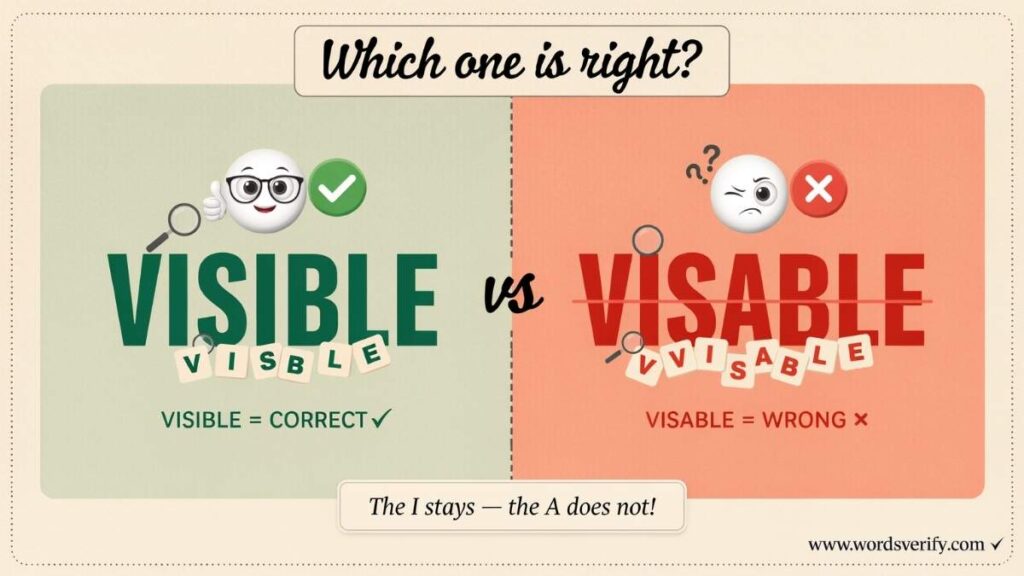
Have you ever looked at a word so long that you started questioning its spelling? If you’re confused about visible vs visable, you’re not alone. One tiny vowel can turn an ordinary word into a surprisingly tricky spelling challenge! Fortunately, solving this mystery doesn’t require a dictionary detective or a grammar degree. Visible is the correct spelling, meaning something can be seen or noticed, while visable is a common misspelling. Although the two may look similar, only one is accepted in standard English. Let’s explore the meaning of visible, understand why this spelling mistake happens, and discover an easy way to remember the correct form.
Quick Answer Visible vs Visable?
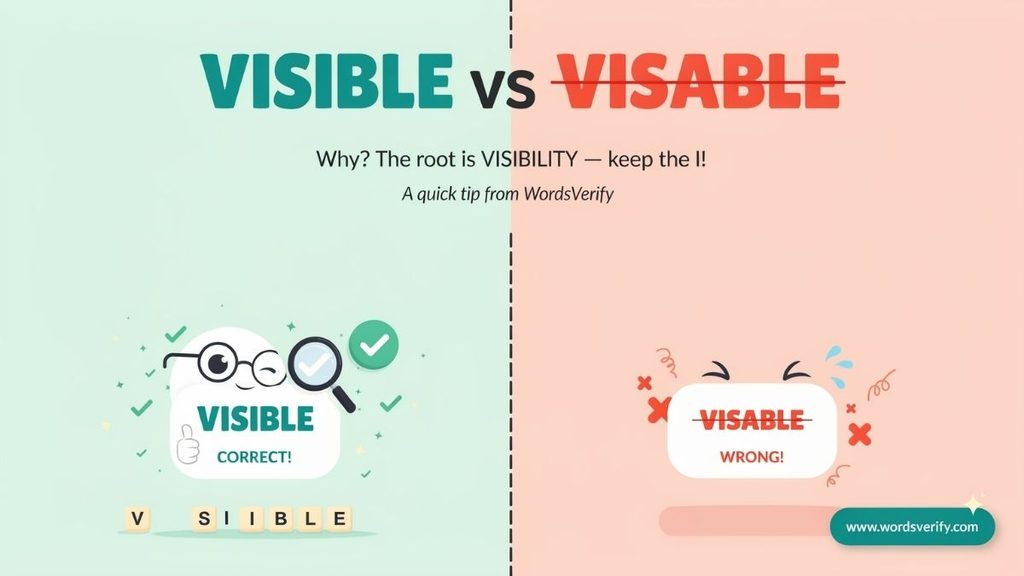
Visible vs Visable , Visible is the correct spelling. Visable is a misspelling when used to mean something that can be seen or noticed.
For example:
- Correct: The stars were visible after sunset.
- Incorrect: The stars were visable after sunset.
- Correct: Her hard work produced visible results.
- Incorrect: Her hard work produced visable results.
The spelling remains the same in American and British English. You don’t need to change it depending on your audience or location.
| Feature | Visible | Visable |
|---|---|---|
| Standard spelling | Correct | Incorrect for the intended meaning |
| Meaning | Able to be seen or noticed | No standard meaning as a substitute for visible |
| American English | Accepted | Not accepted as a spelling variant |
| British English | Accepted | Not accepted as a spelling variant |
| Example | The mark is visible. | The mark is visable. |
The rule is easy to remember: when you mean something can be seen, write visible with an i.
Heros vs Heroes Which one Is Correct?
What Does Visible Mean?
Visible means able to be seen, observed, or noticed. The word can describe physical objects as well as changes, effects, and feelings that people can recognize.
For example, a bird sitting on a branch is visible if you can see it. Similarly, a person’s excitement may be visible through a wide smile or energetic behavior.
The word doesn’t always mean something is easy to see. An object might be visible from a short distance but difficult to recognize from far away. Lighting, weather, distance, and other conditions can affect how clearly you see it.
Visible as Something You Can See
In its most direct sense, visible describes something that your eyes can detect.
Consider these examples:
- The mountains were visible from our hotel window.
- A small crack was visible in the glass.
- The road signs remained visible throughout the journey.
- The lighthouse was visible from the shore.
- Several stars became visible when the clouds cleared.
- The photographer made sure the subject’s face remained visible.
In each sentence, visible refers to something that can be seen under particular conditions.
Imagine driving through thick fog. A road sign might become visible only when you get close to it. The sign hasn’t changed, but the weather has affected how easily you can see it.
Visible as Something Noticeable
Visible can also describe changes or effects that people recognize without necessarily seeing a separate physical object.
For instance, you can’t hold progress in your hand. However, you can notice visible progress when someone improves a skill, completes more work, or becomes more confident.
Here are a few examples:
- The new training program produced visible improvements in employee performance.
- Her disappointment was visible on her face.
- The team made visible progress during the first month.
- There was a visible difference between the two designs.
- The new policy had a visible effect on customer service.
In these examples, visible means noticeable or apparent. The word helps readers understand that a change or effect can be recognized.
Still, be careful when choosing it. If you have measured an improvement using specific data, measurable may be more precise than visible. The two words can overlap, but they don’t mean exactly the same thing.
Visible Light and the Human Eye
The word visible also appears in science, especially in the phrase visible light.
Visible light is the portion of the electromagnetic spectrum that humans can detect with their eyes. Its approximate wavelength range is 380 to 700 nanometers, although the exact limits vary among individuals and viewing conditions.
This explains why you can see a rainbow but can’t directly see radio waves or X-rays with your naked eye. Those forms of electromagnetic radiation fall outside the ordinary range of human vision.
An object can also be visible without being easy to see. A tiny mark on a dark surface may be technically visible but difficult to notice. Likewise, a distant building might become more visible when the fog clears.
Minuscule vs Miniscule which one is correct?
Why Is Visable Incorrect?
The confusion between visible vs visable often comes from the way English spelling works. Both forms look plausible, and the difference may not stand out when you’re writing quickly.
However, English spelling doesn’t always follow pronunciation in a predictable way. Some words contain letter combinations that you simply need to learn through reading, writing, and practice.
The standard spelling is visible, which ends in -ible rather than -able. When someone writes visable with the same intended meaning, the result is a spelling mistake.
Is Visable a Real Word?
If you’re wondering whether visable is a real word, the practical answer is no: it isn’t the standard spelling of the adjective meaning able to be seen.
You might encounter it in informal messages, online posts, or documents that contain spelling errors. Its appearance in a sentence doesn’t make it an accepted spelling alternative.
There is one distinction worth remembering. Someone could use Visable as a brand name, username, or invented term. A proper name can have its own spelling, but that doesn’t change the standard spelling of the ordinary English adjective.
For everyday writing, use visible.
What Does Visable Mean?
When someone searches for the meaning of visable, they’re usually trying to understand visible or check which spelling is correct.
For example, consider this sentence:
“The warning label is visable from the entrance.”
The intended meaning is clear, but the spelling is wrong. The corrected sentence reads:
“The warning label is visible from the entrance.”
The same correction applies in other situations:
- Incorrect: No damage was visable.Correct: No damage was visible.
- Incorrect: The results became visable after testing.Correct: The results became visible after testing.
- Incorrect: Keep your identification card visable.Correct: Keep your identification card visible.
A spelling checker may catch the error, but it’s helpful to understand why the correction is necessary rather than simply accepting the suggestion.
Indure vs Endure Which one Is Correct?
Visible vs Visable What’s the Difference?
The difference between Visible vs Visable is spelling, not meaning. One is the standard English word, while the other is a common error made when someone intends to write the correct form.
Neither American nor British English uses visable as a standard alternative. You don’t need to memorize separate definitions or worry about regional spelling rules in this case.
The following comparison makes the distinction clear.
| Question | Visible | Visable |
|---|---|---|
| Is it the standard spelling? | Yes | No |
| Does it mean able to be seen? | Yes | Not as a standard English form |
| Is it appropriate in formal writing? | Yes | No, unless reproduced as a name or quoted form |
| Example | The stain is visible. | The stain is visable. |
If you’re ever unsure which spelling to choose, remember that visible is the form used in standard English.
Scary vs Scarry which one is correct?
How to Spell Visible Correctly
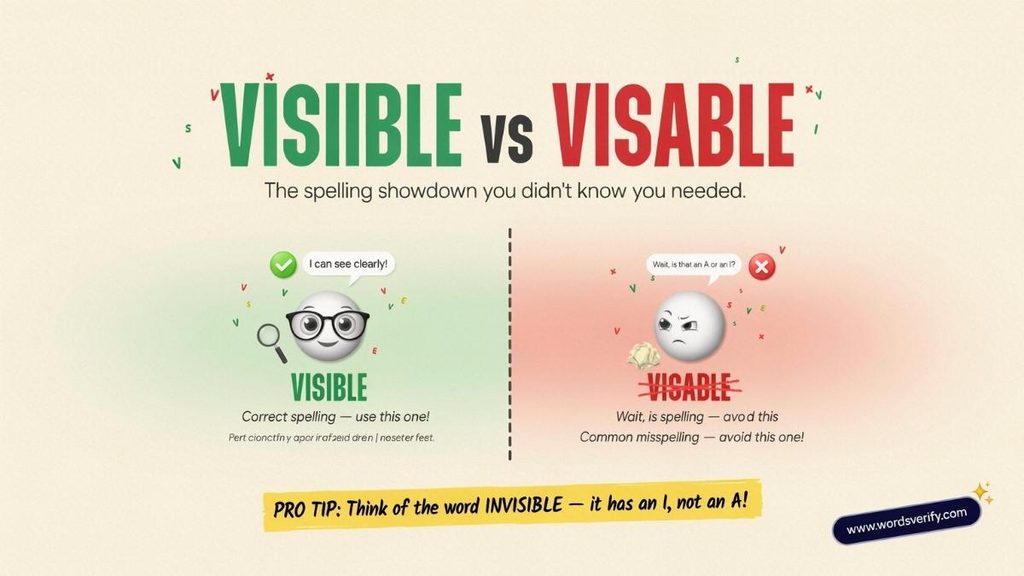
The correct spelling is v-i-s-i-b-l-e. The word contains seven letters, and the final syllable uses i rather than a.
One simple way to remember it is to connect visible with invisible. Both words share the same spelling pattern.
- Visible: The footprints were visible in the sand.
- Invisible: The footprints became invisible after the tide came in.
Learning related words together can make spelling easier. Instead of memorizing one word in isolation, you create a connection that helps you recall the correct form later.
Why Is Visible Spelled With an I?
The spelling of visible reflects the word’s history. It comes through French from the Latin word visibilis, meaning capable of being seen. The Latin word is related to videre, meaning to see.
This connection explains why visible belongs to a family of words associated with sight.
- Visible describes something that can be seen.
- Visibility refers to the state or degree of being seen.
- Visibly describes something that can be noticed through observation.
- Vision refers to the ability to see or an idea of what the future might look like.
- Visual describes something related to sight.
- Invisible describes something that cannot be seen under the relevant conditions.
These words share a connection with sight, but each has its own meaning and grammatical role.
You don’t need to memorize Latin to spell visible correctly. Learning the standard spelling and using it in sentences will usually be enough.
Words Ending in -ible and -able
The visible vs visable confusion is part of a larger spelling challenge involving the endings -ible and -able.
Both endings appear in adjectives. They can express the idea that something can be done or has a particular quality. However, English doesn’t have one simple rule that predicts every word’s ending.
Examples of words ending in -ible include:
- Visible
- Audible
- Flexible
- Possible
- Reversible
- Accessible
Examples of words ending in -able include:
- Readable
- Washable
- Enjoyable
- Predictable
- Adaptable
- Comfortable
Many -able words connect clearly to familiar base words. For example, readable relates to read, while washable relates to wash. In these cases, the ending helps describe something that can be read or washed.
Words ending in -ible often have less obvious connections to modern base words because their spellings reflect their history. However, this is only a general pattern, not a rule without exceptions.
| Word | Ending | Meaning |
|---|---|---|
| Visible | -ible | Able to be seen |
| Audible | -ible | Able to be heard |
| Flexible | -ible | Able to bend or adapt |
| Readable | -able | Easy or possible to read |
| Washable | -able | Able to be washed |
| Predictable | -able | Able to be predicted |
Don’t rely on the ending alone to guess a word’s spelling. English has plenty of exceptions, so checking a dictionary is often the safest option.
Breeched vs Breached which one is correct ?
Examples of Visible in Sentences
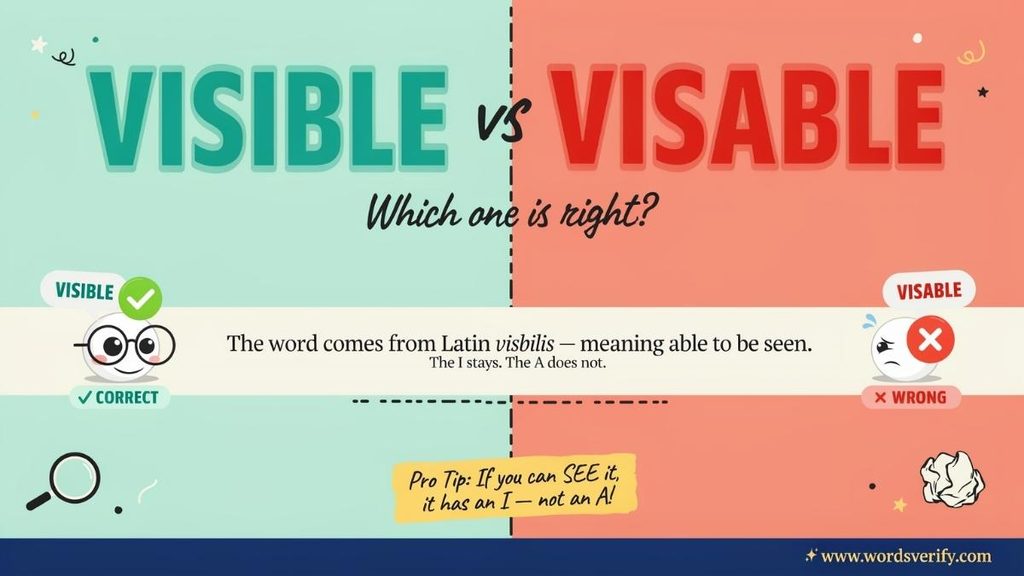
A definition tells you what a word means, but examples show you how to use it naturally. Visible appears in everyday conversations, schoolwork, professional writing, and descriptions of the world around us Visible vs Visable.
Examples of Physical Visibility
These sentences describe something that can be seen directly.
- The full moon was visible above the trees.
- The warning label must remain visible at all times.
- A faint scratch became visible under the bright light.
- The ship was barely visible on the horizon.
- Her reflection was visible in the glass door.
- The trail markers were clearly visible along the path.
- Several stars became visible after the clouds cleared.
- The photographer made sure the subject’s face remained visible.
The surrounding words help explain how easily something can be seen. For example, barely visible suggests that an object is difficult to see, while clearly visible suggests that it’s easy to recognize.
Examples of Figurative Visibility
Visible can also describe changes, feelings, and results.
- The new schedule led to visible improvements in attendance.
- His nervousness was visible during the interview.
- The team made visible progress on the project.
- The policy had a visible effect on customer service.
- A visible difference emerged between the first and second drafts.
- The community showed visible support for the local fundraiser.
- Her confidence became more visible as she gained experience.
- The company’s commitment to safety was visible in its daily practices.
These examples show that visible doesn’t always refer to something you can touch or identify as a separate object. It can describe an effect that people recognize through behavior or results.
Visible in Professional and Academic Writing
In professional writing, visible can describe results, changes, and signs without making a sentence unnecessarily complicated.
For example:
- The redesign produced visible improvements in navigation.
- The report identifies visible signs of wear.
- Researchers observed a visible change in the sample.
- The new process made progress more visible to the team.
However, choose your words carefully when accuracy matters. If you mean that a change can be measured, measurable may be more precise. If you mean that the evidence supports a conclusion, evident or demonstrable may fit better.
For example, “The program produced visible improvements” suggests that people could notice the improvements. “The program produced measurable improvements” suggests that someone assessed the results using measurements or defined indicators.
The meanings overlap, but the words aren’t interchangeable in every situation.
Shiney vs Shiny which one is correct?
Common Mistakes With Visible
Even confident writers make spelling mistakes, especially when a word looks as though it should follow a familiar pattern. Recognizing common errors can help you catch them before they appear in your final draft of Visible vs Visable.
Writing Visable Instead of Visible
This is the main mistake discussed in this guide. It often happens when writers choose a instead of i in the final syllable.
Incorrect: The damage was visable from the street.
Correct: The damage was visible from the street.
A simple proofreading technique is to search your document for visable. If you intend to describe something that can be seen, replace it with visible.
Guessing the Spelling From Pronunciation
English spelling and pronunciation don’t always match neatly. Some words contain silent letters, unexpected vowel combinations, or historical spellings that aren’t obvious from their sounds.
Sounding out a word can help, but it won’t always give you the correct spelling.
If you regularly confuse visible with visable, pay attention to the written form when reading. Seeing the correct spelling in books, articles, and other well-edited material can help you remember it.
Confusing Visible With Visibility and Visibly
Related words often share a spelling pattern, but each one has a different grammatical role.
| Word | Part of speech | Example |
|---|---|---|
| Visible | Adjective | The damage is visible. |
| Visibility | Noun | Fog reduced visibility. |
| Visibly | Adverb | She was visibly relieved. |
| Invisible | Adjective | The object became invisible. |
Using the wrong form can create a grammatical problem even if you spell the word correctly.
For example, “The improvement was visibility” doesn’t work because the sentence needs an adjective rather than a noun. The correct sentence is “The improvement was visible.”
Similarly, “He was visible upset” should be “He was visibly upset.” The adverb visibly modifies the adjective upset.
Trusting Spell-Check Without Reviewing the Sentence
Spelling and grammar checkers can catch many errors, including visable. However, automated tools sometimes miss mistakes or suggest corrections that don’t fit the intended meaning.
For better results:
- Run a spelling and grammar check.
- Review each suggested correction.
- Read the sentence in context.
- Confirm the word’s meaning when necessary.
- Proofread the final version again.
These steps are particularly useful when preparing school assignments, job applications, business reports, or other documents where accuracy matters.
Puting vs Putting Which one Is Correct?
Visible Synonyms What Words Can Replace Visible?
Several words Visible vs Visable have meanings similar to visible, but the best choice depends on what you want to communicate. Some emphasize physical sight, while others focus on recognition, clarity, or evidence.
Common Synonyms of Visible
- Apparent: Something seems clear or can be recognized from the available information.Example: The cause of the delay became apparent after the meeting.
- Noticeable: Something attracts attention or is easy to observe.Example: There was a noticeable improvement in sound quality.
- Observable: Something can be seen or detected through observation.Example: Researchers recorded an observable change in the sample.
- Perceptible: Something can be detected by the senses or recognized, even if it’s subtle.Example: A perceptible shift in temperature occurred overnight.
- Evident: Something is clear from the available facts or signs.Example: Her experience was evident in the quality of her work.
- Obvious: Something is easy to recognize or understand.Example: The error became obvious when we compared the totals.
- Conspicuous: Something stands out and attracts attention.Example: His bright yellow jacket was conspicuous in the crowd.
- Discernible: Something can be distinguished, sometimes with careful examination.Example: A discernible pattern appeared in the data.
- Detectable: Something can be discovered or identified, sometimes with special equipment.Example: The chemical was detectable in the water sample.
- Recognizable: Something can be identified from familiar features.Example: The building remained recognizable after the renovations.
- Manifest: Something is clear or plainly demonstrated.Example: The effects of the storm were manifest throughout the region.
Are Visible Synonyms Always Interchangeable?
No. Although these words overlap in meaning, each carries a slightly different shade of meaning.
A distant bird may be visible through binoculars. A tiny change in a graph may be discernible after careful examination. A bright sign may be conspicuous because it attracts attention, while a conclusion may be evident because the facts support it.
Choosing the right synonym helps you communicate more precisely.
Also, don’t treat transparent as a universal synonym for visible. A transparent window allows light to pass through it, but the window itself may still be visible. In other contexts, transparent can mean open or easy to understand.
Panic vs Panick Which one Is Correct?
What Is the Opposite of Visible?
The most direct opposite of visible is invisible. It describes something that can’t be seen under the relevant conditions.
Examples include Visible vs Visable:
- Some gases are invisible to the naked eye.
- The writing became invisible when the paper dried.
- The tiny particles were invisible without a suitable instrument.
Other words can express related ideas, but their meanings differ slightly.
- Hidden: Kept out of sight or difficult to find.
- Concealed: Deliberately covered or kept secret.
- Obscured: Made difficult to see because something blocks or clouds the view.
- Unnoticeable: Not attracting attention or being readily noticed.
For example, a box behind a curtain is hidden. A mountain covered by thick fog is obscured. A faint mark on a pale wall might be visible but unnoticeable unless someone looks closely.
This distinction matters because something can be visible without being obvious. These words describe related ideas, not identical conditions.
Visible, Visibility, Visibly, and Vision What’s the Difference?
English vocabulary becomes easier to understand when you recognize how related words work together or Visible, visibility, visibly, and vision share a connection with sight, but they serve different purposes in a sentence.
Visible
Visible is an adjective. It describes a person, object, feature, change, or effect that can be seen or noticed.
Example: The fingerprints were visible on the glass.
Visibility
Visibility is a noun. It describes the state or degree to which something can be seen. In weather reports, it often refers to how far a person can see under current conditions.
Example: Heavy rain reduced visibility on the highway.
The word also appears in business and technology. A manager might discuss project visibility, meaning how easily team members can see the status of a task or process.
Visibly
Visibly is an adverb. It describes an action, state, or change that can be seen or noticed.
Example: The audience was visibly excited.
In this sentence, visibly modifies excited and explains how the audience’s excitement appeared to others.
Invisible
Invisible is an adjective formed with the negative prefix in-. It describes something that cannot be seen under the relevant conditions.
Example: The clear liquid left an invisible residue.
The word doesn’t necessarily mean that something can never be seen. Some substances are invisible to the naked eye but detectable with special equipment.
Vision
Vision is a noun with several meanings. It can refer to the ability to see, the way someone sees something, or an idea of what the future could look like.
Examples:
- Regular eye examinations can help monitor changes in vision.
- The architect presented her vision for the new building.
- The organization has a clear vision for its future.
These words belong to a related vocabulary family, but you shouldn’t substitute one for another without checking the sentence’s grammar and intended meaning.
A Practical Example Correcting Visible in Everyday Writing
Imagine a student preparing a report about a school garden. The first draft includes this sentence:
“The visable growth in the plants shows that the new watering schedule is working.”
The intended meaning is clear, but visable is incorrect. A simple correction produces this sentence:
“The visible growth in the plants shows that the new watering schedule is working.”
The spelling is now correct. However, the writer may also want to consider whether the sentence says exactly what the evidence supports.
If the student has noticed that the plants look larger, the revised sentence makes sense. If the student has measured plant height over several weeks, a more precise sentence might be:
“The plants showed measurable growth after the school introduced the new watering schedule.”
The difference is useful. Visible growth describes a change people can see, while measurable growth indicates that someone recorded and compared measurements.
This example illustrates two important lessons.
- Correct spelling improves readability. The accepted form is visible, not visable.
- Precise vocabulary strengthens meaning. The best word depends on the evidence and the point you want to make.
Spelling accuracy is only one part of clear writing. Choosing words that fit the facts matters just as much.
Vendor vs Vender which one is correct?
Is Visible Spelled Differently in American and British English?
No. The standard spelling is visible in both American and British English.
Some English words have recognized regional spelling differences. For example, American English generally uses color, while British English generally uses colour. Visible doesn’t follow that pattern.
Use visible in American school assignments, British essays, professional emails, academic papers, business reports, and international communications.
If your document follows a particular style guide, follow its overall conventions for punctuation, vocabulary, and regional spelling. You won’t need to change visible.
How to Improve Your English Spelling Accuracy
The visible vs. visable mistake may seem small, but it offers a useful lesson about learning commonly confused words. Instead of relying entirely on how a word sounds, combine reading, writing, proofreading, and reference tools.
Read Well-Edited English Regularly
Reading exposes you to standard spelling in context. Pay attention to unfamiliar words rather than simply moving past them.
When you encounter visible, notice how it appears alongside words such as clearly, barely, physically, and easily. These combinations help you remember how the word works in real sentences.
Keep a Personal List of Common Errors
If you repeatedly confuse particular words, record them in a notebook or digital document.
Your list might include:
- Visible, not visable.
- Separate, not seperate.
- Definitely, not definately.
- Necessary, not neccessary.
- Receive, not recieve.
Reviewing your personal list before submitting important writing can help you catch familiar mistakes quickly.
Learn Words in Context
Memorizing isolated letters can help, but sentences give words meaning.
Practice with examples such as these:
- The label must remain visible.
- Fog reduced visibility.
- She was visibly relieved.
- The object became invisible.
This approach reinforces spelling, grammar, and vocabulary at the same time.
Use Reliable Dictionaries and Writing Tools
When you’re unsure about the correct spelling, consult a reputable dictionary. Established dictionaries provide definitions, pronunciation guidance, and usage information.
A dictionary can also help you distinguish a standard word from a typo, identify related forms, and check how a word functions in different contexts.
Spelling tools are useful for catching mistakes, but don’t let them do all the thinking. A checker can suggest a correction; you still need to confirm that the corrected word expresses your intended meaning.
Proofread for Meaning as Well as Spelling
After checking spelling, read the sentence for clarity. Ask yourself:
- Does the word fit the meaning I intend?
- Is it grammatically correct in this sentence?
- Would a more precise word communicate the idea better?
- Have I repeated the same word too many times?
- Could a reader misunderstand the sentence?
These questions improve more than spelling. They help you develop stronger vocabulary and writing skills.
Worse vs Worst which one is correct?
Practice Session Visible vs Visable
fill in the blanks word or form Visible vs Visable
Fill in the Blanks
Choose the correct spelling to complete each sentence.
- The moon was clearly __________ through the clouds.
- The mountains became __________ after the fog lifted.
- A tiny crack was __________ on the glass.
- The warning sign must remain __________ to drivers.
- Her happiness was __________ from her smile.
- The stars were barely __________ in the night sky.
- There was a __________ difference between the two paintings.
- The lighthouse remained __________ from the shore.
- The stain was still __________ after washing the shirt.
- The teacher made the instructions __________ to everyone.
- The damage wasn’t immediately __________ to the naked eye.
- The bird was hardly __________ among the green leaves.
- The company wants to make its brand more __________ online.
- The scratches became __________ in bright sunlight.
- The road markings must be __________ at night.
- His disappointment was __________ during the conversation.
- The house was __________ from the main road.
- The fingerprints became __________ under special lighting.
- Her progress became __________ after several weeks of practice.
- The label should be __________ on the package.
- The rainbow became __________ when the rain stopped.
- The tiny letters weren’t easily __________ on the screen.
- The changes became __________ after the renovation.
- The stars were clearly __________ on a cloudless night.
- Remember that __________ is the correct spelling, not visable.
Answers
- Visible
- Visible
- Visible
- Visible
- Visible
- Visible
- Visible
- Visible
- Visible
- Visible
- Visible
- Visible
- Visible
- Visible
- Visible
- Visible
- Visible
- Visible
- Visible
- Visible
- Visible
- Visible
- Visible
- Visible
- Visible
Here’s a trusted source for clear more words Comparison:
FAQs
Why is “visible” spelled with an “i” instead of an “a”?
“Visible” comes from the Latin word visibilis, meaning “that may be seen.” Its spelling follows its historical word origin rather than a simple sound-based rule. That’s why “visable” is a common misspelling rather than an accepted standard form.
Is “visable” ever considered a correct English word?
No. In standard modern English, “visable” isn’t the accepted spelling of the adjective meaning “able to be seen.” Use “visible” in formal writing, school assignments, emails, and everyday communication.
What is the difference between “visible” and “visibility”?
“Visible” is an adjective that describes something you can see or notice. “Visibility” is a noun that describes the state or degree of being visible.
- The mountain is visible from our window.
- Heavy fog reduced visibility on the highway.
What part of speech is “visible”?
“Visible” is an adjective. It describes a person, object, feature, or change that can be seen, noticed, or recognized.
Example: “The cracks became visible after the paint dried.”
Can something be visible without being easy to see?
Yes. Something can be visible but difficult to distinguish because of distance, darkness, fog, or other obstacles. For example, a ship may be visible on the horizon even though you can barely make out its shape.
What does “visibly” mean, and how is it different from “visible”?
“Visibly” is an adverb that describes how something happens or appears. “Visible” is an adjective that describes something that can be seen.
- Her relief was visible on her face.
- She was visibly relieved after hearing the news.
What is the difference between “visible” and “noticeable”?
“Visible” usually means something can be seen. “Noticeable” means something attracts attention or is easy to recognize. A small mark might be visible under bright light but not noticeable in ordinary conditions.
Can “visible” describe something you cannot physically see?
Yes. Writers often use “visible” figuratively to describe things that become apparent or recognizable. For example, “The team’s progress became visible after several weeks” means the improvement was clear, even if progress itself wasn’t a physical object.
What is the difference between “visible” and “apparent”?
“Visible” often refers to something that can be seen, either literally or figuratively. “Apparent” usually means something seems clear or becomes evident. For example, a stain may be visible on a shirt, while the reason for the stain may not be apparent.
What is the opposite of “visible”?
Common opposites include “invisible,” “hidden,” “concealed,” and “obscured.” The best choice depends on the context. “Invisible” means unable to be seen, while “hidden” and “concealed” suggest that something has been kept out of sight.
Why do people confuse “visible” with “visable”?
The two spellings look similar and sound nearly identical in ordinary speech. Because English spelling doesn’t always match pronunciation, writers may guess the ending and choose the wrong vowel. Remembering the related words “visibility” and “visibly” can help reinforce the correct spelling.
Is “visible” spelled the same way in American and British English?
Yes. Both American and British English use “visible.” Unlike words such as “color” and “colour,” this adjective doesn’t change its spelling between the two varieties.
What are some common phrases that use the word “visible”?
Common expressions include “clearly visible,” “visible signs,” “visible difference,” “visible light,” “visible evidence,” and “make progress visible.” These phrases describe things that can be seen, recognized, or understood.
What does “visible light” mean?
Visible light is the portion of the electromagnetic spectrum that the human eye can detect. It’s the light that allows you to see colors and objects. Ultraviolet and infrared radiation fall outside the range of ordinary human vision.
How can I remember the correct spelling of “visible”?
Connect “visible” with “visibility” and “visibly.” All three words use the same initial spelling pattern. When you’re unsure, remember that the correct word has an “i” after the “v”—not an “a.” One small letter can save your sentence from a spelling mishap!
conclusion
The mystery of visible vs visable isn’t so puzzling anymore! Visible is the correct spelling for something you can see, notice, or recognize. Visable may look right at first glance, but that extra “a” simply doesn’t belong. English spelling has enough surprises without letting one tiny vowel steal the show! To remember the correct form, think of visible, visibility, and visibly, all of which share the same spelling pattern. Whether you’re writing a school assignment, sending a professional email, or polishing an important document, the right spelling makes your writing clearer and more credible. Remember, it’s visible, not visable. One small spelling choice can make a big difference!

Lisa AJS is an experienced blogger and language enthusiast at Words Verify, dedicated to making grammar simple, practical, and enjoyable. She writes engaging content on commonly confused words, grammar mistakes, word meanings, and everyday language challenges.