
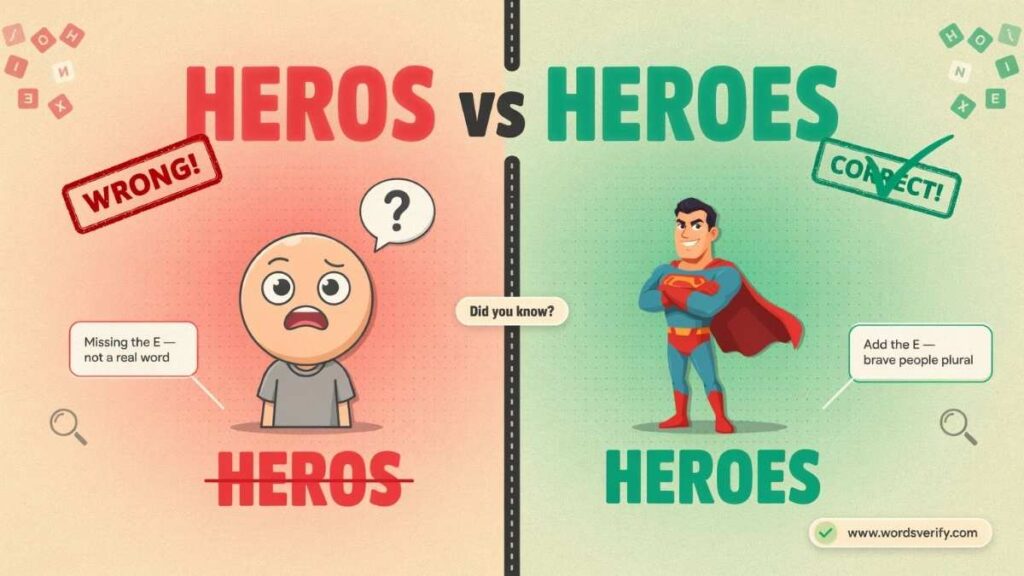
Heros vs heroes may seem like a small spelling mix-up, but even a tiny mistake can trip up your writing! Whether you’re talking about courageous firefighters, legendary superheroes, or everyday people who make a difference, choosing the correct spelling matters. The right plural of “hero” is “heroes,” not “heros.” So, why does this word need an extra letter when some nouns ending in “o” simply add an “s”? Don’t worry; there’s no need for a grammar superhero to rescue you. This guide explains the spelling rule, provides clear examples, and highlights common mistakes to help you write accurately and confidently.
Quick Answer Heros vs Heroes
Heroes is the correct standard plural of hero. Use it whenever you refer to two or more heroes, whether they’re real people, fictional characters, or individuals you admire.
- Hero: The singular noun for one person admired for courage, achievements, or admirable qualities.
- Heroes: The plural noun for two or more heroes.
- Heros: An incorrect spelling when used as the ordinary plural of hero.
Consider these examples:
| Incorrect | Correct |
|---|---|
| The firefighters became heros. | The firefighters became heroes. |
| My parents are my greatest heros. | My parents are my greatest heroes. |
| The movie features three heros. | The movie features three heroes. |
| She admires the heros in the story. | She admires the heroes in the story. |
The rule is straightforward: when you mean several heroes, write heroes. Don’t assume that every noun ending in o forms its plural by adding only s.
Minuscule vs Miniscule which one is correct?
What Does Hero Mean?
A hero is a person admired for courage, noble actions, significant achievements, or qualities that inspire others. The word can describe someone who performs an extraordinary rescue or someone who quietly makes a positive difference in other people’s lives.
For example, a firefighter who enters a burning building to rescue a trapped family might be called a hero. A teacher who helps a struggling student gain confidence might also earn that description. Their circumstances differ, but both demonstrate qualities that others admire.
The word hero has several related uses in English.
Hero as a Brave or Admirable Person
In everyday conversation, hero often describes someone who demonstrates courage, kindness, sacrifice, or exceptional dedication.
Examples include:
- A paramedic who provides emergency care after a serious accident.
- A scientist whose research leads to an important medical breakthrough.
- A parent who consistently supports a child through difficult circumstances.
Calling someone a hero expresses admiration. However, the word doesn’t have to describe a person who performs a dramatic rescue. Everyday acts of courage and generosity can also inspire people to use it.
Hero as the Main Character of a Story
In literature, films, and other forms of storytelling, a hero often serves as the central character in an adventure or conflict.
A character might travel across a dangerous landscape, overcome personal weaknesses, or protect a community from a powerful enemy. Readers follow that character’s choices and struggles as the story unfolds.
A protagonist is the main character in a story. The terms hero and protagonist sometimes refer to the same character, but they aren’t exact synonyms. A protagonist can be morally flawed, selfish, or even villainous. A hero usually carries a more positive meaning, although some stories deliberately challenge that expectation.
Hero in Everyday Expressions
English speakers also use hero in several familiar expressions.
- My hero: Someone you admire deeply.
- Unsung hero: Someone whose valuable contributions receive little recognition.
- Local hero: Someone admired within a community.
- Hero worship: Excessive admiration for a particular person.
These expressions show how broadly the word applies. A hero might be a famous historical figure, a fictional adventurer, or the person who helps you through a difficult day.
Regardless of which meaning you intend, the standard plural remains heroes.
Indure vs Endure Which one Is Correct?
What Does Heroes Mean?
Heroes is the plural form of the noun hero. It refers to more than one person or character regarded as brave, admirable, influential, or central to a story.
The meaning depends on the context. In a news report, heroes might describe rescuers who save lives and In a novel, the word could refer to the main characters. In a personal conversation, it might describe several people who have influenced someone’s life.
Here are a few examples:
- The rescue workers were celebrated as heroes after the flood.
- My grandparents are two of my greatest heroes.
- The heroes of the novel face difficult choices.
- Young viewers often admire the heroes in superhero movies.
In each sentence, heroes refers to multiple people or characters.
Heroes in Real Life
Real-life heroes are people whose actions inspire admiration. Firefighters, emergency medical workers, rescue teams, and other public servants may be described as heroes when they take risks or provide exceptional help.
Heroism isn’t limited to particular jobs, though. Someone who protects another person, stands up against injustice, or provides vital assistance during a crisis may also be called a hero.
Imagine a community that organizes food, shelter, and medical supplies after a severe storm. Residents who coordinate the relief effort might become local heroes because their actions help others recover.
The plural heroes allows you to recognize several people without repeating the singular noun.
Heroes in Movies and Books
Fictional heroes appear in myths, fairy tales, novels, comics, films, television shows, and video games.
Some possess extraordinary abilities. Others rely on courage, intelligence, loyalty, or persistence. Their stories often explore familiar themes such as responsibility, sacrifice, friendship, and the struggle between right and wrong.
For example:
- A group of adventurers works together to save a kingdom.
- Several detectives solve a dangerous mystery.
- A team of superheroes protects a city.
- Ordinary characters help a community survive a crisis.
All these characters can be called heroes when the story presents them in that role.
Heroes in Personal Life
Sometimes, the people you admire most aren’t famous at all. Your parents, grandparents, mentors, friends, or teachers may be your heroes because of their influence on your life.
For example, you might say, “My teachers are my heroes because they encouraged me to pursue my goals.”
The sentence uses heroes correctly because it refers to multiple teachers. It also shows that the word expresses personal admiration rather than a single, fixed definition of bravery.
Scary vs Scarry which one is correct?
Why Is Heroes the Correct Plural of Hero?
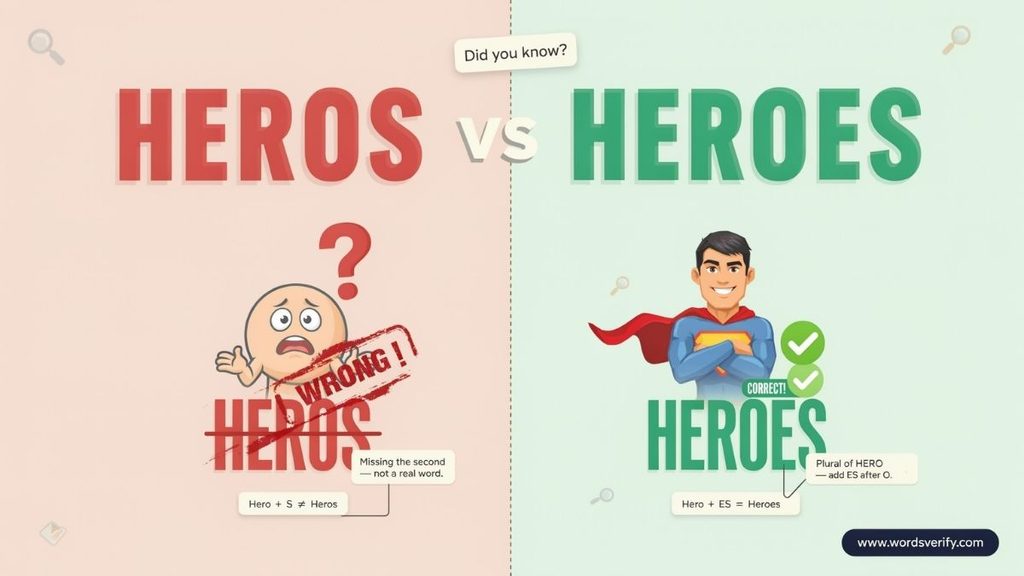
The main reason writers confuse heros vs heroes is that English doesn’t use just one rule for forming the plurals of nouns ending in o. Some take -s, while others take -es. The word hero belongs to the second group.
To understand the spelling rule, start with the singular form and add the conventional plural ending:
hero + es = heroes
The spelling changes from hero to heroes. You don’t simply attach an s to the end.
Why Does Heroes Have an Extra E?
The additional e forms part of the standard plural ending -es. English has retained different plural patterns for nouns ending in o, so writers must learn which pattern applies to each word.
Compare these examples:
| Singular | Correct plural |
|---|---|
| Hero | Heroes |
| Potato | Potatoes |
| Tomato | Tomatoes |
| Echo | Echoes |
| Torpedo | Torpedoes |
The same pattern appears in several familiar words. However, it doesn’t apply to every noun ending in o.
| Singular | Correct plural |
|---|---|
| Photo | Photos |
| Piano | Pianos |
| Video | Videos |
| Radio | Radios |
| Solo | Solos |
Notice the difference. You write heroes but photos. Both singular nouns end in o, yet their plural spellings follow different conventions.
That’s why it’s worth remembering the spelling of hero on its own. General spelling rules can guide you, but they don’t always predict the plural form of every noun.
Is Hero an Irregular Plural Noun?
Not in the same sense as words such as child and children or person and people. Those plurals use forms that differ more substantially from the singular.
The plural heroes follows an established spelling pattern for certain nouns ending in o. Some grammar resources describe these nouns as regular plurals formed with -es, while others discuss the variation among nouns ending in o as a special pluralization pattern.
For practical writing, the distinction is less important than remembering the correct form. Hero becomes heroes, not heros, in standard English.
Breeched vs Breached which one is correct ?
Heroes vs Heros Meaning and Usage
When comparing heroes and heros, it’s important to distinguish an ordinary spelling mistake from less common specialized uses.
In standard writing, heroes means more than one hero. Heros doesn’t normally carry a separate meaning that contrasts with heroes. Instead, writers generally use it by mistake when they intend the standard plural.
| Question | Heroes | Heros |
|---|---|---|
| Is it the standard plural of hero? | Yes | No |
| Does it refer to multiple admired people? | Yes | Not in standard usage |
| Should you use it in an essay about brave people? | Yes | No |
| Can it appear in a specialized context? | Yes | Yes, depending on the context |
The difference is usually a matter of spelling rather than meaning.
Is Heros a Word?
The question needs a little context.
If you’re asking whether heros is the correct plural of the ordinary English noun hero, the answer is no. Standard English uses heroes.
However, Heros can appear in specialized contexts. For example, Heros is the name of a genus of South American cichlid fish. In biological classification, a genus name is capitalized and functions as a scientific name rather than as the plural of the everyday noun hero.
This distinction matters because a spelling that appears in a scientific reference isn’t automatically an accepted alternative spelling for ordinary use.
For everyday writing, remember these three forms:
- Use hero for one hero.
- Use heroes for two or more heroes.
- Don’t use heros as the ordinary plural of hero.
What Does Heros Mean?
When people encounter heros, they often wonder whether it has a definition different from heroes.
In ordinary English, heros is usually a misspelling of heroes. It doesn’t have a standard everyday meaning that competes with the accepted plural.
Specialized references may use Heros as a scientific genus name. Businesses, products, usernames, or fictional names may also use Heros as a proper name. Those contexts differ from standard English pluralization.
If you encounter heros in a sentence about firefighters, fictional champions, or admired family members, check whether the writer intended heroes.
Can Heros Be Used in a Sentence?
The spelling can appear in a sentence when it serves a legitimate specialized purpose, such as a proper name. However, that doesn’t make it the correct plural of hero.
Consider these examples:
- Correct: “The heroes protected the village.”
- Incorrect ordinary plural: “The heros protected the village.”
- Specialized name: “The scientific genus Heros includes South American cichlid fish.”
The third example uses Heros as a scientific name. It doesn’t illustrate an alternative plural spelling.
Shiney vs Shiny which one is correct?
Examples of Heroes in Sentences
Learning a spelling rule is useful, but seeing it in context makes it easier to remember. These examples show how to use heroes naturally in different types of writing.
Heroes in Everyday Conversation
- My parents are my heroes because they always support me.
- The neighbors became heroes after helping the family escape the fire.
- Many people consider nurses and emergency workers heroes.
- The children dressed as their favorite heroes for the school event.
Each sentence refers to more than one person or uses heroes as a plural category.
Heroes in Literature and Entertainment
- The heroes of the fantasy novel must work together to defeat the enemy.
- The film follows two heroes who discover a hidden city.
- The game’s heroes have different skills and abilities.
- Unlike traditional heroes, the main characters make several serious mistakes.
In these examples, heroes describes fictional characters. Remember that a story’s protagonists aren’t always morally admirable, so heroes and protagonists aren’t interchangeable in every context.
Heroes in History and Public Life
- The memorial honors the heroes who lost their lives during the conflict.
- Historians continue to study the achievements of these national heroes.
- The town celebrated the rescuers as heroes after the successful evacuation.
- The documentary examines how societies remember their heroes.
These examples also reveal something important about word choice: calling someone a hero expresses a judgment or perspective. Different communities may interpret a historical figure’s actions differently.
A Short Example One Hero or Several Heroes?
Imagine that a school newspaper publishes a story about a student who rescues a younger child from a dangerous situation. The reporter writes:
“The student became a hero after helping the child reach safety.”
The singular hero is correct because the sentence describes one person.
Now imagine that two students work together during the rescue. The sentence changes:
“The students became heroes after helping the child reach safety.”
The plural heroes is now necessary because the sentence refers to two people.
If the reporter writes “The students became heros,” the meaning remains understandable, but the spelling is incorrect. A proofreading tool or a careful reread should catch the mistake.
This simple example demonstrates the relationship between number and spelling. The meaning determines whether you need the singular or plural, while standard spelling conventions determine how to write that form.
Puting vs Putting Which one Is Correct?
Common Mistakes When Pluralizing Hero
Even when you know the correct spelling, a few related grammar errors can sneak into your writing. These are the most useful distinctions to remember.
Adding Only S to Hero
The most common error is writing heros instead of heroes.
Incorrect: “The heros received medals for their bravery.”
Correct: “The heroes received medals for their bravery.”
Why does the error happen? Writers often assume that adding s is enough to make any noun plural. That approach works for many English nouns, such as book to books and car to cars, but it doesn’t work for every word.
The fix is simple: memorize the complete plural form heroes. Don’t rely on a spelling pattern that applies to a different noun.
Assuming Every Noun Ending in O Takes ES
The opposite problem occurs when writers apply -es to every noun ending in o.
- Incorrect: photoes. Correct: photos.
- Incorrect: pianoes. Correct: pianos.
The words photo and piano take -s, while hero takes -es. English spelling contains patterns, but it also contains exceptions and word-specific conventions.
When you’re uncertain, consult a reliable dictionary rather than creating a plural form by analogy alone.
Confusing Heroes with Hero’s
A missing or misplaced apostrophe can change a sentence’s meaning.
| Word | Grammatical use | Example |
|---|---|---|
| Hero | Singular noun | The hero arrived. |
| Heroes | Plural noun | The heroes arrived. |
| Hero’s | Singular possessive | The hero’s shield was damaged. |
| Heroes’ | Plural possessive | The heroes’ shields were damaged. |
The apostrophe doesn’t form the plural. Instead, it indicates possession in hero’s and heroes’.
For instance, “The hero’s courage inspired the team” refers to the courage of one hero. “The heroes’ courage inspired the team” refers to the courage of multiple heroes.
These differences matter in essays, reports, fiction, and other forms of writing where small punctuation choices affect meaning.
Using Heros in Formal Writing
A reader will probably understand what you mean when you write heros, but that doesn’t make the spelling correct.
In school assignments, business reports, professional emails, and published articles, spelling mistakes can distract readers from your message. Repeated errors may also weaken the impression that you’ve checked your work carefully.
Before submitting a document, search for heros and review each result. If you intended the ordinary plural of hero, replace it with heroes.
However, don’t automatically change every occurrence of Heros. A scientific name, brand, or proper noun may require that exact spelling.
Panic vs Panick Which one Is Correct?
Hero Plural Possessive Heroes’ vs Hero’s?
Possessive forms often confuse writers because the words look similar. The easiest way to get them right is to identify whether you’re talking about one hero or several and whether the sentence expresses ownership.
Hero’s Singular Possessive
Use hero’s when something belongs to one hero.
Examples:
- The hero’s courage inspired the entire team.
- The hero’s journey begins in a small village.
- The hero’s decision changed the course of the story.
Each sentence refers to something associated with one hero.
Heroes’: Plural Possessive
Use heroes’ when something belongs to two or more heroes.
Examples:
- The heroes’ bravery saved the village.
- The heroes’ costumes were displayed at the museum.
- The heroes’ stories inspired a new generation.
The apostrophe comes after the s because the plural noun already ends in s.
A Simple Comparison
| Intended meaning | Correct form |
|---|---|
| One hero | The hero’s story |
| Several heroes | The heroes’ stories |
| One hero performs an action | The hero saves the child. |
| Several heroes perform an action | The heroes save the child. |
Remember that heroes is a plural noun, while heroes’ is its plural possessive form. The two aren’t interchangeable.
Is It Heros vs Heroes Sandwich?
Here’s an interesting twist: hero also names a type of sandwich. In the United States, a hero sandwich is a long sandwich made with bread and fillings such as meat, cheese, vegetables, and condiments. It’s related to what many people call a submarine sandwich or sub.
However, the plural of the sandwich isn’t formed in the same way as the plural of the person.
The usual plural is hero sandwiches.
For example:
- We ordered one hero sandwich for lunch.
- We ordered three hero sandwiches for the party.
In this compound noun, hero describes the type of sandwich, while sandwiches carries the plural ending.
You may encounter heros vs heroes in informal discussions about sandwich names, regional terminology, or business names. Nevertheless, when you’re writing about several sandwiches in ordinary American English, hero sandwiches is a clear and conventional choice.
This distinction illustrates why you need to consider the entire expression rather than pluralize every word automatically.
Vendor vs Vender which one is correct?
Similar Words That Follow the Same Plural Spelling Pattern
If you want to remember heroes, learning a few related words can help. Several English nouns ending in o take -es in the plural.
| Singular | Plural | Example |
|---|---|---|
| Hero | Heroes | The heroes returned home. |
| Potato | Potatoes | The potatoes are ready. |
| Tomato | Tomatoes | The tomatoes need washing. |
| Echo | Echoes | The echoes faded away. |
| Torpedo | Torpedoes | The torpedoes were recovered. |
These examples demonstrate a useful pattern in English spelling. However, don’t turn it into an absolute rule. English also uses plural forms such as photos, pianos, videos, and radios.
The correct ending depends on the individual word and its established usage.
How to Remember the Correct Spelling
Try this simple memory trick:
A hero becomes a team of heroes.
Remember the extra e in heroes as part of the complete plural spelling. When you’re writing about more than one hero, picture the word changing from hero to heroes, not heros.
You can also remember these examples:
- One hero.
- Two heroes.
- One hero’s story.
- Two heroes’ stories.
Reading these examples aloud and using them in your own sentences can help reinforce the difference.
Worse vs Worst which one is correct?
Is Heroes Correct in American and British English?
Yes. Heroes is the standard plural of hero in both American and British English.
Unlike some spelling differences between the two varieties, such as color and colour or organize and organise, the difference between heros vs heroes isn’t a regional spelling choice.
The correct forms are:
- American English: “The heroes saved the town.”
- British English: “The heroes saved the town.”
The spelling stays the same. Whether you’re writing a school assignment in the United States or an article for a British audience, use heroes for the plural of hero.
Practice Session Heros vs Heroes
Test your understanding of the difference between “heros” vs “heroes” with these 25 fill-in-the-blank questions. Choose the correct word or form for each sentence.
Fill in the blanks
- The firefighters were praised as ______ after rescuing the family.
- My parents have always been my biggest ______.
- The movie features several brave ______ who protect the city.
- The ______ courage inspired everyone in the village.
- The school organized a ceremony to honor its local ______.
- Every ______ has a story worth telling.
- The crowd gave the returning soldiers a ______ welcome.
- The ______ actions saved many lives.
- She considers her grandmother one of her greatest ______.
- The comic book introduces two new ______.
- The ______ journey was filled with challenges.
- Many children dream of becoming ______ in their own stories.
- The town celebrated its everyday ______ during the festival.
- The ______ bravery will never be forgotten.
- He wrote a book about the lives of famous ______.
- The ______ names were displayed on the memorial.
- Everyone applauded the ______ after the rescue.
- The ______ achievements inspired the next generation.
- A true ______ helps others without expecting a reward.
- The author created a team of unlikely ______.
- The ______ sacrifices brought peace to the community.
- She thanked her personal ______ for their support.
- The ______ efforts made the rescue possible.
- Each of these ______ represents courage and kindness.
- The community welcomed its returning ______ with cheers.
Answer
- heroes
- heroes
- heroes
- heroes’
- heroes
- hero
- hero’s
- heroes’
- heroes
- heroes
- hero’s
- heroes
- heroes
- heroes’
- heroes
- heroes’
- heroes
- heroes’
- hero
- heroes
- heroes’
- heroes
- heroes’
- heroes
- heroes
Here’s a trusted source for clear more words Comparison:
FAQs
Do we say heros vs heroes?
We say “heroes” when referring to more than one hero. “Heros” is generally an incorrect spelling of the plural noun.
How do Americans spell heroes?
Americans spell the plural of “hero” as “heroes.” The spelling is the same in American and British English.
Is it pronounced heros vs heroes?
“Heroes” is pronounced HEER-ohz, with two syllables. The incorrect spelling “heros” doesn’t represent the standard plural form.
Why is heroes spelled with an E?
The word “hero” takes “-es” to form its plural. This follows a common spelling pattern for certain nouns ending in “o,” such as “potato” becoming “potatoes” and “tomato” becoming “tomatoes.” However, not every noun ending in “o” follows this rule.
Is hero’s grammatically correct?
Yes. “Hero’s” is the singular possessive form, showing that something belongs to one hero. For example, “The hero’s courage inspired everyone.” For several heroes, use “heroes’,” as in “The heroes’ efforts saved the town.”
What does Heros mean?
“Heros” is not the standard plural of “hero.” However, Heros is also the scientific genus name of certain South American cichlid fish. Its meaning therefore depends on the context.
How do you use heroes in a sentence?
Use “heroes” when talking about two or more people admired for their courage, achievements, or admirable qualities. For example: “The firefighters were hailed as heroes after rescuing the family.”
Is it “hero’s welcome” or “heroes’ welcome”?
“Hero’s welcome” is correct when describing a welcome given to one hero. “Heroes’ welcome” refers to a welcome given to multiple heroes. The phrase “a hero’s welcome” is especially common when someone receives enthusiastic public praise after an achievement.
What do you call a group of heroes?
A group of heroes can be called a team of heroes, a band of heroes, or a heroic team. There isn’t one universally accepted collective noun for every group of heroes.
What is a female hero called?
A female hero can be called a “hero” or a “heroine.” “Hero” is widely used for people of any gender, while “heroine” specifically refers to a female hero.
What is the difference between a hero and an antihero?
A hero generally acts courageously or tries to do what is right. An antihero is a central character who lacks some traditional heroic qualities, such as strong moral principles or selfless behavior. Antiheroes may still do admirable things, but their methods and motivations are often complicated.
Can you call a woman a hero?
Yes. “Hero” is a gender-neutral term in modern English and can describe a woman who demonstrates courage, kindness, or exceptional achievement. “Heroine” is also correct when you want to emphasize that the person is female.
Is it “one of my heroes” or “one of my heros”?
“One of my heroes” is correct. The phrase refers to one person selected from a group of people you admire. Because “one of” is followed by a plural noun, you must use “heroes,” not “heros.”
What type of word is “heroes”?
“Heroes” is a plural countable noun. It refers to more than one hero and can function as the subject or object of a sentence. For example: “The heroes arrived” or “We thanked the heroes.”
What are some synonyms for heroes?
Depending on the context, alternatives include champions, rescuers, role models, lifesavers, defenders, and icons. Each word has a slightly different meaning, so choose one that matches the person’s actions and qualities.
What is the meaning of “a hero’s welcome”?
“A hero’s welcome” means an enthusiastic reception given to someone who has accomplished something important or returned after a significant achievement. It often involves applause, cheering, public celebrations, or expressions of gratitude.
Is “heroes” always the plural of “hero”?
Yes. In standard English, “heroes” is the accepted plural of the noun “hero.” Although some nouns ending in “o” form their plurals by adding only “-s,” “hero” takes “-es.”
Is “Davis’s” or “Davises” correct?
Both forms can be correct, but they serve different purposes. “Davis’s” is the singular possessive form in many style guides, as in “Davis’s book.” “Davises” is the plural form of the surname Davis, referring to more than one person with that name, as in “The Davises live next door.”
Piqued vs Peaked which one is correct?
Conclusion
When it comes to “heros” vs “heroes,” the correct spelling is easy to remember: “heroes” is the standard plural of “hero.” Although “heros” may look right at first glance, it’s a common spelling mistake. That extra “e” might seem insignificant, but it makes all the difference!
Whether you’re writing about brave firefighters, inspiring role models, or your favorite superheroes, use “heroes” when referring to more than one. Remember the related forms, too: “hero’s” indicates possession by one hero, while “heroes’” indicates possession by several. Once you understand this simple spelling rule, you can avoid the mistake with confidence. After all, even grammar heroes need to get their spelling right!

Lisa AJS is an experienced blogger and language enthusiast at Words Verify, dedicated to making grammar simple, practical, and enjoyable. She writes engaging content on commonly confused words, grammar mistakes, word meanings, and everyday language challenges.