
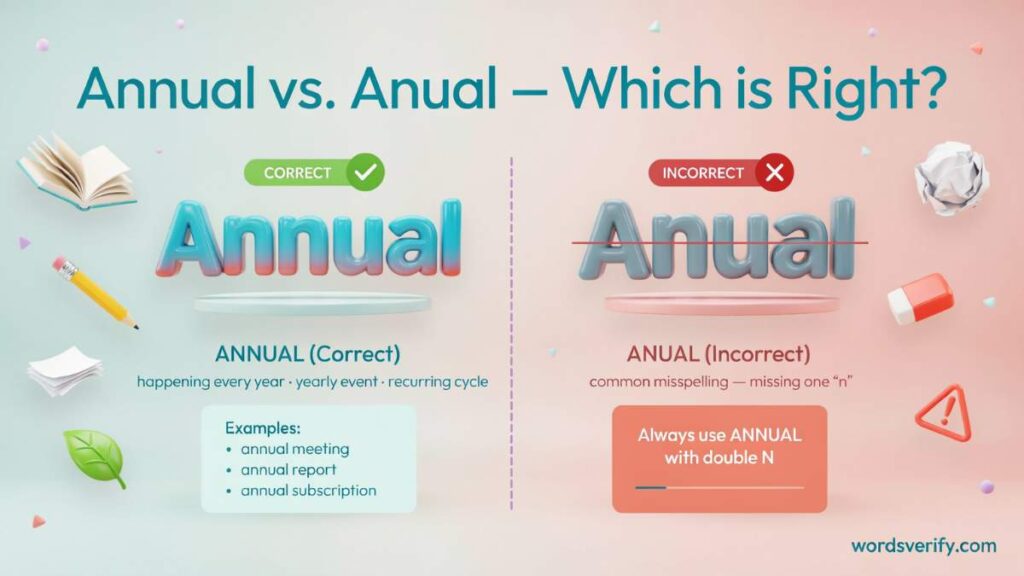
Ever typed “anual” and wondered if your keyboard had misplaced a letter? You’re not alone! The confusion between annual vs anual is common, but English spelling has a clear winner: annual, with two n’s. It describes something that happens once a year or relates to a particular year. Although “anual” is a valid word in Spanish and Portuguese, it isn’t the correct spelling in English. That tiny missing letter can turn a perfectly good sentence into a spelling mistake. In this guide, you’ll explore the meanings, usage, differences, and simple tricks to remember the correct spelling every time.
quick answer
The correct English spelling is annual, with two Ns. Anual is a misspelling when you intend to use the English word.
The difference comes down to one letter, but that missing N can make a sentence look incorrect, particularly in professional or academic writing.
Consider these examples:
- Correct: The company publishes an annual financial report.
- Incorrect: The company publishes an anual financial report.
- Correct: Employees receive an annual performance review.
- Incorrect: Employees receive an anual performance review.
- Correct: We organize an annual family reunion.
- Incorrect: We organize an anual family reunion.
In every example, the word needs two Ns.
| Word | Correct in English? | Meaning |
|---|---|---|
| Annual | Yes | Happening once a year or relating to a year |
| Anual | No | Incorrect English spelling of annual |
| Annually | Yes | Every year or once a year |
| Yearly | Yes | Happening or occurring every year |
The spelling doesn’t change between American and British English. Canadian and Australian English also use annual.
A simple way to remember it is to think of anniversary. Both annual and anniversary contain two Ns and relate to the passage of a year.
Fix common more word mistakes in English
Recurrence vs Reoccurrence What’s the Difference?
What Does Annual Mean?
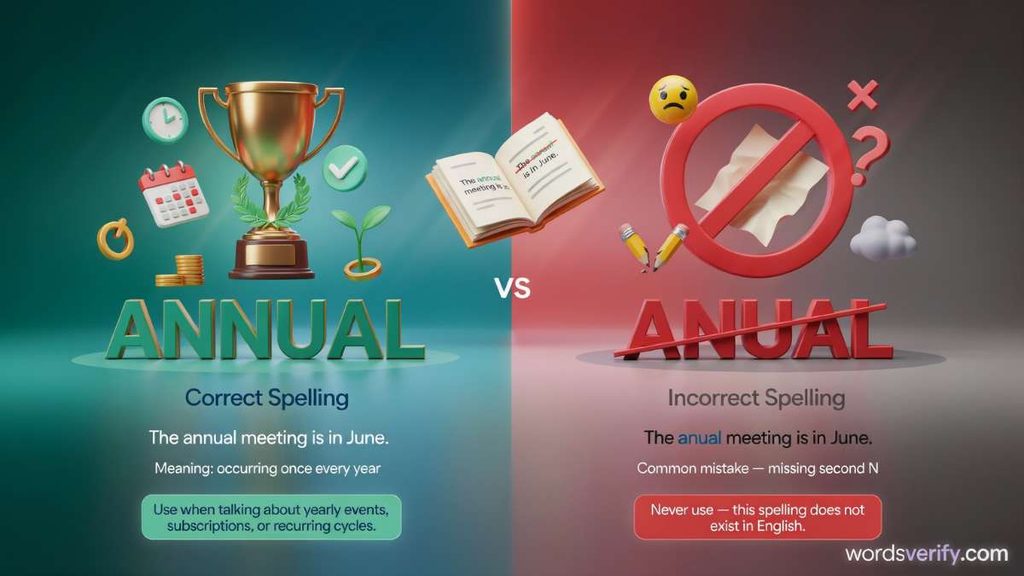
Annual means happening once every year or relating to a year. People use it to describe events, payments, reports, celebrations, and activities that follow a yearly schedule.
For example, an annual meeting takes place once a year. An annual report summarizes an organization’s activities and financial performance over a particular year. Similarly, an annual subscription generally provides access to a service for twelve months.
The word can also describe something that lasts for a year. Its precise meaning depends on the situation.
Here are some common expressions:
| Expression | Meaning |
|---|---|
| Annual meeting | A meeting held once a year |
| Annual report | A report covering an organization’s yearly activities |
| Annual salary | Total earnings over one year |
| Annual subscription | A subscription covering a year |
| Annual fee | A charge applied yearly |
| Annual celebration | An event held every year |
| Annual examination | An examination conducted once a year |
| Annual expenses | Costs incurred over a year |
These expressions appear in many areas of life. You might attend an annual school event, pay an annual membership fee, or read a company’s annual financial report.
Does Annual Mean Once a Year?
Yes, when annual describes a recurring event or activity, it generally means that the event happens once every year.
For example, if a university holds an annual graduation ceremony, students can expect it to take place each year.
However, the word doesn’t always describe an event that happens on precisely the same date. A company might hold its annual meeting in December one year and November the next. It remains an annual meeting because the organization holds it once during each year.
Does Annual Mean 12 Months?
Annual can refer to a twelve-month period, but the meaning depends on the context.
An annual subscription, for example, usually covers twelve months of service , An annual salary represents earnings over a year. An annual budget covers an organization’s expected income and expenses for a financial year.
However, an annual event doesn’t necessarily take place exactly 365 days after the previous one.
A calendar year contains:
- 365 days in a common year.
- 366 days in a leap year.
- 12 months in both cases.
For example, a company might organize its annual conference every December. The event happens once per calendar year, even though the number of days between conferences can vary.
Annual in Different Contexts
The meaning becomes clearer when you see how people use the word in different situations.
| Context | Meaning | Example |
|---|---|---|
| Business | Relating to yearly operations | Annual revenue increased by 8%. |
| Employment | Covering one year of earnings | Her annual salary is $60,000. |
| Education | Happening once every year | The school holds an annual examination. |
| Membership | Lasting or renewing yearly | My annual membership expires in June. |
| Finance | Relating to yearly costs or returns | The investment has an annual growth rate of 5%. |
| Gardening | Completing a life cycle in one growing season | Sunflowers are commonly grown as annual plants. |
As you can see, annual is useful in both everyday and specialized language.
Fix common more word mistakes in English
Copyright vs Copywrite Which one Is Correct?
What Does Anual Mean in English?
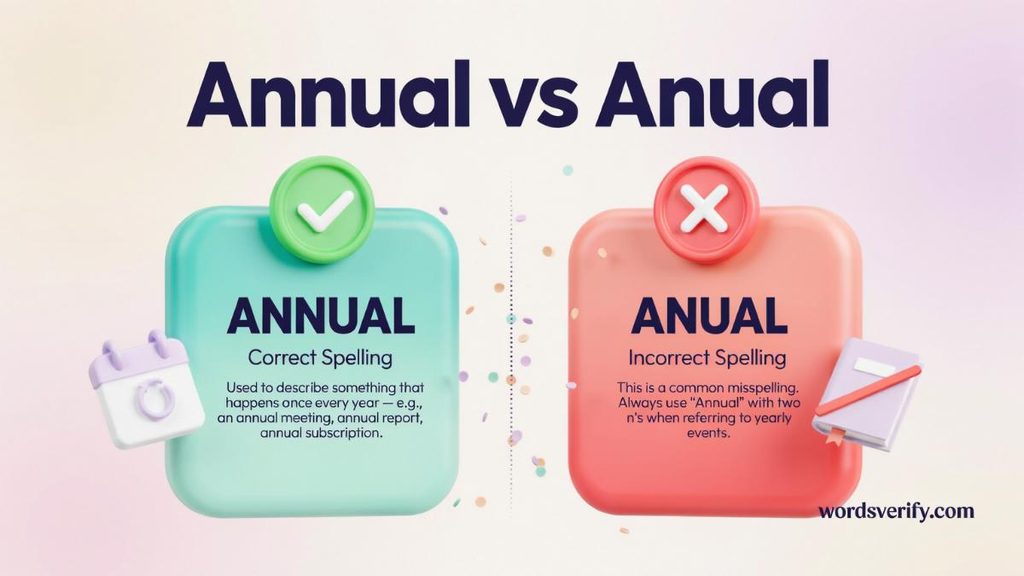
In standard English, anual isn’t the correct spelling of annual. It usually appears when someone accidentally leaves out the second N.
However, the spelling isn’t incorrect in every language. Spanish and Portuguese both use anual as an adjective meaning yearly or relating to a year.
This difference explains why you might encounter the shorter form in foreign-language documents or websites.
Is Anual a Real Word?
Yes, anual is a genuine Spanish and Portuguese word. It simply isn’t the standard English spelling.
For example:
- Spanish: La reunión anual se celebrará en diciembre.
- English: The annual meeting will take place in December.
The Spanish sentence uses anual, while its English translation uses annual. Both express the same general idea.
Portuguese follows a similar pattern:
- Portuguese: Relatório anual.
- English: Annual report.
So, if you see anual in a Spanish or Portuguese document, there’s nothing wrong with it. The problem arises when you use that spelling in an English sentence.
Why Do People Write Anual Instead of Annual?
Several small factors contribute to this mistake.
Forgetting the second N: This is the most straightforward explanation. Writers remember the word’s general appearance but accidentally leave out one letter.
Influence from other languages: People familiar with Spanish or Portuguese may recognize anual and carry that spelling into their English writing.
Pronunciation: The two Ns don’t create separate syllables. Because the word sounds the way it does, some writers don’t notice that the spelling requires both letters.
Typing too quickly: A rushed email or document can contain small errors that escape the writer’s attention.
Whatever the reason, the correction is simple: write annual when using the English word.
Fix common more word mistakes in English
Appraised vs Apprised What’s the Difference?
Annual vs Anual What’s the Difference?
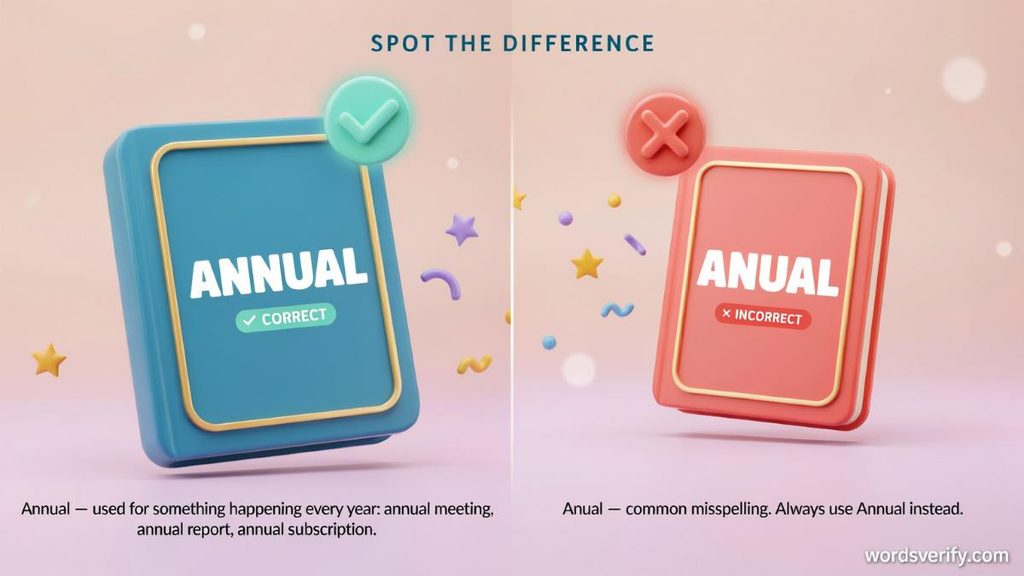
The main difference between annual vs anual is their spelling and language of use.
Annual is the accepted English spelling. Anual is the corresponding Spanish and Portuguese spelling and an error when used as the English equivalent.
| Feature | Annual | Anual |
|---|---|---|
| English spelling | Correct | Incorrect |
| Spanish spelling | Not the standard form | Correct |
| Portuguese spelling | Not the standard form | Correct |
| Number of Ns | Two | One |
| English meaning | Yearly or relating to a year | No standard English meaning |
| English part of speech | Primarily an adjective | Not a standard English word |
The distinction becomes especially important when writing for an international audience. A word can be correct in one language and incorrect in another. Annual vs anual are a good example.
Annual vs Anual in a Sentence
Here are some examples that show the difference between Annual vs Anual .
Correct English sentences:
- The university organizes an annual graduation ceremony.
- Our annual membership expires next month.
- The company released its annual financial statement.
- She receives an annual salary increase.
- The annual festival attracts thousands of visitors.
Incorrect English sentences:
- The university organizes an anual graduation ceremony.
- Our anual membership expires next month.
- The company released its anual financial statement.
- She receives an anual salary increase.
- The anual festival attracts thousands of visitors.
Every incorrect example needs the second N.
Once you become familiar with the correct spelling, you’ll start noticing the difference immediately.
Fix common more word mistakes in English
Simular vs Similar Which one Is Correct?
Examples of Annual in Everyday Sentences
The easiest way to understand a word is to see how people use it. Annual appears in conversations about family gatherings, business activities, education, finances, and even gardening.
1.Annual in Everyday Conversations
- My family organizes an annual reunion during the summer.The family gets together once every year.
- The town holds an annual food festival in October.The festival returns every year.
- Our school has an annual sports competition.Students participate in the competition once a year.
- The library publishes an annual list of its most popular books.The list comes out every year.
- We renew our annual membership in January.The membership covers a yearly period.
2.Annual in Business and Professional Writing
- The company released its annual report last week.The report summarizes the organization’s activities and performance over the year.
- Management will conduct an annual review of employee performance.The company evaluates its employees once a year.
- The business recorded annual revenue of $2 million.The company generated that amount over the year.
- The board approved the annual operating budget.The budget covers the organization’s planned yearly expenses.
- Each department must submit its annual financial statement.Every department prepares a financial summary covering the year.
3.Annual in Education
- The university organizes an annual research conference.
- Students must complete an annual examination.
- The school publishes an annual academic calendar.
- Teachers participate in an annual professional development program.
- The institution reviews its academic policies every year.
4.Annual in Nature and Gardening
Annual also has a specific meaning in botany. An annual plant completes its entire life cycle within one growing season.
This usually involves several stages:
- The seed germinates.
- The plant grows and develops leaves and roots.
- It produces flowers.
- It forms seeds.
- The plant completes its life cycle and dies.
Common annual plants include:
- Marigolds
- Sunflowers
- Zinnias
- Petunias
- Corn
- Wheat
For example, a sunflower planted in spring may grow, flower, produce seeds, and die before winter. It completes its life cycle within one growing season.
However, annual doesn’t mean that the plant must live for exactly twelve months. Its life cycle depends on the species, climate, and growing conditions.
This botanical meaning differs slightly from the everyday use of the word. Here, annual describes the plant’s life cycle rather than an event that happens every year.
Fix common more word mistakes in English
Cataloguing vs Cataloging? Which one Is Correct?
Annual, Annually and Yearly What’s the Difference?
Annual, annually, and yearly are closely related, but they serve different grammatical purposes.
Understanding their differences will help you choose the right word in a sentence.
Annual: An Adjective
Annual is primarily an adjective. It describes a noun and tells readers that something relates to a year or happens every year.
Examples:
- Annual meeting
- Annual report
- Annual income
- Annual examination
- Annual celebration
In the sentence “The company holds an annual conference,” annual describes the conference.
Annually: An Adverb
Annually is the adverb form of annual. It describes how often an action takes place.
Examples:
- The company publishes its financial report annually.
- We renew our membership annually.
- The organization reviews its policies annually.
- The school organizes the competition annually.
Notice the difference:
- The company holds an annual meeting.
- The company meets annually.
Both sentences describe a yearly activity, but their grammatical structures differ.
Yearly: An Adjective and an Adverb
Yearly can function as either an adjective or an adverb.
As an adjective:
- We organize a yearly celebration.
- The company publishes a yearly report.
As an adverb:
- We celebrate the occasion yearly.
- The organization reviews its budget yearly.
Yearly often sounds more conversational, while annual and annually are common in professional, financial, and formal writing.
Annual vs Yearly Which Should You Use?
In many situations, annual and yearly mean the same thing. Both refer to something connected with a year or something that happens every year.
However, some expressions have established forms that sound more natural than their alternatives.
For example, annual leave is a common employment term. Replacing it with yearly leave may sound unusual.
Similarly, annual percentage rate is a recognized financial expression. Yearly percentage rate isn’t the standard term.
| Word | Part of speech | Example |
|---|---|---|
| Annual | Adjective | The annual event starts tomorrow. |
| Annually | Adverb | The event takes place annually. |
| Yearly | Adjective or adverb | We hold a yearly celebration. |
| Per annum | Phrase | The account earns 4% interest per annum. |
A useful rule is to use annual before a noun, annually to describe an action, and yearly when you want a simple alternative that works as either an adjective or an adverb.
Fix common more word mistakes in English
Ingenuine vs Ungenuine Which one Is Correct?
What Does Annual Mean in Salary?
When you see annual in a job advertisement, employment contract, or salary discussion, it usually refers to the total amount an employee earns over one year.
For example, if a company offers an annual salary of $60,000, the employee’s gross salary is $60,000 per year before applicable taxes and deductions.
The company might pay this amount monthly, twice a month, every two weeks, or weekly. The payment schedule doesn’t change the annual salary.
Annual Salary vs Monthly Salary
Suppose an employee earns $48,000 annually.
To calculate the monthly gross salary, divide the annual amount by 12:
$48,000 ÷ 12 = $4,000 per month
The employee earns $4,000 each month before taxes and other deductions.
Here’s how the same salary breaks down across different payment schedules:
| Payment period | Amount |
|---|---|
| Annual salary | $48,000 |
| Monthly salary | $4,000 |
| Semi-monthly salary | $2,000 |
| Biweekly salary | Approximately $1,846.15 |
| Weekly salary | Approximately $923.08 |
These figures assume a standard 52-week year. Biweekly and semi-monthly payments differ because employers use different payment schedules.
Gross Annual Salary vs Net Annual Income
Another important distinction is the difference between gross and net income.
Gross annual salary is the total amount an employee earns before taxes, insurance premiums, retirement contributions, and other deductions.
Net annual income is the amount remaining after applicable deductions.
For example, imagine someone earns a gross annual salary of $60,000. After taxes and other deductions, their take-home income might be $46,000.
The actual net amount depends on the employee’s location, tax rules, benefits, and personal circumstances.
Other Common Salary Expressions
You’ll also encounter annual in several employment and financial expressions:
- Annual income: The total income earned during a year.
- Annual compensation: The overall yearly value of an employee’s salary and benefits.
- Annual raise: An increase in an employee’s yearly salary.
- Annual bonus: Additional compensation paid under a yearly bonus arrangement.
- Annualized salary: A salary expressed as a yearly equivalent, even if the employee hasn’t worked a full year.
Understanding these terms makes it easier to compare job offers, plan your budget, and evaluate employment benefits.
Fix common more word mistakes in English
Manner vs Manor which one is correct?
Annual Synonyms and Related Words
Annual has several synonyms, but not all of them work in every sentence. Some describe something that happens every year, while others refer to a different period or type of repetition.
Common Synonyms of Annual
| Synonym | Meaning | Example |
|---|---|---|
| Yearly | Happening or relating to a year | We hold a yearly celebration. |
| Once a year | Occurring one time each year | The examination takes place once a year. |
| Every year | Repeated each year | The festival returns every year. |
| Annually | Happening each year | The company reports its results annually. |
| Per annum | For each year | The interest rate is 5% per annum. |
| Yearlong | Lasting for an entire year | The students joined a yearlong program. |
| Annualized | Converted into a yearly rate or figure | The investment has an annualized return of 6%. |
These words share a connection with the idea of a year, but their meanings aren’t identical.
For instance, yearly and annual can often replace each other. However, yearlong describes duration rather than frequency.
A yearlong project lasts for an entire year. An annual project might simply take place once every year.
Annual vs Biannual vs. Biennial
These three words often cause confusion because they look and sound similar.
- Annual: Happening once a year.
- Biannual: Happening twice a year.
- Biennial: Happening once every two years.
For example:
- An annual conference takes place once every year.
- A biannual conference takes place twice a year.
- A biennial conference takes place once every two years.
The distinction matters when arranging schedules, writing business agreements, or describing recurring events.
If you want to avoid confusion, you can simply write twice a year instead of biannual and every two years instead of biennial.
Fix common more word mistakes in English
Updated vs Update which one is correct?
The Origin and History of Annual
The history of annual explains why the word relates so closely to the idea of a year.
It ultimately comes from the Latin word annus, meaning year. Latin also had the adjective annalis, meaning yearly or relating to a year.
The word entered English through French, including Old French annuel, and developed into the modern English adjective annual.
Its history reflects the influence of Latin and French on English vocabulary.
The Latin Root Annus
The Latin word annus forms the foundation of several English words associated with years and yearly periods.
Consider these examples:
- Annual: Relating to a year or happening every year.
- Anniversary: The yearly return of a date marking an important event.
- Annuity: A financial arrangement involving payments at regular intervals, often annually.
- Annals: Historical records arranged by year.
These words share a historical connection with the Latin root associated with a year.
Why Does Annual Have Two Ns?
The double N in annual reflects its historical development from Latin annus and related Latin and French forms.
The spelling preserves that double consonant in modern English.
This is also why annual doesn’t become anual in standard English. The two Ns are part of its established spelling.
A useful memory connection is annual and anniversary. Both words relate to years and contain two Ns.
Fix common more word mistakes in English
Light vs Lite which one is correct?
Annual Spelling in American and British English
Some English words have different spellings like Annual vs Anual in American and British English. For example, Americans write color, while British writers generally use colour.
Annual doesn’t follow that pattern.
The word has the same spelling in American and British English. Canadian and Australian English also use annual.
| English variety | Correct spelling | Incorrect spelling |
|---|---|---|
| American English | Annual | Anual |
| British English | Annual | Anual |
| Canadian English | Annual | Anual |
| Australian English | Annual | Anual |
There is no accepted regional spelling that removes the second N.
For example:
- American English: The company publishes an annual report.
- British English: The company publishes an annual report.
- Canadian English: The organization holds an annual meeting.
- Australian English: The school organizes an annual celebration.
The spelling remains unchanged across all four varieties.
Fix common more word mistakes in English
Loss vs Lose which one is correct?
Common Spelling Mistakes Involving Annual
Although annual is a relatively simple word, writers sometimes confuse it with other forms.
Recognizing these mistakes can help you improve your spelling and grammar.
| Incorrect form | Correct form | Explanation |
|---|---|---|
| Anual | Annual | The second N is missing. |
| Annuel | Annual | The ending is incorrect for standard English. |
| Annualy | Annually | The adverb requires two Ls. |
| Anually | Annually | The second N and one L are missing. |
| Anualy | Annually | Both the second N and second L are missing. |
Annual vs Annually
One common mistake involves using annual when the sentence requires annually.
Remember that annual is an adjective, while annually is an adverb.
Incorrect: The company publishes its report annual.
Correct: The company publishes its report annually.
However, annual works perfectly when it describes the report:
Correct: The company publishes an annual report.
The difference involves grammar as well as spelling.
How to Remember the Correct Spelling of Annual
A simple memory trick can help you avoid the most common mistake like Annual vs Anual.
Remember that annual has two Ns, just like anniversary. Both words relate to the passage or return of a year.
You can also break the spelling into smaller parts:
A-N-N-U-A-L
When writing the word, check that both Ns appear before the U.
A few additional habits can help:
- Read your writing before submitting it.
- Use a reliable English dictionary.
- Pay attention to spell-check suggestions.
- Practice common expressions such as annual salary and annual report.
- Remember that the Spanish spelling anual doesn’t apply to English.
With regular practice, the correct spelling will become easier to recognize.
Is Annual an Adjective or a Noun?
Annual is primarily an adjective. It describes a noun and provides information about a yearly period or occurrence.
For example:
“The organization holds an annual conference.”
Here, annual describes the noun conference.
However, annual can also function as a noun in certain situations, particularly when referring to a yearly publication or a type of plant.
Annual as an Adjective
This is the word’s most common grammatical use.
Examples:
- The annual meeting starts at 9 a.m.
- Our annual expenses increased this year.
- The university released its annual publication.
- The annual examination takes place in June.
In each sentence, annual modifies a noun.
Annual as a Noun
Annual can also function as a noun when the context makes its meaning clear.
For example:
- The company publishes an annual for its members.
- The garden contains several colorful annuals.
In the first sentence, an annual refers to a publication produced every year.
In the second, annuals refers to plants that complete their life cycle within one growing season.
The plural form is annuals when the word functions as a countable noun.
How Do You Pronounce Annual?
Annual is pronounced AN-yoo-uhl.
It has three syllables, with the main stress on the first syllable.
Its pronunciation is generally represented in the International Phonetic Alphabet as /ˈæn.ju.əl/.
The pronunciation is similar across American and British English, although individual accents can affect the vowel sounds slightly.
The second N doesn’t create a separate syllable. Nevertheless, it remains essential to the written spelling.
practice session Annual vs Anual
Try these exercises to test your understanding of annual vs anual. Fill in the blanks, then check your answers to see how well you’ve mastered the correct spelling and usage!
- Our school organizes an ______ sports competition every spring.
- The company publishes its financial report ______.
- Is the correct English spelling annual or ______?
- Employees receive an ______ performance review.
- The membership fee is paid ______.
- The city hosts a cultural festival ______.
- We attended the ______ general meeting last Friday.
- The garden looks beautiful because I planted several ______ flowers.
- The organization holds two meetings each year, so they are ______ meetings.
- A celebration that takes place once every year is an ______ event.
- The magazine releases a special ______ edition in December.
- She checks her progress during her ______ review.
- The school holds a ceremony ______ to recognize outstanding students.
- The correct spelling of the English word is ______, with two n’s.
- The company conducts its employee training ______.
- A plant that completes its life cycle in one growing season is called an ______.
- The charity organizes a fundraising dinner ______.
- Our club has a ______ subscription plan.
- The report provides an overview of the company’s ______ activities.
- The conference takes place once a year, so it is an ______ conference.
- The Spanish word “anual” is spelled differently from the English word ______.
- The manager reviews the department’s budget ______.
- An event that happens twice a year is described as ______.
- The word ______ is an adverb that means once every year.
- We look forward to the ______ family gathering every summer.
Answers
- Annual
- Annually
- Anual
- Annual
- Annually
- Yearly
- Annual
- Annual
- Semiannual
- Annual
- Annual
- Annual
- Annually
- Annual
- Annually
- Annual
- Yearly
- Annual
- Annual
- Annual
- Annual
- Annually
- Semiannual
- Annually
- Annual
Here’s a trusted source for clear word meanings:
FAQs
Is annual vs anual the correct spelling?
Annual vs Anual , Annual is the correct spelling in English. It contains two n’s and describes something that happens once a year or relates to a year. Anual is not a standard English spelling, although it is used in Spanish and Portuguese.
What does annual mean in simple words?
Annual means happening once every year or relating to a year. For example, an annual event takes place once a year, while an annual report summarizes an organization’s activities over the year.
Is annual the same as yearly?
Yes. Annual and yearly generally have the same meaning. Both describe something that happens once a year. Annual often sounds more formal, making it common in business, education, and official writing.
What is the difference between annual and annually?
Annual is an adjective that describes a noun, while annually is an adverb that explains how often something happens.
- The company holds an annual meeting.
- The company meets annually.
Is it correct to use yearly in formal writing?
Yes. Yearly is grammatically correct and works in both formal and informal writing. However, annual may sound more professional in business reports, contracts, and official documents.
Should you say an annual or a annual?
You should say an annual because annual begins with a vowel sound. The choice between a and an depends on pronunciation, not simply on the first letter.
Correct: We attended an annual conference.
Incorrect: We attended a annual conference.
What is something that happens twice a year called?
Something that happens twice a year is called semiannual or biannual. Both terms can describe an event that occurs two times in one year, although biannual can sometimes be ambiguous. Semiannual is often clearer.
What is the difference between biannual and biennial?
Biannual means happening twice a year, while biennial means happening once every two years. These words are easy to confuse, so choose carefully when describing schedules or events.
What do you call something that happens three times a year?
Something that happens three times a year can be described as triennial in some contexts, but this word more commonly means occurring every three years. To avoid confusion, say three times a year.
Can annual be used as a noun?
Yes. Annual can function as a noun when it refers to a publication produced once a year or a plant that completes its life cycle in one growing season. For example, a school may publish an annual, or a gardener may plant annuals in the spring.
What is another word for annual?
Depending on the context, synonyms for annual include yearly, once-a-year, and every year. Yearly is the closest everyday alternative, while once-a-year is useful when you want to make the timing especially clear.
What is the opposite of annual?
The opposite depends on the context. If annual describes something that happens every year, possible contrasts include monthly, weekly, daily, or irregular. These words describe different schedules rather than exact opposites.
Does annually mean every year?
Yes. Annually means once every year or on a yearly basis. For example, if you pay an annual membership fee, you pay it annually according to the membership terms.
Conclusion
The difference between annual vs anual may seem tiny, but one missing letter can turn correct English into a spelling mistake. Annual, with two n’s, is the standard English spelling Annual vs Anual. It describes something that happens once a year or relates to a year. Although “anual” is a legitimate word in Spanish and Portuguese, it isn’t accepted as the correct spelling in English .
The easiest way to remember the difference is to connect annual with annually. Both contain two n’s, so there’s no reason to let one disappear! Whether you’re writing about an annual report, meeting, celebration, or event, stick with annual. A little attention to spelling keeps your writing clear, polished, and professional. After all, grammar mistakes may be small, but readers notice the details!

Lisa AJS is an experienced blogger and language enthusiast at Words Verify, dedicated to making grammar simple, practical, and enjoyable. She writes engaging content on commonly confused words, grammar mistakes, word meanings, and everyday language challenges.