The English language has a talent for turning simple spelling choices into little puzzles. Consider “ingenuine vs ungenuine.” Both look like logical opposites of “genuine,” but only one has clear dictionary recognition. So, which spelling should you use? If you’re describing a fake smile, an insincere apology, or something that isn’t authentic, choosing the right word makes your writing clearer. There’s no need to let two similar-looking words trip you up. Let’s explore the difference between ingenuine and ungenuine, uncover their meanings, and find the best alternatives to help you avoid this common English mistake.
Ingenuine vs Ungenuine Quick Answer
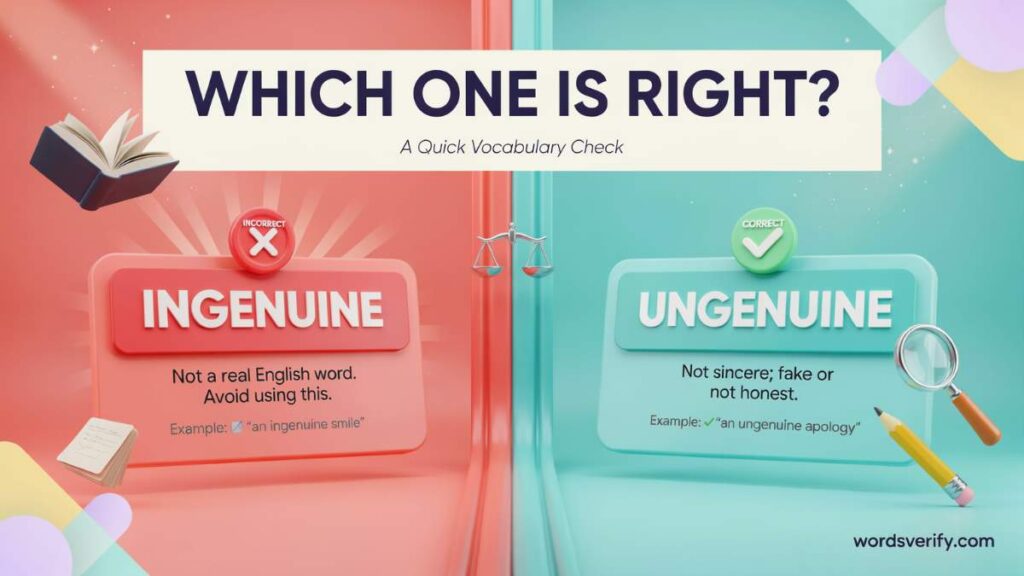
The better-established spelling is ungenuine, not ingenuine. Collins English Dictionary recognizes ungenuine as an adjective meaning false.
However, that doesn’t mean ungenuine is the best word for every situation. It appears far less often in everyday English than familiar expressions such as not genuine, fake, and insincere.
Here’s the simplest way to understand the difference:
- Ungenuine: A recognized but uncommon adjective describing something false or lacking genuineness.
- Ingenuine: An uncommon, nonstandard form that writers should generally avoid.
- Not genuine: A clear and natural expression that works in almost any context.
- Disingenuous: A more precise word for someone who behaves insincerely or deliberately misleads others.
Consider these examples:
| Sentence | Better wording |
|---|---|
| Her apology sounded ingenuine. | Her apology sounded insincere. |
| The seller offered an ungenuine watch. | The seller offered a fake watch. |
| His smile seemed ungenuine. | His smile seemed forced. |
| The manager gave a disingenuous explanation. | Correct as written. |
So, which is correct: ingenuine or ungenuine? Ungenuine has stronger dictionary support, but neither form is usually the best choice in polished writing.
Learn the difference between often confused words
Manner vs Manor which one is correct?
What Does Ungenuine Mean?
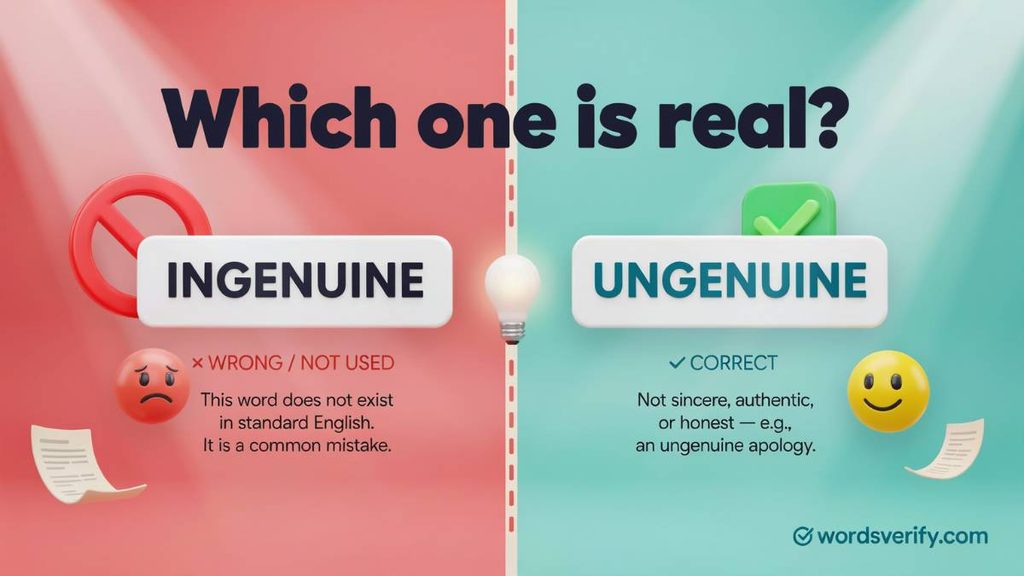
Ungenuine describes something that isn’t genuine, authentic, sincere, or real. It can refer to a person, object, statement, feeling, or action that lacks the qualities associated with genuineness.
Imagine buying a designer handbag from a street vendor. The seller claims it’s an original product, but the logo looks slightly different and the stitching feels cheap. The handbag might resemble the real thing, yet it isn’t authentic. You could describe it as ungenuine, although fake or counterfeit would sound more natural.
The same idea applies to human behavior. Imagine a coworker congratulating you on a promotion while secretly hoping you lose the position. The congratulations might sound pleasant, but the words don’t reflect the person’s actual feelings.
In this situation, insincere or disingenuous would probably communicate the meaning more clearly.
Ungenuine Definition and Main Uses
The definition of ungenuine centers on a lack of authenticity or truthfulness. Its exact meaning depends on the noun it describes.
Here are the main situations in which someone might use the word:
- Objects: Something that imitates an original item without being authentic.
- Emotions: Feelings or expressions that don’t reflect what someone truly feels.
- Behavior: Actions that appear honest or natural but lack sincerity.
- Statements: Claims that misrepresent facts or someone’s real intentions.
- Relationships: Interactions that feel forced, artificial, or dishonest.
For example:
- The customer complained about receiving an ungenuine product.
- Her ungenuine enthusiasm made the presentation uncomfortable.
- Everyone noticed the ungenuine smile on his face.
- The politician’s response seemed ungenuine to the audience.
- Their friendship began to feel ungenuine after several dishonest conversations.
Notice that these examples use the adjective in different situations. However, the best replacement changes with the context. A counterfeit watch is fake, while a forced apology is insincere.
Examples of Ungenuine in Sentences
The following examples show how the word might appear in different contexts.
| Context | Example sentence | More natural alternative |
|---|---|---|
| Personal behavior | His ungenuine kindness made people uncomfortable. | His insincere kindness made people uncomfortable. |
| Appearance | She noticed an ungenuine smile. | She noticed a forced smile. |
| Business | The company received complaints about ungenuine products. | The company received complaints about counterfeit products. |
| Relationships | Their friendship felt ungenuine. | Their friendship felt superficial. |
| Communication | His ungenuine response raised questions. | His dishonest response raised questions. |
| Marketing | The advertisement made an ungenuine claim. | The advertisement made a false claim. |
You can use ungenuine when you want to emphasize a lack of genuineness. Nevertheless, familiar alternatives usually help readers understand your meaning more quickly.
Learn the difference between often confused words
Updated vs Update which one is correct?
Is Ingenuine a Real Word?
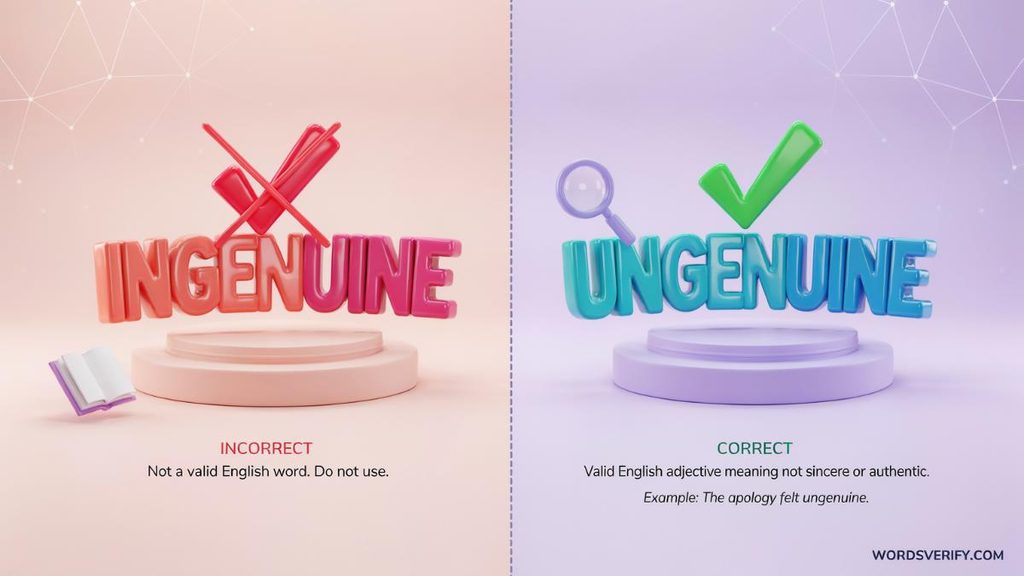
The question deserves a careful answer. You might encounter “ingenuine” in online discussions, informal writing, comments, and occasional published material. However, that doesn’t make it an established standard English adjective. The Ingenuine vs Ungenuine distinction helps explain why the two forms aren’t equally accepted.
Major dictionary references recognize “ungenuine,” but “ingenuine” doesn’t have the same level of acceptance. It’s not a reliable standard alternative to “genuine.” Understanding Ingenuine vs Ungenuine can help you avoid this common spelling mistake.
Why do people use it, then?
The answer probably lies in English word formation. Many familiar adjectives use the negative prefix “in-” to express an opposite meaning. Writers sometimes apply that pattern to “genuine,” assuming the result should be “ingenuine.” This assumption is at the heart of the Ingenuine vs Ungenuine confusion.
Unfortunately, English doesn’t work like a machine in which you can attach any prefix to any word and automatically create an accepted term.
Ingenuine Meaning and Definition
The intended meaning of ingenuine is usually not genuine, fake, artificial, or insincere.
For instance, someone might write:
- Her apology was ingenuine.
- The product looked ingenuine.
- His behavior seemed ingenuine.
- The compliment sounded ingenuine.
Readers can usually understand the intended message. However, the spelling may look unfamiliar or incorrect to someone who expects standard English.
For clearer writing, consider these alternatives:
- Her apology was insincere.
- The product looked fake.
- His behavior seemed dishonest.
- The compliment sounded forced.
The important distinction is between understanding a word and recommending it. Readers might understand ingenuine without recognizing it as a standard English choice.
Is Ingenuine Grammatically Correct?
Generally, no. Ingenuine isn’t recommended as a standard adjective in contemporary English.
Its construction may look logical, but a word’s spelling and grammar depend on established usage, not just familiar prefix rules.
For example:
- Incorrect is a standard English word.
- Incomplete is a standard English word.
- Inaccurate is a standard English word.
- Inauthentic is a standard English word.
- Ingenuine isn’t an established equivalent.
The last example is particularly interesting because inauthentic already provides a recognized word for something that isn’t authentic.
Therefore, if you’re writing an academic paper, business report, article, or formal email, choose a familiar alternative.
Why Do People Spell It Ingenuine?
Several factors contribute to the confusion.
The influence of the prefix in-: English contains many negative adjectives beginning with in-. People naturally assume the same construction should work with genuine.
Confusion with genuine: Writers know that genuine means real or authentic. They may try to create its opposite by adding a negative prefix.
Similarity to ingenuous: The words ingenuine and ingenuous look remarkably similar. However, they don’t share the same meaning.
Online repetition: When people see an uncommon spelling repeatedly on social media or discussion boards, they may assume it’s correct.
Unfamiliar vocabulary: Some writers believe longer or less familiar words sound more sophisticated. In reality, a simple, accurate word often communicates much more effectively.
How to Use Ingenuine in a Sentence
If you’re specifically discussing the spelling ingenuine, you can mention it as a nonstandard form in a linguistic explanation.
For example:
- Some writers mistakenly use ingenuine when they mean insincere.
- The spelling ingenuine is often confused with ungenuine.
- Students sometimes assume ingenuine is correct because of the negative prefix in-.
These examples discuss the word itself rather than recommend it in ordinary writing.
That distinction matters. You can mention an incorrect or nonstandard spelling without using it as your preferred vocabulary.
Learn the difference between often confused words
Light vs Lite which one is correct?
Ingenuine vs Ungenuine Key Differences
The difference between ingenuine vs ungenuine comes down to dictionary recognition, established usage, and suitability for formal writing.
Both spellings appear to express the opposite of genuine. However, they don’t have equal standing in contemporary English.
| Feature | Ingenuine | Ungenuine |
|---|---|---|
| Word status | Nonstandard and uncommon | Dictionary-recognized |
| General meaning | Intended to mean not genuine | False or not genuine |
| Dictionary support | Limited | Listed by Collins |
| Everyday usage | Rare | Uncommon |
| Formal writing | Avoid | Usually replace with a clearer word |
| Pronunciation | No firmly established standard | Dictionary pronunciation available |
| Better alternatives | Insincere, fake, inauthentic | Not genuine, fake, insincere |
The distinction isn’t that one spelling is a widely accepted everyday word and the other is completely meaningless. Rather, ungenuine has stronger dictionary recognition, while ingenuine lacks established standard status.
Which Word Is More Common?
When comparing ingenuine vs ungenuine, dictionary recognition provides a useful starting point. Collins includes an entry for ungenuine and identifies it as an adjective meaning false.
However, dictionary inclusion doesn’t automatically mean a word is popular.
Ungenuine remains uncommon compared with expressions such as:
- Not genuine
- Not authentic
- Fake
- Insincere
- Inauthentic
- Disingenuous
It’s also important not to confuse search popularity with actual language use. Someone searching for ingenuine or ungenuine may simply be trying to resolve a spelling question. Search interest doesn’t prove that either form appears regularly in everyday conversation.
Without reliable comparative usage data, there’s no reason to claim that one spelling dominates in every English-speaking country.
Genuine vs Ungenuine Understanding the Difference
The word genuine describes something real, authentic, sincere, or truly belonging to the source it claims.
Its opposite depends on the context.
| Genuine | Opposite or alternative |
|---|---|
| Genuine leather | Fake leather |
| Genuine affection | Insincere affection |
| Genuine signature | Forged signature |
| Genuine enthusiasm | Forced enthusiasm |
| Genuine concern | Feigned concern |
| Genuine information | False information |
This table highlights an important point: there isn’t one perfect opposite of genuine for every situation.
A counterfeit product isn’t necessarily dishonest in the same way as a misleading statement. Similarly, someone who gives a forced smile isn’t necessarily committing fraud.
Choose the word that describes the actual problem.
Learn the difference between often confused words
Loss vs Lose which one is correct?
The Origin of Genuine and the Prefixes Un- and In-
To understand why people disagree about ingenuine or ungenuine, it helps to examine the word genuine and the prefixes English uses to create negative forms.
The Origin and History of Genuine
The word genuine entered English during the 1590s. Its history traces back to the Latin adjective genuinus, meaning natural, native, or innate. The Latin word is associated with gignere, meaning to beget or produce.
Originally, genuine described something natural rather than acquired or artificial.
Over time, its meaning expanded. By the 1660s, it could describe something that truly came from the source it claimed to come from. That development helped establish its modern connection with authenticity.
Today, genuine has several related meanings:
- Authentic: A genuine antique is an original rather than a reproduction.
- Sincere: A genuine apology expresses real regret.
- Natural: Genuine enthusiasm comes from actual interest.
- Real: A genuine concern reflects a real problem.
This range explains why finding the right opposite can be tricky. A word that describes a fake object might not accurately describe an insincere person.
What Does the Prefix Un- Mean?
The prefix un- commonly expresses negation or reversal in English. It often creates an adjective with the opposite meaning of its base word.
Consider these examples:
| Original word | Negative form |
|---|---|
| Happy | Unhappy |
| Fair | Unfair |
| Kind | Unkind |
| True | Untrue |
| Certain | Uncertain |
| Reliable | Unreliable |
| Natural | Unnatural |
The pattern is easy to recognize. Add un- to a suitable word and you often create its negative form.
That’s why ungenuine may look reasonable to English speakers. The construction follows a familiar pattern, and Collins recognizes the resulting adjective.
However, familiar prefix rules don’t guarantee that every new combination will sound natural or become widely accepted.
What Does the Prefix In- Mean?
The prefix in- can also express negation. It appears in words such as:
- Inaccurate
- Incomplete
- Inactive
- Indirect
- Inadequate
- Insecure
- Inappropriate
However, English uses several related negative-prefix forms, including im-, il-, and ir-.
| Prefix | Examples |
|---|---|
| In- | Inaccurate, incomplete |
| Im- | Impossible, imperfect |
| Il- | Illegal, illogical |
| Ir- | Irregular, irresponsible |
These forms reflect historical word development and sound patterns. They aren’t interchangeable whenever a writer wants to express the opposite of an adjective.
For that reason, attaching in- to genuine doesn’t automatically establish ingenuine as a standard English word.
The established alternative inauthentic already expresses the lack of authenticity clearly.
Is Ingenuine an Obsolete Word?
There’s an important difference between an obsolete word and a nonstandard or uncommon word.
An obsolete word once had established usage but has largely disappeared from modern language. A nonstandard form may appear in writing without ever becoming a widely accepted standard word.
Ingenuine is better described as an uncommon, nonstandard form than confidently labeled an obsolete adjective. There’s insufficient evidence to establish that it was once a widely accepted standard English word and later fell out of use.
When discussing its history, it’s safer to describe its limited recognition rather than invent an earlier period of widespread use.
Learn the difference between often confused words
Nitch vs Niche Which one Is Correct?
Ingenuine vs Ungenuine Pronunciation
Pronunciation adds another layer of confusion because the two spellings look almost identical.
Collins gives the pronunciation of ungenuine as /ʌnˈdʒɛnjʊɪn/. The word contains four syllables, with the main stress falling on the second syllable.
The beginning sounds like the word un, while the remaining sounds resemble those in genuine.
How Do You Pronounce Ungenuine?
Break the word into four parts:
- Un
- Gen
- U
- Ine
The second syllable receives the strongest stress.
The unusual vowel sequence can make the word feel awkward to pronounce, especially if you haven’t encountered it before. Listening to a dictionary pronunciation is useful when you need to say it confidently.
How Do You Pronounce Ingenuine?
Unlike ungenuine, ingenuine doesn’t have a firmly established standard pronunciation in mainstream English dictionaries.
Someone reading it aloud might pronounce it by analogy with ungenuine or genuine. However, that doesn’t establish an official pronunciation.
If you need to express the intended meaning in conversation, it’s easier to choose a familiar word such as insincere, fake, or inauthentic.
Learn the difference between often confused words
Feed vs Fead and which one is correct?
Is Ungenuine American or British English?
The difference between ingenuine vs ungenuine isn’t a traditional American-versus-British spelling issue.
Some English words have recognized regional spelling differences:
| American English | British English |
|---|---|
| Color | Colour |
| Favor | Favour |
| Center | Centre |
| Theater | Theatre |
| Organize | Organise |
These are established spelling variations with recognizable regional patterns.
Ungenuine and ingenuine don’t follow the same pattern. Neither spelling represents a standard regional difference comparable to color and colour.
Collins labels its entry for ungenuine under British English. However, that doesn’t mean American English requires ingenuine instead.
For American readers, the safest choices remain not genuine, fake, insincere, and inauthentic.
British and international readers can use the same alternatives.
Learn the difference between often confused words
Discard vs Disgard Which one Is Correct?
Ungenuine vs Disingenuous What’s the Difference?
The comparison between ungenuine and disingenuous deserves special attention because these words can overlap in meaning, but they aren’t interchangeable.
Ungenuine generally describes something false, artificial, or lacking authenticity.
Disingenuous describes someone or something that isn’t sincere, candid, or straightforward. It often suggests deliberate dishonesty or an attempt to mislead.
Consider this situation.
A manager tells an employee, “I had no idea the project was behind schedule.” However, the manager received three progress reports explaining the delays.
That statement is disingenuous because the manager is pretending not to know something they already know.
Now imagine a manager gives an employee a forced smile while congratulating them on a promotion. The smile might be described as ungenuine, although insincere or forced would sound more natural.
Ungenuine vs Disingenuous Examples
| Situation | Ungenuine | Disingenuous |
|---|---|---|
| Apology | An apology that sounds artificial | An apology intended to hide responsibility |
| Smile | A smile that doesn’t reflect real feelings | A smile used to create a misleading impression |
| Explanation | An explanation that lacks authenticity | An explanation that deliberately avoids the truth |
| Advertising | A false or artificial product claim | A misleading statement made to manipulate customers |
| Conversation | An unnatural or forced response | A deliberately misleading response |
The key difference is intention.
Something can be ungenuine without involving a deliberate attempt to deceive. For example, a nervous person might produce a forced smile without intending to mislead anyone.
Disingenuous behavior generally carries a stronger suggestion of dishonesty or calculated insincerity.
Ingenuine vs Disingenuous
Writers sometimes use ingenuine when they actually mean disingenuous.
That’s usually a vocabulary problem rather than a spelling problem.
Incorrect or nonstandard:
“His ingenuine explanation fooled everyone.”
Better:
“His disingenuous explanation fooled everyone.”
The second sentence suggests that the explanation deliberately misrepresented the truth.
However, if the explanation simply sounds unnatural or lacks authenticity, inauthentic might be more suitable.
Learn the difference between often confused words
Inversely vs Conversely which one is correct?
Better Alternatives to Ingenuine vs Ungenuine
Although ungenuine has dictionary recognition, it isn’t always the most natural choice. The best replacement depends on what you want to describe.
A fake watch, an insincere apology, and a dishonest explanation all lack genuineness in some way. Yet each situation calls for a different adjective.
Here are some useful alternatives.
Not Genuine
Not genuine is the simplest and most flexible alternative. It works when something isn’t real, authentic, or sincere.
Examples:
- The certificate was not genuine.
- Her concern did not seem genuine.
- The seller admitted that the handbag was not genuine.
- His enthusiasm didn’t seem genuine.
This expression is especially useful when you want to avoid an uncommon word without changing your intended meaning.
Insincere
Insincere describes words, feelings, or behavior that don’t reflect someone’s true thoughts or emotions.
For example:
- His apology sounded insincere.
- She offered an insincere compliment.
- Their expressions of gratitude seemed insincere.
- The manager’s response felt insincere.
Use this word when you’re discussing sincerity rather than whether an object is authentic.
An imitation watch can be fake, but an apology can be insincere. The distinction is straightforward.
Inauthentic
Inauthentic describes something that lacks authenticity or doesn’t feel natural, original, or true to its source.
Examples:
- The restaurant received criticism for its inauthentic recipes.
- His online personality seemed inauthentic.
- The advertisement presented an inauthentic image of everyday life.
- Her performance felt inauthentic.
This word works particularly well in professional, academic, and cultural discussions.
It’s also useful when describing a personality or behavior that feels artificial.
Fake
Fake is a direct and familiar adjective for something that isn’t real or genuine.
Examples:
- He bought a fake designer watch.
- The website advertised fake products.
- Her smile looked fake.
- The document turned out to be fake.
The word can describe both physical objects and human behavior. However, context matters.
A fake passport is a counterfeit document, while a fake smile is an artificial expression.
False
False describes something that isn’t true, accurate, or genuine.
Examples:
- The company published a false statement.
- The advertisement contained false information.
- He gave a false impression of his qualifications.
- The document included a false signature.
Use false when the problem involves truth or accuracy rather than simply a lack of authenticity.
Phony
Phony is an informal American English adjective meaning fake, dishonest, or not genuine.
Examples:
- Everyone recognized his phony excuses.
- The salesperson used a phony name.
- Her friendly attitude seemed phony.
- The website offered phony discounts.
It’s a natural choice in casual conversations, although it may sound too informal for some academic or professional documents.
Artificial
Artificial describes something made or produced to imitate what is natural or real.
Examples:
- The flowers looked artificial.
- The advertisement used artificial enthusiasm.
- The product contained artificial ingredients.
- His reaction seemed artificial.
Unlike fake, artificial doesn’t always imply deception. Artificial flowers, for example, can be perfectly legitimate decorative products.
Dishonest and Deceptive
These words focus more directly on misleading behavior.
- Dishonest: Not truthful or trustworthy.
- Deceptive: Likely to mislead someone.
- Fraudulent: Involving intentional deception for an unlawful or unfair purpose.
- Spurious: Not genuine, valid, or trustworthy.
- Counterfeit: Made to imitate an authentic product, usually with the intention of passing it off as genuine.
For example, a counterfeit handbag imitates an original designer product. A fraudulent seller might deliberately claim that the handbag is authentic.
Ingenuine Synonyms and Ungenuine Synonyms
Because ingenuine isn’t an established standard form, its intended synonyms depend on the meaning a writer wants to express.
| Word | Related meaning | Best context |
|---|---|---|
| Fake | Not real or genuine | Objects and appearances |
| Insincere | Lacking genuine feelings | Apologies and compliments |
| Inauthentic | Lacking authenticity | Behavior, products, and experiences |
| False | Not true or real | Statements and claims |
| Phony | Fake or dishonest | Informal conversation |
| Artificial | Not natural | Materials and appearances |
| Dishonest | Not truthful | People and behavior |
| Deceptive | Intended to mislead | Actions and communication |
| Counterfeit | An imitation passed off as genuine | Branded products and documents |
| Disingenuous | Not candid or sincere | Arguments and explanations |
| Fraudulent | Involving deliberate deception | Business and legal situations |
| Spurious | False or lacking validity | Claims and evidence |
Learn the difference between often confused words
Ironic vs Unironic which one is correct?
Common Mistakes When Using Ingenuine or Ungenuine
The confusion surrounding these words often comes from assuming that spelling, meaning, and grammar always follow predictable patterns.
English has plenty of exceptions. These common mistakes explain where writers go wrong.
Assuming Ingenuine Is More Correct
The prefix in- appears in many negative adjectives, so ingenuine may look perfectly reasonable.
However, familiar word-building patterns don’t automatically establish a standard word.
For example:
- Incorrect or nonstandard: Her response was ingenuine.
- Better: Her response was insincere.
Likewise:
- Incorrect or nonstandard: The product was ingenuine.
- Better: The product was fake.
Remember that the intended meaning matters more than the apparent logic of a spelling.
Assuming Ungenuine Is Common Everyday English
Although Collins recognizes ungenuine, that doesn’t make it a common conversational word.
Most speakers would probably choose fake, insincere, or not genuine.
For example, someone is more likely to say:
“That apology didn’t sound sincere.”
Rather than:
“That apology sounded ungenuine.”
Both communicate a similar idea, but the first feels more natural in ordinary conversation.
Confusing Genuine With Ingenuous
This is one of the most important distinctions in the entire topic.
Genuine and ingenuous look similar, but their meanings differ.
Genuine means real, authentic, or sincere.
Ingenuous means honest, innocent, straightforward, or willing to trust people. It can sometimes suggest naivety.
Examples:
- She gave me a genuine compliment.
- The child had an ingenuous smile.
- His genuine concern was easy to recognize.
- Her ingenuous nature made her trust strangers too easily.
Notice that ingenuous isn’t a negative form of genuine. It describes a different quality altogether.
Confusing Ingenuous With Ingenious
These two words are another source of confusion.
| Word | Meaning | Example |
|---|---|---|
| Ingenuous | Honest, innocent, or naive | His ingenuous question surprised everyone. |
| Ingenious | Clever, inventive, or resourceful | She developed an ingenious solution. |
A person can be ingenuous because they trust others easily. Someone is ingenious when they solve a difficult problem creatively.
Using Long Words When Simple Ones Work Better
Longer vocabulary doesn’t automatically make writing more intelligent.
Compare these sentences:
- “The product appears ungenuine.”
- “The product appears fake.”
The second sentence communicates the message immediately.
Likewise:
- “His apology was ingenuine.”
- “His apology was insincere.”
Clear language helps readers understand your point without stopping to decode an unusual word.
Learn the difference between often confused words
Rehireable vs Rehirable Which one Is Correct?
Ingenuine vs Ungenuine in Everyday Writing
Choosing the right word becomes easier when you consider the purpose and audience of your writing.
A casual conversation doesn’t follow exactly the same expectations as an academic paper or business report.
In Emails and Professional Communication
Professional emails benefit from clear and precise vocabulary.
Imagine a customer complains that a retailer sold them a counterfeit watch. You could write:
“The customer believes the watch is not genuine.”
That sounds more natural and professional than:
“The customer believes the watch is ungenuine.”
Similarly, if a colleague offers an apology that doesn’t seem sincere, write:
“Your apology did not seem sincere.”
Avoid ingenuine in workplace communication because readers may question the spelling rather than focus on your message.
In School and Academic Writing
Academic writing requires accuracy. Uncommon vocabulary can be useful when it expresses a precise idea, but unusual words shouldn’t replace established terminology.
For example:
- Use inauthentic when discussing an experience that lacks authenticity.
- Use disingenuous when analyzing a misleading argument.
- Use counterfeit when discussing imitation products.
- Use insincere when examining dishonest expressions of emotion.
If your assignment concerns the words themselves, you can discuss ingenuine as a nonstandard form and ungenuine as a dictionary-recognized but uncommon adjective.
In Business and Marketing
Businesses regularly deal with questions of authenticity.
A company may need to describe counterfeit merchandise, misleading advertisements, fake reviews, or dishonest sales practices.
Consider these examples:
- A retailer discovers counterfeit designer handbags.
- A marketing team identifies false claims in a competitor’s advertisement.
- A customer complains about an inauthentic product description.
- A manager investigates deceptive sales practices.
Each situation has a more precise word than ungenuine.
The difference isn’t just stylistic. Choosing the right adjective helps businesses explain exactly what went wrong.
In Daily Conversations
Everyday conversations usually favor simple expressions.
Imagine a friend asks whether you enjoyed a compliment from someone who rarely treats you kindly.
You might say:
“Honestly, it felt a little fake.”
That sounds natural.
You could also say:
“I don’t think the compliment was sincere.”
Both sentences communicate a lack of genuineness without relying on an uncommon adjective.
A Practical Example Choosing the Right Word
Consider a fictional online retailer named BrightCart. The company receives three separate customer complaints.
Situation 1: A counterfeit product
A customer purchases a designer watch advertised as an original. An inspection reveals that it’s an imitation.
Best word: Counterfeit.
The customer received a counterfeit watch.
Situation 2: An insincere apology
A customer service representative apologizes but immediately blames the customer without addressing the problem.
Best word: Insincere.
The representative offered an insincere apology.
Situation 3: A misleading explanation
A manager knows that the company advertised the watch incorrectly but claims to have no knowledge of the issue.
Best word: Disingenuous.
The manager gave a disingenuous explanation.
All three situations involve a lack of genuineness. Yet each requires a different word because the underlying problem changes.
That’s why context matters more than choosing an adjective simply because it looks like the opposite of genuine.
Ingenuine vs Ungenuine Quick Usage Guide
If you’re still wondering which word to choose, this table offers a simple reference.
| Intended meaning | Recommended word |
|---|---|
| Not real or authentic | Not genuine |
| Counterfeit merchandise | Fake or counterfeit |
| Lacking honest feelings | Insincere |
| Deliberately misleading | Disingenuous |
| Lacking authenticity | Inauthentic |
| Not truthful | False |
| Artificial appearance | Artificial |
| Dishonest behavior | Dishonest |
| Clever or inventive | Ingenious |
| Honest, innocent, or naive | Ingenuous |
The opposite of genuine depends on the context. There isn’t one universal antonym that works perfectly in every sentence.
For example, fake works well for counterfeit products, while insincere works better for dishonest feelings.
When in doubt, not genuine is the safest general expression.
Practice Session Ingenuine vs Ungenuine
Fill in each blank with the correct word Ingenuine vs Ungenuine. Check your answers in the answer key at the end.
1. Her smile seemed __________ because she was clearly unhappy.
2. The company apologized for selling __________ products.
3. His __________ response made everyone believe he was hiding something.
4. A __________ leather bag should come with proof of authenticity.
5. She gave a __________ apology and admitted her mistake.
6. The shop was caught selling __________ designer watches.
7. His friendly behavior felt __________, as though he were pretending.
8. The word __________ is the standard choice for something that lacks authenticity.
9. Her __________ nature made her trust almost everyone she met.
10. The politician’s __________ remarks concealed his real intentions.
11. We need to check the __________ of the document before accepting it.
12. The advertisement made several __________ claims about the product.
13. His compliments sounded __________ because he never meant what he said.
14. The artist created an __________ design that impressed everyone.
15. The seller assured us that the painting was __________, not a reproduction.
16. Her concern seemed __________ because she only wanted attention.
17. The manager gave a __________ explanation instead of answering the question honestly.
18. A __________ product is designed to look like an original item.
19. His __________ approach helped him solve the difficult problem.
20. The actor delivered a __________ performance that moved the audience.
21. The word __________ describes someone who is not being straightforward or honest.
22. The company wants to build a reputation for honesty and __________.
23. Her excitement looked __________ because she showed no real interest.
24. Instead of writing “ingenuine,” choose the more widely accepted word __________ when describing something that lacks authenticity.
25. Although “ungenuine” has dictionary recognition, __________ is usually a clearer choice in formal writing.
Answers
- Insincere
- Inauthentic
- Disingenuous
- Genuine
- Sincere
- Counterfeit
- Ungenuine
- Inauthentic
- Ingenuous
- Disingenuous
- Genuineness
- False
- Insincere
- Ingenious
- Authentic
- Ungenuine
- Disingenuous
- Counterfeit
- Ingenious
- Genuine
- Disingenuous
- Genuineness
- Inauthentic
- Inauthentic
- Inauthentic
Here’s a trusted source for clear word meanings:
FAQs
Is “ungenuine” a real word?
Yes. “Ungenuine” is recognized by Collins English Dictionary. It means not genuine, authentic, or sincere, although it is relatively uncommon.
Can I use “ingenuine” in formal writing?
It’s best to avoid “ingenuine” in formal writing because it isn’t an established standard English adjective. Use “inauthentic,” “insincere,” or “not genuine” instead.
What is the difference between “ungenuine” and “inauthentic”?
Both can describe something that isn’t genuine. However, “inauthentic” is more widely accepted and sounds more natural in formal and everyday writing.
Does “ungenuine” describe a person or an object?
It can describe either. You might call a person’s behavior ungenuine if it seems insincere or describe an object as ungenuine if it isn’t authentic. More familiar alternatives include “fake” and “inauthentic.”
What is the difference between “disingenuous” and “inauthentic”?
“Disingenuous” describes someone who isn’t being honest or straightforward, often because they’re hiding the truth. “Inauthentic” describes something that lacks authenticity or genuineness. The first often suggests deliberate deception.
What do you call someone who pretends to be genuine?
You could describe that person as insincere, dishonest, fake, or disingenuous. The best choice depends on whether they’re pretending to feel something, hiding the truth, or deliberately misleading others.
What is a professional way to say “fake”?
“Inauthentic” is a suitable professional alternative. Depending on the context, “fraudulent” may describe deliberate deception, while “counterfeit” refers to an imitation product made to pass as genuine.
What is the opposite of “genuine”?
Common opposites include “fake,” “false,” “inauthentic,” “artificial,” and “insincere.” Choose the word that best matches what you mean: an imitation object, an untrue statement, or dishonest behavior.
How do you pronounce “ungenuine”?
“Ungenuine” is generally pronounced un-JEN-yoo-in, with the stress on the second syllable. It has four syllables: un-gen-u-ine.
Is “ingenuous” the same as “ingenuine”?
No. “Ingenuous” means innocent, sincere, or straightforward, sometimes to the point of being naive. “Ingenuine” is a nonstandard form sometimes used to mean not genuine. The two words have different meanings.
What is the difference between “genuineness” and “genuinity”?
“Genuineness” is the standard and widely accepted noun meaning the quality of being genuine. “Genuinity” is rare and generally not the preferred choice in modern writing.
What is another way to say “not genuine”?
You can say “inauthentic,” “fake,” “false,” “phony,” or “counterfeit.” For a person’s words or feelings, “insincere” may be more accurate.
Does “genuine” mean real or sincere?
It can mean both. “Genuine” describes something that is real or authentic, such as a genuine leather bag. It can also describe honest feelings or behavior, such as a genuine apology.
Is “genuine” pronounced differently in American and British English?
The pronunciation is broadly similar in both varieties. Accent differences may affect the vowel sounds, but the spelling remains “genuine” in American and British English.
What is a nicer way to say someone is fake?
If you want a softer expression, try “not being entirely sincere,” “putting on an act,” or “seeming inauthentic.” These phrases communicate your point without sounding unnecessarily harsh.
Conclusion
The difference between “ingenuine” vs “ungenuine” might look like a small spelling detail, but choosing the wrong one can leave your writing feeling less polished. Of the two, “ungenuine” has dictionary recognition, while “ingenuine” remains a nonstandard form. When neither sounds quite right, words such as “inauthentic,” “insincere,” and “fake” can express your meaning more naturally. Also, don’t confuse “genuine” with “ingenuous” or “ingenious”—they have very different meanings. English may enjoy throwing a few spelling curveballs, but you don’t have to swing at every one. Choose your words carefully, and your writing will stay clear, accurate, and confident.

Lisa AJS is an experienced blogger and language enthusiast at Words Verify, dedicated to making grammar simple, practical, and enjoyable. She writes engaging content on commonly confused words, grammar mistakes, word meanings, and everyday language challenges.