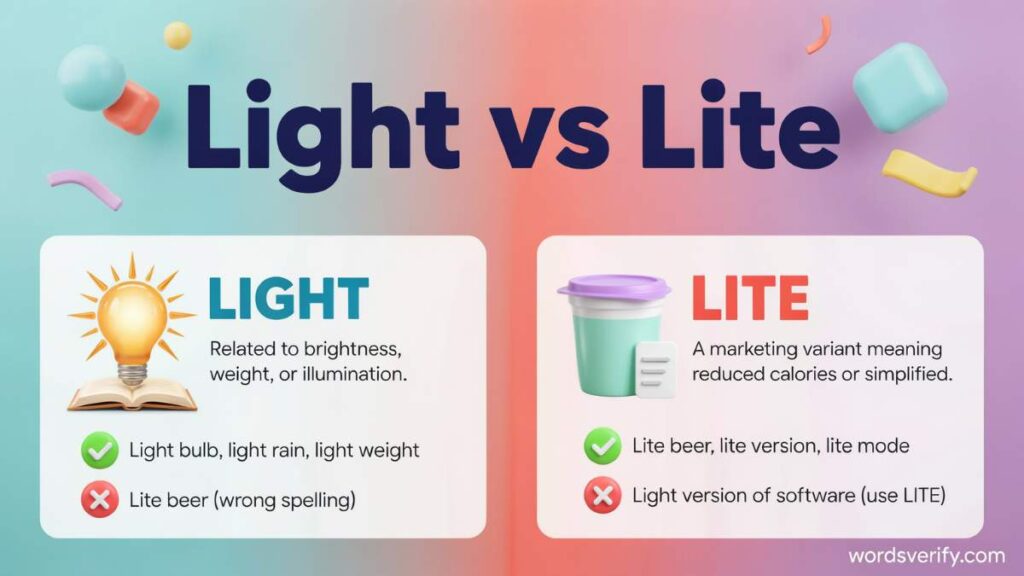
A single letter can change more than you might think, especially when you’re deciding between light and lite. Both words sound identical and look almost interchangeable, but they don’t serve the same purpose. The difference between light vs lite can trip up even confident writers because both spellings appear on everyday products, advertisements, and menus. So, should you write about a light meal or a lite snack? The answer depends on what you mean. In this guide, you’ll explore the meanings, origins, and correct uses of both spellings, with practical examples to help you avoid common grammar and spelling mistakes.
Light vs Lite The Quick Answer
The easiest way to remember the distinction is that light is the standard spelling, while lite is a specialized variant commonly used in commercial and informal language.
Both spellings are recognized in English, but you can’t freely substitute one for the other.
| Feature | Light | Lite |
|---|---|---|
| Standard spelling | Yes | No, specialized variant |
| Main meanings | Illumination, low weight, pale color, mild intensity | Reduced, simplified, or modified |
| Grammatical role | Noun, adjective, and verb | Mainly adjective |
| Food descriptions | Common | Common on product labels |
| Weight descriptions | Standard choice | Sometimes used in marketing |
| Technology | Can describe brightness or low resource use | Often describes simplified software |
| Formal writing | Preferred | Usually limited to product names and established labels |
| Example | This suitcase is light. | Download the lite version. |
Consider these sentences:
- Light: The room needs more light.
- Light: I bought a light jacket for spring.
- Lite: The company released a lite version of its application.
- Lite: She chose a lite dressing from the supermarket.
The difference becomes clearer when you look at the meaning. Light works in ordinary descriptions, while lite usually identifies a particular product or a reduced version of something.
When you’re unsure, light is generally the safer choice. Use lite when the context specifically calls for that spelling.
Learn the difference between confusing word pairs
Loss vs Lose which one is correct?
What Does Light Mean?
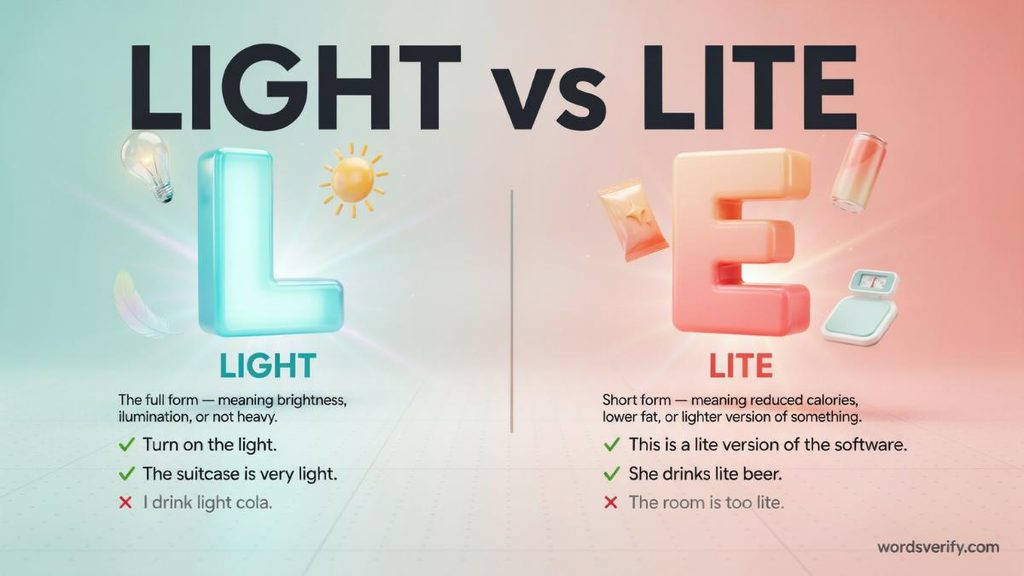
Light is one of those English words that can do several jobs in a sentence. Depending on the context, it can refer to illumination, physical weight, color, intensity, or the act of setting something on fire.
It functions as a noun, adjective, and verb. Each role has its own uses, so understanding them makes the spelling easier to remember.
Light as a Noun
As a noun, light refers to the natural or artificial energy that allows us to see objects. It can also mean a source of illumination or something that helps people understand an idea.
For example:
- Natural light entered through the bedroom window.
- The streetlights illuminated the road.
- Please turn off the light before leaving.
- The new evidence shed light on the mystery.
In the first three sentences, light refers to illumination. In the last one, it has a figurative meaning. The expression “shed light on” means to explain something or make it easier to understand.
There are two common types of light:
- Natural light comes from sources found in nature, such as the sun and stars.
- Artificial light comes from human-made sources, including lamps, lightbulbs, flashlights, and streetlights.
Both play an important role in everyday life. Natural sunlight helps regulate our sleep patterns, while artificial lighting allows us to work, read, and move around after dark.
Light also appears in expressions connected with knowledge and discovery. When someone brings something to light, they reveal information that was previously hidden or unknown.
Light as an Adjective
As an adjective, light describes something that weighs little, has a pale appearance, or lacks intensity.
This is one of the most common reasons people confuse light and lite.
When you describe a suitcase as light, you mean it doesn’t weigh much. The same word works for clothing, boxes, bags, and other objects that are easy to carry.
For example:
- She packed a light suitcase for the weekend.
- This light jacket is perfect for cool spring mornings.
- The delivery worker carried a light box upstairs.
- We chose a lightweight material for the new design.
Light also describes colors that appear pale or soft rather than dark.
For example:
- She painted the bedroom a light blue.
- His shirt was a light shade of gray.
- The walls have a soft, light yellow finish.
Here, light describes the appearance of a color, not its physical weight.
The adjective has other uses, too. It can describe something mild, gentle, or less intense.
- We enjoyed a light lunch before the meeting.
- She prefers light exercise in the morning.
- The soup has a light flavor.
- He wore light clothing during the summer.
All these examples use the standard spelling. Replacing light with lite would generally look out of place in ordinary writing.
Light as a Verb
Light also works as a verb. It means to ignite something, make it burn, or provide illumination.
For example:
- Please light the candle before dinner.
- He used a match to light the fireplace.
- They gathered around the campfire after lighting it.
- The lamps light the garden at night.
The verb has two accepted past-tense forms: lit and lighted.
Both are correct, although lit is more common in everyday conversation.
For example:
- She lit a candle during the power outage.
- She lighted a candle during the power outage.
You’ll also find lighted in expressions such as a lighted sign or a lighted path.
Remember that lite has no role as the standard verb for igniting something. You light a candle, not lite a candle.
Light as an Adverb
Although light is mainly a noun, adjective, and verb, it can also work as an adverb in certain expressions.
A familiar example is the phrase “travel light.” It means to travel without carrying much luggage.
Consider these sentences:
- We decided to travel light during our weekend trip.
- Pack light because the airline has strict baggage limits.
In both cases, light describes how someone travels or packs.
This use is less common than the noun and adjective forms, but it’s perfectly natural English.
Learn the difference between confusing word pairs
Nitch vs Niche Which one Is Correct?
What Does Lite Mean?
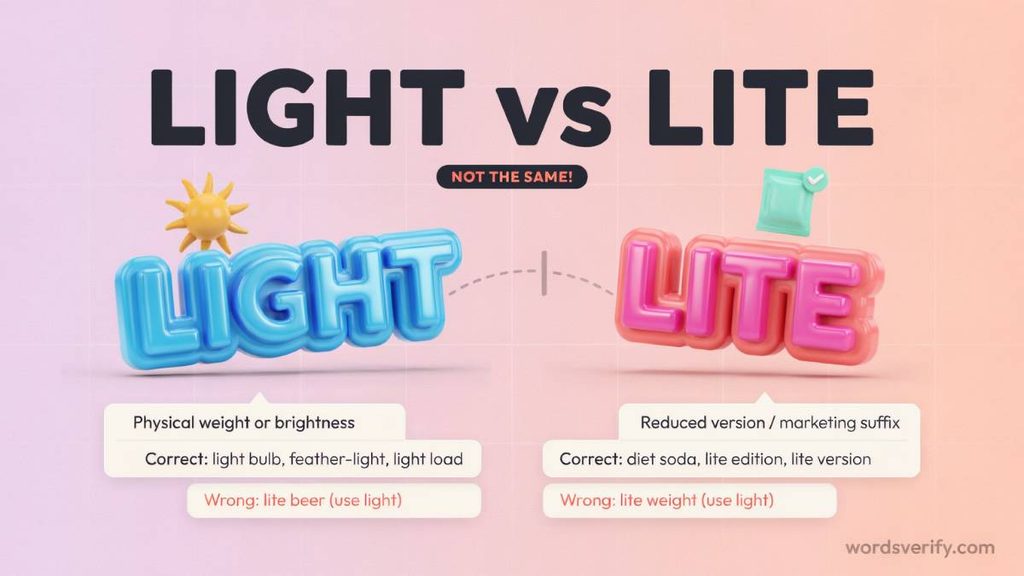
Lite has a narrower meaning than light. It’s a recognized spelling variant that generally describes something reduced, simplified, or modified.
You’ll most often encounter it in advertising, food packaging, product names, and technology.
For example:
- The company introduced a lite version of its software.
- This supermarket sells several lite food products.
- He ordered a Miller Lite at the restaurant.
- The manufacturer released a lite model with fewer features.
The spelling removes the letters GH from light. Companies often prefer this shorter version because it gives products a distinctive commercial identity.
However, lite isn’t a general replacement for light. You wouldn’t use it to describe sunlight, a pale color, or the weight of an ordinary suitcase.
Lite as an Adjective
Is lite an adjective? Yes. It mainly works as an adjective that describes a reduced or simplified version of something.
For example:
- Lite software uses fewer system resources.
- The store offers lite snacks.
- This lite edition includes fewer features than the full version.
In each sentence, lite describes a noun.
Its exact meaning depends on the product. It might refer to fewer calories, reduced fat, fewer features, or a simpler design.
One important point: lite doesn’t automatically mean lightweight. A product may use the spelling to suggest a reduced version without making any claim about its physical weight.
Lite in Food and Beverages
Food packaging is one of the places where lite appears most often.
Manufacturers sometimes use it to describe products with reduced calories, fat, sugar, carbohydrates, or alcohol content. The exact meaning depends on the product and the manufacturer’s labeling claims.
You might encounter expressions such as:
- Lite yogurt
- Lite mayonnaise
- Lite salad dressing
- Lite beer
- Reduced-calorie beverages
A product labeled lite isn’t necessarily free from sugar or fat. It may simply contain less of a particular ingredient than a comparable product.
In the United States, food manufacturers must follow applicable FDA labeling requirements when making nutrient-content claims. Terms such as reduced calorie have specific conditions. The word lite alone doesn’t guarantee that a product meets every consumer’s idea of healthy food.
It’s always worth checking the nutrition facts panel rather than relying on the front of the package.
For example, a product might contain less fat but still have considerable sugar. Another might have fewer calories but a similar amount of sodium.
The label tells only part of the story.
Lite in Technology and Software
Technology companies frequently use lite to identify simplified versions of their products.
A lite application may offer fewer features than the full version while requiring less storage, memory, or processing power.
This can be useful for people with older smartphones, limited storage space, or slower internet connections.
Common examples include:
- Lite versions of mobile applications.
- Basic software editions.
- Simplified photo-editing tools.
- Lightweight digital services.
- Reduced-feature versions of larger programs.
Imagine a photo-editing application with advanced layers, professional filters, and detailed color controls. Its lite version might offer only basic cropping, brightness adjustments, and a few simple filters.
Users still get the essential tools without the extra features.
This approach isn’t limited to mobile apps. Companies also use lite for digital services, online platforms, and other software products.
Lite in Product Names and Advertising
Why do companies use lite instead of light?
The answer often comes down to branding and product positioning.
The shorter spelling gives a product a recognizable identity and can suggest a reduced or simplified experience. It also helps companies distinguish different versions of the same product.
A familiar example is Miller Lite, an American beer brand introduced nationally in 1975. The company uses Lite as part of its established brand name.
Other businesses use similar naming conventions for products with fewer ingredients, reduced features, or different formulations.
There’s one important rule here: preserve the spelling of an official product or brand name. Don’t change Lite to Light simply because the two words sound alike.
Product names sometimes follow commercial conventions rather than ordinary spelling rules.
Learn the difference between confusing word pairs
Feed vs Fead and which one is correct?
Light vs Lite Key Differences Explained
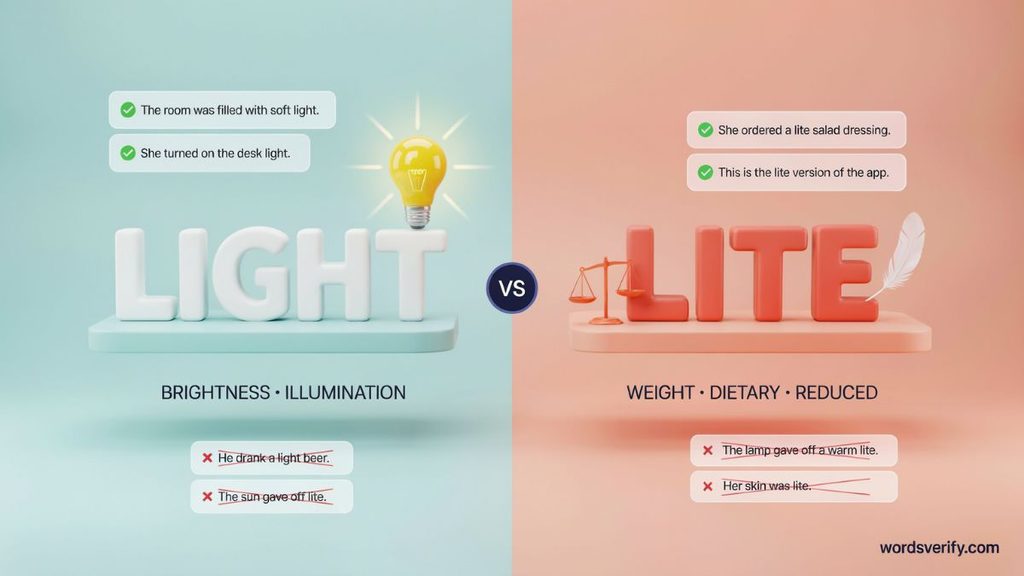
Now that the meanings are clear, let’s look at how the two spellings work in common situations.
The biggest mistake is assuming they mean exactly the same thing. They overlap in some commercial descriptions, but their everyday uses are different.
Light vs Lite for Weight
When describing physical weight, light is the standard spelling.
For example:
- This suitcase is surprisingly light.
- I bought a light jacket for traveling.
- The delivery box is light enough to carry with one hand.
- The manufacturer uses lightweight material to make the product easier to transport.
The word lite sometimes appears in product names to suggest a lightweight design. However, this is a commercial spelling choice rather than the usual English adjective.
| Sentence | Usage |
|---|---|
| This backpack is light. | Standard |
| This backpack is lite. | Informal or marketing usage |
| The jacket feels light. | Standard |
| The company released a lite jacket model. | Possible product-label usage |
If you’re writing a school assignment, business report, or everyday description, choose light when referring to physical weight.
Light vs Lite for Food
Food descriptions create another common spelling problem.
Both light and lite appear in food and beverage contexts, but they don’t always serve the same purpose.
In ordinary English, light describes a meal that isn’t heavy, a mild flavor, or food that doesn’t feel particularly rich.
For example:
- We prepared a light dinner after a large lunch.
- This soup has a light and refreshing flavor.
- She prefers light meals during the summer.
On commercial packaging, manufacturers may use lite to describe a product with a reduced amount of a particular ingredient or nutrient.
For example:
- Lite salad dressing
- Lite yogurt
- Lite mayonnaise
The distinction is fairly simple. Light food is a general description, while lite food often appears as a product label or marketing term.
A restaurant might advertise a light lunch without making any specific nutritional claim. A manufacturer using lite on packaged food may be referring to a modified product formulation.
Light vs Lite in Beer
Beer labels provide another familiar example.
You may encounter both light beer and lite beer. The word light can describe beer with fewer calories, reduced alcohol content, or a lighter body and flavor, depending on the context.
Lite frequently appears in commercial brand names.
Miller Lite is one well-known example. The spelling Lite forms part of the official brand name.
However, don’t assume every beer labeled light or lite has identical nutritional characteristics. Check the alcohol content, calorie information, and serving size before comparing products.
The spelling alone doesn’t tell you everything about what’s inside the bottle.
Light vs Lite in Everyday English
In everyday English, light covers a much wider range of situations.
You can use it when discussing:
- Illumination and brightness.
- Physical weight.
- Pale colors.
- Mild food and flavors.
- Gentle exercise.
- Igniting a candle or fire.
- Mental clarity and understanding.
By contrast, lite generally appears in commercial or specialized descriptions.
For example:
- The room needs more light.
- She wore a light blue dress.
- Please light the fireplace.
- The company released a lite version of its software.
You wouldn’t normally replace the first three instances of light with lite.
Learn the difference between confusing word pairs
Discard vs Disgard Which one Is Correct?
The Origin and History of Light vs Lite
The history of these spellings helps explain why one is standard and the other has a narrower role.
Where Did the Word Light Come From?
The word light has a long history in English.
It comes from Old English lēoht, which referred to brightness or illumination. The word has Germanic roots and is related to similar terms in other Germanic languages.
For example, German uses Licht and Dutch uses licht for light.
Over time, English developed several related meanings. The word came to describe not only illumination but also low physical weight, pale colors, and mild intensity.
These meanings may seem unrelated at first. However, English has long used the same word in different ways as its vocabulary has developed.
Today, light remains one of the most flexible and frequently used words in English.
Why Is Lite Spelled Without GH?
Lite developed as a simplified spelling of light.
It became particularly noticeable in commercial language, especially when companies wanted to promote products with fewer calories, less fat, or a modified formulation.
The shorter spelling also offered a convenient way to distinguish a reduced version from a regular product.
Advertising helped establish lite in everyday language. Food packages, beverage brands, and software products made the spelling familiar to consumers.
Eventually, it developed a recognizable role of its own.
Although lite isn’t the standard spelling in ordinary prose, it isn’t simply a random typo. It’s an established variant with specific modern uses.
Learn the difference between confusing word pairs
Inversely vs Conversely which one is correct?
Is Lite a Real Word or Just a Misspelling of Light?
Here’s a question that causes plenty of confusion: Is lite a real word?
Yes. Lite is a recognized English spelling variant of light. However, that doesn’t mean you can use it wherever you’d normally write light.
Many dictionaries recognize lite as an informal or specialized spelling, particularly in advertising and commercial descriptions.
The important distinction is between a word’s existence and its appropriate use.
Consider these examples:
| Example | Explanation |
|---|---|
| Download the lite version. | Correct specialized usage |
| I need more lite in my bedroom. | Incorrect in standard writing |
| This product contains fewer calories. | Correct |
| This is a lite product. | Possible commercial usage |
| Please lite the candle. | Incorrect |
| Please light the candle. | Correct |
A spelling can be recognized without being suitable in every situation.
That’s why understanding context matters more than simply checking whether a word appears in a dictionary.
Is Lite Grammatically Correct?
Yes, lite can be grammatically correct when used in an appropriate context.
For instance:
- This lite edition offers basic editing tools.
- The company launched a lite application.
- We purchased the lite version of the software.
In each example, lite acts as an adjective.
However, using lite instead of the standard adjective light in ordinary descriptions can make a sentence look incorrect or overly promotional.
For formal writing, academic assignments, and professional reports, use light unless you’re reproducing an official product name, brand, or specialized label.
Learn the difference between confusing word pairs
Ironic vs Unironic which one is correct?
Light vs Lite in American and British English
Does the spelling difference change between American and British English?
Not significantly. Light is the standard spelling in both varieties.
American and British writers use light when discussing illumination, weight, color, and the act of igniting something.
For example:
- American English: The room needs more light.
- British English: The room needs more light.
The spelling remains exactly the same.
Lite also appears in both varieties, particularly in product names, advertising, and commercial descriptions. Its use depends more on branding and context than on a strict regional spelling rule.
This distinction matters because English has many genuine American and British spelling differences, such as color and colour or center and centre. Light and lite don’t follow that pattern.
You shouldn’t treat lite as a British or American spelling equivalent.
Instead, remember:
- Light is standard in American and British English.
- Lite is a specialized spelling used in commercial and informal contexts in both varieties.
If you’re writing for an international audience, light remains the safest choice whenever you mean the ordinary English word.
Learn the difference between confusing word pairs
Rehireable vs Rehirable Which one Is Correct?
Common Expressions When to Use Light vs Lite
Sometimes the easiest way to understand a spelling difference is to see it in familiar expressions.
Here are common phrases that show when each spelling belongs.
| Expression | Meaning | Correct spelling |
|---|---|---|
| Light a candle | Ignite a candle | Light |
| Light a fire | Start a fire | Light |
| Turn on the light | Activate illumination | Light |
| Natural light | Illumination from natural sources | Light |
| Light clothing | Clothing that isn’t heavy | Light |
| Light meal | A meal that isn’t heavy | Light |
| Light exercise | Gentle physical activity | Light |
| Light blue | A pale shade of blue | Light |
| Lite beer | Commercial product description or brand name | Lite |
| Lite version | Simplified product or software edition | Lite |
| Lite software | Reduced-feature software | Lite |
Let’s look at a few expressions more closely.
Light a Candle or Lite a Candle?
The correct expression is light a candle.
Here, light is a verb meaning to ignite something.
For example:
- She used a match to light the candle.
- Please light the candles before the guests arrive.
Writing lite a candle is incorrect because lite isn’t the standard verb for igniting something.
Light a Fire or Lite a Fire?
Again, the correct expression is light a fire.
For example:
- We gathered some dry wood to light a fire.
- He used a lighter to light the campfire.
The spelling stays the same whether you’re starting a fireplace, campfire, or cooking fire.
Light Color or Lite Color?
Use light color when describing a pale shade.
For example:
- She chose a light pink dress.
- The kitchen walls have a light cream color.
The word light describes the color’s appearance. Lite color isn’t the standard expression.
Light Reading or Lite Reading?
The correct expression is generally light reading.
It describes reading material that is easy, entertaining, or not particularly demanding.
For example:
- I packed a novel for some light reading during the flight.
The spelling lite would usually look like a mistake unless it formed part of a specific title or product name.
Learn the difference between confusing word pairs
Monkeys vs Monkies which one is correct?
Common Mistakes When Using Light vs Lite
Even experienced writers sometimes mix up these words. The confusion usually comes from their identical pronunciation and overlapping commercial meanings.
Here are a few mistakes worth avoiding.
Using Lite for Illumination
Incorrect: The room needs more lite.
Correct: The room needs more light.
Remember that light refers to illumination. Lite doesn’t replace it in ordinary writing.
Using Lite for Physical Weight
Incorrect: This suitcase is very lite.
Correct: This suitcase is very light.
Although some brands use Lite in product names, the standard adjective for something that weighs little is light.
Writing Lite a Fire
Incorrect: Please lite the fireplace.
Correct: Please light the fireplace.
When you’re talking about igniting something, always use the verb light.
Assuming Lite Always Means Low-Calorie
Not every product labeled lite has fewer calories.
Depending on the product, the term may refer to reduced fat, sugar, carbohydrates, alcohol, or another feature.
Read the packaging carefully rather than assuming the word guarantees a particular nutritional benefit.
Using Lite in Formal Writing
Awkward: The company designed a lite material for its new building.
Better: The company designed a lightweight material for its new building.
In ordinary professional writing, lightweight or light usually communicates the meaning more clearly.
However, preserve Lite when it belongs to an official product name.
Learn the difference between confusing word pairs
Salvadoran vs Salvadorian Which one Is Correct?
Light vs Lite Examples in Sentences
Examples make the distinction easier to remember. These sentences show how both spellings work in everyday situations.
Examples Using Light
- The sunlight brought plenty of natural light into the kitchen.
- I prefer light clothing during the summer.
- She carried a light backpack on her trip.
- We prepared a light meal before dinner.
- He used a match to light the candle.
- The walls have a light shade of blue.
- Turn off the light before leaving the room.
- Regular walking is a light form of exercise.
- The new lamp provides a bright light for reading.
- We decided to travel light to avoid extra baggage.
Examples Using Lite
- The company released a lite version of its software.
- She prefers lite yogurt with breakfast.
- This product comes in a lite package.
- The application offers a lite mode for older smartphones.
- He ordered a Miller Lite at the restaurant.
- The manufacturer introduced a lite model with fewer features.
- The website offers a lite edition for users with slower internet connections.
- The company markets its lite product as a simplified alternative.
- The lite application requires less storage space than the full version.
- Customers can choose between the standard edition and the lite edition.
Notice how light appears in ordinary descriptions, while lite usually identifies a specialized product or version.
Learn the difference between confusing word pairs
Attend vs Tend which one is correct?
Light vs Lite Grammar and Parts of Speech
The grammatical difference between these words is another useful way to remember their correct usage.
Light has several grammatical roles, while lite functions mainly as an adjective.
| Grammatical role | Light | Lite |
|---|---|---|
| Noun | Yes | Rare in ordinary usage |
| Adjective | Yes | Yes |
| Verb | Yes | No standard equivalent |
| Adverb | Yes, in expressions such as travel light | No standard equivalent |
The word light has a much wider grammatical range.
For example:
- Noun: The light is too bright.
- Adjective: This is a light jacket.
- Verb: Please light the candle.
- Adverb: We decided to travel light.
By comparison, lite usually modifies another word:
- Lite version
- Lite software
- Lite beverage
- Lite edition
What Is the Plural Form of Light?
The plural form depends on how you use light.
When light refers to illumination as a general concept, it’s usually uncountable.
For example:
- Natural light fills the room.
- We need more light in the hallway.
However, when referring to individual lamps or sources of illumination, the plural form is lights.
For example:
- The streetlights illuminate the road.
- Turn off the lights before leaving.
Lite doesn’t normally have a plural form when used as an adjective. The noun it modifies takes the plural form instead.
For example:
- Several lite versions are available.
- The store sells different lite products.
What Is the Difference Between Lit and Lighted?
Both lit and lighted are accepted past-tense and past-participle forms of the verb light.
Examples:
- She lit the fireplace.
- She lighted the fireplace.
- The room was lit by candles.
- The room was lighted by candles.
Lit is generally more common in everyday conversation. Lighted also appears in standard writing, particularly in descriptions such as a lighted sign or lighted area.
Neither form has anything to do with lite.
How to Choose Between Light vs Lite
Still wondering which spelling to choose? A simple decision-making guide can help.
Follow these rules:
- Use light for illumination. Write light when discussing brightness, lamps, sunlight, or other sources of illumination.
- Use light for physical weight. A light suitcase, light jacket, or light box follows standard English spelling.
- Use light for colors. Choose light when describing pale shades such as light blue, light green, or light gray.
- Use light for mildness. Expressions such as light exercise, light meals, and light flavors use the standard spelling.
- Use light as a verb. Write light a candle or light a fire when referring to ignition.
- Use lite for specialized products. Choose lite when it appears in an established product name or describes a simplified or reduced version.
- Preserve official brand names. Don’t change Lite to Light when reproducing a company’s established product name.
A useful memory trick is to associate the letters GH with the standard spelling light. When you’re describing something ordinary, such as brightness or weight, keep the traditional spelling.
Think of lite as a product-label spelling rather than a general replacement.
practice session Light vs Lite
Test your understanding of “light” vs “lite” with these 25 fill-in-the-blank sentences. Choose the correct spelling for each sentence. The answer section follows the exercise.
- Please turn on the _____ so I can read this book.
- I bought a _____ version of the app because it uses less storage.
- This suitcase is surprisingly _____, even when it’s full.
- She prefers _____ salad dressing with fewer calories.
- The room was filled with natural _____ from the windows.
- We ordered a few _____ bites before the main course.
- The company introduced a _____ version of its popular software.
- This jacket is warm but _____ enough to wear in spring.
- The candle gave off a soft, gentle _____.
- My doctor recommended a _____ diet with less fat.
- The sky turned a _____ shade of blue at sunrise.
- I prefer to travel _____ when I go on short trips.
- The restaurant offers a _____ menu with reduced-calorie meals.
- Please _____ the candles before the guests arrive.
- The fireworks _____ up the night sky.
- This beer is marketed as a _____ option.
- We need a _____ meal before the evening event.
- The screen is too bright, so please lower the _____.
- He downloaded the _____ edition because it has fewer features.
- Her bedroom has _____ curtains that let sunlight through.
- The new laptop is powerful but surprisingly _____.
- This yogurt contains less sugar than the regular version, so it’s labeled _____.
- The streetlights _____ up the road after sunset.
- I enjoy reading _____ novels that don’t require too much concentration.
- The company launched a _____ product to attract health-conscious customers.
Answers
- Light
- Lite
- Light
- Light
- Light
- Light
- Lite
- Light
- Light
- Light
- Light
- Light
- Lite
- Light
- Lit
- Lite
- Light
- Light
- Lite
- Light
- Light
- Lite
- Light
- Light
- Lite
Here’s a trusted source for clear word meanings:
FAQs
What does “lite” mean?
“Lite” is an informal or commercial spelling of “light.” It usually describes products with reduced calories, sugar, fat, or features. You’ll often see it on food packaging, drinks, and software.
What does “very lite” mean?
“Very lite” generally means something is especially low in calories, fat, sugar, or weight, depending on the context. However, “very light” is the more natural choice in standard English.
What are the two main meanings of “light”?
“Light” has several meanings, but two common ones are illumination and reduced weight. It can refer to the brightness that helps you see or describe something that isn’t heavy. For example, sunlight provides light, while a light bag is easy to carry.
Is it lite or light for food?
Both spellings appear in food-related contexts, but they serve different purposes. “Light” is the standard spelling in ordinary descriptions, while “lite” often appears on product labels to suggest reduced calories, fat, or sugar. For example, you might see “light yogurt” or “lite dressing.”
Which spelling is correct, light or lite?
Both are correct, but they aren’t interchangeable. “Light” is the standard English spelling, while “lite” is a specialized variant mainly used in advertising, product names, and informal commercial language.
What is “lite” slang for?
“Lite” isn’t a widely established slang term with one fixed meaning. In casual and commercial contexts, it often suggests a reduced, simplified, or less intense version of something.
What is another word for “light”?
The best synonym depends on the meaning. For illumination, you can use “brightness,” “glow,” or “radiance and For reduced weight, try “lightweight” or “airy.” For something pale in color, “pale” or “soft” may work.
What is a beautiful word for light?
“Radiance” is a beautiful word for light because it suggests warmth, brightness, and a gentle glow. Other appealing choices include “luminescence,” “glimmer,” “glow,” and “luster.”
Is “lite” a valid English word?
Yes. “Lite” is a recognized spelling, especially in commercial and informal contexts. However, it doesn’t replace “light” in standard writing. Use it when a product name or established label specifically calls for it.
Do you say “lite bites” or “light bites”?
“Light bites” is the standard expression for small, relatively light meals or snacks. “Lite bites” may appear as a brand name or marketing phrase, but it’s not the usual spelling in everyday English.
Can you use “lite” in a sentence?
Yes. Here are two examples:
- This app offers a lite version for users who need fewer features.
- I bought a lite salad dressing with reduced fat.
In both sentences, “lite” describes a simplified or reduced product.
Why is it spelled “lite” instead of “light”?
“Lite” developed as a simplified commercial spelling of “light.” Businesses use it to make product names and labels look shorter and to emphasize reduced calories, ingredients, or features. The standard spelling remains “light.”
Do you say “lit up” or “light up”?
Both are correct, but they have different grammatical uses. “Light up” is the base verb or present-tense form, while “lit up” is its simple past form and past participle.
- The candles light up the room.
- The room lit up when she switched on the lamps.
When did “lite” become a word?
“Lite” became increasingly popular as a commercial spelling during the 20th century, particularly in food and beverage advertising. Its use grew as companies promoted products with fewer calories or less fat.
When should you use “lite” vs. “light”?
Use “light” in standard writing when discussing illumination, weight, color, or something mild. Choose “lite” when referring to a product label, brand name, reduced-calorie food, or simplified version of software. When in doubt, “light” is usually the safer choice.
Is “lite” grammatically correct?
Yes, “lite” is grammatically acceptable in contexts where this spelling is established, especially in product names and commercial descriptions. However, using it as a replacement for “light” in ordinary sentences is generally considered a spelling mistake.
What’s another word for “lite”?
Depending on the context, alternatives include “reduced,” “lower-calorie,” “low-fat,” “simplified,” and “basic.” For example, a lite software version could be called a basic or simplified version.
What is the old English word for light?
The Old English word for light was “lēoht.” It referred to brightness or illumination and is the historical ancestor of the modern English word “light.”
What is a poetic word for light?
“Effulgence” is a poetic and elegant word meaning brilliant radiance. Other expressive choices include “glow,” “gleam,” “shimmer,” “radiance,” and “luminescence.”
What does “light” mean in simple words?
In simple terms, “light” is the brightness that allows you to see. It can also describe something that isn’t heavy, has a pale color, or feels gentle rather than strong.
What does “light” stand for?
“Light” doesn’t stand for an acronym. It’s an ordinary English word with several meanings, including illumination, low weight, and a pale shade or mild quality.
What does “light” mean in slang?
In informal English, “light” can mean easy, not serious, mild, or not very intense. For example, “Keep it light” means to avoid making a conversation too serious.
What is a fancy name for light?
“Illumination” is a formal alternative to “light,” especially when referring to brightness. “Luminescence” and “radiance” are also useful when describing a visible glow.
What is the difference between “lite” and “light” in product names?
In product names, “lite” usually signals a reduced or simplified version. It might indicate fewer calories in a drink or fewer features in an app. “Light” has a much broader meaning and remains the standard spelling outside these specialized uses.
What is the difference between “light bites” and “lite bites”?
“Light bites” is the conventional phrase for small meals or snacks that aren’t too filling. “Lite bites” is more likely to be a creative marketing or branding choice. Use “light bites” in ordinary writing.
Conclusion
The difference between light and lite may seem small, but choosing the right spelling makes your writing clearer and more accurate. Light is the standard spelling used for illumination, weight, color, and many everyday expressions. Lite, however, has a more specialized role, appearing mainly in product names and marketing to describe reduced-calorie foods, lighter beverages, or simplified versions of products.
Here’s a simple rule to remember: use light in ordinary writing and reserve lite for specific commercial contexts where that spelling is intentional. Once you understand this distinction, you’ll have little trouble choosing the correct word. After all, a single letter shouldn’t be allowed to cast a shadow over your grammar!

Lisa AJS is an experienced blogger and language enthusiast at Words Verify, dedicated to making grammar simple, practical, and enjoyable. She writes engaging content on commonly confused words, grammar mistakes, word meanings, and everyday language challenges.