
Have you ever stopped mid sentence, wondering whether to write “updated” vs “update”? It’s an easy mix-up, but choosing the wrong word can change the meaning of your sentence. Although these two words share the same root, they serve different grammatical purposes. Understanding updated vs. update is simpler than it seems: one refers to making something current, while the other often describes something that has already been changed. The tricky part is knowing when each word fits. In this guide, you’ll discover their meanings, key differences, and everyday uses, along with practical examples to help you avoid common grammar mistakes.
Update vs Updated quick answer
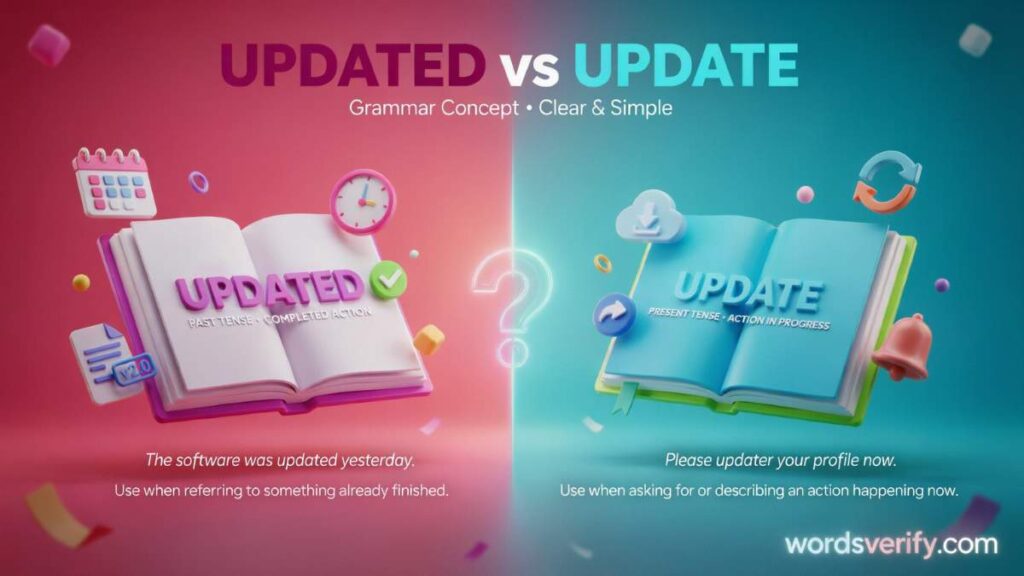
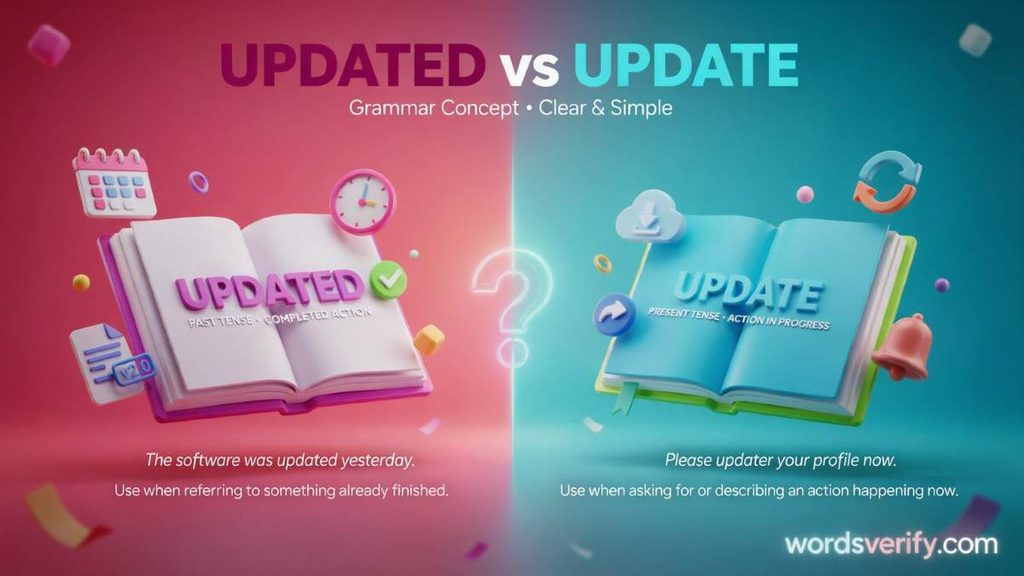
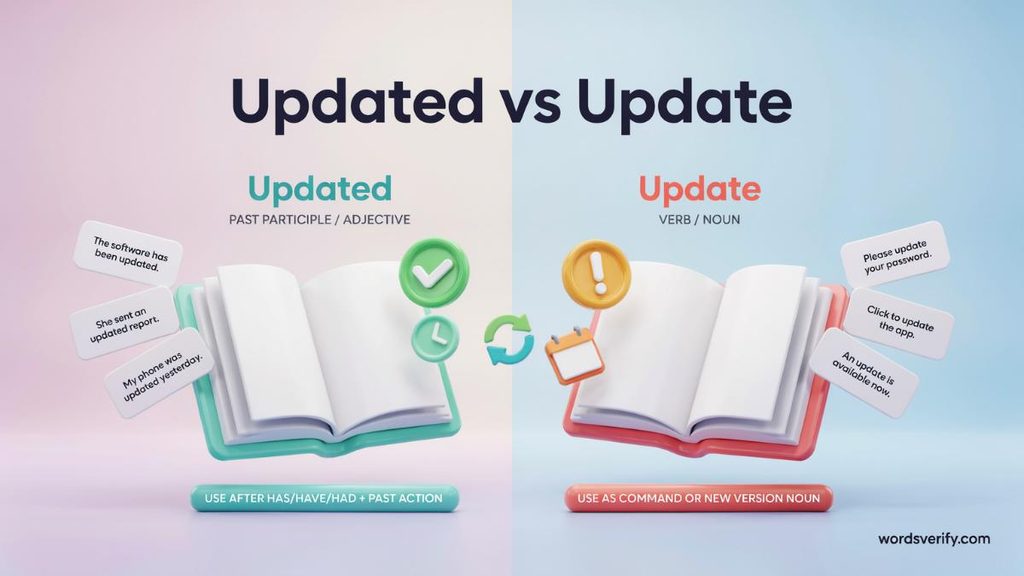
The main difference between “update” and “updated” is their grammatical form. “Update” is the base form of a verb and can also work as a noun. “Updated” is the simple past and past participle form of the verb. It can also function as an adjective.
Both words relate to making something more current, correcting existing details, or adding new information. However, you can’t freely substitute one for the other because each has a different role in a sentence.
Consider these examples:
- Update: Please update your account information before Friday.
- Updated: I updated my account information yesterday.
- Update as a noun: I received an update about the application.
- Updated as an adjective: Please check the updated application.
In the first example, “update” describes an action someone needs to perform. In the second, “updated” tells you that the action has already happened. The third refers to new information, while the fourth describes an application that someone has revised.
Quick Comparison
| Feature | Update | Updated |
|---|---|---|
| Part of speech | Noun and verb | Verb and adjective |
| Verb form | Base form | Simple past and past participle |
| Main meaning | To make something current or provide new information | Made current, revised, or brought up to date |
| Noun usage | Yes | No |
| Adjective usage | Not normally | Yes |
| Example | Please update your profile. | I updated my profile yesterday. |
| Another example | I received an update. | I received an updated report. |
An Easy Rule to Remember
Here’s a simple way to choose the correct word:
- Use “update” when referring to an action in its base form or when talking about new information.
- Use “updated” when describing an action completed in the past or something that has already been revised.
For example:
- “Please update the schedule.” The person still needs to make changes.
- “I updated the schedule.” The changes are already complete.
- “The updated schedule is available.” The schedule now contains revised information.
A single letter group can change the meaning of a sentence. Paying attention to the action and its timing will help you avoid this common mistake.
Avoid everyday grammar mistakes with simple tips
Light vs Lite which one is correct?
What Does Update Mean?
The word “update” means to make something more current by adding new information, correcting existing details, or changing something that no longer reflects the present situation. It can also refer to the new information itself.
For example, when you update your resume, you might add recent work experience, revise outdated details, or include new qualifications. When a company releases a software update, it provides changes that may fix errors, improve security, or introduce new features.
The word has two main grammatical functions: it can work as a verb or a noun.
Update as a Verb
When “update” functions as a verb, it describes an action. It means to revise information, change existing content, or bring something up to date.
You can use it in instructions, requests, statements, and questions.
Examples:
- Please update your phone number in the company directory.
- We update our website every Monday.
- The manager needs to update the project report.
- You should update your computer before installing the application.
- They plan to update the customer database next month.
In each sentence, “update” describes something someone does or needs to do.
The base form also follows modal verbs such as can, should, must, and will.
- You should update your profile.
- We can update the information later.
- Employees must update their contact details.
- I’ll update you when I receive the results.
Remember one important grammar rule: use the base form after modal verbs.
For example, “She will update the document” is correct. “She will updated the document” is incorrect because “will” must be followed by the base form of the verb.
Update as a Noun
“Update” also works as a noun. In this case, it refers to new information, a report about recent developments, or a change to an existing product or system.
Unlike the verb, the noun doesn’t describe the action of making changes. Instead, it identifies the information or result.
Examples:
- I received an update about the job application.
- The latest update includes several security improvements.
- Our manager requested a status update.
- The company released a software update yesterday.
- Do you have an update on the delivery?
The noun often appears with words such as “latest,” “recent,” “status,” “software,” and “system.”
For example, a status update gives someone information about the progress of a task or project. A software update refers to a newer release or changes made to an existing program.
You can also use “update” in its plural form:
- The company released three updates this year.
- I haven’t received any updates about the project.
- These updates improve the application’s performance.
The singular noun is “update,” while the plural is “updates.”
Update in Different Contexts
The meaning of “update” stays much the same across different subjects. However, the type of change depends on the situation.
| Context | Example | Meaning |
|---|---|---|
| Technology | Update your operating system. | Install or apply a newer version. |
| Business | Update the financial report. | Revise existing information. |
| Communication | Give me an update. | Provide recent information. |
| Education | Update the course materials. | Add or revise learning content. |
| Personal records | Update your address. | Replace old details with current ones. |
| News | Check the latest update. | Read newly available information. |
For instance, updating a website might involve correcting a product price, adding a new page, or changing outdated contact details. Updating a computer might involve installing security patches or a newer operating system version.
The action may differ, but the central idea remains the same: make something current or provide new information.
Avoid everyday grammar mistakes with simple tips
Loss vs Lose which one is correct?
What Does Updated Mean?
“Updated” is the past-tense and past-participle form of the verb “update.” It describes an action that has already happened or something that now contains revised, more current information.
When someone updates a document, they make changes to it. Once those changes are complete, the document becomes an updated document.
For example:
- I updated my resume last night.
- The company updated its privacy policy.
- We received the updated price list.
- Her contact information has been updated.
The meaning of “updated” depends on how you use it. As a verb, it describes an action performed in the past or participates in a verb construction. As an adjective, it describes something that has already been revised.
Updated as a Past-Tense Verb
Use “updated” as a simple past-tense verb when describing an action that happened and finished in the past.
It follows the regular English verb pattern of adding “-ed” to the base form.
- Base form: Update
- Simple past: Updated
- Past participle: Updated
- Present participle: Updating
- Third-person singular present: Updates
The past-tense form often appears with expressions that identify a completed action or a past period.
Examples:
- Sarah updated her professional profile yesterday.
- The school updated its admission requirements last month.
- We updated the customer records before the audit.
- The developer updated the application last week.
- He updated his resume after completing the training program.
In each example, the action happened in the past. “Updated” tells readers that someone has already made the necessary changes.
You can also use it without mentioning an exact time when the context makes the timing clear.
For example:
“She updated the document before sending it to her manager.”
The sentence identifies a completed action. It doesn’t need an exact date because the phrase “before sending it” establishes the sequence of events.
Updated as a Past Participle
“Updated” also works as a past participle. This form appears with auxiliary verbs such as “have,” “has,” “had,” and forms of “be.”
Although the spelling remains the same as the simple past form, the grammatical construction changes.
Examples:
- I have updated the report.
- She has updated her contact information.
- They had updated the records before the inspection.
- The website was updated overnight.
- The application has been updated successfully.
In the first three examples, “updated” appears in perfect-tense constructions. The helping verb establishes the relationship between the action and another point in time.
In the final two examples, “updated” appears in passive constructions. The subject receives the action rather than performing it.
| Construction | Example | Explanation |
|---|---|---|
| Simple past | I updated the file. | The action happened in the past. |
| Present perfect | I have updated the file. | The past action has relevance to the present. |
| Past perfect | I had updated the file. | The action happened before another past event. |
| Simple past passive | The file was updated. | Someone updated the file. |
| Present perfect passive | The file has been updated. | The file received the update, and the result matters now. |
Don’t confuse “updated” with “updating.” The former is the past-tense and past-participle form, while the latter is the present participle.
Updated as an Adjective
Can “updated” function as an adjective? Absolutely!
As an adjective, it describes a person, document, system, record, or other item that contains current or revised information.
Examples:
- Please read the updated guidelines before starting.
- We need an updated list of employees.
- The updated version includes several corrections.
- She submitted an updated research paper.
- The company published an updated privacy policy.
In these examples, “updated” describes the condition of the noun that follows it.
You can also use it after linking verbs such as “is,” “seems,” and “looks.”
- The schedule is updated.
- The database looks updated.
- The information seems updated.
However, it’s important to distinguish an adjective from a verb construction.
Compare:
- The team updated the schedule.
- The schedule was updated by the team.
- The schedule is updated and ready for distribution.
The first sentence uses “updated” as a simple past-tense verb. The second uses it as a past participle in a passive construction. The third can use “updated” as an adjective describing the schedule’s condition.
The spelling stays the same, but its grammatical role changes.
Avoid everyday grammar mistakes with simple tips
Nitch vs Niche Which one Is Correct?
Update vs Updated Key Grammar Differences
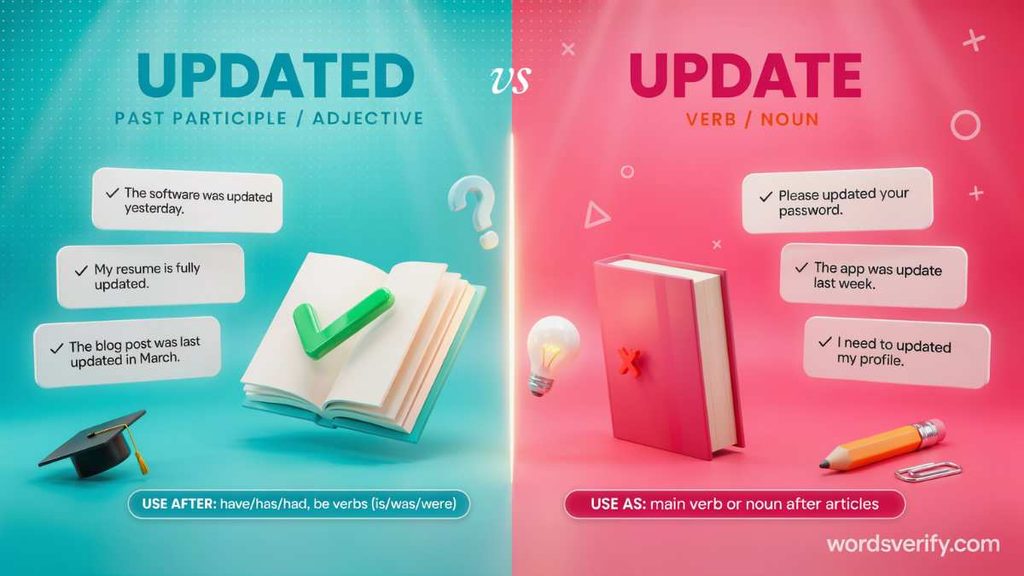
Understanding the difference between these words becomes easier when you look at sentence structure. Both belong to the same verb family, but they appear in different grammatical constructions.
The base form “update” can express regular actions, instructions, and future activities when used with the appropriate helping verbs. Meanwhile, “updated” describes completed past actions or participates in perfect and passive constructions.
Base Form vs Past Form
The most straightforward difference involves verb conjugation.
The base form “update” appears in the simple present with I, you, we, and they. It also appears with plural subjects.
Examples:
- I update my calendar every morning.
- You update your information regularly.
- We update our website every Friday.
- They update the software automatically.
With third-person singular subjects such as he, she, and it, the verb takes an “-s” ending.
- She updates the company website.
- He updates his profile regularly.
- The system updates automatically.
On the other hand, “updated” works with all subjects in the simple past.
- I updated my calendar.
- You updated your information.
- She updated the company website.
- They updated the software.
| Present tense | Past tense |
|---|---|
| I update my profile. | I updated my profile. |
| She updates the records. | She updated the records. |
| They update the website. | They updated the website. |
| We update the schedule. | We updated the schedule. |
A useful trick is to look for time expressions. Words such as “yesterday,” “last week,” and “two days ago” often signal the simple past tense. Expressions such as “every day,” “usually,” and “regularly” often point to habitual present actions.
Update vs Updated in Perfect Tenses
Perfect tenses combine auxiliary verbs with past participles. Since “updated” is the past participle of “update,” it appears in these constructions.
Present perfect:
- I have updated the report.
- She has updated her address.
- They have updated the system.
Past perfect:
- I had updated the document before the meeting.
- The company had updated its website before launching the campaign.
Future perfect:
- We will have updated all the records by Friday.
- She will have updated the presentation before the conference.
Notice that “updated” follows the appropriate auxiliary verbs in these examples.
However, “will” works differently because it takes the base form of the verb.
- Correct: I will update the document.
- Incorrect: I will updated the document.
This is an important rule. Auxiliary verbs determine which verb form belongs in the sentence.
Update vs Updated in Passive Voice
Active and passive voice also influence your choice.
In an active sentence, the subject performs the action. In a passive sentence, the subject receives the action.
Compare:
- Active: The manager updates the employee records.
- Passive: The employee records are updated by the manager.
The active version uses “updates” because the subject performs a present-tense action. The passive version uses “are updated” because the records receive the action.
More examples:
| Active voice | Passive voice |
|---|---|
| The developer updated the application. | The application was updated by the developer. |
| The team updates the website. | The website is updated by the team. |
| The administrator has updated the records. | The records have been updated by the administrator. |
In professional writing, passive constructions are useful when the result matters more than the person who performed the action.
For example, a company might announce:
“The employee handbook has been updated.”
Readers care about the revised handbook, not necessarily who made the changes.
Update as a Noun vs Updated as an Adjective
Another important distinction involves nouns and adjectives.
“Update” can name a piece of new information. “Updated” describes something that has already received changes.
Compare:
- I received an update about the project.
- I received an updated project report.
The first sentence refers to new information. The second describes a revised report.
More examples:
| Update as a noun | Updated as an adjective |
|---|---|
| The latest update is available. | The updated version is available. |
| I need a software update. | I need the updated software. |
| We received a status update. | We received an updated status report. |
| The update contains new features. | The updated application contains new features. |
Ask yourself what you’re describing. Are you talking about the new information itself? Use “update.” Are you describing something that has already been changed? Use “updated.”
Avoid everyday grammar mistakes with simple tips
Feed vs Fead and which one is correct?
When to Use Update vs Updated
Knowing the definitions is helpful, but applying them in everyday conversations and professional writing is what really matters.
The correct choice depends on whether you’re describing an action, naming new information, or explaining the condition of something.
Use Update for Actions and Instructions
Use “update” when describing a regular activity, giving an instruction, or referring to an action someone needs to perform.
Examples:
- Please update your account information.
- I update my work schedule every Sunday.
- We need to update the company website.
- You can update your computer through the settings menu.
- The administrator should update the employee records.
The base form also follows modal verbs.
- You must update your password.
- We should update the report.
- They can update the application later.
In these sentences, the action is required, possible, or habitual rather than described as a completed past action.
Use Updated for Completed Actions
Choose “updated” when describing an action that has already happened.
Examples:
- I updated my contact information yesterday.
- She updated the presentation before the meeting.
- They updated the website last weekend.
- The company updated its customer database.
You can also use “updated” to describe the result of an earlier action.
- The updated schedule is ready.
- Please download the updated version.
- We reviewed the updated policy.
In each case, the word tells readers that someone has already made changes.
Update vs Updated in Professional Writing
Professional communication often includes requests, reports, instructions, and progress summaries. Choosing the correct form helps prevent confusion.
Consider this email sentence:
“Please update the project report before Thursday’s meeting.”
This is correct because the writer asks someone to perform an action.
Now compare:
“The project report was updated before Thursday’s meeting.”
Here, the writer describes a completed action.
More examples:
| Situation | Correct sentence |
|---|---|
| Requesting changes | Please update the attached document. |
| Reporting completed work | I updated the attached document. |
| Describing a revised file | Please review the updated document. |
| Asking for information | Could you provide a status update? |
| Confirming completion | The records have been updated. |
These distinctions matter in business emails because a small grammatical error can make an instruction unclear.
Keep Updated or Keep Updating?
This is another common point of confusion.
The expressions “keep updated” and “keep updating” are both correct, but they have different meanings.
Use “keep updated” when you mean to maintain current information or make sure someone stays informed.
Examples:
- Please keep me updated on the project.
- Keep your contact information updated.
- I’ll keep you updated about the application.
Use “keep updating” when you mean to continue performing the action.
Examples:
- Keep updating the spreadsheet as new information arrives.
- Please keep updating the website.
- They keep updating the customer database.
The distinction is simple:
- Keep updated = maintain current information or remain informed.
- Keep updating = continue making changes.
Avoid everyday grammar mistakes with simple tips
Discard vs Disgard Which one Is Correct?
Update vs Updated Examples in Sentences
Sometimes, the easiest way to understand a grammar rule is to see it in action. These examples show how both words work in everyday situations.
Update in a Sentence
Here are examples showing how to use “update” in different grammatical contexts.
- Please update your phone number in the company directory.
- I update my daily planner every evening.
- The company plans to update its website next month.
- We received an update about the delivery.
- Can you update me on the project’s progress?
- The latest update fixes several technical problems.
- Employees must update their account information annually.
- The application requires a software update.
- She wants to update her professional profile.
- The manager requested a status update before the meeting.
Notice that “update” functions as a verb in some sentences and a noun in others. Its position and relationship with the surrounding words help identify its grammatical role.
Updated in a Sentence
The following examples demonstrate how to use “updated” correctly.
- I updated my resume before applying for the position.
- The company published an updated privacy policy.
- Her contact information has been updated.
- We reviewed the updated project proposal.
- The software was updated automatically.
- He submitted the updated assignment yesterday.
- The updated schedule includes the new meeting time.
- They had updated the database before the inspection.
- The website looks updated and more modern.
- The manager confirmed that all employee records were updated.
These examples show that “updated” can describe completed actions, appear in passive and perfect constructions, and function as an adjective.
Side by Side Examples
Compare these pairs to see how changing one word affects the sentence.
| Update | Updated |
|---|---|
| Please update the document. | I updated the document. |
| We update our records monthly. | We updated our records yesterday. |
| The company needs to update its website. | The company updated its website. |
| I received an update. | I received an updated report. |
| Please update your profile. | Your profile has been updated. |
| We need an update. | We need an updated version. |
The key is to recognize whether the sentence describes an action that needs to happen, an action that already happened, or an item that contains revised information.
Avoid everyday grammar mistakes with simple tips
Inversely vs Conversely which one is correct?
Common Mistakes When Using Update vs Updated
Even experienced English writers sometimes confuse these forms. The problem usually occurs when they overlook auxiliary verbs, sentence tense, or the difference between verbs and adjectives.
Here are some frequent mistakes and their corrections.
Using Updated Instead of Update in Requests
One of the most common mistakes is using “updated” when giving an instruction.
Incorrect: Please updated the document.
Correct: Please update the document.
English commands generally use the base form of the verb. The word “please” doesn’t change this rule.
More examples:
- Incorrect: Please updated your profile.
- Correct: Please update your profile.
- Incorrect: Kindly updated the records.
- Correct: Kindly update the records.
The same rule applies to other regular verbs. You say “please check,” “please review,” and “please submit,” not “please checked,” “please reviewed,” or “please submitted.”
Using Update Instead of Updated for Completed Actions
Another mistake occurs when writers use the base form to describe an action that happened in the past.
Incorrect: I update the report yesterday.
Correct: I updated the report yesterday.
The word “yesterday” establishes a past time. Therefore, the simple past form is necessary.
| Incorrect | Correct |
|---|---|
| She update the website last night. | She updated the website last night. |
| They update the records yesterday. | They updated the records yesterday. |
| He update his address last week. | He updated his address last week. |
Always check time expressions before choosing the verb form.
Confusing Updated with Updating
Although “updated” and “updating” come from the same verb, they have different grammatical functions.
“Updating” is the present participle. It commonly appears in continuous tenses to describe an action in progress.
Compare:
- She is updating the website.
- She updated the website.
- She has updated the website.
The first sentence describes an ongoing activity. The second describes a completed past action. The third uses the present perfect to connect a completed action with the present.
| Word | Grammatical function | Example |
|---|---|---|
| Update | Base form | I update the file. |
| Updating | Present participle | I am updating the file. |
| Updated | Past tense and past participle | I updated the file. |
Using Updated Without the Correct Auxiliary Verb
Some sentences require a helping verb to create a perfect or passive construction.
Incorrect: The report has update.
Correct: The report has been updated.
Here, “has been” forms the present perfect passive construction, and “updated” serves as the past participle.
More examples:
- Incorrect: The application was update.
- Correct: The application was updated.
- Incorrect: The records have update.
- Correct: The records have been updated.
- Incorrect: The website is updating yesterday.
- Correct: The website was updated yesterday.
The important lesson is that auxiliary verbs and participles must work together correctly.
Confusing an Update with an Updated Version
The noun “update” and the adjective “updated” can appear in similar contexts. However, they don’t mean exactly the same thing.
Compare:
- I downloaded an update.
- I downloaded the updated application.
In the first sentence, “update” refers to a change or new release. In the second, “updated” describes the application after someone has made changes.
Here’s another example:
- The company announced a new update.
- The company announced an updated policy.
The first refers to new information or a release. The second describes a policy that has been revised.
Avoid everyday grammar mistakes with simple tips
Ironic vs Unironic which one is correct?
Update vs Updated in Everyday Writing
Both forms appear frequently in emails, technology instructions, business reports, academic work, and casual conversations.
In Emails and Messages
Emails often include requests for information or instructions to revise documents.
Examples:
- Please update the attached spreadsheet.
- I’ve updated the document with the latest figures.
- Could you send me a status update?
- The updated proposal is ready for review.
- I’ll update you as soon as I receive a response.
Imagine a manager asking an employee to revise a report. The manager writes:
“Please update the sales figures before the end of the day.”
After completing the task, the employee replies:
“I’ve updated the sales figures and attached the revised report.”
Both sentences are correct because they describe different stages of the same process.
In Business and Professional Writing
Businesses regularly update financial reports, customer information, company policies, and project documents.
Examples:
- The accounting department updates financial records every month.
- The HR team updated the employee database.
- Management requested an updated business proposal.
- The company released a status update about the new project.
- All customer records have been updated.
Consider a company changing its office address. The administration team must update its website, employee records, invoices, and official documents.
Before the changes, someone might write:
“We need to update the company address across all platforms.”
After completing the work, the correct statement becomes:
“The company address has been updated across all platforms.”
The difference helps readers understand whether work remains or the task is complete.
In Technology and Software
Technology provides some of the most familiar examples of these words.
A software update might introduce new features, fix security problems, improve performance, or correct existing errors. An updated application is a version that already includes those changes.
Examples:
- Update your operating system to the latest version.
- The application needs a software update.
- My computer updated automatically overnight.
- The updated application runs more smoothly.
- The system has been updated with the latest security patches.
There are two common ways to install software changes:
- Automatic update: The device or application downloads and installs available updates automatically, depending on its settings.
- Manual update: The user checks for available updates and installs them.
You might see a notification saying “Update available.” This means a new version or set of changes is ready. After installation, the application may display “Updated successfully.”
These messages demonstrate the grammatical difference in a practical setting.
In News and Social Media
News organizations and social media platforms frequently publish new information about developing stories.
Examples:
- Follow our page for the latest update.
- The article was updated this morning.
- We received a recent update about the investigation.
- The updated report includes additional information.
- I’ll update my followers when more details become available.
The expression “latest update” refers to the newest information released about a subject.
Meanwhile, “updated information” describes details that someone has revised or brought up to date.
In Academic and School Writing
Students and teachers use both forms when discussing assignments, research, schedules, and educational resources.
Examples:
- Please update your bibliography before submitting the paper.
- The teacher updated the course schedule.
- Students must download the updated syllabus.
- The school published an update about examination dates.
- I have updated my research references.
Imagine a student submitting a research paper and receiving feedback from a teacher. The teacher asks the student to correct several references and revise the conclusion.
The teacher might write:
“Please update your references and revise the conclusion before resubmitting your assignment.”
After making the changes, the student replies:
“I have updated the references and submitted the revised assignment.”
The first sentence uses “update” for an action that still needs to happen. The second uses “updated” because the student has completed the work.
In Everyday Conversation
You don’t need formal writing to encounter these words. People use them regularly when discussing appointments, travel plans, personal information, and daily activities.
Examples:
- I’ll update you later.
- Have you updated your phone number?
- Do you have an update about the delivery?
- She updated her social media profile.
- Please keep me updated.
- I need an updated copy of the schedule.
The same grammar rules apply in casual conversation. The sentence structure determines which form you need.
Avoid everyday grammar mistakes with simple tips
Rehireable vs Rehirable Which one Is Correct?
Related Word Forms Update, Updates, Updated and Updating
The verb “update” has several grammatical forms. Learning all four makes it easier to construct sentences correctly.
| Word form | Grammatical role | Example |
|---|---|---|
| Update | Base verb or singular noun | Please update the file. |
| Updates | Third-person singular verb or plural noun | She updates the file. |
| Updated | Simple past, past participle, or adjective | She updated the file. |
| Updating | Present participle or gerund | She is updating the file. |
Update
“Update” is the base form of the verb and the singular form of the noun.
Examples:
- I update my calendar every morning.
- Please update your information.
- We received an update yesterday.
Updates
“Updates” has two main uses.
As a verb, it is the third-person singular present-tense form.
- She updates the website regularly.
- He updates his records every month.
As a noun, it is the plural of “update.”
- The application received several updates.
- We haven’t received any updates yet.
Updated
“Updated” functions as the simple past, past participle, and adjective.
Examples:
- I updated the document.
- The document has been updated.
- Please read the updated document.
Updating
“Updating” is the present participle of “update.” It appears in continuous verb constructions and can also function as a gerund.
Examples:
- I am updating the spreadsheet.
- They were updating the website.
- Updating your contact information regularly is important.
The first two sentences describe ongoing actions. The third uses “updating” as a noun-like gerund.
Avoid everyday grammar mistakes with simple tips
Monkeys vs Monkies which one is correct?
Is There a Difference Between American and British English?
No. There is no spelling difference between “update” vs “updated” in American and British English.
Both varieties use the same spellings, definitions, and basic grammatical rules.
| Usage | American English | British English |
|---|---|---|
| Base verb | Update | Update |
| Simple past | Updated | Updated |
| Past participle | Updated | Updated |
| Present participle | Updating | Updating |
| Third-person singular | Updates | Updates |
| Noun | Update | Update |
American English examples:
- Please update your computer.
- I updated my resume yesterday.
- The updated schedule is available.
British English examples:
- Please update your computer.
- I updated my CV yesterday.
- The updated timetable is available.
The vocabulary surrounding these words may vary. For example, Americans commonly say “resume,” while British English speakers often use “CV” in similar professional contexts.
However, the spelling of “update” and “updated” stays exactly the same.
What Is the Opposite of Update?
“Update” doesn’t have one universal opposite. The best alternative depends on what you’re trying to describe.
If you’re talking about information that is no longer current, “outdated” is often the most suitable opposite of “updated.”
Here are some related words:
| Word | Meaning | Example |
|---|---|---|
| Outdated | No longer current or useful | The website contains outdated information. |
| Obsolete | No longer used because something newer has replaced it | The company replaced its obsolete computer system. |
| Revert | Return something to an earlier state | We decided to revert to the previous version. |
| Downgrade | Move to a lower version or level | The company downgraded its software. |
| Restore | Return something to a previous condition | The technician restored the original settings. |
These words aren’t interchangeable in every situation.
For example, “revert” means to return to an earlier state, while “outdated” describes something that is no longer current.
Similarly, “downgrade” generally refers to moving to a lower version or level. It doesn’t simply mean leaving something unchanged.
If you want the opposite of an updated document, “outdated document” is usually the clearest expression.
Updated vs Update Final Comparison
Here’s a quick reference table covering the most important differences.
| Feature | Update | Updated |
|---|---|---|
| Part of speech | Noun and verb | Verb and adjective |
| Verb form | Base form | Simple past and past participle |
| Main meaning | To make something current or provide new information | Made current, revised, or brought up to date |
| Present-tense use | I update my records. | Not used as a simple present-tense form |
| Past-tense use | Not used as the simple past | I updated my records. |
| Noun usage | I received an update. | Not normally used as a noun |
| Adjective usage | Not normally used as an adjective | The updated records are ready. |
| Example | Please update the website. | The website was updated yesterday. |
The easiest distinction to remember is that “update” refers to an action or a piece of new information, while “updated” describes a completed action or something that has already received changes.
Avoid everyday grammar mistakes with simple tips
Salvadoran vs Salvadorian Which one Is Correct?
practice session Updated vs Update
Test your understanding of “updated” vs “update” with these sentences. Choose the correct word for each blank. Pay attention to the sentence structure and meaning.
- Please ______ your contact information before submitting the form.
- I have already ______ the company website.
- The manager asked me to provide an ______ on the project.
- We ______ the software yesterday to fix several errors.
- The customer database needs to be ______ regularly.
- Have you ______ the latest version of the document?
- The ______ schedule is available on the notice board.
- I’ll ______ you as soon as I receive the results.
- The team has ______ its safety guidelines.
- Could you give me an ______ on the delivery status?
- She is currently ______ the records.
- The application was recently ______ to improve its performance.
- Don’t forget to ______ your password every few months.
- The report hasn’t been ______ since last Monday.
- We received an important ______ from the project manager.
- The company plans to ______ its website next week.
- All employee details have been ______ in the system.
- He promised to keep us ______ about the changes.
- The news channel provides a daily ______ on current events.
- I ______ the spreadsheet before sending it to my supervisor.
- The system automatically ______ the information every night.
- Please check whether the information is ______.
- They are working to ______ the outdated policy.
- The latest ______ includes several useful improvements.
- Once the information is ______, we can share the final report.
Answers
- Update
- Updated
- Update
- Updated
- Updated
- Updated
- Updated
- Update
- Updated
- Update
- Updating
- Updated
- Update
- Updated
- Update
- Update
- Updated
- Updated
- Update
- Updated
- Updates
- Updated
- Update
- Update
- Updated
Here’s a trusted source for clear word meanings:
FAQs
Is “updated” a verb or an adjective?
“Updated” can function as both a verb and an adjective. As a verb, it is the past tense and past participle of “update.” As an adjective, it describes something that is current or has been brought up to date.
Can “update” be used as both a noun and a verb?
Yes. As a noun, “update” refers to new information or a change. As a verb, it means to make something more current.
What is the difference between “has updated” and “has been updated”?
“Has updated” uses the active voice and identifies the person or thing performing the action. “Has been updated” uses the passive voice and focuses on the item that received the change.
Is “to be updated” grammatically correct?
Yes. “To be updated” is a correct infinitive phrase. It often indicates that something needs attention or will receive changes later. For example, “The website needs to be updated.”
Can “updated” describe something that is still current?
Yes. “Updated” can work as an adjective to describe information, software, records, or documents that have been brought up to date. For example, “Please use the updated version of the report.”
What is the difference between “updating” and “updated”?
“Updating” refers to an action that is happening or ongoing, while “updated” generally describes an action that has been completed or something that has already received changes. For example, “I am updating the file” versus “I updated the file.”
How do you use “update” in a professional email?
You can use “update” to introduce new information or request a progress report. For example, “I’m writing to provide an update on the project” or “Could you share an update on the current timeline?”
What does “subject to update” mean?
“Subject to update” means that information may change as new details become available. It commonly appears in schedules, announcements, policies, and official documents.
Is “updated information” correct?
Yes. “Updated information” is grammatically correct because “updated” acts as an adjective describing information that has been revised or brought up to date.
What is the difference between “update” and “revision”?
An “update” adds new information or brings something up to date. A “revision” involves reviewing and changing existing content, often to improve its accuracy, clarity, or quality. The words can overlap, but they aren’t always interchangeable.
Can “update” refer to software or technology?
Yes. In technology, an “update” usually refers to a new version or modification that improves, fixes, or adds features to software, an application, or a device. For example, “The latest update fixed several security issues.”
What does “keep someone informed” mean?
“Keep someone informed” means regularly sharing important information or developments with them. It’s a professional alternative to “keep someone updated,” especially in business communication.
Is “recently updated” grammatically correct?
Yes. “Recently updated” describes something that received changes not long ago. For example, “The recently updated policy is available on the company website.”
What is the difference between “update” and “upgrade”?
An “update” brings something current by adding information, fixing problems, or making changes. An “upgrade” improves something by moving it to a better or more advanced version. For example, correcting a software bug is an update, while moving to a more powerful version may be an upgrade.
Can “updated” be used without mentioning who made the changes?
Yes. You don’t always need to identify the person who made the changes. For example, “The customer records have been updated” is grammatically correct and focuses on the completed action rather than who performed it.
Conclusion
The difference between “updated” vs “update” may seem like a tiny grammar detail, but choosing the right word makes your writing clearer and more accurate. Use “update” when referring to the act of making something current or to a change itself. Choose “updated” when describing something that has already been changed or brought up to date. Once you understand how these words work, you’ll no longer need to second-guess yourself every time they appear in a sentence. Remember, good grammar isn’t about making writing complicated; it’s about making your message easy to understand. Keep this simple distinction in mind, and you’ll never let “updated” vs “update” trip you up again!

Lisa AJS is an experienced blogger and language enthusiast at Words Verify, dedicated to making grammar simple, practical, and enjoyable. She writes engaging content on commonly confused words, grammar mistakes, word meanings, and everyday language challenges.