
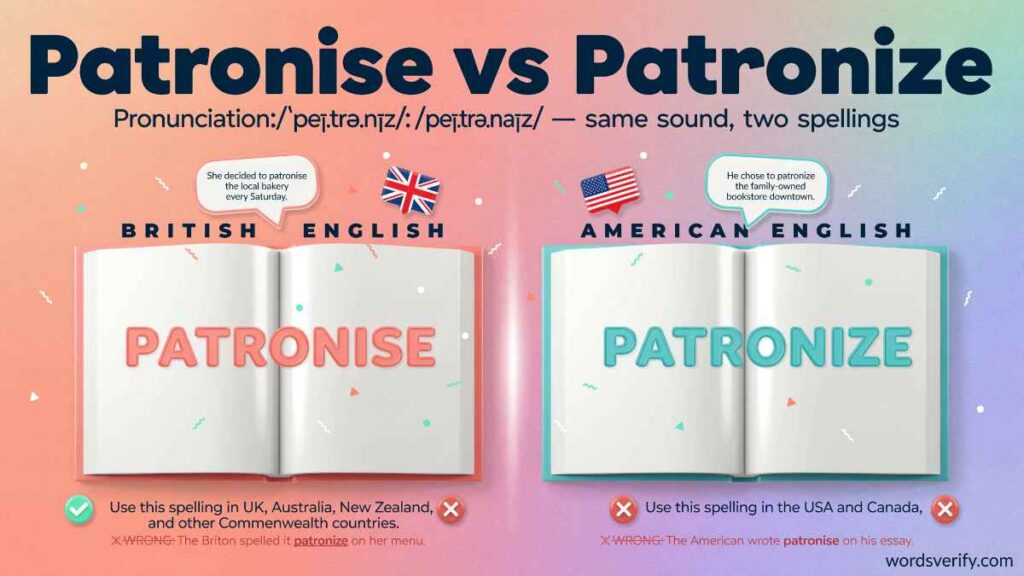
Have you ever written “patronize” and wondered whether “patronise” might be the better choice? English spelling loves a little mischief, and this pair is a perfect example. The difference is just one letter, but choosing the right form depends on where you’re writing. Both patronise vs patronize are correct and carry the same meaning. One is preferred in British English, while the other is standard in American English. However, there’s a little more to the story. From their meanings and pronunciation to their regional spelling rules, let’s clear up the confusion and help you use both forms with
Patronise vs Patronize The Quick Answer
Both patronise vs patronize are correct English spellings. The choice depends mainly on which spelling convention you’re following.
American English prefers patronize with a Z. British English commonly uses patronise with an S. The two forms have identical meanings and pronunciation.
Here’s a quick comparison:
| Feature | Patronize | Patronise |
|---|---|---|
| Common usage | American English | British English |
| Part of speech | Verb | Verb |
| Meaning | To treat someone condescendingly or support a business | Same |
| Pronunciation | /ˈpæt.rə.naɪz/ | /ˈpæt.rə.naɪz/ |
| Past tense | Patronized | Patronised |
| Present participle | Patronizing | Patronising |
| Third-person singular | Patronizes | Patronises |
| Related noun | Patronization | Patronisation |
For example:
- American English: Don’t patronize me just because I’m younger than you.
- British English: Don’t patronise me just because I’m younger than you.
The spelling changes, but the message stays exactly the same.
If you’re writing for American readers, use patronize. For a British audience, patronise is generally the more familiar choice. Whichever form you select, keep it consistent throughout your writing.
Learn the difference between confusing more English words
Hide vs Hid which one is correct?
What Does Patronize vs Patronise Mean?
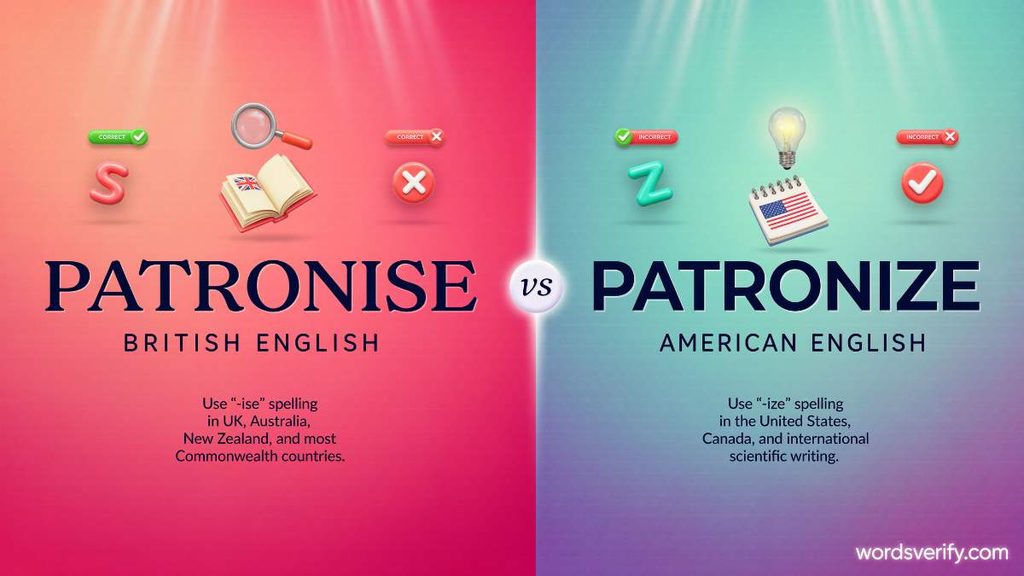
The meaning of patronize depends on the situation. This verb has two main meanings that seem quite different at first glance. One describes condescending behavior, while the other refers to supporting a business, organization, or individual.
Understanding both meanings will help you recognize how the word works in everyday English.
Patronize Someone by Treating Them Condescendingly
The first meaning of patronize is to speak to or treat someone as though they’re less intelligent, capable, experienced, or important than you are.
This behavior often comes from an attitude of superiority. Someone who patronizes another person may believe they’re being helpful or friendly. However, their words or actions suggest that they don’t respect the other person’s abilities.
For example:
- The manager shouldn’t patronize employees who understand their responsibilities.
- My colleague explained the procedure in a patronizing tone even though I already knew how it worked.
- She felt embarrassed when her supervisor patronized her in front of the team.
- Don’t patronize me just because I’m younger than you.
In these examples, patronize describes condescending behavior rather than genuine kindness.
A patronizing person might explain something in an unnecessarily childish way, offer exaggerated praise, or assume that another person cannot understand a simple idea. Even a polite comment can sound insulting when it carries an attitude of superiority.
Consider this exchange:
“Well, you actually did a pretty good job for someone with so little experience!”
The speaker appears to offer a compliment. However, the final phrase weakens the praise and suggests that the listener’s success came as a surprise.
That’s what makes the comment patronizing. It sounds encouraging on the surface but carries an insulting message underneath.
Patronize a Business by Supporting It
The second meaning is quite different. To patronize a business means to support it by purchasing its products or services. This often involves becoming a regular customer or choosing that establishment over its competitors.
For example:
- We regularly patronize the small bookstore near our house.
- Local residents should patronize independent businesses.
- Tourists often patronize restaurants that serve traditional food.
- My family has patronized that neighborhood bakery for years.
Here, patronize has a positive or neutral meaning. It doesn’t suggest arrogance or disrespect. Instead, it describes customer support.
Imagine a small coffee shop competing against several large chains. People in the neighborhood choose to buy their coffee there because they appreciate the service and want to support the owner. Those customers patronize the business.
This use of the word often appears in conversations about shopping, tourism, local economies, and community support.
For instance, a town council might encourage residents to patronize local shops rather than purchase everything from large retailers. The goal is to help independent businesses attract customers and remain successful.
Patronize Through Financial or Official Support
Patronize also has a more formal meaning connected to acting as a patron.
A patron is someone who provides money, protection, encouragement, or other assistance to a person or organization. Historically, wealthy individuals and powerful institutions often supported artists, musicians, writers, and scholars.
For example:
- Wealthy families patronized artists during the Renaissance.
- The royal family patronized several cultural institutions.
- The organization patronizes young musicians through financial assistance.
This meaning connects closely with the modern idea of supporting a business. In both situations, someone provides help or resources that allow another person or organization to continue its work.
Learn the difference between confusing more English words
Envisage vs Envision what’s the difference
Patronize Definition, Examples Understanding Both Meanings
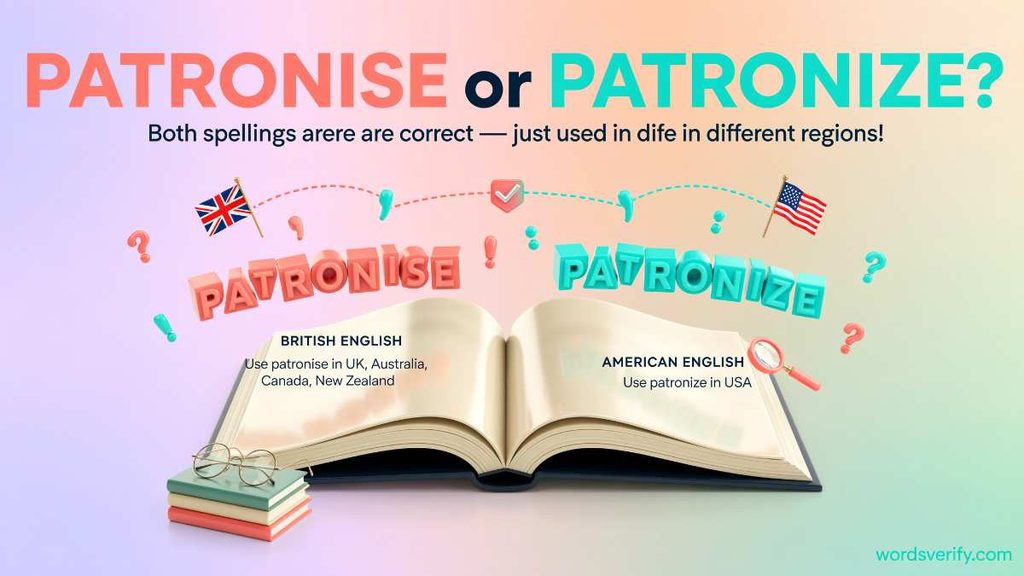
A dictionary definition provides a useful starting point, but examples make the distinction easier to understand.
The following sentences show how the surrounding context changes the meaning of patronize.
| Sentence | Meaning |
|---|---|
| Don’t patronize me during this discussion. | Don’t treat me as inferior. |
| We patronize a local restaurant every Friday. | We regularly eat there. |
| His patronizing attitude annoyed the entire team. | His behavior suggested superiority. |
| The wealthy family patronized several artists. | They provided financial support. |
| Tourists often patronize small shops in the village. | They purchase goods from those shops. |
Recognizing the Negative Meaning
When patronize describes condescending behavior, look for clues involving communication, attitude, or personal relationships.
Common signs include:
- Speaking to an adult as though they’re a small child.
- Explaining something in an unnecessarily simplistic way.
- Giving compliments that contain hidden insults.
- Dismissing someone’s knowledge or experience.
- Assuming another person cannot understand a subject.
- Using an exaggeratedly patient or superior tone.
For example, imagine an experienced employee explaining a technical problem to a manager.
The manager replies, “Don’t worry about the complicated details. I’ll explain everything slowly so you can understand.”
The response might sound helpful at first. However, it suggests that the employee lacks the intelligence to follow the discussion.
That’s a patronizing attitude.
Recognizing the Supporting Meaning
The positive or neutral meaning usually appears alongside words related to shopping, customers, restaurants, businesses, and financial support.
Look for expressions such as:
- Regular customers
- Local businesses
- Independent shops
- Customer patronage
- Financial support
- Shopping habits
- Restaurants and stores
- Cultural institutions
For example, “We encourage visitors to patronize family-owned restaurants” clearly refers to spending money at those establishments.
The surrounding words make the intended meaning easy to identify.
Learn the difference between confusing more English words
Saucy vs Saucey Which one Is Correct?
Patronise vs Patronize in British and American English
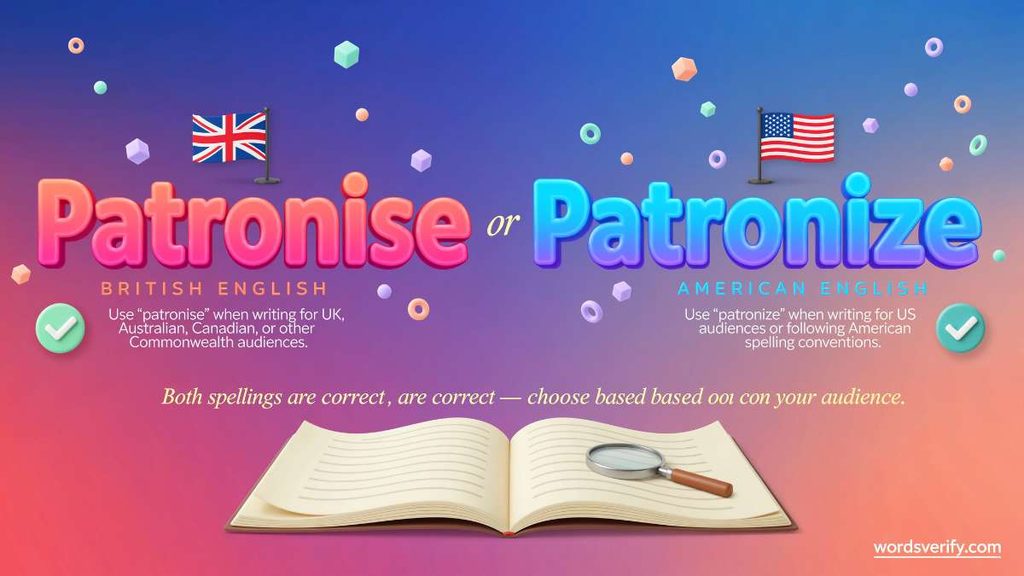
English spelling changes across countries. Words such as color and colour, favorite and favourite, and organize and organise demonstrate how regional conventions produce different written forms.
Patronise vs patronize follow a similar pattern.
Why American English Uses Patronize
American English generally favors the -ize ending in words of this type.
American writers commonly use:
- Patronize
- Organize
- Recognize
- Apologize
- Realize
- Modernize
- Specialize
For example:
“The company hopes to patronize local suppliers whenever possible.”
An American editor would normally retain patronize rather than change it to patronise.
This preference reflects a broader American spelling tradition that favors forms such as organize and recognize.
Why British English Often Uses Patronise
British English commonly uses the -ise ending in these words.
British writers often choose:
- Patronise
- Organise
- Recognise
- Apologise
- Realise
- Modernise
- Specialise
For example:
“The council encourages residents to patronise independent shops.”
This spelling is familiar in British publications, educational materials, and everyday writing.
However, there’s an important exception worth knowing.
The Oxford spelling convention traditionally uses -ize in words such as organize, recognize, and patronize. This approach follows the Greek-derived suffix -ize and is accepted by certain British publishers.
Therefore, it’s not accurate to claim that every British writer must use patronise. Both patronise vs patronize appear in British English, depending on the dictionary and style guide.
What About Canadian and Australian English?
Canadian and Australian English share several spelling conventions with British English, although neither variety follows British spelling in every situation.
Both patronise vs patronize may appear depending on the publication, dictionary, and editorial preference.
| English variety | Common spelling |
|---|---|
| American English | Patronize |
| British English | Patronise |
| Oxford-style British English | Patronize |
| Australian English | Patronise commonly |
| Canadian English | Both forms occur |
For professional writing, the safest approach is to follow the dictionary or style guide used by your intended publication.
The important point is that regional spelling preferences don’t change the word’s meaning.
Learn the difference between confusing more English words
Annual vs Anual Which one Is Correct?
How to Pronounce Patronize vs Patronise
Despite their different endings, patronize and patronise have the same standard pronunciation.
IPA: /ˈpæt.rə.naɪz/
The word has three syllables, with the stress on the first syllable.
Here’s a simple breakdown:
- First syllable: Begins with the short A sound heard in “cat.”
- Second syllable: Contains a short, unstressed vowel.
- Third syllable: Rhymes with “eyes.”
The final sound is a voiced Z, not an S.
Is Patronize Pronounced Pay-tronize or Pah-tronize?
Neither approximation is quite right for standard American pronunciation.
The first vowel is generally the short /æ/ sound, as in “cat” or “apple.” It isn’t the long A sound in “pay.”
The final syllable contains the same vowel sound heard in “time,” “fine,” and “wise.”
Regional accents may affect the exact vowel quality slightly. However, the spelling difference between patronise vs patronize doesn’t create a pronunciation difference.
Does Patronize Have a Long A or Short A Sound?
The first syllable uses the short A sound in standard American English.
The final syllable contains the /aɪ/ diphthong, commonly called the long I sound.
Remember these pronunciation points:
- First syllable: Short A.
- Final syllable: Long I sound.
- Stress: First syllable.
- Final consonant: Voiced Z.
The American pronunciation of patronize and the British pronunciation of patronise follow the same basic pattern.
Learn the difference between confusing more English words
Recurrence vs Reoccurrence What’s the Difference?
Where Does the Word Patronize Come From?
The history of patronize helps explain why one word can describe both generous support and condescending behavior.
Its origins connect to the word patron, which refers to someone who provides protection, support, or financial assistance.
Patron ultimately comes from the Latin word patronus, meaning protector or defender. The Latin word is related to pater, meaning father.
The idea of a patron was especially important in societies where wealthy or influential individuals supported people who lacked the resources to fund their own work.
From Protection to Financial Support
Historically, a patron could provide money, shelter, influence, or protection to another person.
Artists, writers, musicians, and scholars often depended on wealthy patrons. Without their assistance, many creative projects would have been difficult to complete.
During the Renaissance, for example, powerful families and members of the clergy supported painters, sculptors, architects, and other artists.
This relationship strengthened the connection between patronage and financial support.
The modern verb patronize developed from the broader idea of acting as a patron or providing support.
Today, someone can patronize a local bookstore, neighborhood restaurant, or cultural organization by regularly supporting it.
How Did the Negative Meaning Develop?
The negative meaning connects to the social relationship between a powerful benefactor and someone who depended on that person’s support.
A patron could occupy a position of authority or superiority. Over time, behaving like a patron began to carry a negative implication when someone treated another person as though they were beneath them.
In modern English, patronizing behavior suggests an unnecessary display of superiority.
The original connection with protection and support remains visible in the positive meaning. However, the negative meaning focuses on the unequal relationship between the people involved.
This history helps explain why patronize can describe two actions that seem almost opposite.
Learn the difference between confusing more English words
Copyright vs Copywrite Which one Is Correct?
Patronise vs Patronize Related Words and Their Forms
Once you understand the basic spelling difference, related words become much easier to recognize.
The same regional pattern generally appears in other forms of the verb.
| American English | British English |
|---|---|
| Patronize | Patronise |
| Patronizes | Patronises |
| Patronized | Patronised |
| Patronizing | Patronising |
| Patronization | Patronisation |
Patronizing vs Patronising
Patronizing is the American spelling, while patronising is the common British spelling.
Both forms can function as adjectives or participles.
For example:
- American: His patronizing comments upset the new employee.
- British: His patronising comments upset the new employee.
The word commonly describes behavior that makes another person feel inferior or disrespected.
It also appears in expressions such as “a patronizing attitude” and “a patronising tone.”
Patronized vs Patronised
These are the simple past and past participle forms of the verb.
For example:
- American: We patronized that restaurant during our vacation.
- British: We patronised that restaurant during our vacation.
Both sentences describe a completed action.
The context determines whether the word means supporting a business or behaving condescendingly toward someone.
Patronizes vs Patronises
These are third-person singular forms used with subjects such as he, she, and it.
Examples:
- American: She patronizes the small bookstore every weekend.
- British: She patronises the small bookstore every weekend.
The spelling changes, but the meaning remains the same.
Patronization vs Patronisation
Patronization and patronisation are noun forms referring to the act or practice of patronizing.
Depending on the context, they can describe condescending treatment or the act of providing support.
For example:
“His patronization of younger employees created tension in the workplace.”
Here, patronization refers to condescending treatment.
The spelling follows the same American and British pattern.
Learn the difference between confusing more English words
Appraised vs Apprised What’s the Difference?
Patronize vs Patronise in a Sentence Practical Examples
Sometimes the easiest way to understand a word is to see it in action.
These examples cover both meanings, along with different grammatical forms.
1.Examples of Patronizing Someone
- Please don’t patronize me; I understand the problem perfectly well.
- His patronizing tone made the new employee uncomfortable.
- She dislikes people who patronize others because of their age.
- The supervisor spoke in such a condescending manner that everyone noticed.
- I appreciate your help, but there’s no need to patronize me.
- His patronizing attitude damaged his relationship with the team.
- Teachers should explain difficult subjects without patronizing their students.
- She felt that her colleague was talking down to her during the meeting.
2.Examples of Patronizing a Business
- We patronize the same family-owned restaurant every weekend.
- Tourists should patronize local businesses when visiting small towns.
- My parents regularly patronize the neighborhood grocery store.
- Many customers prefer to patronize independent bookstores.
- The residents were encouraged to patronize local restaurants.
- She patronizes a small clothing shop instead of shopping at large chains.
- Our family has patronized that bakery for more than ten years.
- Visitors often patronize traditional markets to purchase handmade products.
3.Examples Using British Spelling
- Don’t patronise me when I’m explaining my own work.
- The manager’s patronising remarks upset the staff.
- We regularly patronise the local coffee shop.
- She felt patronised by the unnecessary explanation.
- The community should patronise independent businesses.
4.Examples Using Different Word Forms
| Word form | Example |
|---|---|
| Patronize | Don’t patronize your colleagues. |
| Patronizes | He patronizes the local bookstore. |
| Patronized | We patronized several restaurants during our trip. |
| Patronizing | Her patronizing attitude annoyed everyone. |
| Patronization | His patronization of junior staff caused tension. |
| Patronage | The theater depends on public patronage. |
These examples show how the spelling and grammatical form work together.
Learn the difference between confusing more English words
Simular vs Similar Which one Is Correct?
What Does “Don’t Patronize Me” Mean?
“Don’t patronize me” is a common expression used when someone feels that another person is treating them as inferior.
It’s usually a response to condescending behavior, an insulting explanation, or an exaggerated display of superiority.
Imagine telling a colleague that you’ve already completed a complicated assignment. Instead of acknowledging your work, they reply:
“Well, look at you! You’ve finally figured it out.”
You might respond, “Don’t patronize me.”
The expression communicates that you don’t appreciate the other person’s attitude. You’re asking them to treat you with respect rather than speaking as though you’re incapable.
When Do People Use This Expression?
The phrase commonly appears in:
- Workplace disagreements.
- Arguments between friends or family members.
- Conversations involving age or experience.
- Discussions where someone feels underestimated.
- Situations involving unwanted advice or explanations.
Consider this conversation:
Person A: “Let me explain it again, but this time I’ll make it really simple.”
Person B: “I understand perfectly well. Please don’t patronize me.”
The second speaker isn’t rejecting help. They’re rejecting the condescending way that help is being offered.
The British spelling produces the same expression: “Don’t patronise me.”
Learn the difference between confusing more English words
Cataloguing vs Cataloging? Which one Is Correct?
Patronize Synonyms What Words Can You Use Instead?
Choosing a synonym depends on which meaning you intend. A word that works for condescending behavior may sound completely wrong when discussing customer support.
It’s helpful to separate the two meanings.
Synonyms for Patronize Meaning Talk Down to Someone
When patronize describes condescending behavior, suitable alternatives include:
| Synonym | Meaning |
|---|---|
| Condescend | Behave as though you’re superior to someone. |
| Belittle | Make someone seem less important or capable. |
| Disparage | Speak negatively about someone or something. |
| Demean | Reduce someone’s dignity or worth. |
| Look down on | Regard someone as inferior. |
| Talk down to | Speak to someone in a superior or insulting way. |
| Insult | Say or do something offensive. |
| Humiliate | Make someone feel ashamed or embarrassed. |
| Put down | Criticize or undermine someone. |
For example, instead of saying “He patronized his colleagues,” you could write “He talked down to his colleagues.”
However, these alternatives aren’t always interchangeable. Belittle emphasizes making someone seem unimportant, while condescend focuses more directly on an attitude of superiority.
Synonyms for Patronize Meaning Support a Business
When the word refers to supporting a business or organization, consider these alternatives:
| Synonym | Meaning |
|---|---|
| Support | Help a business or organization succeed. |
| Frequent | Visit a place regularly. |
| Sponsor | Provide financial or other assistance. |
| Back | Give support or encouragement. |
| Fund | Provide money for an activity or organization. |
| Shop at | Purchase products from a store. |
| Encourage | Help an organization grow or continue. |
| Promote | Help increase awareness or sales. |
For example:
“Residents should patronize local shops.”
You could rewrite this as:
“Residents should support local shops.”
Or:
“Residents should shop at independent businesses.”
Each alternative communicates a similar idea, although the exact meaning can vary slightly.
Antonyms of Patronize
The negative meaning has several useful opposites:
- Respect
- Appreciate
- Value
- Treat as an equal
- Praise
- Acknowledge
- Encourage
When patronize refers to supporting a business, possible opposites include avoiding, boycotting, or refusing to support an establishment.
Context matters. An antonym for one meaning might not work for the other.
Is Patronizing Always Negative?
Not necessarily. The answer depends on how the word functions in a sentence.
When patronizing describes someone’s behavior toward another person, it generally carries a negative meaning. It suggests condescension, arrogance, or an assumption of superiority.
However, when patronizing refers to regularly supporting a business, it isn’t negative.
For example:
“Thank you for patronizing our store.”
This is a perfectly normal expression in business communication. A shop owner might use it to thank customers for their continued support.
Now consider:
“Thank you for patronizing me during the meeting.”
This would usually sound sarcastic because the speaker is referring to condescending treatment.
The surrounding context makes all the difference.
Learn the difference between confusing more English words
Ingenuine vs Ungenuine Which one Is Correct?
Practice session Patronise vs Patronize
Test your understanding of patronise vs patronize with these 25 fill-in-the-blank sentences. Choose the correct spelling or word based on the meaning and context. Remember, American English generally uses -ize, while British English commonly uses -ise.
- Please don’t __________ me just because I’m younger than you.
- Many local residents __________ small businesses to support their community.
- She felt __________ when her manager explained a simple task in a childish tone.
- We should __________ independent bookstores whenever possible.
- His __________ attitude made the new employee feel uncomfortable.
- The restaurant is popular with tourists who __________ it throughout the year.
- I don’t need you to __________ me; I understand the instructions perfectly.
- The teacher warned the students not to __________ their classmates.
- Many customers __________ the family-owned bakery every weekend.
- Her __________ comments made the conversation awkward.
- He tends to __________ people who have less professional experience.
- The charity hopes local businesses will __________ its fundraising events.
- Stop speaking to me in that __________ tone.
- They regularly __________ the neighborhood coffee shop.
- Nobody likes being treated in a __________ manner.
- The manager encouraged employees to __________ local suppliers.
- His attempt to help sounded more like an effort to __________ his colleague.
- We appreciate everyone who chooses to __________ our small business.
- She asked her supervisor not to __________ her during meetings.
- The customer’s __________ remarks upset the shop assistant.
- If you want to help, offer advice without trying to __________ anyone.
- The family has continued to __________ the same restaurant for years.
- His friendly words sounded __________ because of his superior tone.
- The campaign encourages residents to __________ businesses in their area.
- I respect your experience, but please don’t __________ me.
Answers
- Patronize
- Patronize
- Patronized
- Patronize
- Patronizing
- Patronize
- Patronize
- Patronize
- Patronize
- Patronizing
- Patronize
- Patronize
- Patronizing
- Patronize
- Patronizing
- Patronize
- Patronize
- Patronize
- Patronize
- Patronizing
- Patronize
- Patronize
- Patronizing
- Patronize
- Patronize
Here’s a trusted source for clear word meanings:
FAQs
What does it mean to patronize someone?
To patronize someone means to speak or behave toward them as though they’re less intelligent, capable, or experienced than you. It often involves talking down to someone, giving unwanted advice, or explaining simple things in a disrespectful way.
Is it patronizing or patronising?
Both spellings are correct. Patronizing is the standard American English spelling, while patronising is commonly used in British English. The meaning and pronunciation are the same.
Why does patronize have two meanings?
The verb has two related meanings that developed over time. It can mean supporting a person, business, or organization, usually as a customer or benefactor. It can also mean treating someone with an air of superiority. The second meaning carries a negative tone.
What does “Don’t patronize me” mean?
When someone says “Don’t patronize me,” they mean they don’t want to be treated as though they’re foolish, helpless, or unable to understand something. It’s a direct way of asking someone to stop talking down to them.
What is an example of patronizing a person?
Imagine an experienced employee explaining a basic task to a new colleague. Instead of offering helpful guidance, the employee says, “Well, let me explain this slowly so you can understand.” The unnecessary remark makes the colleague feel belittled. That’s patronizing behavior.
What’s a better word for patronizing?
Depending on the situation, you can use condescending, dismissive, superior, or belittling. These words describe someone who treats others as less capable or important. “Condescending” is often the closest alternative.
Is patronize or patronise the correct spelling?
Both are correct. Use patronize in American English and patronise in British English. Some British style guides, including Oxford-based styles, also accept the -ize spelling. Follow your preferred dictionary or style guide and remain consistent.
Is gaslighting the same as patronizing?
No. Gaslighting involves manipulating someone into questioning their memory, judgment, or perception of reality. Patronizing means treating someone as though they’re inferior or less intelligent. Both can be hurtful, but they describe different behaviors.
What is a synonym for “patronize”?
When patronize means treating someone condescendingly, synonyms include:
- Condescend
- Talk down to
- Belittle
- Demean
- Look down on
- Treat as inferior
When it means supporting a business, alternatives include support, frequent, shop at, and buy from.
Is it rude to patronize someone?
Yes, when patronize means treating someone as inferior, it’s generally considered rude. It can make people feel embarrassed, disrespected, or undervalued. However, patronize also has a neutral meaning: regularly supporting a business or service.
Are there two ways to pronounce patronize?
No major pronunciation difference separates the American spelling patronize from the British spelling patronise. Both generally have three syllables, with the stress on the first syllable. Accent differences may affect the exact sound.
What is the difference between condescending and patronizing?
Both describe behavior that suggests superiority, but they aren’t always used in exactly the same way. Condescending directly describes an attitude or behavior that makes someone seem inferior. Patronizing often emphasizes speaking or acting toward someone as though they’re less capable. The meanings overlap considerably.
What happens if you patronize someone?
If you treat someone condescendingly, they may feel insulted, frustrated, or disrespected. They might lose confidence in the conversation or become less willing to communicate with you. Even if you intend to help, your tone can make the situation worse.
Is “Do well to patronize me” correct?
The phrase is grammatically possible, but it sounds unnatural in most everyday situations. If you want someone to support your business, say, “Please support my business” or “I’d appreciate your patronage.” If you mean someone is talking down to you, say, “Please don’t patronize me.”
What does patronize actually mean?
Patronize has two main meanings. First, it can mean treating someone as though they’re less intelligent or capable than you. Second, it can mean regularly supporting a business, shop, or service by being a customer. The intended meaning depends on the context.
How do you handle someone who is patronizing?
Stay calm and address the behavior directly. You could say, “I understand what you’re explaining, but please don’t talk to me as though I don’t know anything.” You can also ask the person to explain their point without making personal remarks. Clear boundaries often work better than trading insults.
Is patronizing a form of bullying?
Not necessarily. Patronizing behavior can be rude or disrespectful without meeting the definition of bullying. However, repeated condescending remarks, humiliation, or belittling behavior may become a form of workplace or personal bullying, depending on the circumstances.
What are examples of patronizing behavior?
Common examples include:
- Explaining an obvious point in an insulting tone.
- Calling an adult “sweetie” or “dear” to make them feel inferior.
- Praising someone for completing a basic task as though it were extraordinary.
- Interrupting someone because you assume they don’t understand.
- Saying, “You’ll understand when you’re older,” to dismiss a valid opinion.
What’s a nicer word for condescending?
If you want a less harsh description, consider overly helpful, patronizing, or talking down unintentionally, depending on the context. However, these aren’t exact substitutes. For genuinely respectful behavior, words such as supportive, considerate, and encouraging are better choices.
What’s the opposite of patronizing?
The opposite depends on the intended meaning. When patronizing means treating someone as inferior, suitable opposites include respectful, considerate, humble, and supportive. When it means supporting a business, an opposite could be avoiding or boycotting it.
What does it mean if you patronise someone?
If you patronise someone, you treat them as though they’re less intelligent, experienced, or capable than you. For example, explaining something in an exaggeratedly simple way while using a superior tone can make your behavior seem patronizing.
What is another word for patronize someone?
Condescend is one of the closest alternatives when you mean treating someone as inferior. Other options include belittle, demean, talk down to, and look down on. Choose the word that best matches the situation.
Why does patronize have two different meanings?
The two meanings reflect different uses of the idea of being a patron. A patron may support or provide for someone, but the relationship can also suggest a difference in status or power. Over time, patronize developed a negative sense involving an attitude of superiority toward another person.
How can you tell if someone is patronizing?
Pay attention to their tone, word choice, and behavior. Someone may be patronizing if they repeatedly interrupt you, dismiss your ideas, overexplain simple things, or speak as though you cannot understand ordinary information. One awkward comment doesn’t always prove condescension, but a repeated pattern can reveal it.
What are some phrases to respond to gaslighting?
If someone repeatedly tries to make you question your memory or perception, you can respond with calm, direct statements:
- “I remember what happened differently.”
- “Please don’t dismiss my experience.”
- “I know what I heard and saw.”
- “We don’t have to agree, but I won’t debate my reality.”
- “Let’s focus on the issue rather than questioning my memory.”
These phrases can help you set boundaries without escalating the conversation.
What is the difference between greenlighting and gaslighting?
Greenlighting means approving or giving permission for something to happen. Gaslighting means manipulating someone into doubting their memory, judgment, or understanding of reality. The two terms have very different meanings despite their similar endings.
What do you call someone who patronizes others?
Someone who regularly treats others as inferior may be described as condescending, patronizing, arrogant, or superior. In everyday conversation, you might simply say that the person talks down to people.
What is a positive synonym for “patronize”?
When patronize means supporting a business or organization, positive alternatives include support, encourage, and champion. For example, “We encourage customers to support local businesses” expresses the positive meaning without the possible confusion of patronize.
Conclusion
So, should you write patronise vs patronize? Fortunately, there’s no spelling disaster here. Both forms are correct, and the choice depends mainly on the variety of English you’re using. Patronize is the standard American spelling, while patronise is commonly preferred in British English.
Although the spelling changes, the meaning and pronunciation stay the same. Both words can describe speaking to someone condescendingly or supporting a business by being a regular customer. The trick is to choose the spelling that matches your audience and use it consistently. Once you understand this simple regional difference, you won’t have to second-guess every letter. And remember, correcting someone’s spelling is one thing; patronizing them about it is quite another!

Lisa AJS is an experienced blogger and language enthusiast at Words Verify, dedicated to making grammar simple, practical, and enjoyable. She writes engaging content on commonly confused words, grammar mistakes, word meanings, and everyday language challenges.