Have you ever stopped mid-sentence to wonder whether it’s copyright vs copywrite? You’re not alone! These look-alike words can easily trip up even careful writers, but using the wrong one can change the meaning entirely. The confusion grows when copywriting and copywriter join the mix. So, which spelling is correct, and does copywrite have a meaning of its own? Let’s put the mystery to rest. This guide breaks down the differences, explains what each term means, explores its history, and offers practical examples to help you avoid common spelling mistakes. By the end, you’ll know exactly which word to use and why.
quick Answer
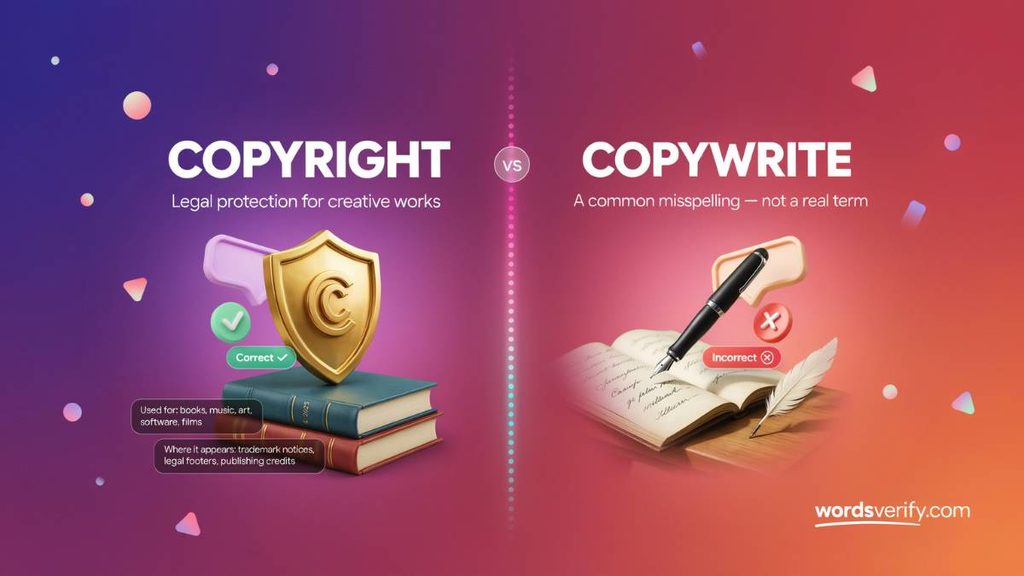
The correct spelling is copyright when referring to the legal protection of original creative work. It’s the standard spelling in American English, British English, Canadian English, and Australian English.
The word combines copy and right. It refers to the legal rights that creators have over the reproduction and use of their original work. For example, an author may own the copyright to a novel, while a photographer may hold the copyright to an original photograph.
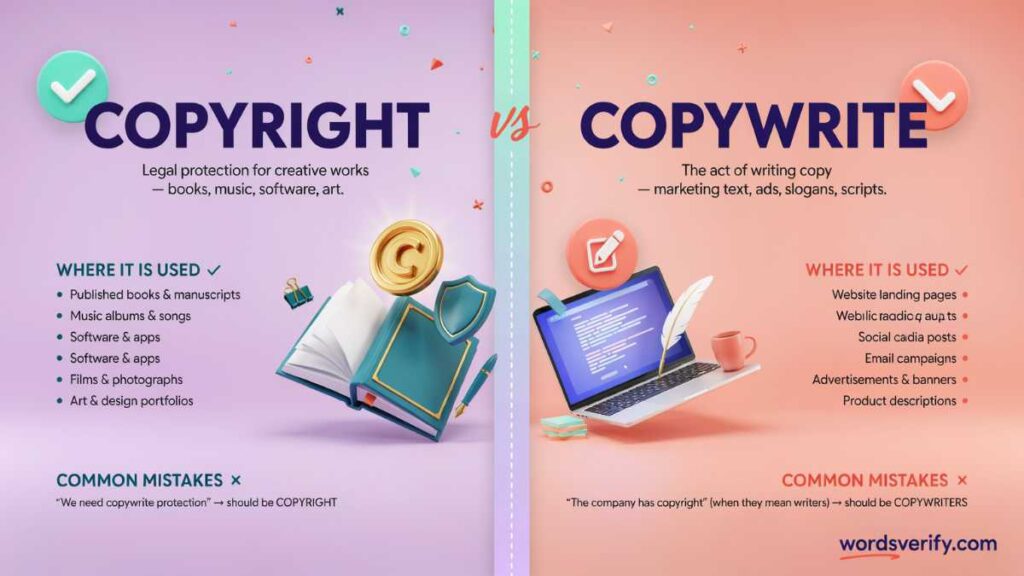
Here’s a quick comparison of copyright vs copywrite:
| Word | Meaning | Example |
|---|---|---|
| Copyright | Legal protection for original creative work | The author owns the copyright to the book. |
| Copywrite | A common misspelling of copyright; also a rare advertising-related verb | Copywrite protection is incorrect in this context. |
| Copywriting | Writing persuasive or promotional content | She works in copywriting for a marketing agency. |
| Copywriter | Someone who writes promotional content | The company hired a professional copywriter. |
| Copyrighting | An informal way of referring to securing or asserting copyright | The company is seeking copyright protection for its software. |
The easiest way to remember the distinction is to connect copyright with legal rights and copywriting with persuasive writing.
Consider these examples:
- Correct: The photographer owns the copyright to the image.
- Incorrect: The photographer owns the copywrite to the image.
- Correct: The marketing agency hired a copywriter to write its advertisements.
- Incorrect: The marketing agency hired a copyright writer to create its advertising copy.
Remember this simple rule: Use copyright when discussing legal protection and copywriting when talking about advertising or promotional writing.
Learn the difference between often confused words
Appraised vs Apprised What’s the Difference?
Copyright vs Copywrite Meaning and Definition
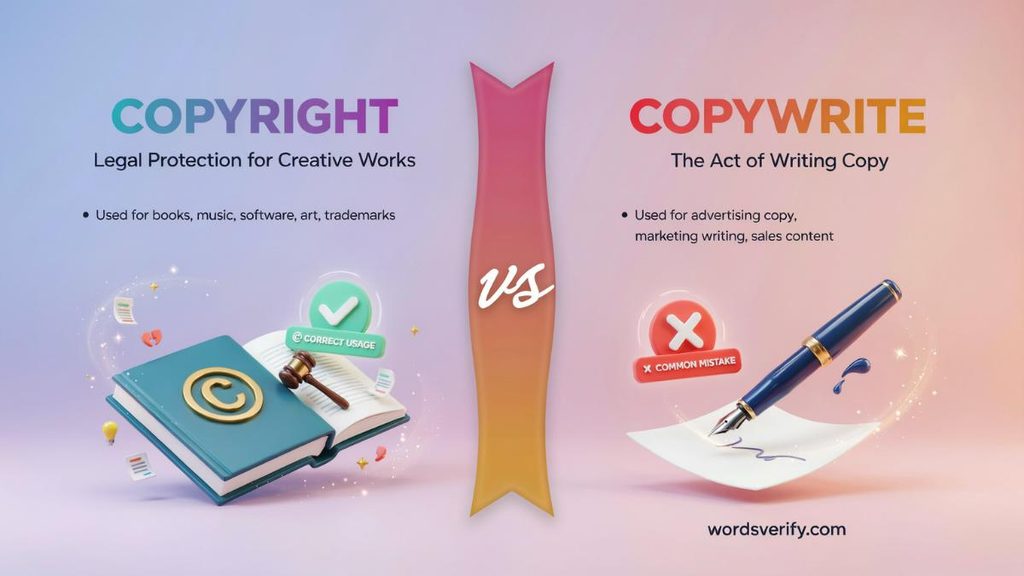
Although copyright vs copywrite sound alike, they have different meanings. Understanding what each term represents makes the distinction much easier.
What Does Copyright Mean?
Copyright refers to a legal form of intellectual property protection that gives creators certain exclusive rights over their original works.
In the United States, copyright protects original works of authorship once someone fixes them in a tangible form. In simple terms, the work must exist in a form that people can perceive, reproduce, or communicate, either directly or with the help of a device.
For example, writing a poem in a notebook, recording an original song, or saving a photograph as a digital file can establish copyright protection if the work meets the legal requirements.
Copyright generally gives the owner the right to:
- Reproduce the original work.
- Distribute copies to the public.
- Create adaptations or derivative works.
- Publicly perform certain types of work.
- Publicly display certain types of work.
- Authorize others to exercise these rights.
These rights allow creators to control important uses of their work and potentially earn money through licensing, sales, and other commercial arrangements.
Copyright definition: A legal right that protects original creative expression and gives its owner certain exclusive rights to reproduce, distribute, display, perform, or adapt the protected work.
Imagine writing an original 200-page novel. Copyright protects your particular written expression, including the original text and creative elements that qualify for protection. Someone else can’t simply reproduce the entire novel and sell it as their own without permission or another valid legal justification.
However, copyright doesn’t protect every idea or piece of information. It protects the original expression of an idea rather than the idea itself.
What Does Copywrite Mean?
The meaning of copywrite depends on how someone uses the word.
In everyday writing, copywrite is usually an incorrect spelling of copyright. People make this mistake because write and right sound alike. They also associate copyright with writing and copying, which makes the incorrect spelling seem reasonable.
Some English dictionaries also recognize copywrite as a rare verb meaning to write advertising copy or work as a copywriter. This usage comes from its connection with the word copywriter.
For example:
- She copywrites advertisements for local businesses.
- He copywrote promotional material for a clothing company.
These forms are uncommon. Most professional writers would naturally say:
- She writes advertising copy for local businesses.
- He wrote promotional material for a clothing company.
Therefore, if you’re discussing legal protection, use copyright. If you’re talking about marketing, copywriting or writing copy is the more familiar choice.
What Does Copyright Mean in Simple Words?
Copyright means the law protects certain original creative works and gives their owners control over specific ways people can use them.
Think about a photographer who takes an original picture of a mountain landscape. Another person can’t automatically download that photograph, print hundreds of copies, and sell them without permission or another valid legal justification.
The photographer owns the copyright unless the rights belong to someone else through an applicable agreement or legal arrangement.
In simple terms, copyright protects original creative work and gives its owner certain legal rights over its use.
Learn the difference between often confused words
Simular vs Similar Which one Is Correct?
Copyright vs Copywriting What’s the Difference?
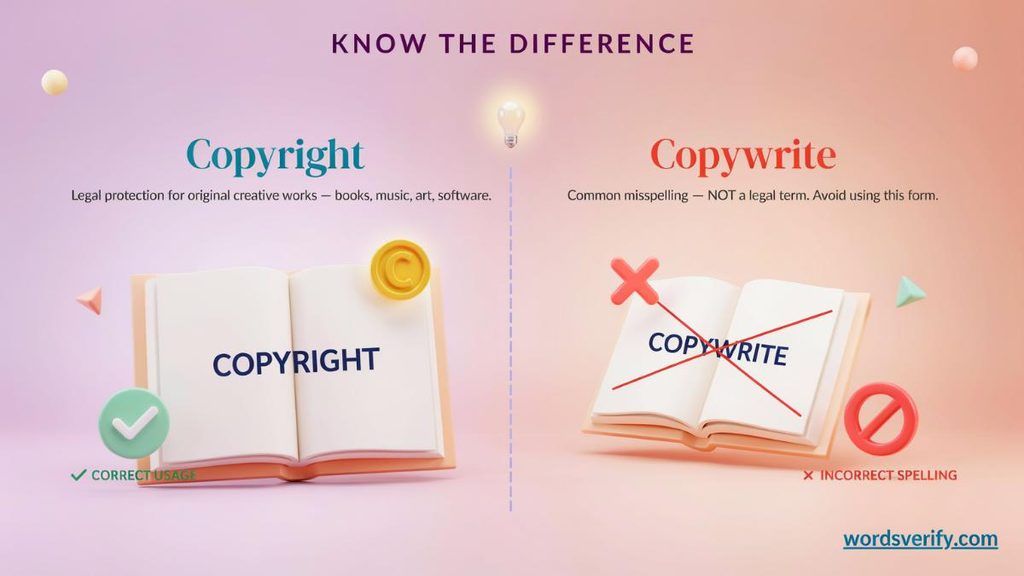
Here’s where things become a little more interesting. Copyright vs copywriting look similar, but they describe two completely different activities.
Copyright deals with legal protection. Copywriting involves creating persuasive written content.
What Is Copywriting?
Copywriting is the process of writing words that encourage readers to take a particular action. That action might involve purchasing a product, subscribing to a newsletter, requesting a service, downloading an application, or registering for an event.
Businesses use copywriting to communicate with potential customers and promote their products or services.
You’ll find copywriting in many places, including:
- Newspaper and magazine advertisements.
- Website landing pages.
- Social media advertisements.
- Product descriptions.
- Promotional emails.
- Sales letters.
- Advertising slogans and taglines.
- Marketing brochures.
- Email newsletters.
- Website sales pages.
Imagine an online store selling running shoes. Its copywriter might create a product description highlighting comfort, durability, and performance.
For example:
“Run farther and feel better with lightweight shoes designed to keep you comfortable on every mile.”
That’s copywriting. The sentence highlights the product’s benefits and encourages potential customers to consider buying it.
Copywriting isn’t simply about making sentences sound attractive. Good promotional writing requires research, an understanding of the audience, and a clear message.
What Is a Copywriter?
A copywriter is someone who creates promotional content to influence an audience’s decisions.
Copywriters work in advertising agencies, marketing departments, publishing companies, digital businesses, and freelance environments.
Their responsibilities may include:
- Researching a company’s products and target audience.
- Understanding customer needs and purchasing habits.
- Writing advertising headlines and promotional messages.
- Creating website and landing-page content.
- Developing email marketing campaigns.
- Writing product descriptions and sales copy.
- Maintaining a consistent brand voice.
A professional copywriter doesn’t simply put attractive words together. Good copywriting takes research, creativity, clear communication, and an understanding of persuasive writing.
For instance, a copywriter working for a fitness company might create advertisements highlighting the benefits of a new exercise program. Another might write email campaigns for a software company.
Both professionals create marketing content, but neither activity is the same as copyright protection.
Copyright vs Copywriting Key Differences
The distinction becomes clearer when you compare their purposes.
| Copyright | Copywriting |
|---|---|
| A form of legal protection | A writing activity |
| Protects original creative expression | Creates persuasive promotional content |
| Falls under intellectual property law | Falls under writing and marketing |
| Gives copyright owners certain exclusive rights | Helps businesses communicate with customers |
| Applies to qualifying creative works | Applies to advertisements, emails, and sales pages |
| Example: Protecting an original advertisement | Example: Writing an advertisement |
Here’s another important connection: copywriting itself can produce work that receives copyright protection.
Suppose a professional copywriter creates an original advertising campaign for a restaurant. The campaign’s original written expression may qualify for copyright protection.
Who owns those rights depends on the circumstances, including employment arrangements, work-made-for-hire rules, and written agreements.
In other words, copywriting creates content, while copyright may protect that content.
Copyright vs Copywriter Who Owns the Work?
The difference between a copywriter and a copyright holder is equally important.
A copywriter creates promotional material. A copyright holder owns the legal rights to a protected work.
These roles don’t always belong to the same person.
Consider this example:
A marketing agency hires a freelance copywriter to create advertisements for a clothing brand. The copywriter writes the material, but the contract may assign copyright ownership to the agency or client.
The copywriter is the creator. The copyright holder is the person or organization that legally owns the relevant rights.
However, the outcome depends on the agreement and applicable law. Hiring someone to create content doesn’t automatically transfer every copyright interest in every situation.
Learn the difference between often confused words
Cataloguing vs Cataloging? Which one Is Correct?
Copywriting vs Copyrighting Are They the Same?
No. Copywriting and copyrighting have different meanings, even though their similar spellings often cause confusion.
Copywriting means creating persuasive written content for marketing and advertising.
Copyrighting is sometimes used informally to describe obtaining, securing, or asserting copyright protection. However, it isn’t the usual technical term for the legal protection itself.
For example:
- Correct: She specializes in copywriting for online businesses.
- Correct: The company registered its original software with the U.S. Copyright Office.
- Less conventional: The company is copyrighting its software.
When discussing legal protection, phrases such as securing copyright protection, claiming copyright, and registering a copyright are clearer.
Another related term is copyright holder. It describes the person or organization that owns the rights to a protected work.
These roles serve different purposes:
- A copywriter creates advertising content.
- A copyright holder owns protected creative work.
- A copyright lawyer provides legal advice about copyright matters.
- A content writer creates informative, educational, or other written material.
Learn the difference between often confused words
Ingenuine vs Ungenuine Which one Is Correct?
The Origin and History of Copyright
The history of copyright explains why the word contains right rather than write.
The term combines two recognizable English words: copy and right. It refers to the legal rights associated with an original work and the ability to control certain forms of reproduction.
The word copy has a long history in English. It entered the language through Old French and Medieval Latin roots associated with reproducing or transcribing written material.
The word right comes from Old English riht, which referred to what was proper, lawful, or just. Over time, it also developed the meaning of a legal entitlement.
The word copyright emerged in the early eighteenth century. Its use became closely connected with the exclusive right to make and sell copies of intellectual work.
The Statute of Anne and the Development of Copyright Law
Modern copyright protection has important historical roots in Britain’s Statute of Anne, passed in 1710.
Before this legislation, printers and booksellers held considerable control over the publication and reproduction of books. Unauthorized printing was a major concern for authors and publishers.
The Statute of Anne introduced a system that recognized authors’ rights over their books for limited periods. It marked an important change by giving authors a central role in the ownership of literary works.
The legislation generally provided:
- A 14-year protection period for newly published books.
- An additional 14-year term if the author remained alive after the first period.
- A 21-year term for certain books already in print when the law took effect.
This legislation became an important foundation for modern copyright systems.
Copyright in the United States
Copyright also has a long history in American law.
The U.S. Constitution gives Congress the authority to secure exclusive rights for authors and inventors for limited periods.
Article I, Section 8, Clause 8 states:
“To promote the Progress of Science and useful Arts…”
This constitutional provision forms the foundation of federal copyright law in the United States.
Congress passed the first federal Copyright Act in 1790. Initially, the law focused mainly on books, maps, and charts. Later legislation expanded protection to cover additional creative formats and new technologies.
Today, U.S. copyright law protects a much wider range of original works, including photography, music, films, software, and digital content.
The history also explains why copyright is a legal term rather than another form of the word copywriting.
Learn the difference between often confused words
Manner vs Manor which one is correct?
Is Copyright the Same in American and British English?
Yes. Copyright is the standard spelling in both American and British English.
Unlike words such as color and colour or organize and organise, copyright doesn’t have different regional spellings.
Whether you’re writing for an American newspaper, a British publisher, an Australian company, or a Canadian website, the spelling remains copyright.
| English variety | Correct spelling | Incorrect spelling for legal protection |
|---|---|---|
| American English | Copyright | Copywrite |
| British English | Copyright | Copywrite |
| Canadian English | Copyright | Copywrite |
| Australian English | Copyright | Copywrite |
| New Zealand English | Copyright | Copywrite |
Copyright laws may differ between these countries, but those legal differences don’t change the spelling.
For example, a photographer in the United States and another in the United Kingdom can both own copyright in their original photographs. Their rights and legal procedures may differ depending on the applicable national laws and international agreements.
The important point is that copyright isn’t a British or American spelling preference. It’s the standard English legal term.
Learn the difference between often confused words
Updated vs Update which one is correct?
What Does Copyright Protect?
Copyright protects many types of original creative work. However, it doesn’t cover every idea, fact, name, or piece of information.
Under U.S. copyright law, original works of authorship fall into eight broad categories.
The Main Types of Copyright-Protected Work
| Category | Examples |
|---|---|
| Literary works | Books, articles, blog posts, and computer programs |
| Musical works | Original songs, melodies, and musical compositions |
| Dramatic works | Plays and scripts |
| Pantomimes and choreographic works | Original dance routines and choreographed performances |
| Pictorial, graphic, and sculptural works | Paintings, illustrations, photographs, and sculptures |
| Motion pictures and audiovisual works | Films, television programs, and videos |
| Sound recordings | Recorded music, spoken-word recordings, and audio productions |
| Architectural works | Original architectural designs and building plans |
These categories cover a wide range of creative activities.
An author can receive copyright protection for an original novel. A musician may own copyright in an original musical composition. Similarly, a software developer may hold copyright in qualifying original computer code.
What Copyright Does Not Protect
Copyright doesn’t protect ideas themselves. It protects the original expression of those ideas. Understanding copyright vs copywrite helps clarify why the law protects a writer’s actual work rather than a general concept.
Imagine someone develops an idea for a mystery novel about a detective investigating a disappearance in a small coastal town. Another writer may create a different mystery using the same general concept. However, that writer can’t simply copy the original author’s chapters, dialogue, or creative expression. This distinction is central to copyright vs copywrite because copyright protects original written content, while copywrite is not the standard legal term. Knowing the difference between copyright vs copywrite helps writers avoid confusion when discussing creative ownership.
Other things that copyright generally doesn’t protect include:
- Facts and discoveries.
- Ideas and concepts.
- Methods and procedures.
- Systems and processes.
- Names and titles.
- Short phrases and slogans.
- Familiar symbols and designs.
- Mere lists of ingredients or information.
Some of these elements may receive protection under other areas of intellectual property law. For example, trademarks may protect qualifying brand names, logos, and slogans that identify commercial goods or services.
This distinction matters because copyright, patents, and trademarks protect different interests.
Learn the difference between often confused words
Light vs Lite which one is correct?
What Is the Copyright Symbol and How Do You Use It?
The copyright symbol is ©. You’ll often see it at the bottom of websites, inside books, on photographs, and on other published creative material.
The symbol communicates that someone claims copyright protection over the work.
A traditional copyright notice contains three elements:
- The copyright symbol (©), or the word “Copyright.”
- The year of first publication.
- The name of the copyright owner.
For example:
© 2026 Jane Smith. All rights reserved.
Another example might appear on a business website:
© 2026 ABC Creative Studio. All rights reserved.
A photographer might use:
© 2026 Michael Brown Photography.
These notices help identify the person or organization claiming copyright ownership.
However, there’s an important legal detail: In the United States, copyright protection generally begins automatically when an eligible original work is fixed in a tangible medium. Displaying the symbol isn’t required to establish protection.
A notice can still be useful because it tells visitors who claims the rights and where to direct permission requests.
Is the Copyright Symbol Necessary?
No. Under modern U.S. copyright law, the copyright symbol is generally optional.
For works created on or after January 1, 1978, copyright protection doesn’t depend on including a copyright notice.
Nevertheless, businesses, photographers, publishers, and content creators often use the symbol because it communicates ownership clearly.
It also helps distinguish original material from content that someone may freely reproduce.
Learn the difference between often confused words
Loss vs Lose which one is correct?
How Does Copyright Registration Work?
Many people assume they must register their work before receiving copyright protection. That’s generally not true in the United States. Understanding copyright vs copywrite helps clear up common confusion about the term and its legal meaning.
Copyright protection normally begins automatically when an original work is created and fixed in a tangible form.
However, registration with the U.S. Copyright Office provides important legal and practical benefits. Knowing the difference between copyright vs copywrite also helps writers use the correct terminology when discussing ownership, protection, and registration.
These include:
- Creating a public record of the copyright claim.
- Providing a certificate of registration.
- Establishing a legal record of ownership information.
- Helping satisfy the registration requirement before filing an infringement lawsuit involving a U.S. work.
- Potentially making statutory damages and attorney’s fees available when the legal requirements for those remedies are satisfied.
For U.S. works, registration or refusal of registration is generally required before the copyright owner can bring an infringement lawsuit.
Timely registration is particularly important. Depending on the circumstances, registering before infringement begins or within three months after first publication can affect eligibility for statutory damages and attorney’s fees.
The process generally involves:
- Preparing an application.
- Identifying the work and its author or claimant.
- Paying the applicable filing fee.
- Submitting a copy or deposit of the work.
- Waiting for the Copyright Office to examine the application.
The exact requirements depend on the type of work and application.
Learn the difference between often confused words
Nitch vs Niche Which one Is Correct?
Copyright Examples in Everyday Life
Copyright isn’t limited to famous novels, Hollywood movies, or commercially successful songs. It can affect ordinary creative work produced by individuals and businesses.
Here are some everyday examples that show how copyright protection works.
Books and Articles
An author writes an original nonfiction book about personal finance. Copyright may protect the book’s original text, explanations, and creative presentation.
Another person can discuss the same financial principles but can’t simply reproduce the author’s entire book without permission or a valid legal exception.
Photographs
A photographer takes an original photograph of a sunset over the ocean.
The photograph may receive copyright protection as soon as the photographer captures and saves it in a fixed digital format.
Someone who wants to use the photograph in a commercial advertisement may need permission from the copyright owner.
Music and Songs
A musician creates an original song with lyrics and a melody.
The musical composition and the actual sound recording can involve separate copyrights. For example, the songwriter may own rights in the composition, while a record label may own the rights to a particular recording under an applicable agreement.
Films and Videos
A filmmaker creates an original short film featuring actors, dialogue, music, and visual effects.
Copyright may protect different creative elements of the production, including the audiovisual work itself and qualifying contributions.
Software
A developer writes original code for a mobile application.
Copyright may protect the original expression in the computer program. However, it doesn’t automatically protect the general idea, function, or method behind the application.
Website Content
A blogger publishes an original article on a personal website.
The article’s original written expression may receive copyright protection even if the blogger never prints it or sells it.
The same principle applies to original photographs, illustrations, and other qualifying creative material appearing on the website.
Advertising Material
A copywriter creates an original advertising campaign for a new product.
The campaign’s written content may qualify for copyright protection. Ownership depends on the applicable employment arrangements, contracts, and copyright law.
These examples show that copyright and copywriting can overlap in practice, even though their meanings remain different.
Learn the difference between often confused words
Feed vs Fead and which one is correct?
Common Copyright vs Copywrite Mistakes
The confusion between copyright vs copywrite is only one of several mistakes people make when discussing intellectual property.
Understanding these errors will help you improve your writing and avoid inaccurate statements.
Using Copywrite Instead of Copyright
This is one of the most common mistakes.
Incorrect: The artist owns the copywrite to the painting.
Correct: The artist owns the copyright to the painting.
Always use copyright when discussing legal protection.
Confusing Copyright With Copywriting
Copyright protects original creative expression, while copywriting involves persuasive writing.
Incorrect: The company hired a copyright expert to write its advertisements.
Correct: The company hired a copywriter to write its advertisements.
A copyright specialist and a copywriter perform different jobs.
Assuming Everything Online Is Free to Use
Just because someone uploads a photograph, article, or video to the internet doesn’t mean other people can freely reproduce it.
Online material may remain protected by copyright.
Before using someone else’s work, check its licensing terms and determine whether you need permission.
Assuming Buying a Product Transfers Copyright
Purchasing a book doesn’t normally make you the copyright owner.
When you buy a novel, you generally acquire a physical or digital copy under the applicable terms. You don’t automatically receive the author’s exclusive rights to reproduce or distribute the work.
The same principle applies to photographs, software, films, and other creative products.
Confusing Copyright With Trademark
Copyright and trademark are both forms of intellectual property protection, but they serve different purposes.
Copyright protects original creative expression. Trademark law protects qualifying names, logos, symbols, and other identifiers that distinguish the source of goods or services.
For example, copyright may protect an original illustration used in a company logo, while trademark law may protect the logo as a brand identifier.
Copyright vs Copywrite A Simple Memory Trick
If you still struggle to remember the correct spelling of copyright, try this simple trick.
Think about the word right as a legal entitlement.
Copyright gives creators certain legal rights over their original creative work. That’s why the word ends with right, not write.
For copywriting, remember that a copywriter writes advertising copy.
Here’s an easy way to separate the terms:
- Copyright = Legal rights.
- Copywriting = Persuasive writing.
- Copywriter = A person who writes promotional content.
- Copywrite = Usually a misspelling when referring to copyright.
You can also remember these two sentences:
“The author owns the copyright to the book.”
“The copywriter wrote the advertisement.”
Once you connect each word with its purpose, the spelling becomes much easier to remember.
Practice Session Copyright vs Copywrite?
Test your understanding of copyright vs copywrite and related terms. Fill in each blank with the most appropriate word. The answers are provided at the end so you can check your work.
Fill in the Blanks
1. The author owns the __________ to her newly published novel.
2. Always ask for permission before using someone else’s __________ material.
3. A professional __________ writes persuasive content for advertisements and websites.
4. __________ protects original creative works from unauthorized use.
5. Writing catchy slogans and promotional messages is known as __________.
6. The photographer registered the __________ for her collection of images.
7. Many people mistakenly use __________ when they mean copyright.
8. The company hired a skilled __________ to write its product descriptions.
9. You cannot claim __________ protection for an idea alone.
10. The copyright symbol is represented by the letter __________ inside a circle.
11. A songwriter generally owns the __________ to an original song once it is fixed in a tangible form.
12. Good __________ encourages readers to take action through clear and persuasive language.
13. The publisher obtained permission to reproduce the __________ work.
14. A __________ notice often includes the symbol, publication year, and owner’s name.
15. The term __________ refers to legal protection for original works of authorship.
16. The marketing team asked the __________ to create a memorable advertising campaign.
17. Using another person’s copyrighted photograph without permission may constitute copyright __________.
18. A book, a photograph, and an original song can all receive __________ protection.
19. The word __________ is not the standard spelling for legal ownership of creative work.
20. Before publishing the article, the writer checked that all borrowed content respected __________ law.
21. A copywriter creates promotional content, while a copyright holder owns the relevant __________.
22. Copyright protection generally begins when an original work is fixed in a __________ form.
23. The company used persuasive __________ to promote its new service.
24. Giving credit to an author does not automatically grant __________ to reproduce their work.
25. Remember: copyright protects creative work, while __________ helps businesses communicate with customers.
Answers
- Copyright
- Copyrighted
- Copywriter
- Copyright
- Copywriting
- Copyright
- Copywrite
- Copywriter
- Copyright
- C
- Copyright
- Copywriting
- Copyrighted
- Copyright
- Copyright
- Copywriter
- Infringement
- Copyright
- Copywrite
- Copyright
- Copyright
- Tangible
- Copywriting
- Permission
- Copywriting
Here’s a trusted source for clear word meanings:
FAQs
Is copywrite a correct spelling?
Copywrite is a rare verb sometimes used to mean writing advertising copy. However, it isn’t the correct spelling when referring to legal protection for creative work. The standard term is copyright.
What is the difference between copyright and the copyright symbol ©?
Copyright refers to the legal rights that protect original creative work. The © symbol is a notice used to identify a work as protected and indicate its copyright claim.
What is the proper way to write a copyright notice?
A traditional copyright notice includes three elements: the © symbol, the year of first publication, and the copyright owner’s name. For example: © 2026 Jane Smith.
Is copywriting illegal?
No. Copywriting is a legal profession that involves creating persuasive content for advertisements, websites, emails, and other marketing materials. However, copywriters must avoid plagiarism and respect copyright laws when using someone else’s work.
What is the golden rule of copyright?
The golden rule is to get permission before using someone else’s copyrighted work unless a legal exception applies. Giving credit to the original creator doesn’t automatically give you permission to use their content.
Can someone steal your song if you don’t register its copyright?
In the United States, copyright protection generally begins automatically when you create and record an original song in a tangible form. Registration isn’t required for basic protection, but it provides important legal benefits if someone infringes your rights.
Can I use the letter C for copyright?
Yes. You can use the © symbol, commonly called the copyright symbol, to indicate copyright protection. You can also write the word “Copyright” or use the abbreviation “Copr.”
Is copyright protection free?
In many countries, including the United States, copyright protection begins automatically when an original work is created and fixed in a tangible form. You don’t need to pay a fee to receive basic protection. However, official registration may involve a fee.
Should I copyright my book before publishing it?
In the United States, your book receives copyright protection automatically once you write it down or save it in a fixed format. Registering it before publication isn’t mandatory, but timely registration can provide valuable legal advantages if infringement occurs.
Can I simply write “Copyright” on something?
Yes, you can include the word “Copyright” in a notice. However, writing it on your work doesn’t create copyright protection by itself. In countries such as the United States, protection generally exists automatically when an original work is fixed in a tangible form.
Is copyright the same as copywriting?
No. Copyright protects original creative works, while copywriting involves writing persuasive content to promote products, services, or ideas. A copywriter creates content, whereas copyright law helps protect eligible creative work.
How can beginners learn copywriting?
Beginners can start by studying advertisements, practicing headlines, writing product descriptions, and learning how to address a target audience. Building a small portfolio and testing different writing styles can also help develop practical skills.
Is copywriting still worth learning in 2026?
Yes. Businesses still need clear, persuasive content for websites, advertisements, emails, and social media. AI can help generate drafts, but human judgment, creativity, research, and audience understanding remain valuable.
What are three things that copyright does not protect?
Copyright generally does not protect:
- Ideas, facts, or concepts by themselves.
- Systems, methods, or procedures.
- Names, titles, and short phrases.
Some of these may qualify for other forms of legal protection, such as trademarks or patents.
What is the Mickey Mouse copyright law?
The phrase usually refers to the Copyright Term Extension Act of 1998, often nicknamed the Mickey Mouse Protection Act. It extended copyright terms in the United States, including protection for certain works by 20 years.
What is the 70-year copyright rule?
In many countries, including the United Kingdom and much of the European Union, copyright in an individual author’s work generally lasts for the author’s lifetime plus 70 years. The United States also applies this term to many works created by individual authors. However, rules differ for older works, anonymous works, and works made for hire.
Can I copyright a word I invented?
Generally, no. Copyright doesn’t protect individual words, names, slogans, or short phrases. However, you may be able to protect a distinctive name or phrase as a trademark if it meets the relevant legal requirements.
What is another name for copyright?
Copyright is sometimes described as authors’ rights or creators’ rights. These terms relate to legal protection for creative works, although their precise meanings can vary between legal systems.
Can I get sued for sampling a song?
Yes. Sampling a copyrighted song without permission can lead to a copyright infringement claim. A sample may involve rights in both the original musical composition and the sound recording. Certain exceptions may apply, but it’s safest to obtain the necessary licenses.
How do you use copyright correctly in a sentence?
Here are three examples:
- The photographer owns the copyright to the original image.
- The publisher secured copyright protection for the book.
- You must obtain permission before reproducing copyrighted material.
Can you give five examples of copyright infringement?
Common examples include:
- Reproducing an entire book without permission.
- Uploading someone else’s song without authorization.
- Using copyrighted photographs in advertisements without permission.
- Distributing pirated movies or television episodes.
- Copying substantial portions of another person’s article and publishing them as your own.
How do you write a copyright disclaimer?
A basic copyright notice might look like this:
© 2026 Jane Smith. All rights reserved.
A disclaimer can also explain how visitors may use your content and whether they need permission to reproduce it. However, a disclaimer doesn’t replace copyright protection or guarantee that every use of your work is legally restricted.
What is the difference between copyright vs copywrite in one sentence?
Copyright refers to legal protection for original creative work, while copywrite is a rare verb associated with writing advertising copy and is commonly mistaken for copyright.
Conclusion
So, should you write copyright vs copywrite? When referring to legal protection for creative work, copyright is the correct spelling. Copywrite is occasionally used as a rare verb related to writing advertising copy, but it isn’t an alternative to copyright. Copywriting, on the other hand, means creating persuasive content, while a copywriter is the person who writes it.
Although these terms look and sound alike, they have different meanings. Mixing them up can turn an otherwise polished sentence into an avoidable spelling blunder. Just remember: copyright protects creative work, while copywriting helps sell an idea, product, or service. Keep that distinction in mind, choose your words carefully, and you’ll have one less grammar mix-up to worry about. After all, good writing deserves the right words!

Lisa AJS is an experienced blogger and language enthusiast at Words Verify, dedicated to making grammar simple, practical, and enjoyable. She writes engaging content on commonly confused words, grammar mistakes, word meanings, and everyday language challenges.