
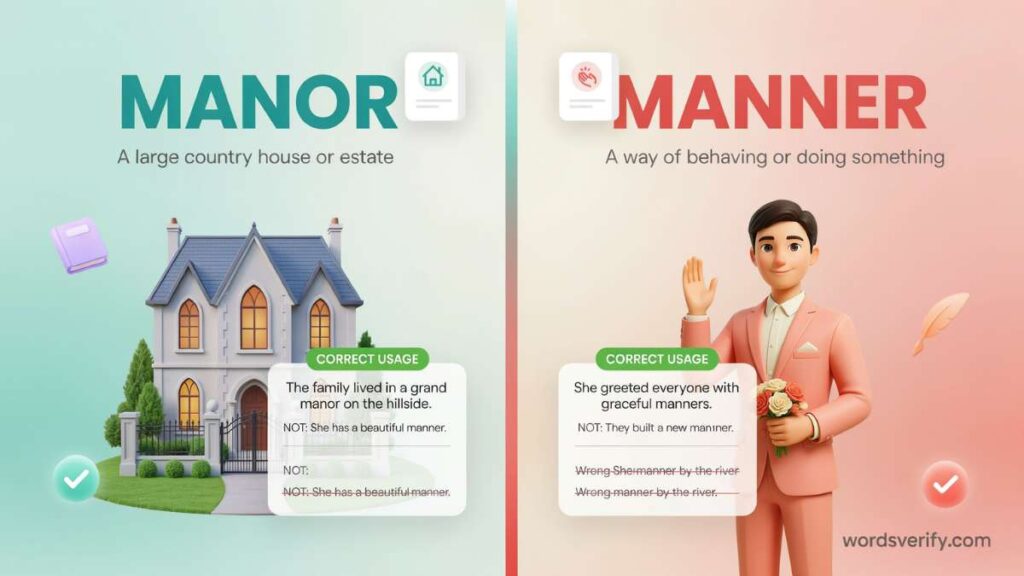
Have you ever paused over manor vs manner, wondering which word belongs in your sentence? You’re not alone. These look-alike words sound identical, yet their meanings couldn’t be more different. A manor is a large country house or estate, while manner describes how someone behaves or does something. Confuse the two, and you might turn a discussion about good manners into a conversation about grand country homes! It’s an easy mistake to make, but one worth avoiding. In this guide, you’ll discover the difference between manor vs manner, explore clear examples, and learn simple ways to use each word correctly.
Manner vs Manor The Quick Answer
The difference between these words is simple once you understand what each one describes.
Manner refers to the way someone behaves, speaks, acts, or performs a task. Manor refers to a large country house or historic estate, often associated with surrounding land.
Here’s an easy way to remember them:
- Manner: A way of behaving, speaking, or doing something.
- Manor: A large house, country residence, or historic estate.
Consider these examples:
- The manager handled the complaint in a professional manner.
- The wealthy family lived in a beautiful country manor.
In the first sentence, manner explains how the manager handled the complaint. In the second, manor identifies the family’s home.
The words aren’t interchangeable. Writing professional manor instead of professional manner would change the meaning and make the sentence incorrect in that context.
Manor vs Manner Key Differences
Although manner and manor look and sound similar, their meanings and grammatical uses are quite different.
| Feature | Manner | Manor |
|---|---|---|
| Part of speech | Noun | Noun |
| Main meaning | A way of behaving or doing something | A large house or landed estate |
| Common context | Behavior, communication, methods, etiquette | Property, architecture, history |
| Pronunciation (US) | /ˈmænər/ | /ˈmænər/ |
| Syllables | Two | Two |
| Plural | Manners | Manors |
| Example | She spoke in a friendly manner. | They restored an old manor. |
The extra letter N in manner makes all the difference in writing. Interestingly, it doesn’t change the pronunciation.
Both words belong to a group of commonly confused English words. Their similar sounds can easily trick writers into choosing the wrong spelling, especially when typing quickly.
Learn the difference between often confused words
Updated vs Update which one is correct?
What Does Manner Mean?
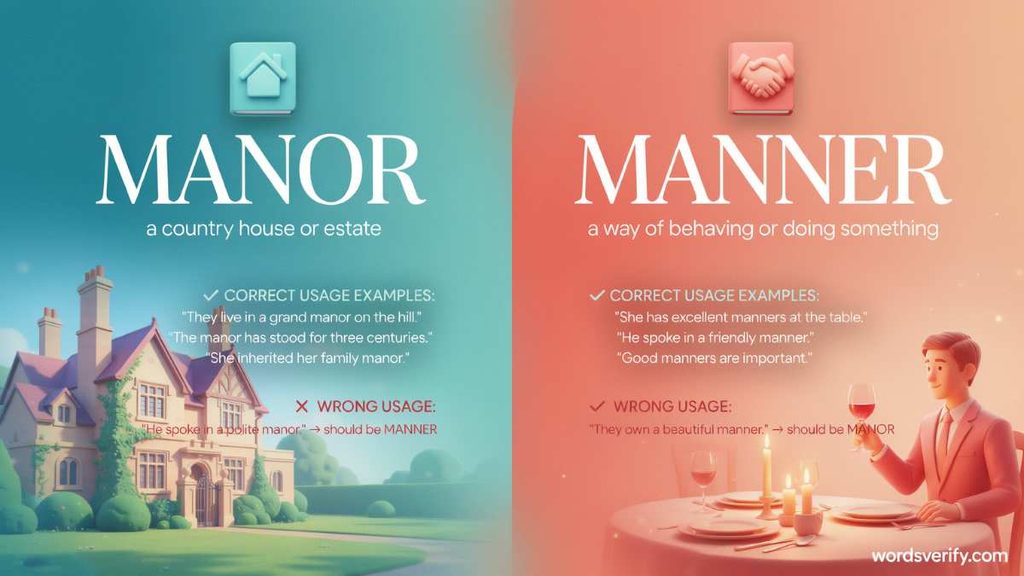
Manner describes how someone behaves, performs an action, communicates, or approaches a situation. It can refer to a person’s conduct, attitude, or the method used to complete a task.
Imagine two employees responding to the same customer complaint. One listens patiently and responds politely. The other becomes impatient and dismissive. Both deal with the same problem, but their manners are quite different.
That’s the basic idea behind the word.
Manner has several related meanings:
- Behavior: How someone acts around other people.
- Method: The way someone completes an activity.
- Style: The particular way someone communicates or performs something.
- Conduct: How someone behaves in social or professional situations.
- Attitude: The way someone expresses their feelings through words and actions.
Depending on the situation, manner can describe someone’s personality, social etiquette, or approach to a particular task.
Manner as a Noun
Manner is a noun that describes someone’s behavior or a particular way of doing something.
For example:
- She has a warm and friendly manner.
- The teacher addressed the students in a calm manner.
- He explained the instructions clearly and politely.
- The employee handled the disagreement in a professional manner.
- Her quiet manner made her difficult to notice in a crowded room.
In each sentence, manner explains how someone behaves or communicates.
The word also appears when describing how an action takes place. If someone completes a task in a particular manner, the word identifies the method or approach they use.
Common Types and Uses of Manner
Manner appears in several everyday situations. Understanding these uses makes it easier to recognize the word in different contexts.
Behavior and personal conduct
This meaning describes how someone acts around others. A person’s manner might seem friendly, rude, respectful, confident, or nervous.
Examples:
- The new employee has an exceptionally polite manner.
- His aggressive manner made the discussion uncomfortable.
- She greeted everyone in a cheerful manner.
Social etiquette and politeness
When used in the plural form, manners often refers to accepted standards of polite behavior.
Examples:
- Children should learn good manners at an early age.
- Interrupting someone repeatedly is considered bad manners.
- Remember your table manners when eating with guests.
Good manners include simple habits such as saying please and thank you, listening without interrupting, and treating others with respect.
Method or approach
Sometimes manner describes how someone performs a task or handles a problem.
Examples:
- The technician repaired the equipment in a careful manner.
- The company introduced a new manner of organizing its records.
- The students completed the experiment in a similar manner.
Communication and expression
Manner can also describe someone’s way of speaking, writing, or expressing ideas.
Examples:
- His manner of speaking impressed the audience.
- She communicated the disappointing news in a gentle manner.
- The speaker maintained a confident manner throughout the presentation.
Common Expressions With Manner
English contains several familiar expressions that use manner. You’ll encounter them in everyday conversations, workplace communication, and formal writing.
| Expression | Meaning | Example |
|---|---|---|
| In a timely manner | Within an appropriate time | Please submit the form in a timely manner. |
| In a professional manner | With suitable workplace conduct | She handled the complaint in a professional manner. |
| In a polite manner | Respectfully and courteously | He declined the invitation in a polite manner. |
| In a friendly manner | In a warm and welcoming way | They greeted us in a friendly manner. |
| In this manner | In this particular way | Follow the instructions in this manner. |
| In a similar manner | Using a comparable approach | The second team completed the task in a similar manner. |
| Manner of speaking | Someone’s characteristic way of speaking | Her manner of speaking is easy to recognize. |
| Mind your manners | Behave politely | Mind your manners when visiting your grandparents. |
One expression deserves special attention: in a timely manner.
It means completing something within an appropriate or expected period. You’ll often see it in workplace emails, business instructions, and formal documents.
For example:
“The accounting department must process all invoices in a timely manner.”
Using timely manor here would be incorrect because the sentence describes how quickly an action should happen, not a building.
Manner in Example Sentences
Here are more examples showing how manner works in different situations:
- The nurse spoke to the frightened child in a gentle manner.
- Please complete the application in the requested manner.
- His cheerful manner made everyone feel welcome.
- The manager expected employees to behave professionally.
- She has a distinctive manner of walking.
- The instructions explain the proper manner of handling chemicals.
- The guests appreciated the host’s polite manner.
- The two researchers conducted their experiments in a similar manner.
- His careless manner of communication caused unnecessary confusion.
- Good manners can make everyday interactions more pleasant.
Notice that manner doesn’t always describe politeness. It can also refer to a method, style, or general way of doing something.
Learn the difference between often confused words
Light vs Lite which one is correct?
What Does Manor Mean?
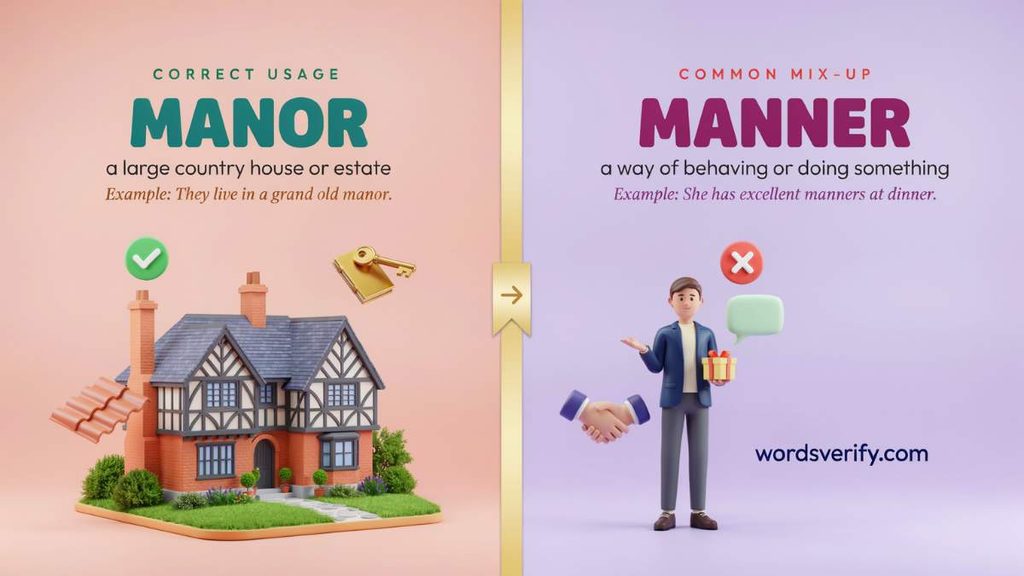
A manor is a large country house or historic estate, often associated with substantial property and surrounding land. Historically, the word also described an estate or territorial unit connected to a landowner or lord.
The word has strong connections to medieval European society, particularly the system of landownership that developed in medieval England.
Imagine an old English estate surrounded by gardens, farmland, woodland, and smaller buildings. At its center stands a large residence that once belonged to a wealthy landowner. That property could be described as a manor.
However, a manor historically meant more than just a large house. A medieval estate could include agricultural land, tenant holdings, a village, and other resources that supported the property.
Today, people commonly use manor when discussing historic residences, traditional country houses, and large rural estates.
Manor as a Noun
Manor is a noun that identifies a particular building or estate. Its plural form is manors.
Examples:
- The family purchased an old manor in the English countryside.
- The historic manor dates back several centuries.
- Tourists visited the restored manor during their vacation.
- The wealthy landowner lived in a magnificent manor.
- Several historic manors remain in the surrounding region.
Unlike manner, this word doesn’t describe someone’s behavior or the way they perform an action. It refers to a physical property.
What Is a Manor House?
A manor house is the principal residence associated with a historic manor or landed estate.
Historically, it was often the home of the lord of the manor. It could also serve as an administrative center where the landowner managed estate affairs and dealt with tenants.
A traditional manor house might feature:
- Large reception rooms.
- Formal gardens and landscaped grounds.
- Extensive surrounding farmland.
- Historic architectural details.
- Separate buildings for agricultural or household activities.
- Family rooms and private living quarters.
Not every manor house resembles a royal palace. Some are relatively modest historic residences, while others look like impressive mansions.
For example, Little Moreton Hall in Cheshire, England, is a well-known Tudor manor house. Its distinctive timber-framed architecture makes it an important example of historic English domestic architecture.
What Is a Country Manor?
A country manor is a large traditional residence in a rural setting, often surrounded by gardens, farmland, woodland, or other estate grounds.
The expression usually brings to mind an expansive countryside property with an elegant or historic character.
For example:
“The family spent the weekend at their country manor, enjoying the peaceful gardens and surrounding countryside.”
A country manor doesn’t have to follow one particular architectural style. The expression mainly emphasizes the property’s rural location and substantial character.
Common Expressions With Manor
Here are several expressions you’ll encounter in historical writing, property descriptions, and everyday English.
| Expression | Meaning |
|---|---|
| Manor house | The principal residence of a historic manor estate |
| Country manor | A substantial rural residence |
| Historic manor | An old residence or estate with historical importance |
| Manor estate | A property associated with a manor and its grounds |
| Lord of the manor | Historically, the person who held the manor’s lordship |
| Manor grounds | The land and landscaped areas surrounding a manor |
| Old family manor | A historic residence associated with a family |
Manor in Example Sentences
These sentences demonstrate how to use manor correctly:
- The wealthy family restored their ancestral manor.
- Visitors explored the gardens surrounding the historic manor.
- The old manor stood on a hill overlooking the village.
- The property included a manor house, farmland, and several cottages.
- The lord of the manor collected rents from tenants.
- The architect transformed the abandoned manor into a luxury hotel.
- We spent the afternoon visiting an English manor house.
- The family inherited a beautiful country manor from their grandparents.
Each example refers to a physical residence or estate. That’s the clearest sign that manor is the correct choice.
Learn the difference between often confused words
Loss vs Lose which one is correct?
Manor vs Manner in Common Expressions
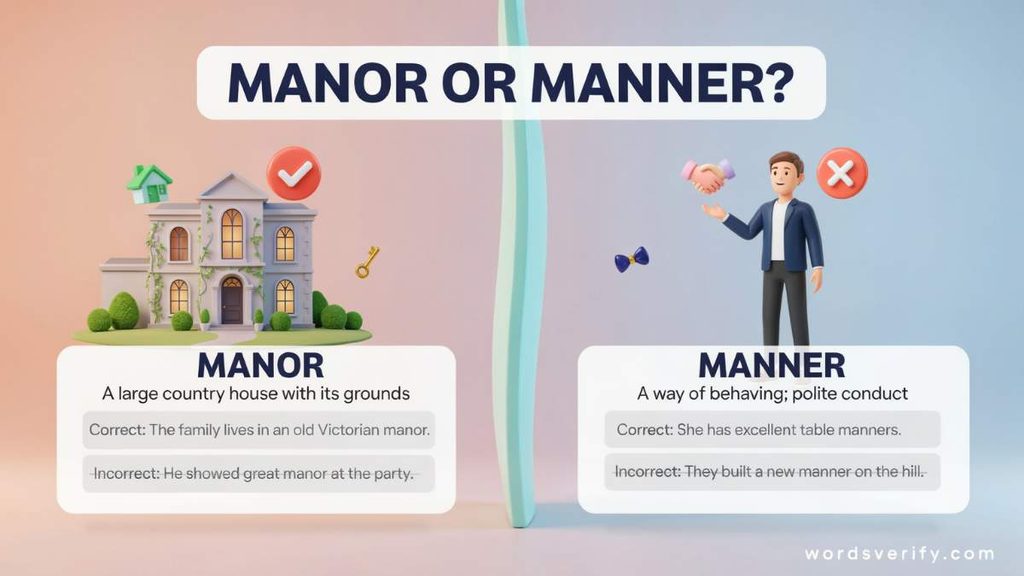
Some expressions make the difference between these words especially clear. When a sentence describes behavior, communication, or the way an activity happens, manner is generally the correct choice.
Let’s look at a few common examples.
In a Timely Manner or in a Timely Manor?
The correct expression is in a timely manner.
It means completing an action within a reasonable or expected period.
Examples:
- Employees must complete their assignments in a timely manner.
- The customer service team responded to the complaint in a timely manner.
- Please send the requested documents in a timely manner.
- The technician repaired the equipment in a timely manner.
Why not timely manor?
Because manor refers to a property or historic residence. It has nothing to do with completing tasks quickly or meeting deadlines.
In a Professional Manner or Professional Manor?
The correct expression is in a professional manner.
It describes behavior that meets appropriate workplace standards, including respect, responsibility, and good communication.
Examples:
- The supervisor handled the disagreement in a professional manner.
- Employees should communicate with customers in a professional manner.
- She responded to the criticism in a professional manner.
A professional manor would refer to a property associated with a professional person or business, not someone’s workplace behavior.
In This Manner or in This Manor?
Both expressions are grammatically possible, but they have different meanings.
In this manner means in this particular way.
Example: “Complete the exercise in this manner to achieve the correct result.”
In this manor refers to something inside or within a particular estate or manor house.
Example: “The historical documents were discovered in this manor.”
One describes a method. The other identifies a location.
Good Manners or Good Manors?
The correct expression for polite behavior is good manners.
Good manners refer to social etiquette, courtesy, and respectful conduct. They include habits such as saying please and thank you, listening without interrupting, and treating other people considerately.
Examples:
- Children should develop good manners at home and school.
- Saying thank you is an example of good manners.
- Good table manners make shared meals more pleasant.
Good manors would refer to multiple estates or properties considered good in some respect. It isn’t the expression used for social etiquette.
Learn the difference between often confused words
Nitch vs Niche Which one Is Correct?
Manner vs Manor Pronunciation Differences
Here’s something interesting: although manner and manor have different spellings and meanings, they’re pronounced identically in standard American English.
Both have the IPA pronunciation /ˈmænər/.
Each word has two syllables:
- First syllable: /ˈmæn/
- Second syllable: /ər/
The stress falls on the first syllable.
In many British English accents, the words also sound alike, although vowel quality can vary from one accent to another.
This makes them homophones: words that share the same pronunciation but have different spellings and meanings.
Are Manner vs Manor Homophones?
Yes. Manner and manor are homophones in standard American English.
Their identical pronunciation explains why people sometimes confuse their spelling. You can’t always identify the correct word by listening to a sentence. You need to understand its meaning.
Other familiar examples include:
| Word pair | Meaning |
|---|---|
| Their / There | Possession / Location |
| To / Too | Direction or infinitive marker / Also or excessively |
| Flour / Flower | Baking ingredient / Part of a plant |
| Right / Write | Correct or a direction / To form words |
| Sea / See | Large body of water / To look at something |
| Manner / Manor | Way of behaving / Large house or estate |
The important lesson is that pronunciation alone doesn’t always reveal the correct spelling. Context does the heavy lifting.
Learn the difference between often confused words
Feed vs Fead and which one is correct?
Where Do Manor vs Manner Come From?
Although manner and manor look and sound similar, they developed from different historical sources. Their origins help explain why the words have separate meanings today.
The Origin and History of Manor
The word manor entered English through Old French manoir, meaning a dwelling or residence.
Its deeper roots connect to the Latin verb manēre, meaning “to remain” or “to dwell.”
Over time, the word became associated with landed estates and the residences of wealthy landowners.
During the medieval period, particularly in England, a manor represented more than a large house. It could function as an economic and administrative unit consisting of land, a principal residence, agricultural holdings, and dependent tenants.
The medieval manor played an important role in the manorial system.
A typical estate might include:
- A manor house occupied by the landowner or lord.
- Agricultural fields worked by tenants.
- Pastures used for livestock.
- Woodlands and other natural resources.
- A village or smaller settlements.
- Facilities supporting farming and local economic activities.
The lord of the manor traditionally held certain rights over the estate and its tenants. However, the exact arrangements varied across regions and historical periods.
As landholding systems changed, the word continued to describe large historic residences and country estates.
The Origin and History of Manner
The word manner entered Middle English through Old French maniere, meaning a way, fashion, or method.
Its deeper linguistic history is associated with Medieval Latin manuaria and Latin manus, meaning “hand.”
The historical connection reflects an association between the hand, the way something is handled, and the method used to perform an action.
Over time, manner developed its familiar meanings involving behavior, style, method, and personal conduct.
For example, the expression manner of speaking describes someone’s characteristic way of communicating. Similarly, in a particular manner identifies a specific approach to completing an activity.
Today, the word appears in everyday conversations, professional writing, literature, and discussions about social etiquette.
Although the two words traveled through different linguistic paths, their histories help explain why they have distinct meanings despite their similar sounds.
Learn the difference between often confused words
Discard vs Disgard Which one Is Correct?
Are There Differences in American and British English?
No standard spelling difference separates American and British English when it comes to manner and manor.
Both words retain the same spelling and basic meanings in the two varieties.
| Word | American English | British English |
|---|---|---|
| Manner | Manner | Manner |
| Manor | Manor | Manor |
| Plural of manner | Manners | Manners |
| Plural of manor | Manors | Manors |
| Meaning of manner | Way of behaving or doing something | Way of behaving or doing something |
| Meaning of manor | Large house or historic estate | Large house or historic estate |
Pronunciation can vary slightly because American and British accents use different vowel sounds. However, the words remain homophones in many common accents.
For writers, the rule is simple: neither spelling needs to change when switching between American and British English.
Learn the difference between often confused words
Inversely vs Conversely which one is correct?
Common Mistakes When Using Manor vs Manner
Even experienced writers sometimes confuse these words. Their identical pronunciation makes spelling mistakes easy, particularly when typing quickly.
Here are some common errors and their corrections.
| Incorrect sentence | Correct sentence | Explanation |
|---|---|---|
| Please respond in a timely manor. | Please respond in a timely manner. | Describes how quickly someone responds. |
| He behaved in a polite manor. | He behaved in a polite manner. | Describes someone’s behavior. |
| She has excellent manor. | She has excellent manners. | Refers to polite social behavior. |
| The family restored their old manner. | The family restored their old manor. | Refers to a historic property. |
| The workers handled the situation in a professional manor. | The workers handled the situation in a professional manner. | Describes their approach. |
| We visited a beautiful country manner. | We visited a beautiful country manor. | Identifies a rural residence. |
A few simple habits can help you avoid these mistakes:
- Check the meaning before choosing the spelling.
- Remember that manner relates to behavior, methods, and styles.
- Associate manor with houses, estates, and land.
- Pay attention to expressions such as good manners and in a timely manner.
- Proofread important emails and professional documents before sending them.
A quick meaning check often catches the mistake before anyone else sees it.
Learn the difference between often confused words
Ironic vs Unironic which one is correct?
How to Remember the Difference Between Manner vs Manor
You don’t need complicated grammar rules to remember these words. A simple connection between each spelling and its meaning can make the distinction stick.
Manner Means Method
Both manner and method begin with M.
When describing how someone performs an action, behaves, or communicates, choose manner.
Example:
“She completed the project in a careful manner.”
The word describes her approach to the task.
Manor Means Mansion
Both manor and mansion begin with M and relate to large buildings or residences.
When discussing a country house, historic estate, or substantial rural property, choose manor.
Example:
“The family owns a beautiful manor in the countryside.”
The word identifies their property.
A Simple Memory Trick
Remember these two associations:
- Manner = Method: How someone does something.
- Manor = Mansion: A large house or estate.
You can also ask yourself one simple question before writing:
“Am I describing someone’s behavior or a building?”
If you’re describing behavior, use manner. If you’re identifying a property, use manor.
Learn the difference between often confused words
Rehireable vs Rehirable Which one Is Correct?
Paired Examples in Everyday Situations
Sometimes, the easiest way to understand a spelling difference is to see both words in similar sentences.
The following comparisons show how their meanings change depending on context.
| Manner example | Manor example |
|---|---|
| She spoke in a friendly manner. | She lived in a historic manor. |
| The manager handled the issue in a professional manner. | The manager purchased an old manor. |
| His polite manner impressed the guests. | His family owned a country manor. |
| The teacher explained the lesson in a clear manner. | The teacher visited a restored manor. |
| They completed the work in a similar manner. | They explored two historic manors. |
A Professional Email
Imagine a company manager writing instructions to employees about completing their assignments.
Incorrect version:
“Please complete all outstanding tasks in a timely manor.”
Correct version:
“Please complete all outstanding tasks in a timely manner.”
Why does the second version work?
The manager wants employees to complete their tasks within an appropriate period. The sentence describes how an action should happen, so manner is the correct choice.
Using manor would introduce an unrelated reference to a property.
A Historic Property Description
Now imagine a travel writer describing an old English residence.
Incorrect version:
“The visitors spent the afternoon exploring a beautiful country manner.”
Correct version:
“The visitors spent the afternoon exploring a beautiful country manor.”
Here, the writer describes a physical property in a rural setting. Therefore, manor is the appropriate spelling.
These examples show why context matters more than pronunciation when choosing between similar-sounding words.
To the Manner Born or To the Manor Born?
This expression deserves attention because both versions appear in English, but they have different historical associations.
The original literary expression is “to the manner born.”
William Shakespeare used it in Hamlet, Act 1, Scene 4. Hamlet discusses a local drinking custom and explains that although he is native to the place and accustomed to its customs, he doesn’t approve of the practice.
The phrase describes someone who is naturally accustomed to a particular environment, custom, or way of life.
In modern usage, people sometimes confuse manner with manor because a manor is associated with aristocratic families and inherited wealth.
“To the manor born” is a familiar humorous adaptation. It suggests someone born into an upper-class lifestyle or accustomed to wealth and privilege.
The expression also became widely recognizable as the title of the British television sitcom To the Manor Born, which first aired in 1979.
The distinction is worth remembering:
- To the manner born: Naturally accustomed to a particular custom, environment, or way of life.
- To the manor born: A humorous variation suggesting an upper-class background or privileged lifestyle.
The two expressions play on the similarity between the words, but their meanings aren’t identical.
Learn the difference between often confused words
Monkeys vs Monkies which one is correct?
practice session Manor vs Manner
Test your understanding of manor vs manner with these sentences. Choose the correct word for each blank. Remember, manor refers to a country house or estate, while manner describes behavior or the way something is done.
- The wealthy family lived in a beautiful old ______ surrounded by gardens.
- She spoke to the guests in a polite and friendly ______.
- The historic ______ had several bedrooms, a library, and a large dining hall.
- His rude ______ upset everyone at the dinner table.
- We visited a grand ______ during our trip to the countryside.
- Please complete your work in a timely ______.
- The lord of the ______ owned large areas of farmland.
- Her calm ______ helped everyone feel comfortable.
- The guide explained the history of the ancient ______.
- He answered the difficult question in a confident ______.
- The children learned good table ______ at home.
- The beautiful ______ stood on a hill overlooking the village.
- She has a charming ______ that makes people feel welcome.
- The family restored the old ______ and turned it into a museum.
- Please behave in a respectful ______ during the meeting.
- The estate included a large ______ and several acres of farmland.
- His cheerful ______ made the interview enjoyable.
- The visitors admired the architecture of the medieval ______.
- She handled the disagreement in a professional ______.
- Good ______ can make a positive impression on others.
- The old ______ had a beautiful garden and a private lake.
- He has a habit of speaking in a sarcastic ______.
- The historical documentary explored life on a medieval ______.
- The teacher praised the students for their polite ______.
- The guests admired the grand ______ and the owner’s welcoming ______.
Answers
- Manor
- Manner
- Manor
- Manner
- Manor
- Manner
- Manor
- Manner
- Manor
- Manner
- Manners
- Manor
- Manner
- Manor
- Manner
- Manor
- Manner
- Manor
- Manner
- Manners
- Manor
- Manner
- Manor
- Manners
- Manor, manner
Here’s a trusted source for clear word meanings:
FAQs
What is the difference between manor vs manner?
Manor refers to a large country house or estate, often with surrounding land. Manner describes how someone behaves, acts, or does something. For example, a wealthy family might live in a manor, while a polite person shows good manners.
Is it “to the manner born” or “to the manor born”?
The original expression is “to the manner born.” William Shakespeare used it in Hamlet to describe someone naturally accustomed to a particular way of life. “To the manor born” is a later humorous variation that plays on the similar sounds of the two words.
How do you pronounce manor in American English?
In standard American English, manor is pronounced with two syllables: MAN-er. It sounds the same as manner, which is why people often confuse them in writing.
Is a manor the same as a mansion?
Not exactly. A mansion is a large, impressive house, while a manor traditionally refers to a substantial country estate associated with land and, historically, a manor system. A manor house may look like a mansion, but the terms don’t have identical meanings.
What qualifies a house as a manor?
Traditionally, a manor was the main residence of a landowner who held an estate. It was often connected to agricultural land and a local community. Today, people may use the term more loosely for a large historic country house or estate.
What is another word for manor?
Depending on the context, alternatives include estate, country house, manor house, and stately home. Mansion may also fit when you’re describing the building’s size and grandeur rather than its historical role.
Can you use manor and manner in the same sentence?
Yes! Here’s an example: “The guests admired the beautiful manor and praised the owner’s polite manner.” The sentence uses manor for the property and manner for someone’s behavior.
What does manor mean in simple words?
A manor is a large country house, usually with land around it. Historically, it was the home of a landowner who managed an estate.
What does manner mean?
Manner means the way someone behaves, speaks, or performs an action. For example, “She answered the question in a friendly manner.” It can also refer to a person’s habits or style of doing things.
Should I use manner or manners?
Use manner when referring to a way of behaving or doing something. Use manners when talking about someone’s social behavior, politeness, or etiquette.
- Singular: He has a calm manner.
- Plural: She has excellent table manners.
What are some examples of good manners?
Good manners are habits that show respect and consideration for others. Common examples include:
- Saying please and thank you.
- Greeting people politely.
- Listening without interrupting.
- Respecting personal space.
- Holding the door for someone when appropriate.
- Waiting your turn.
- Speaking respectfully, even during disagreements.
Who traditionally lived in a manor?
Historically, a manor was usually home to a landowning lord or wealthy family. Servants, workers, and other people connected to the estate might also have lived there or nearby. The exact arrangement varied by period and region.
Why is a house called a manor?
The word manor comes through Old French manoir, meaning a dwelling or residence, and ultimately traces back to the Latin verb manēre, meaning “to remain” or “to dwell.” Over time, it became associated with a country estate and the house at its center.
What is the difference between a manor and a castle?
A manor was generally a country estate or landholding centered on a residence. A castle was primarily a fortified structure designed for defense and residence. Some castles served as important estate centers, but not every manor was a castle.
What is the difference between a manor and an estate?
An estate usually refers to a large area of land, property, or possessions. A manor traditionally refers to a particular type of estate and its principal residence, often with historical links to land ownership and local administration.
Is manor used as slang?
Manor isn’t generally used as a standard slang word in American English. In some British contexts, “the manor” can refer informally to someone’s neighborhood or local area. Its meaning depends on the speaker and context.
What are smaller mansions called?
A smaller mansion might be described as a large house, villa, country house, or estate home. The best term depends on its architecture, location, and historical background. There isn’t one official name for every house that’s smaller than a mansion.
What is the opposite of manor?
Manor has no exact antonym because it names a type of property rather than a quality. Depending on the context, you could contrast it with a cottage, hut, or small dwelling.
How can I remember when to use manor vs manner?
Use this simple memory trick: manor has an “o” for a property, while manner has two “n”s like the word “nice”—a helpful reminder when you’re talking about behavior and politeness. When in doubt, check whether your sentence refers to a place or a way of acting.
Conclusion
Although manor vs manner sound alike, their meanings are worlds apart. A manor is a large country house or estate, while manner describes how someone behaves or does something. Once you understand this simple difference, you’ll have no trouble choosing the right word. Use manner when discussing someone’s behavior, attitude, or way of doing things. Save manor for grand houses, historic estates, and country properties. Mixing them up can turn a compliment about someone’s good manners into an unexpected reference to real estate! So, remember: good manners can make a great impression, but owning a manor is an entirely different matter.

Lisa AJS is an experienced blogger and language enthusiast at Words Verify, dedicated to making grammar simple, practical, and enjoyable. She writes engaging content on commonly confused words, grammar mistakes, word meanings, and everyday language challenges.