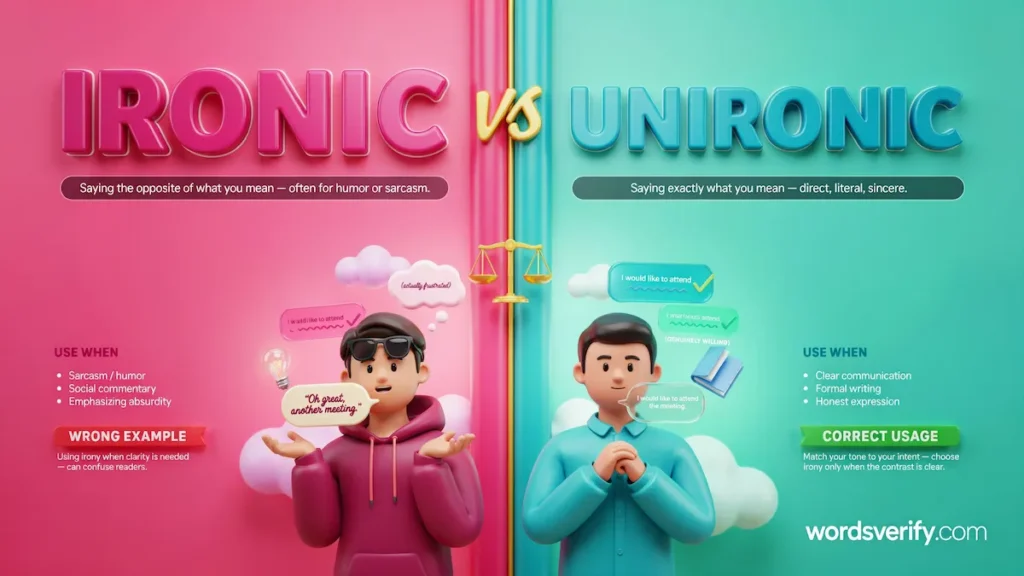
Have you ever described something as ironic when you meant the exact opposite? It’s an easy mistake to make. The difference between ironic vs unironic can confuse even experienced writers, especially when online conversations and everyday slang blur the lines. Although these words may seem like simple opposites, each has a distinct meaning and purpose. In this guide to ironic vs unironic, you’ll learn what both words mean, how they differ, and when to use them correctly. With practical examples, common usage mistakes, and a few memorable explanations, you’ll soon know which word fits the situation. No guesswork or grammar headaches required!
Ironic vs Unironic Quick Answer
The easiest way to understand these words is to consider whether someone is expressing irony or speaking sincerely.
- Ironic: Describes something involving irony, such as a contrast between expectations and reality or between literal words and intended meaning.
- Unironic: Describes something sincere or genuine that isn’t intended ironically.
Consider these two sentences:
- “I absolutely love getting stuck in traffic,” someone says while clearly looking frustrated. This is ironic because the speaker means the opposite of the literal statement.
- “I absolutely love driving through the countryside.” The speaker genuinely enjoys the experience. This is unironic because the statement expresses a sincere preference.
Here’s a quick comparison:
| Feature | Ironic | Unironic |
|---|---|---|
| Basic meaning | Involving irony | Sincere or without irony |
| Main idea | A contrast between meaning, expectation, or outcome | A genuine or straightforward expression |
| Intention | May involve humor, sarcasm, or an ironic effect | Usually communicates what the speaker genuinely means |
| Tone | Can be humorous, critical, sarcastic, or serious | Can be serious, playful, enthusiastic, or humorous |
| Example | “Great weather!” during a heavy rainstorm | “I love rainy days.” |
| Part of speech | Adjective | Adjective |
One important detail: irony doesn’t always involve saying the opposite of what you mean. That’s one form of verbal irony. Situational and dramatic irony work differently because they involve events or differences in knowledge rather than a speaker’s words.
Learn the difference between confusing more English words
Rehireable vs Rehirable Which one Is Correct?
What Does Ironic Mean?
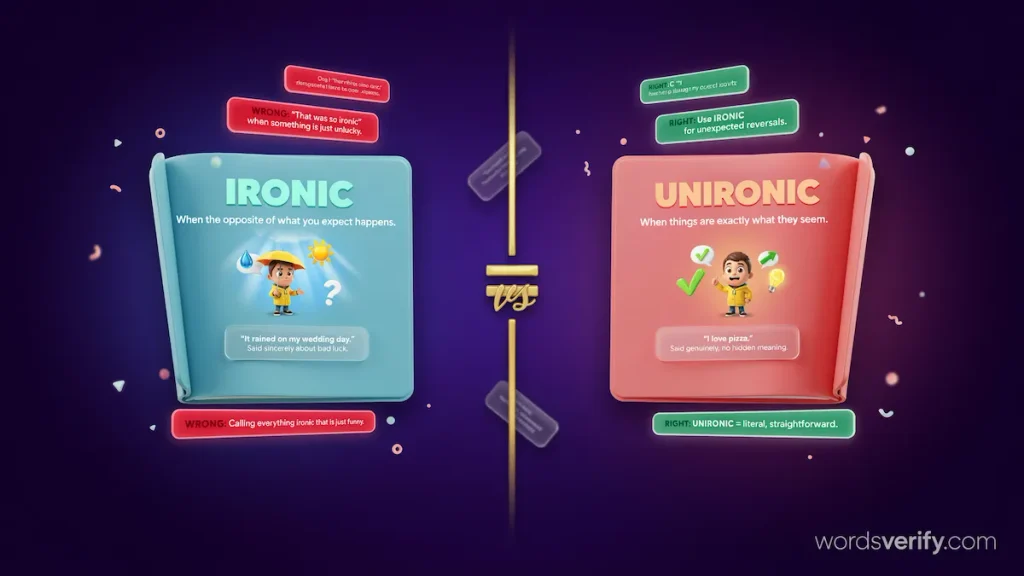
Ironic describes something involving irony. It often refers to a situation in which the actual result differs significantly from what someone expects. It can also describe a statement in which the intended meaning differs from the literal words.
The meaning depends heavily on context. A sentence might sound completely ordinary when read literally but become ironic when you understand the circumstances surrounding it.
For example:
“That’s exactly what I needed today!”
Imagine someone spills coffee on an important document before a major meeting. If they make this comment with an annoyed expression, they’re using verbal irony. Their literal words suggest satisfaction, but their actual meaning communicates frustration.
Irony can also occur without anyone deliberately making a joke.
Imagine a fire station catching fire. The situation seems contradictory because a place associated with fighting fires becomes the location of one. That’s an example of situational irony.
Something ironic doesn’t necessarily have to be funny. It can be amusing, frustrating, disappointing, tragic, or simply surprising.
The Three Main Types of Irony
Irony appears in everyday conversations, literature, movies, television, and real-life situations. However, not every example works in the same way. Three major types help explain how it operates.
Verbal Irony
Verbal irony occurs when someone says something but intends a different meaning, often one that contrasts with the literal words.
People frequently use verbal irony to express frustration, amusement, criticism, or humor. The listener must understand the context and tone to recognize the intended message.
Examples:
- Someone arrives two hours late and says, “I’m always right on time!”
- A person drops their phone into a puddle and comments, “Well, that went perfectly.”
- Someone walks into a freezing room and says, “It’s practically tropical in here.”
In each example, the speaker’s actual meaning differs from the literal interpretation.
Verbal irony can overlap with sarcasm, particularly when someone uses an ironic statement to criticize another person. However, not all verbal irony is sarcastic.
Situational Irony
Situational irony occurs when an actual outcome contrasts with what people reasonably expect.
Unlike verbal irony, it doesn’t require someone to make a statement or intentionally create humor. The irony comes from the circumstances themselves.
Examples:
- A driving instructor receives a speeding ticket while teaching a student about road safety.
- A professional organizer has an extremely messy office.
- A company that advertises reliable internet service experiences a major outage during its online product launch.
These situations contain an unexpected contradiction between what people anticipate and what actually happens.
However, an unusual event isn’t automatically ironic. The contrast must have some meaningful connection to the expectations involved.
Dramatic Irony
Dramatic irony occurs when the audience knows something important that a character doesn’t know.
Writers frequently use this technique in novels, plays, television shows, and movies to create suspense, tension, or humor.
For example, imagine a movie in which the audience knows that a character’s best friend has secretly planned a surprise birthday party. The character spends the entire day complaining that everyone has forgotten their birthday.
The audience understands what’s happening, but the character doesn’t. That difference in knowledge creates dramatic irony.
Another familiar example appears in mystery stories. Readers might discover the identity of the villain before the detective does. Every conversation between the detective and the villain then carries an additional meaning that the detective cannot recognize.
Is Ironic Always Negative or Funny?
No. This is one of the most common misunderstandings about irony.
An ironic situation can have a positive, negative, or neutral outcome. The defining feature is the meaningful contrast, not whether the event makes someone laugh.
For example:
- Humorous irony: A professional comedian forgets the punchline to their own joke.
- Unfortunate irony: A person who buys an expensive security system gets locked out of their house.
- Positive irony: Someone who misses a train accidentally meets an old friend at the station.
- Literary irony: A character’s confidence leads directly to the failure they believed they had avoided.
Irony is a form of figurative language and communication that depends heavily on context. If you focus only on whether something is funny, you’ll miss many genuine examples.
Learn the difference between confusing more English words
Monkeys vs Monkies which one is correct?
What Does Unironic Mean?
Unironic means sincere, genuine, or not involving irony. It describes a statement, reaction, opinion, or behavior that communicates what someone actually thinks or feels without an intended ironic message.
In simple terms, unironic often describes the opposite of an ironic expression.
For example:
“I unironically love cheesy romantic movies.”
The speaker genuinely enjoys these movies. They aren’t pretending to like them for amusement, mocking their popularity, or making a sarcastic comment. They simply enjoy watching them.
This is why people often use unironic when discussing things that others might consider embarrassing, outdated, ridiculous, or unusual.
Imagine someone wearing a bright, oversized sweater from the 1980s. A friend might assume the person wears it as a joke. However, if they genuinely love the style, they could say:
“I wear this unironically. I actually think it’s fashionable.”
The word removes any uncertainty about the person’s intention.
Unironic Meaning in Everyday English
Although unironic is a straightforward adjective, its modern use is particularly interesting because it often appears in situations where people expect humor or sarcasm.
Here are some common examples:
Genuine enthusiasm: Someone openly expresses excitement about something without mocking it.
Example: “I unironically think this is the best video game soundtrack ever.”
Sincere appreciation: A person praises something because they genuinely admire it.
Example: “She unironically loves old-fashioned furniture.”
Honest preferences: Someone admits to enjoying something that others might consider embarrassing.
Example: “He unironically listens to Christmas music all year.”
Straightforward opinions: A speaker wants to make clear that their statement isn’t a joke.
Example: “I unironically believe everyone should learn basic cooking skills.”
In each case, unironic emphasizes sincerity.
Does Unironic Mean Serious?
Not necessarily.
A sincere statement can still be funny, playful, exaggerated, or entertaining. Being unironic simply means that the speaker isn’t using irony to communicate a different intended meaning.
For example:
“I unironically think my cat deserves a promotion.”
This statement might make people laugh. However, the speaker could genuinely believe that their cat has an important place in the household.
Sincerity and seriousness aren’t the same thing. You can genuinely enjoy something silly, make a sincere joke, or express an earnest opinion in a playful way.
Learn the difference between confusing more English words
Salvadoran vs Salvadorian Which one Is Correct?
Ironic vs Unironic Key Differences
The difference between ironic vs unironic becomes easier to recognize when you consider the speaker’s intention, the situation, and the meaning behind the words.
An ironic statement often communicates something beyond its literal meaning. An unironic statement, however, expresses a genuine thought or feeling without relying on an ironic interpretation.
Still, there’s a small complication: ironic vs unironic don’t always describe opposite intentions in exactly the same way. The word ironic can describe events and outcomes that have nothing to do with what a speaker intends. Unironic usually describes the absence of irony in an expression, attitude, or reaction.
For instance, a fire station burning down can be ironic even though nobody intended the situation to happen. Meanwhile, a firefighter saying, “I genuinely enjoy my job,” is expressing an unironic opinion.
Side by Side Examples
The following examples show how the two words work in different situations.
| Situation | Ironic expression | Unironic expression |
|---|---|---|
| Music | “I only listen to this terrible song as a joke.” | “I genuinely love this song.” |
| Movies | “This movie is so bad that it’s entertaining.” | “This is one of my favorite movies.” |
| Fashion | “I’m wearing these clothes ironically.” | “I actually love this fashion style.” |
| Food | “Fantastic! Another burnt dinner.” | “I genuinely enjoy cooking dinner.” |
| Weather | “Lovely weather for a picnic!” during a storm | “I love sunny weather for picnics.” |
| Opinions | “That was the most brilliant idea ever,” after a disastrous decision | “I sincerely think that was a brilliant idea.” |
Notice how context changes the interpretation. The same subject can inspire both ironic vs unironic reactions.
The Difference Between Ironically vs Unironically
This comparison deserves special attention because ironically and unironically are adverbs, while ironic vs unironic are adjectives.
Consider these examples:
- “That’s an ironic situation.”
- “He responded ironically.”
- “That’s an unironic compliment.”
- “She genuinely and unironically loves the song.”
The adjectives describe nouns, while the adverbs explain how someone performs an action or expresses an idea.
Here’s another way to understand the difference:
Ironic vs unironic:
“That was an ironic comment.”
“That was an unironic comment.”
Ironically vs unironically:
“He praised the performance ironically.”
“He praised the performance unironically.”
The first pair describes the nature of a comment. The second pair describes the manner or intention behind an action.
Can Both Describe the Same Thing?
Yes. Something can be enjoyed ironically by one person and unironically by another.
Imagine a movie with exaggerated dialogue, outdated costumes, and an unusually dramatic storyline. One viewer watches it because its flaws make it entertaining. Another genuinely considers it a masterpiece.
The movie itself might contain ironic elements, but the viewers’ reactions differ.
This also explains why people sometimes use phrases such as “I ironically enjoy it” and “I unironically enjoy it.”
- I enjoy it ironically: I enjoy it partly because I recognize its absurdity, ridiculousness, or humorous qualities.
- I enjoy it unironically: I genuinely enjoy it without pretending or using my appreciation as a joke.
However, ironic enjoyment doesn’t always mean pretending to like something. A person can genuinely enjoy the humor or absurdity of a movie while recognizing its flaws.
Learn the difference between confusing more English words
Attend vs Tend which one is correct?
Ironic vs Unironic in Everyday Examples
Definitions are helpful, but real conversations make the distinction much easier to understand. People rarely stop to explain whether they’re being sincere or sarcastic. Instead, listeners rely on tone, facial expressions, surrounding circumstances, and shared knowledge.
Let’s look at how these expressions appear in ordinary situations.
in Conversations
Imagine a friend arrives late to dinner after promising to be punctual.
You might say:
“Well, you’re certainly the most punctual person I know!”
Your friend understands that you’re criticizing the delay rather than offering genuine praise. That’s verbal irony.
Now consider another situation. Your friend arrives early and helps arrange the table. You say:
“You’re always so reliable. I really appreciate it.”
This is an unironic compliment because you genuinely mean what you’re saying.
The difference lies in the intended message. In the first example, the literal words conflict with the speaker’s actual meaning or In the second, the words communicate the speaker’s genuine feelings.
in Compliments
Compliments offer another useful way to understand the difference.
An ironic compliment might sound positive on the surface but carry an entirely different message.
For example:
“Wonderful job breaking the printer!”
If someone accidentally damages office equipment, this comment probably expresses frustration rather than admiration.
An unironic compliment communicates genuine appreciation:
“You did a wonderful job fixing the printer. Thanks for taking care of it.”
Both comments contain positive-sounding words. However, only the second communicates sincere praise.
A sarcastic compliment can sometimes hurt more than a direct criticism because its negative meaning hides behind positive language.
in Personal Preferences
People frequently use unironically when discussing their tastes and interests.
For example:
- “I unironically love pineapple on pizza.”
- “She unironically enjoys watching old cartoons.”
- “He unironically collects vintage lunchboxes.”
- “I genuinely love listening to 1990s pop music.”
Why add the word unironically?
Because people sometimes hide their genuine interests behind jokes. Someone might praise an unusual song, movie, or fashion trend while pretending to dislike it. Adding unironically makes their real opinion clear.
Consider this exchange:
Alex: “You actually listen to that song?”
Jordan: “Yes! I unironically love it.”
Jordan isn’t mocking the song or using exaggerated praise for comic effect. The enjoyment is genuine.
in Online Discussions
Internet conversations provide countless examples of both expressions.
A person might comment:
“That advertisement is so ridiculous that it’s actually brilliant.”
Depending on the context, this could express ironic appreciation. The person enjoys the advertisement because its absurdity makes it entertaining.
Another user might write:
“I unironically think this advertisement is excellent.”
Here, the person wants readers to understand that the praise is genuine.
Online communication often lacks facial expressions and vocal tone. A short comment can therefore create confusion. Words such as unironically help clarify intent when readers might otherwise assume the speaker is joking.
Learn the difference between confusing more English words
Hoodie vs Hoody Which one Is Correct?
Ironic vs Unironic Funny What’s the Difference?
Something can be funny ironically or unironically. The distinction concerns why someone finds it amusing rather than whether laughter is involved.
Ironic humor often depends on contrast, unexpected meaning, contradiction, or an amusing difference between expectations and reality.
Unironic humor involves genuine amusement without requiring an ironic interpretation. A person might laugh at a silly situation, an entertaining character, or a genuinely funny joke.
Consider these examples:
| Example | Type of humor | Explanation |
|---|---|---|
| Watching an intentionally terrible movie because its flaws are hilarious | Ironic enjoyment | The entertainment comes partly from recognizing its shortcomings. |
| Laughing at a clever joke | Unironic enjoyment | The person genuinely finds the joke funny. |
| Enjoying a ridiculous costume because it looks absurd | Potentially ironic | The appeal may come from its exaggerated appearance. |
| Loving a cartoon because its characters are entertaining | Unironic enjoyment | The appreciation is genuine. |
| Laughing at a serious advertisement that accidentally becomes ridiculous | Situationally ironic humor | The humor comes from an unexpected contrast. |
Can Something Be Ironic vs Unironically Funny?
Absolutely.
Imagine watching an old television commercial with exaggerated acting and dramatic music. You might recognize that the advertisement unintentionally looks hilarious by modern standards.
You could say:
“I unironically find this commercial hilarious.”
This means you genuinely find it funny, even though the humor comes from something that might seem outdated or unintentionally absurd.
Another example involves a deliberately terrible horror movie. You might genuinely enjoy watching it because its awkward dialogue and predictable scenes entertain you.
Your enjoyment is sincere. The humor, however, may depend on the movie’s shortcomings.
This distinction matters because ironic enjoyment doesn’t necessarily mean fake enjoyment. Someone can sincerely enjoy a ridiculous movie for ironic reasons.
Learn the difference between confusing more English words
Outting vs Outing which one is correct?
Ironic vs Unironic in Internet Slang and Modern Culture
The internet has given unironic and unironically a particularly visible place in everyday English.
Social media users often express opinions through jokes, memes, exaggeration, and deliberate sarcasm. As a result, readers sometimes struggle to determine whether a statement reflects genuine enthusiasm or playful mockery.
That’s where these words become useful.
Why Do People Say Unironically?
People use unironically to remove uncertainty from a statement.
For example:
“I unironically love this outfit.”
Without the adverb, someone might interpret the comment as a joke, especially if the outfit looks unusual or deliberately outdated.
Adding unironically tells the reader that the speaker genuinely likes it.
Common online expressions include:
- “I unironically listen to this every day.”
- “This is unironically one of the best games I’ve played.”
- “I unironically think that movie deserves an award.”
- “That character is unironically my favorite.”
- “I unironically enjoy these old internet videos.”
These expressions often appear in informal discussions about entertainment, fashion, music, gaming, and popular culture.
What Does Unironically Mean in Slang?
In internet slang, unironically often means genuinely or without joking.
It can also signal that someone is willing to admit an unpopular or unusual preference without hiding behind humor.
For example:
“I unironically love cheesy love songs.”
The speaker might expect others to laugh at the preference. Nevertheless, they aren’t using the statement sarcastically.
The expression has become especially useful in online spaces where people frequently communicate through exaggerated praise and self-aware humor.
Ironic Memes and Unironic Enjoyment
Internet memes often blur the line between sincere entertainment and ironic humor.
A meme might use an awkward photograph, an outdated design, or an intentionally exaggerated caption. Some users share it because they find the image genuinely funny. Others enjoy it because they recognize the absurdity of the format.
Sometimes both reactions happen together.
Consider a deliberately low-quality meme featuring a poorly drawn cartoon character. One person might share it ironically because the image looks ridiculous. Another might genuinely appreciate its unusual style.
The same meme can therefore produce different reactions without changing its content.
This is one reason ironic and unironic appear so frequently in internet discussions. They help people explain not just what they like but also why they like it.
Learn the difference between confusing more English words
Excel vs Excell which one is correct?
Ironic vs Sarcastic Are They the Same?
Although people often use ironic and sarcastic interchangeably, they don’t have exactly the same meaning.
Irony is a broader concept. Sarcasm is a form of expression that often uses verbal irony to mock, criticize, or insult someone or something.
In simple terms, sarcasm can involve irony, but irony doesn’t always involve sarcasm.
For example, imagine someone walks into a room and accidentally knocks over a glass of water.
A friend says:
“Excellent coordination!”
The comment is sarcastic because it mocks the person’s clumsiness through an ironic expression.
Now consider a different situation:
A swimming instructor accidentally falls into the pool while explaining how to stay dry outside the water.
This is situational irony. Nobody needs to make a sarcastic comment for the situation to be ironic.
Ironic vs Sarcastic Comparison Table
| Feature | Ironic | Sarcastic |
|---|---|---|
| Meaning | Involves irony or a contrast in meaning or expectations | Uses cutting, mocking, or critical remarks |
| Purpose | Can entertain, surprise, criticize, or create dramatic effect | Often mocks, teases, or expresses disapproval |
| Tone | Can be humorous, serious, or neutral | Often sharp, teasing, or dismissive |
| Requires a speaker? | No, situational irony doesn’t | Yes, sarcasm involves communication |
| Example | A fire station catches fire | “Brilliant idea!” after someone makes an obvious mistake |
Difference Between Irony and Sarcasm
The distinction becomes clearer when you separate the broader concept from one particular way of expressing it.
Irony can appear in literature, real-life events, conversations, and storytelling. Sarcasm generally involves a person’s remark or attitude.
For example:
- Irony: A dentist develops severe tooth decay despite teaching patients about dental hygiene.
- Sarcasm: “You’re a real genius!” someone says after a friend makes a foolish decision.
The dentist example involves a contradiction between professional expectations and personal circumstances. The sarcastic example uses praise to communicate criticism.
Not every ironic statement is sarcastic, and not every sarcastic remark needs to involve a major contradiction.
Learn the difference between confusing more English words
Studder vs Stutter which one is correct?
Ironic vs Coincidental What’s the Difference?
Another common misunderstanding involves the words ironic and coincidental.
People sometimes describe an unexpected event as ironic when they really mean that it happened by coincidence.
However, the two words communicate different ideas.
Coincidental describes events that happen together or around the same time without an obvious causal connection. Ironic describes a meaningful contrast between expectations, circumstances, or intended meanings.
Consider this example:
You meet an old school friend at a grocery store after thinking about them earlier that morning.
That’s a coincidence. The meeting is unexpected, but it doesn’t necessarily involve irony.
Now imagine that you spend an entire afternoon searching for your lost car keys. After finally giving up, you discover them inside the pocket of the jacket you wore throughout the search.
You might describe the situation as ironic because the keys were with you all along, contradicting your expectation that they were lost somewhere else.
Ironic vs Coincidental Comparison Table
| Feature | Ironic | Coincidental |
|---|---|---|
| Meaning | A meaningful contrast or unexpected contradiction | An occurrence without an obvious causal connection |
| Main feature | Reversal of expectations or conflicting meanings | Unexpected timing or connection |
| Requires humor? | No | No |
| Example | A swimming instructor forgets how to swim | Two old friends meet unexpectedly |
| Common use | Describing contradictions and unexpected outcomes | Describing surprising encounters or events |
Can Ironically Mean Unexpectedly?
Sometimes, people use ironically to describe an unexpected or surprising event. However, surprise alone doesn’t make something ironic.
For example:
“Ironically, the restaurant was closed on the day of its grand opening.”
This sentence could be ironic if the closure contradicts the restaurant’s preparations and expectations in a meaningful way.
Compare it with:
“Coincidentally, I visited the restaurant on the same day as its grand opening.”
The second sentence describes timing rather than a contradiction.
Use coincidentally when you mean something happened by chance. Use ironically when the situation contains a meaningful contrast.
Learn the difference between confusing more English words
Choosing vs Chosing which one is correct?
The Origin and History of Ironic vs Unironic
The history of ironic and unironic begins with the older word irony. Although the two adjectives look like opposites, they developed through different stages of English vocabulary.
Understanding their origins helps explain why ironic has several meanings and why unironic became useful in modern conversations.
Where Does the Word Ironic Come From?
The word ironic comes from irony, which entered English through Latin ironia and Old French forms associated with the Greek word eirōneia.
The ancient Greek term referred to dissimulation or feigned ignorance. It was associated with eirōn, a person who concealed their knowledge or intentions.
The concept became particularly familiar through ancient Greek literature and philosophy. Socrates, for example, was associated with a conversational technique now called Socratic irony. He would sometimes present himself as less knowledgeable than his conversation partner to encourage questioning and expose weaknesses in their reasoning.
Over time, the meaning of irony expanded. It became associated with expressions in which the intended meaning differed from the literal words, as well as situations in which actual events contradicted expectations.
Today, ironic describes these different forms of contrast in communication and real-life circumstances.
How Did Unironic Develop?
The word unironic follows a much simpler word-formation pattern.
It combines:
- Un-: A prefix meaning not, opposite of, or lacking.
- Ironic: An adjective describing something involving irony.
Together, they create unironic, meaning not ironic or without an intended ironic meaning.
The related adverb unironically follows the same pattern, with the adjective unironic taking the suffix -ly.
Although the construction is straightforward, the word has become especially useful in modern informal English. People use it to emphasize sincere opinions when the surrounding culture or conversation might otherwise suggest sarcasm or mockery.
For example:
“I unironically enjoy watching old cartoons.”
The speaker wants to make clear that the enjoyment is genuine rather than a joke.
Irony vs Unirony , Is Unirony a Real Concept?
The expression irony vs unirony sometimes appears in online discussions, but unirony isn’t nearly as established or commonly used as irony.
The more familiar and useful comparison is between ironic and unironic, or ironically and unironically.
While unironic is a recognizable English adjective, unirony is an uncommon formation. Most speakers simply use sincerity, earnestness, or lack of irony when discussing the opposite concept as a noun.
For example:
- “Her sincerity was obvious.”
- “He spoke without irony.”
- “The statement expressed genuine enthusiasm.”
These expressions sound more natural in many formal contexts than unirony.
Learn the difference between confusing more English words
Accross vs Across Which one Is Correct?
Ironic vs Unironic Parts of Speech and Word Forms
English grammar plays an important role in choosing between these words. Although ironic, unironic, ironically, and unironically share the same root, they don’t perform identical functions in a sentence.
The main difference is that ironic and unironic are adjectives, while ironically and unironically are adverbs.
Adjective Forms Ironic vs Unironic
An adjective describes a noun or pronoun. It gives information about a person, object, statement, event, or situation.
Ironic examples:
- “It was an ironic coincidence.”
- “Her response was ironic.”
- “The ending contained an ironic twist.”
- “That was an ironic outcome.”
Unironic examples:
- “His appreciation was unironic.”
- “She gave an unironic compliment.”
- “It was a sincere and unironic expression of gratitude.”
- “Their enthusiasm was completely unironic.”
In these examples, the adjectives describe the nature of the nouns.
Adverb Forms Ironically and Unironically
Adverbs modify verbs, adjectives, or other adverbs. They explain how, when, where, or to what extent something happens.
Ironically examples:
- “He ironically praised the terrible performance.”
- “She commented ironically about the weather.”
- “Ironically, the person who hated driving became a driving instructor.”
- “They responded ironically to the announcement.”
Unironically examples:
- “He unironically loves classical music.”
- “She unironically believes the movie is excellent.”
- “I unironically enjoy spending weekends at home.”
- “They unironically support the unusual fashion trend.”
These sentences show how the adverbs modify the actions or expressions.
Related Word Forms
Here’s a useful breakdown of the main forms:
| Word | Part of speech | Meaning | Example |
|---|---|---|---|
| Irony | Noun | A contrast between meaning, expectation, or outcome | “The irony was obvious.” |
| Ironic | Adjective | Involving irony | “It was an ironic situation.” |
| Ironically | Adverb | In an ironic manner or with an ironic effect | “He responded ironically.” |
| Unironic | Adjective | Sincere or not involving irony | “It was an unironic compliment.” |
| Unironically | Adverb | Sincerely or without ironic intent | “She unironically loves the song.” |
Is Ironic the Same as Ironical?
No meaningful difference exists between ironic and ironical in their basic dictionary meanings. Both are established adjectives that describe something involving irony.
However, ironic is generally more common in everyday modern English.
For example:
- “That was an ironic ending.”
- “That was an ironical ending.”
Both sentences are grammatically acceptable, but the first sounds more natural to most contemporary American English speakers.
For ordinary writing, ironic is usually the better choice.
Ironic vs Unironic American English and British English
Some English words change spelling or meaning depending on whether you use American or British English. Fortunately, ironic and unironic don’t have separate regional spellings.
Both American and British English use:
- Ironic
- Ironically
- Unironic
- Unironically
- Irony
The basic meanings remain consistent across both varieties.
Are both Used Differently in American and British English?
The main difference involves usage and conversational style rather than spelling.
For example, an American speaker might say:
“I unironically love this movie.”
A British speaker could use exactly the same sentence with the same intended meaning.
The word unironically is particularly noticeable in informal online English, including discussions about entertainment, humor, fashion, and internet culture. However, it isn’t restricted to one country.
In formal writing, speakers in both varieties may prefer sincerely, genuinely, or without irony, depending on the context.
There is no American-versus-British spelling distinction here. The choice depends on meaning, tone, and the level of formality.
Common Mistakes When Using Ironic vs Unironic
Even fluent English speakers sometimes misuse these words. The problem usually comes from confusing irony with surprise, sarcasm, or humor.
Here are the mistakes worth avoiding.
Assuming Every Unexpected Event Is Ironic
An unexpected event isn’t automatically ironic.
For example:
“Ironically, I saw my neighbor at the supermarket.”
This sentence doesn’t necessarily describe irony. If you simply encountered your neighbor unexpectedly, coincidentally is probably more accurate.
Better:
“Coincidentally, I ran into my neighbor at the supermarket.”
Use ironically when there’s a meaningful contradiction or contrast.
Confusing Irony With Sarcasm
Irony and sarcasm overlap, but they aren’t interchangeable.
Consider these sentences:
- “The fire station burned down.” This may describe situational irony.
- “Wonderful job setting off the fire alarm!” This may be sarcasm.
The first describes an event. The second uses an ironic expression to criticize someone.
Thinking Unironic Means Boring
An unironic statement doesn’t have to sound serious or dull.
For example:
“I unironically think this ridiculous cartoon is hilarious.”
The speaker genuinely enjoys the cartoon. Their statement can still be playful and funny.
Sincerity doesn’t remove humor from a conversation.
Using Ironic When You Mean Unfortunate
People sometimes describe any bad situation as ironic.
However, something unfortunate isn’t necessarily ironic.
Imagine someone loses their wallet while walking through a shopping mall. That’s unfortunate, but it doesn’t automatically involve irony.
Now imagine someone loses their wallet while attending a public event organized specifically to teach people how to protect their belongings. The contrast between the purpose of the event and the actual outcome makes the situation more clearly ironic.
Assuming Ironic Always Means the Opposite
This mistake comes from focusing too heavily on verbal irony.
When someone says, “What a beautiful day!” during a thunderstorm, they may mean the opposite of their literal words.
However, situational irony doesn’t require anyone to say anything.
A professional swimmer who accidentally forgets their swimming gear before a competition might experience an ironic situation without making an ironic statement.
Overusing Unironically
The word unironically is useful when readers might mistake genuine enthusiasm for sarcasm. However, adding it to every sincere statement makes writing repetitive.
Compare:
“I unironically love this book and I unironically recommend it. I unironically think everyone should read it.”
With:
“I genuinely love this book and recommend it to anyone who enjoys historical fiction.”
The second version sounds more natural.
Use unironically when the distinction matters. Otherwise, straightforward language usually works better.
Confusing Unironic With Literal
These concepts are related but not identical.
A literal statement communicates its direct meaning. An unironic statement communicates a sincere intention.
For example:
“I genuinely think that painting is beautiful.”
This is both literal and unironic.
However, someone might sincerely say:
“That painting is a little masterpiece.”
The phrase little masterpiece is figurative language, but the speaker can still mean it sincerely.
Therefore, unironic doesn’t always mean literal. It means the speaker isn’t using an ironic interpretation.
Which Word Should You Use Ironic vs Unironic?
Choosing between ironic and unironic becomes simple when you first identify what you want to communicate.
Are you describing a contradiction, an unexpected outcome, or a statement with a hidden meaning? Choose ironic.
Are you emphasizing that someone genuinely means what they’re saying? Choose unironic.
When to Use Ironic
Use ironic when:
- An outcome contradicts reasonable expectations.
- Someone communicates a meaning different from their literal words.
- A story uses dramatic irony.
- A situation contains an unexpected or meaningful contradiction.
- You want to describe an ironic expression, remark, or twist.
Examples:
- “It’s ironic that the driving instructor received a speeding ticket.”
- “Her ironic comment made everyone laugh.”
- “The movie’s ending was full of dramatic irony.”
- “It’s ironic that the company selling backup batteries experienced a power failure.”
When to Use Unironic
Use unironic when:
- Someone expresses a genuine preference.
- A compliment is sincere rather than sarcastic.
- You want to clarify that an unusual opinion isn’t a joke.
- Someone genuinely enjoys something that others might consider ridiculous.
- You need to distinguish earnest enthusiasm from ironic appreciation.
Examples:
- “I unironically love watching old cartoons.”
- “His praise was completely unironic.”
- “She unironically believes the movie is a masterpiece.”
- “I’m being unironic when I say this is my favorite restaurant.”
A Simple Decision Guide
| What are you trying to express? | Better word |
|---|---|
| A surprising contradiction | Ironic |
| A sarcastic comment | Ironic or sarcastic, depending on the context |
| A sincere opinion | Unironic |
| Genuine appreciation | Unironic |
| An unexpected coincidence without a meaningful contradiction | Coincidental |
| An honest feeling | Sincere or genuine |
| A statement without hidden meaning | Straightforward or literal, depending on context |
Is Unironic Appropriate in Formal Writing?
Yes, unironic is a legitimate English adjective. However, whether it’s the best choice depends on your audience and the purpose of the writing.
In casual articles, conversations, reviews, and social media posts, it sounds natural.
In academic writing, business communication, or formal reports, alternatives may communicate the intended meaning more clearly.
For example:
Informal: “I unironically love this old-fashioned design.”
Formal: “I genuinely appreciate this traditional design.”
Informal: “Her praise was unironic.”
Formal: “Her praise was sincere.”
Neither version is inherently incorrect. The goal is to choose vocabulary that suits the situation.
Ironic vs Unironic Memory Trick
Still mixing up these words? A simple look at their prefixes will help you remember the difference.
The word unironic contains the prefix un-, which commonly means “not” or “the opposite of.”
Think of these examples:
- Ironic: Irony is involved.
- Unironic: No ironic intention; the expression is sincere.
Here’s an easy way to remember:
Ironic = Involves irony.
Unironic = Without ironic intent.
Consider this paired example:
- Ironic: “I absolutely love Mondays,” says someone who clearly hates going to work.
- Unironic: “I absolutely love Mondays because I enjoy starting a new workweek.”
The first statement uses verbal irony. The second communicates a genuine preference.
One additional trick: remember that ironic and unironic are adjectives, while ironically and unironically are adverbs. The endings can help you choose the correct word when constructing a sentence.
practice session Ironic vs Unironic
Test your understanding of ironic vs unironic with these fill in the blank sentences. Choose the word that best completes each sentence based on its meaning and context.
1. It was __________ that the fire station caught fire during the night.
2. I __________ love listening to old jazz records, even though my friends find them boring.
3. She made an __________ comment about the restaurant’s terrible service while sitting in its dining room.
4. He __________ believes that handwritten letters are more meaningful than text messages.
5. Isn’t it __________ that the person who teaches road safety received a speeding ticket?
6. I __________ enjoy watching cheesy romantic movies, and I’m not embarrassed to admit it.
7. The weather forecast predicted sunshine, but it rained all day. What an __________ turn of events!
8. She __________ recommended the book because she genuinely thought it was excellent.
9. It was __________ that the lifeguard needed someone to teach him how to swim.
10. He __________ thinks pineapple belongs on pizza, despite everyone’s complaints.
11. The comedian made an __________ remark about how relaxing his stressful vacation had been.
12. I __________ think that old-fashioned fashion deserves more appreciation.
13. It’s __________ that the spelling teacher made a mistake in the word “spelling.”
14. She __________ enjoys the song, even though everyone else considers it ridiculous.
15. The town’s biggest traffic safety campaign was launched on the day of a major traffic jam. How __________!
16. He __________ supports the idea because he believes it will genuinely help the community.
17. The dentist who hates brushing his teeth is an __________ example of contradiction.
18. I __________ admire her unusual painting style. I’m not pretending to like it.
19. The politician promised to reduce paperwork, but introduced five new forms. How __________!
20. They __________ enjoyed the old movie rather than watching it just for laughs.
Answers
- Ironic
- Unironically
- Ironic
- Unironically
- Ironic
- Unironically
- Ironic
- Unironically
- Ironic
- Unironically
- Ironic
- Unironically
- Ironic
- Unironically
- Ironic
- Unironically
- Ironic
- Unironically
- Ironic
- Unironically
Here’s a trusted source for clear word meanings:
FAQs
What does it mean to be unironic?
Being unironic means expressing something sincerely, without using irony or pretending to mean the opposite. For example, saying “I genuinely love this old-fashioned song” is an unironic statement if you mean it.
Is unironically the opposite of ironically?
In many contexts, yes. Unironically means sincerely or without irony, while ironically means in a way that involves irony. However, their meanings depend on how they’re used in a sentence.
What is commonly mistaken for irony?
Sarcasm, coincidence, and unexpected events are often mistaken for irony. However, they aren’t interchangeable. Sarcasm usually involves mockery or criticism, while coincidence refers to events that happen together by chance. Irony involves a contrast between expectations and reality, meaning, or outcome.
What are the four main types of irony?
The three widely recognized types are verbal, situational, and dramatic irony. Some discussions also identify cosmic irony as a fourth type, describing situations in which fate or circumstances seem to work against a person’s plans or expectations.
What is the difference between ironic and unironic?
Ironic describes something involving irony, such as a statement with an unexpected or opposite meaning. Unironic describes something expressed sincerely, without an ironic intention. For example, praising a terrible movie as a joke may be ironic, while genuinely enjoying it is unironic.
What does it mean to be ironic?
Being ironic means expressing or experiencing a contrast between what someone says, what they mean, what people expect, and what actually happens. For example, calling a swimming instructor’s inability to swim ironic highlights an unexpected contradiction.
Is unironically serious?
Yes. When someone says something unironically, they mean it sincerely rather than as a joke, sarcastic remark, or ironic comment. For example, “I unironically enjoy watching cartoons” means the person genuinely enjoys them.
Is unironically grammatically correct?
Yes. Unironically is a standard English adverb formed by adding the prefix un- to ironically. It describes an action or statement performed without irony. For example, “She unironically recommended the old-fashioned restaurant.”
How do you use unironically correctly?
Use unironically when you want to make it clear that you’re being sincere. For example:
- “I unironically love cheesy romantic movies.”
- “He unironically thinks that song is brilliant.”
- “She wore the unusual outfit unironically.”
In each sentence, the speaker genuinely means what they say.
Is irony basically sarcasm?
No. Irony and sarcasm are related, but they aren’t the same. Sarcasm often uses sharp or mocking language to criticize someone or something. Irony is broader and can involve unexpected outcomes, contrasts, or differences between literal and intended meanings. Sarcasm can be a form of verbal irony, but not every ironic statement is sarcastic.
What is an ironic paradox?
An ironic paradox is a seemingly contradictory situation or statement that reveals an unexpected truth or meaningful contrast. For example, a person might say, “The more choices I have, the harder it is to decide.” The statement sounds contradictory, but it highlights a recognizable human experience.
What is reverse irony?
Reverse irony isn’t a widely established literary term with one agreed-upon definition. People sometimes use it informally to describe a situation in which an expected ironic outcome doesn’t happen or an apparent contradiction turns out to be straightforward. The intended meaning usually depends on context.
What is Socratic irony?
Socratic irony is a technique associated with the ancient Greek philosopher Socrates. He would sometimes pretend to know less than his conversation partners, asking seemingly simple questions to expose weaknesses or contradictions in their arguments.
What is double irony?
Double irony occurs when one ironic meaning is layered over another. A speaker might make a sarcastic comment about someone else’s sarcastic remark, creating two levels of intended meaning. The exact interpretation depends on context and tone.
What is romantic irony?
Romantic irony is a literary technique in which writers or narrators draw attention to the artificial nature of a story, often by interrupting the narrative or commenting on their own storytelling. It allows readers to recognize the difference between fiction and reality.
What is another word for unironic?
Depending on the context, synonyms for unironic include sincere, genuine, earnest, heartfelt, and straightforward. These words aren’t perfect substitutes in every sentence, but they communicate a similar sense of honesty or seriousness.
Why do people say unironically?
People often use unironically to clarify that they genuinely mean something, especially when their statement might sound humorous, exaggerated, or unexpected. For example, “I unironically think this is the best movie ever” tells listeners that the speaker isn’t joking.
What is the opposite of ironic?
Unironic is the most direct opposite of ironic when discussing sincerity and intention. Other possible alternatives include sincere, genuine, and earnest, depending on the sentence.
What does ironic mean in slang?
In slang, ironic often describes something that is funny, unexpected, contradictory, or deliberately different from what it appears to be. Online, people also use it to describe humor that mocks a trend, exaggerates an idea, or pretends to support something ridiculous.
What is a better word for ironic?
There isn’t one perfect replacement for ironic. Depending on the intended meaning, you might use contradictory, unexpected, paradoxical, coincidental, or sarcastic. Choose the word that describes the actual situation rather than treating these terms as interchangeable.
What is unironically vs. ironically?
Ironically describes something involving irony, while unironically means sincerely or without irony. Compare these examples:
- “I ironically wore a ridiculous outfit.” This suggests the choice was intentional for humorous effect.
- “I unironically wore that outfit.” This means the person genuinely liked it.
What does unironically funny mean?
Unironically funny describes something that is genuinely amusing rather than funny because it is awkward, ridiculous, or unintentionally entertaining. For example, a clever comedy sketch can be unironically funny because its humor works exactly as intended.
When did unironic become a word?
Unironic developed by adding the prefix un- to ironic. The exact date of its first use is not firmly established. Its use became more noticeable in modern informal English, particularly in online discussions where people wanted to distinguish sincere opinions from ironic humor.
Is unironically an actual word?
Yes. Unironically is a recognized English word, not just internet slang. It is the adverb form of unironic and means sincerely or without irony.
How do you pronounce unironically?
Unironically is commonly pronounced “un-eye-RON-ik-lee.” It has five syllables, with the main stress on the third syllable.
What is another word for unironically?
Depending on the sentence, alternatives include sincerely, genuinely, earnestly, honestly, and seriously. For example, “I genuinely enjoy this music” can express the same idea as “I unironically enjoy this music.”
What does it mean to do something unironically?
Doing something unironically means doing it because you genuinely want to, believe in it, or enjoy it, rather than as a joke or sarcastic performance. For example, wearing an old-fashioned outfit because you love the style is doing it unironically.
Is sarcasm the lowest form of wit?
The phrase “sarcasm is the lowest form of wit” is a popular saying, but it isn’t an objective rule about humor. Sarcasm can be clever, playful, or biting. Its effectiveness depends on timing, delivery, and context. Like any form of humor, it can be brilliant or simply rude.
Is “I am lying” a paradox?
The statement “I am lying” is a version of the liar paradox. If the statement is true, the speaker must be lying, which makes it false. But if it’s false, the speaker isn’t lying, which makes it true. This creates a logical contradiction rather than an example of ordinary irony.
Is an oxymoron a form of irony?
No. An oxymoron combines two apparently contradictory terms, such as “deafening silence” or “bittersweet.” Irony involves a contrast between expectations, intentions, or outcomes. Both can create surprising effects, but they are different literary devices.
What are some famous examples of irony?
Famous examples include:
- In Shakespeare’s Romeo and Juliet, the audience knows Juliet is alive while Romeo believes she is dead. This is dramatic irony.
- In O. Henry’s The Gift of the Magi, a couple sacrifices their most treasured possessions to buy gifts for each other that become difficult to use. This is situational irony.
- A fire station catching fire is a common example of situational irony because the place associated with preventing fires experiences one itself.
Conclusion
The difference between ironic vs unironic may seem confusing at first, but once you understand their meanings, choosing the right word becomes much easier. Ironic describes something involving irony, while unironic expresses a thought or feeling sincerely, without an ironic twist. The key is to pay attention to context and consider what you actually want to say. Whether you’re describing an unexpected situation, making a sarcastic remark, or sharing a genuine opinion online, the right word helps you communicate clearly. So, the next time you find yourself debating ironic vs unironic, remember that a little attention to meaning goes a long way. After all, the only thing worse than an ironic situation is an avoidable grammar mistake!

Lisa AJS is an experienced blogger and language enthusiast at Words Verify, dedicated to making grammar simple, practical, and enjoyable. She writes engaging content on commonly confused words, grammar mistakes, word meanings, and everyday language challenges.