
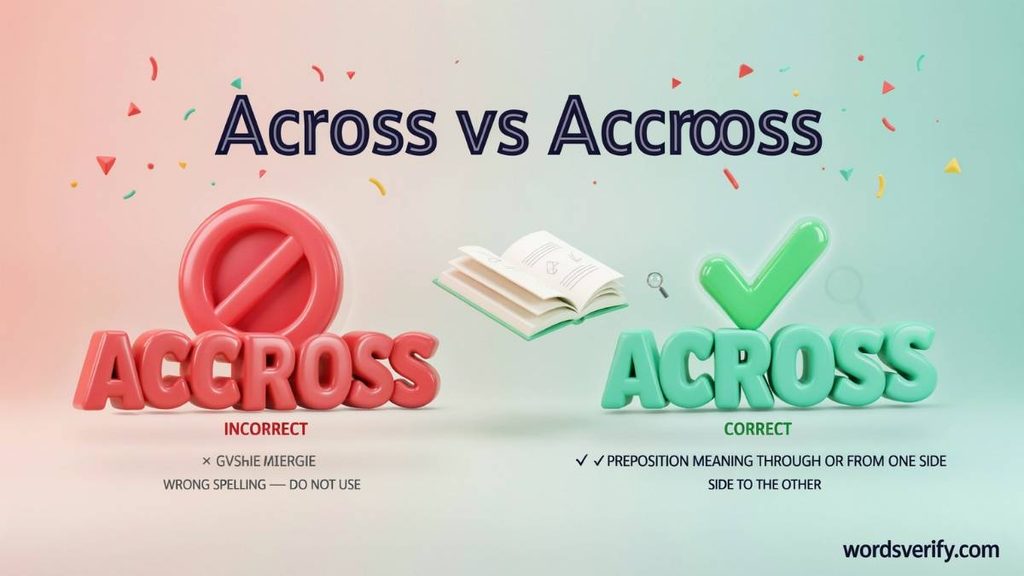
Have you ever stopped mid sentence to wonder whether it’s across vs accross? It’s a small spelling puzzle, but that extra letter can cause quite a bit of confusion! The good news is that the answer is simple: across is the correct spelling, with one C and two S’s. Accross is a common misspelling that has no place in standard English. Whether you’re writing about crossing a busy street, traveling over a bridge, or describing something on the opposite side, knowing the difference helps you write with confidence. Let’s explore the meaning, pronunciation, examples, and easy ways to remember the correct spelling.
Quick Answer
If you’re unsure whether to write across vs accross, choose across. It’s the standard spelling in English dictionaries and everyday writing.
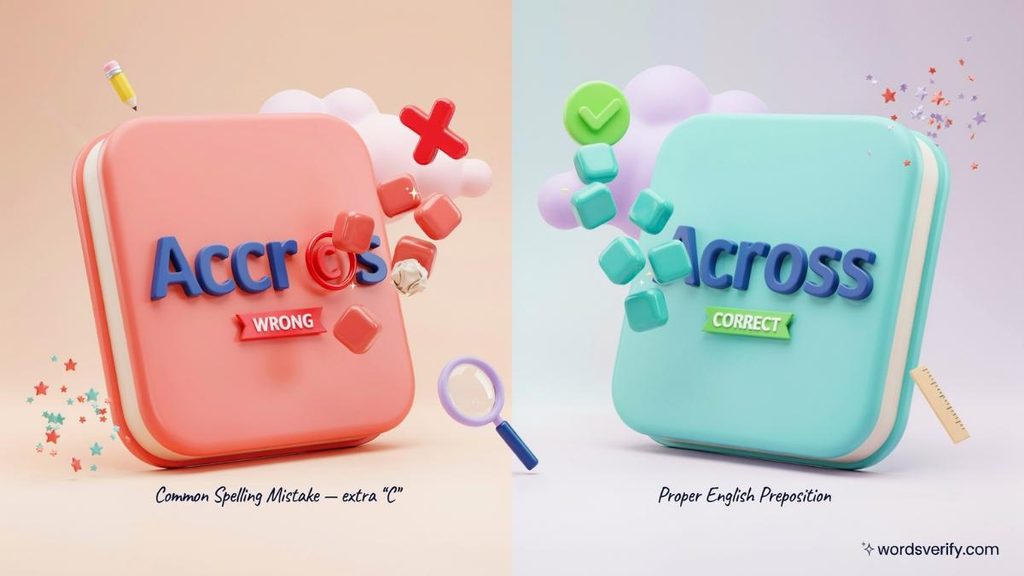
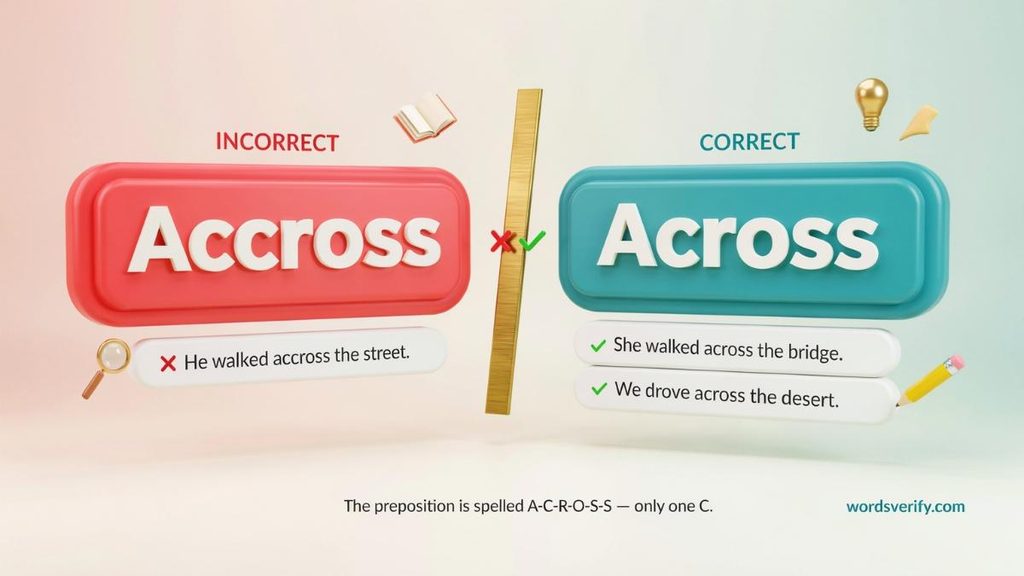
The difference is one extra letter. Across contains one C followed by two S’s. Accross contains two C’s, making it incorrect.
Consider these examples:
| Correct spelling | Incorrect spelling |
|---|---|
| She walked across the street. | She walked accross the street. |
| We drove across the country. | We drove accross the country. |
| The store is across from the bank. | The store is accross from the bank. |
| His message came across clearly. | His message came accross clearly. |
The correct form stays the same regardless of the sentence or meaning. You don’t need a different spelling for formal writing, casual conversations, or professional documents.
A simple way to remember it is that across has one C and two S’s. If you see two C’s, you’ve added one too many.
Learn the difference between tricky more English words
Sponsor vs Sponser Which one Is Correct?
What Does Across Mean?
Across describes movement, position, or extension from one side to another. It can also refer to something located on the opposite side of a place or spread over a particular area.
Imagine standing beside a river. When you walk from your bank to the opposite bank, you move across the river. Similarly, if a bookstore stands on the other side of the street from your house, you can say it’s across the street.
The meaning depends on how the word appears in a sentence. Here are its main uses.
From One Side to the Other
Across often describes movement between two opposite sides of a physical space.
Examples:
- The children ran across the playground.
- A wooden bridge stretches across the river.
- She walked across the room to answer the phone.
- We drove across the bridge during the morning rush.
In each example, across shows movement or extension between different sides of a place.
On the Opposite Side
Across can also describe the position of something in relation to another location. In this case, it doesn’t necessarily involve movement.
Examples:
- The restaurant is across the street.
- My office is across from the hospital.
- A small park sits across the road from our house.
These sentences tell you where something is rather than where someone is going.
Throughout an Area or Region
Sometimes across describes something distributed over several places, communities, or locations.
Examples:
- The company operates across the country.
- The news spread across the world.
- The organization has offices across Europe.
- Similar problems appeared across several departments.
Here, across emphasizes how far something extends or how many places it reaches.
When Talking About Communication
Across also appears in expressions involving ideas, messages, and impressions. These uses aren’t about physical movement. Instead, they describe how information reaches another person.
Examples:
- She struggled to get her message across.
- His confidence came across during the interview.
- The teacher got the main idea across through practical examples.
In these sentences, across helps explain how successfully someone communicates an idea or creates an impression.
Chalet vs Château which one is corrcet?
What Part of Speech Is Across?
Across mainly functions as a preposition and an adverb. Understanding these two roles makes it easier to use the word correctly.
Although the functions are closely related, they serve different purposes in a sentence.
Across as a Preposition
Across functions as a preposition when it connects a noun or pronoun to another part of a sentence. It usually describes movement, direction, position, or location.
Examples:
- The dog ran across the garden.
- We sailed across the lake.
- She looked across the table.
- The pharmacy is across the street.
In each example, across introduces a noun phrase that identifies a place or object. The words garden, lake, table, and street are the objects of the preposition.
A useful way to recognize this function is to look at what follows across. When it introduces a noun phrase that explains location or direction, it generally acts as a preposition.
Across as an Adverb
Across also functions as an adverb when it describes movement or direction without taking a direct object.
Examples:
- He walked across.
- The ball rolled across.
- She looked across.
- The message came across clearly.
In the first three examples, across describes direction or movement without naming the space being crossed.
The last example uses the expression came across to describe how a message was understood or perceived.
Compare the following sentences:
| Sentence | Grammatical function |
|---|---|
| She walked across the bridge. | Preposition |
| She walked across. | Adverb |
| The shop is across the street. | Preposition |
| He looked across. | Adverb |
The surrounding words help determine which grammatical role across performs.
Learn the difference between tricky more English words
Reins vs Reigns which one is correct?
Across in a Sentence Examples and Usage
Seeing a word in different situations is one of the easiest ways to understand how it works. When exploring Across vs Accross, you’ll find that across appears in sentences about movement, location, distance, communication, and time. Understanding these everyday uses also makes it easier to recognize why across is the correct spelling and avoid confusion when comparing Across vs Accross.
Across for Movement and Direction
Use across when someone or something moves from one side of a space to another.
Examples:
- The students walked across the schoolyard.
- We watched a boat sail across the lake.
- The cyclist rode across the bridge.
- A little boy ran across the road to meet his father.
- They swam across the river before sunset.
- She moved across the floor to reach the window.
The focus is on moving between two sides rather than simply moving around within a space.
Across for Location and Position
Across can identify where something is located, especially when two places face each other.
Examples:
- The grocery store is across the street.
- My grandparents live across the road.
- There is a small café across from the station.
- The hotel stands across the river.
- He sat across the table from his manager.
These sentences describe positions rather than actions.
Across for Distribution and Coverage
When something extends over several places, groups, or locations, across helps describe its reach.
Examples:
- The brand sells products across the country.
- The charity supports families across several communities.
- The campaign gained attention across the world.
- The new policy applies across all departments.
- The problem spread across the region.
In each case, across connects different locations or groups under one broader area.
Across for Communication and Ideas
Some expressions use across to explain how people communicate or create impressions.
Examples:
- The speaker got her message across successfully.
- His friendly personality comes across in his writing.
- The instructions didn’t come across clearly.
- She used a simple example to get the idea across.
- The manager wanted to get the importance of teamwork across.
Here, across describes the transfer of an idea or impression rather than physical movement.
Across When Talking About Time
Although across usually describes physical space, it can also refer to periods of time.
Examples:
- The family stayed close across the years.
- Technology has changed dramatically across the decades.
- The company experienced steady growth across the period.
- His interest in music continued across his childhood and adulthood.
In these examples, across connects different points within a period.
However, it isn’t always interchangeable with throughout. Across can emphasize changes or developments over a span of time, while throughout often highlights something that continues during the entire period.
Learn the difference between tricky more English words
Stellar vs Steller which one is correct?
Why Do People Misspell Across as Accross?
Even though across is a familiar word, its spelling can still catch people off guard, especially when comparing Across vs Accross. The mistake usually happens when someone adds an unnecessary C without realizing that the word already has the correct letter pattern. Understanding the difference between Across vs Accross helps you avoid this common spelling error and use the correct form confidently in your writing.
Several factors explain this common error.
Confusion About Double Consonants
English contains many words with doubled consonants, including accommodate, successful, occasion, and necessary. Because writers encounter these patterns regularly, they sometimes assume that across needs another consonant too.
However, English spelling doesn’t follow one universal doubling rule. Each word has its own established spelling.
Across has one C followed by two S’s. Adding another C doesn’t make it more accurate.
Influence of the Word Cross
The word cross may also contribute to the confusion. Since across contains the complete word cross, some writers mentally divide it into a + cross and accidentally double the C.
However, the correct spelling is across, not accross.
Pronunciation Can Be Misleading
The pronunciation of across doesn’t clearly reveal how many letters the word contains. In ordinary speech, its two syllables flow together naturally.
As a result, someone relying on sound alone may add an unnecessary letter.
This is a useful reminder that English spelling and pronunciation don’t always match perfectly. When you’re unsure, checking a dictionary is better than guessing.
Familiarity With Incorrect Spellings
Repeated exposure to a spelling mistake can make it look familiar. If you frequently see accross in informal messages, comments, or unedited online content, you might eventually assume it’s acceptable.
However, seeing an error repeatedly doesn’t make it correct. The same problem occurs with many commonly misspelled English words.
Learn the difference between tricky more English words
Cheer vs Chear Which one Is Correct?
Across vs Accross Key Spelling Differences
The difference between across vs accross is straightforward. One spelling follows standard English conventions, while the other contains an unnecessary C.
Here’s how across compares with several other common mistakes.
| Spelling | Correct or incorrect? | Reason |
|---|---|---|
| Across | Correct | Standard English spelling |
| Accross | Incorrect | Contains an extra C |
| Accros | Incorrect | Missing one S |
| Acrosss | Incorrect | Contains an extra S |
| Acros | Incorrect | Missing one S |
The correct spelling contains six letters:
A-C-R-O-S-S
Remember the pattern:
- A: First letter.
- C: One C.
- R: One R.
- O: One O.
- S: First S.
- S: Second S.
If someone asks whether across has one C or two, the answer is always one C.
Is Accros Also Wrong?
Yes. Accros is another incorrect spelling.
Unlike accross, which contains an extra C, accros leaves out one of the two S’s. Neither form is accepted as the standard spelling.
Remember two simple rules:
- Don’t add another C.
- Don’t remove either S.
The correct form remains across.
Learn the difference between tricky more English words
Suit vs Suite which one is correct?
Is There a British vs American Spelling of Across?
Some English words have different spellings depending on the variety of English. For example, American English uses color, while British English generally uses colour. Similarly, Americans write center, whereas British writers use centre.
However, across doesn’t follow this pattern.
The spelling remains identical in American, British, Canadian, and Australian English.
| English variety | Correct spelling | Incorrect spelling |
|---|---|---|
| American English | Across | Accross |
| British English | Across | Accross |
| Canadian English | Across | Accross |
| Australian English | Across | Accross |
There is no special UK or US spelling for this word. Across is the standard form in all these varieties.
The important point is simple: regional differences affect some English words, but they don’t change the spelling of across.
Learn the difference between tricky more English words
Busing vs Bussing Which one Is Correct?
How Do You Pronounce Across?
Correct pronunciation can help you recognize a word when speaking, although it doesn’t always explain its spelling.
Across has two syllables, with the main stress on the second syllable. Its pronunciation varies slightly between American and British English.
| Variety | IPA pronunciation |
|---|---|
| American English | /əˈkrɑːs/ |
| British English | /əˈkrɒs/ |
The first syllable contains a weak vowel sound, while the second carries the main stress.
To pronounce across naturally:
- Begin with the unstressed vowel sound /ə/.
- Move into the /k/ sound.
- Pronounce the /r/ sound.
- Finish with the vowel and /s/ sound.
- Give the second syllable more emphasis.
Although the vowel sound differs slightly between accents, the written form remains the same.
How Many Syllables Does Across Have?
Across has two syllables. You can divide it into A-cross, with the main stress falling on the second syllable.
A few examples make the rhythm easier to recognize:
- Across the road.
- Across the river.
- Across the room.
- Across the country.
When you say these expressions aloud, you’ll notice that the second syllable receives more emphasis.
The syllable count also helps distinguish across from shorter words such as cross, which has only one syllable.
Learn the difference between tricky more English words
Sentence vs Sentance which one is correct?
What Is the Origin and History of Across?
The history of across goes back several centuries, offering useful context for understanding Across vs Accross. Its development connects to the word cross and older French expressions that described something positioned in the shape of a cross.
Early forms appeared in English around the 12th century. One recorded form was o cros, which referred to something arranged in the shape of a cross. Later forms included a-croiz and acros. Over time, the word developed the meaning of moving from one side to another, which explains its modern use in the Across vs Accross spelling comparison.
Its history also connects to the Old French expressions a croix and en croix, meaning “in or on a cross.” Understanding this background makes it easier to recognize why across is the established spelling, while accross is simply a misspelling.
How Did Across Develop Its Modern Meaning?
The word gradually gained new uses as the English language developed.
Its history can be understood through several stages:
- Around 1200: Early forms described something arranged in the shape of a cross.
- Around 1300: The word appeared in forms associated with a crossed position.
- Early 14th century: It developed the meaning of moving from one side to another.
- Later centuries: Its use expanded to describe opposite positions, distances, and broader spatial relationships.
Today, across commonly functions as a preposition and adverb.
Its connection to cross also helps explain why the word can describe something extending from one side to another.
However, its history doesn’t justify the spelling accross. The standard modern form uses one C and two S’s.
Learn the difference between tricky more English words
Training vs Trainning which one is correct?
Across vs Cross What’s the Difference?
Across and cross look related because they share the same root. However, they perform different grammatical jobs.
Across generally functions as a preposition or adverb. It describes movement, direction, or position.
Cross can function as a verb, noun, or adjective. As a verb, it describes the action of moving from one side to another.
Compare these examples:
| Across | Cross |
|---|---|
| She walked across the bridge. | She crossed the bridge. |
| He swam across the river. | He crossed the river by swimming. |
| The store is across the road. | The road has a pedestrian crossing. |
| They traveled across the border. | They crossed the border yesterday. |
Notice how across describes the relationship between movement and space, while cross can directly express the action.
When Should You Use Across?
Use across when you want to describe movement or position in relation to two sides.
Examples:
- The children ran across the field.
- The hotel stands across the street.
- A cable stretches across the ceiling.
When Should You Use Cross?
Use cross when you want to describe the action itself.
Examples:
- Please cross the road carefully.
- The train crossed the bridge.
- They crossed the border at midnight.
A helpful way to remember the difference is that you can walk across a bridge or cross a bridge. Both expressions are correct, but their grammatical structures differ.
Learn the difference between tricky more English words
Phenix vs Phoenix Which one Is Correct?
Across vs Through vs Over What’s the Difference?
Across, through, and over can all describe movement. However, they don’t mean exactly the same thing.
The right choice depends on the path, direction, and space involved.
| Word | Main meaning | Example |
|---|---|---|
| Across | From one side to another | She walked across the field. |
| Through | Moving within or inside something | She walked through the forest. |
| Over | Above something or passing over an obstacle | The plane flew over the mountains. |
Across From Side to Side
Use across when movement takes place between opposite sides of a space.
Examples:
- He ran across the playground.
- We drove across the bridge.
- She swam across the lake.
The focus is on reaching the other side.
Through Within or Inside Something
Use through when someone or something moves inside an area, passage, or enclosed space.
Examples:
- We walked through the tunnel.
- The train passed through the mountain.
- She pushed through the crowd.
The movement takes place within the space rather than simply across its surface.
Over Above or Across an Obstacle
Use over when movement involves passing above something or crossing an obstacle.
Examples:
- The bird flew over the house.
- He jumped over the fence.
- The ball rolled over the wall.
Sometimes across and over can describe similar movements, but the emphasis changes.
For example, walk across the bridge focuses on traveling from one end to the other. Walk over the bridge can also describe that movement, but it emphasizes passing over the bridge’s surface.
Across vs Throughout What’s the Difference?
Across and throughout can both describe something spread over an area or extending through a period. However, they emphasize different ideas.
Across often highlights different locations, points, or areas within a larger space.
Throughout emphasizes something happening or existing in every part of an area or during an entire period.
Compare these examples:
| Across | Throughout |
|---|---|
| The company operates across Europe. | The company maintains offices throughout Europe. |
| The news spread across the country. | The festival is celebrated throughout the country. |
| The relationship changed across the years. | Their friendship remained strong throughout the years. |
Consider another example:
- The organization provides services across five states.
- The organization provides services throughout the region.
The first sentence emphasizes geographical reach across five states. The second highlights coverage in all parts of the region.
Neither word is automatically better. Choose the one that communicates your intended meaning.
Common Expressions and Phrases With Across
Across appears in many everyday expressions. Some describe physical positions, while others have figurative meanings involving communication, unexpected encounters, and general situations.
Learning these expressions will help you understand the word beyond its basic meaning.
Across From
Across from means opposite or facing something, usually on the other side of a street, room, or other space.
Examples:
- The bakery is across from the library.
- She sat across from her best friend.
- Our apartment is across from the shopping center.
Use across from, not across of, when describing an opposite location.
Come Across
Come across has several meanings depending on the context.
It can mean finding or encountering something unexpectedly.
Examples:
- I came across an old family photograph.
- She came across an interesting article online.
- We came across a small village during our journey.
It can also describe the impression someone creates.
Examples:
- He comes across as friendly and confident.
- Her speech came across as sincere.
- The manager didn’t want to come across as rude.
Get Across
Get across means communicating an idea or message successfully so another person understands it.
Examples:
- The teacher used pictures to get the lesson across.
- I couldn’t get my point across during the meeting.
- She explained the problem clearly and got her message across.
This expression is especially common when discussing communication and understanding.
Run Across
Run across means encountering someone or something unexpectedly. It doesn’t necessarily involve running physically.
Examples:
- I ran across an old school friend yesterday.
- She ran across a useful website while researching.
- We ran across an interesting historical document.
Across the Board
Across the board means applying generally to everyone or everything within a particular group or category.
Examples:
- The company announced salary increases across the board.
- Prices increased across the board this year.
- The new rules apply across the board.
The expression is commonly used in business, finance, and everyday discussions.
Synonyms and Similar Words to Across
Finding alternatives to across requires understanding the sentence first. When exploring Across vs Accross, remember that no single word works in every situation because across has several meanings.
For example, through can sometimes replace across when describing movement, but it doesn’t always communicate the same direction or relationship. Understanding these differences helps clarify Across vs Accross and choose the most suitable word for your sentence.
Here are useful alternatives grouped by context.
| Context | Alternatives | Example |
|---|---|---|
| Movement from side to side | Crosswise, from side to side | The rope stretched crosswise over the opening. |
| Opposite location | Opposite, facing | The bank is opposite the hotel. |
| Movement over a space | Over, from one side to another | They walked over the bridge. |
| Distribution | Throughout, all over | The message spread throughout the country. |
| Unexpected encounter | Find, encounter, discover | I encountered an old photograph. |
| Communication | Convey, communicate, express | She communicated her idea clearly. |
Examples of Similar Words in Sentences
- Opposite: The pharmacy is opposite the hospital.
- Crosswise: A wooden beam lies crosswise over the frame.
- Throughout: The organization has branches throughout the country.
- All over: The news spread all over the world.
- Encounter: We encountered an unexpected problem during the trip.
Be careful when replacing across with another word. An alternative should preserve the intended meaning and fit the sentence’s grammar.
For instance, you can say walk across the street or cross the street. However, walk throughout the street communicates a different idea.
Memory Tricks to Remember the Correct Spelling of Across
Remembering the correct spelling doesn’t require complicated rules. A simple visual reminder can prevent the extra-C mistake and make the Across vs Accross difference easier to understand.
Here are some practical ways to remember how to spell across and avoid confusion when writing Across vs Accross.
Remember One C and Two S’s
The easiest trick is to memorize the letter pattern:
A-C-R-O-S-S
Across has one C and two S’s. Say the letters slowly when writing the word until the pattern becomes familiar.
Connect Across With Cross
Think about the relationship between across and cross.
The word across contains the complete spelling of cross at its end. Since cross has one C and two S’s, across keeps that same spelling pattern.
For example:
- Cross the road.
- Walk across the road.
Both expressions use the same spelling of cross within their structure.
Practice With a Simple Sentence
Choose a short sentence that’s easy to remember:
She walked across the street.
Write it a few times. Then try creating similar sentences:
- He ran across the field.
- We drove across the bridge.
- They swam across the river.
Repeating the correct spelling in different contexts helps reinforce it.
Check for the Extra C
When proofreading, pay special attention to the beginning of the word.
If you see accross, remove the extra C. Also check that both S’s remain in place.
This small habit can help you avoid an easy spelling mistake in everyday writing.
Across vs Accross Quick Comparison in Real Life Writing
Sometimes the easiest way to understand Across vs Accross spelling difference is to see how it appears in ordinary writing.
Consider this short example.
Incorrect version:
“During our vacation, we drove accross the country and stopped at several small towns. We found a beautiful lake accross from our hotel.”
Corrected version:
“During our vacation, we drove across the country and stopped at several small towns. We found a beautiful lake across from our hotel.”
The correction doesn’t change the meaning or sentence structure. It simply replaces the misspelling with the standard form.
A Practical Editing Example
Imagine an employee preparing a company newsletter. The newsletter contains this sentence:
“Our new services are now available accross the country.”
The sentence communicates the intended message, but the spelling mistake makes the document look less polished.
The corrected sentence reads:
“Our new services are now available across the country.”
Only one letter needed to change. However, that small correction improves the accuracy and professionalism of the writing.
This example highlights an important lesson: even familiar words deserve a quick spelling check, especially in professional documents, emails, and published articles.
Practice session Across vs Accross
Complete each sentence with the correct spelling of Across vs Accross. Remember, across has one C and two S’s, while accross is a common misspelling.
- We walked ______ the bridge to reach the other side.
- The bookstore is just ______ the street from the library.
- A beautiful rainbow stretched ______ the sky.
- She traveled ______ the country to visit her family.
- The news quickly spread ______ the office.
- He looked ______ the room and waved at his friend.
- The children ran ______ the playground.
- A small boat sailed ______ the lake.
- The company has offices ______ several countries.
- I came ______ an interesting article while browsing online.
- The message was shared ______ all departments.
- We found a quiet café ______ from the train station.
- The dog ran ______ the road to greet its owner.
- Her voice carried ______ the crowded hall.
- The team worked together ______ different locations.
- A narrow path leads ______ the garden.
- The new policy applies ______ the entire organization.
- He swam ______ the river to reach the opposite bank.
- The museum stands ______ from the city hall.
- The teacher explained the idea clearly to get it ______.
- The bridge stretches ______ the wide valley.
- We spotted an old friend ______ the busy market.
- The storm moved ______ the northern part of the state.
- Her influence can be seen ______ many areas of the business.
- They placed colorful lights ______ the front of the building.
Answers
- Across
- Across
- Across
- Across
- Across
- Across
- Across
- Across
- Across
- Across
- Across
- Across
- Across
- Across
- Across
- Across
- Across
- Across
- Across
- Across
- Across
- Across
- Across
- Across
- Across
Here’s a trusted source for clear word meanings:
FAQs
What is the correct spelling of across?
The correct spelling is across: A-C-R-O-S-S. It has one C and two S’s at the end. The spelling accross is incorrect and should be avoided in standard English writing.
How do you use across in a sentence?
Use across to describe movement from one side to another, a position on the opposite side, or something extending over an area. For example, “She walked across the bridge to reach the park.”
Which is correct: “I came across” or “came across”?
Both expressions are grammatically correct. The choice depends on the subject and sentence structure. For example, “I came across an interesting article” is a complete sentence, while “came across” needs a subject or additional context in most ordinary sentences.
What is the difference between “a cross” and “across”?
Across is a preposition or adverb describing movement, position, or extension from one side to another. A cross is a noun phrase referring to a cross-shaped object or symbol. For example, “She walked across the field” and “He wore a cross around his neck.”
What does across mean?
Across means from one side to another, on the opposite side, or throughout an area. For example, “The children ran across the playground” describes movement from one side of the playground to the other.
What is a better word for across?
The best alternative depends on the sentence. Possible synonyms include over, throughout, on the opposite side, from one side to another, and crosswise. Each has a slightly different meaning, so choose one that fits your context.
When should you use the word across?
Use across when describing movement between two sides, a location opposite something, or something spread over an area. For example:
- “We walked across the street.”
- “The pharmacy is across from the bank.”
- “The news spread across the country.”
What is another way to say “across the street”?
You can say on the opposite side of the street, opposite the street, or across the road, depending on the context. For example, “The bakery is on the opposite side of the street.”
What does “across the street” mean?
The phrase across the street means on the other side of a street, usually directly opposite or facing a particular place. For example, “The library is across the street from the school.”
What is a better way to say “I came across”?
Depending on the context, you can use I found, I discovered, I encountered, or I stumbled upon. For example, “I came across an old photograph” can become “I discovered an old photograph.”
Is “had had” grammatically correct?
Yes, had had is grammatically correct. The first had acts as an auxiliary verb, while the second is the past participle of have. For example, “She had had enough time to prepare before the meeting.”
Is “I’ve came” or “I’ve come” correct?
I’ve come is correct. The present perfect tense uses have or has followed by the past participle. Since come is the past participle of come, write “I’ve come a long way.” The phrase “I’ve came” is grammatically incorrect.
Is it across vs accross?
Across is the correct spelling. Accross is a common spelling mistake caused by adding an unnecessary second C. Remember: one C, two S’s.
What is the difference between cross and across?
Cross can be a verb meaning to move from one side to another, a noun describing a cross-shaped symbol, or an adjective in certain expressions. Across usually describes the direction, position, or extent of that movement. For example, “Cross the road” gives an instruction, while “Walk across the road” describes the movement.
What does the phrase “come across” mean?
Come across is a phrasal verb with several meanings. It can mean to find something unexpectedly, meet someone by chance, or create a particular impression. For example, “I came across an old friend” means I met that person unexpectedly.
What is an example of across?
Here are three examples showing different uses of across:
- “The cat ran across the garden.” (Movement)
- “The hotel is across from the station.” (Position)
- “The company operates across several countries.” (Extent)
What does “get across” mean?
Get across means to communicate an idea successfully so that someone understands it. For example, “The teacher used a simple example to get the message across to her students.”
What is the meaning of across in one word?
A simple one-word meaning of across is over. However, the exact meaning depends on the sentence. In some contexts, opposite or throughout may be more accurate.
Does across mean opposite?
Sometimes. When across describes a location, it can mean on the opposite side of something. For example, “The café is across the street” means the café is on the other side of the street. However, across doesn’t always mean opposite.
What are some synonyms for across?
Common synonyms and alternative expressions include:
- Over
- Through
- From side to side
- On the opposite side
- Throughout
- Crosswise
- Beyond
The best choice depends on whether you’re describing movement, location, or something extending over an area.
What is a professional word for across?
In professional writing, alternatives such as throughout, across the organization, among, between, or spanning may sound more precise. For example, “The policy applies throughout the organization” is a clear alternative to “The policy applies across the organization.”
What does “across the road” mean?
Across the road means on the other side of a road or moving from one side to the other. For example, “The grocery store is across the road from my house” means the store is opposite the house.
conclusion
You can finally put the across vs accross spelling confusion to rest! The correct spelling is always across, with one C and two S’s. Accross might look convincing, but that extra C has no business sneaking into your writing. Whether you’re talking about crossing a busy street, traveling across the country, or sharing information across a team, the right spelling makes your sentences clearer and more professional. Remember the simple rule, and this common mistake will be easy to avoid. After all, your words should travel smoothly across the page, not get caught up in an extra letter!

Lisa AJS is an experienced blogger and language enthusiast at Words Verify, dedicated to making grammar simple, practical, and enjoyable. She writes engaging content on commonly confused words, grammar mistakes, word meanings, and everyday language challenges.