
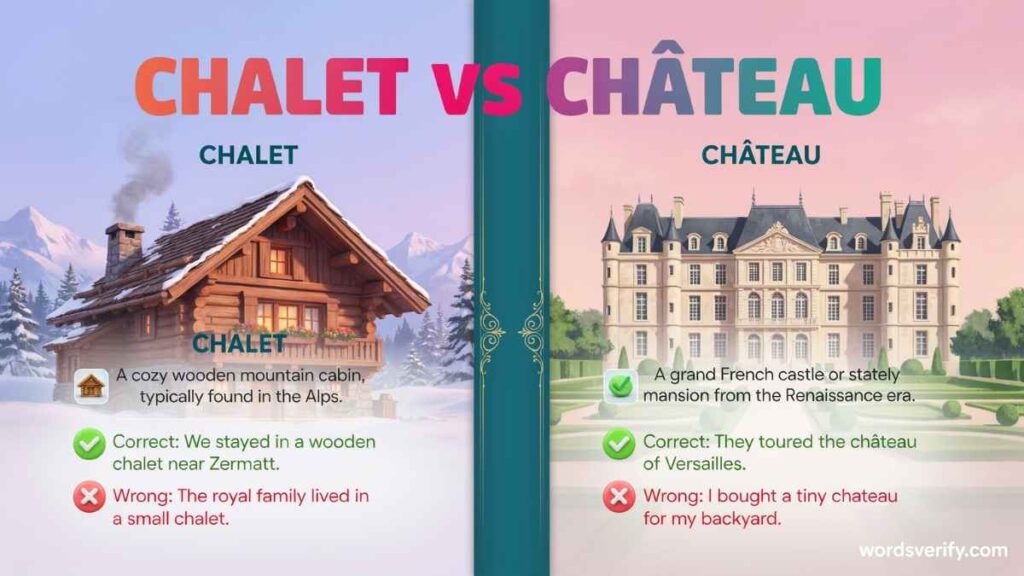
A charming wooden retreat in the snowy Alps and a grand French estate surrounded by elegant gardens may both spell luxury, but they’re far from identical! That’s where the confusion between chalet vs château begins. These two words may sound equally sophisticated, yet they describe very different buildings with distinct histories, designs, and purposes. The chalet vs château difference is easier to understand than you might think. You don’t need to be an architecture expert or speak fluent French to get it right. Let’s explore their meanings, origins, and features so you can tell these two elegant properties apart with confidence.
Chalet vs Château The Basic Difference
The main difference between a chalet and a château lies in their traditional setting, architectural style, and historical purpose.
A chalet is a mountain dwelling traditionally found in the Swiss Alps, French Alps, and other Alpine regions. Early chalets supported farming communities, particularly families involved in livestock raising and dairy production. Their timber construction, stone foundations, and sloping roofs helped them cope with demanding mountain conditions.
A château is a French country residence, estate, or castle-like building. Historically, many belonged to nobles and wealthy landowners. Some served defensive purposes, while others functioned mainly as comfortable family homes and centers of agricultural estates.
Here’s how the two compare:
| Feature | Chalet | Château |
|---|---|---|
| Traditional origin | Alpine regions | France |
| Basic meaning | Mountain dwelling | Country residence, estate, or castle-like building |
| Common setting | Mountainous areas | French countryside and historic estates |
| Main materials | Timber and stone | Stone, brick, and masonry |
| Roof design | Often steep and sloping | Varies by period and architectural style |
| Appearance | Rustic and practical | Often grand and decorative |
| Historical connection | Mountain farming and pastoral life | French nobility and landownership |
| Traditional purpose | Shelter and mountain residence | Family residence and estate center |
| Modern uses | Vacation homes and ski accommodation | Hotels, private residences, museums, and event venues |
The distinction isn’t simply about size or luxury. A large mountain property can still be a chalet, while a historic French residence doesn’t need to be enormous to qualify as a château.
The easiest way to remember the difference is simple: a chalet belongs to the tradition of Alpine mountain living, while a château belongs to the history of French country estates and grand residences.
Fix common more word mistakes in English
Reins vs Reigns which one is correct?
What Is a Chalet?
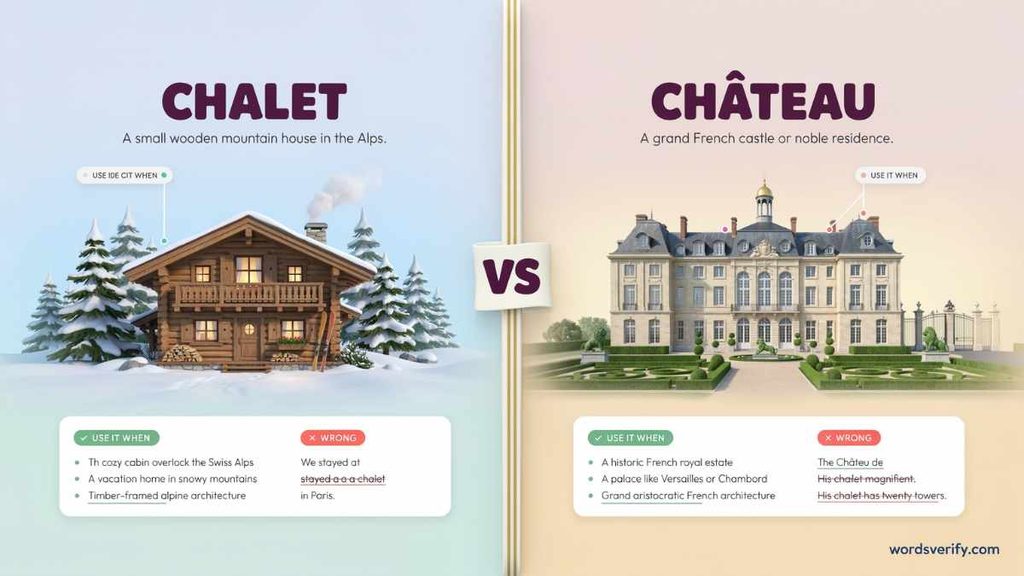
A chalet is a traditional mountain dwelling associated with the Alpine regions of Europe, particularly Switzerland, France, and Austria. Its familiar appearance includes timber walls, exposed wooden beams, balconies, and a sloping roof designed to handle snowfall.
The word originally described a type of mountain shelter or farm building. These structures supported rural communities that raised livestock and produced dairy products in high-altitude pastures.
Over time, chalets developed from practical agricultural buildings into recognizable residential properties. Today, the term covers everything from modest wooden mountain cottages to expensive vacation homes near popular ski resorts.
Chalet Meaning and Definition
The word chalet refers to a mountain house traditionally associated with Alpine regions. Its design often includes wooden construction, stone foundations, and features suited to cold weather.
In everyday English, people commonly use chalet to describe a vacation home or lodge in a mountain destination.
For example:
- The family rented a chalet in the Swiss Alps for their winter vacation.
- Their mountain chalet featured exposed timber beams and a large stone fireplace.
- The ski resort offers comfortable chalets with beautiful views of the surrounding peaks.
The word also appears in travel brochures, accommodation listings, and descriptions of mountain architecture.
Traditional Features of a Chalet
Traditional Alpine architecture developed in response to practical needs. Builders had to consider heavy snowfall, freezing temperatures, steep terrain, and the availability of local materials.
Several features became closely associated with chalet design.
Wooden construction: Timber plays an important role in traditional chalet architecture. Builders used locally available wood for walls, structural frames, balconies, and roof components. Wood also provided useful insulation and helped create warm interiors.
Stone foundations: Many traditional chalets combine wooden upper sections with stone foundations or lower floors. Stone offered durability and helped protect buildings from ground moisture and changing weather conditions.
Sloping roofs: Steep roofs help manage snowfall by allowing snow to slide away instead of accumulating in excessive quantities. Roof designs vary across Alpine regions, depending on local weather and construction traditions.
Wide roof eaves: Broad overhangs protect exterior walls, balconies, and entrances from rain and snow. They also provide shelter during changing mountain weather.
Wooden balconies: Balconies provide outdoor space and allow residents to enjoy mountain views during warmer months. They also contribute to the familiar appearance of Alpine homes.
Exposed timber beams: Inside a chalet, visible wooden beams add character and contribute to its rustic atmosphere. Combined with wooden floors, natural finishes, and fireplaces, they create the warm appearance many people associate with mountain living.
Where Are Chalets Commonly Found?
Traditional chalets developed across the Alpine regions of Europe. Switzerland has a particularly strong association with this architectural style, but it isn’t the only country with a long chalet tradition.
Some important regions include:
- Switzerland: Traditional chalets are closely connected with Swiss Alpine villages and mountain farming communities.
- French Alps: Chalet-style buildings appear throughout mountain destinations such as Chamonix and Megève.
- Austria: Traditional Alpine houses often feature timber construction, balconies, and distinctive roof designs.
- Germany: Southern Bavaria has mountain houses influenced by Alpine architectural traditions.
- Italy: Northern regions, particularly South Tyrol, feature buildings that share several characteristics with traditional chalets.
Modern chalet-style properties also appear in Canada, the United States, and other mountain destinations.
Are chalets only found in Switzerland? No. Switzerland is strongly associated with the style, but its architectural roots extend across a much wider Alpine region.
Why Were Chalets Built in the Mountains?
Traditional chalets developed because mountain communities needed buildings that could support everyday life in challenging environments.
Several practical factors influenced their construction:
- Snow protection: Sloping roofs helped manage heavy winter snowfall.
- Local materials: Timber and stone were readily available in many Alpine communities.
- Agricultural needs: Buildings supported livestock, dairy production, and seasonal mountain farming.
- Weather resistance: Construction methods adapted to cold temperatures, rain, and changing mountain conditions.
- Uneven terrain: Builders designed structures to suit steep landscapes and available building sites.
A chalet wasn’t originally designed just to look attractive in a vacation photograph. It served an important practical purpose long before mountain tourism turned it into a symbol of luxury.
How Are Chalets Used Today?
Modern chalets have moved well beyond their agricultural beginnings. Many now serve as private residences, holiday rentals, and luxury accommodations.
Common uses include:
- Mountain vacation homes: Families purchase chalets as seasonal retreats.
- Ski resort accommodation: Visitors rent chalets near ski slopes and winter sports facilities.
- Luxury properties: High-end chalets may feature swimming pools, saunas, private cinemas, and spacious living areas.
- Permanent residences: Some people live in chalet-style houses throughout the year.
- Tourist lodges: Businesses use chalet-style buildings to accommodate visitors in mountain destinations.
A modern mountain chalet may have large glass windows, advanced heating systems, and contemporary interiors. Even so, its design often retains recognizable Alpine influences.
Fix common more word mistakes in English
Stellar vs Steller which one is correct?
What Is a Château?
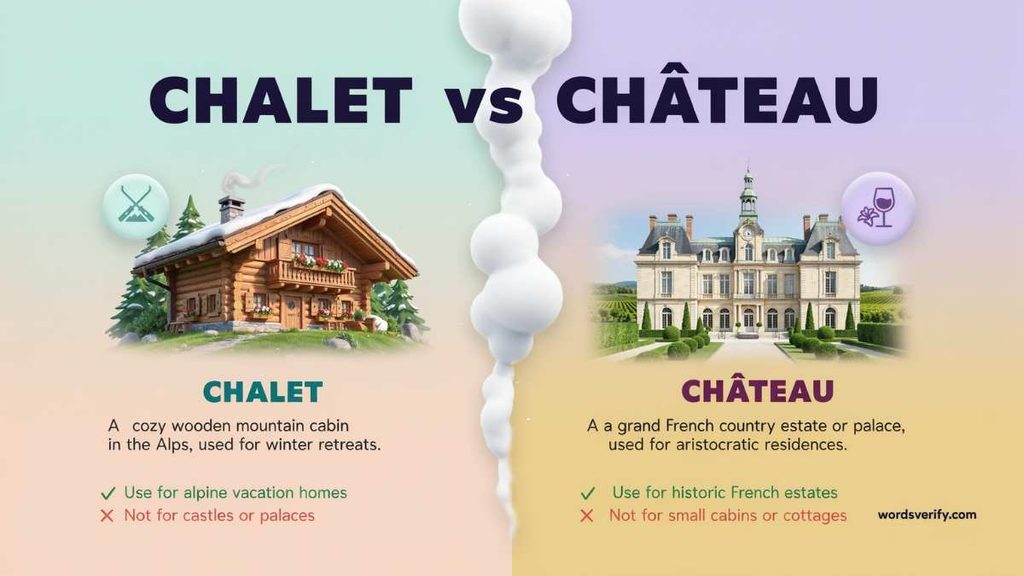
A château is a large French residence, country house, or castle-like building traditionally associated with wealthy landowners, aristocratic families, and historic estates.
The word has a broader meaning than the English word castle. Some châteaux have fortified walls and defensive towers, while others are elegant country homes designed for comfortable living and entertaining.
Many famous examples stand in the French countryside, particularly in regions such as the Loire Valley and Bordeaux. Their architecture reflects different periods of French history, from medieval fortifications to Renaissance residences and later classical country houses.
Today, the word appears in descriptions of historic properties, luxury hotels, vineyards, and French country estates.
Château Meaning and Definition
The word château describes a large French country house, manor, or castle-like residence, often connected with a historic estate.
In French, it can refer to a castle or a grand country residence. Its precise meaning depends on the building and its historical context.
The word also appears in the names of French wine estates. In Bordeaux, for example, many wineries use Château as part of their official property or estate names.
Consider these examples:
- The family restored an old château in the French countryside.
- Visitors explored the château’s gardens and historic rooms.
- The wine came from a château surrounded by Bordeaux vineyards.
- A historic château now operates as a luxury hotel.
The word therefore describes more than a defensive building. It can refer to an aristocratic residence, an estate center, or a historic country property.
Traditional Features of a Château
Château architecture varies considerably because French estates developed over several centuries. A medieval fortified building looks quite different from an elegant Renaissance residence or an eighteenth-century country mansion.
Nevertheless, many traditional examples share recognizable features.
Stone masonry: Stone and masonry construction are common in historic French châteaux. These materials provided durability and allowed builders to create substantial walls, decorative façades, and elaborate architectural details.
Large interiors: Many châteaux contain extensive interior spaces, including reception rooms, formal dining rooms, private apartments, and grand halls. Their layouts often reflected the lifestyle and social position of their owners.
Towers and turrets: Some medieval châteaux feature defensive towers, thick walls, battlements, and fortified entrances. However, these features aren’t essential to every château. Later residential buildings often used towers and decorative elements for appearance rather than defense.
Symmetrical architecture: Many Renaissance and classical châteaux emphasize balance and symmetry. Their façades may feature evenly arranged windows, formal entrances, and carefully planned proportions.
Grand gardens: Formal gardens are another recognizable feature of many French estates. Depending on the period, they may include geometric flower beds, fountains, tree-lined paths, terraces, and ornamental ponds.
Extensive grounds: A historic château may stand within a large estate containing farmland, forests, vineyards, gardens, or smaller residential buildings. The surrounding land often played an important role in the property’s original purpose and economic value.
Where Are Châteaux Commonly Found?
France has thousands of historic châteaux, ranging from medieval fortifications to elaborate country residences.
Some regions are particularly well known for their architectural heritage.
- Loire Valley: Famous for Renaissance châteaux, including Château de Chambord and Château de Chenonceau.
- Bordeaux: Known for wine estates that use château in their property and winery names.
- Burgundy: Contains historic estates, country residences, and wine-producing properties.
- Normandy: Features medieval castles, historic country houses, and traditional rural estates.
- Dordogne: Known for historic fortified châteaux and countryside architecture.
- Provence: Contains country estates and historic residences influenced by Mediterranean architectural traditions.
The Loire Valley offers particularly clear examples of how château architecture evolved. Its historic buildings include grand Renaissance residences that combine comfortable living spaces with impressive architectural design.
How Are Châteaux Used Today?
A château no longer needs to function as the private residence of an aristocratic family.
Many historic properties have adapted to modern life. Their owners, preservation organizations, and hospitality businesses have found ways to maintain these buildings while giving them new purposes.
Common modern uses include:
- Private residences: Some families continue to live in historic châteaux.
- Luxury hotels: Restored estates provide accommodation for visitors who enjoy historic surroundings.
- Museums: Certain properties preserve important collections and architectural heritage.
- Wedding venues: Large interiors and landscaped gardens make châteaux popular locations for special events.
- Wine estates: In regions such as Bordeaux, château properties may include vineyards, cellars, and wine production facilities.
- Tourist attractions: Historic buildings welcome visitors interested in French history and architecture.
A château can therefore be a family home, museum, hotel, or working wine estate. Its historical identity doesn’t depend on one particular modern use.
Fix common more word mistakes in English
Cheer vs Chear Which one Is Correct?
Chalet vs Château Architectural Differences
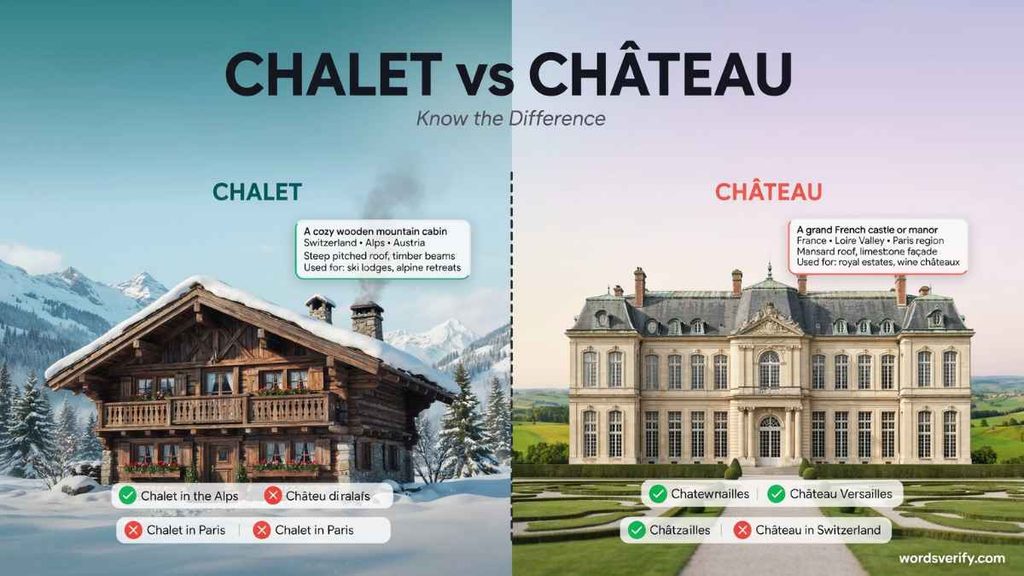
At first glance, the distinction seems straightforward. One usually looks like a wooden mountain house, while the other resembles a grand French estate.
However, their architectural differences go deeper than appearance. Climate, construction materials, historical purpose, and local building traditions shaped both styles.
| Architectural feature | Chalet | Château |
|---|---|---|
| Main materials | Timber and stone | Stone, brick, and masonry |
| Roof | Often steep and sloping | Depends on architectural period |
| Exterior | Rustic and natural | Formal and often decorative |
| Structural design | Practical mountain construction | Residential, estate, or defensive design |
| Windows | Often arranged to provide natural light and mountain views | May feature formal, symmetrical arrangements |
| Outdoor features | Balconies and covered entrances | Courtyards, terraces, and formal gardens |
| Interior style | Natural wood and comfortable spaces | Formal rooms and elaborate decoration |
| Surroundings | Mountain slopes and forests | Gardens, farmland, vineyards, and estate grounds |
Chalet Architecture Practical Alpine Design
Traditional chalet architecture developed around the demands of mountain living.
Builders needed structures that could handle cold winters, snowfall, and changing weather. They also relied on materials available in their local communities.
This explains why timber and stone became such important parts of Alpine construction.
A traditional chalet may include:
- A timber-framed structure.
- A stone lower level or foundation.
- A steep gabled roof.
- Wide roof eaves.
- Wooden balconies.
- Exposed interior beams.
- A central fireplace or another heating feature.
The overall design often feels informal and connected to the surrounding landscape.
Modern Alpine houses may use large windows, contemporary insulation, and open-plan interiors. Yet designers often retain traditional rooflines, timber finishes, and natural materials to preserve the familiar chalet appearance.
Château Architecture Formal French Design
Château architecture developed through several important periods of French architectural history.
Medieval examples often emphasized defense. Later residences increasingly focused on comfort, symmetry, decoration, and displays of wealth.
A château may include:
- Large stone façades.
- Formal entranceways.
- Multiple floors.
- Decorative towers or turrets.
- Grand staircases.
- High ceilings.
- Reception halls.
- Symmetrical windows and architectural details.
- Extensive gardens and courtyards.
The design depends heavily on the building’s age and regional traditions.
For example, Château de Chambord in the Loire Valley is famous for its elaborate Renaissance architecture, distinctive roofline, and monumental scale. By contrast, a medieval château in southwestern France may retain a much more defensive appearance.
The important distinction is that chalet architecture grew from practical mountain housing, while château architecture reflects a broader history of French residences, estates, and fortifications.
Fix common more word mistakes in English
Suit vs Suite which one is correct?
History and Origins of Chalets vs Châteaux
Although both buildings belong to European architectural history, they developed under different social and environmental conditions.
The chalet emerged from Alpine rural life. The château developed through French traditions of landownership, defense, and aristocratic residence.
The History of the Chalet
Traditional chalets have strong roots in Alpine farming communities.
For centuries, families in mountain regions depended on livestock, dairy production, and seasonal movement between lower valleys and higher pastures.
These activities required practical buildings that could provide shelter, store agricultural supplies, and support daily work.
In some Alpine areas, farmers used seasonal mountain dwellings during warmer months when livestock grazed at higher elevations.
Traditional buildings often had separate areas for living, storing hay, keeping equipment, and processing milk. Their exact layouts differed according to local farming practices.
Over time, these agricultural buildings became permanent homes and developed into a recognizable architectural style.
Mountain tourism later transformed the chalet’s public image. As Alpine destinations attracted visitors for hiking, skiing, and winter holidays, chalet-style buildings became popular forms of accommodation.
Today, a chalet can be a working residence, a holiday rental, or a luxury mountain retreat.
The History of the Château
The history of the château connects closely with medieval France, feudal landholding, and the development of aristocratic residences.
During the Middle Ages, powerful landowners and nobles constructed fortified residences to protect their territories and control important areas.
These buildings sometimes included:
- Defensive walls.
- Towers.
- Moats.
- Fortified gates.
- Guard rooms.
- Storage facilities.
However, the château gradually became more than a military structure.
During the Renaissance, French architecture experienced significant changes. Wealthy families commissioned grand residences influenced by classical design, Italian Renaissance ideas, and French decorative traditions.
Many buildings became symbols of status and refined living rather than centers of military defense.
Later periods introduced additional architectural styles, including more formal classical designs. These residences often featured symmetrical façades, spacious interiors, landscaped gardens, and elaborate decorative details.
The French Revolution and subsequent political changes also transformed château ownership. Some estates changed hands, while others became museums, public attractions, or privately owned historic properties.
Today, châteaux remain an important part of French architectural heritage.
Fix common more word mistakes in English
Busing vs Bussing Which one Is Correct?
Chalet vs Château Differences in Location and Setting
Location is one of the easiest ways to understand the difference between a chalet and a château.
Traditional chalets belong to mountain environments. Châteaux are more closely associated with French countryside estates and historic settlements.
Where You Find a Chalet
Traditional chalets appear in the Alpine regions of Switzerland, France, Austria, and neighboring areas.
Their surroundings often include:
- Snow-covered mountains.
- Pine and fir forests.
- Alpine meadows.
- Mountain villages.
- Ski slopes.
- Hiking trails.
- Lakes and valleys.
These locations influenced both the construction and original purpose of chalet buildings.
A chalet in the French Alps might overlook a ski resort, while a traditional Swiss example may sit near a mountain pasture or village.
Where You Find a Château
Châteaux often stand in rural French settings, although historic examples also appear within towns and cities.
Their surroundings may include:
- Vineyards.
- Agricultural land.
- Formal gardens.
- Forests.
- Courtyards.
- Historic villages.
- Large landscaped estates.
The Bordeaux region provides a useful example. Many wine estates use the château designation as part of their names and identities.
Meanwhile, the Loire Valley is known for its historic country residences and elaborate gardens.
A château doesn’t need to stand in a remote countryside location. Some historic properties developed near towns, rivers, and important trade routes.
Fix common more word mistakes in English
Sentence vs Sentance which one is correct?
Size, Layout and Interior Design Are Châteaux Bigger Than Chalets?
Châteaux are often larger than traditional chalets, but size isn’t a reliable rule for identifying either building.
A chalet can be an enormous luxury property with several bedrooms, extensive living areas, and multiple floors. Similarly, a château may be relatively modest compared with the grandest French estates.
The difference becomes clearer when you examine how people traditionally used their interiors.
Inside a Traditional Chalet
A traditional chalet interior emphasizes warmth, practicality, and natural materials.
Common features include:
- Exposed timber beams.
- Wooden ceilings and floors.
- Stone fireplaces.
- Comfortable seating areas.
- Functional kitchens.
- Natural fabrics and rustic furniture.
- Windows that frame mountain views.
The design creates a relaxed atmosphere suited to mountain living.
Modern chalets may add open-plan kitchens, large glass doors, underfloor heating, and contemporary furniture. However, natural wood and stone often remain important design elements.
Inside a Traditional Château
A traditional château often has a more formal interior layout.
Depending on its history and size, it may contain:
- Grand entrance halls.
- Large reception rooms.
- Formal dining rooms.
- High ceilings.
- Elaborate staircases.
- Decorative fireplaces.
- Historic furniture.
- Private family apartments.
- Guest rooms and service areas.
In larger estates, the interior arrangement reflected the household’s social structure. Family members, guests, servants, and estate workers often occupied different parts of the property.
Many restored châteaux now combine historic features with modern kitchens, bathrooms, heating systems, and hospitality facilities.
Fix common more word mistakes in English
Training vs Trainning which one is correct?
Modern Chalets vs Châteaux How Their Uses Have Changed
Both building types have evolved beyond their original purposes.
Tourism, changing lifestyles, restoration projects, and luxury real estate have expanded the ways people use them.
Modern Chalet Living
Today’s chalet market includes traditional mountain homes, modern vacation properties, and high-end ski accommodations.
A luxury mountain chalet may include:
- Heated swimming pools.
- Private saunas.
- Home theaters.
- Large terraces.
- Designer kitchens.
- Floor-to-ceiling windows.
- Underground parking.
- Direct access to ski areas.
Some modern properties maintain traditional Alpine architecture, while others combine timber and stone with contemporary glass and steel.
People searching for a chalet may be interested in a permanent mountain residence, a second home, or a recreational property that generates rental income.
A mountain chalet rental can also offer more privacy and space than a standard hotel room, particularly for families and groups.
Modern Château Living
Modern château properties serve several different purposes.
Some remain private homes, while others operate as hotels, event venues, museums, or wine estates.
The French luxury property market includes restored historic residences as well as estates that require substantial renovation.
Anyone considering an older property should look beyond its purchase price. Historic buildings can require significant investment in roofs, masonry, heating, electrical systems, plumbing, and restoration work.
Important considerations include:
- Building condition: Historic stonework, roofs, and foundations may need specialist repairs.
- Maintenance: Large properties require regular upkeep.
- Heating and energy: Older buildings can be expensive to heat.
- Legal protection: Historic status may restrict certain renovations.
- Land management: Vineyards, gardens, forests, and farmland can add management responsibilities.
- Commercial potential: Hotels, event venues, and wine estates may require additional permits and business planning.
A historic château may offer impressive architecture and remarkable character, but ownership often involves more responsibility than purchasing an ordinary house.
Fix common more word mistakes in English
Phenix vs Phoenix Which one Is Correct?
Chalet vs Château vs Other French Property Types
French property terminology includes several words that describe different kinds of houses, estates, and rural buildings.
Understanding these terms helps explain why a château isn’t simply another name for a mansion and why a chalet doesn’t describe every wooden mountain house.
France has a diverse range of residential architecture. Regional building materials, local climate, historical ownership, and traditional lifestyles all influenced the country’s property styles.
| French property term | Meaning and typical characteristics |
|---|---|
| Maison de maître | A substantial traditional residence historically associated with a wealthy family or property owner |
| Maison de campagne | A country house or rural home |
| Maison de village | A house located within a village |
| Maison bourgeoise | A substantial residence traditionally associated with the French bourgeoisie |
| Longère | A long, narrow traditional rural house, particularly associated with western France |
| Bastide | A term for certain historic planned towns and, in southern France, particular country residences |
| Mas provençal | A traditional farmhouse associated with Provence |
| Château | A French country residence, estate, or castle-like building |
| Chalet | A mountain dwelling associated with Alpine architecture |
Maison de Maître
A maison de maître is traditionally a substantial house associated with a wealthy landowner, merchant, or prominent local family.
These properties often appear in French towns and countryside settings. Some feature symmetrical façades, tall windows, formal entrances, and spacious interiors.
Unlike a château, the term doesn’t necessarily imply an aristocratic estate or fortified history.
Maison de Campagne
A maison de campagne simply means a country house.
It may be a modest rural residence or a substantial holiday property. The term describes its country setting rather than one fixed architectural style.
Maison de Village
A maison de village is a village house, often located along a narrow street or within a traditional settlement.
These homes may have stone walls, shutters, compact layouts, and multiple floors. Their appearance varies considerably across France.
Longère
A longère is a traditional long, narrow rural house found particularly in parts of western France.
Many examples originally served agricultural households and included living spaces alongside areas used for storage or farming activities.
Bastide
The word bastide has more than one regional use in France.
Historically, it refers to certain planned medieval towns, especially in southwestern France. In Provence, the term can also describe a country residence or substantial rural house.
Mas Provençal
A mas provençal is a traditional farmhouse associated with Provence.
These buildings often use local stone, thick walls, shutters, and simple forms adapted to the Mediterranean climate.
Unlike an Alpine chalet, a mas reflects southern French rural architecture.
Understanding these terms makes it easier to explore traditional French properties without treating every historic house as a château.
Fix common more word mistakes in English
Chef vs Cheff which one is correct?
Chalet vs Château in Everyday English
English speakers use both chalet vs château as borrowed French words. However, they usually appear in different situations.
Chalet commonly appears in:
- Travel and tourism descriptions.
- Ski resort accommodation listings.
- Mountain vacation rental advertisements.
- Architecture and interior design.
- Real estate descriptions.
- Discussions of Alpine homes.
For example:
The resort offers a luxury chalet with direct access to the ski slopes.
Château commonly appears in:
- French history.
- Architecture.
- Luxury property descriptions.
- Wine production.
- Historic estate listings.
- Tourism and hospitality.
For example:
The historic château welcomes visitors to its gardens and wine cellar.
The distinction remains clear even when English speakers use these words in broader commercial contexts.
A modern building doesn’t have to follow every traditional design feature to be marketed as a chalet or château. However, the words still carry different cultural associations.
Shakey vs Shaky which one is correct?
Pronunciation and Spelling of Chalet vs Château
Both words entered English from French, so their spellings don’t always tell English speakers exactly how to pronounce them.
Learning their standard pronunciations makes the difference easier to remember.
How to Pronounce Chalet
The word chalet is commonly pronounced:
- American English: shuh-LAY
- IPA: /ʃæˈleɪ/
It has two syllables, with the stress on the second syllable.
The first sound resembles the beginning of the English word shut. The second syllable rhymes with day.
Example:
We booked a chalet near the ski resort.
A common mistake is pronouncing the opening letters like the English word chair. The standard pronunciation begins with the familiar sh sound.
How to Pronounce Château
The word château is commonly pronounced:
- American English: sha-TOH
- IPA: /ʃæˈtoʊ/
It also has two syllables, with the stress on the second syllable.
The final sound resembles the ending of go.
Example:
The château overlooks a beautiful vineyard.
Is It Chateau vs Château?
Both spellings appear in English, but château preserves the standard French accent mark.
The circumflex (^) appears over the letter a. In French, this mark has historical and linguistic significance and forms part of the traditional spelling.
English writers commonly use both forms:
- Château: The standard French spelling.
- Chateau: A widely accepted English spelling without the accent.
For formal writing, particularly when discussing French architecture or historic properties, retaining the accent is a good choice.
However, the unaccented spelling is also common in English-language publications, property listings, and business names.
The important point is consistency. Choose the form that suits your publication and use it throughout your writing.
What Is the Plural of Château?
English recognizes two plural forms:
- Châteaux.
- Châteaus.
Châteaux retains the French plural spelling and is especially common in formal writing.
Châteaus follows the English pattern of adding an s.
For example:
- The Loire Valley contains many historic châteaux.
- Several châteaus in the region now operate as hotels.
The singular remains château or chateau.
Fix common more word mistakes in English
Natzi vs Nazi which one is correct?
Word Origins and Etymology Where Do Chalet vs Château Come From?
Although chalet vs château both have French connections, their histories reveal different meanings and cultural backgrounds.
Origin of the Word Chalet
The word chalet comes from French and is associated with the traditional mountain dwellings of Alpine regions.
Its earlier regional history connects with pastoral buildings used by mountain farming communities. These structures provided shelter and supported seasonal agricultural activities.
As Alpine tourism expanded, the word became increasingly associated with mountain vacation homes and recreational properties.
Today, English speakers use chalet for both traditional Alpine houses and modern buildings inspired by their architectural style.
Origin of the Word Château
The word château comes from French and traces back to the Latin word castellum, meaning a small castle or fort.
The Latin term developed into the Old French word castel and eventually the modern French château.
This history explains the connection between château and castle. However, the modern French word developed a broader meaning that includes large country residences and estates.
Its historical development also explains why château appears in the names of French aristocratic residences and wine estates.
American and British English Usage Chalet vs Château
American and British English generally use chalet vs château with the same basic meanings.
Neither word has a major difference in meaning between the two varieties of English. However, pronunciation, spelling preferences, and everyday contexts can vary.
| Word | American English | British English |
|---|---|---|
| Chalet | Mountain house or vacation accommodation | Mountain house or holiday accommodation |
| Château | French country residence or estate | French country residence or estate |
| Chateau | Accepted unaccented spelling | Accepted unaccented spelling |
There are a few practical differences worth remembering.
Vacation terminology: American English commonly uses vacation, while British English generally uses holiday.
For example:
- American: We rented a chalet for our winter vacation.
- British: We rented a chalet for our winter holiday.
Property descriptions: Both varieties use château when discussing historic French residences, luxury properties, and wine estates.
Pronunciation: The standard pronunciations are broadly similar, although individual speakers may show differences in vowel sounds and accents.
Spelling: Both American and British publications use château and chateau. The French spelling with the circumflex is widely recognized.
Neither word has a separate American or British meaning that changes the basic distinction.
Common Mistakes When Using Chalet vs Château
The words may sound elegant, but confusing them can create an inaccurate description of a building.
Here are some mistakes worth avoiding.
Treating Chalet vs Château as Synonyms
A chalet and a château describe different traditional building types.
A mountain vacation house isn’t automatically a château, and a French country estate isn’t a chalet simply because it has a cozy interior.
Use chalet for an Alpine-style mountain dwelling and château for a French country residence or castle-like estate.
Assuming Every Chalet Must Be in Switzerland
Switzerland has a strong association with chalet architecture, but the tradition extends across several Alpine regions.
Traditional chalets also appear in France, Austria, and other parts of the European Alps.
Modern chalet-style houses can be found much farther away.
Assuming Every Château Is a Castle
Not every château has defensive walls, battlements, or military towers.
Some were built primarily as elegant residences for wealthy families and landowners.
A château can be a grand country house without ever having served as a fortress.
Thinking Every Chalet Must Be Made Entirely of Wood
Traditional chalets often combine timber and stone.
Stone foundations and lower levels are common in many examples. Modern chalet-style properties may also use concrete, steel, glass, and other building materials.
Confusing Luxury With Historical Identity
A property doesn’t become a château simply because it has expensive furniture, a swimming pool, and a large garden.
Likewise, a luxurious mountain property may qualify as a chalet even if it has modern architecture.
Historical and architectural context matters more than price, size, or luxury features.
Using Château for Every French Country House
France has many different residential property types.
A maison de campagne, maison de maître, maison bourgeoise, and mas provençal all describe different kinds of homes.
Calling every traditional French house a château overlooks these important distinctions.
Memory Tricks to Remember Chalet vs Château
If you regularly confuse these words, a simple association can make them easier to remember.
Chalet = Mountains
Think of snowy Alpine peaks, wooden balconies, timber beams, and a cozy fireplace.
Château = French Estate
Think of stone buildings, historic gardens, grand rooms, vineyards, and French country residences.
Try these two example sentences:
- We rented a chalet in the Swiss Alps for a week of skiing.
- The French château stood among vineyards and carefully maintained gardens.
The images are different, so the words become easier to distinguish.
Chalet vs Château Examples in Real Sentences
Examples help show how each word works in everyday English. They also demonstrate why replacing one word with the other can change the meaning of a sentence.
Chalet Examples
- The family purchased a traditional chalet overlooking the French Alps.
- Our chalet had a large wooden balcony and a stone fireplace.
- The ski resort offers several luxury chalets for winter visitors.
- They renovated an old mountain chalet into a comfortable year-round home.
- The chalet’s steep roof helped protect the building from heavy snowfall.
- We spent our winter vacation in a cozy wooden chalet near the mountains.
- The architect combined traditional Alpine design with modern glass windows.
- Their chalet rental included a private sauna and beautiful mountain views.
Château Examples
- The historic château stands in the French countryside.
- The family restored an eighteenth-century château and opened it to visitors.
- The château’s gardens attract tourists throughout the summer.
- A historic château in Bordeaux now operates as a wine estate.
- The wedding took place in a beautiful French château.
- The property includes a large stone residence and several acres of vineyards.
- The museum preserves the château’s original furniture and decorative artwork.
- The historic estate features grand halls and impressive architectural details.
Using Chalet and Château in the Same Sentence
You can use both words in one sentence when comparing different properties.
For example:
- Unlike a traditional Alpine chalet, a French château often features formal gardens and extensive stone architecture.
- The travelers stayed in a mountain chalet before visiting a historic château in the Loire Valley.
- A luxury chalet offers a mountain retreat, while a château provides a glimpse into France’s historic country estates.
These examples show the difference without making the explanation complicated.
Which Word Should You Use Chalet vs Château?
Choosing between chalet and château becomes easy when you consider the building’s traditional identity and setting.
Use chalet when discussing:
- A traditional Alpine mountain dwelling.
- A wooden mountain cottage.
- A mountain vacation home.
- Ski resort accommodation.
- A modern property inspired by Alpine architecture.
- A mountain retreat with traditional chalet features.
Use château when discussing:
- A historic French country residence.
- A large French estate.
- An aristocratic residence.
- A castle-like French building.
- A historic property surrounded by gardens or vineyards.
- A French wine estate that uses château in its established name.
Here’s a simple guide:
| If you’re describing… | Use |
|---|---|
| A wooden mountain home in Switzerland | Chalet |
| A ski vacation rental in the French Alps | Chalet |
| A traditional Alpine farmhouse | Chalet, if it follows the chalet tradition |
| A historic French country estate | Château |
| A medieval French fortified residence | Château or castle, depending on context |
| A French vineyard estate | Château, where that is its established name |
| A modern luxury house in the mountains | Chalet, if designed in the chalet tradition |
| A grand historic residence in the Loire Valley | Château |
For travelers, writers, and property buyers, this distinction is especially useful.
Someone searching for a chalet is likely interested in mountain properties or Alpine-style homes. Someone looking for a French château is more likely interested in a historic country residence, estate, or luxury rural property.
The two searches point toward very different kinds of real estate.
Key Differences Between Chalet vs Château
The comparison becomes much clearer when you look beyond their modern luxury associations.
A chalet developed from practical mountain housing in the Alpine regions. Its traditional design reflects local materials, cold weather, farming, and mountain living.
A château developed through French traditions of landownership, defense, and aristocratic residence. Its architecture ranges from medieval fortified buildings to elaborate Renaissance and classical country houses.
Here are the most important points to remember:
- Meaning: A chalet is traditionally an Alpine mountain dwelling, while a château is a French country residence, estate, or castle-like building.
- Architecture: Chalets commonly feature timber, stone, balconies, and sloping roofs. Châteaux often feature masonry, formal façades, grand interiors, and landscaped grounds.
- History: Chalets developed around mountain farming and pastoral life. Châteaux have stronger connections with French nobility, landownership, and historic estates.
- Location: Traditional chalets belong to Alpine regions, while châteaux are strongly associated with the French countryside.
- Modern use: Chalets commonly serve as mountain homes and vacation rentals. Châteaux may operate as private residences, hotels, museums, event venues, or wine estates.
- Spelling: Château is the traditional French spelling, while chateau is also accepted in English.
Neither word is simply a more luxurious version of the other. They describe different architectural traditions with their own histories and purposes.
Practice Session Chalet vs Château
Test your understanding of chalet vs château with these fill-in-the-blank sentences. Choose the correct word or term based on its meaning, architecture, history, and usage.
Fill in the Blanks
1. A traditional __________ is a mountain dwelling commonly associated with the Swiss Alps.
2. A French country residence or historic estate is often called a __________.
3. Traditional Alpine chalets commonly feature wooden walls, exposed beams, and __________ roofs.
4. Many historic French châteaux were built using stone and other durable __________ materials.
5. The word __________ is associated with mountain living and Alpine architecture.
6. The Loire Valley is famous for its beautiful historic __________.
7. A __________ may include wooden balconies and a cozy fireplace overlooking snowy mountains.
8. A grand French estate surrounded by formal gardens and vineyards may be called a __________.
9. Traditional chalets developed to support mountain farming and __________ life.
10. The French word __________ can describe both a castle and a grand country residence.
11. A traditional farmhouse in Provence is often called a __________.
12. The word chalet has strong historical connections with the __________ regions of Europe.
13. Many Bordeaux wine estates include the word __________ in their names.
14. A small, simple wooden dwelling in a forest is generally called a __________.
15. The standard French spelling of château includes a circumflex over the letter __________.
16. The plural form of château commonly used in formal writing is __________.
17. A __________ is traditionally associated with a wealthy landowner or prominent family in France.
18. Traditional chalet construction often combines timber with __________ foundations.
19. Unlike a chalet, a château may feature formal gardens, grand halls, and extensive __________.
20. A French holiday home is commonly called a maison de __________.
Answers
- Chalet
- Château
- Sloping
- Masonry
- Chalet
- Châteaux
- Chalet
- Château
- Rural
- Château
- Mas provençal
- Alpine
- Château
- Cabin
- A
- Châteaux
- Maison de maître
- Stone
- Grounds
- Vacances
Here’s a trusted source for clear word meanings:
FAQs
What Makes a House a Chalet?
A house is generally considered a chalet when it follows the traditional Alpine mountain-house style. Common features include timber construction, stone foundations, sloping roofs, wooden balconies, and exposed beams. Modern chalets may incorporate glass, steel, and contemporary interiors while retaining their traditional mountain-inspired character.
What Is a Swiss Chalet House?
A Swiss chalet is a traditional mountain dwelling associated with Switzerland and Alpine architecture. It typically features wooden walls, a sloping roof, wide eaves, and decorative balconies. Originally built to support mountain farming and rural life, Swiss chalets now serve as permanent homes, vacation properties, and tourist accommodations.
What Are French Mansions Called?
French grand residences have several names depending on their size, history, and architectural style. A château usually refers to a grand country residence, estate, or castle-like building. A maison de maître describes a substantial traditional home historically associated with a wealthy family or prominent landowner.
What Is a French Farmhouse Called?
A traditional farmhouse in Provence is often called a mas provençal. In other regions, rural houses may be known as longères, particularly in western France. Each term reflects a different regional building tradition, so the name depends on the property’s location and architectural features.
What Is Another Name for a Chalet?
A chalet may also be described as an Alpine house, mountain lodge, or mountain cottage. However, these terms aren’t exact substitutes. A chalet has a distinct connection to Alpine architecture, while a lodge or cottage can follow many different regional styles.
What Makes a Bungalow a Chalet?
A bungalow doesn’t automatically become a chalet because it has wooden walls or a sloping roof. A bungalow describes a house’s layout, usually with most living spaces on one floor. A chalet describes an architectural tradition associated with Alpine mountain homes. A property can combine elements of both styles, but the terms aren’t interchangeable.
What Is a Fancy Name for a Castle?
Château, palace, fortress, citadel, and manor house are some elegant alternatives, but each has a different meaning. Château is commonly associated with French country residences and historic estates, while a fortress or citadel emphasizes defense. A palace generally suggests a grand royal or official residence.
Why Are Some Châteaux in France So Cheap?
Some French châteaux have surprisingly low asking prices because they need extensive repairs and restoration. Work on roofs, stone walls, plumbing, heating, and electrical systems can cost far more than the purchase price. Large grounds, historic preservation requirements, and ongoing maintenance can also make ownership expensive.
Why Are So Many Châteaux Abandoned in France?
Some historic châteaux have fallen into disrepair because their owners couldn’t afford the cost of maintaining them. Others lost their original purpose as aristocratic residences or agricultural estates. Expensive restoration work, inheritance complications, and restrictions on protected buildings can make these properties difficult to preserve.
Can an American Buy a Castle in France?
Yes. Americans can generally purchase property in France, including historic châteaux and castles. French citizenship isn’t required to own real estate. However, buyers should carefully consider renovation costs, property taxes, legal obligations, and restrictions that may apply to historically protected buildings.
What Do the French Call a Holiday Home?
The French commonly use maison de vacances to describe a holiday home. Another expression is résidence secondaire, meaning a second home. Both terms refer to properties used for vacations or occasional stays rather than as someone’s primary residence.
What Are Apartments in France Called?
The French word for an apartment is appartement. A small apartment with one main living space is often called a studio. A furnished rental may be described as an appartement meublé, while immeuble refers to an apartment building.
What Is the Difference Between a Cottage and a Bungalow?
A cottage is generally a small, cozy house associated with rural or village settings. A bungalow usually describes a house with most of its living space on one floor, although some designs include a partial upper level. Cottage refers more to a home’s character and traditional style, while bungalow mainly describes its layout.
What Is the Difference Between a Chalet and a Cabin?
A chalet is traditionally associated with Alpine architecture and mountain living. A cabin is a broader term for a small, simple dwelling, often made from wood and located in a forest or rural area. Both can have rustic interiors, but a chalet has a more specific regional architectural background.
What Is the Difference Between a Château and a Manor House?
A château is a French country residence, estate, or castle-like building. A manor house traditionally served as the principal home of a landowning family associated with a manor, particularly in Britain. Both can be grand historic residences, but their architectural traditions and cultural backgrounds differ.
What Are the Main Features of a Traditional French Château?
Traditional French châteaux vary by region and historical period. However, many feature stone or masonry construction, spacious reception rooms, decorative façades, formal entrances, and landscaped grounds. Medieval examples may include defensive towers, while Renaissance and later residences often emphasize symmetry and elaborate architectural details.
Is Every Château in France a Historic Castle?
No. Many French châteaux were designed as comfortable country residences rather than defensive fortifications. The word can describe both castles and grand country houses. A building’s architecture, age, and historical purpose help determine which description fits best.
Are Chalets Only Used as Vacation Homes?
No. Although chalets are popular in ski resorts and mountain destinations, many serve as permanent residences. Traditional Alpine chalets originally supported everyday rural life, and modern examples can function as full-time family homes, holiday properties, or luxury rentals.
What Is the Difference Between a Chalet and a Cottage?
A chalet is traditionally an Alpine mountain dwelling with features such as timber construction, wooden balconies, and a sloping roof. A cottage is a broader term for a small, usually cozy house. A chalet may resemble a cottage, but not every cottage follows Alpine architectural traditions.
What Is the Difference Between a Château and a Villa?
A château generally refers to a French country residence, estate, or castle-like property with historical associations. A villa is a substantial private house, often designed for comfortable living and sometimes associated with warm climates or leisure settings. Unlike a château, a villa doesn’t necessarily have a connection to aristocratic history or a large estate.
Conclusion
Chalet vs château may both sound luxurious, but confusing them is like mistaking a cozy mountain retreat for a grand French estate! A chalet is traditionally associated with the Alps, wooden beams, snowy peaks, and warm fireplaces. A château, by contrast, brings to mind historic French residences, elegant architecture, and sprawling gardens. The difference becomes easy to remember once you understand their origins and traditional uses: think mountains and timber for chalet, and French estates and historic grandeur for château. With this simple distinction, you’ll choose the right word with confidence and avoid an unnecessary spelling mix-up. After all, even fancy French words should know their place!

Lisa AJS is an experienced blogger and language enthusiast at Words Verify, dedicated to making grammar simple, practical, and enjoyable. She writes engaging content on commonly confused words, grammar mistakes, word meanings, and everyday language challenges.