
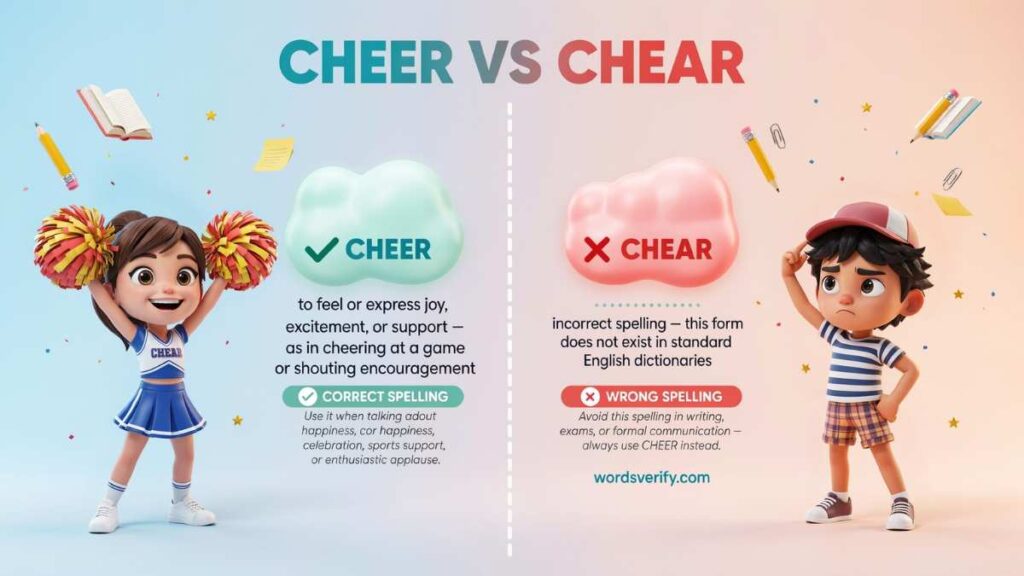
One small spelling mistake can take the cheer out of your writing! If you’re unsure whether to use cheer vs chear, you’re not alone. These spellings may look similar, but only one is correct in modern English. Cheer refers to happiness, encouragement, or a loud expression of support, while chear is an outdated historical spelling. So, how did this confusion begin, and why does one spelling still matter today? Let’s explore the meaning, history, pronunciation, and everyday use of cheer, along with clear examples to help you avoid this common mistake and write with confidence.
quick answer
The correct spelling is cheer. It contains the letters C-H-E-E-R, with two E’s in the middle. The spelling chear appeared in older English writing, but it isn’t an accepted alternative in modern standard English.
Use cheer in everyday conversations, school assignments, professional emails, articles, and other contemporary writing. You may still encounter chear in an old poem or historical document, but that doesn’t make it suitable for modern communication.
Consider these examples:
- Correct: The crowd began to cheer when the players entered the stadium.
- Incorrect: The crowd began to chear when the players entered the stadium.
- Correct: Her cheerful personality brought joy to everyone.
- Incorrect: Her chearful personality brought joy to everyone.
The same spelling applies to related words such as cheering, cheered, cheerful, and cheerfulness.
Here’s a quick comparison of cheer vs chear:
| Feature | Cheer | Chear |
|---|---|---|
| Modern spelling | Correct | Obsolete |
| Historical use | Yes | Yes |
| Modern dictionary usage | Standard | Historical or obsolete |
| Meaning | Happiness, encouragement, applause, or support | Historical form of cheer |
| Part of speech | Noun and verb | Historical noun and verb form |
| Modern writing | Recommended | Avoid |
| Example | The fans cheer for their team. | An old text may use chear. |
A simple way to remember the correct spelling is to connect cheer with cheerful. Both words contain two E’s.
Learn the difference between tricky more English words
Suit vs Suite which one is correct?
What Does Cheer Mean?
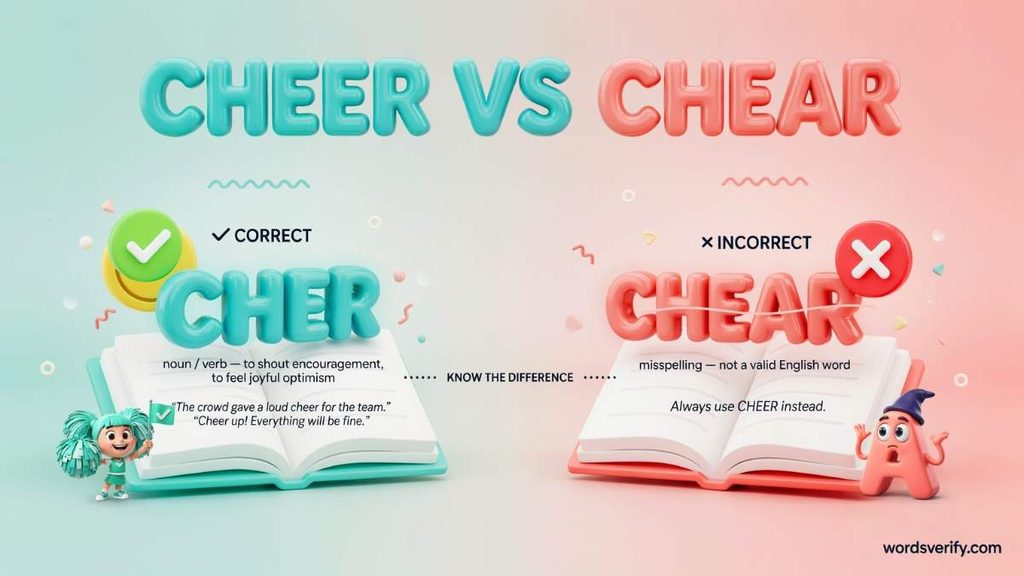
The word cheer describes happiness, encouragement, or an enthusiastic expression of support. Its exact meaning depends on the context.
As a noun, it can describe a happy mood, a positive atmosphere, or a shout of approval. As a verb, it means to encourage someone, applaud an achievement, or help another person feel better.
Here are its main meanings:
- Happiness: A feeling of joy, optimism, or pleasure.
- Encouragement: Words or actions that give someone confidence or support.
- Applause: A shout or expression of approval, often from a crowd.
- Enthusiasm: An energetic expression of excitement or interest.
- Comfort: Something that makes a difficult situation feel a little easier.
Imagine a student preparing for an important examination. A few encouraging words from a friend might bring some cheer during a stressful week. Similarly, when a sports team scores a winning goal, the crowd may erupt into cheers.
Although these situations are different, they share one idea: expressing or creating positive feelings.
Cheer as a Noun
As a noun, cheer refers to happiness, encouragement, or an expression of approval. It can describe an emotion, an atmosphere, or a sound made by people.
Cheer as happiness or a positive mood
In this sense, the word describes someone’s emotional state or a pleasant atmosphere.
Examples:
- The bright flowers added cheer to the otherwise quiet room.
- Her warm smile brought cheer to the entire family.
- Everyone enjoyed the holiday cheer during the celebration.
- A little sunshine brought some cheer to the gloomy afternoon.
The expression good cheer often describes a positive attitude, friendliness, or a happy mood. You’ll commonly see it in phrases such as “full of good cheer” and “a spirit of good cheer.”
Cheer as a shout of approval
The noun can also describe a loud expression of happiness, praise, or encouragement.
Examples:
- A loud cheer filled the stadium after the final goal.
- The audience gave the singer a huge cheer.
- Cheers erupted when the winners received their medals.
- The children let out a cheer when the school announced the holiday.
In sports, a cheer often represents collective support. Fans use chants, applause, and enthusiastic shouts to encourage their favorite players.
Cheer as an organized team chant
In American English, cheer can also refer to a short chant or routine performed by cheerleaders to encourage a sports team.
For example:
“The cheerleaders performed a new cheer before the basketball game.”
This meaning is especially common in school sports and organized athletic competitions.
Cheer as a Verb
As a verb, cheer describes an action. It can mean expressing happiness, shouting in approval, supporting someone, or making another person feel better.
The word appears in both transitive and intransitive sentence structures. A transitive verb takes a direct object, while an intransitive verb doesn’t require one.
Cheer meaning to encourage or support
When you cheer someone, you show encouragement through words, applause, or enthusiastic actions.
Examples:
- The students cheered their classmates during the competition.
- Thousands of fans cheered the runners along the track.
- We cheered our school team throughout the tournament.
- Her parents cheered her after the successful performance.
Cheer meaning to become happier
The verb can also describe a change in someone’s mood.
Examples:
- The children cheered when they heard the good news.
- He cheered at the sight of his old friends.
- The room cheered up when the music started.
Cheer meaning to make someone happier
You can also use cheer when something improves another person’s mood.
Examples:
- A funny message cheered her after a difficult day.
- The unexpected visit cheered him considerably.
- Their support cheered the injured player.
The expression cheer someone up is particularly common in everyday English.
Learn the difference between tricky more English words
Busing vs Bussing Which one Is Correct?
What Does Chear Mean?
Chear is an obsolete spelling of cheer. It appeared in historical English writing when spelling conventions differed from those used today.
Its historical meaning was connected to the same general ideas associated with cheer, including mood, happiness, and encouragement. It wasn’t simply a modern alternative that writers could freely choose.
You may encounter chear in historical dictionaries, older literary works, or archived documents. These references explain why the spelling exists, but they don’t make it appropriate for ordinary modern writing.
A well-known example appears in William Blake’s poem “Introduction” from Songs of Innocence (1789):
So I piped with merry chear.
Blake used the historical spelling in the original poem. In contemporary English, the phrase would use cheer instead.
This example shows that older spellings can appear in respected literary works without remaining standard today.
Is Chear a Word?
Yes, chear is a documented historical English spelling. However, its status needs a little explanation.
If someone asks whether chear is a real word, the most accurate answer is that it exists in historical records as an obsolete form of cheer. It isn’t the standard spelling used in contemporary English.
There are two separate questions to consider:
- Does chear appear in historical English? Yes.
- Should you use chear in modern writing? No, unless you’re deliberately reproducing an older text or discussing historical spelling.
A word can have a genuine place in the history of English without belonging to modern everyday vocabulary.
Learn the difference between tricky more English words
Sentence vs Sentance which one is correct?
Why Is Chear Considered an Obsolete Spelling?
English spelling didn’t always follow the conventions you learn in school today. Before dictionaries, printing standards, and formal education helped establish more consistent spelling practices, writers often used different forms of the same word.
The spelling chear belongs to that earlier period of variation.
Over time, cheer became the established modern form. Historical spellings gradually disappeared from ordinary writing as English spelling conventions became more standardized.
Several factors help explain this change.
Spelling standardization
English spelling became more consistent through the influence of printing, dictionaries, education, and publishing practices. Once a particular spelling gained wider acceptance, competing historical forms became less common.
Changes in written conventions
Older writers didn’t always follow the spelling patterns that modern readers recognize. A word could appear in several forms across different manuscripts, books, and periods.
Dictionary recognition
Modern dictionaries list cheer as the standard word. Historical references document chear as an obsolete spelling rather than a recommended alternative.
Modern publishing practices
Schools, newspapers, publishers, and professional organizations follow established spelling conventions. As a result, chear rarely appears outside historical quotations, specialized discussions, or spelling mistakes.
The important point is that English changes over time. A spelling that once appeared in published writing can eventually become outdated.
Learn the difference between tricky more English words
Training vs Trainning which one is correct?
Cheer vs Chear Key Differences
Although cheer vs chear share a historical connection, their modern status differs significantly. Understanding these differences makes it easier to avoid spelling mistakes.
| Comparison | Cheer | Chear |
|---|---|---|
| Status | Standard modern English | Obsolete spelling |
| Historical connection | Developed through Middle English and French forms | Historical variant of cheer |
| Current meaning | Happiness, support, encouragement, or applause | Same historical word meaning |
| Noun usage | Common | Obsolete |
| Verb usage | Common | Obsolete |
| Modern pronunciation | /tʃɪr/ in American English | No separate standard modern pronunciation |
| Formal writing | Correct | Generally inappropriate |
| Everyday conversation | Common | Rare and outdated |
Spelling and Modern Acceptance
The most obvious difference is the spelling itself.
Cheer contains two E’s, while chear uses the combination EA. Although both forms have appeared in historical English, modern spelling conventions recognize cheer as the standard form.
You should therefore write:
- Cheerful, not chearful.
- Cheering, not chearing.
- Cheered, not cheared.
- Cheerfulness, not chearfulness.
These distinctions matter when writing essays, business documents, educational materials, or online articles.
Meaning and Definition
The difference between cheer vs chear isn’t primarily about meaning. Historically, chear represented an older spelling of the same word.
Modern cheer can describe happiness, a positive atmosphere, encouragement, or a shout of approval. Its meaning depends on the sentence.
For example:
- The audience gave the performers a cheer.
- Her kind words brought cheer to the family.
- The fans cheer for their favorite team.
You shouldn’t treat chear as a separate modern word with its own independent definition.
Dictionary Recognition
Contemporary dictionaries recognize cheer as a standard English word. They explain its meanings as a noun and verb and provide examples of how people use it.
Historical language references also document chear as an older spelling. This distinction is important because historical recognition doesn’t mean a spelling remains acceptable today.
When checking an unfamiliar word, look at whether a dictionary identifies it as current, archaic, or obsolete. That small detail can prevent many writing mistakes.
Everyday and Professional Usage
In contemporary communication, cheer is the appropriate choice.
You might use it in:
- School assignments and academic essays.
- Workplace emails and reports.
- Newspaper articles and online publications.
- Sports commentary and announcements.
- Personal messages and everyday conversations.
- Creative writing and social media posts.
Using chear in these situations may look like a typographical error unless you’re deliberately discussing historical language.
Historical and Literary Usage
There is one situation in which chear may be appropriate: when reproducing an original historical source.
Suppose you’re quoting an old poem that contains the word chear. Changing its spelling without explanation could alter the original text.
In that case, preserve the historical spelling and make it clear that you’re quoting an older source.
However, when explaining the quotation in your own words, use modern spelling. This approach respects the original document while keeping your writing understandable to contemporary readers.
Learn the difference between tricky more English words
Phenix vs Phoenix Which one Is Correct?
Examples of Cheer in Sentences
Examples cheer vs chear make it easier to understand how cheer works in different situations. The following sentences demonstrate its use as a noun and a verb.
Cheer as a noun
- The crowd erupted into cheers when the team scored the winning goal.
- Her cheerful personality brought warmth and cheer to the workplace.
- A message from her best friend brought some much-needed cheer.
- The holiday decorations added cheer to the entire neighborhood.
- The audience responded with loud cheers after the performance.
- His words of encouragement gave the struggling student some cheer.
- The stadium echoed with cheers as the players celebrated.
- The community gathered to spread holiday cheer.
- The children gave their teacher a loud cheer.
- Three cheers for everyone who helped organize the event!
Cheer as a verb
- The fans cheer for their team during every match.
- We cheered when the school announced the competition results.
- Her friends cheered her on during the marathon.
- The teacher cheered the students after their successful presentation.
- His encouraging words cheered me after a difficult afternoon.
- The crowd began to cheer as the singer walked onto the stage.
- The children cheered loudly when their team won.
- I tried to cheer my brother up after his disappointing result.
- The supporters cheered the players throughout the game.
- Everyone cheered when the final decision was announced.
Chear in a Sentence
The spelling chear should generally appear only in historical or explanatory contexts.
Here are some examples:
- The spelling chear appears in historical English texts.
- William Blake used chear in an original version of his poem “Introduction.”
- Modern readers may mistake chear for a contemporary spelling.
- Historical dictionaries identify chear as an obsolete form of cheer.
- Writers should preserve chear when quoting a historical document exactly.
These sentences discuss the spelling itself. They don’t recommend using it as a modern replacement for cheer.
Learn the difference between tricky more English words
Chef vs Cheff which one is correct?
Common Expressions That Use Cheer
The word cheer vs chear ,cheer appears in several familiar English expressions. Some describe encouragement, while others communicate happiness, approval, or celebration.
Learning these phrases will help you use the word naturally.
Cheer Up
The phrasal verb cheer up means to become happier or to make someone feel less sad or discouraged.
It can describe a change in mood or an action intended to improve someone’s feelings.
Examples:
- I sent her a funny video to cheer her up.
- Cheer up! Things will get better.
- The good news cheered everyone up.
- A short walk outside helped him cheer up.
You can use cheer up when someone feels disappointed, worried, lonely, or unhappy.
Imagine your friend didn’t get the job they wanted. You might invite them for coffee, listen to their concerns, and try to cheer them up.
The expression doesn’t mean every problem disappears. It simply describes an attempt to improve someone’s mood.
Cheer On
To cheer someone on means to encourage or support them while they’re doing something.
This expression is especially common in sports, competitions, and challenging activities.
Examples:
- The parents gathered to cheer on their children.
- We cheered the runners on during the race.
- Her teammates cheered her on as she approached the finish line.
- The audience cheered on the performers.
The phrase emphasizes support during an activity rather than simply celebrating its result.
Compare these examples:
- The fans cheered the team after the victory.
- The fans cheered the team on throughout the match.
The first sentence describes a reaction after the achievement. The second emphasizes encouragement during the game.
Three Cheers
The expression three cheers is a traditional way to celebrate or congratulate someone.
It usually introduces three enthusiastic shouts of approval. The familiar form is:
“Hip, hip, hooray!”
For example:
- Three cheers for the winning team!
- Let’s give three cheers to our hardworking volunteers.
- The students gave three cheers for their retiring teacher.
The expression often appears in informal celebrations, speeches, and public gatherings.
Cheers
The word cheers has several uses in modern English.
It can refer to multiple shouts of encouragement or approval. It also works as a toast when people raise their glasses.
In informal British English, cheers can mean “thank you” or serve as a friendly farewell.
Examples:
- Cheers filled the stadium after the final whistle.
- Everyone raised their glasses and said, “Cheers!”
- Cheers for helping me with the project.
Although cheers and cheer are closely related, they aren’t interchangeable in every sentence.
For example:
- Correct: The crowd gave the singer a cheer.
- Correct: The crowd gave the singer three cheers.
- Correct: The audience cheered loudly.
The singular noun, plural noun, and verb form serve different grammatical purposes.
Learn the difference between tricky more English words
Shakey vs Shaky which one is correct?
Common Spelling Mistakes to Avoid
English contains many commonly confused words and historical spellings. The difference between cheer vs chear is a useful reminder that a form found in an old book isn’t automatically acceptable in modern writing.
Watch out for these mistakes:
Using chear instead of cheer
This is the main mistake. Remember that the standard spelling contains two E’s.
Incorrect: The audience began to chear.
Correct: The audience began to cheer.
Writing chearful instead of cheerful
The adjective comes from cheer, so it also uses the double-E spelling.
Incorrect: She has a chearful personality.
Correct: She has a cheerful personality.
Confusing cheer vs cheers
Cheer can be a singular noun or a verb. Cheers can be its plural noun form or a third-person singular verb.
Examples:
- One cheer came from the back of the room.
- Several cheers filled the stadium.
- She cheers for her favorite team.
Using incorrect verb forms
The past tense and past participle of cheer are both cheered. The present participle is cheering.
| Verb form | Correct spelling |
|---|---|
| Base form | Cheer |
| Third-person singular | Cheers |
| Present participle | Cheering |
| Simple past | Cheered |
| Past participle | Cheered |
Assuming historical spelling is still acceptable
Old books contain spellings that differ from modern conventions. Always consider the period and context before copying an unfamiliar form into contemporary writing.
Learn the difference between tricky more English words
Natzi vs Nazi which one is correct?
Practice Session Cheer vs Chear
Complete the following sentences by filling in each blank with the correct word or form Cheer vs Chear. This practice will help you understand the spelling, meaning, and everyday use of cheer.
Fill in the blanks
- The crowd began to ______ when their team scored the winning goal.
- A little encouragement can ______ someone up on a difficult day.
- The children shouted three ______ for their favorite teacher.
- Her cheerful smile brought ______ to the entire room.
- The audience erupted into loud ______ after the performance.
- The coach asked the fans to ______ on the players.
- Everyone raised their glasses and said, “______!”
- A positive attitude can spread ______ wherever you go.
- The students organized a ______ to support their school team.
- His kind words gave me the ______ I needed.
- The fans continued ______ as the players entered the stadium.
- She tried to ______ up her friend after a disappointing result.
- The team received plenty of ______ from its supporters.
- A ______ person often makes others feel happier.
- The children ______ loudly when the parade passed by.
- The old book used the historical spelling ______ instead of cheer.
- The captain encouraged everyone to ______ for their teammates.
- The room was filled with laughter and good ______.
- The crowd gave the winning team a loud ______.
- Her ______ personality made her popular among her classmates.
- The supporters waved their flags and ______ for their team.
- A few encouraging words can lift someone’s ______.
- The word ______ is the standard spelling in modern English.
- The adjective form of cheer is ______.
- The audience showed its appreciation with loud ______ and applause.
Answers
- Cheer
- Cheer
- Cheers
- Cheer
- Cheers
- Cheer
- Cheers
- Cheer
- Cheer
- Cheer
- Cheering
- Cheer
- Cheer
- Cheerful
- Cheered
- Chear
- Cheer
- Cheer
- Cheer
- Cheerful
- Cheered
- Spirits
- Cheer
- Cheerful
- Cheers
Here’s a trusted source for clear word meanings:
FAQs
What does chear mean?
Chear is an obsolete spelling of cheer. It appeared in older English writing and carried similar meanings, including happiness, mood, and encouragement. Modern English uses cheer instead.
Is chear a valid Scrabble word?
Chear is not generally accepted in standard English Scrabble dictionaries. Since word lists can vary by edition, check the official dictionary used in your game before playing it.
How do you spell cheers?
The correct spelling is cheers: C-H-E-E-R-S. It is the plural form of cheer and is also used when making a toast, expressing thanks, or saying goodbye.
Can Americans say cheers?
Absolutely! Americans use cheers when raising a glass, expressing gratitude, or acknowledging someone. However, the expression is more common in everyday conversation in British and Australian English.
Is it chear vs cheer?
Cheer is the correct spelling in modern English. Chear is an outdated historical variant that you may encounter in older books or documents, but it isn’t appropriate for standard contemporary writing.
What does cheer mean?
Cheer has several meanings. It can describe happiness, a positive mood, encouragement, or a loud expression of approval. As a verb, it means to support someone enthusiastically or make them feel happier.
Is cheer a valid Scrabble word?
Yes, CHEER is accepted in standard English Scrabble word lists. It can earn points as a five-letter word, although the final score depends on the letters and board bonuses.
What is a three-letter Q word in Scrabble?
Some accepted three-letter words beginning with Q include QAT, QIS, and QUA. Their validity may depend on the official word list used in your version of Scrabble.
Can you use cheer in Scrabble?
Yes, CHEER is generally a valid Scrabble word. It is a useful five-letter option when you have the right tiles. Always follow the dictionary approved for your game.
What is a good synonym for cheer?
The best synonym depends on how you use the word. For happiness, try joy or delight or For encouragement, use support or motivate. For a loud expression of approval, applause or acclaim may fit better.
What does cheer mean in slang?
In casual conversation, cheer can express enthusiasm, happiness, or support. The word cheers is also commonly used to mean “thanks” or as a friendly way to make a toast.
What do you call a cheer?
A cheer is a loud shout, chant, or expression of enthusiasm used to encourage someone or celebrate an achievement. Organized groups may perform a cheer or chant at sporting events and school gatherings.
What is another way to spell cheer?
In modern English, cheer is the standard spelling. Chear is an obsolete historical form, not an accepted alternative for everyday writing.
What does cheer mean in older English?
In older English texts, cheer and its historical variant chear could refer to a person’s face, expression, mood, or general condition. Over time, the meaning developed toward happiness, encouragement, and celebration.
What is the adjective form of cheer?
The most common adjective form is cheerful, meaning happy, positive, or full of good spirits. For example: “Her cheerful attitude brightened the entire room.”
Learn the difference between tricky more English words
Enrol vs Enroll which one is correct?
Conclusion
The confusion between cheer vs chear may seem tricky, but the answer is simple: cheer is the correct spelling in modern English. Whether you’re expressing happiness, offering encouragement, or celebrating a victory, this is the word to use. Although chear appears in historical texts, it’s an outdated spelling that no longer belongs in everyday writing. Now that you understand the difference, you can leave this spelling mistake behind. Just remember the extra e in cheer, and you’ll never have to second-guess it again. After all, good spelling is something worth cheering about!

Lisa AJS is an experienced blogger and language enthusiast at Words Verify, dedicated to making grammar simple, practical, and enjoyable. She writes engaging content on commonly confused words, grammar mistakes, word meanings, and everyday language challenges.