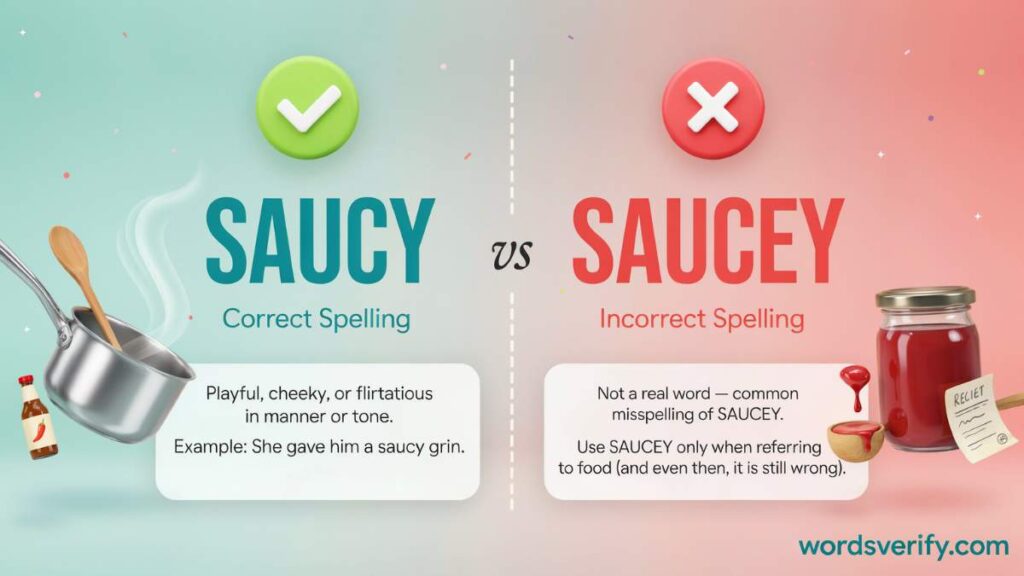
Is it saucy vs saucey? One small letter can create quite a spelling mix-up! Since the word comes from sauce, keeping the final “e” might seem logical. However, English spelling doesn’t always follow the rules you expect. The correct spelling is saucy, while saucey is a common misspelling. Whether you’re describing a delicious plate of saucy pasta, someone’s cheeky personality, or a playful remark, using the right form makes your writing clearer. Let’s settle this tasty spelling debate once and for all as we explore the meaning, pronunciation, history, and proper use of saucy.
Quick answer
The correct spelling is saucy, without an e between the c and y. Although saucey appears in online posts, social media captions, and casual messages, it isn’t the standard spelling of the adjective.
The confusion comes from the noun sauce. When you add the suffix -y to form the adjective, you drop the final e.
The correct formation is:
- Sauce + y = Saucy
- Sauce + y does not become Saucey.
For example:
| Correct spelling | Incorrect spelling |
|---|---|
| She made a saucy comment. | She made a saucey comment. |
| The restaurant serves saucy chicken. | The restaurant serves saucey chicken. |
| He gave her a saucy smile. | He gave her a saucey smile. |
| That was a rather saucy remark. | That was a rather saucey remark. |
The difference between saucy vs saucey is primarily a spelling issue. Both forms may appear in written communication, but only saucy is the standard English adjective.
Is Saucy the Correct Spelling in American and British English?
Yes. Saucy is the correct spelling in both American and British English. There is no regional spelling difference between the two varieties.
Some English words have different accepted spellings depending on where you use them. For example:
| American English | British English |
|---|---|
| Color | Colour |
| Favorite | Favourite |
| Center | Centre |
| Organize | Organise |
| Traveling | Travelling |
| Saucy | Saucy |
Notice that the last word doesn’t change.
Whether you’re writing for an American audience in New York or a British audience in London, use saucy. The spelling remains the same in both regions.
Saucy vs Saucey A Quick Comparison
Here’s a simple comparison to make the distinction easier to remember.
| Feature | Saucy | Saucey |
|---|---|---|
| Standard spelling | Yes | No |
| Recognized adjective | Yes | No |
| Food-related meaning | Yes | Intended meaning, but misspelled |
| Cheeky or bold meaning | Yes | Intended meaning, but misspelled |
| American English | Correct | Nonstandard |
| British English | Correct | Nonstandard |
| Formal writing | Appropriate when relevant | Avoid |
The answer is straightforward: if you’re wondering which spelling to choose, use saucy. The extra e doesn’t belong there.
Fix common more word mistakes in English
Annual vs Anual Which one Is Correct?
What Does Saucy Mean?
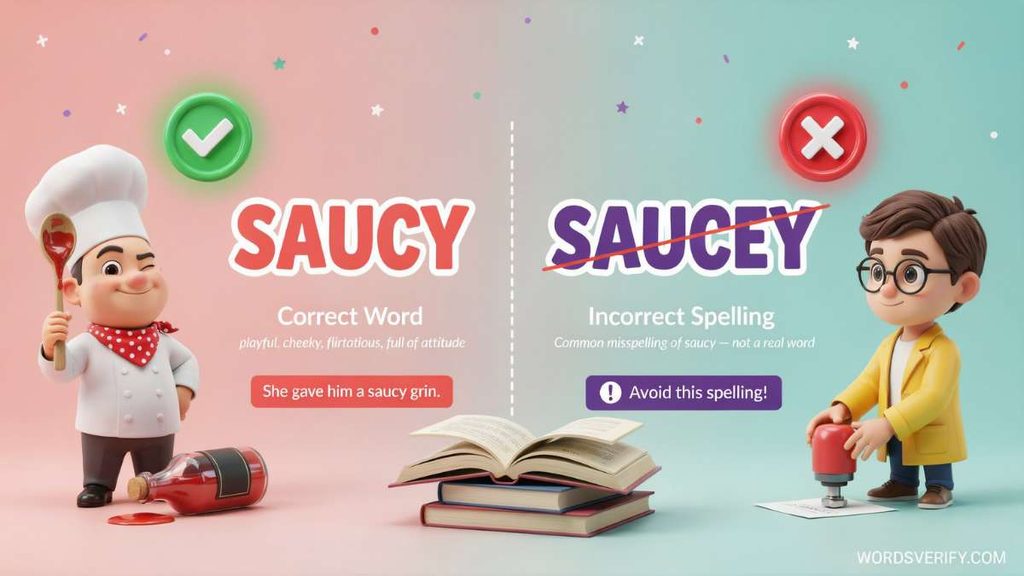
Saucy is an adjective with several meanings. Its interpretation depends on the situation, the speaker’s tone, and the subject being described.
The word can describe something containing plenty of sauce, someone who behaves boldly or cheekily, or a remark that sounds playful and slightly suggestive.
It has three common uses:
- Food-related: Containing plenty of sauce or having a rich, sauce-like quality.
- Personality-related: Cheeky, bold, spirited, or slightly disrespectful.
- Informal and flirtatious: Playfully suggestive, teasing, or provocative.
Let’s look at each meaning more closely.
Saucy Meaning in Food
When someone describes food as saucy, they’re usually talking about its sauce, texture, or preparation.
A saucy dish contains a noticeable amount of sauce or has a consistency that makes the sauce an important part of the meal. It might be creamy, tangy, spicy, sweet, savory, or rich.
Think about the difference between plain grilled chicken and chicken covered in a thick garlic sauce. Both can taste delicious, but the second is clearly saucier.
Common examples include:
- Saucy pasta: Pasta generously coated in tomato, Alfredo, or another sauce.
- Saucy chicken: Chicken served with a rich coating of gravy, barbecue sauce, or another flavorful mixture.
- Saucy ribs: Tender ribs covered in sticky barbecue sauce.
- Saucy carrots: Cooked carrots tossed in a flavorful butter-based or honey-based sauce.
- Saucy noodles: Noodles mixed with enough sauce to coat them thoroughly.
In cooking, the word often suggests that the sauce contributes significantly to the dish’s flavor and texture.
Consider these examples:
- The restaurant is famous for its saucy chicken wings.
- I prefer saucy pasta because dry noodles aren’t as enjoyable.
- These barbecue ribs are tender, sticky, and wonderfully saucy.
- The chef prepared saucy carrots with garlic butter and fresh herbs.
However, saucy doesn’t necessarily mean spicy. A creamy cheese sauce can make a dish saucy without adding any chili or pepper.
Saucy Meaning in Personality and Behavior
When someone describes a person as saucy, the meaning shifts away from food.
A saucy person often has a cheeky, lively, bold, or mischievous personality. They might make witty comments, challenge someone playfully, or respond with unexpected confidence.
Imagine a student who answers a teacher’s question with a clever remark that makes the entire classroom laugh. The teacher might describe the response as saucy.
Depending on the situation, the word can suggest:
- Cheeky: Playfully disrespectful or teasing.
- Sassy: Confident and outspoken, sometimes with attitude.
- Impudent: Showing little respect for authority or social expectations.
- Mischievous: Enjoying harmless troublemaking or playful behavior.
- Bold: Speaking or acting confidently without hesitation.
- Spirited: Showing energy, enthusiasm, and personality.
- Impertinent: Acting inappropriately familiar or disrespectful.
A saucy attitude isn’t always negative. Sometimes it adds humor and charm to a conversation. At other times, it can cross the line into rudeness.
For example:
- Her saucy reply made the entire room laugh.
- The little boy gave his teacher a saucy grin.
- He has a lively and saucy personality.
- Don’t give your grandmother that saucy look!
Context matters. A playful comment between close friends might sound funny, while the same comment directed at a manager during a serious meeting could seem disrespectful.
Saucy Meaning in Slang and Flirting
In informal language, saucy can describe something teasing, naughty, flirtatious, or slightly suggestive.
People often use it when talking about playful conversations, romantic messages, jokes, or expressions that carry a little extra attitude.
For example:
- She sent him a saucy text after their date.
- His saucy joke made everyone blush.
- They exchanged a few saucy remarks during dinner.
- That was a rather saucy comment!
This meaning doesn’t automatically suggest anything explicit. A saucy remark can be mildly flirtatious or simply cheeky.
The word also appears in social media captions, entertainment writing, romantic conversations, and everyday informal speech.
However, remember that saucy is an adjective, not a specific slang term with one fixed meaning. Its interpretation changes with the conversation.
What Does Saucy Girl Mean?
The expression saucy girl usually describes a girl or woman who acts cheeky, confident, spirited, or flirtatious.
It can refer to someone who isn’t afraid to express an opinion, make a witty remark, or tease people in a playful way.
For example:
- She’s a saucy girl who always has a clever comeback.
- The saucy girl gave her friend a mischievous smile.
- Everyone enjoys her saucy personality and lively sense of humor.
Depending on the speaker’s intention, the phrase can sound affectionate, complimentary, teasing, or mildly critical.
It isn’t necessarily an insult. Someone might use it to praise a woman’s confidence and playful attitude. However, in a different context, it could suggest that she behaves too boldly or disrespectfully.
Fix common more word mistakes in English
Recurrence vs Reoccurrence What’s the Difference?
Why Is Saucy the Correct Spelling?
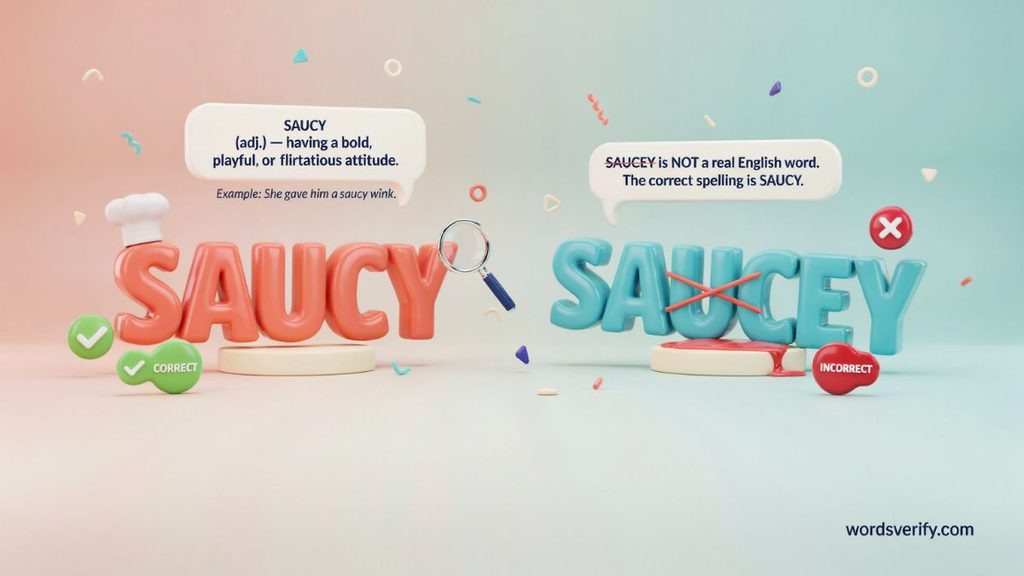
The reason saucy is correct comes down to a common English spelling pattern. When certain words ending in a silent e take the suffix -y, the final e usually disappears.
The noun sauce becomes the adjective saucy because English drops the final e before adding the suffix.
The same pattern appears in several familiar words:
| Root word | Correct adjective |
|---|---|
| Spice | Spicy |
| Juice | Juicy |
| Ice | Icy |
| Grease | Greasy |
| Noise | Noisy |
| Lace | Lacy |
| Sauce | Saucy |
Look closely at these examples. The original words end in e, but the adjectives don’t retain that letter before y.
This pattern makes the correct spelling easier to remember. You wouldn’t normally write spicey, juicey, or icey when you mean spicy, juicy, or icy. The same principle applies to saucy.
Why Do People Write Saucey?
The spelling saucey probably comes from a straightforward assumption: people see sauce and add y without removing the final e.
It looks logical at first glance. Unfortunately, English spelling doesn’t always follow the rules that seem most obvious.
Several factors contribute to this mistake:
- The original noun creates confusion. Since sauce ends in e, writers may assume the adjective should preserve that letter.
- Pronunciation doesn’t reveal the difference. Both spellings are generally intended to represent the same spoken word.
- Informal writing spreads mistakes. Social media posts, usernames, captions, and casual messages often contain nonstandard spellings.
- Branding encourages creative spelling. A business might deliberately use Saucey as a distinctive name. That doesn’t make it the standard English spelling.
The important distinction is between a creative spelling and a correct dictionary spelling. A restaurant can call itself “Saucey Kitchen” as a branding choice, but the ordinary adjective remains saucy.
Fix common more word mistakes in English
Copyright vs Copywrite Which one Is Correct?
The Origin and History of Saucy
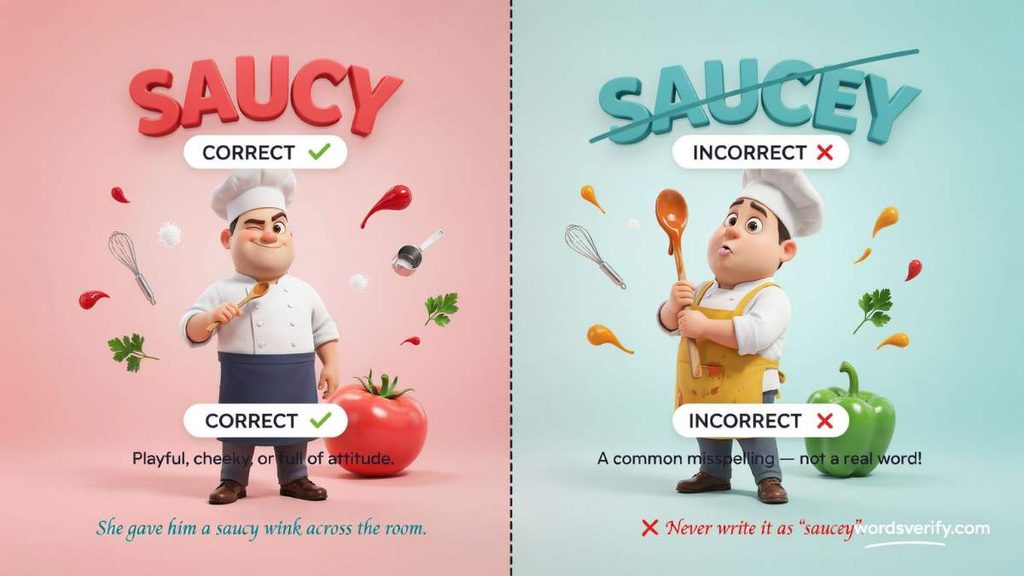
The history of saucy begins with the word sauce, which entered English through French. Its development shows how a word connected to food gradually acquired meanings related to personality and behavior.
The English noun sauce traces back to Old French sauce, which came from Latin salsa. The Latin term relates to salsus, meaning salted. This connection makes sense because early sauces often relied on salt and other strongly flavored ingredients to improve food.
Over time, English speakers developed the adjective saucy from sauce. Initially, the word related to sauce or something having a sauce-like quality. Its figurative meaning later developed around ideas of boldness, impertinence, and cheekiness.
How Did Saucy Develop Its Figurative Meaning?
Food-related language has long influenced descriptions of human personality. English speakers often borrow words from everyday experiences to describe people’s behavior. This connection also helps explain the figurative meaning behind Saucy vs Saucey.
For example, someone can be described as spicy because of their lively personality, even when they’re not particularly interested in hot food. A similar development occurred with saucy, giving the word a meaning beyond food.
Over time, saucy became associated with people who displayed an unusually bold, cheeky, or forward manner. It could describe someone who made impudent remarks, showed playful confidence, or behaved in a slightly provocative way. Understanding this change adds useful context to Saucy vs Saucey and explains why saucy is the correct spelling when describing someone’s personality.
This figurative meaning remains part of modern English.
Today, saucy can describe:
- A sauce-covered meal.
- A cheeky response.
- A mischievous expression.
- A flirtatious comment.
- A bold or spirited personality.
The connection between these meanings is historical rather than literal. A saucy person doesn’t need to have anything to do with food!
Fix common more word mistakes in English
Appraised vs Apprised What’s the Difference?
Saucy in American English vs British English
One common question about English spelling is whether a word changes depending on the country. With saucy, the answer is simple: it doesn’t.
Saucy is the standard spelling in both American and British English.
Although the two varieties differ in many spelling conventions, they agree on this word.
| Category | American English | British English |
|---|---|---|
| Correct spelling | Saucy | Saucy |
| Incorrect standard form | Saucey | Saucey |
| Food-related meaning | Yes | Yes |
| Cheeky meaning | Yes | Yes |
| Flirtatious meaning | Yes | Yes |
| Standard adjective | Saucy | Saucy |
There can be small differences in how people use the word conversationally. British English has a particularly familiar tradition of using cheeky and saucy to describe playful impertinence.
For example, a British speaker might call a bold response “a bit saucy.” An American speaker could use the same expression, although sassy or cheeky might be more common in some situations.
These are differences in usage and preference, not spelling.
Examples of Saucy in Both Varieties
American English:
- That was a saucy comment!
- The restaurant serves saucy barbecue chicken.
- She gave him a saucy smile.
British English:
- Don’t give me that saucy look!
- He’s always making saucy remarks.
- We ordered a delicious saucy chicken dish.
The spelling remains unchanged in every example.
Fix common more word mistakes in English
Simular vs Similar Which one Is Correct?
How to Pronounce Saucy
The standard American pronunciation of saucy is /ˈsɔːsi/.
The word contains two syllables, with the stress on the first syllable.
Here’s a simple breakdown:
| Feature | Explanation |
|---|---|
| Syllables | 2 |
| Primary stress | First syllable |
| Initial sound | /s/ |
| Middle vowel | /ɔː/ in the indicated pronunciation |
| Ending sound | /si/ |
The ending sounds like the beginning of the word see.
Pronunciation can vary slightly across English accents, particularly in the vowel sound. However, the spelling doesn’t change.
One important point: saucy vs saucey don’t have separate standard pronunciations. People who write saucey generally intend to pronounce it exactly like saucy.
Fix common more word mistakes in English
Cataloguing vs Cataloging? Which one Is Correct?
Saucy in Everyday Sentences
Understanding a word becomes much easier when you see it in real sentences. Since saucy has several meanings, it’s helpful to organize examples by context.
Saucy in Food-Related Sentences
- The restaurant serves saucy noodles with fresh vegetables and garlic.
- My mother makes the best saucy chicken for Sunday dinner.
- These ribs taste even better when they’re covered in a rich barbecue sauce.
- The chef prepared saucy carrots with honey, butter, and herbs.
- I prefer a saucy burger because the extra sauce makes it more flavorful.
- The pasta looked delicious with its creamy and saucy consistency.
- We ordered saucy wings with a sweet and tangy glaze.
In these examples, saucy describes the food’s preparation, texture, or amount of sauce.
Saucy in Personality-Related Sentences
- Her saucy response surprised everyone at the meeting.
- The little boy gave his father a saucy grin.
- He has a saucy attitude that makes ordinary conversations entertaining.
- The actress delivered her lines with a confident, saucy expression.
- My sister is naturally cheeky and always has a saucy comeback.
- His saucy behavior annoyed the teacher.
- The young performer impressed the audience with her lively personality and saucy remarks.
Here, the word describes behavior rather than food.
Saucy in Flirting and Informal Conversation
- She sent her boyfriend a saucy message before dinner.
- His saucy comment made her blush.
- They exchanged a few playful and saucy remarks.
- That was a rather saucy joke for a family gathering.
- He gave her a mischievous smile after making a saucy suggestion.
- Their conversation became increasingly flirtatious and playful.
These examples demonstrate the informal and sometimes suggestive meaning.
Saucy in Different Writing Contexts
The word works in several types of writing, but its tone matters.
| Writing context | Example | Suitability |
|---|---|---|
| Casual conversation | That was a saucy remark! | Natural |
| Food review | The restaurant serves deliciously saucy pasta. | Natural |
| Creative writing | She answered with a saucy smile. | Natural |
| Social media | A little saucy, a little sweet! | Natural |
| Professional writing | The employee made a saucy remark. | Depends on context |
| Academic writing | The character displays a saucy attitude toward authority. | Acceptable when relevant |
For formal and academic writing, choose the word carefully. It can work when describing a literary character or analyzing dialogue, but more precise alternatives may suit technical discussions.
For instance, impudent, flirtatious, or disrespectful might communicate a more specific meaning than saucy.
Fix common more word mistakes in English
Ingenuine vs Ungenuine Which one Is Correct?
Saucy Synonyms and Related Words
The best synonym for saucy depends on what you’re describing. A word that works for a cheeky person might sound strange when describing food. This distinction is also useful when exploring Saucy vs Saucey, since understanding the correct spelling helps you use the adjective confidently.
For example, zesty can describe a flavorful dish, while impudent describes someone who shows little respect. Neither word replaces saucy in every situation. Knowing the Saucy vs Saucey spelling difference ensures you choose the correct form while using these alternatives naturally.
Here are some useful alternatives organized by meaning.
Synonyms of Saucy for Food
When describing food, saucy often suggests a generous amount of sauce, a rich texture, or a noticeable flavor.
| Synonym | Meaning | Example |
|---|---|---|
| Flavorful | Full of appealing taste | The chicken is flavorful and tender. |
| Rich | Having a strong, full taste or texture | The pasta has a rich cream sauce. |
| Savory | Pleasantly salty or spicy rather than sweet | The dish has a savory sauce. |
| Zesty | Having a lively, sharp flavor | The chef prepared zesty lemon chicken. |
| Tangy | Having a pleasantly sharp or sour taste | The ribs have a tangy glaze. |
| Well-sauced | Covered with a generous amount of sauce | The noodles are perfectly well-sauced. |
These words describe different qualities, so choose the one that best matches the food.
Synonyms of Saucy for Personality
When describing someone’s behavior, the following words may work as alternatives:
| Synonym | Meaning | Example |
|---|---|---|
| Cheeky | Playfully disrespectful or bold | He gave a cheeky answer. |
| Sassy | Confident, lively, and outspoken | She has a sassy personality. |
| Impudent | Showing little respect | His impudent response upset the manager. |
| Bold | Confident and willing to take risks | She made a bold statement. |
| Mischievous | Enjoying playful troublemaking | The mischievous child smiled. |
| Impertinent | Inappropriately bold or disrespectful | His impertinent question surprised everyone. |
| Spirited | Full of energy and enthusiasm | She gave a spirited reply. |
| Audacious | Willing to take surprising or daring action | His audacious remark caught everyone’s attention. |
Although these words overlap, they aren’t identical. Cheeky often sounds playful, while impudent and impertinent usually carry a stronger negative meaning.
Synonyms of Saucy for Flirting and Suggestive Behavior
When saucy describes a flirtatious or provocative comment, these alternatives may fit:
- Flirtatious: Showing romantic or playful interest.
- Teasing: Playfully provoking someone.
- Suggestive: Hinting at something without stating it directly.
- Naughty: Slightly improper or mischievous.
- Provocative: Intended to attract attention or provoke a reaction.
- Playful: Lighthearted and full of fun.
- Forward: Showing boldness, especially in social or romantic situations.
For example, “She made a saucy remark” could also become “She made a flirtatious remark” if the sentence specifically refers to romantic interest.
What Is the Opposite of Saucy?
Antonyms also depend on the meaning you’re trying to express.
| Meaning of saucy | Possible opposite |
|---|---|
| Cheeky | Respectful |
| Impudent | Polite |
| Bold | Timid |
| Sassy | Reserved |
| Mischievous | Well-behaved |
| Flirtatious | Uninterested |
| Rich in sauce | Dry |
| Playfully provocative | Restrained |
There isn’t one perfect opposite for every use of saucy. A dry dish is the opposite of saucy in a food-related context, while a polite or reserved person might be the opposite of someone with a saucy personality.
Fix common more word mistakes in English
Manner vs Manor which one is correct?
Saucy vs Sauce What’s the Difference?
The words sauce and saucy are related, but they perform different grammatical jobs.
Sauce is a noun, while saucy is an adjective.
A sauce is a liquid or semi-liquid preparation that people serve with food to add flavor, moisture, or texture. Saucy describes food that contains plenty of sauce or a person who behaves in a cheeky or bold manner.
Consider these examples:
- The chef prepared a delicious tomato sauce.
- The pasta was wonderfully saucy.
- I added extra sauce to my chicken.
- My friend made a saucy comment about the restaurant.
The distinction is straightforward:
| Word | Part of speech | Meaning |
|---|---|---|
| Sauce | Noun | A liquid or semi-liquid food preparation |
| Saucy | Adjective | Containing sauce or displaying cheeky behavior |
| Sauces | Plural noun or verb | More than one sauce, or the act of adding sauce |
| Sauciest | Superlative adjective | Most saucy |
| Saucily | Adverb | In a saucy manner |
| Sauciness | Noun | The quality of being saucy |
This distinction also explains why saucey isn’t the correct standard adjective. The word comes from sauce, but its accepted spelling changes when the suffix -y is added.
Fix common more word mistakes in English
Updated vs Update which one is correct?
Common Spelling Mistakes with Saucy
English spelling has plenty of small traps, and the Saucy vs Saucey confusion is one of them. People often keep the final “e” because they recognize the original noun, sauce. However, the correct adjective drops that letter before adding “y.” Understanding the Saucy vs Saucey spelling difference can help you avoid this common mistake and use the correct form confidently.
Here are some other common mistakes to avoid.
Writing Saucey Instead of Saucy
This is the most obvious mistake.
Incorrect: The chef prepared a saucey chicken dish.
Correct: The chef prepared a saucy chicken dish.
Remember that the final e disappears when forming the adjective.
Confusing Saucy with Spicy
These words sometimes appear in similar food descriptions, but they don’t mean the same thing.
- Saucy describes food with plenty of sauce or a sauce-like consistency.
- Spicy describes food containing spices or ingredients that create a strong, sometimes hot flavor.
A dish can be saucy without being spicy. Creamy Alfredo pasta is a good example. Likewise, a spicy dry rub can make chicken spicy without making it saucy.
Assuming Saucy Always Describes Food
The word has both literal and figurative meanings.
Calling a meal saucy refers to its sauce. Calling a person saucy refers to their personality or behavior.
For example:
- The restaurant serves saucy noodles.
- The comedian made a saucy remark.
The same adjective works in both sentences, but the meanings differ.
Confusing Saucy with Sassy
Although saucy and sassy can describe similar behavior, they’re not completely interchangeable.
Saucy often suggests cheekiness, impudence, or flirtatious boldness. Sassy usually emphasizes confidence, spirited remarks, and an outspoken personality.
For example:
- Her saucy comment was slightly suggestive.
- Her sassy response showed that she wasn’t afraid to speak her mind.
Both words can describe a confident person, but saucy sometimes carries a more teasing or provocative tone.
Fix common more word mistakes in English
Light vs Lite which one is correct?
How to Remember the Correct Saucy Spelling
A simple spelling trick can save you from making the same mistake repeatedly Saucy vs Saucey.
Remember this formula:
Sauce + y = Saucy
Drop the final e before adding y. That’s the entire trick.
You can also remember the spelling through familiar comparisons:
- Spice becomes spicy.
- Juice becomes juicy.
- Ice becomes icy.
- Grease becomes greasy.
- Sauce becomes saucy.
If you remember spicy and juicy, you already know the pattern.
Another useful approach is to connect the word to a sentence you use frequently:
“The saucy chicken tastes delicious.”
The more you see and use the correct form, the easier it becomes to recognize saucey as a spelling mistake.
Common Word Forms of Saucy
Understanding related forms helps you use the adjective correctly in different sentences.
| Word form | Part of speech | Meaning | Example |
|---|---|---|---|
| Saucy | Adjective | Cheeky or rich in sauce | She made a saucy remark. |
| Saucier | Comparative adjective | More saucy | This pasta is saucier than the last one. |
| Sauciest | Superlative adjective | Most saucy | These are the sauciest ribs on the menu. |
| Saucily | Adverb | In a cheeky manner | She answered saucily. |
| Sauciness | Noun | The quality of being saucy | His sauciness made the conversation entertaining. |
Notice that the final y changes to i when forming saucier, sauciest, saucily, and sauciness.
These forms follow familiar English spelling patterns and help expand your vocabulary beyond the basic adjective.
Practice session Saucy vs Saucey
Now that you’ve explored the meanings, spelling rules, and common uses of saucy, it’s time to put your knowledge to the test. Try the following fill-in-the-blanks practice to see how well you’ve mastered Saucy vs Saucey!
- The chef prepared a delicious, ______ pasta dish with creamy tomato sauce.
- Her ______ reply made everyone burst into laughter.
- Is the correct spelling saucy or ______?
- The little boy gave his teacher a ______ grin.
- This chicken recipe needs a little more sauce to make it ______.
- She gave him a ______ look across the room.
- His ______ comments made the conversation more entertaining.
- The restaurant is famous for its rich and ______ dishes.
- Stop being so ______ and answer the question politely!
- The actress delivered a ______ line that surprised the audience.
- A person who is cheeky, bold, or mischievous can be described as ______.
- The word sauce becomes ______ when you add the suffix “-y.”
- Her playful and ______ personality made her popular among her friends.
- The waiter recommended the pasta with extra ______.
- That was a rather ______ remark. Were you trying to tease me?
- The word ______ can describe both flavorful food and cheeky behavior.
- He flashed a ______ smile before making another joke.
- The children made several ______ comments during the game.
- Unlike spicy, the word ______ can describe food containing plenty of sauce.
- She gave her brother a ______ answer when he asked where his cookies had gone.
- The comparative form of saucy is ______.
- The superlative form of saucy is ______.
- The adverb form of saucy is ______.
- The noun form of saucy is ______.
- Remember, ______ is the standard English spelling, not saucey.
Answers
- Saucy
- Saucy
- Saucey
- Saucy
- Saucy
- Saucy
- Saucy
- Saucy
- Saucy
- Saucy
- Saucy
- Saucy
- Saucy
- Sauce
- Saucy
- Saucy
- Saucy
- Saucy
- Saucy
- Saucy
- Saucier
- Sauciest
- Saucily
- Sauciness
- Saucy
Here’s a trusted source for clear word meanings:
FAQs
Is saucy a real word?
Yes, saucy is a standard English adjective. It describes food containing plenty of sauce, a cheeky or bold personality, or playful and sometimes flirtatious behavior.
What does saucy mean in slang?
In informal language, saucy often means cheeky, sassy, daring, or slightly naughty. Depending on the situation, it can describe a playful comment, a teasing remark, or someone who behaves with confidence and attitude.
Does saucy mean flirty?
Yes, saucy can mean flirtatious when someone uses playful, teasing, or suggestive language or behavior. However, it doesn’t always have a romantic meaning. It can also describe someone who’s simply cheeky or mischievous.
What does it mean when someone gets saucy?
When someone gets saucy, they become more cheeky, bold, or outspoken. They might make a teasing remark, answer back playfully, or show a little attitude. Whether it sounds charming or rude depends on the context and tone.
What does saucy mean as an insult?
Saucy can sound insulting when it describes someone who is disrespectful, impertinent, or overly bold. However, it’s often used playfully rather than harshly. The speaker’s tone and the situation determine how it comes across.
What does a saucy look mean?
A saucy look is a cheeky, playful, or flirtatious facial expression. It might include a knowing smile, a raised eyebrow, or a mischievous glance that suggests someone is teasing or being a little bold.
What does saucy girl mean?
A saucy girl is usually someone who’s confident, cheeky, spirited, or playfully flirtatious. The phrase can be affectionate or teasing, although it may sound slightly critical if the speaker means she’s being too forward or disrespectful.
What does saucy boy mean?
A saucy boy is someone who behaves in a cheeky, mischievous, or bold way. The phrase can describe a playful sense of humor, teasing comments, or a boy who likes to push boundaries.
What is the difference between sassy and saucy?
Sassy generally describes someone who is bold, outspoken, and quick with clever or cheeky remarks. Saucy can have a similar meaning, but it may also suggest flirtatious, naughty, or suggestive behavior. Saucy also has a separate food-related meaning, while sassy does not.
What’s another word for saucy?
The best synonym depends on the context. For personality, you can use cheeky, sassy, bold, mischievous, or impudent. For flirtatious behavior, try teasing, playful, suggestive, or provocative also For food, words such as flavorful, rich, tangy, and well-sauced may fit.
Can you use saucy in a sentence?
Yes. Here are a few examples Saucy vs Saucey:
- The chef served a saucy pasta dish with a rich tomato topping.
- Her saucy reply made everyone at the table laugh.
- He gave her a saucy smile before walking away.
- The comedian is known for his saucy jokes and cheeky humor.
What is the difference between sauce and saucy?
Sauce is a noun that refers to a liquid or semi-liquid food mixture served with other dishes. Saucy is an adjective that describes something containing plenty of sauce or someone behaving in a cheeky, bold, or flirtatious way.
What does saucy mean in British English?
In British English, saucy commonly means cheeky, impudent, or slightly suggestive. It can also describe food containing plenty of sauce. The spelling is the same in American and British English.
What did saucy mean in the 1700s?
In the 1700s, saucy was commonly used to describe someone who was impudent, bold, cheeky, or disrespectful. Its figurative meaning had developed from the word’s earlier association with sauce and lively, sharp behavior.
Is saucey accepted as a spelling variation?
No. Saucey is generally considered a misspelling of the standard adjective saucy. You might see it in usernames, brand names, or creative writing, but saucy is the correct form in standard English.
Is saucy vs saucey the correct spelling in Scrabble?
Saucy is the standard spelling and the form to use in Scrabble, subject to the official word list for the version you’re playing. Saucey is not a standard English spelling and generally isn’t accepted.
Conclusion
The verdict is clear saucy is the correct spelling, while saucey is usually a spelling mistake. Keeping the final “e” might seem logical because the word comes from sauce, but English spelling doesn’t always play by the rules we expect. When you add “y” to sauce, the “e” takes a little break and disappears.
Remember, saucy can describe a delicious, sauce-rich dish, a cheeky personality, or a playful, flirtatious remark. Saucey may look tempting, but unless you’re using it as a creative name or brand, it’s best left out of standard writing. So, the next time you reach for this word, choose saucy. Your spelling will be spot-on, and your writing won’t need an extra letter to add flavor!

Lisa AJS is an experienced blogger and language enthusiast at Words Verify, dedicated to making grammar simple, practical, and enjoyable. She writes engaging content on commonly confused words, grammar mistakes, word meanings, and everyday language challenges.