
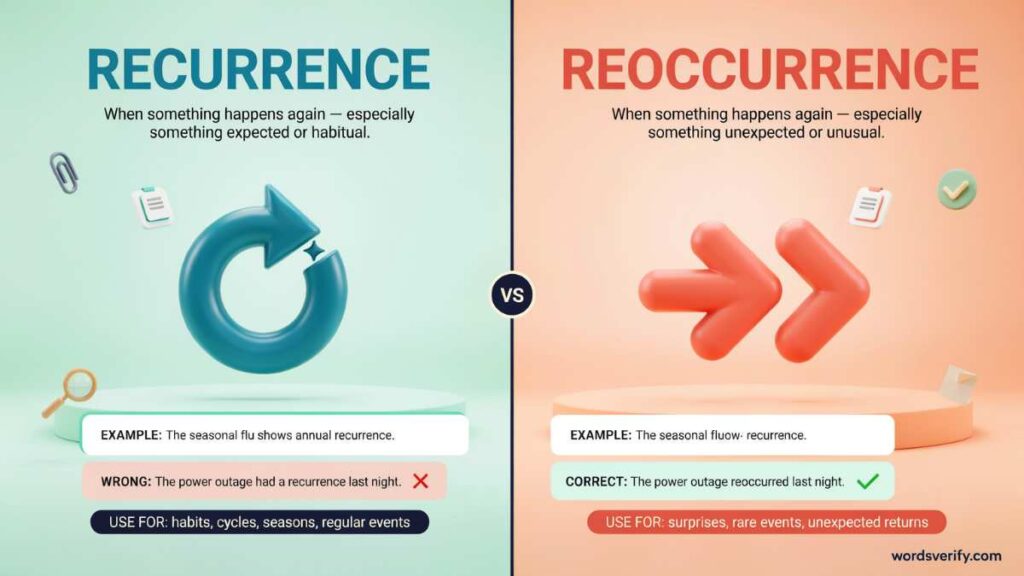
Recurrence vs reoccurrence? These two words look so much alike that choosing between them can feel like a spelling puzzle. The good news is that both are correct, but they aren’t always used in quite the same way. Although their meanings overlap, each word has its own place in everyday writing, medicine, science, and other fields. In this guide to recurrence vs reoccurrence, you’ll learn what each word means, how they differ and when to use them. We’ll also explore common mistakes and practical examples to help you choose the right word with confidence without letting one extra syllable trip you up.
Recurrence vs Reoccurrence The Quick Answer
Recurrence vs reoccurrence are both nouns that describe something happening or appearing again. However, recurrence generally has broader usage and often describes repeated events, returning conditions, or recognizable patterns. Reoccurrence places more emphasis on another instance of something happening.
Here’s a quick comparison:
| Feature | Recurrence | Reoccurrence |
|---|---|---|
| Part of speech | Noun | Noun |
| Basic meaning | Something happening or returning again | Something happening or appearing again |
| Main emphasis | Repetition, return, or a recurring pattern | Another occurrence |
| Common usage | Medical, scientific, academic, and everyday writing | General descriptions of repeated events |
| Frequency | More common | Less common |
| Correct spelling | Yes | Yes |
Consider these examples:
- Recurrence: The recurrence of the software problem forced the company to investigate its system.
- Reoccurrence: The manager introduced new procedures to prevent the reoccurrence of the same mistake.
Both sentences are grammatically correct. They describe a problem happening again, although recurrence is the more established choice.
Which Word Should You Choose?
Use recurrence when discussing repeated patterns, recurring conditions, or events that return over time. It’s also the preferred term in established medical expressions such as cancer recurrence.
Choose reoccurrence when you want to emphasize another instance of something happening again. However, don’t treat this distinction as a strict grammar rule. The meanings overlap and either word can work in many everyday sentences.
If you’re unsure, recurrence is usually the safer choice.
Learn the difference between tricky grammar more words
Copyright vs Copywrite Which one Is Correct?
What Does Recurrence Mean?
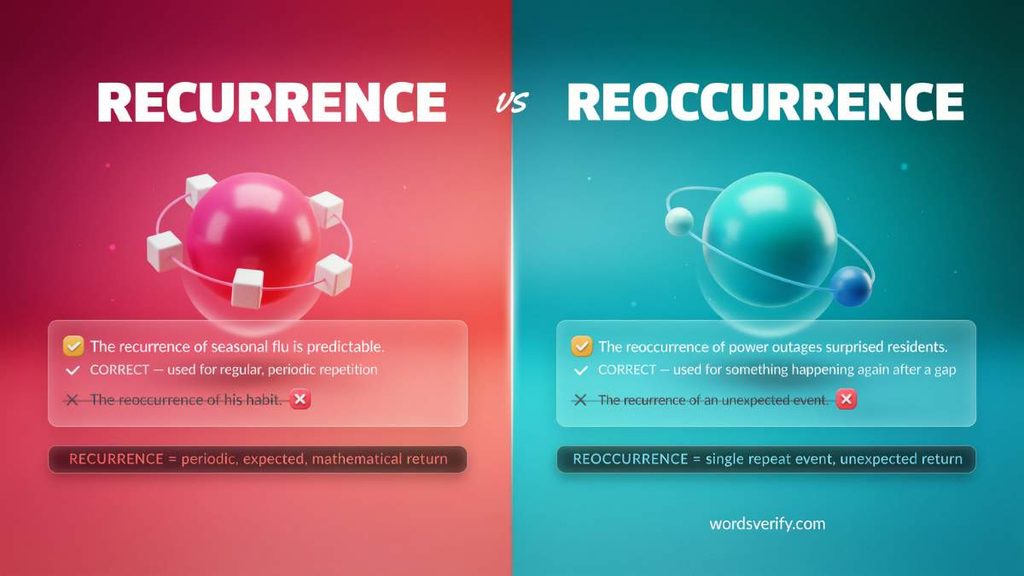
Recurrence refers to the act or process of happening, appearing, or returning again. It describes an event, condition, problem, or situation that happens more than once.
In simple terms, recurrence means the return or repetition of something that has happened before.
Imagine that your computer crashes every few days. You fix the problem, but it returns a week later. That repeated problem is a recurrence.
Similarly, if someone experiences the same symptoms after recovering from an illness, a doctor might describe the situation as a recurrence of symptoms or a recurrence of the condition.
The word appears in several fields, including medicine, mathematics, science, psychology, and everyday communication.
Recurrence Definition and Meaning
Recurrence means the act of recurring or the state of occurring again. The word comes from the verb recur, which means to happen or appear again.
Here are its main characteristics:
- Repetition: Something happens more than once.
- Return: An earlier event, condition, or situation appears again.
- Pattern: The repeated event may follow a recognizable sequence or interval.
- Frequency: The word can describe how often something happens over time.
However, recurrence doesn’t always mean that something happens at regular intervals. An event can return unexpectedly or occur from time to time without following a predictable schedule.
For example, a headache might return after several weeks. Even if there’s no regular pattern, you can still describe it as a recurrence.
Examples of Recurrence in Everyday English
Recurrence fits naturally into conversations about repeated situations and returning problems.
Consider these examples:
- The recurrence of the power outage disrupted business operations.
- Regular maintenance can reduce the recurrence of mechanical problems.
- Researchers studied the recurrence of the unusual weather pattern.
- The recurrence of his headaches concerned his family.
- The company introduced new procedures to prevent a recurrence of the error.
- The recurrence of the same argument made their disagreement worse.
Notice how recurrence works as a noun in each sentence. It identifies the return or repetition of an earlier event.
Recurrence in Medical Terminology
Medicine provides one of the clearest examples of how recurrence works.
Doctors use the term to describe a disease, condition, or symptom returning after it previously improved or disappeared.
For example, cancer recurrence refers to cancer returning after a period during which treatment reduced or eliminated detectable signs of the disease.
A recurrence may happen in the same location as the original cancer or in another part of the body. Medical professionals distinguish between local, regional, and distant recurrence depending on where the cancer returns.
It’s important to understand that recurrence doesn’t automatically mean a new primary cancer. It generally describes the return of the original cancer.
The word also appears in discussions about:
- Recurrence of infection.
- Recurrence of depression.
- Recurrence of chronic pain.
- Recurrence of kidney stones.
- Recurrence of symptoms after treatment.
In medical writing, recurrence is the established term. Although people may understand reoccurrence in these situations, recurrence is the more conventional choice.
Recurrence in Mathematics and Science
Recurrence also has a specific role in mathematics and scientific research.
In mathematics, a recurrence relation defines a sequence by expressing each term in relation to earlier terms. Rather than calculating every value independently, you use previous values to determine the next one.
The Fibonacci sequence provides a familiar example:
\[ F_n = F_{n-1} + F_{n-2} \]
Each term equals the sum of the two preceding terms. The sequence begins:
0, 1, 1, 2, 3, 5, 8, 13, 21…
This mathematical concept shows how recurrence describes a relationship in which earlier values help determine later ones.
Scientists also use recurrence when studying repeating processes, seasonal patterns, recurring events, and repeated observations.
Learn the difference between tricky grammar more words
Appraised vs Apprised What’s the Difference?
What Does Reoccurrence Mean?
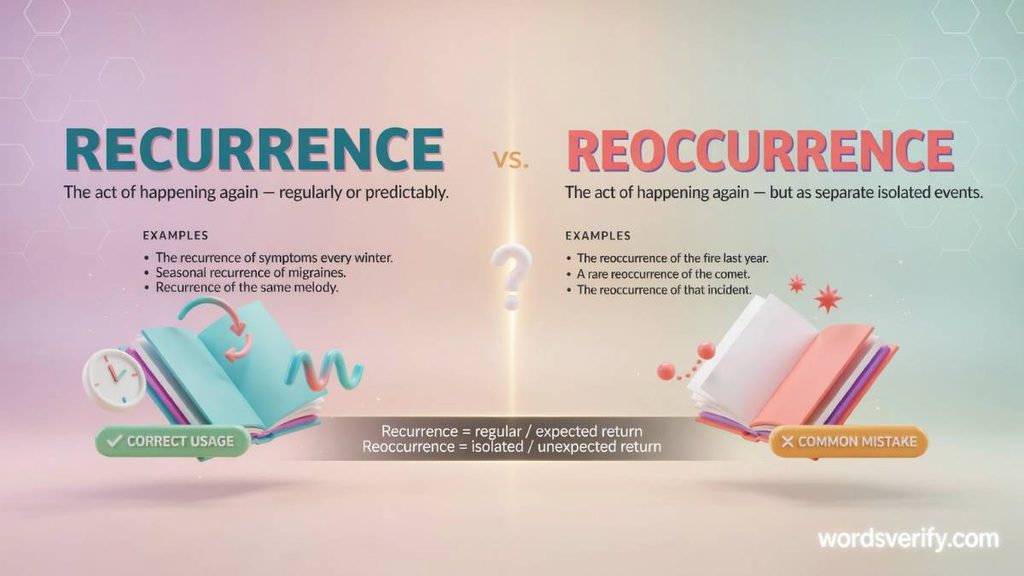
Reoccurrence means the act or instance of something happening or appearing again.
Its meaning is closely related to recurrence. The main difference is that reoccurrence can place greater emphasis on another instance of an earlier event.
For example:
“The reoccurrence of the equipment failure delayed production.”
This sentence tells you that the equipment failed before and then failed again.
The meaning is straightforward: something happens again after an earlier occurrence.
Reoccurrence Definition and Word Formation
The meaning of reoccurrence becomes easier to understand when you examine its two components:
- Re-: A prefix meaning again or back.
- Occurrence: An event, incident, or instance of something happening.
When combined, these elements form reoccurrence, meaning another occurrence of something.
For example, consider the following sequence:
- A company experiences a technical failure.
- Its technicians repair the equipment.
- The same failure happens again.
- The company investigates the reoccurrence of the problem.
The word identifies another instance of an earlier event.
However, reoccurrence doesn’t necessarily mean something happens only twice. It can describe a third, fourth, or later instance as well.
Is Reoccurrence a Word?
Yes! Reoccurrence is a real, recognized English word. It isn’t simply an incorrect version of recurrence.
Although recurrence appears more frequently in standard writing, dictionaries recognize reoccurrence as a noun meaning the act of occurring again.
This distinction matters because people sometimes assume that reoccurrence is a spelling error. It isn’t.
Both forms are legitimate. The difference lies mainly in common usage, emphasis, and context.
Examples of Reoccurrence in Everyday English
Here are some examples showing how to use reoccurrence naturally:
- The engineers investigated the reoccurrence of the machine failure.
- Better security measures could prevent the reoccurrence of the incident.
- Nobody expected the reoccurrence of such an unusual event.
- The company changed its procedures after the reoccurrence of the error.
- The reoccurrence of the power outage affected several neighborhoods.
- The team wanted to prevent the reoccurrence of the same disagreement.
In each example, reoccurrence refers to an event happening again after an earlier instance.
When Does Reoccurrence Sound Natural?
Reoccurrence can work well when you want to emphasize that something has happened another time.
Imagine a restaurant experiences a food delivery problem. The manager resolves it, but the supplier makes the same mistake during the next delivery.
You could write:
“The restaurant introduced a new ordering system to prevent the reoccurrence of delivery errors.”
The sentence emphasizes another instance of the same problem.
Nevertheless, recurrence would also be correct. Reoccurrence isn’t required simply because you’re describing a second incident.
Learn the difference between tricky grammar more words
Simular vs Similar Which one Is Correct?
Recurrence vs Reoccurrence What’s the Difference?
The main difference between recurrence and reoccurrence isn’t a strict grammatical distinction. Both words describe something happening again, but they can carry slightly different shades of meaning.
Recurrence often suggests a returning condition, repeated event, or recognizable pattern. Reoccurrence can place more emphasis on another instance of something that happened previously.
Think about two situations:
- A person experiences headaches every few weeks. The repeated return of those headaches is a recurrence.
- A machine breaks down, gets repaired, and unexpectedly breaks down again. You could describe the second failure as a reoccurrence.
The first situation involves a repeated condition. The second highlights another instance of an earlier incident.
However, these are usage preferences rather than strict English grammar rules. You could use recurrence in the second example without changing its basic meaning.
Key Differences at a Glance
| Comparison | Recurrence | Reoccurrence |
|---|---|---|
| Definition | The act of happening or returning again | The act of happening or appearing again |
| Typical emphasis | Repeated return or pattern | Another occurrence |
| Regularity | Can describe regular or irregular repetition | Can describe regular or irregular repetition |
| Medical terminology | Established and widely used | Less conventional |
| Academic writing | Common choice | Less frequently preferred |
| Everyday writing | Very common | Correct but less common |
| Example | The recurrence of the symptoms worried him. | The reoccurrence of the incident surprised everyone. |
Does Recurrence Always Mean Something Happens Repeatedly?
Not necessarily. Recurrence can describe something that happens again even if it doesn’t follow a predictable pattern.
For example, suppose a restaurant experiences a power failure in January. Everything works normally for six months before another outage occurs.
The second outage represents a recurrence, even though the event didn’t happen regularly.
Similarly, a recurring problem doesn’t have to appear every day or every week. It simply needs to return or happen again.
Does Reoccurrence Mean Something Happens Again?
Yes. That’s its central meaning.
The prefix re- indicates repetition or return, while occurrence refers to an event or happening. Together, they describe another instance of something taking place.
For example:
“The unexpected reoccurrence of the storm damaged several buildings.”
The sentence communicates that a similar event happened before and then happened again.
Nevertheless, reoccurrence doesn’t automatically suggest a single repeat. The word can describe subsequent occurrences as well.
Can Recurrence and Reoccurrence Be Used Interchangeably?
In many everyday sentences, yes.
For example:
- The recurrence of the problem frustrated the staff.
- The reoccurrence of the problem frustrated the staff.
Both sentences communicate essentially the same idea.
However, interchangeability doesn’t mean that both words are equally natural in every context. Medical terminology, mathematical expressions, and established professional phrases often favor recurrence.
When choosing between the two, consider the accepted terminology of your subject rather than forcing a distinction that English doesn’t consistently maintain.
Learn the difference between tricky grammar more words
Cataloguing vs Cataloging? Which one Is Correct?
When to Use Recurrence vs Reoccurrence
Knowing the definitions is useful. Knowing which word sounds natural in a particular situation is even better.
Although the two nouns overlap, some contexts strongly favor recurrence while others comfortably accept both.
Use Recurrence for Repeated Patterns and Regular Events
Choose recurrence when describing a condition, event, or situation that returns over time.
The word works particularly well when repetition forms an important part of the discussion.
For example:
- The recurrence of seasonal allergies affects many people.
- Scientists examined the recurrence of the weather pattern.
- The recurrence of the same mistake suggests a training problem.
- The business wants to reduce the recurrence of customer complaints.
- Researchers measured the recurrence of the phenomenon.
Recurrence also works well in formal and technical writing because it has established meanings in several professional fields.
A useful rule: When discussing an ongoing pattern, repeated condition, or returning event, recurrence is usually a strong choice.
Use Reoccurrence When Emphasizing Another Occurrence
Reoccurrence can work when you want to highlight another instance of something happening.
For example:
- The company introduced additional checks after the reoccurrence of the manufacturing error.
- The reoccurrence of the unusual incident surprised local residents.
- The manager wanted to prevent the reoccurrence of the disagreement.
- Engineers investigated the reoccurrence of the equipment failure.
In these examples, the writer focuses on another occurrence rather than describing an established cycle.
Still, recurrence would also work in most of these sentences.
When Either Word Works
Sometimes the difference is so small that either noun communicates the intended meaning.
Consider these paired examples:
| Using recurrence | Using reoccurrence |
|---|---|
| The recurrence of the error caused delays. | The reoccurrence of the error caused delays. |
| They investigated the recurrence of the incident. | They investigated the reoccurrence of the incident. |
| The recurrence of the problem worried the manager. | The reoccurrence of the problem worried the manager. |
| New rules could prevent a recurrence of the mistake. | New rules could prevent a reoccurrence of the mistake. |
Both columns contain grammatically correct sentences.
However, recurrence generally sounds more natural because it’s the more established and widely used term.
Learn the difference between tricky grammar more words
Ingenuine vs Ungenuine Which one Is Correct?
Recurrence vs Reoccurrence in Different Contexts
The best way to understand word choice is to see how each word behaves in real situations. Some contexts have well-established terminology, while others leave more room for personal preference.
Recurrence vs Reoccurrence of Cancer
When discussing cancer, recurrence is the established medical term.
Cancer recurrence describes cancer returning after treatment and a period in which no cancer was detected or the disease appeared to be under control.
Cancer can return in the same location where it first developed or in another part of the body. Medical professionals generally classify recurrence into three categories.
- Local recurrence: Cancer returns in the same place where it originally developed or very close to that location.
- Regional recurrence: Cancer returns in nearby lymph nodes or tissues.
- Distant recurrence: Cancer appears in another, more distant part of the body.
For example:
- The doctor monitored the patient for signs of cancer recurrence.
- Follow-up examinations help identify possible recurrence.
- The treatment plan depends partly on the location of the cancer recurrence.
You might encounter the phrase reoccurrence of cancer in informal writing. Readers can understand it, but medical professionals generally use cancer recurrence.
It’s also important not to confuse recurrence with a second primary cancer. A second primary cancer is a new, separate cancer rather than the return of the original one. Doctors may use additional tests, including biopsies, to distinguish between these conditions.
Recurring vs Reoccurring Meetings
The difference between recurring and reoccurring becomes particularly useful when discussing meetings.
A recurring meeting is a meeting scheduled to happen repeatedly, usually at regular intervals.
For example:
- A weekly team meeting.
- A monthly budget review.
- A quarterly performance meeting.
- An annual company conference.
A reoccurring meeting can describe a meeting that happens again, but it isn’t the usual choice when discussing a planned schedule.
Consider this example:
“Our department holds a recurring meeting every Monday morning.”
The word recurring makes sense because the meeting follows a regular schedule.
Now imagine that a company holds an emergency meeting about a serious problem. The meeting ends, but another meeting becomes necessary when the issue returns.
You could describe the second meeting as a reoccurring meeting, although another meeting or a follow-up meeting would often sound more natural.
| Expression | Meaning | Example |
|---|---|---|
| Recurring meeting | A regularly scheduled meeting | We have a recurring meeting every Friday. |
| Reoccurring meeting | A meeting happening again | The unexpected issue led to a reoccurring meeting. |
| One-time meeting | A meeting held on one occasion | The manager scheduled a one-time meeting. |
For calendars, business communication, and workplace scheduling, recurring meeting is the preferred expression.
Recurrence vs Reoccurrence of Problems
Problems rarely disappear forever after one quick fix. Sometimes they return, making recurrence and reoccurrence useful words for describing the situation.
For example, a company might fix a software bug only to discover that the same issue appears after the next update.
You could write:
“The recurrence of the software problem suggests that the original repair didn’t address its underlying cause.”
Alternatively:
“The reoccurrence of the software problem forced the developers to investigate again.”
Both sentences work.
However, recurrence is often the more natural choice when discussing an ongoing technical issue.
Other examples include:
- The recurrence of customer complaints affected the company’s reputation.
- Management introduced new procedures to prevent the recurrence of workplace accidents.
- The reoccurrence of the same billing error frustrated customers.
- Engineers investigated the recurring failures in the production system.
Recurrence vs Reoccurrence in Mathematics and Science
In mathematics, recurrence has a well-established technical meaning.
A recurrence relation describes a sequence in which each term depends on one or more earlier terms.
The Fibonacci sequence is a classic example:
\[ F_n = F_{n-1} + F_{n-2} \]
The sequence starts with 0 and 1. Each subsequent number comes from adding the two numbers immediately before it.
This produces:
0, 1, 1, 2, 3, 5, 8, 13, 21, 34…
Mathematicians use recurrence relations in number theory, computer science, algorithms, and other areas of mathematics.
The term also appears in scientific research when describing repeated patterns, periodic events, and processes that return over time.
For instance:
- Researchers studied the recurrence of extreme weather events.
- The mathematical model describes the recurrence of a particular sequence.
- Scientists examined the frequency of recurrence across several observations.
In these contexts, recurrence is the established technical word. Reoccurrence isn’t an appropriate replacement for specialized expressions such as recurrence relation.
Learn the difference between tricky grammar more words
Manner vs Manor which one is correct?
Recurring vs Reoccurring Understanding the Difference
The words recurring and reoccurring are related to their respective nouns, recurrence and reoccurrence.
Both describe something happening again. However, recurring is generally the more natural choice when discussing repeated patterns or regular events.
What Does Recurring Mean?
Recurring is the present participle of recur. It can function as a verb form or an adjective.
As an adjective, it describes something that returns or happens repeatedly.
Examples include:
- Recurring payments.
- Recurring headaches.
- Recurring dreams.
- Recurring expenses.
- Recurring problems.
- Recurring meetings.
Consider this sentence:
“The company reviews its recurring expenses at the end of every month.”
The word recurring tells readers that these expenses happen repeatedly.
What Does Reoccurring Mean?
Reoccurring is the present participle of reoccur. It describes something happening again.
For example:
- The reoccurring equipment failure disrupted production.
- She experienced a reoccurring issue with her internet connection.
- The reoccurring incident raised concerns among employees.
The word is grammatically correct. However, recurring is usually more common when describing repeated events and conditions.
Comparison Table
| Word | Meaning | Example |
|---|---|---|
| Recurring | Happening repeatedly or returning over time | The recurring problem needs attention. |
| Reoccurring | Happening again after an earlier occurrence | The reoccurring error disrupted the system. |
The difference is subtle. In many situations, both adjectives can describe the same event.
For regularly scheduled activities, predictable patterns, and ongoing conditions, recurring is usually the better choice.
Learn the difference between tricky grammar more words
Updated vs Update which one is correct?
Recur vs Reoccur What’s the Difference?
The nouns recurrence and reoccurrence come from two related verbs: recur and reoccur.
Both verbs describe something happening again, but they have slightly different patterns of usage.
What Does Recur Mean?
The verb recur means to happen, appear, or return again.
It often describes repeated events, thoughts, conditions, or situations.
Examples:
- The same problem may recur after the software update.
- Her symptoms began to recur several months later.
- The theme continues to recur throughout the novel.
- Similar mistakes tend to recur when employees receive insufficient training.
The meaning of recur is closely connected to repetition and return.
What Does Reoccur Mean?
The verb reoccur means to occur again.
It’s a straightforward combination of the prefix re- and the verb occur.
Examples:
- The power outage could reoccur during the storm.
- The incident may reoccur if the company ignores the warning.
- The same error continued to reoccur after several repairs.
- Nobody expected the problem to reoccur so quickly.
The meaning of reoccur emphasizes another instance of an earlier event.
Recur vs Reoccur Comparison
| Feature | Recur | Reoccur |
|---|---|---|
| Part of speech | Verb | Verb |
| Meaning | To happen or return again | To occur again |
| Usage | More common and established | Less common |
| Common contexts | Medical, scientific, academic, and everyday | General descriptions of repeated events |
| Past tense | Recurred | Reoccurred |
| Present participle | Recurring | Reoccurring |
Is Recur a Word?
Yes. Recur is a standard English verb with a long history.
It’s used in everyday communication and specialized writing. You can use it to describe a repeated thought, returning symptom, or problem that appears again.
Is Reoccur a Word?
Yes. Reoccur is also a recognized English verb.
It means to occur again and isn’t a spelling mistake. Although recur is more established in many contexts, reoccur remains a valid option.
What Is the Difference Between Recur and Reoccur
The difference is often one of emphasis rather than meaning.
For example:
- The technical problem may recur.
- The technical problem may reoccur.
Both sentences indicate that the problem could happen again.
However, recur often sounds more natural when describing repeated patterns, symptoms, or conditions. Reoccur can work when the writer simply wants to say that another occurrence is possible.
A practical tip: Use recur as your default verb. Choose reoccur when it fits the sentence and communicates your intended meaning naturally.
Learn the difference between tricky grammar more words
Light vs Lite which one is correct?
The Origin and History of Recurrence vs Reoccurrence
Although recurrence vs reoccurrence share similar meanings, they developed through different word formations.
Understanding their origins makes their spellings easier to remember.
Where Does Recurrence Come From?
The word recurrence comes from the verb recur, which traces back to the Latin verb recurrere.
This Latin word combines two elements:
- Re-: Meaning back or again.
- Currere: Meaning to run.
Together, these elements create the idea of running back or returning.
The verb recur entered English during the late 14th or 15th century, although its early meanings differed somewhat from modern usage. The noun recurrence appeared in the 1640s.
Over time, recurrence developed into a common word for describing returning events, repeated conditions, and recognizable patterns.
Where Does Reoccurrence Come From?
Reoccurrence developed through a different construction.
It combines the prefix re- with the noun occurrence.
The word occurrence comes from the verb occur, which traces back to the Latin occurrere, meaning to run toward or meet.
Adding re- creates the meaning of another occurrence.
Historical records place reoccurrence around 1804. Its earlier hyphenated form, re-occurrence, also appeared in historical usage.
Recurrence vs Reoccurrence Historical Comparison
| Word | Historical origin | Approximate English record |
|---|---|---|
| Recur | Latin recurrere | Late 14th century |
| Recurrence | Recur + -ence | 1640s |
| Occurrence | Latin occurrere, through French or Medieval Latin | 1530s |
| Reoccur | Re- + occur | Early 19th century |
| Reoccurrence | Re- + occurrence | Around 1804 |
These dates refer to recorded historical usage rather than the exact moment someone first spoke or wrote each word.
The history also explains why recurrence has a longer-established place in English. It developed from recur centuries before reoccurrence appeared as a separately formed noun.
Learn the difference between tricky grammar more words
Loss vs Lose which one is correct?
Recurrence vs Reoccurrence American vs British English
Some English words change their spelling depending on whether you’re writing for an American or British audience.
For example, American English uses color, while British English generally uses colour. Similarly, organize is common in American English, whereas organise is also widely used in British English.
However, recurrence and reoccurrence don’t follow this pattern.
Both spellings are accepted in American and British English. Neither word belongs exclusively to one region.
Here are some examples:
| American English | British English |
|---|---|
| Recurrence | Recurrence |
| Reoccurrence | Reoccurrence |
| Recurring | Recurring |
| Reoccurring | Reoccurring |
| Recur | Recur |
| Reoccur | Reoccur |
The main difference concerns frequency and word choice rather than regional spelling conventions.
In both varieties, recurrence is generally the more common and established option.
Which Word Should You Use in Formal Writing?
For academic papers, professional reports, business documents, and technical publications, recurrence is usually the better choice.
For example:
- The study examined the recurrence of the observed pattern.
- Researchers investigated the recurrence of the disease.
- The report identified several factors associated with recurrence.
You can still use reoccurrence when it fits your sentence. However, there’s little reason to choose the less common alternative when recurrence communicates your meaning clearly.
Common Mistakes When Using Recurrence vs Reoccurrence
Even though both words are correct, writers sometimes confuse their meanings or use the wrong word form.
Here are some mistakes worth avoiding.
Assuming Reoccurrence Is Incorrect
This is one of the most common misconceptions.
Reoccurrence is a legitimate English noun. It doesn’t become incorrect simply because recurrence is more common.
Incorrect assumption: Reoccurrence is a misspelling of recurrence.
Correct understanding: Both words exist, but recurrence is generally more widely used.
Assuming Reoccurrence Means Exactly Two Occurrences
The prefix re- means again, but it doesn’t impose a numerical limit.
Reoccurrence can describe something happening again multiple times.
For example:
“The repeated reoccurrence of the equipment failure disrupted production.”
The sentence describes repeated failures rather than limiting the event to its second appearance.
Using Reoccurrence in Established Technical Expressions
Some professional expressions strongly favor recurrence.
For example:
- Recurrence rate.
- Cancer recurrence.
- Recurrence relation.
- Recurrence of symptoms.
- Recurrence of disease.
Although readers might understand alternative wording, established terminology makes technical writing clearer.
Confusing Recurrence With Recurring
Recurrence is a noun, while recurring is the present participle of recur and can function as an adjective.
Compare:
- The recurrence of the problem surprised everyone.
- The recurring problem surprised everyone.
Both sentences are correct, but their grammatical structures differ.
Adding Unnecessary Letters
Another spelling mistake involves adding extra letters to recurrence or reoccurrence.
Remember these standard forms:
- Recurrence
- Reoccurrence
- Recur
- Reoccur
- Recurring
- Reoccurring
The correct spelling of recurrence contains two Cs and two Rs across its letter sequence: recur + -ence.
The correct spelling of reoccurrence retains the double O at the joining point of re- and occurrence.
Learn the difference between tricky grammar more words
Nitch vs Niche Which one Is Correct?
Synonyms and Alternative Words
Both words have several synonyms, although no alternative works perfectly in every sentence.
The best replacement depends on whether you’re describing repetition, a return, or the appearance of something that existed before.
Here are some useful alternatives.
| Synonym | Meaning | Example |
|---|---|---|
| Repetition | Something happening or being done again | The repetition of the error caused delays. |
| Return | Something coming back | The return of the symptoms worried her. |
| Reappearance | Something becoming visible or noticeable again | The reappearance of the problem surprised everyone. |
| Resurgence | A renewed increase or revival | The resurgence of the disease raised concerns. |
| Revival | The return of something after a period of inactivity | The revival of the old tradition attracted attention. |
| Reemergence | Something appearing again after being absent | The reemergence of the issue required investigation. |
| Renewal | The beginning or continuation of something again | The renewal of the agreement took place in June. |
| Repeat occurrence | Another instance of an event | A repeat occurrence prompted an investigation. |
What Is Another Word for Recurrence?
The most suitable synonym depends on your intended meaning.
For ordinary writing, repetition, return, and reappearance are useful alternatives.
For example:
- Recurrence of a problem → Reappearance of a problem.
- Recurrence of an event → Repetition of an event.
- Recurrence of symptoms → Return of symptoms.
- Recurrence of a trend → Resurgence of a trend.
Be careful with resurgence and revival. Both suggest renewed activity or strength rather than simply another occurrence.
What Is the Opposite of Recurrence?
The opposite of recurrence depends on the context.
Some useful antonyms and contrasting expressions include:
- Cessation – The stopping of an activity or process.
- Discontinuation – The decision to stop something.
- Prevention – The act of stopping something from happening.
- Permanence – The quality of remaining unchanged.
- Finality – The state of being finished or concluded.
For example:
“The company introduced new safety measures to prevent the recurrence of workplace accidents.”
Here, prevention expresses the opposite idea of allowing the problem to happen again.
Recurrence vs Reoccurrence Examples in Sentences
Examples make word choice easier to understand, especially when two words have such similar meanings.
The following sentences show how recurrence and reoccurrence work in everyday, professional, and academic contexts.
Examples Using Recurrence
- The recurrence of the technical issue forced the company to replace its software.
- Regular exercise may help reduce the recurrence of certain health problems.
- Researchers examined the recurrence of the unusual weather pattern.
- The doctor discussed the possibility of a recurrence of symptoms.
- The recurrence of the same argument damaged their relationship.
- The company introduced new procedures to prevent a recurrence of the error.
- Scientists studied the recurrence of the phenomenon over several decades.
- The recurrence of seasonal allergies affects many people.
- The report highlighted the recurrence of workplace accidents.
- The recurrence of the problem suggested that the original solution had failed.
Examples Using Reoccurrence
- The manager investigated the reoccurrence of the equipment failure.
- Nobody expected the reoccurrence of such an unusual event.
- The team changed its procedures after the reoccurrence of the mistake.
- The reoccurrence of the power outage disrupted business operations.
- Better maintenance could prevent the reoccurrence of the problem.
- The unexpected reoccurrence of the incident surprised employees.
- The company wanted to avoid the reoccurrence of delivery errors.
- Engineers examined the reoccurrence of the system malfunction.
- The reoccurrence of the disagreement delayed the project.
- Additional safety checks may prevent the reoccurrence of similar incidents.
Paired Examples
These examples demonstrate how both words can fit the same sentence.
| With recurrence | With reoccurrence |
|---|---|
| The recurrence of the issue caused concern. | The reoccurrence of the issue caused concern. |
| We want to prevent a recurrence of the mistake. | We want to prevent a reoccurrence of the mistake. |
| The recurrence of the incident surprised everyone. | The reoccurrence of the incident surprised everyone. |
| The team studied the recurrence of the pattern. | The team studied the reoccurrence of the pattern. |
| The recurrence of the problem delayed production. | The reoccurrence of the problem delayed production. |
Both versions are grammatically acceptable. However, recurrence generally provides the more familiar and natural word choice.
Practice session Recurrence vs Reoccurrence
Test your understanding with these fill-in-the-blank sentences. Choose the correct form of recurrence vs reoccurrence based on the context. The exercise also covers related words, including recur, reoccur, recurring, and recurrent.
Fill in the blanks
- The doctor monitored the patient for any sign of cancer __________.
- The unexpected __________ of the error frustrated the entire team.
- Regular maintenance can help prevent the __________ of technical problems.
- The scientist studied the __________ pattern of the disease.
- We hope there will be no __________ of the same issue.
- The __________ meetings take place every Monday morning.
- The problem __________ whenever the software receives an update.
- The company introduced new safety measures to reduce the risk of __________.
- A __________ headache may require medical attention.
- The manager was concerned about the __________ delays in project delivery.
- The patient experienced another __________ of the symptoms.
- The software developer fixed the bug to prevent it from __________.
- The team discussed ways to stop the problem from __________.
- The mathematical model uses a __________ relation to describe the sequence.
- The __________ of the power outage caused further disruption.
- The doctor explained that cancer __________ doesn’t always mean a new primary cancer has developed.
- We changed the process after the __________ of the same mistake.
- Her __________ visits to the dentist helped maintain her oral health.
- The company wants to identify the cause of the issue before it can __________.
- The report examined the frequent __________ of equipment failures.
- The __________ nature of the complaint suggested a deeper problem.
- The team created a backup system to prevent the __________ of data loss.
- The old problem began to __________ after the latest system update.
- The researcher used a recurrence relation to calculate the next number in the sequence.
- The organization reviewed its policies after the __________ of several security incidents.
Answers
- Recurrence
- Reoccurrence
- Recurrence
- Recurrence
- Reoccurrence
- Recurring
- Recurs
- Recurrence
- Recurrent
- Recurring
- Recurrence
- Reoccurring
- Recurring
- Recurrence
- Reoccurrence
- Recurrence
- Recurrence
- Recurring
- Recur
- Recurrence
- Recurrent
- Reoccurrence
- Recur
- Recurrence
- Reoccurrence
Here’s a trusted source for clear word meanings:
FAQs
Is reoccurrence considered a misspelling?
No. Reoccurrence is a correctly spelled English word. It means the act of happening again. Although recurrence is more common, reoccurrence is also accepted and has a place in standard writing.
Is recurrence more formal than reoccurrence?
Recurrence is generally the more established and widely used term, particularly in professional, academic, medical, and scientific writing. Reoccurrence is also acceptable, but writers often prefer recurrence because it is shorter and more familiar.
Can recurrence and reoccurrence be used interchangeably?
In many contexts, yes. Both words describe something happening again. However, recurrence is often preferred when discussing repeated patterns, medical conditions, or mathematical processes. Reoccurrence can emphasize another instance of an earlier event. The distinction is a matter of usage rather than a strict grammatical rule.
What is the plural form of recurrence and reoccurrence?
The plural forms are recurrences and reoccurrences. Both follow the regular English spelling pattern of changing the final -ence to -ences.
Examples:
- The patient experienced two recurrences of the condition.
- Several reoccurrences of the problem were reported.
How do you pronounce recurrence and reoccurrence?
Recurrence is commonly pronounced ri-KUR-uhns, while reoccurrence is pronounced ree-uh-KUR-uhns. The main difference is the additional syllable at the beginning of reoccurrence.
Does reoccurrence have a different meaning in formal writing?
Not necessarily. Reoccurrence generally retains the meaning of something happening again, even in formal writing. It doesn’t automatically suggest a different type or number of repeated events. The surrounding context determines the intended meaning.
Should I use recurrence or reoccurrence in academic writing?
Recurrence is usually the safer choice in academic writing because it is more established across many disciplines. It appears frequently in research involving medicine, mathematics, science, and statistics. However, reoccurrence is not incorrect when it accurately expresses your intended meaning.
Can an event have multiple recurrences?
Yes. Recurrence doesn’t refer only to something happening for a second time. It can describe an event or condition that returns repeatedly. For example, a recurring technical problem may have several recurrences over the course of a year.
Conclusion
The difference between recurrence vs reoccurrence may seem small, but choosing the right word can make your writing clearer and more precise. Both spellings are correct, and both describe something happening again. However, recurrence is the more common and widely accepted choice, particularly in medical, scientific, and mathematical contexts. Reoccurrence is also useful when referring to another instance of an earlier event. The trick is to consider your context rather than assume the extra letters make one word more correct than the other. With this distinction in mind, you can avoid a common spelling mix-up and use both words with confidence. Let the events recur if they must, but don’t let the confusion return!

Lisa AJS is an experienced blogger and language enthusiast at Words Verify, dedicated to making grammar simple, practical, and enjoyable. She writes engaging content on commonly confused words, grammar mistakes, word meanings, and everyday language challenges.