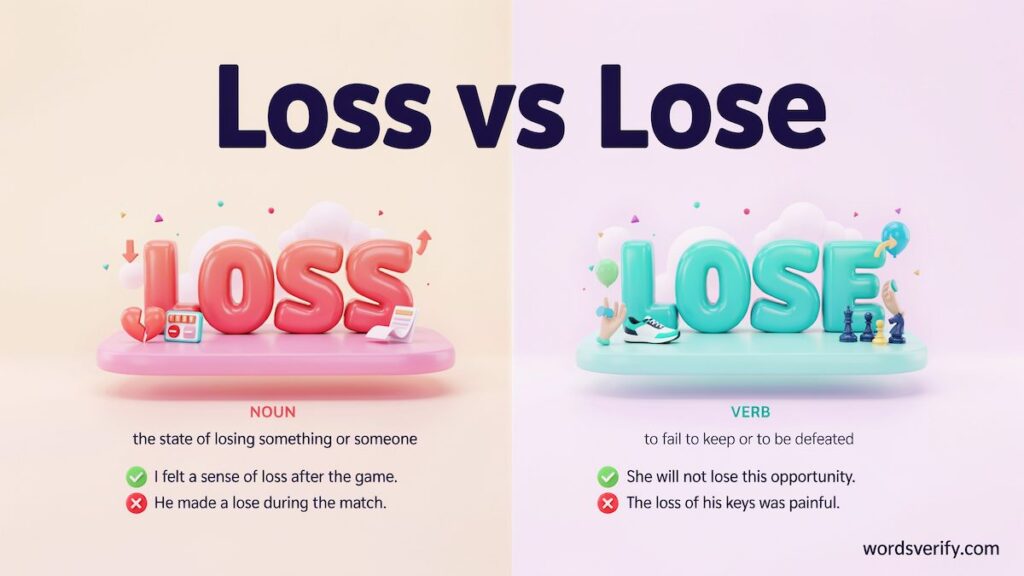
Ever stopped while writing, wondering whether you should use “lose” vs “loss”? You’re certainly not alone. These two commonly confused words look almost identical, but using one in place of the other can change the meaning of your sentence. The good news? Telling them apart is easier than it seems. The key to understanding the difference between lose and loss is knowing what each word does. One describes an action, while the other names an outcome or experience. In this guide, we’ll break down lose vs loss with simple explanations, everyday examples, and helpful tips so you can use both words with confidence.
Loss vs Lose The Quick Difference
The main difference between loss and lose comes down to their parts of speech. Although both words relate to losing something, they don’t perform the same job in a sentence.
Loss is a noun. It describes the act, fact, or result of losing something. It can refer to a missing possession, a financial setback, a defeat, or the death of someone.
Lose is a verb. It describes an action or experience, such as misplacing an object, failing to win a competition, or no longer having something.
Consider these examples:
- I don’t want to lose my phone.
- Losing my phone would be a terrible loss.
- The team might lose the championship.
- The team’s loss disappointed its supporters.
Notice how the words work differently. In the first and third examples, lose describes an action or possible event. In the second and fourth examples, loss names the result or experience.
Loss vs Lose Comparison Table
| Feature | Loss | Lose |
|---|---|---|
| Part of speech | Noun | Verb |
| Meaning | The act, fact, or result of losing | To misplace, fail to win, or no longer have something |
| Main function | Names an event or outcome | Describes an action or state |
| Singular/plural | Loss/losses | Not applicable |
| Related forms | Losses | Loses, losing, lost |
| Example | The loss was unexpected. | Don’t lose your keys. |
| Common phrase | Financial loss | Lose money |
An easy way to remember the difference is to think of loss as something you experience and lose as something you do.
For instance, you can lose your job, but the loss of your job might create financial difficulties. One word describes what happens. The other names the experience or outcome.
Learn the difference between commonly mixed-up more words
Nitch vs Niche Which one Is Correct?
What Does Loss Mean?
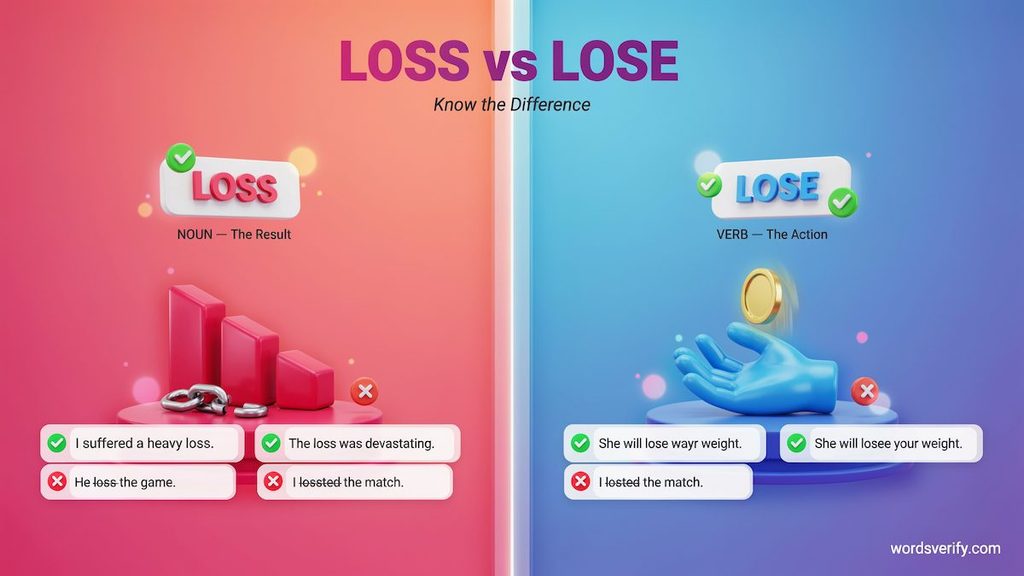
Loss is a noun that describes the act, fact, or result of losing something valuable, useful, or important. It can involve physical possessions, money, opportunities, relationships, health, or even life itself.
The meaning depends on the situation. Sometimes loss describes something you no longer possess. In other cases, it refers to a reduction, defeat, or painful personal experience.
Here are its most common uses.
Loss as the Absence of Something
One common use of loss involves something that disappears or becomes unavailable. You might experience the loss of your keys, a document, a phone, or an important possession.
For example:
- The loss of her passport delayed the trip.
- The company reported the loss of several important documents.
- His greatest concern was the loss of his family photographs.
- The loss of electricity interrupted the entire neighborhood.
In these sentences, loss identifies something that is missing or no longer available.
Loss as Grief or Bereavement
Loss can also describe the emotional experience of someone dying. When a person passes away, their family and friends may experience grief, sadness, and bereavement.
Expressions such as “a tragic loss,” “the loss of a loved one,” and “a great personal loss” frequently appear in everyday conversations, news reports, and formal writing.
Examples:
- The family struggled to cope with the loss of their mother.
- His sudden death was a devastating loss for the community.
- She needed time to recover from the emotional impact of her personal loss.
- The entire town mourned the tragic loss of life.
Remember that loss names the event or experience. It doesn’t describe the action of someone losing a person.
Loss as a Financial Setback
In business and finance, loss refers to a situation in which expenses exceed income or an asset decreases in value.
A company might experience financial losses because of falling sales, rising operating costs, poor investments, or unexpected expenses.
For example:
- The business suffered a significant financial loss last year.
- Rising production costs contributed to the company’s losses.
- The investor accepted a loss after selling the shares.
- The store reported a loss during its first quarter.
In financial writing, loss often appears alongside words such as revenue, profit, investment, capital, and income.
Loss as a Defeat in Sports or Competition
When a person or team fails to win a game, match, or competition, the result can be described as a loss.
For example:
- The team’s loss surprised its supporters.
- Their latest loss ended a five-game winning streak.
- The coach accepted responsibility for the championship loss.
- It was a disappointing loss after months of preparation.
Here, loss refers to the outcome rather than the action of competing.
Loss as a Reduction or Decrease
Another important meaning involves a reduction in weight, quantity, value, or ability.
Common expressions include:
- Weight loss: A reduction in body weight.
- Hearing loss: A partial or complete reduction in the ability to hear.
- Data loss: The disappearance or destruction of stored information.
- Memory loss: Difficulty remembering information or experiences.
- Loss of appetite: A reduced desire to eat.
- Loss of confidence: A decline in someone’s belief in their abilities.
Examples:
- Regular exercise contributed to her weight loss.
- The damaged equipment caused data loss.
- The patient experienced temporary hearing loss.
- A series of setbacks resulted in a loss of confidence.
Common Expressions Using Loss
Several everyday expressions use loss as a noun.
| Expression | Meaning | Example |
|---|---|---|
| Financial loss | Losing money or value | The company reported a financial loss. |
| Weight loss | Reduction in body weight | Her weight loss happened gradually. |
| Loss of life | Death or deaths | The accident resulted in a loss of life. |
| Personal loss | An individual setback or bereavement | He experienced a painful personal loss. |
| At a loss | Confused or unsure what to do | I was at a loss for words. |
| Total loss | Something completely destroyed or no longer usable | The damaged vehicle was declared a total loss. |
| Heavy loss | A significant defeat or financial setback | The business suffered a heavy loss. |
Learn the difference between commonly mixed-up more words
Feed vs Fead and which one is correct?
What Does Lose Mean?
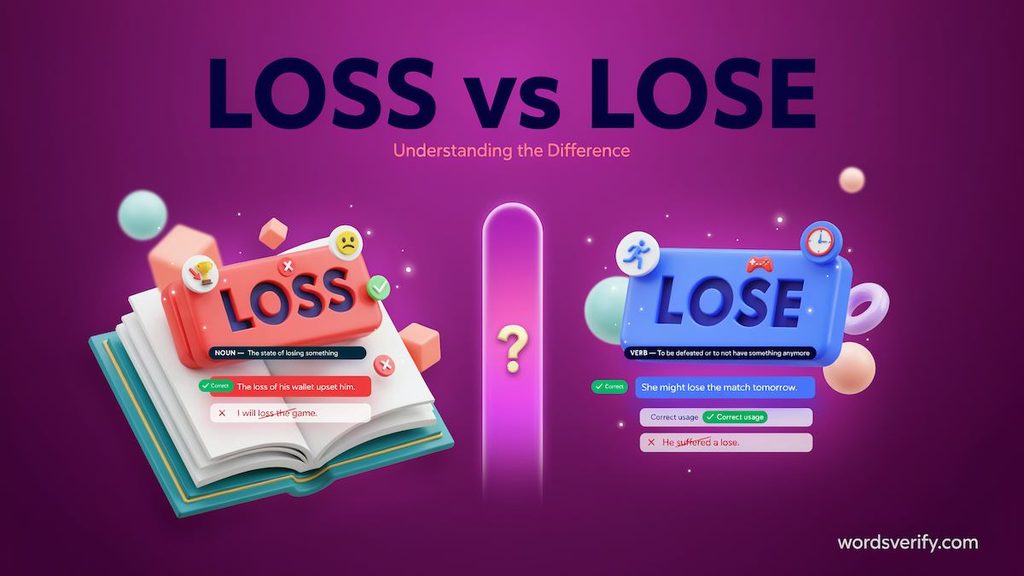
Lose is a verb that describes an action or situation in which someone misplaces something, fails to win, or no longer possesses something.
You can lose your wallet, lose a competition, lose money, lose confidence, or lose someone you love. Although the situations differ, the word describes an action or experience.
To Misplace Something
The most familiar meaning of lose involves putting something somewhere and being unable to find it.
For example:
- I always lose my car keys.
- Don’t lose the receipt after purchasing the laptop.
- She managed to lose her phone during the journey.
- He doesn’t want to lose his passport before the flight.
In these examples, lose means to misplace something or become unable to locate it.
To Fail to Win
Another common use involves competitions, sports, games, and contests.
When someone fails to win, they lose.
Examples:
- Our team might lose the final match.
- She trained hard because she didn’t want to lose the competition.
- They could lose the championship if they don’t improve.
- Nobody enjoys watching their favorite team lose.
This meaning also appears in the expression “win or lose.” It refers to both possible outcomes of a competition.
For example:
“Win or lose, we should appreciate the team’s effort.”
Here, win and lose describe two possible outcomes. However, when you’re talking about a particular defeat as an event or result, use loss.
Compare:
- We might lose the match.
- We suffered a painful loss.
To No Longer Have Someone or Something
Lose can describe the experience of no longer having someone or something important.
For example:
- She was afraid of losing her best friend.
- He didn’t want to lose his job.
- The family feared they might lose their home.
- Nobody wants to lose someone they love.
This meaning can involve separation, death, or the disappearance of an important relationship or possession.
To Reduce Weight, Money or Value
Lose also appears when someone experiences a reduction in something.
Examples:
- She wants to lose five pounds.
- The company could lose money if sales continue falling.
- The investment may lose value over time.
- He lost several kilograms during the training program.
Notice the grammatical difference between “weight loss” and “lose weight.” The first expression uses a noun. The second uses a verb.
To Waste Time or Miss an Opportunity
Sometimes lose describes failing to use something effectively or allowing an opportunity to disappear.
Examples:
- Don’t lose time arguing about minor problems.
- He lost his chance to apply for the scholarship.
- We shouldn’t lose this opportunity.
- The company lost valuable customers because of poor service.
Common Expressions Using Lose
| Expression | Meaning | Example |
|---|---|---|
| Lose weight | Reduce body weight | I want to lose weight. |
| Lose interest | Stop being interested | He began to lose interest in the project. |
| Lose control | No longer manage a situation | The driver lost control of the vehicle. |
| Lose hope | Stop believing something will happen | Never lose hope during difficult times. |
| Lose track | Stop knowing or remembering something | I lost track of time. |
| Lose your temper | Become angry | She lost her temper during the argument. |
| Lose confidence | Become less confident | He started to lose confidence. |
| Lose money | Experience a financial decrease | The company could lose money. |
Learn the difference between commonly mixed-up more words
Discard vs Disgard Which one Is Correct?
Loss vs Lose Key Differences Explained
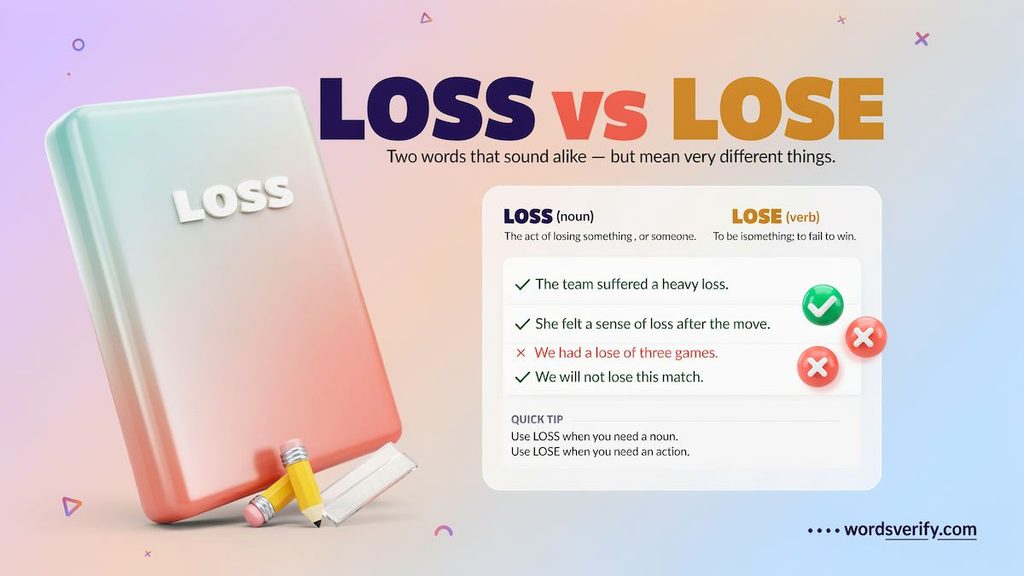
Understanding the difference between lose vs loss becomes easier when you examine how each word behaves in a sentence.
Although their meanings are closely connected, their grammatical functions remain separate.
Loss Is a Noun
A noun names a person, place, thing, idea, event, or experience. Loss belongs to this category because it identifies the event or result of losing something.
You can place articles and adjectives before it.
Examples:
- A significant loss
- The financial loss
- An unexpected loss
- Several business losses
- A tragic loss
You can also use loss as the subject or object of a sentence.
For example:
“The financial loss affected the company’s operations.”
Here, loss is the main noun in the subject.
“She couldn’t accept the loss of her favorite necklace.”
In this sentence, loss functions as the object of the preposition “of.”
Lose Is a Verb
A verb describes an action, event, or state. Lose belongs to this category because it explains what someone does or experiences.
It can change according to tense and subject.
Examples:
- I lose my keys frequently.
- She loses interest quickly.
- They lost the match yesterday.
- He is losing confidence.
- We don’t want to lose this opportunity.
You can also use lose with an object.
For example:
“She doesn’t want to lose her job.”
Here, lose is the main verb, while “her job” is its direct object.
Can You Use Loss vs Lose Interchangeably?
No. The two words cannot replace each other because they have different grammatical functions.
Consider these sentences:
| Incorrect sentence | Correct sentence | Reason |
|---|---|---|
| I don’t want to loss my wallet. | I don’t want to lose my wallet. | The sentence needs a verb. |
| She experienced a lose. | She experienced a loss. | The sentence needs a noun. |
| He wants weight lose. | He wants weight loss. | Loss functions as a noun. |
| The team might loss the game. | The team might lose the game. | Modal verbs take the base form of a verb. |
| Their lose was unexpected. | Their loss was unexpected. | A noun is needed to describe the result. |
The easiest way to remember the difference is to check the job the word performs. If the sentence describes an action, choose lose. If it names an event or outcome, choose loss.
Learn the difference between commonly mixed-up more words
Inversely vs Conversely which one is correct?
Loss vs Lose Pronunciation How to Say Each Word
Although loss and lose look similar, they don’t sound exactly alike. Their final consonants create an important pronunciation difference.
The word loss ends with an unvoiced /s/ sound, while lose ends with a voiced /z/ sound.
Here are their standard American English IPA pronunciations:
| Word | IPA | Final sound |
|---|---|---|
| Loss | /lɔːs/ | /s/ |
| Lose | /luːz/ | /z/ |
The exact vowel quality in loss can vary by American accent. Some speakers pronounce it with a vowel closer to /ɑː/.
How to Pronounce Loss
To pronounce loss:
- Start with the /l/ sound.
- Use the vowel sound found in words such as “thought” for many American speakers.
- Finish with an unvoiced /s/ sound.
The final sound resembles the one in “bus,” “miss,” and “class.”
How to Pronounce Lose
To pronounce lose:
- Start with the /l/ sound.
- Use the long /uː/ vowel sound, similar to the vowel in “blue.”
- Finish with a voiced /z/ sound.
The final sound resembles the one in “zoo,” “buzz,” and “please.”
Why Do Loss and Lose Sound Different?
The final consonants make the biggest difference.
When you pronounce /s/, your vocal cords don’t vibrate. When you pronounce /z/, they do.
Try placing your fingers lightly against your throat while saying both sounds. You should feel vibration when producing /z/ but not when producing /s/.
This small pronunciation detail can help you distinguish the words when speaking and listening.
Learn the difference between commonly mixed-up more words
Ironic vs Unironic which one is correct?
Loss vs Lose in Example Sentences
Sometimes, the best way to understand a grammar rule is to see it working in real situations. The following examples show how both words can describe the same general event while serving different purposes.
1.Losing a Personal Belonging
- I might lose my wallet if I don’t keep it somewhere safe.
- The loss of my wallet caused several problems.
- She doesn’t want to lose her phone again.
- The loss of her phone disrupted her daily routine.
2.Losing a Game or Competition
- Our team could lose the championship.
- The team’s loss shocked its supporters.
- They don’t want to lose another match.
- Their latest loss ended an impressive winning streak.
3.Losing Money
- The investor could lose money.
- The investment resulted in a significant loss.
- The business might lose customers.
- The company reported substantial customer and revenue losses.
4.Losing Someone You Love
- Nobody wants to lose someone they love.
- The loss of a loved one can be deeply painful.
- She feared she might lose her father.
- The family struggled after the loss of their grandfather.
5.Losing Weight
- She wants to lose ten pounds.
- Her gradual weight loss improved her fitness.
- Exercise can help people lose weight.
- The doctor discussed the causes of unexpected weight loss.
These examples demonstrate that the difference between lose and loss isn’t about the general situation. It’s about whether you’re describing the action or naming the outcome.
Learn the difference between commonly mixed-up more words
Rehireable vs Rehirable Which one Is Correct?
Loss vs Lose in Different Contexts
Certain expressions cause more confusion than others. Weight loss, financial loss, and losing someone are particularly useful examples because both words frequently appear in these situations.
Weight Loss vs Lose Weight
Both expressions are correct, but they have different grammatical structures.
Weight loss is a noun phrase that describes a reduction in body weight.
Lose weight is a verb phrase that describes the action of reducing body weight.
Examples:
- Her weight loss was gradual.
- She wants to lose weight.
- The doctor explained the possible causes of weight loss.
- Regular physical activity can help people lose weight.
You can remember the distinction by asking whether you’re naming the result or describing the action.
Lose Someone vs Loss of Someone
When someone dies or leaves your life, both lose and loss can describe the situation. However, their sentence structures differ.
Use lose someone when describing the experience or possibility of no longer having that person in your life.
Use the loss of someone when naming the event or emotional experience.
Examples:
- She was afraid of losing her husband.
- The loss of her husband changed her life.
- He didn’t want to lose his closest friend.
- The loss of a close friend can be difficult to accept.
A common question is whether to say “lose someone or loss someone.”
The correct expression depends on the sentence:
- “I don’t want to lose someone I love.” Correct.
- “The loss of someone I love was devastating.” Correct.
- “I don’t want to loss someone I love.” Incorrect.
- “The lose of someone I love was devastating.” Incorrect.
Remember that lose is a verb and loss is a noun.
Lose a Game vs Suffer a Loss
Sports provide some of the clearest examples of the difference between lose and loss.
Use lose when describing the action of failing to win. Use loss when referring to the defeat itself.
Examples:
- Our team might lose the final.
- The team suffered a disappointing loss.
- They don’t want to lose another game.
- Their latest loss ended an impressive winning streak.
Both expressions are natural. The correct choice depends on the sentence structure.
Lose Money vs Financial Loss
Financial writing also uses both words frequently.
Lose money describes an action or financial experience. Financial loss names the negative result.
Examples:
- The company could lose money this quarter.
- The business reported a financial loss.
- Investors may lose money when market prices fall.
- The company experienced substantial financial losses.
In professional writing, choosing the correct word helps distinguish between an ongoing financial problem and a recorded outcome.
Learn the difference between commonly mixed-up more words
Monkeys vs Monkies which one is correct?
Common Grammatical Forms of Loss vs Lose
The spelling problem becomes even more confusing when you introduce related words such as lost, loses, losses, and losing.
These forms belong to different grammatical categories. Understanding their functions will help you avoid mistakes.
Loss, Losses and Losing
Loss is the singular noun.
Example: The company suffered a loss.
Losses is the plural noun.
Example: The company suffered several losses.
Losing is the present participle or gerund form of the verb lose.
Example: Losing the competition disappointed the players.
Notice that losses and losing aren’t interchangeable.
- The team experienced several losses.
- The team is losing the match.
The first sentence names multiple defeats. The second describes an ongoing action.
Lose, Loses, Lost and Losing
Lose is an irregular verb. It changes form depending on the tense and grammatical subject.
| Verb form | Grammatical use | Example |
|---|---|---|
| Lose | Base form | I don’t want to lose. |
| Loses | Third-person singular present | He loses his keys frequently. |
| Lost | Simple past | She lost her phone yesterday. |
| Lost | Past participle | They have lost the match. |
| Losing | Present participle/gerund | He is losing confidence. |
The past tense of lose is lost, not lossed.
For example:
- Present: I lose my keys.
- Past: I lost my keys.
- Present perfect: I have lost my keys.
- Future: I will lose my keys if I’m careless.
What Is the Plural of Loss?
The plural of loss is losses.
You use losses when referring to more than one loss, setback, defeat, or reduction.
Examples:
- The company reported annual losses.
- The team suffered three consecutive losses.
- The business experienced financial losses.
- The country faced significant economic losses.
The pronunciation also changes slightly. Losses is generally pronounced /ˈlɔːsɪz/ in American English.
Loses vs Losses What’s the Difference?
These words look similar but have different grammatical functions.
Loses is a verb form. It describes an action performed by a singular third-person subject in the present tense.
Losses is the plural form of the noun loss.
Compare:
- He loses his keys frequently.
- His frequent losses of important documents frustrate his colleagues.
Another example:
- The company loses money every month.
- The company reports monthly financial losses.
A simple test helps: if the word follows a subject and describes an action, you probably need loses. If it names multiple negative outcomes, you need losses.
Learn the difference between commonly mixed-up more words
Salvadoran vs Salvadorian Which one Is Correct?
Common Mistakes When Using Loss vs Lose
Even experienced English speakers sometimes mix up these words. Their similar spelling and related meanings make the confusion understandable. However, a few simple grammar checks can prevent most errors.
Using Loss Instead of Lose
This mistake usually happens when someone uses a noun where the sentence requires a verb.
Incorrect: I don’t want to loss my job.
Correct: I don’t want to lose my job.
Incorrect: She might loss the competition.
Correct: She might lose the competition.
Incorrect: Please don’t loss your temper.
Correct: Please don’t lose your temper.
One useful clue is the word “to.” When to introduces a verb in an infinitive construction, you need the base form lose.
For example:
- To lose weight.
- To lose money.
- To lose interest.
- To lose a competition.
You wouldn’t write “to loss weight” because loss is a noun.
Using Lose Instead of Loss
This mistake happens when a sentence requires a noun rather than a verb.
Incorrect: The company experienced a financial lose.
Correct: The company experienced a financial loss.
Incorrect: Her lose was unexpected.
Correct: Her loss was unexpected.
Incorrect: Weight lose can happen for several reasons.
Correct: Weight loss can happen for several reasons.
Remember that words such as “a,” “the,” and possessive adjectives often introduce nouns. If your sentence needs a noun in that position, loss may be the correct choice.
Confusing Lose with Loose
The words lose, loss, and loose create another common spelling problem.
Although their spellings are similar, their meanings and grammatical functions differ.
- Lose: A verb meaning to misplace something, fail to win, or no longer have something.
- Loss: A noun describing the act, event, or result of losing.
- Loose: Usually an adjective meaning not tight, firmly attached, or securely fixed.
Examples:
- Don’t lose your house keys.
- The company reported a financial loss.
- My shirt feels too loose.
- The dog escaped because its collar was loose.
Loose can also function as a verb in the less common sense of releasing or setting something free. The related verb loosen means to make something less tight or firm.
For example:
- Please loosen the knot.
- He loosened his tie after dinner.
A simple memory trick helps: loose has two O’s, while lose has only one. Think of the extra O in loose when something isn’t tight.
Why Do People Confuse Loss and Lose?
Several factors contribute to the confusion.
Similar spelling: Both words begin with “los” and differ by only one letter at the end.
Related meanings: Both words describe situations involving something disappearing, decreasing, or no longer being available.
Pronunciation differences: The final /s/ and /z/ sounds can be difficult to notice, especially when people speak quickly.
Typing mistakes: Autocorrect and predictive text sometimes replace one word with another.
Grammatical uncertainty: Writers who don’t recognize nouns and verbs may choose a word based on meaning alone rather than sentence structure.
The solution is simple: identify the part of speech before choosing the spelling.
Learn the difference between commonly mixed-up more words
Attend vs Tend which one is correct?
Easy Ways to Remember Loss vs Lose
You don’t need complicated grammar rules to remember the correct spelling. A few practical tricks can make the difference stick.
Use the Noun and Verb Trick
Remember this simple rule:
- Loss = noun.
- Lose = verb.
If you can replace the word with another noun such as problem, event, or setback, loss is probably correct.
If you can replace it with another verb such as misplace, drop, or fail to win, lose is probably correct.
For example:
“I don’t want to lose my wallet.”
You could replace lose with misplace:
“I don’t want to misplace my wallet.”
The sentence still makes sense. Therefore, lose is the correct choice.
Now consider:
“The loss of my wallet caused problems.”
You could replace loss with disappearance:
“The disappearance of my wallet caused problems.”
Again, the sentence works.
Use the Sentence Substitution Test
When you’re unsure whether to use lose or loss, replace the word with a simple alternative.
| If you mean… | Use… | Example |
|---|---|---|
| Misplace | Lose | Don’t lose your keys. |
| Fail to win | Lose | We might lose the match. |
| No longer have | Lose | She could lose her job. |
| An event or result | Loss | The loss was unexpected. |
| A financial setback | Loss | The company reported a loss. |
| Multiple setbacks | Losses | The business suffered losses. |
This technique works particularly well when editing emails, essays, articles, and professional documents.
Remember These Quick Examples
- I don’t want to lose my phone.
- The loss of my phone was frustrating.
- She might lose the game.
- Her team’s loss surprised everyone.
- He wants to lose weight.
- His weight loss was gradual.
A little practice can make correct word choice almost automatic.
Learn the difference between commonly mixed-up more words
Hoodie vs Hoody Which one Is Correct?
Loss vs Lose in American and British English
One useful fact about loss and lose is that their spelling doesn’t change between American and British English.
Both varieties use:
- Loss
- Lose
- Lost
- Losing
- Loses
- Losses
There is no separate British spelling of loss or lose. The same spelling rules apply in American, British, Canadian, and Australian English.
Pronunciation can vary slightly between regional accents. For example, American speakers may pronounce the vowel in loss differently from many British speakers. However, these accent differences don’t change the words’ meanings or spellings.
Examples in both American and British English:
- I don’t want to lose my wallet.
- The company suffered a financial loss.
- She wants to lose weight.
- The team experienced several losses.
Regardless of where you write, the grammatical distinction remains the same.
Loss vs Lose in Everyday and Professional Writing
These words appear in almost every type of writing, from casual text messages to financial reports. Understanding their correct usage helps make your communication clearer.
in Emails and Messages
In everyday communication, lose usually describes an action or possibility, while loss names the experience or result.
Examples:
- Please don’t lose the documents I sent you.
- I’m sorry for your loss.
- We don’t want to lose this opportunity.
- The loss of the original files caused a delay.
Notice the expression “I’m sorry for your loss.” It’s a common phrase used to express sympathy after someone’s death. Replacing loss with lose would make the sentence grammatically incorrect.
in Business and Financial Writing
Businesses use these words when discussing revenue, investment, customers, profits, and operating performance.
Examples:
- The company could lose money if demand continues to fall.
- The business reported an operating loss.
- Poor customer service may cause the company to lose clients.
- Rising expenses contributed to substantial financial losses.
In accounting, a loss generally refers to a negative financial result. The exact meaning depends on the financial measure being discussed.
For example, a company can report a net loss when its total expenses exceed its total income during a reporting period.
The distinction between lose and loss matters because financial reports need precise language. A company might lose customers, but the resulting decline in revenue could contribute to a financial loss.
in Sports and News Writing
Sports journalists regularly use both words when reporting match results and competition outcomes.
Examples:
- The national team could lose its next match.
- The team’s latest loss disappointed its supporters.
- The players don’t want to lose the final.
- The coach discussed the reasons behind the defeat.
News reports also use loss when describing deaths, missing resources, and major setbacks.
For example:
“The accident resulted in a significant loss of life.”
Here, loss refers to deaths rather than an action performed by someone.
in Academic and Formal Writing
Academic writing uses both words when discussing research, information, performance, and measurable changes.
Examples:
- Data loss can affect the reliability of a research project.
- Researchers may lose important information if they fail to preserve original records.
- The study examined memory loss among older adults.
- Students can lose marks for incorrect answers.
- The experiment resulted in a loss of statistical information.
In formal writing, grammatical accuracy matters because the wrong word can make an otherwise clear sentence confusing.
A Complete Word Comparison
The following table brings together the most important forms and related words.
| Word | Part of speech | Meaning | Example |
|---|---|---|---|
| Loss | Noun | The act, fact, or result of losing | The loss was unexpected. |
| Losses | Plural noun | Multiple losses or setbacks | The company reported losses. |
| Lose | Verb | To misplace or fail to win | Don’t lose your wallet. |
| Loses | Verb | Third-person singular present of lose | He loses his keys frequently. |
| Lost | Past tense/past participle | No longer has or failed to win | She lost her phone. |
| Losing | Present participle/gerund | The action of losing | He is losing confidence. |
| Loose | Adjective, sometimes verb | Not tight or securely fixed; to release | The screw is loose. |
| Loosen | Verb | To make less tight | Loosen the knot. |
| Loser | Noun | Someone who loses | The loser congratulated the winner. |
Understanding these related forms makes the spelling distinction easier to remember.
practice session Lose vs Loss
Test your understanding of lose vs loss with these sentences. Choose the correct word in each blank. Pay attention to the grammatical context rather than guessing!
- I don’t want to ______ my new phone.
- The team suffered a disappointing ______ in the final match.
- She hopes to ______ a few pounds before summer.
- The company reported significant financial ______ last year.
- Don’t ______ your patience over such a small mistake.
- The ______ of his grandfather deeply affected the family.
- Our team never likes to ______ a championship game.
- He often ______ his keys because he’s forgetful.
- The business experienced a major ______ after the economic downturn.
- Did you ______ your wallet at the shopping mall?
- Her greatest fear is the ______ of someone she loves.
- If you don’t practice regularly, you may ______ your progress.
- The player couldn’t accept the ______ after working so hard.
- She doesn’t want to ______ another opportunity.
- The company faced heavy ______ during its first year.
- My brother always ______ his temper when he’s frustrated.
- We should learn from every ______ instead of giving up.
- I don’t want to ______ sleep over something I cannot control.
- The sudden ______ of electricity interrupted the meeting.
- If the team plays carelessly, it might ______ the match.
- He has worked hard and doesn’t want to ______ everything he’s achieved.
- The family is still grieving over their tragic ______.
- She ______ interest whenever the conversation becomes boring.
- A small spelling mistake can sometimes result in a significant ______ in meaning.
- You may ______ a game, but that doesn’t mean you’ve failed at everything.
Answers
- lose
- loss
- lose
- losses
- lose
- loss
- lose
- loses
- loss
- lose
- loss
- lose
- loss
- lose
- losses
- loses
- loss
- lose
- loss
- lose
- lose
- loss
- loses
- loss
- lose
Here’s a trusted source for clear word meanings:
FAQs
How do you use lose vs loss correctly?
Use lose as a verb when describing an action, such as misplacing something, failing to win, or no longer having something. Use loss as a noun when referring to the result or experience of losing.
- I don’t want to lose my keys.
- The company reported a financial loss.
Is it loss or lost when talking about a game?
Use lost when describing a game that someone failed to win. Use loss when referring to the defeat itself.
- Our team lost the final match.
- The defeat was a disappointing loss.
Which is correct losses or loses?
Both are correct, but they have different grammatical roles. Losses is the plural form of the noun loss, while loses is the third-person singular form of the verb lose.
- The business suffered heavy losses.
- She loses her patience easily.
Is it loss or lose weight?
Lose weight is correct because lose describes the action of reducing your weight. Loss appears in the noun phrase weight loss.
- I want to lose weight.
- Regular exercise can support weight loss.
How do you use loss in a sentence?
Use loss as a noun to describe something that has been lost, a defeat, or a reduction in value or amount.
- The team suffered a major loss.
- The loss of his wallet ruined his day.
- The company reported a financial loss.
When you lose someone, is it loss or lost?
Use lose when describing the action or possibility of no longer having someone in your life. Use loss when referring to the experience itself.
- I don’t want to lose someone I love.
- Losing her was a painful loss.
Which is correct: “I’ve lost” or “I lost”?
Both are correct. I’ve lost uses the present perfect tense and connects a past event to the present. I lost uses the simple past tense to describe a completed event.
- I’ve lost my phone, so I can’t call you.
- I lost my phone yesterday.
Do you lose or loose a game?
Lose is correct because it means to fail to win. Loose is usually an adjective meaning not tight or firmly attached.
- We don’t want to lose the game.
- My loose shoelace keeps coming undone.
Is it “win or lose” or “win or loss”?
Win or lose is the correct expression. Both words describe possible outcomes, and lose is the verb that contrasts with win.
- I’ll support my team whether they win or lose.
Is it “my team lose” or “my team loses”?
In American English, my team loses is generally correct because team is treated as a singular collective noun. Use lose with a plural subject.
- My team loses whenever it plays that rival.
- My favorite teams lose occasionally.
What does loss mean?
Loss is a noun that describes the act, result, or experience of losing something. It can refer to money, a competition, an opportunity, or someone important.
- The family experienced a tragic loss.
- The company suffered a financial loss.
How do you use loses in a sentence?
Loses is the present-tense form of lose used with singular third-person subjects such as he, she, and it.
- He loses his keys almost every week.
- She loses focus when she’s tired.
- The team loses another close match.
What is the difference between loose and lose?
Lose is a verb meaning to misplace something or fail to win. Loose is usually an adjective meaning not tight, firmly attached, or secure.
- Don’t lose your wallet.
- These trousers are too loose.
Why do people write “loose” instead of “lose”?
People often confuse these words because their spellings are similar and their pronunciation can sound close in casual speech. However, lose ends with a voiced Z sound, while loose ends with an unvoiced S sound. Remember: you lose your keys, but your shoelaces shouldn’t be loose.
What is an example of a loss?
A loss can refer to a defeat, a financial setback, or the experience of losing someone or something valuable.
- The team suffered a 3–1 loss.
- The business recorded a financial loss.
- The loss of her grandfather was heartbreaking.
Should I say “sorry for your lost” or “sorry for your loss”?
Sorry for your loss is correct. Loss is a noun that refers to the death of someone or another painful experience. Lost is a verb form or adjective and doesn’t fit this expression.
- I’m so sorry for your loss.
Is “I lost him” or “I lose him” correct?
Both expressions are correct, depending on the context. I lost him describes a past event, while I lose him describes a present or repeated situation.
- I lost him in the crowded shopping mall.
- I lose him whenever he starts explaining complicated subjects.
Is “I have lost” or “I had lost” correct?
Both are grammatically correct, but they express different time relationships. I have lost uses the present perfect tense and connects a past event to the present. I had lost uses the past perfect tense for an event that happened before another past event.
- I have lost my wallet.
- I had lost my wallet before I found it under the sofa.
Is “I am lost” correct?
Yes. I am lost is grammatically correct. Here, lost functions as an adjective describing someone who cannot find their way or feels confused.
- I am lost. Can you show me the way?
- I’m lost when it comes to these grammar rules.
Is it “your loss” or “you’re lost”?
Both expressions are correct, but they mean different things. Your loss refers to something someone misses out on. You’re lost means you cannot find your way or understand something.
- If you don’t want to join us, it’s your loss.
- You’re lost, so let me give you directions.
Is it “lose sleep” or “loose sleep”?
Lose sleep is correct. It means getting less sleep than you need or being unable to sleep because of worry, stress, or another reason.
- I lose sleep whenever I worry about work.
- Don’t lose sleep over a small mistake.
Is it loss or lose a match?
Lose a match is correct because lose is the verb describing the action of failing to win. Loss is the noun used to describe the result.
- We don’t want to lose the match.
- It was our first loss of the season.
What does “to lose” mean?
To lose means to misplace something, fail to win, or no longer have something. It can also describe a reduction in weight, amount, or value.
- Don’t lose your passport.
- They lose every match against that team.
- She wants to lose weight.
Did you lose or lost weight?
Did you lose weight? is correct because did already marks the sentence as past tense. The main verb must stay in its base form, lose, rather than lost.
- Correct: Did you lose weight?
- Incorrect: Did you lost weight?
Is loss the same as lost?
No. Loss is a noun, while lost is the past tense and past participle of lose. Lost can also function as an adjective.
- The team suffered a loss.
- The team lost the game.
- I feel lost without my phone.
What does loss stand for?
Loss isn’t an abbreviation or acronym. It’s an ordinary English noun that refers to the act or result of losing something, such as money, a competition, an opportunity, or a loved one.
What is another word for loss?
The best synonym depends on the context. Common alternatives include:
- Defeat: losing a game or competition.
- Setback: an event that delays progress.
- Decline: a reduction in value, amount, or quality.
- Deprivation: the state of being without something important.
- Bereavement: the experience of losing someone through death.
What does “loses” mean?
Loses is the third-person singular present-tense form of lose. It describes an action performed by he, she, or it.
- He loses his temper quickly.
- She loses interest in boring movies.
- The team loses another game.
What does “I am loose” mean?
I am loose is grammatically possible, but it generally suggests that something about you is not tight, firmly attached, or controlled. It doesn’t mean the same as I am lost, which describes being unable to find your way or feeling confused.
- My clothing is loose.
- I am lost in this unfamiliar city.
Do you say “lost weight” or “lose weight”?
Both expressions are correct, but they refer to different situations. Use lose weight when describing an action or goal. Use lost weight when describing a completed action in the past.
I lost weight last month.
I want to lose weight.
Conclusion
Understanding the difference between lose vs loss doesn’t require a grammar degree. You just need to remember one simple rule: lose is a verb, while loss is a noun. You lose your keys, lose a match, or lose weight. However, you experience a loss, suffer a loss, or report financial losses.
Once you recognize how each word works, choosing the correct spelling becomes much easier. When describing an action, reach for lose. When referring to something you’ve lost or the experience of losing it, use loss. Keep this distinction in mind, and these commonly confused words won’t catch you off guard again. After all, good grammar is worth keeping, not losing!

Lisa AJS is an experienced blogger and language enthusiast at Words Verify, dedicated to making grammar simple, practical, and enjoyable. She writes engaging content on commonly confused words, grammar mistakes, word meanings, and everyday language challenges.