
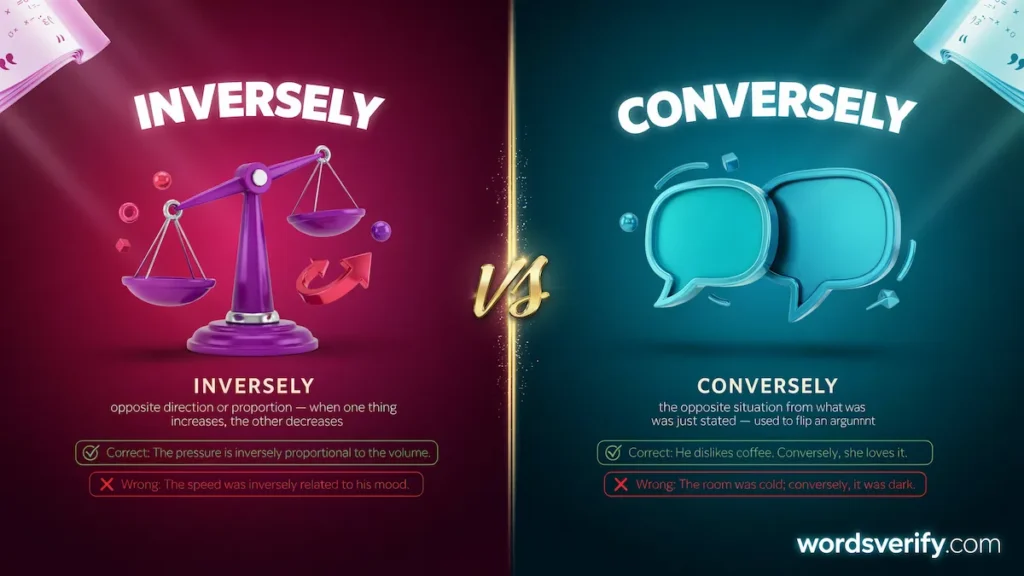
Some words seem interchangeable until you put them in a sentence. “Inversely” vs “conversely” are perfect examples. Both can express an opposite or reversed idea, but they don’t serve exactly the same purpose. Mixing them up can turn a clear sentence into a confusing one, especially when you’re explaining relationships or contrasting ideas. Fortunately, understanding inversely vs. conversely is easier than it sounds. Once you know what each word means and how it works, choosing the right one becomes second nature. Let’s break down their differences, explore practical examples, and uncover common grammar mistakes so you can use both words correctly and confidently.
Inversely vs Conversely Quick Answer
The main difference between inversely vs conversely lies in how you use them.
- Inversely means in an opposite, reverse, or inverse manner. It often describes a relationship in which one thing changes in the opposite direction from another.
- Conversely means in an opposite or contrasting way. It introduces a different perspective, an opposing statement, or a reversed situation.
Consider these examples:
Inversely: The time required to complete a journey decreases as travel speed increases, provided the distance stays the same.
Conversely: Some students prefer studying alone. Conversely, others learn better in groups.
The first example describes a relationship between two quantities. The second introduces a contrasting preference.
Here’s a simple comparison:
| Word | Main purpose | Example |
|---|---|---|
| Inversely | Describes an opposite relationship or direction | Demand and price may move in opposite directions. |
| Conversely | Introduces a contrasting or reversed idea | Some people enjoy cold weather. Conversely, others prefer warm climates. |
Although both words relate to opposite ideas, you can’t always substitute one for the other.
Learn the difference between confusing more English words
Ironic vs Unironic which one is correct?
What Does Inversely Mean?
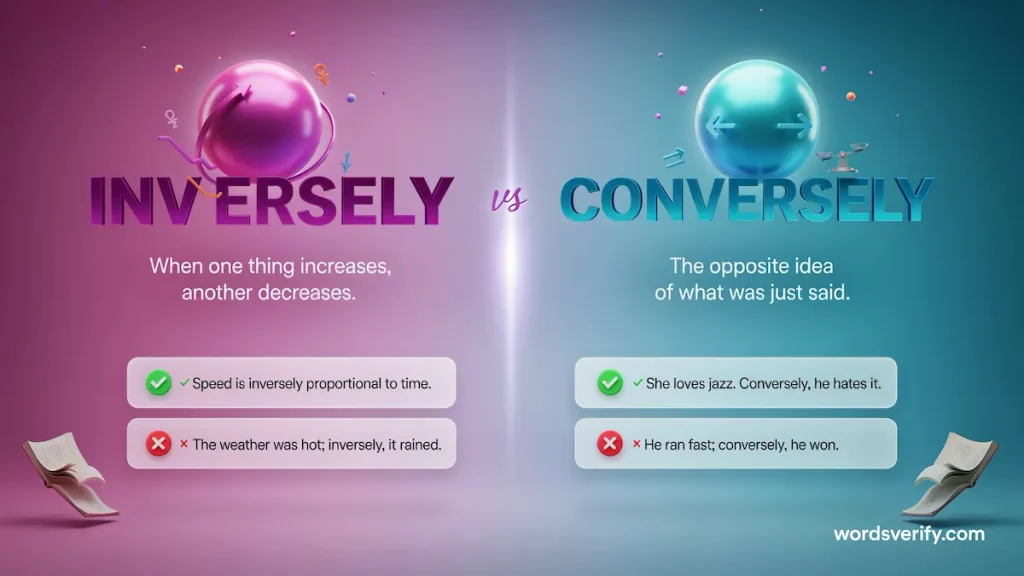
“Inversely” is an adverb that means in an inverse, opposite, or reversed manner. It describes how something relates to or changes in relation to something else.
The word frequently appears when discussing two related quantities. For instance, if one quantity increases while another decreases, you may describe their relationship as inverse.
Imagine driving a car over a fixed distance. When you increase your speed, you generally reduce the time needed to reach your destination. The two quantities move in opposite directions.
However, there’s an important distinction. Not every relationship involving an increase and a decrease qualifies as an inverse proportion. Strict inverse proportion follows a specific mathematical rule.
Inversely in Everyday Language
You don’t need a mathematics degree to understand or use inversely. The word also appears in everyday discussions about behavior, performance, and changing circumstances.
Imagine a company introducing a more efficient production system. As productivity increases, the time needed to manufacture each item may decrease. You could describe these changes as moving in opposite directions.
Here are a few more examples:
- The time needed to complete a task may decrease as the number of equally productive workers increases.
- As the temperature outside rises, the demand for heating generally decreases.
- The number of available seats decreases as more passengers board a vehicle.
- The effort required to complete a familiar task may decrease as experience increases.
- The time needed to fill a swimming pool decreases as the water flow rate increases, assuming the pool’s capacity stays the same.
These examples show how two things can move in opposite directions. However, they don’t all represent strict inverse proportionality.
For example, experience and effort don’t follow a fixed mathematical formula. Someone who has practiced a skill for several years may complete a task faster than a beginner, but additional experience won’t necessarily reduce the required effort at a constant rate.
That distinction matters when choosing precise language.
Inversely in Mathematics and Science
Mathematics provides one of the clearest examples of how inversely works. The word frequently appears when describing inverse proportion, inverse variation, and relationships between variables.
Two quantities are inversely proportional when an increase in one produces a corresponding decrease in the other while their product remains constant.
The mathematical expression is:
[
y \propto \frac{1}{x}
]
This can also be written as:
[
y = \frac{k}{x}
]
Here, (k) represents a nonzero constant.
Let’s look at a practical example.
Suppose a vehicle must travel 120 miles. The following table shows how travel time changes at different constant speeds:
| Speed | Travel time |
|---|---|
| 20 mph | 6 hours |
| 30 mph | 4 hours |
| 40 mph | 3 hours |
| 60 mph | 2 hours |
| 120 mph | 1 hour |
The relationship is inversely proportional because the distance stays fixed.
For every combination, multiplying speed by travel time gives 120.
[
\text{Speed} \times \text{Time} = 120
]
This is a genuine example of inverse proportion.
The same principle appears in science. Boyle’s law, for instance, describes the relationship between the pressure and volume of a fixed amount of gas when its temperature remains constant.
As the volume decreases, the pressure increases. The relationship can be expressed as:
[
P_1V_1=P_2V_2
]
These applications explain why inversely appears so often in mathematics, physics, engineering, and scientific research.
Inversely in Formal and Academic Writing
In academic writing, inversely helps researchers describe relationships between measurable quantities, variables, and opposing trends.
You’ll often encounter it in studies involving economics, biology, environmental science, statistics, and physics.
Consider these examples:
- Under constant temperature, gas pressure varies inversely with volume.
- The time required to complete the experiment decreases as the number of equally productive workers increases.
- The researchers identified an inverse relationship between exercise frequency and resting heart rate.
- The concentration of the substance decreased as the dilution rate increased under the specified experimental conditions.
It’s also important to understand the difference between an inverse relationship and an inverse correlation.
An inverse correlation generally describes a negative statistical association. As one variable increases, another tends to decrease. However, this doesn’t mean the variables follow a strict inverse-proportion formula.
For example, income and the percentage of income spent on basic necessities may show a negative association in certain populations. That doesn’t make them mathematically inversely proportional.
The distinction is simple: use inversely when describing an opposite relationship, but use inversely proportional only when the relationship follows the mathematical definition of inverse proportion.
Learn the difference between confusing more English words
Rehireable vs Rehirable Which one Is Correct?
What Does Conversely Mean?
“Conversely” is an adverb meaning in an opposite, contrasting, or reversed way. Writers commonly use it to introduce an opposing statement, an alternative perspective, or the reverse of a previously discussed situation.
Unlike inversely, conversely doesn’t usually describe a measurable relationship between two variables. Instead, it helps readers understand how one statement contrasts with another.
For example:
“Some people prefer working in a quiet environment. Conversely, others feel more productive in a busy office.”
The second sentence introduces an opposing preference. It doesn’t describe a mathematical relationship or suggest that one preference causes the other.
Conversely is particularly useful in essays, discussions, reports, and formal writing because it connects contrasting ideas.
Conversely as a Contrast Transition
One of the most common uses of conversely is as a transitional adverb.
A transitional adverb connects ideas and shows how one statement relates to another. Conversely signals that the next statement presents an opposing or contrasting situation.
Consider this example:
“Online education offers flexibility for students with busy schedules. Conversely, traditional classroom learning provides direct interaction with teachers and classmates.”
The two statements discuss different advantages of education methods. Conversely introduces the alternative perspective.
Here are more examples:
- Some employees prefer flexible working hours. Conversely, others value a fixed daily schedule.
- City life offers convenient access to services and entertainment. Conversely, rural living often provides more space and quieter surroundings.
- Some businesses focus on short-term profits. Conversely, others prioritize long-term growth.
- Some students learn best through games. Conversely, others prefer structured lessons.
- A large company may have more financial resources. Conversely, a small business can often make decisions more quickly.
In each example, conversely introduces a different perspective.
You can also use expressions such as “on the other hand,” “in contrast,” and “by contrast.” These alternatives help connect contrasting ideas, although their meanings and uses aren’t always identical.
Conversely to Show a Reversed Relationship
Conversely doesn’t only introduce contrasting opinions. It can also explain a relationship from the opposite direction.
For example:
“As the number of available workers increases, the time needed to complete a fixed amount of work may decrease. Conversely, fewer available workers may increase the time required.”
The second statement describes the reverse side of the first relationship.
This use is helpful in analytical writing because it lets you explain both sides of a situation without repeating the entire discussion.
However, reversing a statement doesn’t automatically make the reversed statement true.
In logic, if one statement establishes that A implies B, the reverse statement that B implies A isn’t necessarily true.
Consider this example:
“If a person lives in Paris, that person lives in France.”
The converse would be:
“If a person lives in France, that person lives in Paris.”
The second statement is false because France contains many cities besides Paris.
This distinction is important when using conversely in mathematics, science, and formal arguments.
Conversely in Formal and Academic Writing
In academic writing, conversely helps authors introduce opposing evidence, alternative interpretations, and contrasting research findings.
It’s particularly useful when an argument requires more than one perspective.
For example:
“Previous research suggests that smaller class sizes can improve individual attention. Conversely, larger classrooms may provide more opportunities for group discussion and peer interaction.”
The word helps readers recognize the change in perspective.
Here are a few more examples:
- Previous research found that smaller class sizes improved individual attention. Conversely, larger classrooms offered more opportunities for group discussion.
- Urban development can create employment opportunities. Conversely, it may also increase traffic congestion and housing costs.
- Some researchers emphasize genetic influences on behavior. Conversely, others focus more heavily on environmental factors.
- The proposed policy could reduce operational expenses. Conversely, it might increase the administrative workload.
Use conversely when the second statement genuinely offers an opposing or reversed perspective. Don’t insert it simply because you want a formal-sounding transition.
Sometimes, a straightforward “however” works much better.
Learn the difference between confusing more English words
Monkeys vs Monkies which one is correct?
Inversely vs Conversely Key Differences
Understanding the difference between inversely vs conversely becomes easier when you compare their definitions, grammatical functions, and common uses.
Both words relate to opposition or reversal. However, inversely generally describes the nature of a relationship, while conversely often introduces an alternative or opposite statement.
Comparison Table
| Feature | Inversely | Conversely |
|---|---|---|
| Part of speech | Adverb | Adverb |
| Main meaning | In an inverse or opposite manner | In a contrasting or reversed manner |
| Primary purpose | Describes a relationship or direction | Introduces an opposing or reversed idea |
| Common usage | Mathematics, science, economics | Essays, arguments, discussions, logic |
| Mathematical application | Inverse proportion and inverse variation | Reversing a proposition or relationship |
| Sentence function | Modifies a relationship or action | Often works as a transitional adverb |
| Common alternatives | Oppositely, in reverse | In contrast, on the other hand, by contrast |
| Example | Pressure varies inversely with volume under Boyle’s law conditions. | Some people prefer summer. Conversely, others enjoy winter. |
Where Do Inversely vs Conversely Overlap?
The words sometimes overlap because both can communicate an opposite or reversed situation.
Consider this example:
“Demand increases as supply decreases.”
You could describe the relationship using inversely if the context supports that description.
You could also introduce the reverse situation with conversely:
“When supply decreases, market conditions may push prices upward. Conversely, increased supply may put downward pressure on prices when demand remains unchanged.”
The first word describes the relationship. The second introduces the reverse perspective.
However, supply and demand relationships depend on other market conditions. They shouldn’t automatically be treated as strict inverse proportions.
The important point is that inversely vs conversely don’t simply differ because one means opposite and the other means contrast. Their sentence functions also matter.
Learn the difference between confusing more English words
Salvadoran vs Salvadorian Which one Is Correct?
Inversely vs Conversely Sentence Examples
Examples make the correct usage of both words much easier to understand. The following comparisons show how each one works in different situations.
Inversely Used in a Sentence
Here are some practical examples:
- The time required to travel a fixed distance varies inversely with speed.
- Under constant temperature, the pressure of a gas varies inversely with its volume.
- The time needed to complete the task decreased as the workers’ efficiency improved.
- In the model, the two variables were inversely related.
- The study found an inverse correlation between the two measured variables.
- The intensity of light decreases as the distance from a point source increases, following an inverse-square relationship under ideal conditions.
- The time needed to fill a tank decreases as the water flow rate increases.
- The percentage of household income spent on certain essential goods may decrease as income rises.
These examples show how inversely can describe mathematical, scientific, and everyday relationships.
Conversely Used in a Sentence
Here are some practical examples of conversely in a sentence:
- Some people enjoy working independently. Conversely, others prefer collaborating with a team.
- A larger home offers more living space. Conversely, it may require higher maintenance costs.
- The first method saves time but requires specialized equipment. Conversely, the second method uses basic tools but takes longer.
- Some students learn best through visual materials. Conversely, others prefer listening to explanations.
- The company experienced strong sales during summer. Conversely, winter sales remained relatively low.
- Some people prefer buying products online. Conversely, others enjoy visiting physical stores.
- The first proposal focuses on reducing costs. Conversely, the alternative emphasizes improving service quality.
- The northern region experienced heavy rainfall. Conversely, the southern region remained relatively dry.
Each sentence uses conversely to introduce a different or opposing situation.
Side by Side Examples
The following examples highlight the difference between the two words in similar contexts.
| Inversely | Conversely |
|---|---|
| Travel time varies inversely with speed when distance remains constant. | Faster travel reduces journey time. Conversely, slower travel increases it. |
| Pressure varies inversely with volume under constant-temperature conditions. | Increasing pressure can reduce gas volume. Conversely, reducing pressure can allow the gas to expand. |
| The two variables showed an inverse relationship. | The first group responded positively. Conversely, the second group showed a negative response. |
| The time required decreased as the available work rate increased. | More workers completed the task quickly. Conversely, fewer workers needed more time. |
The first column uses inversely to describe relationships. The second uses conversely to introduce an alternative or reversed statement.
Learn the difference between confusing more English words
Attend vs Tend which one is correct?
Common Mistakes When Using Inversely vs Conversely
Even experienced writers sometimes confuse these words. Their shared connection with opposite ideas makes the mistake understandable. Fortunately, a few simple distinctions can help you avoid awkward sentences.
Using Conversely Instead of Inversely in Mathematical Relationships
A common mistake involves using conversely when describing a mathematical relationship between two variables.
Incorrect: “The travel time varies conversely with speed.”
Better: “The travel time varies inversely with speed when the distance remains constant.”
The second sentence clearly describes an inverse proportional relationship.
However, conversely still has legitimate mathematical uses when introducing a reversed statement or proposition.
Using Inversely to Introduce an Opposing Opinion
Inversely isn’t usually the right choice when you want to introduce a contrasting viewpoint.
Incorrect: “Some people enjoy working from home. Inversely, others prefer working in an office.”
Better: “Some people enjoy working from home. Conversely, others prefer working in an office.”
The corrected sentence uses conversely to introduce an opposing preference.
Assuming Inversely Always Means Inversely Proportional
This mistake can create problems in scientific and mathematical writing.
Two quantities may move in opposite directions without maintaining a constant product.
For example, the price of a product may increase while consumer demand decreases. These variables can have an inverse relationship under certain conditions. However, they aren’t necessarily inversely proportional.
Strict inverse proportion requires a constant product.
Always distinguish between an inverse relationship, an inverse correlation, and inverse proportionality.
Using Conversely When You Mean Completely Different
Conversely doesn’t simply mean unrelated, unusual, or completely different.
For example:
Incorrect: “The two buildings have different architectural styles. Conversely, they were constructed in different centuries.”
Better: “The two buildings have different architectural styles. Additionally, they were constructed in different centuries.”
The second sentence adds another fact rather than introducing an opposing perspective.
Treating Both Words as Perfect Synonyms
Although inversely vs conversely can both express opposition, their grammatical functions aren’t identical.
Consider these examples:
- The relationship between the two variables is inversely proportional.
- The first method is expensive. Conversely, the second method is affordable.
Replacing inversely with conversely in the first sentence would change its intended meaning. Likewise, replacing conversely with inversely in the second would sound unnatural.
The correct choice depends on the relationship between the ideas and the role each word plays.
Learn the difference between confusing more English words
Hoodie vs Hoody Which one Is Correct?
Inversely Proportional vs Directly Proportional
To understand inversely more thoroughly, it’s worth exploring the difference between direct and inverse proportion.
These mathematical concepts describe how two quantities change in relation to each other. Both involve proportional relationships, but their patterns differ.
What Does Directly Proportional Mean?
Two quantities are directly proportional when they increase or decrease together at a constant rate.
The mathematical expression is:
[
y \propto x
]
Or:
[
y=kx
]
Here, (k) represents a constant.
For example, imagine purchasing notebooks that cost $3 each.
| Number of notebooks | Total cost |
|---|---|
| 1 | $3 |
| 2 | $6 |
| 3 | $9 |
| 4 | $12 |
| 5 | $15 |
As the number of notebooks increases, the total cost increases at the same rate.
This is a directly proportional relationship because the price per notebook remains constant.
Other examples include:
- Distance and travel time at a constant speed.
- Total wages and working hours at a fixed hourly rate.
- The circumference and diameter of a circle.
- The amount of an ingredient and the number of servings in a recipe with an unchanged formula.
What Does Inversely Proportional Mean?
Two quantities are inversely proportional when one increases while the other decreases in a way that keeps their product constant.
The formula is:
[
y \propto \frac{1}{x}
]
Or:
[
xy=k
]
Consider a group of workers completing a fixed amount of work. If everyone has equal productivity and works independently, increasing the number of workers reduces the completion time.
| Number of workers | Completion time |
|---|---|
| 1 | 12 hours |
| 2 | 6 hours |
| 3 | 4 hours |
| 4 | 3 hours |
| 6 | 2 hours |
The product remains constant at 12 worker-hours.
Real workplaces don’t always follow this exact pattern. Workers may share equipment, require coordination, or experience diminishing returns. The table illustrates an ideal mathematical model.
Directly Proportional vs Inversely Proportional Comparison
| Feature | Direct proportion | Inverse proportion |
|---|---|---|
| Direction | Both quantities move together | Quantities move in opposite directions |
| Formula | (y=kx) | (y=k/x) |
| Constant | Ratio remains constant | Product remains constant |
| Graph | Straight line through the origin | Hyperbola |
| Example | Number of items and total cost at a fixed price | Speed and travel time over a fixed distance |
Is Inversely the Opposite of Directly?
In mathematical contexts, directly and inversely describe two different types of proportional relationships.
With direct proportion, both quantities change in the same direction. With inverse proportion, they change in opposite directions while maintaining a constant product.
For example, doubling the number of products purchased doubles the total cost when the unit price stays fixed.
Similarly, doubling the speed of a vehicle halves the travel time over a fixed distance.
The distinction is straightforward: direct proportion means the quantities change together, while inverse proportion means they change in opposite directions.
Learn the difference between confusing more English words
Outting vs Outing which one is correct?
Conversely vs Adversely What’s the Difference?
Conversely and adversely sometimes cause confusion because both appear in discussions involving opposing situations. However, they have different meanings.
Conversely means in an opposite, contrasting, or reversed way.
Adversely means negatively, unfavorably, or harmfully.
The difference becomes obvious when you examine their sentence examples.
What Does Adversely Mean?
Adversely describes an unfavorable or harmful effect. It’s commonly used when discussing health, business, weather, environmental conditions, and financial outcomes.
For example:
- The medication adversely affected the patient’s sleep.
- Rising production costs adversely influenced the company’s profits.
- Severe weather conditions adversely affected agricultural production.
- The economic downturn adversely impacted several small businesses.
In each sentence, adversely describes a negative effect.
What Does Conversely Mean?
Conversely introduces an opposing or reversed statement.
For example:
- Some employees prefer morning shifts. Conversely, others work better at night.
- The first investment option offers higher potential returns. Conversely, the second provides greater stability.
- Some regions experienced heavy rainfall. Conversely, others faced drought conditions.
Unlike adversely, conversely doesn’t automatically suggest harm or negativity.
Adversely vs Conversely Comparison
| Feature | Adversely | Conversely |
|---|---|---|
| Meaning | Negatively or unfavorably | In an opposite or contrasting way |
| Function | Describes a harmful effect | Introduces a contrasting idea |
| Common contexts | Health, business, finance, environment | Essays, discussions, arguments |
| Example | Inflation adversely affected purchasing power. | Some prices increased. Conversely, others remained stable. |
Remember the distinction: adversely describes something going badly, while conversely introduces something different or opposite.
Learn the difference between confusing more English words
Excel vs Excell which one is correct?
Synonyms and Related Words
Understanding synonyms can help you choose more natural wording. However, similar words don’t always carry exactly the same meaning.
Synonyms of Inversely
Depending on the context, possible alternatives include:
| Synonym | Meaning or usage |
|---|---|
| Oppositely | In an opposite manner |
| In reverse | In the reverse direction or order |
| Contrarily | In an opposing or contrary way |
| Reciprocally | In a corresponding or mutual relationship |
| Inversely proportionally | According to a strict inverse proportion |
| In the opposite direction | Moving or changing against another direction |
For mathematical writing, “inversely proportional” is often more precise than a general synonym.
For everyday writing, “in the opposite direction” may sound more natural.
Synonyms of Conversely
Useful alternatives include:
| Synonym | Meaning or usage |
|---|---|
| On the other hand | Introduces another perspective |
| In contrast | Highlights a difference |
| By contrast | Emphasizes an opposing comparison |
| Alternatively | Presents another option |
| On the contrary | Introduces a direct contradiction or correction |
| Vice versa | Indicates that the reverse relationship also applies |
For example:
“Some people prefer working independently. On the other hand, others enjoy teamwork.”
You could replace “on the other hand” with “conversely” if the second statement presents a genuine contrast.
However, “vice versa” serves a different purpose. It indicates that the reverse of a stated relationship also applies.
Inverse vs Converse Understanding the Difference
The difference between inverse and converse is closely related to the difference between inversely vs conversely.
Both inverse and converse can refer to something reversed or opposite. However, their meanings depend on context.
- Inverse commonly describes something reversed or opposite in direction, order, or relationship.
- Converse commonly refers to the opposite statement, reverse proposition, or contrasting idea.
For example:
- The inverse of a number is its reciprocal.
- The converse of a conditional statement reverses its hypothesis and conclusion.
In mathematics and logic, inverse and converse have specific meanings. They shouldn’t be treated as identical concepts.
Understanding this distinction makes it easier to recognize why inversely vs conversely aren’t perfect substitutes.
Learn the difference between confusing more English words
Studder vs Stutter which one is correct?
How to Choose Between Inversely vs Conversely
Still unsure which word to use? Start by identifying what you want to communicate.
Are you describing a relationship between two quantities? Or are you introducing an opposing idea?
That simple question usually points you toward the correct choice.
When to Use Inversely
Choose inversely when you want to describe:
- Two quantities changing in opposite directions.
- An inverse proportional relationship.
- A reversed arrangement or order.
- A relationship between variables in mathematics or science.
- Opposing trends in economic or statistical observations.
Example:
“The time needed to complete the journey decreases as speed increases, assuming the distance remains fixed.”
When to Use Conversely
Choose conversely when you want to:
- Introduce a contrasting statement.
- Present an alternative perspective.
- Explain the reverse of a previously discussed situation.
- Compare opposing viewpoints.
- Introduce a converse relationship in a logical argument.
Example:
“Some students prefer online classes because of their flexibility. Conversely, others value the direct interaction offered by traditional classrooms.”
An Easy Trick to Remember the Difference
Here’s a simple way to remember the distinction:
Inversely = Inverse relationship.
Think about two quantities moving in opposite directions. When one increases and the other decreases, inversely may describe their relationship.
Conversely = Contrasting statement.
Think about presenting another side of an argument. When you want to introduce an opposing perspective, conversely is often the better choice.
Try this comparison:
- The temperature rises while heating demand decreases. The two quantities may have an inverse relationship.
- Some people enjoy hot weather. Conversely, others prefer cold weather.
The first describes a relationship. The second contrasts preferences.
Before choosing either word, ask yourself whether you’re describing an opposite relationship or introducing an opposing idea.
Learn the difference between confusing more English words
Choosing vs Chosing which one is correct?
Practice session Inversely vs Conversely
Complete each sentence with the correct word: inversely vs conversely.
- As the speed of a vehicle increases, the time needed to cover a fixed distance decreases __________.
- Some students enjoy studying alone. __________, others learn better in groups.
- For a fixed amount of gas at constant temperature, pressure and volume are __________ proportional.
- The first experiment produced positive results. __________, the second experiment revealed several problems.
- In a fixed-distance journey, travel time varies __________ with speed.
- Some people prefer online shopping. __________, others enjoy visiting physical stores.
- As the number of workers increases, the time required to complete a fixed task may decrease __________.
- The company experienced higher sales in summer. __________, its winter sales were considerably lower.
- Under the right mathematical conditions, two quantities can be __________ proportional.
- One group supported the proposed changes. __________, another group strongly opposed them.
- If the distance remains constant, travel time changes __________ with speed.
- Some readers prefer printed books. __________, others choose digital editions.
- In an inverse-proportional relationship, one quantity changes __________ as the other changes.
- The first method proved effective. __________, the alternative method failed to produce similar results.
- When the temperature of a fixed gas sample remains constant, pressure and volume are __________ proportional.
- Some employees prefer flexible working hours. __________, others value a fixed daily schedule.
- If the number of identical machines increases, the time needed to finish a fixed amount of work may vary __________ with the number of machines.
- The research found strong support for the first theory. __________, the second theory received little attention.
- In a simple inverse relationship, one variable increases while the other decreases __________.
- Some people enjoy busy city life. __________, others prefer the quiet of the countryside.
- For a fixed journey, the time required decreases __________ as average speed increases.
- The first proposal focused on reducing costs. __________, the second emphasized improving quality.
- In Boyle’s law, gas pressure and volume are __________ proportional when temperature and the amount of gas remain constant.
- Some businesses prioritize customer service. __________, others focus more heavily on product development.
- The two quantities do not increase together. Instead, they change __________ under the conditions of the experiment.
Answers
- Inversely
- Conversely
- Inversely
- Conversely
- Inversely
- Conversely
- Inversely
- Conversely
- Inversely
- Conversely
- Inversely
- Conversely
- Inversely
- Conversely
- Inversely
- Conversely
- Inversely
- Conversely
- Inversely
- Conversely
- Inversely
- Conversely
- Inversely
- Conversely
- Inversely
Here’s a trusted source for clear word meanings:
FAQs
Can “conversely” be used at the beginning of a sentence?
Yes. You can use “conversely” at the beginning of a sentence to introduce a contrasting idea or an alternative perspective. For example: “Some people prefer working independently. Conversely, others thrive in a team environment.”
Is “conversely” appropriate in academic writing?
Yes. “Conversely” works well in academic and research writing when you need to present an opposing viewpoint, contrast findings, or explain a different relationship. Use it only when the connection between the ideas supports a genuine contrast.
Can “conversely” replace “however” in every sentence?
No. Although both words can introduce contrasting ideas, they aren’t interchangeable in every context. “However” signals a contrast or qualification, while “conversely” usually introduces an opposing or alternative perspective. Choose the word that best expresses your intended meaning.
What is the difference between “contrary” and “conversely”?
“Contrary” describes something that conflicts with or opposes another idea. “Conversely” is an adverb that introduces a contrasting or reversed point. For example, “Contrary to expectations, sales increased” uses “contrary” to show disagreement with expectations. “Conversely, sales increased in the second quarter” introduces a contrasting development.
Does “converse” have a meaning related to speaking?
Yes. “Converse” can be a verb meaning to talk or have a conversation. It can also function as a noun or adjective referring to an opposite or reversed statement or relationship. Context tells you which meaning applies.
Are the converse and inverse of a logical statement the same?
No. In logic, the converse and inverse are different transformations of a conditional statement. For “If A, then B,” the converse is “If B, then A,” while the inverse is “If not A, then not B.” Neither is automatically equivalent to the original statement.
What is the difference between an inverse relationship and an inverse correlation?
An inverse relationship describes two quantities that move in opposite directions. An inverse correlation is a statistical association in which one variable tends to decrease as the other increases. However, a negative correlation doesn’t necessarily mean the variables follow a strict inverse-proportional relationship.
What is the difference between inversely proportional and negatively correlated?
Inversely proportional describes a specific mathematical relationship in which the product of two quantities remains constant. Negatively correlated means two variables generally move in opposite directions, but their relationship doesn’t have to follow a fixed mathematical formula.
What is the opposite of an inversely proportional relationship?
A directly proportional relationship is the mathematical counterpart of an inversely proportional one. In direct proportion, both quantities increase or decrease together at a constant ratio. In inverse proportion, one increases as the other decreases while their product remains constant.
Can “conversely” describe a mathematical relationship?
Yes. “Conversely” can introduce a reversed or contrasting mathematical statement. For example: “As the number of workers increases, the time needed to complete the task may decrease. Conversely, fewer workers may require more time.” The word introduces the opposite situation rather than defining a specific mathematical formula.
What is a suitable formal alternative to “on the other hand”?
Depending on the context, you can use “conversely,” “in contrast,” “by comparison,” or “alternatively.” Each has a slightly different meaning, so choose the one that accurately connects your ideas.
How can I tell whether “inversely” is the right word in a sentence?
Use “inversely” when you want to describe something happening in an opposite or reversed way, especially when explaining how two quantities relate. For example: “For a fixed distance, travel time varies inversely with speed.” If you are introducing a contrasting viewpoint instead, “conversely” may be the better choice.
Conclusion
Getting the difference between inversely vs conversely right doesn’t have to feel like solving a tricky math problem. Remember, “inversely” describes an opposite or reversed relationship, particularly between quantities, while “conversely” introduces a contrasting idea or presents an alternative perspective. Although both words relate to opposites, they don’t always fit the same situations. Swapping them carelessly can leave readers scratching their heads. The trick is to consider what your sentence is trying to express before choosing a word. With a little practice and attention to context, you’ll avoid common grammar mistakes, write more clearly, and use both terms with confidence. Your sentences will thank you!

Lisa AJS is an experienced blogger and language enthusiast at Words Verify, dedicated to making grammar simple, practical, and enjoyable. She writes engaging content on commonly confused words, grammar mistakes, word meanings, and everyday language challenges.