
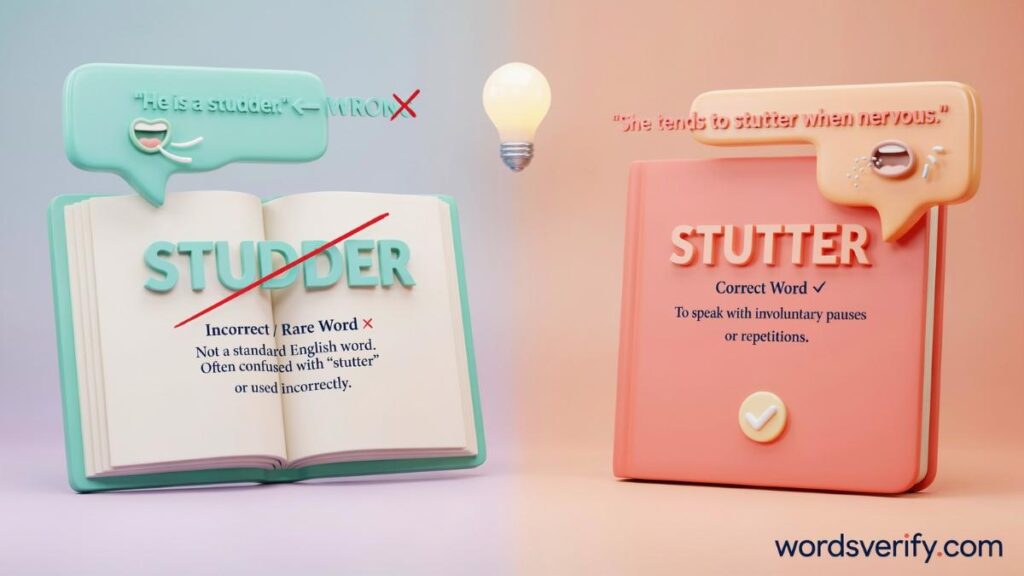
Is it studder vs stutter? A single letter can trip up even confident writers! These two spellings may look and sound similar, but only one is correct in standard English. Stutter is the proper spelling. It can describe interrupted speech, such as repeating sounds or struggling to get words out. It can also refer to an engine or device that runs unevenly. Studder, on the other hand, is a common misspelling, often influenced by pronunciation. So, how can you tell them apart? Let’s explore their meanings, usage, examples, and a few simple tips to help you spell stutter correctly every time.
Studder vs Stutter quick answer
Stutter is the correct standard spelling in English. Studder is a common misspelling, not an accepted alternative. Although people sometimes write it this way because of how they hear the word, standard English dictionaries recognize stutter.
The confusion often comes from American English pronunciation. In many American accents, the middle T in stutter sounds like a quick D. This happens because the tongue briefly touches the area behind the upper front teeth, creating a sound similar to the D in ladder.
As a result, someone might hear stutter and assume it contains a D. However, pronunciation doesn’t determine the correct spelling.
Consider these examples:
- Correct: He began to stutter when the teacher asked him a question.
- Incorrect: He began to studder when the teacher asked him a question.
- Correct: The old engine started to stutter on the highway.
- Incorrect: The old engine started to studder on the highway.
The difference is simple: stutter contains two T’s, not a D.
| Feature | Stutter | Studder |
|---|---|---|
| Standard spelling | Correct | Incorrect |
| Dictionary recognition | Established English word | Not a standard alternative |
| Meaning | Interrupted speech or irregular operation | Usually intended to mean stutter |
| Part of speech | Noun and verb | Not a standard form of stutter |
| Past tense | Stuttered | Studdered (incorrect) |
| Present participle | Stuttering | Studdering (incorrect) |
| Recommended usage | Standard writing | Avoid in ordinary writing |
Whether you’re writing an email, preparing an academic paper, or having a casual conversation, always choose stutter. The spelling doesn’t change with the situation.
Learn how to use confusing more words correctly
Choosing vs Chosing which one is correct?
Stutter Meaning, Definition and Usage
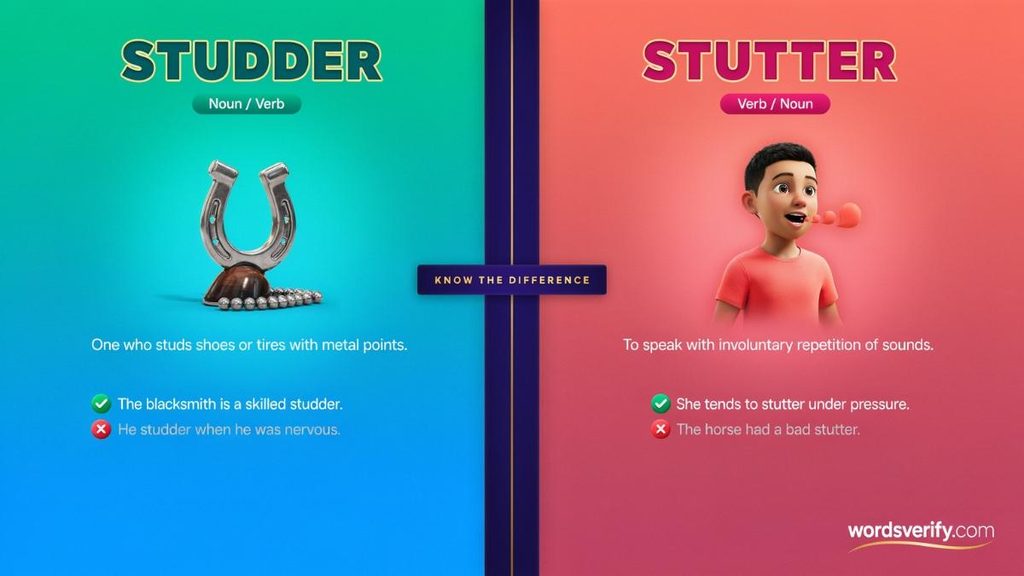
The Stutter describes speech that doesn’t flow smoothly. Someone who stutters may repeat sounds, stretch certain sounds, or experience interruptions while trying to speak.
The word has two main grammatical roles. It works as both a noun and a verb, and its meaning can change slightly depending on how you use it.
What Does Stutter Mean?
As a speech-related term, stutter describes disruptions in the normal flow of spoken language. A person who stutters might repeat the beginning of a word, struggle to produce a particular sound, or experience a pause that interrupts speech.
For example:
- She sometimes stutters when introducing herself.
- His stutter became noticeable during the presentation.
- The child repeated the first syllable several times.
Stuttering isn’t simply speaking too quickly or forgetting what to say. It involves specific disruptions in speech fluency, including:
- Sound repetitions: Repeating individual sounds, such as “b-b-ball.”
- Syllable repetitions: Repeating parts of words, such as “ba-ba-baby.”
- Prolongations: Stretching a speech sound longer than intended.
- Blocks: Experiencing a temporary interruption when trying to produce a word or sound.
These characteristics explain why stuttering is classified as a speech fluency disorder.
The word also has a figurative meaning. It can describe something that operates irregularly, repeatedly stops, or fails to maintain a steady rhythm. For example, an engine might stutter when it hesitates during operation.
Stutter as a Verb
As a verb, stutter describes the act of speaking with repeated sounds, prolonged sounds, or interruptions. It can also describe something that operates unevenly.
Here are some examples:
- He began to stutter when everyone turned toward him.
- The student tried to answer but continued to stutter.
- She doesn’t stutter when speaking with close friends.
- The engine started to stutter before the vehicle stopped.
- The old computer seemed to stutter while playing the video.
The surrounding words help readers understand which meaning applies. In the first three examples, stutter describes speech. In the last two, it describes irregular operation.
Stutter as a Noun
As a noun, stutter refers to a speech difficulty or an irregular interruption.
For example:
- His stutter doesn’t define his communication skills.
- The speaker has a noticeable stutter.
- A sudden stutter interrupted the engine’s steady rhythm.
- The recording contained a brief digital stutter.
The noun can describe a person’s speech pattern or an interruption in the operation of a machine.
Other Meanings of Stutter
Stutter also appears in descriptions of movement, sound, and technology.
For instance, an audio recording might stutter when playback repeatedly pauses or skips. A video may stutter when its frames fail to display smoothly.
Similarly, a machine can produce an irregular rhythm that sounds like a series of interruptions.
These uses share one basic idea: something that should flow continuously becomes uneven or interrupted.
Learn how to use confusing more words correctly
Accross vs Across Which one Is Correct?
Studder Meaning and Why It Is Incorrect
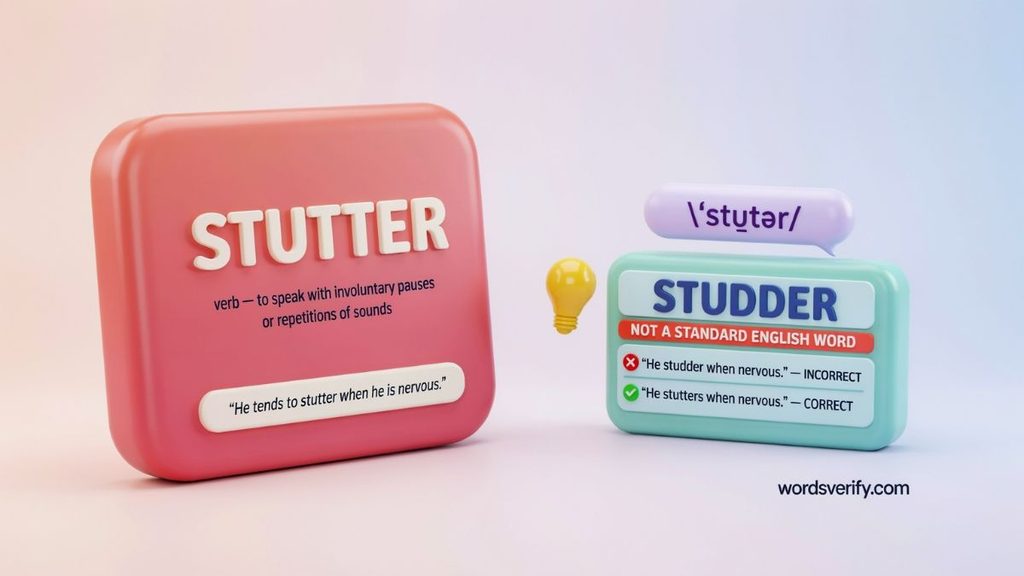
If you’ve searched for studder meaning or looked up the word in an English dictionary, you may have noticed that it generally appears as a misspelling of stutter rather than an accepted alternative.
People usually write studder when they mean stutter. The mistake often comes from hearing the word rather than seeing it written. Since the middle consonant in stutter can sound similar to a D in American English, the incorrect version may seem reasonable.
However, English spelling doesn’t always follow pronunciation. Several words contain letters that sound different depending on their position or the speaker’s accent.
Is Studder a Word?
The answer depends on what you mean by a word.
Studder can appear in usernames, surnames, product names, or other proper names. Someone might also use it informally as a spelling error. However, it isn’t the standard English spelling of the noun or verb stutter.
If you’re writing about interrupted speech, use stutter.
For example:
- Standard: The little boy began to stutter while reading aloud.
- Nonstandard: The little boy began to studder while reading aloud.
The same distinction applies to related forms.
| Nonstandard spelling | Correct spelling |
|---|---|
| Studder | Stutter |
| Studdered | Stuttered |
| Studdering | Stuttering |
| Studders | Stutters |
Why Do People Confuse Studder vs Stutter?
Several factors contribute to the common spelling mistake studder vs stutter.
- Pronunciation: In many American accents, the middle T in stutter sounds like a quick D. This makes the incorrect spelling seem logical.
- Sound-based spelling: People sometimes spell unfamiliar words according to how they hear them. Unfortunately, English doesn’t always follow that pattern. This is one reason the confusion between studder vs stutter is so common.
- Repeated consonants: Writers may remember the sound but forget whether the word contains a single consonant, a double consonant, or a different letter.
- Typing habits: Once someone repeatedly uses an incorrect spelling, the mistake can become familiar and harder to notice.
The solution is straightforward: remember that stutter has two Ts. Understanding the difference between studder vs stutter also makes it easier to recognize the correct form and spell its grammatical variations correctly.
Learn how to use confusing more words correctly
Sponsor vs Sponser Which one Is Correct?
Stutter vs Studder Pronunciation and Spelling Differences
The main difference between stutter vs studder concerns spelling rather than meaning.
Stutter is an established English word. Studder is generally an attempt to represent how some people pronounce it.
Stutter Pronunciation
The standard American pronunciation of stutter is commonly represented as /ˈstʌtər/.
The word has two syllables, with the stress on the first syllable. The middle T may sound like a quick D because of a common American pronunciation feature called flapping.
During this process, the tongue briefly touches the area behind the upper front teeth. The resulting sound resembles the D in ladder.
This explains why someone might hear stutter as studder.
Studder Pronunciation
Studder doesn’t have a separate standard dictionary pronunciation because it isn’t an established alternative spelling of stutter.
When people write studder, they generally intend to represent the same pronunciation as stutter. In other words, the difference usually exists on the page rather than in the speaker’s intended meaning.
An incorrect spelling doesn’t automatically create a different pronunciation or vocabulary word.
Learn how to use confusing more words correctly
Chalet vs Château which one is corrcet?
Studdering vs Stuttering Which Form Is Correct?
The correct form is stuttering. This distinction matters when comparing studder vs stutter because changing the spelling of an incorrect word doesn’t make it correct. Since the base word is stutter, its grammatical forms must retain the double T. Remembering this simple rule will help you avoid common spelling mistakes and use stutter, stuttered, and stuttering correctly.
| Incorrect | Correct |
|---|---|
| Studdering | Stuttering |
| Studdered | Stuttered |
| Studders | Stutters |
| Studder | Stutter |
Why Is It Stuttering Instead of Studdering?
The word stutter follows the usual spelling pattern for verbs ending in a consonant when adding -ing. The final R remains in place, and the ending attaches directly.
Stutter + ing = Stuttering
There is no need to change the spelling of the base word.
The same principle applies to the past tense:
Stutter + ed = Stuttered
These forms are easy to recognize once you remember the original spelling.
Examples of Stuttering in Sentences
Here are some natural examples showing how to use the correct forms:
- The child is stuttering less frequently during conversations.
- He started stuttering when he had to speak before a large audience.
- She has experienced stuttering since early childhood.
- The teacher noticed that the student was stuttering during the reading exercise.
- Stuttering can affect people differently.
If you’re unsure whether to write stuttering or studdering, choose the form that retains the two T’s in the original word.
Learn how to use confusing more words correctly
Reins vs Reigns which one is correct?
Examples of Stutter in Sentences
Examples make spelling rules easier to remember, especially when comparing studder vs stutter. They also show how the correct word can work in different situations without changing its spelling.
The following examples highlight the proper use of stutter in everyday conversation, professional writing, literature, and technology, helping you understand the difference between studder vs stutter in real-world contexts.
Stutter in Everyday Conversation
In ordinary conversations, stutter usually describes interrupted or hesitant speech.
- He began to stutter when his name was announced.
- My younger brother sometimes stutters when he gets excited.
- She tried to explain the situation but started to stutter.
- The nervous speaker continued to stutter throughout the introduction.
- He spoke slowly to avoid rushing through his words.
Stutter in Professional and Formal Writing
The word also appears in professional communication, educational material, and formal descriptions.
- The presentation discussed the challenges associated with stuttering.
- The student received support from a speech-language pathologist.
- The report described several factors affecting speech fluency.
- The speaker’s stutter didn’t prevent him from delivering an effective presentation.
- The organization provides resources for people experiencing speech difficulties.
In formal writing, use stutter when discussing the speech pattern itself. When referring to the broader condition, stuttering is often more appropriate.
Stutter in Literature and Dialogue
Writers sometimes represent stuttering through repeated letters, syllables, or interrupted phrases.
For example:
- “I-I didn’t know you were coming,” he said.
- “Th-th-there’s something outside,” she whispered.
- “I was trying to tell you, but…” He stopped speaking.
These examples represent speech patterns through dialogue. However, writers should use such techniques thoughtfully. Repeated letters can help communicate a character’s speech pattern, but excessive phonetic spelling can make dialogue difficult to read.
A more respectful and readable approach is often to describe the character as stuttering rather than changing the spelling of every spoken word.
Stutter in Technology and Machinery
Stutter isn’t limited to human speech. It can also describe an irregular mechanical or digital process.
- The car’s engine began to stutter during acceleration.
- The video started to stutter because of a weak internet connection.
- The computer produced a stutter while processing the file.
- The audio recording had a noticeable stutter.
- The machine’s steady rhythm turned into a series of irregular movements.
In these examples, stutter describes interruptions that prevent smooth operation.
Learn how to use confusing more words correctly
Stellar vs Steller which one is correct?
The Origin and History of Stutter
The history of stutter helps explain how the word developed its particular spelling and meaning.
Stutter has roots in Middle English and belongs to a broader family of Germanic words associated with interrupted or hesitant speech. Historical forms include Middle English stutten.
Over time, stutter became established in English as both a noun and a verb. Its meaning also expanded beyond speech.
Today, writers can use it figuratively to describe irregular sounds, mechanical interruptions, and uneven movement.
For example, an engine that repeatedly hesitates may be described as stuttering. Similarly, a digital recording that skips or interrupts playback can have a stutter.
The important point is that the established spelling developed as stutter, not studder. The incorrect spelling isn’t an accepted historical alternative that writers can use interchangeably.
American English vs British English Is Stutter Spelled Differently?
Some English words change spelling depending on whether you’re writing for an American or British audience. Color and colour, favorite and favourite, and center and centre are familiar examples.
However, stutter doesn’t follow this pattern.
The spelling remains the same in American, British, Canadian, and Australian English. There is no standard regional variation that replaces the double T with a D.
| English variety | Correct spelling | Incorrect spelling |
|---|---|---|
| American English | Stutter | Studder |
| British English | Stutter | Studder |
| Canadian English | Stutter | Studder |
| Australian English | Stutter | Studder |
Although the spelling stays consistent, regional vocabulary can differ.
For example, stutter is especially common in American English, while stammer is frequently used in British English. Both words describe similar disruptions in speech fluency.
Consider these sentences:
- American English: He began to stutter during the interview.
- British English: He began to stammer during the interview.
Both sentences are understandable and grammatically correct. The difference concerns word preference rather than spelling.
Therefore, don’t change stutter to studder when writing for a particular English-speaking country. The double-T spelling works across all four varieties.
Learn how to use confusing more words correctly
Cheer vs Chear Which one Is Correct?
Stutter Vs Stammer Are They the Same?
Stutter and stammer are closely related words. In everyday English, people often use them interchangeably to describe disruptions in speech.
Both can refer to repeating sounds, prolonging certain sounds, or experiencing difficulty producing words smoothly.
However, their regional preferences and contexts can differ.
What Does Stammer Mean?
Stammer is both a noun and a verb.
As a verb, it describes speaking with interruptions, repetitions, or difficulty maintaining fluent speech.
As a noun, it refers to the speech pattern itself.
Examples:
- He began to stammer when the interviewer asked a difficult question.
- She has a slight stammer.
- The child stammered while trying to introduce himself.
Stammering vs Stuttering
The distinction between stammering and stuttering is largely regional rather than a strict difference in meaning.
| Feature | Stutter | Stammer |
|---|---|---|
| Part of speech | Noun and verb | Noun and verb |
| General meaning | Interrupted or disfluent speech | Interrupted or disfluent speech |
| Regional preference | Common in American English | Common in British English |
| Present participle | Stuttering | Stammering |
| Past tense | Stuttered | Stammered |
Both terms can describe similar speech patterns. Neither word automatically indicates a different severity or type of speech difficulty.
In clinical and educational contexts, terminology may depend on the professional, organization, or country. Stuttering is widely used in American speech-language pathology, while stammering is common in British healthcare settings.
Is Stammering Always the Same as Stuttering?
In ordinary conversation, the terms often refer to the same general condition.
However, some speakers and professionals may prefer one term over the other. Personal preference also matters. Some people identify as people who stutter, while others use the expression people who stammer.
The most respectful approach is to follow the language a person uses for themselves.
Learn how to use confusing more words correctly
Suit vs Suite which one is correct?
Common Spelling Mistakes Related to Stutter
The spelling mistake doesn’t always stop at studder. Writers sometimes carry the same error into the word’s different grammatical forms.
For example, someone who writes studder may also write studdered or studdering. These forms remain incorrect when the intended word is stutter.
Here are the most common mistakes and their correct versions.
| Incorrect spelling | Correct spelling | Example |
|---|---|---|
| Studder | Stutter | He tends to stutter. |
| Studdered | Stuttered | She stuttered during the speech. |
| Studdering | Stuttering | The child is stuttering. |
| Studders | Stutters | He sometimes stutters. |
| Studdering disorder | Stuttering disorder | She received help for stuttering. |
Wrong vs Correct Practical Examples
Wrong: He started to studder when the manager questioned him.
Correct: He started to stutter when the manager questioned him.
Wrong: The little girl was studdering while reading.
Correct: The little girl was stuttering while reading.
Wrong: The engine studdered before stopping.
Correct: The engine stuttered before stopping.
Wrong: She sometimes studders when speaking quickly.
Correct: She sometimes stutters when speaking quickly.
One useful proofreading trick is to search your document for studder. If you intend to describe speech interruptions or irregular operation, replace it with the appropriate form of stutter.
Learn how to use confusing more words correctly
Busing vs Bussing Which one Is Correct?
How to Remember the Correct Spelling of Stutter
Remembering the correct spelling doesn’t require complicated grammar rules. A simple visual reminder can help you avoid the extra-D mistake.
Here are some practical techniques.
Remember the Double T
The easiest trick is to associate stutter with its two T’s.
Think of the word as:
STU + TT + ER
Whenever you write it, check the middle consonants. Two T’s belong there.
Connect the Word With Its Meaning
Stuttering often involves repeated sounds or syllables. You can use that idea as a memory aid.
Think of the repeated T in stutter as a reminder of the repetitions associated with the word.
This is a memory trick rather than a formal linguistic rule, but it makes the spelling easier to recall.
Learn the Related Forms Together
Instead of memorizing each form separately, learn the complete word family:
- Stutter
- Stutters
- Stuttered
- Stuttering
- Stutterer
Once you remember the base spelling, the other forms become much easier.
Read the Word in Context
Seeing the word in complete sentences can strengthen your spelling memory.
For example:
- He began to stutter during the interview.
- She was stuttering while answering questions.
- The engine stuttered before shutting down.
Reading different forms in context helps you recognize the correct spelling more quickly.
Learn how to use confusing more words correctly
Sentence vs Sentance which one is correct?
Stuttering in Children and Adults
Stuttering is more than an occasional hesitation during conversation. It is a speech fluency disorder that can affect how a person produces sounds, words, and sentences.
It can occur in children and adults. However, its development and characteristics may differ depending on the person’s age and circumstances.
Childhood-Onset Fluency Disorder
Many people begin stuttering during childhood, often while developing language and communication skills.
This is commonly called childhood-onset fluency disorder.
A child who stutters may:
- Repeat sounds or syllables.
- Stretch certain speech sounds.
- Experience blocks when trying to speak.
- Show visible tension while attempting to produce words.
- Avoid particular words or speaking situations.
Not every child who repeats words has a stuttering disorder. Young children naturally experience periods of disfluency while learning language.
For example, a child might repeat a phrase while deciding what to say next. Such ordinary repetitions don’t necessarily indicate stuttering.
However, persistent or concerning speech difficulties deserve attention from a qualified speech-language pathologist.
Can Adults Stutter?
Yes. Adults can stutter, including people who have experienced the condition since childhood.
Some adults also develop stuttering later in life. In these cases, the speech difficulty may be associated with neurological conditions, brain injuries, certain medications, or other medical factors.
A newly developed stutter should receive appropriate medical evaluation rather than being dismissed as ordinary nervousness.
Does Stuttering Affect Intelligence?
No. Stuttering doesn’t indicate low intelligence, poor understanding, or an inability to communicate effectively.
A person who stutters may understand a subject perfectly well but experience difficulty expressing their thoughts fluently.
For example, someone may prepare an excellent presentation yet struggle to deliver certain words aloud.
It’s important to distinguish speech fluency from knowledge, intelligence, and communication ability.
What Role Does Speech Therapy Play?
Speech-language pathologists are trained professionals who assess and support people with speech and language difficulties.
Speech therapy may help people who stutter develop communication strategies, manage speech-related challenges, and improve their confidence in different speaking situations.
The right approach depends on the individual’s age, needs, and communication goals.
There isn’t one treatment that works identically for everyone. A qualified professional can recommend an appropriate plan.
What Causes a Person to Stutter?
Stuttering doesn’t have one universal cause. Research suggests that several factors can contribute to its development.
These include:
- Genetic factors: Stuttering often runs in families, suggesting that inherited differences can influence a person’s likelihood of developing it.
- Neurological factors: Differences in how the brain coordinates speech production and language processing may contribute to stuttering.
- Speech development: Childhood-onset stuttering often appears during the years when children rapidly develop language and communication skills.
- Environmental influences: Communication situations and emotional experiences can affect how noticeable stuttering becomes, although they aren’t considered the sole underlying cause.
Stress and excitement may make stuttering more noticeable for some people. However, nervousness doesn’t explain every case, and people don’t develop a stutter simply because they’re shy.
Understanding these factors helps prevent a common misconception: stuttering isn’t a habit someone can always stop by trying harder.
Stuttering vs Speech Disfluency What’s the Difference?
Speech disfluency refers to interruptions in the normal flow of speech. Everyone experiences some disfluency occasionally, even people who don’t have a speech disorder.
For example, you might say “um,” repeat a word, pause to think, or restart a sentence.
These moments are part of ordinary communication.
Stuttering, however, involves particular patterns of disfluency, including sound repetitions, prolongations, and blocks.
| Feature | Ordinary speech disfluency | Stuttering |
|---|---|---|
| Word repetition | May happen occasionally | Can occur repeatedly |
| Sound repetition | Less characteristic | Common feature |
| Prolonged sounds | Not usually a defining feature | Can occur |
| Speech blocks | Not typically persistent | Can occur |
| Impact on communication | Usually minor | Can vary considerably |
| Professional assessment | Not always necessary | Helpful when difficulties persist or cause concern |
A person who occasionally repeats a word isn’t necessarily experiencing a speech fluency disorder.
The distinction depends on the pattern, frequency, characteristics, and impact of the speech interruptions.
Stutter Synonyms and Related Words
Several English words describe interrupted, hesitant, or irregular speech. However, they don’t all have exactly the same meaning.
Choosing the right synonym depends on the sentence.
Synonyms of Stutter
| Word or phrase | Meaning | Example |
|---|---|---|
| Stammer | Speak with interrupted or repeated sounds | He began to stammer. |
| Hesitate | Pause before speaking or acting | She hesitated before answering. |
| Falter | Lose confidence or become unsteady while speaking | His voice began to falter. |
| Stumble over words | Struggle to produce words smoothly | He stumbled over his words. |
| Speak haltingly | Speak with frequent pauses | She spoke haltingly during the interview. |
| Splutter | Speak quickly and indistinctly, often with emotion | He spluttered in surprise. |
Although these words are related, they aren’t interchangeable in every sentence.
For example, hesitate describes pausing before speaking. It doesn’t necessarily involve the repeated sounds or speech blocks associated with stuttering.
Similarly, falter can describe a loss of confidence or an interruption in speech without suggesting a speech fluency disorder.
Related Speech Terms
Understanding a few related terms can make the meaning of stutter clearer.
- Speech impediment: A broad, commonly used expression for a difficulty affecting speech.
- Speech disorder: A condition that affects the production or clarity of speech.
- Speech fluency disorder: A condition involving disruptions in the smooth flow of speech.
- Disfluency: An interruption in normal speech flow.
- Prolongation: Extending a speech sound longer than intended.
- Blocking: Experiencing difficulty initiating or continuing a speech sound.
These terms describe different aspects of communication. A speech-language pathologist can help determine which terminology best describes an individual’s difficulties.
Stutter in Everyday and Technical Contexts
One interesting feature of stutter is that it can describe more than human speech. Its figurative meaning appears in discussions about machines, digital media, and movement.
Engine Stuttering
An engine stuttering refers to irregular operation in which the engine repeatedly hesitates, misfires, or struggles to maintain a steady rhythm.
For example:
“The car’s engine started to stutter whenever the driver pressed the accelerator.”
An engine that stutters may have several possible mechanical problems, including ignition issues, fuel delivery problems, or air intake difficulties.
The word describes the irregular behavior rather than identifying a particular mechanical fault.
Video and Audio Stuttering
Digital media can also stutter.
A video may appear to freeze briefly or skip frames instead of playing smoothly. Audio may repeatedly pause, skip, or break up.
For example:
- The video began to stutter during the online meeting.
- Poor internet connectivity caused the audio to stutter.
- The computer struggled to play the recording without interruptions.
In these examples, stutter describes inconsistent playback.
Stutter Step
The expression stutter step has a different but related use.
In sports, particularly basketball, a stutter step refers to a series of quick, short steps that disrupt an opponent’s timing or help a player change direction.
For example:
“The basketball player used a stutter step to get past the defender.”
The expression uses stutter figuratively to describe an interrupted or uneven movement pattern. It doesn’t refer to a speech disorder.
Studder vs Stutter A Quick Comparison for Writers
When you’re editing an article, writing an email, or checking a sentence, this summary can help you choose the correct form.
| Question | Answer |
|---|---|
| Is it studder vs stutter? | Stutter |
| Is studder the correct spelling? | No, not as the standard spelling of stutter |
| Is stutter a real English word? | Yes |
| Does studder have the same meaning? | It is generally an attempted misspelling of stutter |
| How many T’s does stutter contain? | Two |
| How do you spell the past tense? | Stuttered |
| How do you spell the present participle? | Stuttering |
| Is stammer another word for stutter? | Yes, in many everyday contexts |
| Does American English use studder? | No, stutter is standard |
| Does British English use studder? | No, stutter is standard |
The key distinction is simple: stutter is the correct English word, while studder is generally a spelling error.
Practice session Studder vs Stutter
Test your understanding of the correct spelling and usage of Studder vs Stutter. Complete each sentence with the appropriate word or form.
- He began to ______ when he felt nervous during the interview.
- The correct spelling is ______, not studder.
- She sometimes ______ when speaking in front of a large audience.
- The speaker’s ______ made it difficult to finish the sentence.
- The car engine started to ______ before shutting down.
- He ______ while trying to explain what had happened.
- The child is receiving support for ______.
- A video may ______ when the internet connection is weak.
- She noticed a slight ______ in his speech.
- The past tense of stutter is ______.
- The present participle of stutter is ______.
- Someone who stutters may be called a ______.
- The machine began to ______ during operation.
- His speech included several repeated sounds and ______.
- The speaker tried not to ______ during the presentation.
- The word stutter contains two ______.
- In British English, ______ is also commonly used to describe interrupted speech.
- The engine’s uneven sound made it seem to ______.
- He spoke slowly to manage his ______.
- The spelling ______ is incorrect when referring to interrupted speech.
- She ______ briefly before answering the question.
- A person who experiences stuttering may work with a speech-language ______.
- The computer audio began to ______ during the online meeting.
- The word ______ can function as both a noun and a verb.
- Remember to write ______ with a double T, not a D.
Answers
- Stutter
- Stutter
- Stutters
- Stutter
- Stutter
- Stuttered
- Stuttering
- Stutter
- Stutter
- Stuttered
- Stuttering
- Stutterer
- Stutter
- Blocks
- Stutter
- Ts
- Stammer
- Stutter
- Stutter
- Studder
- Stuttered
- Pathologist
- Stutter
- Stutter
- Stutter
Here’s a trusted source for clear word meanings:
FAQs
Can stutter be used as both a noun and a verb?
Yes. Stutter works as both a noun and a verb. As a noun, it describes interrupted or repeated speech. As a verb, it means to speak with repeated sounds, syllables, or pauses.
What is the past tense of stutter?
The past tense is stuttered. For example: “He stuttered while introducing himself.” The word keeps its double T when you add the ending.
Is stuttering the same as stammering?
Stuttering and stammering generally describe the same type of speech difficulty. Stutter is more common in American English, while stammer is often preferred in British English. Both terms are correct.
How do you pronounce stutter?
Stutter is pronounced “STUH-ter.” The first syllable sounds like “stuh,” and the second sounds like “ter.” In some American accents, the middle T sounds similar to a quick D, which can cause spelling confusion.
Why is stutter sometimes spelled with a D?
The mistake usually comes from pronunciation. In many American accents, the middle T in stutter has a soft sound that resembles D. However, the standard spelling always uses two Ts.
Does stutter have a plural form?
Yes. The plural noun is stutters. For example: “His speech included occasional stutters.” When referring to the verb, use stutters for the third-person singular form, as in “She stutters when nervous.”
Is stutter used outside speech?
Yes. Stutter can describe uneven or interrupted operation. For example, an engine may stutter when it struggles to run smoothly, or a video may stutter when its playback repeatedly freezes.
What is the difference between stutter and stutterer?
Stutter can refer to the speech pattern or the act of speaking with interruptions. Stutterer is a noun for someone who stutters. In respectful everyday language, however, “a person who stutters” is often preferred.
Can nervousness cause temporary stuttering?
Stress, anxiety, or excitement can make speech less fluent and increase repetitions or hesitation. However, occasional speech disfluency doesn’t necessarily mean someone has a persistent stuttering disorder.
Conclusion
Choosing between studder vs stutter doesn’t have to leave you stumbling over your words. Stutter is the correct spelling in standard English, while studder is a common misspelling influenced by pronunciation. Whether you’re describing interrupted speech, an engine that runs unevenly, or a video that keeps freezing, remember to use the double T in stutter. It’s a small detail, but getting it right makes your writing clearer and more polished. Once you remember the correct spelling, you can leave the extra D behind and let your words flow smoothly!

Lisa AJS is an experienced blogger and language enthusiast at Words Verify, dedicated to making grammar simple, practical, and enjoyable. She writes engaging content on commonly confused words, grammar mistakes, word meanings, and everyday language challenges.