

Have you ever looked at a word and wondered whether a letter had quietly disappeared? The confusion between choosing vs chosing can leave even careful writers second-guessing themselves. Fortunately, the answer is simple: choosing, with two o’s, is correct, while chosing is a common spelling mistake. That tiny missing letter can make a noticeable difference in your writing. But why do both o’s stay when the final e disappears? The spelling rule is easier than it looks. Let’s explore the meaning, pronunciation, grammar, and practical examples of choosing so you can spell it correctly with confidence.
Choosing vs Chosing quick answer
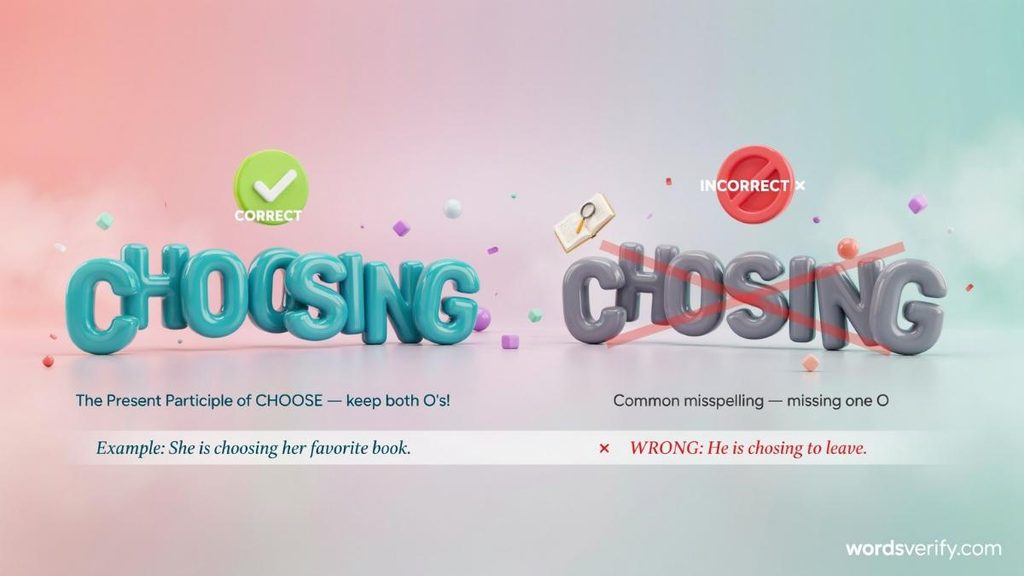
Choosing is the correct spelling. Chosing is incorrect because it leaves out one of the two o’s in the original verb choose.
The difference comes down to a simple English spelling rule. When a verb ends in a silent e, you generally remove that final letter before adding -ing. However, you don’t remove any of the other letters.
Here’s how the transformation works:
- Start with the base verb: choose.
- Remove the final silent e: choos.
- Add -ing: choosing.
Both o’s remain in the finished word. That’s the detail many writers overlook.
| Spelling | Correct or incorrect? | Explanation |
|---|---|---|
| Choosing | Correct | The standard -ing form of choose |
| Chosing | Incorrect | Missing one o |
| Chooseing | Incorrect | The final e should be removed |
| Choosen | Incorrect | The correct past participle is chosen |
Consider these examples:
- Correct: She is choosing a new laptop.
- Incorrect: She is chosing a new laptop.
- Correct: Thank you for choosing our company.
- Incorrect: Thank you for chosing our company.
The same spelling applies in casual messages, school assignments, professional emails, and formal documents.
A simple reminder makes the rule easier to remember: choose already has two o’s, and both stay when you add -ing.
Learn the difference between tricky English words with easy explanations
Accross vs Across Which one Is Correct?
What Does Choosing Mean?
Choosing means selecting something from two or more possibilities. It describes the act of making a decision, expressing a preference, or deciding which option best suits a particular need.
The word comes from the verb choose. When you choose something, you select it from the available alternatives. When you’re choosing, you’re carrying out that action.
Imagine walking into a bookstore with three interesting novels in front of you. You read their descriptions, compare the stories, and decide which one you’d like to buy. That entire process involves choosing.
The word also appears in situations that carry much greater importance. You might be choosing a career, selecting a university, deciding where to live, or considering a major business opportunity.
Here are some examples:
- She is choosing a college based on its courses and tuition fees.
- We spent an hour choosing the best restaurant for dinner.
- He enjoys choosing books for his weekend reading.
- The company is choosing a new manager.
- Choosing wisely can make a difference in your future.
In each example, choosing describes an action that involves considering possibilities and selecting an option.
Choosing in Different Situations
The meaning stays connected to making a selection, but the situation determines how important or complicated the decision might be.
| Context | Meaning | Example |
|---|---|---|
| Everyday life | Selecting something you like | I’m choosing a shirt for the party. |
| Education | Deciding between subjects or schools | She is choosing her college major. |
| Business | Selecting a product, service, or strategy | The company is choosing a new supplier. |
| Relationships | Deciding whom to trust or support | He is choosing his friends carefully. |
| Personal development | Making decisions about your future | I’m choosing a healthier lifestyle. |
Choosing can describe a decision that takes only a few seconds or one that requires months of thought. Picking a snack is usually quick. Choosing a career, on the other hand, may involve research, planning, and careful consideration.
Is Choosing a Word?
Yes. Choosing is a standard English word that follows established spelling and grammar rules.
It has two main grammatical functions:
- As a present participle, it helps form continuous verb tenses. For example, “I am choosing a dress.”
- As a gerund, it acts as a noun. For example, “Choosing the right career takes time.”
The spelling doesn’t change between these two uses. Its grammatical role depends on how it functions in the sentence.
What Does Chosing Mean?
Chosing isn’t the accepted spelling of a standard English word. People who write it usually intend to mean choosing.
For example, if someone writes, “She is chosing a new phone,” the intended meaning is clear. However, the spelling is incorrect.
The correct sentence is:
“She is choosing a new phone.”
For accurate writing, always use choosing when referring to the act of making a selection or decision.
Learn the difference between tricky English words with easy explanations
Sponsor vs Sponser Which one Is Correct?
Why Is Chosing Incorrect?
English spelling can be tricky, particularly when a word contains repeated vowels. However, the problem with chosing is straightforward: it drops a letter that belongs in the original verb.
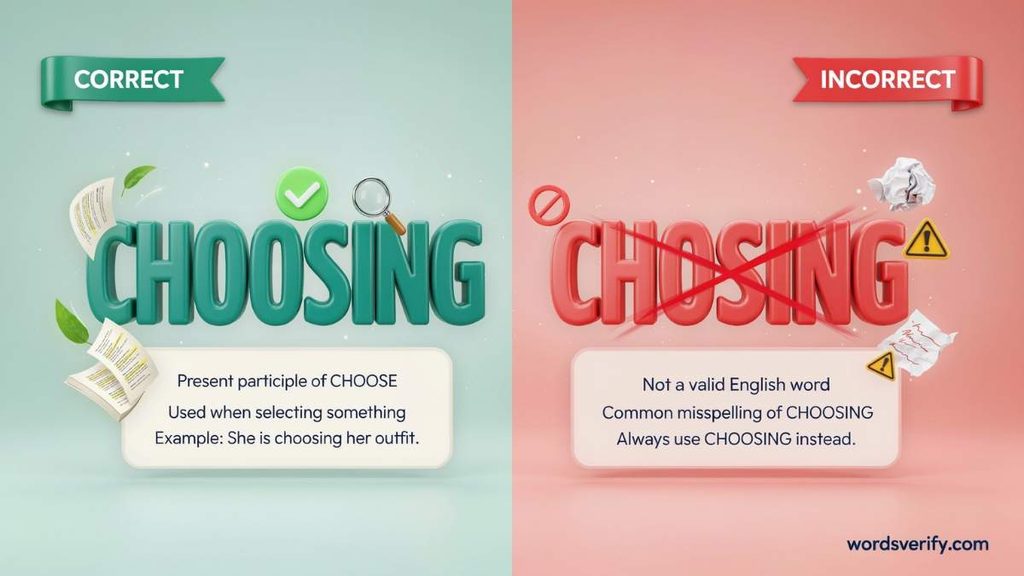
The base word choose contains two o’s followed by an s and a silent e. When you form the -ing version, you remove only the final e. Both o’s remain.
Compare these forms:
- Choose → Choosing
- Chose → Chosing (incorrect)
The second example highlights a common misunderstanding. Some writers confuse the past-tense form chose with the base verb choose. Others simply assume that one o isn’t necessary when adding -ing.
Neither approach produces the correct spelling.
Why Do People Write Chosing Instead of Choosing?
Several things can lead to this mistake.
- Confusion about repeated vowels: Some writers assume that two consecutive o’s look unusual or unnecessary. They remove one without realizing that both belong to the original spelling.
- Pronunciation: Choosing doesn’t sound as though it contains two separate o sounds. People who rely on pronunciation rather than spelling may forget the second letter.
- Confusion between verb forms: Choose and chose look similar but have different spellings and grammatical functions. Mixing them up can lead to incorrect forms.
- Typing too quickly: When writing in a hurry, it’s easy to leave out a letter. Words with repeated letters are especially vulnerable to this mistake.
- Unfamiliarity with spelling rules: Writers who don’t recognize the silent-e pattern may remove the wrong letter or leave the final e in place.
Choosing vs Chosing in Example Sentences
The following examples show how to recognize and correct the mistake of Choosing vs chosing.
| Incorrect sentence | Correct sentence |
|---|---|
| She is chosing a wedding dress. | She is choosing a wedding dress. |
| We are chosing a new team leader. | We are choosing a new team leader. |
| Thank you for chosing our company. | Thank you for choosing our company. |
| He is chosing between two universities. | He is choosing between two universities. |
| They are chosing the best solution. | They are choosing the best solution. |
The correction is the same in every sentence. Replace chosing with choosing, and the spelling becomes correct.
Learn the difference between tricky English words with easy explanations
Chalet vs Château which one is corrcet?
Word Origin and History of Choose
The history of choose goes back much further than modern English. Its roots can be traced to Old English, where the verb appeared as cēosan. This history also adds context to the common confusion surrounding Choosing vs Chosing, especially when writers try to understand how the word developed.
The original word carried the meaning of choosing, selecting, or deciding between possibilities. It belonged to a Germanic family of words associated with preference and selection. As the English language developed, the word passed through Middle English forms before reaching its modern spelling, choose.
Its history also helps explain why some of its verb forms don’t follow a regular pattern. Choose is an irregular verb, meaning its past-tense and past-participle forms change rather than simply taking the usual -ed ending. Today, the four familiar forms are choose, chose, choosing, and chosen. Understanding these forms makes Choosing vs Chosing easier to remember because each follows a specific grammatical pattern, even though their spellings differ.
Verb Forms of Choose Choose, Chose, Choosing and Chosen

Understanding the different forms of choose makes it easier to use choosing correctly. Although these words share the same basic meaning, each one has a different grammatical function.
Choose is the base form. Chose is the simple past tense, and chosen is the past participle. Choosing is the -ing form, which can work as a present participle or gerund.
| Verb form | Grammatical role | Example |
|---|---|---|
| Choose | Base form and present tense | I choose the healthier option. |
| Chose | Simple past tense | She chose the earlier flight. |
| Choosing | Present participle or gerund | They are choosing a new location. |
| Chosen | Past participle | We have chosen our winner. |
Let’s look at each form more closely.
Choose: The Base Form
Choose is the base form of the verb. You use it when talking about a present decision, giving instructions, or discussing a possible future action.
Examples:
- I choose my clothes before going to bed.
- You can choose any seat you like.
- They choose their own study schedules.
- We need to choose a suitable name for the project.
- Please choose the correct answer.
The word also appears after modal verbs such as can, could, should, and might.
For example:
- You should choose carefully.
- She can choose between the two options.
- We might choose a different approach.
Chose: The Past Tense of Choose
Chose is the simple past tense of choose. It describes a decision or selection that happened in the past.
Examples:
- I chose the blue jacket last week.
- She chose medicine as her college major.
- They chose a quieter restaurant for dinner.
- He chose to leave before the meeting ended.
A common mistake is writing choosed instead of chose. However, choose is an irregular verb, so it doesn’t form its past tense by adding -ed.
Correct: She chose the first option.
Incorrect: She choosed the first option.
Remember that choose describes the base action, while chose describes an action that has already happened.
Choosing: The Present Participle and Gerund
Choosing is the -ing form of choose. It can function as a present participle or a gerund, depending on its role in the sentence.
As a present participle, it helps form continuous tenses:
- I am choosing a new phone.
- She was choosing a topic when the teacher arrived.
- They are choosing their preferred candidates.
As a gerund, choosing functions as a noun:
- Choosing wisely requires patience.
- Choosing the right words can prevent misunderstandings.
- Her favorite activity is choosing books for her collection.
The spelling remains exactly the same in both cases.
Chosen: The Past Participle of Choose
Chosen is the past participle of choose. It commonly appears with helping verbs such as have, has, and had. It can also describe someone or something selected for a particular purpose.
Examples:
- I have chosen a new career path.
- She had chosen her favorite design before the sale ended.
- They have chosen three candidates for the final interview.
- He was chosen as the team captain.
Writers sometimes spell this form as choosen because they assume it needs the same double-o pattern as choosing. However, chosen has only one o after the h.
| Correct form | Incorrect form |
|---|---|
| Choosing | Chosing |
| Chosen | Choosen |
| Chose | Choosed |
These mistakes look similar, but each involves a different misunderstanding of the verb’s forms.
Choose vs Chose vs. Chosen What’s the Difference?
The difference becomes clearer when you compare the time and grammatical structure of each sentence.
- Choose: I choose the evening class.
- Chose: I chose the evening class yesterday.
- Choosing: I am choosing the evening class.
- Chosen: I have chosen the evening class.
Notice how the helping verbs affect the sentence. Choosing works with forms of be to express an ongoing action, while chosen commonly appears with have in perfect tenses.
Learning these forms together is more useful than memorizing choosing on its own. It also helps prevent other common spelling mistakes.
Is Choosing a Verb or a Noun?
Choosing can function as both a verb form and a noun. Its grammatical role depends on how it appears in a sentence.
This distinction matters because the same word can perform different functions without changing its spelling.
Choosing as a Verb
When choosing functions as a present participle, it describes an ongoing action. It usually appears with a form of the helping verb be.
Examples:
- I am choosing a new apartment.
- She is choosing between two job offers.
- We were choosing a movie when our friends arrived.
- They will be choosing the final design tomorrow.
In these sentences, choosing describes what the subject is doing.
The present participle appears in continuous tenses, including the present continuous, past continuous, and future continuous.
Choosing as a Noun
When choosing functions as a gerund, it acts as a noun. It can serve as the subject or object of a sentence.
Examples:
- Choosing a healthy breakfast is a good habit.
- He enjoys choosing gifts for his family.
- Choosing between two excellent candidates can be difficult.
- Her responsibility includes choosing suitable materials.
In the first example, choosing a healthy breakfast is the subject. In the second, choosing gifts is the object of enjoys.
A gerund can also follow a preposition:
- She is interested in choosing a career in education.
- They succeeded by choosing a different strategy.
- He apologized for choosing the wrong date.
Remember that a present participle helps describe an ongoing action, while a gerund performs the role of a noun. Both use the same -ing spelling.
Learn the difference between tricky English words with easy explanations
Reins vs Reigns which one is correct?
How to Pronounce Choosing
Choosing has two syllables in standard American English, with the main stress on the first syllable.
The first syllable contains the long oo sound, as in moon or food. The second syllable has an unstressed sound similar to the ending in running and reading.
Here are a few pronunciation points to remember:
- The first syllable carries the main stress.
- The initial ch produces the sound heard in chair.
- The oo has a long vowel sound.
- The ending sounds like the -ing in words such as running and reading.
The two o’s don’t represent two separate syllables. Together, they represent one vowel sound. This pronunciation detail helps explain the common confusion in Choosing vs Chosing. Although the word doesn’t sound as though it contains two separate o’s, both letters must appear in its spelling.
When you understand how the word sounds and how it is formed, the difference between Choosing vs Chosing becomes easier to remember.
How to Use Choosing in a Sentence
Knowing the correct spelling is only half the job. You also need to understand how to use choosing naturally in different situations.
The word commonly appears when someone describes an ongoing decision, explains a preference, or discusses the process of selecting something.
Choosing in Everyday Conversation
In daily conversation, choosing often describes ordinary decisions involving food, clothing, entertainment, travel, and personal preferences.
Examples:
- I am choosing a book to read during my vacation.
- She is choosing a dress for the wedding.
- We’re choosing between pizza and burgers for dinner.
- He spends too much time choosing what to watch.
- My brother is choosing a name for his new puppy.
- They are choosing a place to celebrate their anniversary.
- I’m choosing a different route because the usual road is busy.
- She enjoys choosing gifts for her friends.
These examples show how naturally the word fits into everyday communication.
Choosing in Business and Professional Writing
In business communication, choosing often relates to selecting suppliers, employees, services, products, or strategies.
Companies make decisions regularly. They might compare several service providers, review product features, or select a suitable candidate for an important position.
Examples:
- Thank you for choosing our company for your business needs.
- The management team is choosing a new supplier.
- We are choosing the most cost-effective solution.
- The hiring committee is choosing candidates for the final interview.
- Choosing reliable partners can strengthen a business relationship.
- Customers are choosing products based on quality and price.
The phrase “Thank you for choosing us” is especially common in customer communication. Businesses use it to acknowledge a customer’s decision to purchase a product or service.
For example:
“Thank you for choosing our services. We appreciate your trust and look forward to working with you.”
Notice that choosing follows for in this sentence. The preposition for takes a gerund when it introduces an action.
Choosing in Academic Writing
Academic writing uses choosing when discussing research decisions, educational options, methods, and the selection of evidence.
The word can describe both an individual’s decision and a formal selection process.
Examples:
- Choosing an appropriate research method is essential for reliable results.
- Students are choosing their preferred subjects for the next semester.
- The researchers are choosing participants according to specific criteria.
- Choosing relevant sources helps strengthen an academic argument.
- The study examines how people make decisions when choosing between alternatives.
In academic contexts, choosing often appears alongside words such as method, criteria, approach, participants, and alternatives.
It can also explain the reasoning behind a decision. For instance, a researcher might discuss why a particular sampling method was chosen rather than another.
Learn the difference between tricky English words with easy explanations
Training vs Trainning which one is correct?
Choosing vs Selecting vs. Picking What’s the Difference?
Choosing, selecting, and picking all describe the act of making a decision or taking something from a group of possibilities. However, they don’t always sound equally natural.
The difference usually comes down to formality, context, and the type of decision involved.
Choosing is the broadest and most flexible term. You can use it for almost any decision, from selecting breakfast to deciding on a career.
Selecting often sounds more formal or deliberate. It commonly appears in professional, academic, and technical situations where someone evaluates options before making a selection.
Picking is more casual. People often use it in everyday conversation when choosing something quickly or informally.
Comparison of Choosing, Selecting and Picking
| Word | Meaning | Common context | Example |
|---|---|---|---|
| Choosing | Making a decision between options | General and everyday use | I’m choosing a new phone. |
| Selecting | Identifying one option from several | Formal and professional use | The committee is selecting three finalists. |
| Picking | Taking or deciding on something | Casual conversation | She’s picking a movie. |
| Deciding | Reaching a conclusion | General decision-making | We’re deciding where to travel. |
| Opting | Choosing one possibility over another | Personal preferences | He is opting for the cheaper plan. |
| Electing | Choosing someone through a formal vote | Politics and organizations | Members are electing a new president. |
| Preferring | Favoring one option over another | Personal likes and dislikes | She prefers the smaller design. |
One important distinction is that preferring doesn’t always mean making a final choice. You can prefer one option while still considering several possibilities.
Similarly, electing usually involves a formal selection process, often through voting.
When Should You Use Each Word?
Consider these examples:
- Choosing: I’m choosing a university for my undergraduate studies.
- Selecting: The admissions committee is selecting applicants for interviews.
- Picking: I’m picking up a sandwich before work.
- Deciding: We’re deciding whether to move next year.
- Opting: She is opting for a shorter training course.
- Electing: The members are electing a new chairperson.
The words overlap, but replacing one with another can change the tone or meaning of a sentence.
For instance, “The committee is picking a new director” sounds more conversational than “The committee is selecting a new director.” Both can be correct, but selecting often suits formal business writing better.
Stellar vs Steller which one is correct?
Common Spelling Mistakes Related to Choosing
Choosing belongs to a group of commonly misspelled words that cause confusion because writers misunderstand their base forms or how suffixes work. This is why Choosing vs Chosing can be tricky, especially when people aren’t sure what happens to the final silent e when adding -ing.
The most common mistakes include chosing, choosen, and chooseing, along with confusion between choose and chose. Understanding these errors makes Choosing vs Chosing easier to remember and helps you use the correct form in everyday writing.
Chosing vs Choosing
This is the main spelling confusion.
- Correct: Choosing the right career takes careful thought.
- Incorrect: Chosing the right career takes careful thought.
The incorrect version leaves out one o. Remember that the base verb choose contains two o’s, and both remain when you add -ing.
Choosen vs Chosen
Choosen is another common error. However, the correct past participle is chosen.
Examples:
- Correct: She has chosen a new school.
- Incorrect: She has choosen a new school.
Writers sometimes assume that chosen should preserve the double-o spelling found in choose. However, irregular verbs don’t always follow that pattern.
The past participle changes to chosen, not choosen.
Choose vs Chose
The Choose and chose are both correct English words, but they serve different grammatical purposes.
Choose is the base form and present-tense form. Chose is its simple past tense.
Examples:
- I choose my clothes carefully.
- Yesterday, I chose a different outfit.
Using chose for a present action or choose for a completed past action can make a sentence grammatically incorrect.
Chooseing vs Choosing
Chooseing is incorrect because it retains the final silent e when adding -ing.
The correct spelling follows the silent-e pattern:
- Choose → Choosing
- Write → Writing
- Make → Making
- Dance → Dancing
In these examples, the final e disappears before the suffix -ing is added.
Learn the difference between tricky English words with easy explanations
Cheer vs Chear Which one Is Correct?
Does British English Spell Choosing Differently?
No. The spelling of choosing remains the same in American, British, Canadian, and Australian English.
There is no standard regional variation in which one country writes choosing and another uses chosing.
This differs from certain English words that have recognizable regional spelling differences. add keywords
| American English | British English |
|---|---|
| Color | Colour |
| Favorite | Favourite |
| Center | Centre |
| Traveling | Travelling |
| Organize | Organise |
| Choosing | Choosing |
Although some English words change according to regional spelling conventions, choosing doesn’t.
You should use the same spelling whether you’re writing for an American, British, Canadian, or Australian audience.
Synonyms for Choosing
Choosing has several synonyms, but the best alternative depends on the sentence.
For example, selecting might sound more appropriate in a formal report, while picking may feel more natural in casual conversation.
Here are some useful alternatives and their meanings.
| Synonym | Meaning | Example |
|---|---|---|
| Selecting | Identifying one option from several | She is selecting a suitable candidate. |
| Picking | Choosing something, often informally | He is picking a birthday gift. |
| Deciding | Reaching a conclusion | We’re deciding where to eat. |
| Opting | Choosing one alternative | I’m opting for the smaller package. |
| Electing | Choosing through a vote | Citizens are electing their representatives. |
| Determining | Establishing or deciding something | The team is determining the best approach. |
| Preferring | Favoring one possibility | She prefers the earlier appointment. |
| Making a selection | Choosing from available options | Customers are making a selection from the menu. |
Some alternatives have slightly different grammatical patterns.
For example, choosing and selecting can often replace each other directly:
- She is choosing a candidate.
- She is selecting a candidate.
However, deciding often works differently:
“She is deciding which candidate to hire.”
The words are related, but they aren’t interchangeable in every sentence. Always consider the meaning and structure before replacing one with another.
Learn the difference between tricky English words with easy explanations
Suit vs Suite which one is correct?
How to Remember the Correct Spelling of Choosing
Remembering the correct spelling doesn’t require memorizing a complicated grammar rule. A simple understanding of the base verb can prevent the missing-o mistake.
The most reliable method is to start with choose and remove only the final e.
Choose → Choos → Choosing
Both o’s remain throughout the transformation.
Use the Base Word as a Reminder
Whenever you’re unsure about the spelling, think of the word choose.
Ask yourself:
- Does choose contain two o’s? Yes.
- Does adding -ing remove both o’s? No.
- Does the final silent e disappear? Yes.
- What is the correct result? Choosing.
This small check can prevent the incorrect spelling chosing.
Remember the Silent-E Rule
Many English verbs ending in a silent e drop that final letter before adding -ing.
Examples:
| Base verb | -ing form |
|---|---|
| Choose | Choosing |
| Write | Writing |
| Make | Making |
| Take | Taking |
| Dance | Dancing |
| Smile | Smiling |
| Drive | Driving |
| Hope | Hoping |
This pattern explains why you write choosing rather than chooseing.
However, English spelling has exceptions. For example, verbs ending in -ee generally retain their final e when adding -ing.
- See → Seeing
- Agree → Agreeing
- Free → Freeing
The important point is to remove the final silent e in choose, not the vowels that come before it.
Create a Simple Visual Reminder
Try remembering this sentence:
“Choose has two o’s, and choosing keeps them both.”
You can also write the four principal verb forms together:
Choose – Chose – Choosing – Chosen
Looking at them as a group helps you remember their spelling differences and avoid mixing up their grammatical functions.
Learn the difference between tricky English words with easy explanations
Busing vs Bussing Which one Is Correct?
Practice Session Choosing vs Chosing
Practice using Choosing vs chosing by completing the following sentences. Fill in each blank with the correct word. Pay attention to the tense and meaning of the sentence.
Fill in the Blanks
- She is __________ a birthday gift for her best friend.
- We __________ the Italian restaurant for dinner last night.
- I have __________ a new topic for my research paper.
- They are __________ the best candidate for the position.
- You should __________ your words carefully.
- He enjoys __________ books for his collection.
- The committee has __________ three finalists.
- My parents __________ our vacation destination last year.
- I am __________ between two different universities.
- She had already __________ her favorite design.
- Please __________ the option that suits you best.
- They were __________ a movie when I called.
- He has __________ to study engineering.
- We need to __________ a suitable name for the business.
- __________ the right career requires careful thought.
- Thank you for __________ our services.
- She __________ the blue dress instead of the red one.
- The students are __________ their subjects for next semester.
- I would __________ the earlier flight if I had the option.
- He was __________ a gift for his sister.
- Have you __________ a name for your new puppy?
- She prefers __________ healthy meals at home.
- The manager will __________ the final design tomorrow.
- They have carefully __________ their new team leader.
- Making a good decision often involves __________ between several possibilities.
Answers
Check your answers below to see how well you understand the different forms of choose.
- Choosing
- Chose
- Chosen
- Choosing
- Choose
- Choosing
- Chosen
- Chose
- Choosing
- Chosen
- Choose
- Choosing
- Chosen
- Choose
- Choosing
- Choosing
- Chose
- Choosing
- Choose
- Choosing
- Chosen
- Choosing
- Choose
- Chosen
- Choosing
Here’s a trusted source for clear word meanings:
FAQs
What is the difference between choosing and making a decision?
Choosing means selecting one option from several possibilities. Making a decision is a broader expression that describes reaching a conclusion after considering available choices. Both phrases often work in similar situations.
Which is correct: choosing or choice?
Both words are correct, but they have different grammatical roles. Choosing describes the act of selecting something, while choice is a noun that refers to the option selected or the act of making a selection. For example, “Choosing a dress takes time” and “You have made a good choice.”
Can choosing be used at the beginning of a sentence?
Yes. Choosing can begin a sentence when it functions as a gerund, or verbal noun. For example, “Choosing the right words can prevent misunderstandings.”
What preposition usually follows choosing?
The preposition depends on the sentence. Common combinations include choosing between two options, choosing from a selection, and choosing for a particular purpose. For example, “She is choosing between two job offers.”
Can choosing describe a difficult decision?
Yes. Choosing can describe simple everyday selections as well as complicated decisions involving careers, relationships, education, or finances. For example, “Choosing the right career path requires careful thought.”
What is the difference between choosing and deciding?
Choosing generally focuses on selecting an option, while deciding emphasizes reaching a conclusion. For example, “I’m choosing a blue shirt” identifies the selected item, while “I’m deciding what to wear” describes the decision-making process.
Can choosing be followed by an infinitive?
Yes. Choosing can be followed by a to-infinitive when it means deciding to do something. For example, “She is choosing to study abroad.” The phrase describes her decision to take a particular action.
Is choosing a regular or irregular verb form?
Choosing is the regular -ing form of the irregular verb choose. Although choose has irregular past forms (chose and chosen), you form its present participle by removing the final silent e and adding -ing.
Does choosing have a plural form?
No. Choosing does not have a separate plural form when it functions as a gerund. However, you can use it in sentences with plural subjects, such as “They are choosing their preferred subjects.”
What words are commonly confused with choosing?
Choosing is sometimes confused with chosing, chooseing, and chosen. Chosing omits an o, chooseing keeps the silent e, and chosen is the past participle. Each form has a different spelling and grammatical use.
Is choosing used in formal writing?
Yes. Choosing is appropriate in formal, academic, professional, and everyday writing. You can use it to describe selecting research methods, evaluating candidates, making business decisions, or considering different possibilities.
Does choosing have the same spelling in all English-speaking countries?
Yes. American, British, Canadian, and Australian English all use choosing. Unlike words such as color and colour, this word has no standard regional spelling variation.
Learn the difference between tricky English words with easy explanations
Sentence vs Sentance which one is correct?
conclusion
Choosing vs chosing? This spelling mystery is finally solved! The correct form is choosing, with two o’s, while chosing is simply a missing-letter mistake. Remember the rule: remove the final silent e from choose, add -ing, and keep both o’s. It’s a small detail, but getting it right makes your writing clearer and more professional. Choosing vs chosing Whether you’re choosing a career, making an important decision, or picking the perfect words for an email, there’s no reason to let this tricky spelling trip you up. Keep those two o’s together, and you’ll always know which form to choose!

Lisa AJS is an experienced blogger and language enthusiast at Words Verify, dedicated to making grammar simple, practical, and enjoyable. She writes engaging content on commonly confused words, grammar mistakes, word meanings, and everyday language challenges.