
Have you ever paused while typing and wondered whether “training” needs an extra N? English spelling loves throwing little surprises your way! If you’re caught between “training vs trainning,” you’re not alone. One tiny letter can turn a perfectly good word into a noticeable spelling mistake. Fortunately, this mystery is easier to solve than it looks. In this guide, you’ll discover the correct spelling, understand why the extra N doesn’t belong, and explore simple examples that make the rule stick. By the end, you’ll know exactly how to use “training” with confidence and leave this common spelling confusion behind.
Training vs Trainning quick answer?
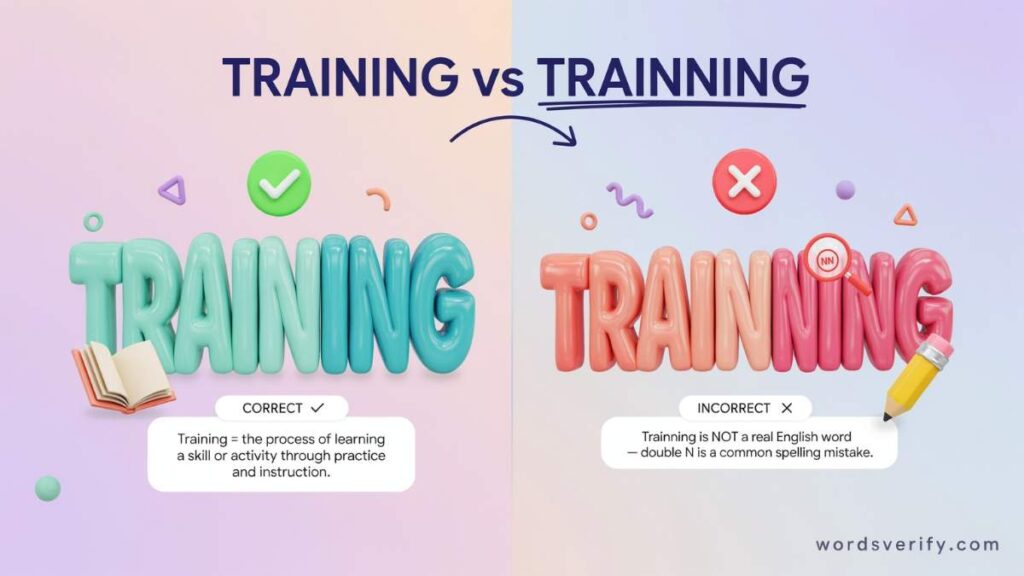
The correct spelling is training, with one N immediately after the letters AI. The spelling “trainning” is incorrect in standard English.
The word comes from the verb “train.” When you add the suffix “-ing,” you get “training.” You don’t need to double the final N.
Here is a quick comparison:
| Spelling | Correct or Incorrect | Explanation |
|---|---|---|
| Training | Correct | Standard English spelling |
| Trainning | Incorrect | Contains an unnecessary extra N |
For example:
- The company provides training for new employees.
- She is training for her first marathon.
- The students are receiving computer training.
- He completed his safety training last week.
In each sentence, “training” describes learning, preparation, or practice.
Writing “trainning” in these examples would be a spelling error. Although readers might understand what you mean, the incorrect form can make your writing look less polished.
Fix common more word mistakes in English
Mentioned vs Mentionned Which one Is Correct?
What Does Training Mean?
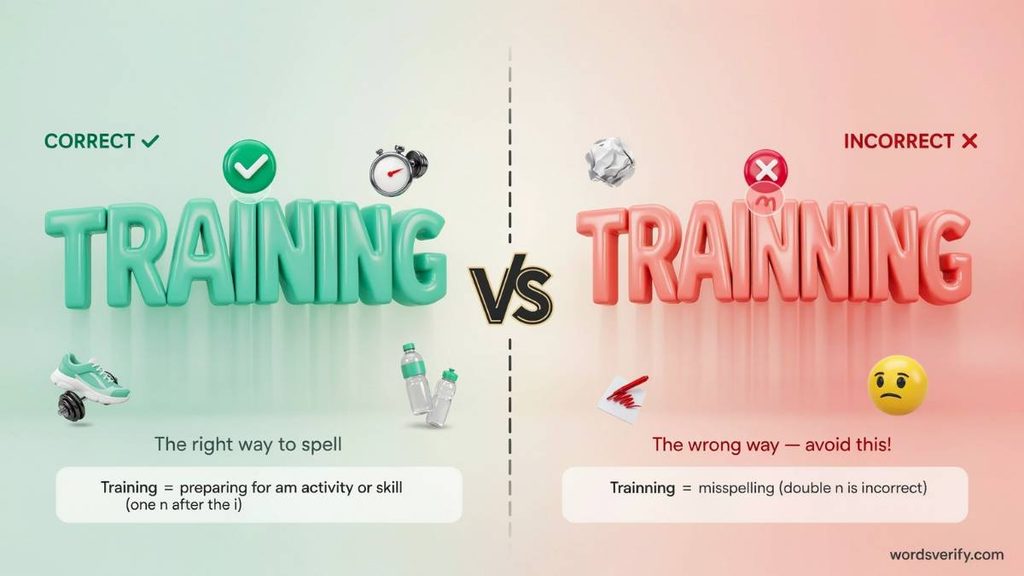
Training refers to the process of teaching, learning, or practicing the skills and knowledge needed to perform a particular task. It helps people improve their abilities, gain experience, and become more confident.
You can receive training in almost any area of life. A new employee might attend workplace training, an athlete might follow a fitness program, and a student might receive computer training.
The meaning depends on the situation, but the central idea remains the same: training helps someone become better prepared to do something.
Training as a Noun
As a noun, “training” refers to the process or activity of developing skills and knowledge.
Examples:
- The new employees will begin their training on Monday.
- Professional training can improve your career opportunities.
- The school offers computer training to beginners.
- Proper training helps workers perform their duties safely.
In these sentences, “training” names an activity or process.
Training as a Verb Form
“Training” also works as the present participle of the verb “train.” It can describe an action that is happening now or continuing over time.
Examples:
- She is training to become a professional chef.
- The coach is training the players for the upcoming tournament.
- They are training their staff to use the new software.
- My brother has been training at the gym for several months.
Here, “training” describes an ongoing action rather than simply naming a process.
Fix common more word mistakes in English
Phenix vs Phoenix Which one Is Correct?
Why Is Training Correct and Trainning Incorrect?
The difference comes down to how English spelling rules work when you add the suffix “-ing” to a verb.
The base word is “train.” To form the present participle or gerund, you simply add “-ing”:
Train + ing = Training
There is no need to double the final consonant.
The spelling “trainning” adds an extra N that doesn’t belong there. This mistake often happens because English has many words that double their final consonant before adding “-ing.”
Consider these examples:
| Base Verb | Correct -ing Form |
|---|---|
| Train | Training |
| Run | Running |
| Plan | Planning |
| Swim | Swimming |
| Sit | Sitting |
| Clean | Cleaning |
| Rain | Raining |
Notice that some verbs double their final consonant, while others don’t.
The difference depends on the spelling and sound of the original verb.
Understanding the Consonant-Doubling Rule
In many short verbs, you double the final consonant before adding “-ing” when the verb ends in a single consonant preceded by a single short vowel.
For example:
- Run becomes running.
- Sit becomes sitting.
- Plan becomes planning.
- Swim becomes swimming.
However, “train” has the vowel combination “ai” before its final N. Because of this spelling pattern, you don’t double the N.
The same idea appears in other words:
- Rain becomes raining.
- Clean becomes cleaning.
- Explain becomes explaining.
- Join becomes joining.
So, remember that not every verb ending in a consonant follows the doubling rule.
Fix common more word mistakes in English
Chef vs Cheff which one is correct?
Training vs Trainning Common Differences

The two spellings may look similar, but their status in standard English is completely different.
| Feature | Training | Trainning |
|---|---|---|
| Spelling | Correct | Incorrect |
| Standard English | Yes | No |
| Meaning | Learning or developing skills | No standard meaning |
| Word formation | Train + ing | Incorrect extra N |
| Formal writing | Acceptable | Should be avoided |
“Training” is the form you should use in emails, school assignments, reports, articles, resumes, and everyday communication.
“Trainning” is not an alternative spelling. It is simply a typographical or spelling mistake.
Fix common more word mistakes in English
Shakey vs Shaky which one is correct?
Examples of Training in Everyday Sentences
The easiest way to remember a spelling is to see it used naturally. The following examples show how “training” works in different situations.
Workplace and Professional Training
Training is common in professional settings because employees often need to learn new procedures, tools, and responsibilities.
- The company provides regular training for its employees.
- New staff members must complete safety training before starting work.
- The manager arranged additional training for the customer service team.
- Her professional training helped her qualify for a better position.
- The organization introduced a training program for future leaders.
Education and Academic Training
Students and teachers also use the word when discussing learning opportunities and skill development.
- The university offers teacher training programs.
- Computer training has become useful in many academic fields.
- The students received practical training in the laboratory.
- She completed her teaching training before applying for a job.
- The course includes training in research and communication skills.
Fitness and Sports Training
In sports, training refers to regular physical activity and practice designed to improve strength, endurance, technique, or performance.
- He is training for a long-distance race.
- The football team started training early this morning.
- Regular training helps athletes improve their performance.
- She follows a daily training routine to build strength.
- The coach changed the team’s training schedule.
Personal and Skill Development
Training isn’t limited to schools, offices, or sports fields. People also train to develop practical skills and improve their everyday lives.
- I’m training myself to manage my time more effectively.
- She received first-aid training last month.
- Learning a new language requires regular training and practice.
- The dog is receiving training to follow basic commands.
- His musical training helped him become a better performer.
Fix common more word mistakes in English
Natzi vs Nazi which one is correct?
Training vs Trainning Understanding the Difference
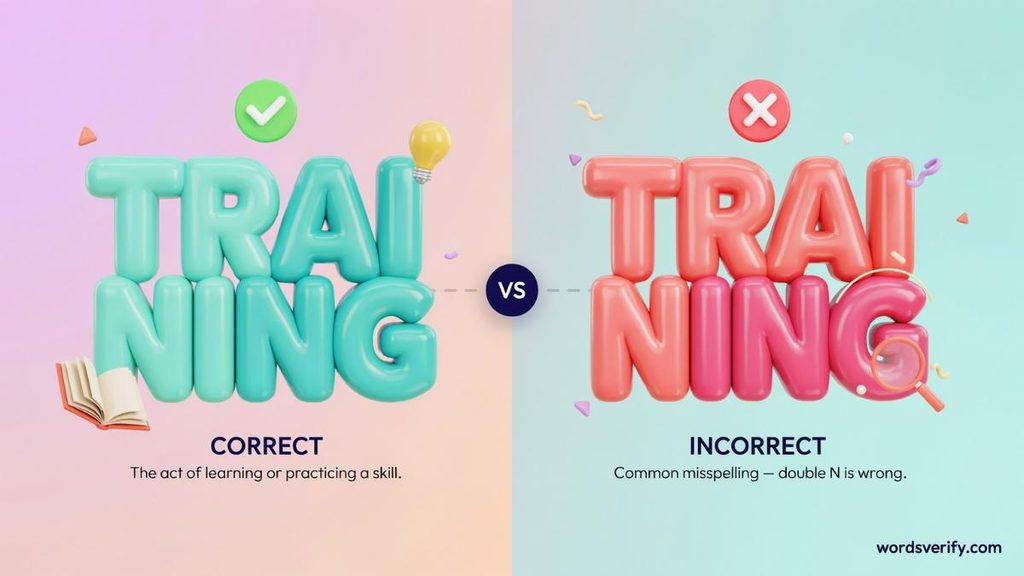
“Train” and “training” are related words, but they serve different grammatical purposes. When comparing Training vs Trainning, remember that “train” is the base form of the verb. It can mean teaching someone a skill or preparing for an activity. “Training” can refer to the learning process itself or describe an action that is currently happening. The correct spelling is always “training,” not “trainning.”
| Word | Part of Speech | Meaning | Example |
|---|---|---|---|
| Train | Verb | To teach or prepare | They train new employees. |
| Training | Noun or verb form | The process of learning or preparing | She is training for a competition. |
| Trained | Past tense or past participle | Prepared or taught | He trained the new staff. |
| Trainer | Noun | A person who teaches or prepares others | The trainer explained the exercise. |
| Trains | Verb | Teaches or prepares | She trains young athletes. |
These forms are all correct, but you need to choose the one that fits your sentence.
For example:
- I train at the gym every evening.
- I am training for a cycling competition.
- I trained with an experienced coach.
- My trainer created a new workout plan.
Each sentence uses a different form of the same word family.
Training vs Practice Are They the Same?
People sometimes use “training” and “practice” as if they mean exactly the same thing. Although their meanings overlap, there is a small difference.
Training usually involves a planned process of learning or developing skills. It may include instructions, guidance, exercises, and feedback.
Practice generally means repeating an activity to improve performance or maintain a skill.
For example, a new employee might receive training to learn how to use company software. Afterward, the employee may practice using that software to become more confident.
Here are a few examples:
- The coach provides training to help players understand new techniques.
- The players practice those techniques during their daily sessions.
- She received professional training before starting her job.
- Regular practice helped her improve her performance.
Training often provides direction, while practice helps strengthen what you’ve learned.
Fix common more word mistakes in English
Enrol vs Enroll which one is correct?
Is Training Spelled the Same in American and British English?
Yes. “Training” is spelled the same way in American, British, Canadian, and Australian English. Unlike words such as “color” and “colour,” this word doesn’t have a regional spelling variation. When discussing Training vs Trainning, the correct spelling remains “training” in every variety of English..
| English Variety | Correct Spelling |
|---|---|
| American English | Training |
| British English | Training |
| Canadian English | Training |
| Australian English | Training |
No matter where you live or which English variety you follow, “training” is the correct form.
Fix common more word mistakes in English
Suing vs Sueing which one is correct?
Common Mistakes Related to Training
Even though “training” is a straightforward word, people sometimes make mistakes when writing it or using it in sentences.
Here are a few errors worth avoiding.
Writing Trainning Instead of Training
This is the main spelling mistake.
Incorrect: The company provides trainning to new employees.
Correct: The company provides training to new employees.
The word “train” takes the suffix “-ing” without doubling its final N.
Confusing Training With Trained
Both words are correct, but they serve different purposes.
Incorrect: She is trained for the competition right now.
This sentence may be grammatically possible in some contexts, but if you mean that she is currently preparing, “training” is more appropriate.
Correct: She is training for the competition right now.
Use “trained” when referring to someone who has already received instruction or preparation.
Using Training When You Mean Trainer
A trainer is a person who teaches or prepares others. Training is the process of learning or teaching.
For example:
- The trainer explained the exercise.
- The training lasted three weeks.
These words are connected, but they aren’t interchangeable.
Forgetting the Word’s Correct Form in Formal Writing
Misspellings can slip into emails, applications, reports, and other professional documents. Before submitting your work, check words that you often type incorrectly.
A quick proofreading pass can prevent small errors from distracting readers.
Fix common more word mistakes in English
Whiny vs Whiney difference and correct usage
How to Remember the Correct Spelling
If you frequently confuse “training” and “trainning,” a simple memory trick can help.
Start with the base word:
TRAIN + ING = TRAINING
You don’t need to add another N. The original word already ends with one.
You can also remember this sentence:
“I’m training, not trainning.”
It may sound simple, but repeating the correct spelling can help you recognize it more quickly.
Another useful approach is to remember similar words:
- Rain becomes raining.
- Clean becomes cleaning.
- Explain becomes explaining.
- Train becomes training.
These examples follow the same spelling pattern. Once you become familiar with it, the correct form will feel more natural.
Fix common more word mistakes in English
Pricy vs Pricey which one is correct?
Practice Session Training vs Trainning
Complete the following sentences by filling in each blank with the correct word or form Training vs Trainning. This practice session will help you remember the spelling of “training” and understand how to use it naturally in different situations.
Fill in the Blanks
1. The company provides regular ________ for its new employees.
2. She is ________ for her first marathon.
3. The coach started ________ the players early in the morning.
4. Proper ________ helps employees perform their jobs safely.
5. My brother enjoys ________ at the gym every evening.
6. The school offers computer ________ to beginners.
7. He completed his professional ________ last month.
8. The dog is receiving ________ to follow basic commands.
9. Regular ________ can help athletes improve their performance.
10. The manager arranged additional ________ for the customer service team.
11. She has been ________ to become a professional chef.
12. The new employees will begin their ________ on Monday.
13. The company hired an experienced ________ to teach its staff.
14. The football team is ________ for the upcoming tournament.
15. His technical ________ helped him find a better job.
16. The coach ________ the team for the championship.
17. A good ________ program can improve workplace productivity.
18. The students received practical ________ in the laboratory.
19. She is ________ herself to manage her time more effectively.
20. Safety ________ is essential in many workplaces.
21. The fitness ________ created a new workout routine.
22. Learning a new skill requires patience, guidance, and ________.
23. He received first-aid ________ before starting his new job.
24. The company provides ongoing ________ to help employees develop new skills.
25. Remember, the correct spelling is ________, not trainning.
Answers
- Training
- Training
- Training
- Training
- Training
- Training
- Training
- Training
- Training
- Training
- Training
- Training
- Trainer
- Training
- Training
- Trained
- Training
- Training
- Training
- Training
- Trainer
- Practice
- Training
- Training
- Training
Here’s a trusted source for clear word meanings:
FAQs
What is the correct spelling of training?
The correct spelling is “training.” It contains one N immediately after the letters AI. “Trainning” is a common misspelling and isn’t accepted in standard English.
Is “trainings” grammatically correct?
Yes, “trainings” can be correct when referring to separate training sessions, courses, or programs. However, “training” is generally an uncountable noun when discussing the overall process of learning or developing skills.
How do you spell the verb train when describing preparation?
The verb is spelled “train.” When you add the suffix “-ing,” it becomes “training.” For example: “She is training to become a professional athlete.”
What are the two main approaches to employee training?
The two common approaches are on-the-job training and off-the-job training. On-the-job training takes place in the workplace, while off-the-job training happens through separate courses, workshops, or learning activities.
What does training mean in simple words?
Training means learning or developing the knowledge and skills needed to perform a particular task. It often involves instruction, guidance, practice, and hands-on experience.
What is another word for training?
Depending on the context, you can use instruction, coaching, education, preparation, teaching, or practice. Each alternative has a slightly different meaning, so choose the one that best fits your sentence.
What is the difference between training and learning?
Learning is the process of gaining knowledge or understanding new ideas. Training usually involves a more structured approach to developing specific skills through instruction and practical activities.
What are four common types of employee training?
Four common types of workplace training include:
- Technical training, which develops job-related knowledge and practical skills.
- Soft skills training, which improves communication, teamwork, and leadership.
- Compliance training, which teaches employees about workplace policies and legal requirements.
- Safety training, which helps workers prevent accidents and handle workplace risks.
What is the most common type of workplace training?
On-the-job training is one of the most common approaches. Employees learn by performing real tasks under the guidance of an experienced colleague, supervisor, or trainer.
What is someone called when they are receiving training?
A person receiving training is called a trainee. Depending on the situation, they may also be described as a learner, student, apprentice, or participant.
Does training mean the same thing as practice?
Not exactly. Training is a structured process of developing knowledge and skills, while practice involves repeating an activity to improve performance. Training often includes practice as an important part of learning.
What is another way to say “training someone”?
You can say teaching, coaching, instructing, mentoring, or preparing someone. The best expression depends on the type of guidance you’re providing.
What is another word for “in training”?
Depending on the context, alternatives include learning, developing skills, undergoing instruction, or preparing. For example, “a trainee chef” describes someone learning to become a chef.
What is a more formal word for training?
Instruction, professional development, education, and skills development are useful formal alternatives. In workplace writing, “professional development” often describes activities that help employees improve their abilities and advance their careers.
Is “learning” or “learnings” correct?
“Learning” is the standard choice when referring to the process of gaining knowledge. “Learnings” is also used in business writing to describe insights or lessons gained from an experience. However, “lessons learned” is often a clearer and more natural alternative.
How do you use “training” correctly in a sentence?
You can use “training” as a noun to describe a learning process or as a verb form to describe an ongoing action.
Examples:
- The company provides training for new employees.
- He is training for a cycling competition.
- Her professional training helped her develop new skills.
Why do people mistakenly write “trainning”?
People often add an extra N because they confuse “train” with verbs such as “run,” “swim,” and “plan,” which double their final consonants before adding “-ing.” However, “train” doesn’t follow that spelling pattern. Its correct form is “training.”
Can “training” be used when talking about animals?
Yes. “Training” can describe teaching animals to follow commands, develop good habits, or perform specific tasks. For example: “The dog is receiving training to follow basic instructions.”
Is “training” a gerund or a present participle?
It can be both, depending on how you use it. As a gerund, it functions as a noun: “Training requires patience.” As a present participle, it forms part of a verb phrase: “She is training for a race.”
What is the difference between a trainer and a trainee?
A trainer is the person who teaches or guides someone, while a trainee is the person receiving instruction. For example, a fitness trainer demonstrates exercises, and the trainee learns how to perform them correctly.
Fix common more word mistakes in English
Fliers vs Flyers which one is correct?
Conclusion
English spelling has its share of surprises, but choosing between “training” vs “trainning” doesn’t have to be one of them. The correct spelling is always “training.” Simply add “-ing” to the verb “train” without doubling the final N. Although words like “running” and “planning” follow the consonant-doubling rule, “training” plays by different spelling rules. Remember this simple formula: train + ing = training. Once you understand the pattern, you’ll avoid this common mistake and write with confidence. After all, you’re learning to improve your skills, not giving an extra letter a free ride!

Lisa AJS is an experienced blogger and language enthusiast at Words Verify, dedicated to making grammar simple, practical, and enjoyable. She writes engaging content on commonly confused words, grammar mistakes, word meanings, and everyday language challenges.