
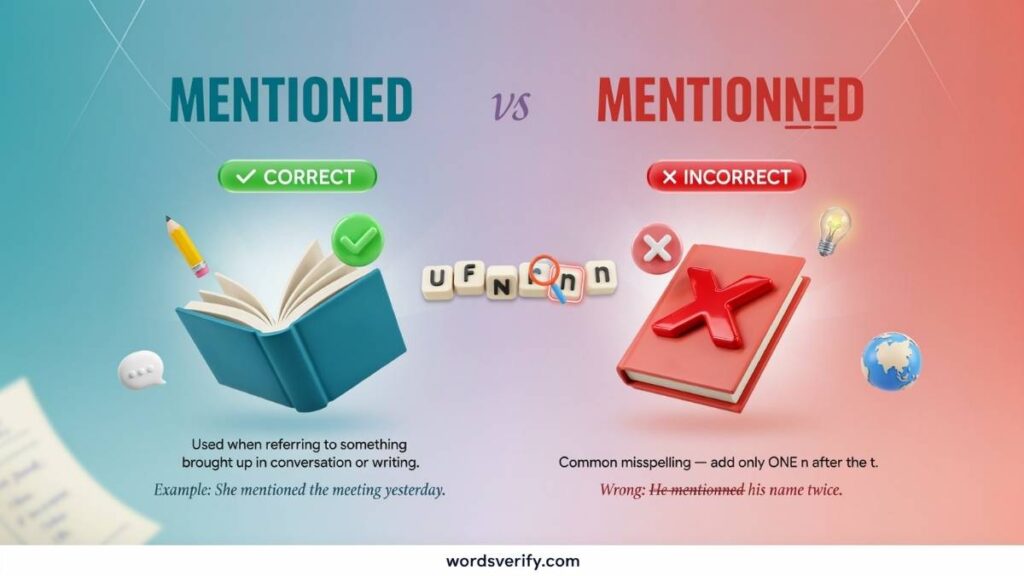
Have you ever stopped mid-sentence to wonder whether it’s mentioned vs mentionned? English spelling has a knack for making simple words surprisingly confusing. One extra letter can turn a perfectly good sentence into a spelling slip! Fortunately, this mistake is easy to fix once you understand the rule. In this guide, you’ll learn why “mentioned” is the correct spelling, why “mentionned” is incorrect in standard English, and how to remember the difference. With clear explanations, practical examples, and simple grammar tips, you’ll avoid this common mistake and write with greater confidence. No spelling detective work required!
Quick Answer Mentioned vs Mentionned?
Mentioned is correct. Mentionned is incorrect in standard English.
Mentioned is the simple past tense and past participle of the verb mention. It means that someone referred to a person, subject, event, or idea, usually without discussing it in detail.
For example:
- Correct: She mentioned your name during the meeting.
- Incorrect: She mentionned your name during the meeting.
The difference is one extra n. English doesn’t require that additional letter when you add -ed to mention.
Remember this simple rule:
Mention + ed = mentioned
Use mentioned in American English, British English, academic writing, professional communication, and everyday conversation. The spelling stays the same across these varieties of English.
Mentioned vs Mentionned What’s the Difference?
The two spellings may look similar, but Mentioned vs Mentionned don’t have the same status in standard English. “Mentioned” is the correct spelling, while “mentionned” is a common misspelling that adds an unnecessary extra “n.”
| Feature | Mentioned | Mentionned |
|---|---|---|
| Spelling | Correct | Incorrect |
| Meaning | Referred to something or someone | Intended to mean mentioned |
| Base verb | Mention | Intended base verb: mention |
| Past tense | Correct form | Nonstandard form |
| Past participle | Correct form | Nonstandard form |
| American English | Accepted | Incorrect |
| British English | Accepted | Incorrect |
| Formal writing | Appropriate | Should be corrected |
The distinction isn’t a matter of personal preference or regional spelling. You can’t choose mentionned simply because it looks familiar or resembles another verb.
When writing in English, use mentioned. If you encounter mentionned in a message, article, or document, treat it as a spelling error unless the writer is deliberately discussing or quoting the incorrect form.
Learn how to use confusing more words correctly
Journeys vs Journies Which one Is Correct?
What Does Mentioned Mean?
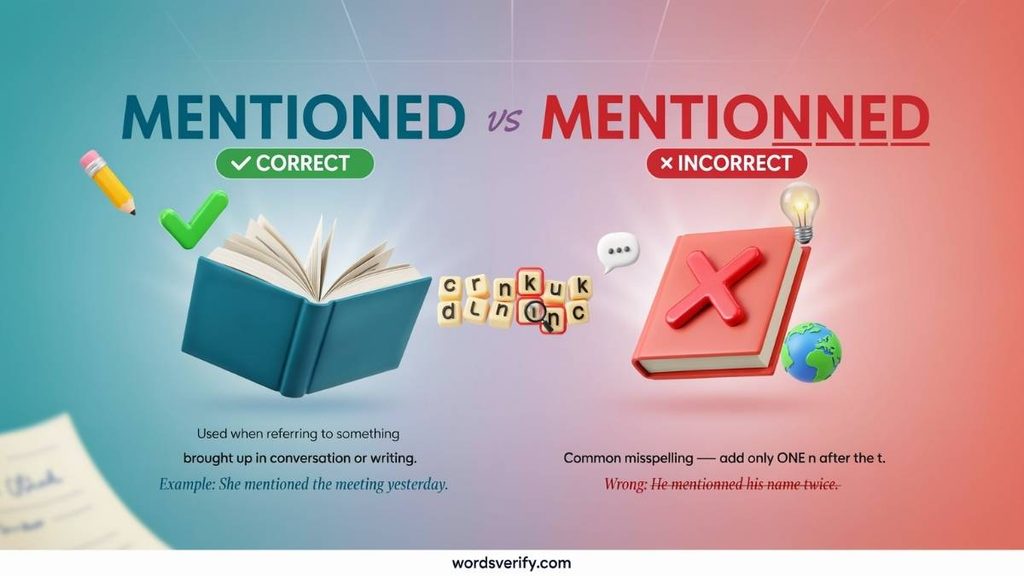
Mentioned means that someone referred to a person, thing, idea, or event in speech or writing. The reference may be brief, and it doesn’t necessarily involve a detailed explanation.
Imagine that your coworker says, “We need to review the budget before Friday.” Your coworker has mentioned the budget. They haven’t necessarily explained every expense or presented a complete financial analysis. They’ve simply brought the subject into the conversation.
This distinction matters because mention often describes a brief reference rather than an extended discussion.
Definition and Meaning of Mentioned
The word mentioned has two main grammatical uses.
- Simple past tense: It describes a reference that happened in the past.Example: Maria mentioned the problem yesterday.
- Past participle: It appears with helping verbs in perfect tenses and passive constructions.Example: Maria has mentioned the problem before.Example: The problem was mentioned during the meeting.
In each sentence, the word refers to the act of bringing something to someone’s attention. The surrounding grammar determines how the sentence expresses time and meaning.
Common Uses of Mentioned
You’ll find mentioned in many everyday and professional situations.
| Context | Example | Meaning |
|---|---|---|
| Conversation | You mentioned a new movie. | Someone referred to the movie earlier. |
| As mentioned in my previous email, the deadline is Monday. | The information appeared in an earlier message. | |
| Meeting | The manager mentioned the staffing issue. | The manager brought up the issue. |
| Academic writing | The study mentioned several limitations. | The study referred to those limitations. |
| News report | Officials mentioned possible policy changes. | Officials referred to potential changes. |
| Personal communication | Someone mentioned you at lunch. | Another person talked about you during lunch. |
Mentioned works naturally in both casual and formal writing. You don’t need a different word just because you’re writing to a manager, professor, or client.
What Does “You Were Mentioned” Mean?
In the context of Mentioned vs Mentionned, the expression “you were mentioned” means that someone referred to you during a conversation, in a message, or in another form of communication.
For example:
- You were mentioned during today’s meeting.
- Someone mentioned me in their email.
- Your name was mentioned in the article.
- I heard that you were mentioned in the discussion.
The phrase doesn’t automatically mean someone praised or criticized you. Context determines whether the reference was positive, negative, or neutral.
If a friend says, “You were mentioned at dinner,” they may simply mean that someone brought your name into the conversation. You’d need more information to know what the person actually said. Understanding this usage can also help you avoid confusion when learning the difference between mentioned vs mentionned and using the correct spelling in your writing.
Examples of Mentioned in Sentences
Here are more examples showing how to use mentioned correctly.
- The teacher mentioned the assignment before class ended.
- I have already mentioned the main concern.
- The contract mentioned several important conditions.
- She mentioned that she would arrive after lunch.
- The previously mentioned documents are attached.
- He briefly mentioned his plans for the summer.
- The report specifically mentioned the need for further research.
- Nobody mentioned the change in schedule.
- As mentioned above, the application closes on Friday.
These examples show how the word fits conversations, reports, instructions, and professional documents.
Learn how to use confusing more words correctly
Developed vs Developped which one is correct?
Why Is Mentioned Correct and Mentionned Incorrect?
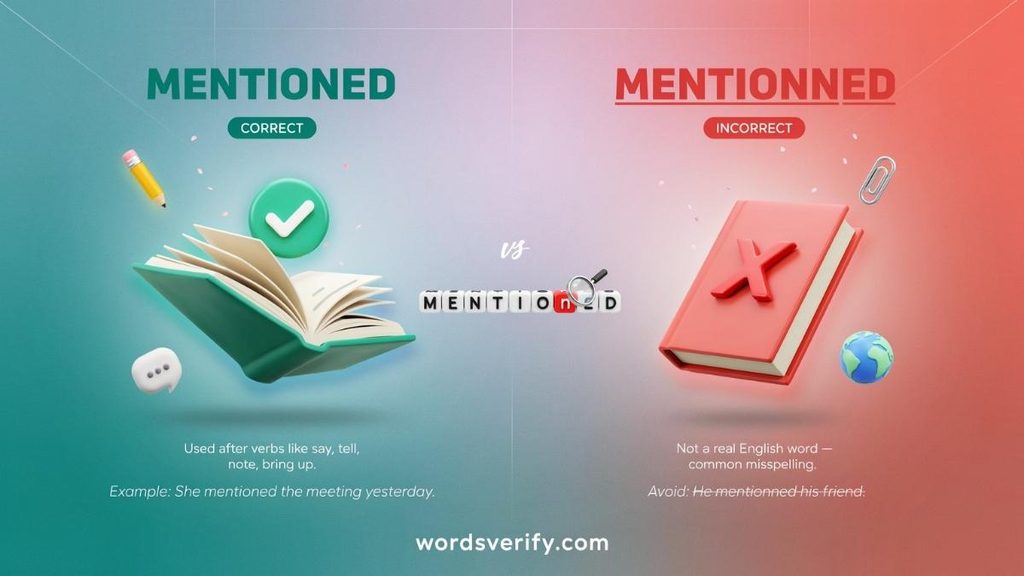
The key to understanding Mentioned vs Mentionned is knowing how to spell the base word correctly.
The verb is “mention,” not “mentionn.” When you add the regular past-tense ending “-ed,” you keep the original spelling and attach the ending without doubling the final “n.”
The result is “mentioned,” not “mentionned.” Remembering this simple spelling rule will help you avoid this common mistake in emails, essays, reports, and everyday writing.
The Base Word Is Mention
Let’s break down the word:
| Word part | Spelling | Function |
|---|---|---|
| Base verb | Mention | Names the action of referring to something |
| Past-tense ending | -ed | Forms the regular past tense |
| Complete word | Mentioned | Past tense and past participle |
The spelling follows a straightforward pattern:
Mention + ed = mentioned
The base word already contains its single n. Adding -ed doesn’t require you to repeat that letter.
Learning the base form of a verb is one of the easiest ways to avoid spelling mistakes. Once you know how to spell mention, you have the information you need to spell mentioned correctly.
Why Doesn’t Mentioned Have a Double N?
English has several rules for adding endings to verbs, but those rules don’t apply identically to every word.
Some verbs double their final consonant before adding -ed. Others keep the original consonant and simply add the ending.
| Base verb | Past tense | Spelling pattern |
|---|---|---|
| Mention | Mentioned | Add -ed without doubling n. |
| Plan | Planned | Double the final n. |
| Stop | Stopped | Double the final p. |
| Open | Opened | Add -ed without doubling n. |
| Visit | Visited | Add -ed without doubling t. |
| Refer | Referred | Double the final r. |
| Clean | Cleaned | Add -ed without doubling n. |
The important point is that consonant doubling isn’t automatic.
A common English spelling pattern doubles the final consonant in certain verbs that end in a consonant preceded by a single vowel letter. Stress and word structure also influence the rule, particularly in longer words.
Consider plan. It ends in a consonant preceded by a single vowel letter, so its past-tense form doubles the n: planned.
Mention follows a different pattern. It ends with the letter sequence ion, and its spelling doesn’t call for consonant doubling.
Planned vs Planed Why the Difference Matters
The difference between planned and planed helps explain why English spelling rules can seem inconsistent.
- Planned is the past tense of plan, meaning to arrange or prepare something.
- Planed is the past tense of plane, which can mean to smooth a surface with a tool.
For example:
- We planned a family trip.
- The carpenter planed the rough wooden board.
Both spellings are correct English words, but they have different meanings and follow different spelling patterns.
With mention, there isn’t a comparable standard form mentionned with a different meaning. The extra n is simply unnecessary.
Why Is Referred Correct but Refered Incorrect?
The pair referred and refered illustrates a different spelling pattern.
The verb refer doubles its final r when forming referred because it follows a consonant-doubling pattern. Mention doesn’t follow that same pattern.
Compare these forms:
- Refer becomes referred.
- Plan becomes planned.
- Stop becomes stopped.
- Mention becomes mentioned.
Don’t assume that one verb’s spelling rule applies to every other verb. Learn the base form and pay attention to the conditions that govern its endings.
Learn how to use confusing more words correctly
Realist vs Realest which one is correct?
Is Mentionned a Real Word?
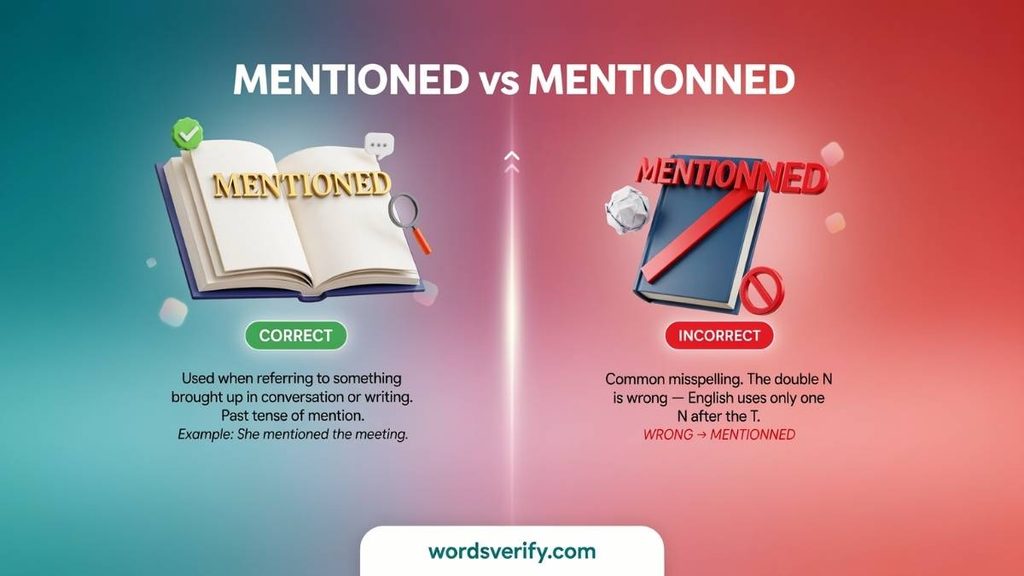
In the Mentioned vs Mentionned spelling debate, “mentionned” isn’t the accepted spelling of the verb “mention” in the past tense or past participle. The correct form is “mentioned.”
You might still encounter “mentionned” online. Someone may type it accidentally, copy an existing error, or confuse English spelling with another language. Its appearance in a search result or social media post doesn’t make it a standard English variant.
There’s an important difference between a sequence of letters appearing somewhere and a spelling being accepted in standard usage. People make mistakes every day, but those mistakes don’t automatically become correct.
If you’re editing an article, writing a school assignment, preparing a business email, or checking a professional document, change “mentionned” to “mentioned.” Understanding the difference between mentioned vs mentionned will help you choose the correct spelling and keep your writing clear and professional.
Is Mentionned Influenced by French Spelling?
French may help explain why some writers find the extra letter plausible, but the two languages use different spelling conventions.
The French verb is mentionner, and its past participle is mentionné. These are French forms, not alternative English spellings.
| Language | Form | Explanation |
|---|---|---|
| English | Mention | Base verb |
| English | Mentioned | Past tense and past participle |
| French | Mentionner | Infinitive meaning to mention |
| French | Mentionné | Past participle, shown in the masculine singular form |
The English word mentioned isn’t normally written as mentionné or mentionned.
French spelling may contribute to confusion for bilingual writers or English learners. However, you can’t know why a particular person made the mistake without more context.
The practical lesson is simple: follow the spelling conventions of the language you’re writing in.
Learn how to use confusing more words correctly
Unphased vs Unfazed which one is correct?
Mentioned Grammar Rules Tense, Forms and Usage
Spelling is only half the story. To use mentioned correctly, you also need to understand how it fits into a sentence.
Mention is a regular English verb. It forms its simple past tense and past participle by adding -ed.
What Is the Past Tense of Mention?
The past tense of mention is mentioned.
Use it when someone referred to a person, thing, or idea at a particular point in the past.
Examples:
- I mentioned your suggestion yesterday.
- The speaker mentioned three important points.
- They mentioned the new policy during the call.
- My colleague mentioned that the office would close early.
You don’t need an additional helping verb when mentioned functions as the main verb in a simple past-tense sentence.
For instance, “She mentioned the deadline” is complete. “She did mentioned the deadline” is incorrect because English uses the base form after did: “She did mention the deadline.”
What Is the Past Participle of Mention?
The past participle of mention is also mentioned. Although the spelling is identical to the simple past form, its grammatical function depends on the sentence.
You’ll often see the past participle with have, has, or had.
| Tense | Example | Explanation |
|---|---|---|
| Simple past | She mentioned the issue. | A completed past action |
| Present perfect | She has mentioned the issue. | A past reference connected to the present |
| Past perfect | She had mentioned the issue before I arrived. | A reference that happened before another past event |
| Future perfect | She will have mentioned the issue by noon. | A reference expected to be completed before a future point |
The past participle also appears in passive constructions, such as “The issue was mentioned.” This sentence emphasizes the issue rather than the person who brought it up.
The Different Forms of Mention
The main forms of mention are easy to learn.
| Verb form | Example | Usage |
|---|---|---|
| Mention | I want to mention one detail. | Base form |
| Mentions | She mentions the deadline. | Present tense with he, she, or it |
| Mentioned | He mentioned the deadline. | Simple past |
| Mentioning | They are mentioning the deadline. | Present participle |
| Mentioned | They have mentioned the deadline. | Past participle |
Learning these forms helps you avoid confusion between mention, mentions, mentioning, and mentioned.
Mention vs Mentioned What’s the Difference?
The difference comes down to grammatical context.
Use mention when the sentence requires the base form. Use mentioned when you need the past tense or past participle.
Compare these examples:
- Present: I mention the problem whenever it comes up.
- Past: I mentioned the problem yesterday.
- Present perfect: I have mentioned the problem several times.
- Continuous: I am mentioning the problem because it matters.
- Third-person singular: She mentions the problem at every meeting.
A useful shortcut is to look at the words around the verb. Helping verbs such as have, has, had, was, and were can help you identify the form the sentence requires.
Mentioned in the Passive Voice
The passive voice places the focus on the person or thing receiving attention rather than the person performing the action.
For example:
- Active: The manager mentioned your name.
- Passive: Your name was mentioned by the manager.
Both sentences communicate essentially the same information, but they emphasize different parts of the situation.
You can also write:
- Your name has been mentioned several times.
- The issue was mentioned during the discussion.
- The new policy had been mentioned before the meeting began.
The spelling remains mentioned in every case. Changing the voice doesn’t change the word’s spelling.
Common Sentence Patterns With Mentioned
Certain structures appear frequently in everyday English.
- Mentioned + noun: “She mentioned the new schedule.” The noun identifies the subject someone referred to.
- Mentioned + that-clause: “He mentioned that the train was delayed.” The clause explains what the person said.
- Mentioned + question word: “She mentioned where the documents were stored.” Words such as where, when, why, and how introduce the information being reported.
- Mentioned + verb ending in -ing: “They mentioned moving the meeting to Thursday.” The word moving functions as a gerund.
- As mentioned earlier: “As mentioned earlier, all applications must arrive by Friday.” This phrase points back to information presented previously.
The last expression is common in reports, instructions, presentations, and formal emails. However, repeating it too often can make writing feel stiff.
Learn how to use confusing more words correctly
Signer vs Signor which one is correct?
Mentioned Pronunciation and Spelling
The pronunciation of mentioned is relatively straightforward once you recognize its syllables.
In standard English, the word is commonly represented in the International Phonetic Alphabet as /ˈmen.ʃənd/. It generally has two syllables, with the stress on the first. Pronunciation can vary slightly by accent.
How to Remember the Correct Spelling of Mentioned
If you keep writing mentionned, try this simple method:
- Start with the base word mention.
- Check that the base word contains one n.
- Add -ed.
- Read the finished word: mentioned.
This approach encourages you to build the word from its correct base instead of guessing how many letters it needs.
How to Avoid Spelling Errors
A few practical habits can help you catch this and similar mistakes.
- Learn the base verb. Knowing how to spell mention makes mentioned easier.
- Watch for familiar patterns. Don’t automatically apply the spelling of planned or referred to other verbs.
- Use spell-check tools. Writing tools can flag nonstandard spellings, although their suggestions aren’t always perfect.
- Proofread after editing. Typing quickly or copying text can introduce extra letters.
- Read the whole sentence. Context helps you catch grammatical mistakes as well as spelling errors.
These techniques are useful beyond this particular word. They can help you recognize many commonly confused spellings in English.
Learn how to use confusing more words correctly
Macaroon vs Macaron which one is correct?
Mentioned Synonyms What Other Words Can You Use?
When exploring Mentioned vs Mentionned, it’s also helpful to understand synonyms for “mentioned.” A synonym for mentioned is a word or phrase that expresses a similar idea. The best choice depends on what you want to communicate.
For example, “noted” may suggest that someone recorded or acknowledged a point, while “cited” often refers to naming a source or providing supporting evidence. “Discussed” usually suggests more detailed consideration than “mentioned.”
| Synonym or phrase | Typical meaning | Example |
|---|---|---|
| Referred to | Directed attention toward something | She referred to the earlier report. |
| Brought up | Introduced a topic into conversation | He brought up the budget. |
| Noted | Recorded or acknowledged a point | The reviewer noted several concerns. |
| Cited | Referred to a source or example | The researcher cited two studies. |
| Stated | Expressed something clearly | The announcement stated the new rules. |
| Acknowledged | Recognized or admitted something | She acknowledged the delay. |
| Pointed out | Drew attention to a detail | He pointed out a spelling error. |
| Discussed | Talked about something in greater detail | They discussed the proposal. |
These words overlap, but they aren’t perfect substitutes in every sentence.
For example, “She mentioned the study” doesn’t necessarily mean she explained its methods or findings. “She discussed the study” suggests a more substantial conversation.
Related Forms and Expressions
Several expressions built around mention appear regularly in English.
- Briefly mentioned: Referred to something without much detail.
- Previously mentioned: Referred to earlier in a conversation or document.
- Frequently mentioned: Referred to many times.
- Specifically mentioned: Identified something directly rather than vaguely.
- Worth mentioning: Important or interesting enough to include.
- As mentioned above: Refers to information earlier in a document.
- As previously mentioned: Points back to an earlier statement.
For example, “One detail worth mentioning is that the deadline changed” draws attention to information the reader shouldn’t overlook.
Another example is “The previously mentioned figures appear in Table 2.” This phrase connects one part of a report to another.
The adjective mentionable also exists. It describes something that can be or is worth mentioning, although it’s less common than the main verb forms.
Learn how to use confusing more words correctly
Withdraw vs Withdrawal which one is correct?
Is Mentioned Spelled the Same in American and British English?
Yes. American English and British English both use mentioned. There is no regional spelling difference for this word.
Unlike color and colour or organize and organise, mentioned follows the same standard spelling in both countries.
| Variety of English | Correct spelling | Incorrect spelling |
|---|---|---|
| American English | Mentioned | Mentionned |
| British English | Mentioned | Mentionned |
| Canadian English | Mentioned | Mentionned |
| Australian English | Mentioned | Mentionned |
You can use mentioned in an American college essay, a British business email, an Australian news report, or a Canadian research paper without changing its spelling.
The key is to follow standard English spelling conventions consistently. Regional differences don’t make mentionned acceptable.
Learn how to use confusing more words correctly
Duchess vs Dutchess Which one Is Correct?
Common Mistakes With the Word Mentioned
When comparing Mentioned vs Mentionned, it’s helpful to recognize common spelling and grammar mistakes. Even though “mentioned” is a regular verb form, several mistakes can creep into writing. Understanding them will help you avoid errors beyond this single word and improve your overall writing accuracy.
Adding an Extra N
The most obvious mistake is writing mentionned instead of mentioned.
Incorrect: The teacher mentionned the assignment.
Correct: The teacher mentioned the assignment.
The fix is simple. Start with the correctly spelled base word and add -ed.
Using the Wrong Verb Form
Another mistake involves choosing the wrong form of mention.
Incorrect: She did mentioned the deadline.
Correct: She did mention the deadline.
After did, use the base form of the verb. However, when you use has or have, the past participle is required.
Correct: She has mentioned the deadline.
These examples show why spelling and grammar work together. A word can be spelled correctly but still appear in the wrong grammatical form.
Confusing Mention With Discuss
The verbs mention and discuss have related meanings, but they don’t always communicate the same thing.
“She mentioned the proposal” means she referred to it. “She discussed the proposal” suggests that she talked about it in greater detail.
Trusting Incorrect Online Examples
Search results, social media posts, and informal messages sometimes contain spelling errors. Seeing a word repeatedly doesn’t prove that dictionaries or standard writing conventions accept it.
When you’re unsure, consult a reliable dictionary or grammar reference rather than copying a spelling simply because you’ve seen it before.
Learn how to use confusing more words correctly
Written vs Writen Which one Is Correct?
practice session Mentioned vs Mentionned
Complete these sentences by filling in each blank with the correct word or form. This Mentioned vs Mentionned practice session will help you understand the spelling difference and use “mentioned” correctly in context. The answer session is provided below, so you can practice first and check your answers afterward.
fill in the blanks
- She ______ the spelling mistake during the meeting.
- The teacher has ______ the importance of correct grammar.
- I did ______ the issue in my previous email.
- He ______ my name in his speech yesterday.
- As ______ earlier, the deadline is Friday.
- The problem was ______ during the discussion.
- Have you ______ the new project to your manager?
- She is ______ the same example again.
- The report ______ several important details.
- I don’t remember ______ that word before.
- He has never ______ this problem to me.
- The previously ______ rules still apply.
- She ______ that the instructions were unclear.
- It is worth ______ the main difference.
- The manager did not ______ the mistake.
- You’ve ______ this topic several times.
- The issue was ______ in the final paragraph.
- I ______ the matter to my colleague last week.
- The author is often ______ in academic discussions.
- She said she had already ______ the news to him.
- The above-______ information explains the rule.
- He ______ the correct spelling in his notes.
- I wanted to ______ one more important detail.
- The changes were ______ in the updated document.
- She has ______ that English spelling can be confusing.
Answers
- mentioned
- mentioned
- mention
- mentioned
- mentioned
- mentioned
- mentioned
- mentioning
- mentioned
- mentioning
- mentioned
- mentioned
- mentioned
- mentioning
- mention
- mentioned
- mentioned
- mentioned
- mentioned
- mentioned
- mentioned
- mentioned
- mention
- mentioned
- mentioned
Here’s a trusted source for clear word meanings:
FAQs
1. Is “mentionned” ever correct in English?
No. “Mentionned” is a misspelling in standard English. The correct spelling is “mentioned,” formed by adding “-ed” to “mention” without doubling the final “n.”
2. Why is “mentioned” spelled with one “n” before “-ed”?
The verb “mention” keeps its original spelling when you add “-ed.” Unlike “plan,” which becomes “planned,” “mention” doesn’t require a doubled final consonant. The correct form is simply “mentioned.”
3. Can “mentioned” be used without naming a specific person or thing?
Yes. You can use “mentioned” when the subject is already understood or doesn’t need to be identified. For example, “It was mentioned during the meeting” is grammatically correct even if you don’t say who mentioned it.
4. What is the difference between “mentioned” and “referred to”?
“Mentioned” usually means bringing something up briefly, while “referred to” can mean pointing to, discussing, or directing someone toward a particular person, topic, or source. For example, “She mentioned the report” means she brought it up, while “She referred to the report” suggests she used it as a point of reference.
5. Is “previously mentioned” grammatically correct?
Yes. “Previously mentioned” describes something discussed or identified earlier. For example, “Please review the previously mentioned guidelines before submitting your application.” It’s a useful phrase in professional emails, reports, and formal writing.
6. Which is correct: “above-mentioned” or “above mentioned”?
Both forms appear in English, but “above-mentioned” is traditionally hyphenated when it comes directly before a noun, as in “the above-mentioned issue.” In many cases, “mentioned above” sounds more natural and reads more smoothly: “Please review the issue mentioned above.”
7. What is the difference between “mentioned” and “discussed”?
“Mentioned” generally means referring to something briefly, while “discussed” suggests exploring a subject in greater detail. For example, “We mentioned the budget” means it came up in conversation. “We discussed the budget” suggests that you examined it more closely.
8. Can “mentioned” start a sentence?
Yes. For example, “Mentioned in the report was a serious safety concern” is grammatically correct, although it sounds formal. A clearer, more natural version is “The report mentioned a serious safety concern.”
9. Is “worth mentioning” grammatically correct?
Yes. “Worth mentioning” means that something deserves attention or should be brought up. For example, “One detail worth mentioning is that the deadline has changed.” The phrase works well in both everyday conversation and professional writing.
10. What does “not to mention” mean?
“Not to mention” introduces an additional point that strengthens or adds to what you’ve already said. For example, “The trip was expensive, not to mention exhausting.” It emphasizes that the second detail is another important consideration.
11. What is the difference between “mentioning” and “mentioned”?
“Mentioning” is the -ing form of the verb “mention,” while “mentioned” is its simple past tense and past participle.
Examples:
- “She is mentioning the issue now.”
- “She mentioned the issue yesterday.”
The correct form depends on the sentence’s tense and structure.
12. What are some professional alternatives to “mentioned”?
Depending on the context, you can use “noted,” “stated,” “highlighted,” “identified,” “observed,” or “referred to.”
For example, “The manager noted the concern” sounds professional and concise. However, choose carefully because these words have slightly different meanings. “Highlighted” emphasizes importance, while “stated” focuses on what someone said directly.
13. Is “as I mentioned before” grammatically correct?
Yes. “As I mentioned before” refers to something you’ve already said. It’s common in everyday conversation and professional communication. For a more concise or formal tone, you can also write “As mentioned earlier” or “As noted previously.”
14. What does “you mentioned it” mean?
“You mentioned it” means that someone brought up a particular subject, fact, or detail earlier. For example, “You mentioned it during our last conversation” means the person referred to that topic at the time. The phrase uses the simple past tense of “mention.”
15. How can I remember the correct spelling of “mentioned”?
Start with “mention” and add “-ed” to form “mentioned.” You don’t need to double the final “n.” A simple memory trick is to write the base verb first, then add the ending: mention + ed = mentioned. That extra “n” in “mentionned” is unnecessary, so leave it out!
Learn how to use confusing more words correctly
Icycle vs Icicle Which one Is Correct?
Conclusion
The confusion between mentioned vs mentionned comes down to one simple rule: “mentioned” is the correct spelling in standard English. The word “mention” takes “-ed” to form its past tense and past participle, without doubling the final “n.” Although “mentionned” may look plausible, that extra letter has no place in standard English.
Now that you know the difference, you can avoid this common spelling mistake in emails, essays, reports, and everyday conversations. Remember, good grammar doesn’t always require complicated rules or a dictionary within arm’s reach. Sometimes, it’s simply about knowing which letter to leave out. So, stick with “mentioned,” keep that extra “n” out of the picture, and give your writing one less spelling mistake to worry about!

Lisa AJS is an experienced blogger and language enthusiast at Words Verify, dedicated to making grammar simple, practical, and enjoyable. She writes engaging content on commonly confused words, grammar mistakes, word meanings, and everyday language challenges.