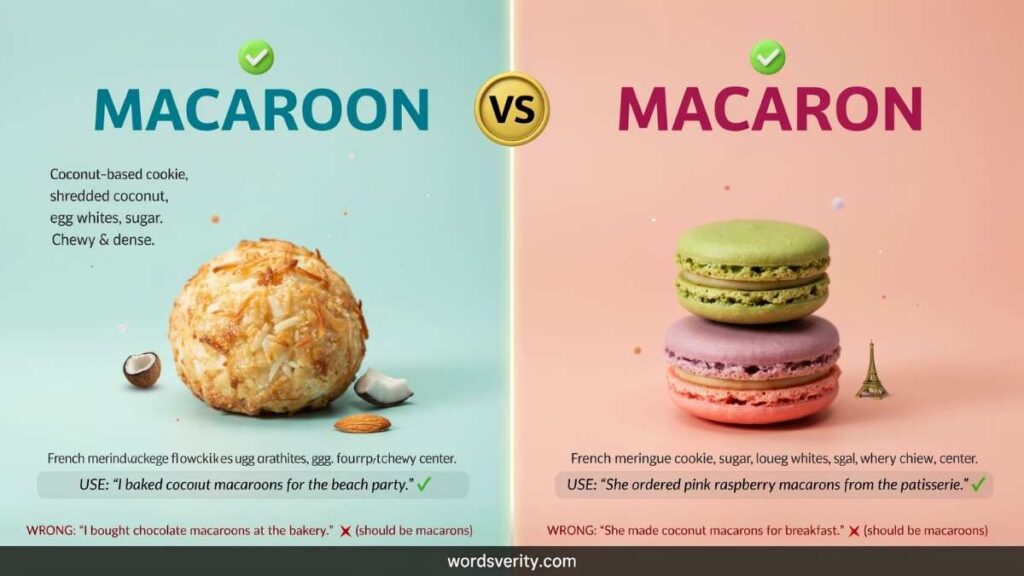
Ever ordered a macaroon when you really wanted a macaron? That tiny spelling mix-up can lead to a sweet surprise! The macaroon vs macaron debate confuses even dessert lovers because these two treats have nearly identical names but very different personalities. One is a chewy, coconut-filled cookie, while the other features delicate almond shells sandwiched around a creamy or fruity filling. Delicious? Absolutely. Interchangeable? Not quite! Understanding the difference between macaron and macaroon will help you spell each word correctly, avoid awkward ordering mistakes, and choose the perfect treat for your next sugar craving.
Macaroon vs Macaron Quick Answer
A macaroon is a small cookie commonly made with shredded coconut, sugar, and egg whites or sweetened condensed milk. It usually has a rough, rounded shape, a moist center, and a lightly toasted exterior.
A macaron is a French-style cookie made with almond flour, egg whites, and sugar. Bakers pipe the mixture into small circles, bake the shells, and sandwich them around a filling such as chocolate ganache, buttercream, or fruit jam.
Here’s a quick comparison of the two desserts.
| Feature | Macaroon | Macaron |
|---|---|---|
| Main ingredient | Usually shredded coconut | Usually almond flour |
| Appearance | Rough, rounded mound | Smooth, round shells |
| Texture | Moist and chewy | Delicate shell with a soft center |
| Shape | Usually a single mound | Two shells joined by filling |
| Filling | Usually none | Ganache, buttercream, or jam |
| Common flavors | Coconut, chocolate, vanilla | Chocolate, raspberry, pistachio, lemon |
| Baking difficulty | Generally easier | Requires more precision |
| Common serving style | Plain or dipped in chocolate | Filled and arranged as individual cookies |
Neither spelling is incorrect. The right choice depends on which dessert you’re describing. If you want a chewy coconut cookie, choose a macaroon. If you’re looking for a colorful French cookie with a filling, you’re probably after a macaron.
Learn how to use confusing more words correctly
Withdraw vs Withdrawal which one is correct?
What Is a Macaroon?
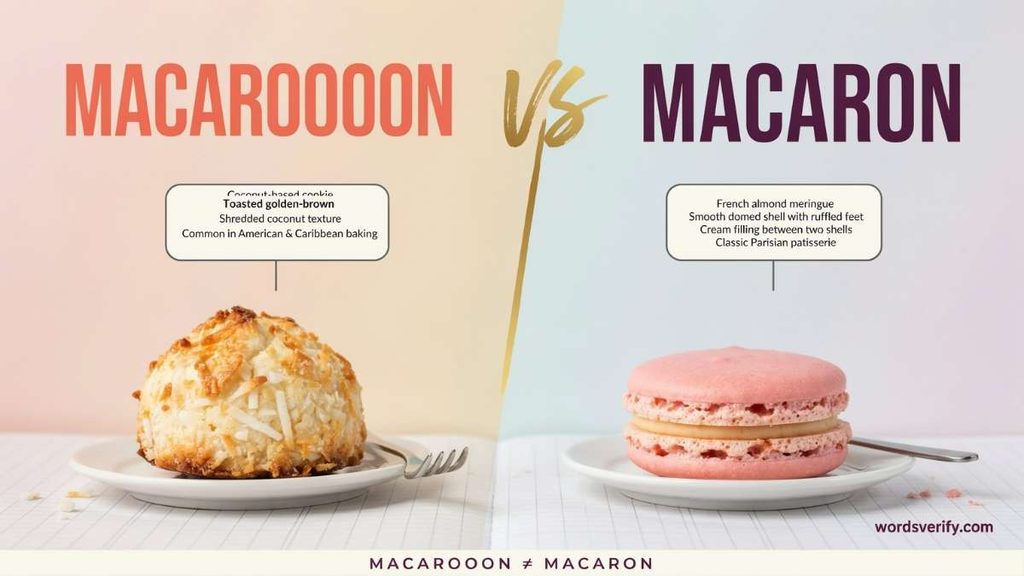
A macaroon is a small, sweet cookie that often features shredded coconut as its main ingredient. Bakers combine the coconut with a sweet binder, shape the mixture into mounds, and bake the cookies until the outside turns lightly golden.
The result is a simple treat with plenty of texture. Unlike the smooth, even surface of a macaron, a coconut macaroon has a rustic appearance. Loose coconut strands give it a distinctive look and a satisfying bite.
What Are Macaroons Made Of?
The ingredients depend on the recipe, but most coconut macaroons use a few familiar baking staples.
- Shredded coconut: Provides the main flavor, chewy texture, and recognizable appearance.
- Sugar: Adds sweetness and helps the exterior brown during baking.
- Egg whites: Bind the ingredients together and can give the cookies a lighter structure.
- Sweetened condensed milk: Acts as a thick, sweet binder in many recipes and helps keep the cookies moist.
- Vanilla extract: Adds warmth and complements the coconut flavor.
- Chocolate: Often used as a coating, drizzle, or finishing touch.
Not every recipe uses both egg whites and condensed milk. Some rely on egg whites and sugar, while others use condensed milk as the main binder. That’s why macaroons can vary in texture even when they look similar.
Although coconut is the most familiar ingredient in modern American macaroons, the word has also described almond-based confections. Its meaning has changed across culinary traditions, so coconut isn’t a requirement in every version.
Macaroon Texture and Flavor
The best part of a coconut macaroon is the contrast between its outside and center. The edges may become lightly crisp or toasted, while the inside stays soft, moist, and chewy.
Its flavor is usually sweet and rich, with coconut taking center stage. Toasting adds deeper, caramel-like notes, while vanilla gives the cookie a fuller aroma. A chocolate coating introduces a pleasant contrast, especially when bakers use dark chocolate.
Macaroons can be soft and tender or firmer and crunchier, depending on the ingredients and baking time. Recipes made with sweetened condensed milk often produce a dense, moist center. Those made with whipped egg whites may have a lighter texture.
Common varieties include:
- Classic coconut macaroons with golden edges and chewy centers.
- Chocolate-dipped macaroons coated partly or fully in melted chocolate.
- Chocolate-drizzled macaroons finished with thin lines of chocolate.
- Almond macaroons made with ground almonds or almond flavoring.
- Flavored macaroons that include vanilla, lemon zest, or other additions.
How Are Coconut Macaroons Made?
Coconut macaroons are usually straightforward to prepare. You don’t need to master delicate piping techniques or achieve a precise batter consistency.
The general process looks like this:
- Mix shredded coconut with the sweetener and binding ingredients.
- Add vanilla or other flavorings if desired.
- Scoop the mixture into small mounds and place them on a lined baking sheet.
- Bake until the cookies set and the edges turn golden.
- Let them cool before dipping or drizzling them with chocolate.
The mixture should hold together when you scoop it. If it falls apart, it may need more mixing or a little more binder, depending on the recipe.
Baking time also matters. Remove the cookies too early and they may remain overly wet or fragile. Leave them in the oven too long and the coconut can become dry or burnt. A little golden color adds flavor, but excessive browning can make the cookies bitter.
Are Coconut Macaroons Easy to Make?
Yes. Coconut macaroons are a good choice for beginner bakers because they don’t usually require the precision needed for French macarons.
You may need only a mixing bowl, a spoon or scoop, and a baking sheet. Some recipes use just three main ingredients, although vanilla, salt, and chocolate can add more flavor.
Macaroons are also forgiving when it comes to shape. A slightly uneven mound can still turn into a delicious cookie. French macarons are less flexible because small changes in mixing or baking can affect their appearance and texture.
Learn how to use confusing more words correctly
Duchess vs Dutchess Which one Is Correct?
What Is a Macaron?
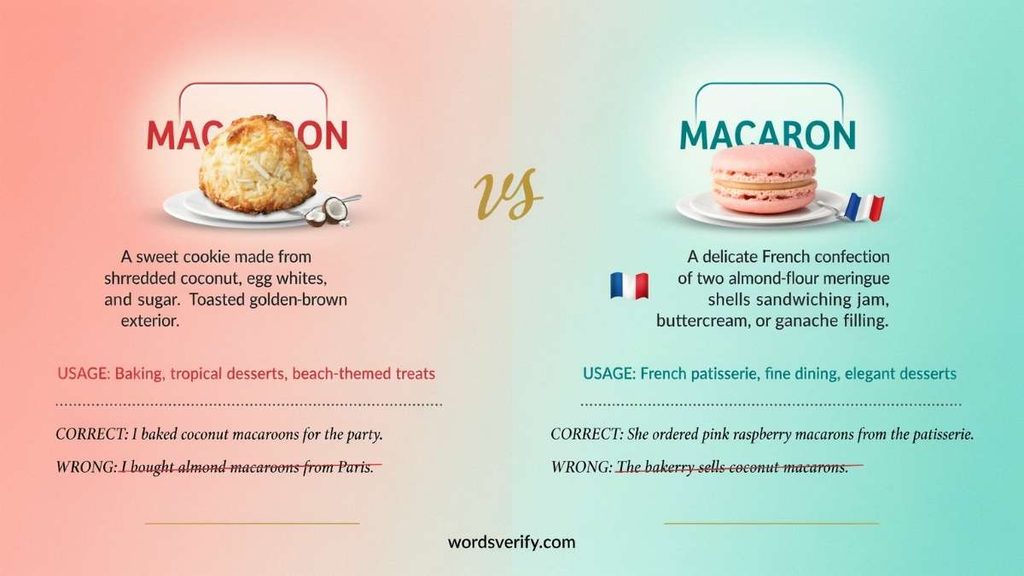
A macaron is a delicate French-style cookie made from almond flour, sugar, and whipped egg whites. Bakers pipe the batter into small circles, bake the shells, and pair them with a filling to create a sandwich-style dessert.
Macarons are closely associated with French pastry shops, especially those in Paris. You’ll often see them arranged in neat rows or packed into gift boxes, with different colors representing different flavors.
Despite their elegant appearance, macarons aren’t simply miniature cakes or ordinary sandwich cookies. Their texture depends on the balance of almond flour, sugar, and meringue. When made well, each shell has a delicate outer layer, a slightly chewy interior, and a filling that adds moisture and flavor.
What Are Macarons Made Of?
Traditional French macarons use a short list of ingredients, but each one plays an important role.
- Almond flour: Finely ground almonds provide the shells’ structure and mild nutty flavor.
- Powdered sugar: Sweetens the shells and helps create a fine texture.
- Egg whites: Whipped into a foam, they provide the air needed for the shells to rise and develop their structure.
- Granulated sugar: Helps stabilize the meringue and supports the shells’ structure.
- Food coloring: Often used to create different colors, although it’s optional.
- Filling: Ganache, buttercream, fruit jam, or fruit curd joins the two shells.
Some recipes use French meringue, made by whipping egg whites with sugar. Others use Italian meringue, which involves pouring hot sugar syrup into whipping egg whites. Both methods can produce excellent macarons, but they require different techniques.
For a traditional almond flour macaron, bakers often sift the almond flour and powdered sugar together to remove larger particles. This helps create the smooth surface that gives the shells their familiar appearance.
The filling matters just as much as the shells. Chocolate ganache adds richness, raspberry jam brings a tart note, and vanilla buttercream provides a creamy sweetness. Bakers often match the filling to the shell’s flavor, although contrasting combinations can work just as well.
Macaron Appearance and Texture
The classic macaron has a smooth, rounded top and a ruffled base known as the foot. These little frills form as the batter expands during baking and the surface sets. They’re one of the clearest signs that you’re looking at a French-style macaron.
A properly baked macaron usually has three distinct textural elements:
- A thin, delicate outer shell.
- A slightly chewy interior.
- A soft, flavorful filling that brings the two shells together.
The exact texture varies with the recipe and freshness. Some macarons have a more noticeable crunch when freshly baked, while others become softer after the filling transfers moisture into the shells.
This change explains why pastry chefs often let filled macarons rest in the refrigerator before serving them. During this time, moisture moves between the filling and shells, helping the textures blend. The ideal resting time depends on the recipe and filling, so follow the baker’s storage and serving instructions.
What Does a French Macaron Taste Like?
The answer depends on the flavor, but the almond-based shells usually have a mild, sweet, nutty taste. The filling often supplies the strongest flavor.
A chocolate macaron can taste rich and slightly bitter, while a raspberry version may combine sweet shells with a sharp fruit filling. Pistachio macarons offer a deeper nutty flavor, and lemon versions tend to taste bright and tangy.
Texture also shapes the experience. A macaron shouldn’t feel like a dry, crunchy biscuit from edge to edge. Ideally, the thin shell gives way to a tender center, followed by the creamy or fruity filling.
Macarons can be very sweet, especially when the filling contains buttercream or white chocolate. Bakers often balance that sweetness with dark chocolate, tart fruit, citrus, or a little salt.
Why Are French Macarons Difficult to Make?
Macarons have a reputation for being tricky, and there’s a good reason for it. The ingredients are simple, but the technique leaves less room for error than many other cookie recipes.
One crucial step is macaronage, the process of folding the almond flour and powdered sugar mixture into the meringue until the batter reaches the right consistency.
Under-mixing can leave the batter too stiff, while over-mixing can make it too runny. Either problem can affect the shells’ shape and texture.
Other important factors include:
- Meringue stability: The egg whites must form a suitable foam.
- Batter consistency: The mixture needs to flow smoothly without becoming too thin.
- Piping technique: Uniform circles help the shells bake evenly.
- Resting time: Some recipes require the piped shells to develop a dry surface before baking.
- Oven temperature: Excessive or uneven heat can cause cracks, browning, or other defects.
- Humidity: Moisture in the air can affect how quickly the shells dry.
Even experienced bakers sometimes encounter hollow shells, cracked tops, uneven feet, or lopsided cookies. These problems don’t necessarily mean the recipe is bad. Often, a small adjustment to mixing, resting, or oven temperature can improve the result.
If you’re new to baking, start with a tested macaron recipe and measure ingredients by weight. Precision is far more useful than guessing.
Learn how to use confusing more words correctly
Written vs Writen Which one Is Correct?
Macaron vs Macaroon Key Differences Explained
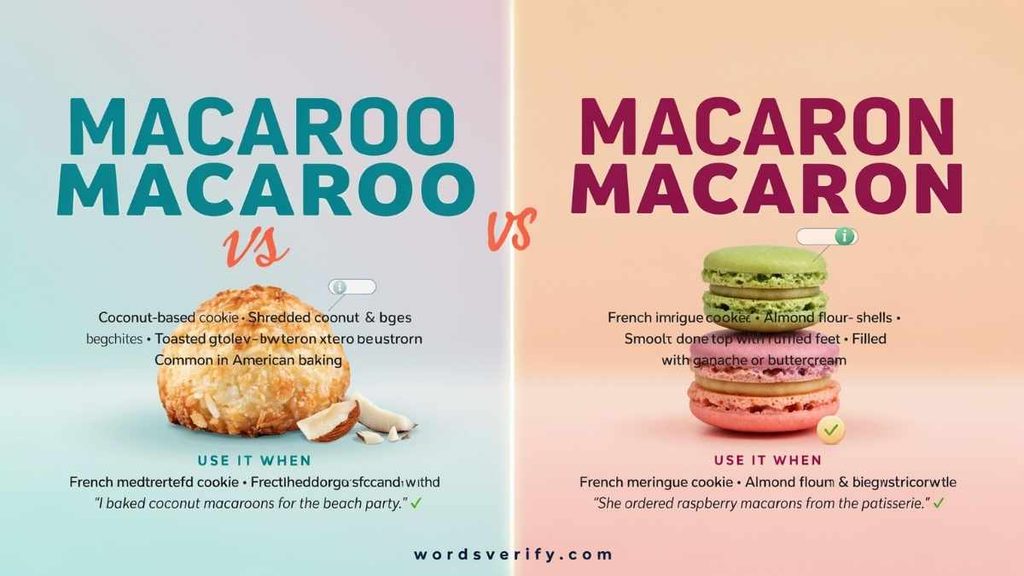
The easiest way to understand the difference between macarons and macaroons is to compare their ingredients and how those ingredients behave during baking. Their similar names can be misleading, but the cookies have distinct characteristics.
Macaron vs Macaroon Ingredients
The biggest difference starts with the main dry ingredient. French macarons typically use almond flour, while American-style coconut macaroons rely on shredded coconut.
Both recipes may use egg whites and sugar, but those ingredients serve different purposes. In macarons, whipped egg whites create the meringue structure that supports the smooth shells. In many coconut macaroons, egg whites or condensed milk help hold the coconut together.
| Ingredient or feature | French macaron | Coconut macaroon |
|---|---|---|
| Main dry ingredient | Almond flour | Shredded coconut |
| Egg whites | Commonly whipped into meringue | Used in many recipes |
| Sugar | Granulated and powdered sugar | Granulated sugar or sweetened condensed milk |
| Almond flavor | Comes from ground almonds | Optional |
| Filling | Usually ganache, buttercream, or jam | Usually none |
| Food coloring | Common but optional | Less common in traditional versions |
| Gluten-free potential | High when made without gluten-containing additions | High when made without gluten-containing additions |
This table describes typical recipes rather than every possible variation. Some macaroons contain almonds, while other recipes use ingredients that change the usual texture or dietary profile.
Macaron vs Macaroon Appearance
A macaron usually looks smooth, symmetrical, and polished. Two round shells form a sandwich, with a visible band of filling between them. Their colors can range from pale cream to bright pink, green, yellow, and purple.
A coconut macaroon looks more rustic. Shredded coconut creates a rough surface, and the cookie often resembles a small haystack or rounded mound. Its color typically ranges from pale gold to deep toasted brown.
A simple visual test works well: if you see two smooth shells joined by filling, you’re probably looking at a macaron. If you see a single mound of toasted coconut, it’s probably a macaroon.
Macaron vs Macaroon Texture
Texture is one of the most noticeable differences.
A coconut macaroon is usually dense, moist, and chewy. The coconut fibers provide structure, so each bite feels substantial. Depending on the recipe, the outside may become crisp or caramelized.
A French macaron has a more layered texture. Its thin shell may crack lightly when bitten, followed by a soft interior and a creamy or fruity filling. A well-made macaron feels delicate rather than heavy.
Neither cookie has one fixed texture. Baking time, ingredient ratios, storage, and freshness all affect the result. Still, the general distinction holds: macaroons tend to be coconut-chewy, while macarons combine a delicate shell with a soft center and filling.
Macaron vs Macaroon Taste
The flavor difference is just as clear.
A coconut macaroon tastes sweet and rich, with coconut at the center. Toasting adds deeper notes, while chocolate brings a slightly bitter contrast. Depending on the recipe, the cookie may also have a buttery or vanilla flavor.
A macaron usually gets much of its flavor from the filling. The almond-based shells provide a mild foundation for chocolate, fruit, coffee, pistachio, and other flavors.
Consider a chocolate-dipped coconut macaroon beside a raspberry macaron. The first offers a rich, chewy coconut bite. The second combines a delicate almond shell with sweet-tart fruit and a softer center.
Neither dessert is automatically sweeter than the other. A heavily sweetened coconut macaroon may taste sweeter than a macaron filled with dark chocolate ganache. The recipe determines the final balance.
Macaron vs Macaroon Baking Process
Coconut macaroons are generally easier to prepare. Bakers mix the ingredients, portion the mixture into mounds, and bake until the cookies set and develop color.
Macarons require more control at several stages. The meringue needs the right structure, the batter needs the right consistency, and the shells may need to rest before baking. Bakers also have to consider how the filling affects the finished cookie.
That difference makes macarons more sensitive to technique. A macaroon can look irregular and still taste excellent. A macaron with cracked shells, uneven feet, or an overly hollow center may indicate a problem with the process.
For beginners, coconut macaroons are often the more forgiving option. For bakers who enjoy precision and careful technique, macarons offer a rewarding challenge.
Macaron vs Macaroon Filling
Traditional French macarons are filled after the shells have baked and cooled. Common fillings include:
- Chocolate ganache.
- Vanilla or chocolate buttercream.
- Raspberry or strawberry jam.
- Lemon curd.
- Pistachio cream.
- Salted caramel.
Coconut macaroons are usually served as individual cookies without a separate filling. Their flavor and texture come mainly from the coconut mixture itself.
However, macaroons can still receive extra toppings. Bakers may dip the bottoms in chocolate, drizzle melted chocolate over the tops, or add chopped nuts. These additions change the flavor without turning the cookie into a filled sandwich.
Macaron vs Macaroon Cost
Macarons often cost more per piece at bakeries because they require precise preparation, careful assembly, and delicate handling. Their fillings also add another production step.
Coconut macaroons tend to be simpler to produce in batches. The mixture is easy to portion, and the finished cookies are generally sturdier than macarons.
Still, price depends on more than technique. Ingredient quality, bakery reputation, packaging, location, and labor costs all matter. A premium chocolate macaroon can cost more than a basic macaron, so there’s no universal price difference.
For a fair comparison, look at similarly sized products from the same bakery rather than assuming every macaron costs more than every macaroon.
Learn how to use confusing more words correctly
Excelerate vs Accelerate Which one Is Correct?
Macaron vs Macaroon Pronunciation and Spelling
The spelling difference is small, but pronunciation makes the words easier to tell apart. In common American English, macaroon ends with the same sound as “moon,” while macaron ends with a sound similar to the final syllable of “salon.”
How to Pronounce Macaroon
The standard American English pronunciation is mack-uh-ROON.
The stress falls on the final syllable. The word rhymes with “moon” and “spoon” for speakers who use the same vowel sound in those words.
When ordering a coconut macaroon, make the final syllable clear. That can help distinguish the word from macaron, especially in a busy café or bakery.
How to Pronounce Macaron
In American English, macaron is commonly pronounced mack-uh-ROHN.
The final syllable sounds like the ending of “salon” for many American speakers. French pronunciation differs because French uses nasal vowels, so an English pronunciation won’t reproduce every detail of the original.
Both pronunciations are widely recognizable in food settings. Learning the distinction is useful when discussing recipes or ordering desserts.
How to Remember the Difference
Try this simple memory aid:
- Macaroon means coconut cookie in common American usage. Connect the longer spelling with a chewy coconut mound.
- Macaron means French-style sandwich cookie. Remember the smooth shells and filling.
- Macron is a different word altogether. It refers to a mark placed above a letter in some writing systems.
The first two points are memory tricks rather than formal spelling rules. What matters is matching the word to the dessert.
A macron, meanwhile, is a horizontal mark placed above a letter. In some languages and transcription systems, it indicates a long vowel. It has no connection to either cookie.
Learn how to use confusing more words correctly
Rug vs Rag What’s the Difference?
Macaron vs Macaroon Origin Where Did the Names Come From?
The similar spellings aren’t a coincidence. The words share a historical connection through European culinary traditions, although the history of each dessert is more complicated than a single origin story.
Shared Italian Roots
Both macaron and macaroon trace their linguistic history to forms of the Italian word maccarone or maccherone. The terms passed through French and English, and their meanings changed over time.
Early versions of these confections weren’t necessarily the coconut mounds familiar in American bakeries today. Almond-based cookies existed long before coconut macaroons became a common modern variety.
That distinction matters. It’s misleading to assume that the original macaroon was always a coconut cookie or that the modern French macaron appeared in its current sandwich form centuries ago.
How the Macaron Developed
Almond-based confections became part of European baking traditions, and France developed its own distinctive versions. Over time, pastry chefs refined the techniques used to create smooth meringue shells.
The familiar Parisian-style macaron, with two colorful shells and a filling, represents a later development in that history. Its modern appearance depends on careful meringue preparation, precise batter mixing, piping, and baking.
Popular accounts sometimes credit Catherine de’ Medici’s arrival in France in the 16th century with bringing macarons from Italy. However, stories about the exact origin of the dessert are difficult to establish conclusively.
The safer conclusion is that almond-based confections developed through centuries of European culinary exchange, while the modern filled macaron became strongly associated with French pastry making.
How the Macaroon Developed
The word macaroon once covered a wider range of almond-based confections than the coconut cookie many Americans recognize today. Recipes and regional traditions varied, using ingredients such as ground almonds, egg whites, and sugar. Coconut later became a defining ingredient in many North American versions.
Coconut macaroons became popular because they’re practical to make in batches and work well with chocolate coatings and other additions.
They also became associated with Passover baking in Jewish communities because many recipes can be made without wheat flour or leavening agents. However, ingredients and preparation methods vary, so a particular product must still meet the relevant dietary requirements to qualify for Passover.
The two names reflect related histories rather than identical modern recipes. Shared ancestry explains their similar spelling, while centuries of culinary change explain why the desserts now look and taste so different.
Learn how to use confusing more words correctly
Bougie vs Boujee which one is correct?
both in American and British English
Regional usage can add another layer of confusion, but the basic distinction remains useful in both American and British English.
in American English
In the United States, macaroon commonly refers to a coconut-based cookie, while macaron usually means the colorful French-style sandwich cookie.
You’ll often find coconut macaroons in supermarket bakeries, home-baking recipes, and holiday dessert collections. French macarons are common in pastry shops, specialty bakeries, and gift assortments.
American usage also recognizes broader definitions of macaroon that include almond-based versions. Coconut is the usual association, not an absolute requirement in every context.
in British English
British usage can be broader, particularly in traditional baking. A macaroon may refer to a sweet biscuit made with ground almonds, sugar, and egg whites rather than specifically to a coconut cookie.
The word macaron is also widely used for the modern French-style pastry with smooth shells and a filling. On a bakery menu, the ingredients and description will usually make the intended dessert clear.
Do the Words Mean Different Things in Every Country?
Not necessarily. Culinary terms can overlap across regions, and local bakeries may use traditional names for different varieties.
Rather than relying on geography alone, check the ingredients or appearance. A filled almond-meringue sandwich cookie is generally a macaron in modern English food writing. A chewy coconut mound is generally a coconut macaroon.
Learn how to use confusing more words correctly
Excel vs Accel which one is correct?
Macaron vs Macaroon Examples in Sentences
Examples make the spelling distinction easier to remember. Notice how the ingredients or shape often provide a clue to the correct word.
Macaroon Examples in Sentences
- The bakery sells chewy coconut macaroons dipped in dark chocolate.
- She added shredded coconut to the mixture before shaping the macaroons.
- These homemade macaroons have golden edges and soft centers.
- We served coconut macaroons with coffee after dinner.
- The recipe uses sweetened condensed milk to bind the macaroon mixture.
Macaron Examples in Sentences
- She chose a raspberry macaron from the colorful display.
- The pastry chef filled the macaron shells with chocolate ganache.
- Pistachio macarons were arranged in neat rows inside the gift box.
- He learned the macaronage technique in a French pastry class.
- The bakery makes almond flour macarons in several seasonal flavors.
both in Everyday Writing
The distinction matters in menus, recipes, and food reviews.
Unclear: “The bakery sells French coconut macarons.”
Clearer: “The bakery sells French macarons filled with raspberry buttercream and coconut macaroons dipped in chocolate.”
The second version identifies each dessert by its ingredients and preparation. Readers know what to expect, and the wording avoids mixing up the two names.
Learn how to use confusing more words correctly
Bellies vs Bellys Which one Is Correct?
Macaroon vs Macaron Dietary Considerations
Neither dessert is automatically suitable for every diet. The ingredients matter more than the name.
Are Macarons Gluten-Free?
Traditional French macarons use almond flour rather than wheat flour, so their shells are naturally gluten-free when made with suitable ingredients. However, fillings, flavorings, decorations, and cross-contact during preparation can introduce gluten.
If you need to avoid gluten for medical reasons, check the ingredients rather than relying on the cookie’s traditional recipe.
Are Coconut Macaroons Gluten-Free?
Many coconut macaroons are made without wheat flour. Common ingredients include coconut, sugar, egg whites, and sweetened condensed milk.
Still, recipes differ. Some products contain flour or other gluten-containing ingredients, and shared baking equipment can create cross-contact risks. Check the label or ask the baker if you need to avoid gluten.
Can People With Nut Allergies Eat Macarons?
Traditional French macarons contain almonds, which are tree nuts. People with almond or tree-nut allergies shouldn’t assume that macarons are safe to eat.
Some bakeries also handle other nuts, creating additional cross-contact concerns. Coconut macaroons may be an alternative for some people, but only if the ingredients and preparation meet their allergy needs. Some recipes contain almonds, and some facilities handle multiple allergens.
For a serious allergy, check the exact product and ask about the bakery’s allergen controls. Never rely on appearance or the dessert’s name alone.
Are Macarons and Macaroons Suitable for Passover?
Some recipes for both desserts can be suitable for Passover because they don’t use wheat flour or conventional leavening agents. Coconut macaroons are especially familiar in many Passover food traditions.
However, not every macaroon or macaron automatically qualifies as kosher for Passover. Certification requirements, ingredient sourcing, equipment, and preparation practices matter. If you observe Passover dietary rules, look for appropriate certification and follow the guidance of your community.
Learn how to use confusing more words correctly
Bearer vs Barer which one is correct?
Which Is Easier to Make Macarons or Macaroons?
For most home bakers, coconut macaroons are easier to make. You can mix the ingredients, shape the cookies, and bake them without mastering the delicate batter consistency required for French macarons.
Macarons take more practice because the meringue, folding technique, piping, resting, and oven temperature all affect the final result. A small mistake can change the shape or texture.
| Baking factor | Macarons | Coconut macaroons |
|---|---|---|
| Measuring ingredients | Precision is important | Usually more forgiving |
| Mixing | Requires careful folding | Usually straightforward |
| Shaping | Piping consistent circles | Scooping or shaping mounds |
| Resting | Often required | Usually unnecessary |
| Troubleshooting | More technique-sensitive | Generally simpler |
| Best for beginners | Possible with practice | Usually easier |
If you’re new to baking, start with macaroons. Once you’re comfortable handling egg whites and controlling oven temperatures, you can move on to macarons.
practice session Macaroon vs Macaron
Complete the following sentences by filling in each blank with the correct word macaroon vs macaron. Check your answers in the answer key at the end.
fill in the blanks
1. A chewy cookie made mainly with shredded coconut is called a __________.
2. A French-style sandwich cookie made with almond flour is called a __________.
3. The main ingredient in a traditional coconut macaroon is shredded __________.
4. French macarons are traditionally made with __________ flour.
5. Two macaron shells are usually joined together with a sweet __________.
6. Chocolate __________ is a popular filling for French macarons.
7. The ruffled edge at the bottom of a macaron shell is called its __________.
8. The technique used to fold macaron batter to achieve the right consistency is called __________.
9. Coconut macaroons usually have a moist and __________ texture.
10. French macarons typically have smooth shells and a delicate outer __________.
11. The word __________ refers to the French-style filled cookie.
12. In American English, the coconut cookie is commonly spelled __________.
13. Whipped egg whites help create the __________ used in traditional macaron shells.
14. Fruit preserves can be used as a __________ for macarons.
15. Coconut macaroons are generally __________ to make than French macarons.
16. The Italian method of making macaron meringue uses hot sugar __________.
17. The French macaron is especially associated with the city of __________.
18. A mark placed above a letter to indicate a long vowel is called a __________.
19. Macarons have a mild, nutty flavor partly because they contain __________ flour.
20. A chocolate coating is a popular variation of a coconut __________.
21. Macarons can be filled with buttercream, fruit jam, or chocolate __________.
22. Bakers pipe macaron batter to create evenly sized __________.
23. Unlike filled macarons, traditional coconut macaroons are often served without a separate __________.
24. Many macarons and coconut macaroons can be made without __________ flour.
25. Although their names look similar, macarons and macaroons differ in ingredients, texture, and __________.
Answers
- Macaroon
- Macaron
- Coconut
- Almond
- Filling
- Ganache
- Foot
- Macaronage
- Chewy
- Surface
- Macaron
- Macaroon
- Meringue
- Filling
- Easier
- Syrup
- Paris
- Macron
- Almond
- Macaroon
- Ganache
- Shells
- Filling
- Wheat
- Appearance
Here’s a trusted source for clear word meanings:
FAQs
Why do Americans sometimes confuse macarons with macaroons?
The names look almost identical, making them easy to mix up. In American English, a macaroon usually refers to a chewy coconut cookie, while a macaron is a delicate French-style cookie made with almond flour and a sweet filling. Their shared history adds to the confusion, but their ingredients and appearance set them apart.
Do the French say macaron or macaroon?
The French word is macaron, which refers to the delicate, often colorful cookie made with almond flour and meringue. Macaroon is the English spelling commonly associated with coconut cookies, particularly in the United States.
What do Americans call coconut macaroons?
Americans generally call them coconut macaroons. These cookies combine shredded coconut with sugar and a binder, such as egg whites or sweetened condensed milk. Some recipes include vanilla, while others add a chocolate coating or drizzle.
What do British people call French macarons?
British people commonly call them macarons, just as the French do. The word macaroon can refer to other small, sweet confections, including coconut cookies and traditional almond-based varieties. The ingredients and appearance usually make the intended dessert clear.
How unhealthy is a macaron?
A macaron is a sweet treat that typically contains sugar, almond flour, and a filling made with ingredients such as butter, chocolate, or cream. Its calorie and sugar content depends on its size and recipe. Enjoying one occasionally can fit into a balanced diet, but eating several can add up quickly.
How do Italians pronounce macaron?
When speaking Italian, people may adapt the French word macaron to Italian pronunciation patterns. The exact pronunciation can vary depending on the speaker and context. Italy also has its own almond-based sweets, including amaretti, which are different from French macarons.
Why is a macaron so expensive?
Macarons often cost more because they require precise measurements, careful mixing, consistent piping, and controlled baking. Bakers must also prepare the filling and assemble the delicate shells without damaging them. Premium ingredients, decorative finishes, and elegant packaging can raise the price further.
Which country invented macarons?
France is closely associated with the modern filled macaron, especially the version popularized by Parisian pastry shops. However, the dessert’s roots connect to older almond-based confections found in European culinary traditions. Its exact origins remain uncertain, so attributing every version to a single country oversimplifies its history.
Why are there different types of macarons?
Macarons vary because bakers use different meringue methods, fillings, flavors, and regional techniques. French and Italian meringue methods are two common approaches. Bakers also experiment with chocolate, fruit, coffee, pistachio, and other ingredients to create distinctive varieties.
What does macaroon mean in slang?
Macaroon doesn’t have one widely recognized slang meaning in everyday American English. Its standard meaning refers to a small sweet cookie, often made with coconut. Any alternative meaning depends on the context or community using the word.
Which is correct: macarons or macaroons?
Both spellings are correct, but they usually refer to different desserts. Macarons commonly means French-style almond sandwich cookies, while macaroons often refers to chewy coconut cookies in American English. The correct choice depends on which treat you’re describing.
How do Americans pronounce macaron?
Americans commonly pronounce macaron with the final syllable sounding similar to the ending of “salon.” Pronunciation varies slightly among speakers, but the ending distinguishes it from macaroon, which rhymes with “moon.”
What do British people call spaghetti?
British people generally call it spaghetti, just as Americans do. The word refers to long, thin strands of Italian pasta. Although British and American English differ in some food terms, they use the same name for this popular dish.
What do British people call a hamburger?
British people commonly use burger or hamburger, just as Americans do. The term usually refers to a patty served in a bun with toppings such as lettuce, cheese, onions, and sauces.
What are macarons called in Italy?
The French-style filled cookie is generally known as a macaron in Italy. Italian bakeries also make traditional almond-based sweets, including amaretti, but these have different ingredients, shapes, and textures. Despite their similarities, amaretti and macarons aren’t the same dessert.
Are macaroons a French dessert?
Macaroons have historical connections to European baking traditions, including Italian and French almond-based confections. However, the chewy coconut macaroon familiar in the United States is a particular variety that developed through changing recipes and culinary traditions. Macaroons aren’t exclusive to France.
What country is famous for macaroons?
France is famous for its pastry culture and almond-based confections, particularly the modern macaron. In the United States, coconut macaroons are a familiar bakery treat. The name can refer to different cookies depending on the region and culinary tradition.
How are you supposed to eat a macaron?
There’s no strict rule for eating a macaron, but these tips can help you enjoy its delicate texture:
- Follow the baker’s serving instructions, especially if the macarons have been refrigerated.
- Hold the cookie gently to avoid crushing its shells.
- Take a bite that includes both shells and the filling to experience the combined flavors and textures.
- Pair it with coffee, tea, or another drink if you like.
You don’t need special etiquette to enjoy a macaron. Just avoid squeezing it too hard unless you want the filling to make an unexpected escape.
Which city is famous for macarons?
Paris is particularly famous for macarons. Its pastry shops offer a wide range of flavors, including raspberry, chocolate, pistachio, and vanilla. Although Paris remains closely associated with these elegant cookies, excellent macarons are now made around the world.
How much do 12 macarons cost?
The price of a dozen macarons depends on the bakery, location, ingredients, and packaging. Supermarket and standard bakery options are often more affordable than premium pastry-shop assortments. For the most accurate estimate, compare current prices from local bakeries and check the size and quality of each cookie.
Which store-bought macarons are considered the best?
The best store-bought macarons depend on your budget and taste preferences. Look for smooth shells, a delicate exterior, a soft interior, and a filling that tastes fresh and balanced. Customer reviews, ingredient quality, and storage instructions can also help you choose. Specialty pastry shops may offer more refined textures, while packaged varieties can be convenient and affordable.
Which is better: French or Italian macarons?
Neither method is automatically better. French macarons use meringue made by whipping egg whites with sugar, while Italian macarons use hot sugar syrup to help stabilize the whipped egg whites. The Italian method can produce a more stable meringue, while the French method is often simpler to prepare. Both techniques can produce delicious macarons when handled correctly.
Conclusion
Who knew one extra letter could cause so much dessert confusion? The difference between macaroon vs macaron is easy to remember once you know what makes each treat special. A macaroon is typically a chewy, coconut-filled cookie, while a macaron features delicate almond shells with a delicious filling. Although their names share a history, their ingredients, textures, and appearances set them apart. Remember the distinction, and you’ll avoid spelling mistakes, recipe mix-ups, and unexpected surprises at the bakery. After all, there’s nothing wrong with either cookie, but choosing the right one makes every sweet bite even better!

Lisa AJS is an experienced blogger and language enthusiast at Words Verify, dedicated to making grammar simple, practical, and enjoyable. She writes engaging content on commonly confused words, grammar mistakes, word meanings, and everyday language challenges.