

Have you ever wanted to speed things up but got stuck on a spelling mistake instead? That’s exactly what happens when writers confuse “excelerate” vs “accelerate.” These words look similar enough to cause a little grammatical traffic jam, but only one is the standard spelling. So, when choosing between excelerate vs accelerate, which one should you use? The answer is simple: “accelerate” is correct, while “excelerate” is generally a misspelling. In this guide, you’ll learn the word’s meaning, see how to use it in everyday sentences, and discover easy ways to avoid common spelling mistakes. Let’s put your confusion in the rearview mirror!
Quick Answer Excelerate vs Accelerate?
The correct spelling is accelerate when you mean to increase speed or make something happen faster.
Excelerate is not the standard spelling of this verb. Although you may encounter it in a company name or another proper name, use accelerate in ordinary writing.
Consider these examples excelerate vs accelerate,:
- Correct: The company plans to accelerate production next month.
- Incorrect: The company plans to excelerate production next month.
Accelerate works for both physical movement and progress. A driver can accelerate a vehicle, a teacher can help accelerate learning, and a business can accelerate growth.
The easiest way to remember the correct spelling is to connect accelerate with the idea of speeding up.
Excelerate vs Accelerate What’s the Difference?
| Feature | Accelerate | Excelerate |
|---|---|---|
| Standard spelling | Correct | Generally a misspelling |
| Meaning | To increase speed or make something happen faster | No established standard meaning as an ordinary English verb |
| Part of speech | Verb | Usually an incorrect substitute for accelerate |
| Pronunciation | Commonly pronounced ak-SEL-uh-rayt | No single standard pronunciation as a misspelling |
| Formal writing | Appropriate | Avoid unless it’s an intentional name or title |
| Common contexts | Science, transportation, business, education, and daily conversation | Stylized names or spelling errors |
| Example | We need to accelerate the process. | We need to excelerate the process. |
The distinction is simple: accelerate is the established English word, while excelerate is generally incorrect when used to express the same meaning.
Avoid everyday grammar mistakes with simple tips
Rug vs Rag What’s the Difference?
What Does Accelerate Mean?
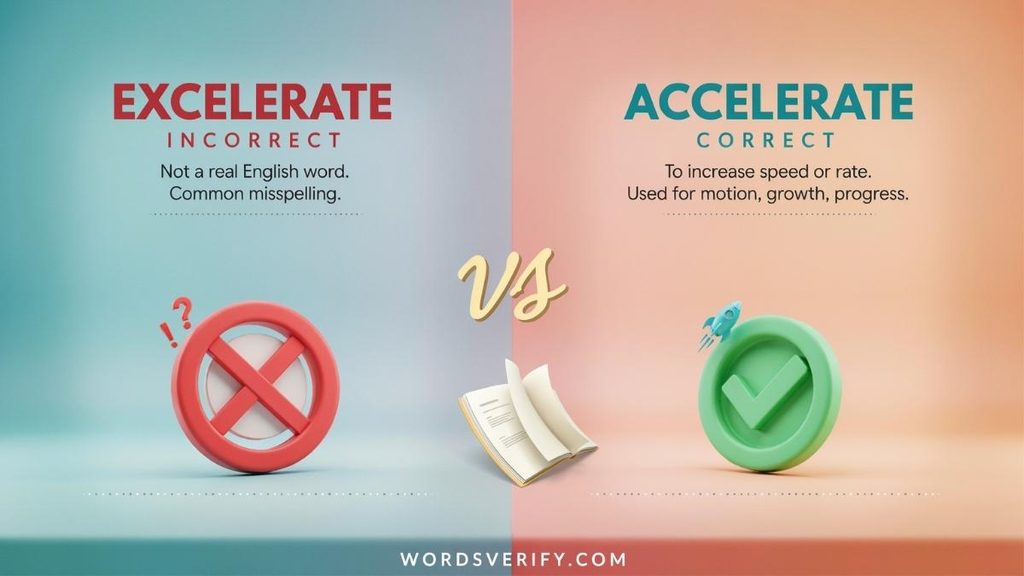
Accelerate means to increase speed or cause something to happen faster. It can describe a moving object, a business process, a student’s progress, or a change in the pace of an activity.
For example, when a car accelerates, its speed increases. When a company accelerates production, it tries to manufacture goods more quickly. When a student accelerates learning, the student makes progress at a faster rate.
Although the word appears in many different situations, the central idea remains the same: something gains speed or moves forward more quickly than before.
The Meaning of Accelerate in Everyday English
Accelerate has two main uses:
- To increase speed. A moving object travels faster than it did before.
- To make something happen faster. A person, action, or event speeds up a process or increases the rate of progress.
Here are a few examples:
- The driver accelerated as the highway opened up.
- The new software helped accelerate data analysis.
- Regular practice can accelerate your progress in learning a language.
- The storm caused the river’s current to accelerate.
- The company introduced new equipment to accelerate production.
Notice that accelerate doesn’t always describe physical movement. A project can accelerate even though it doesn’t travel anywhere. In that situation, the word refers to faster progress.
Accelerate in Science and Physics
In physics, acceleration has a more precise meaning. It describes a change in velocity over time. Velocity includes both speed and direction, so an object can accelerate when it speeds up, slows down, or changes direction.
For example, a car traveling around a curve can accelerate in the scientific sense even if its speed remains constant. Its direction changes, which means its velocity changes.
This distinction matters because everyday English often uses accelerate to mean speed up, while physics uses acceleration to describe a broader change in velocity.
Accelerate in Business, Technology, and Education
In professional settings, accelerate often describes faster progress toward a goal.
Common expressions include:
- Accelerate growth: Increase the pace of business or economic growth.
- Accelerate development: Help a product, project, or system progress more quickly.
- Accelerate production: Increase the rate at which goods are manufactured.
- Accelerate innovation: Help new ideas or technologies advance faster.
- Accelerate learning: Help someone acquire knowledge or skills more quickly.
- Accelerate the process: Reduce the time needed to complete a task or series of steps.
For example, a company might automate routine work to accelerate product development. A school might introduce targeted practice to help students learn more efficiently. A research team might improve its equipment to complete experiments sooner.
These examples share one idea: making progress happen faster.
Avoid everyday grammar mistakes with simple tips
Bougie vs Boujee which one is correct?
Is Excelerate a Real Word?
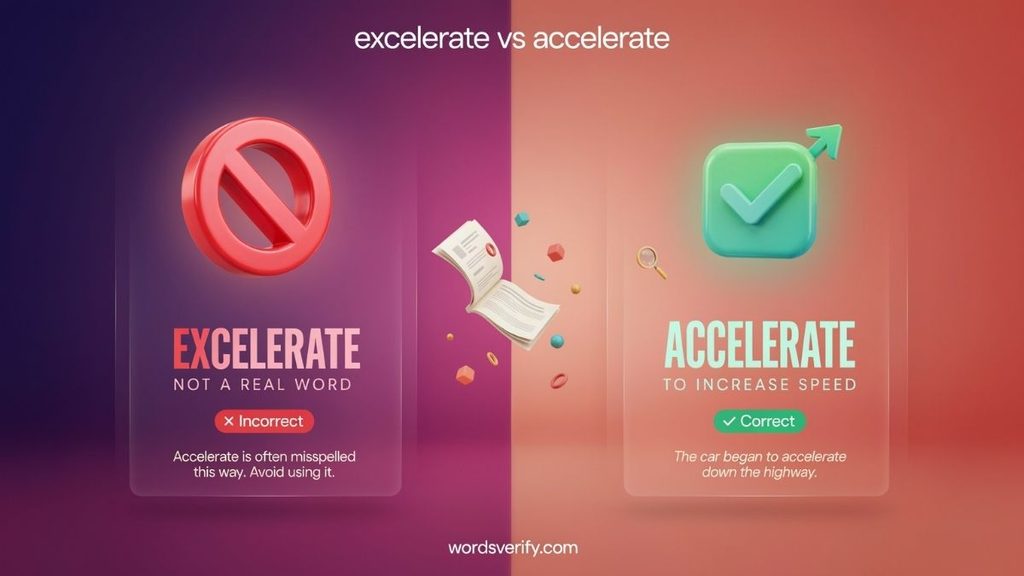
The answer depends on how the spelling is used. In ordinary English, excelerate isn’t the standard spelling of the verb meaning to increase speed or make something happen faster. Standard dictionaries recognize accelerate for that meaning.
However, English includes proper names, trademarks, and creative spellings that don’t follow ordinary dictionary conventions. A company might use Excelerate as its name, for example. That doesn’t make it the correct spelling of the standard verb.
Here’s how to handle the word in different situations:
- In a school essay, use accelerate.
- In a business report, use accelerate unless you’re referring to an official name.
- In a company name, preserve the organization’s official spelling.
- In a creative title or slogan, a stylized spelling may be intentional, so check the context.
What Does Excelerate Mean?
When someone writes excelerate in an ordinary sentence, they usually intend to express the meaning of accelerate. The spelling may result from confusion with excel, which means to perform exceptionally well.
For example:
Incorrect: We hope to excelerate our progress this year.
Correct: We hope to accelerate our progress this year.
The first sentence contains a spelling error if the writer intends the standard verb. The second uses the established English word.
Why Is Excelerate Considered Incorrect?
The main reason is that standard English uses accelerate, not excelerate, for this meaning. The correct form begins with acc rather than exc.
The mistake can happen for several reasons:
- Sound-based spelling: People sometimes spell words according to how they think they sound.
- Word confusion: The familiar word excel may influence how someone spells accelerate.
- Typing errors: A quick typo can slip through when you’re writing a message or document.
- Unfamiliar spelling patterns: Writers may remember a word’s general sound without remembering its exact letters.
A spell-checker can catch many mistakes, but it won’t always recognize an error when the spelling resembles a proper name or an unusual term. A quick proofreading pass can save you from sending an otherwise polished document with an avoidable spelling mistake.
Avoid everyday grammar mistakes with simple tips
Excel vs Accel which one is correct?
Key Differences Between Excelerate vs Accelerate

Understanding the difference between excelerate vs accelerate, involves more than memorizing a spelling. It also helps to know how the word works in sentences and how its meaning changes with context.
Spelling Differences
If you’re unsure how to spell accelerate, remember this form:
A-C-C-E-L-E-R-A-T-E
The word begins with acc, not exc. It also contains two consecutive c’s.
A useful way to remember it is to focus on the opening letters. Once you’ve learned the correct form, you can recognize it in related words such as acceleration and accelerated.
Compare these examples:
| Incorrect spelling | Correct spelling |
|---|---|
| Excelerate the project | Accelerate the project |
| Excellerate growth | Accelerate growth |
| Accellerate the vehicle | Accelerate the vehicle |
| Excelerated progress | Accelerated progress |
The last example shows why learning the word family helps. The same spelling pattern carries through its related forms.
Meaning Differences Accelerate vs Excel
One source of confusion is the word excel. Although excel and accelerate both appear in discussions about achievement and progress, they don’t mean the same thing.
Excel means to perform exceptionally well or achieve a high level of skill. Accelerate means to increase speed or make something happen faster.
Consider these examples:
- Maya excels at mathematics.
- Maya accelerated her mathematics study plan to prepare for an exam.
In the first sentence, Maya performs very well. In the second, she increases the pace of her studying.
A person can excel without accelerating. Someone might produce excellent work at a steady pace. Likewise, a project can accelerate without excelling; it may move faster without improving in quality.
Faster progress doesn’t automatically mean better results.
Grammar and Part of Speech
Accelerate is a verb. It describes an action or change.
You can use it with a direct object:
- The team accelerated the launch.
- The company accelerated production.
- The new system accelerated the process.
You can also use it without a direct object:
- The vehicle accelerated.
- Inflation accelerated.
- The pace of change accelerated.
In the first group, the subject causes something else to move faster. In the second, the subject itself increases speed or rate.
Both sentence structures are correct. Choose the one that matches what you want to describe.
Pronunciation Differences
In standard American English, accelerate is commonly pronounced ak-SEL-uh-rayt. It has three syllables, with the main stress on the second syllable.
The opening sound resembles the beginning of acknowledge, not the word excel. Listening to a dictionary’s audio pronunciation can help you connect the correct spelling with the spoken word.
Remember that spelling and pronunciation are related but different skills. You may recognize a word immediately when you hear it and still struggle to spell it correctly.
Formality and Context
Accelerate works in both formal and informal writing.
In casual conversation, you might say, “We need to speed things up.” In a workplace report, you might write, “The revised schedule should accelerate implementation.”
Both expressions communicate a similar idea, but the second sounds more formal.
Excelerate, on the other hand, shouldn’t replace the standard verb in an essay, report, résumé, presentation, or professional email. Use it only when the context specifically calls for that spelling, such as when reproducing an official name.
Avoid everyday grammar mistakes with simple tips
Bellies vs Bellys Which one Is Correct?
Which Form Is Correct Excelerate vs Accelerate?
If you’re asking which spelling is correct, accelerate is the right choice for standard English when you mean to increase speed or make progress happen faster.
You can apply this rule across many writing situations.
| Situation | Recommended wording |
|---|---|
| School assignment | Accelerate learning |
| Business proposal | Accelerate growth |
| Scientific explanation | The object begins to accelerate |
| Workplace email | We need to accelerate the review process |
| News report | The pace of economic growth accelerated |
| Official company name | Use the organization’s verified spelling |
The key is to distinguish an ordinary word from a proper name. A name can use a creative spelling, but that doesn’t change the standard spelling of the verb.
A Simple Editing Test
When you see excelerate in a sentence, ask yourself: Does the writer mean speed up or make something happen faster?
If the answer is yes, change it to accelerate unless the spelling belongs to a specific name or title.
For instance:
- “We must excelerate the approval process.” becomes “We must accelerate the approval process.”
- “The company wants to excelerate its growth.” becomes “The company wants to accelerate its growth.”
- “The car began to excelerate.” becomes “The car began to accelerate.”
This quick test focuses on the intended meaning instead of the appearance of the word.
Avoid everyday grammar mistakes with simple tips
Bearer vs Barer which one is correct?
Accelerate in a Sentence 10 Correct Examples
Examples make spelling rules easier to remember. These sentences show how to use accelerate in different situations.
| Example sentence | Meaning |
|---|---|
| The driver began to accelerate as the road cleared. | The vehicle increased its speed. |
| The company hopes to accelerate growth next year. | The company wants its business to grow faster. |
| The new software will accelerate data processing. | The software will help process information more quickly. |
| Daily practice can accelerate language learning. | Practice can help a learner make faster progress. |
| The team changed its schedule to accelerate production. | The team aimed to manufacture goods more quickly. |
| Heavy rainfall can accelerate soil erosion. | Rain can increase the rate at which soil wears away. |
| The researchers developed a method to accelerate testing. | The method reduces the time needed for tests. |
| The pace of technological change continues to accelerate. | Technological change is happening at an increasing rate. |
| The company hired more staff to accelerate the project. | Additional workers may help complete the project sooner. |
| The vehicle accelerated as it entered the highway. | The vehicle increased its speed while joining traffic. |
These examples illustrate an important point: accelerate can describe physical movement, natural processes, professional tasks, or long-term changes.
Incorrect and Correct Spelling Examples
Compare the correct word with the common misspelling.
- Incorrect: The manager wants to excelerate the project.Correct: The manager wants to accelerate the project.
- Incorrect: The new policy may excelerate economic growth.Correct: The new policy may accelerate economic growth.
- Incorrect: The driver excelerated too quickly.Correct: The driver accelerated too quickly.
- Incorrect: We need to excelerate the approval process.Correct: We need to accelerate the approval process.
- Incorrect: The company is trying to excelerate development.Correct: The company is trying to accelerate development.
Notice that the mistake can affect the base word and its related forms. Learning accelerate correctly helps you avoid errors such as excelerated and excelerating when you intend the same verb.
Avoid everyday grammar mistakes with simple tips
Panel vs Pannel which one is correct?
Common Spelling Mistakes Related to Accelerate
English contains many words that look or sound alike. The best way to avoid spelling mistakes is to learn the correct form and recognize the pattern behind the error.
Excelerate vs Accelerate
This is the main confusion addressed in this article. Writers may substitute exc for acc, possibly because they associate the word with excel.
Remember that excel relates to outstanding performance, while accelerate relates to speed or pace.
Accellerate vs Accelerate
Adding an extra l produces another common misspelling: accellerate.
The correct form is accelerate, with two c’s and one l. The spelling follows the same pattern in American English regardless of the verb’s tense.
Accelerater vs Accelerator
The standard noun is accelerator, not accelerater.
An accelerator can refer to a vehicle control that helps the engine produce more power, a device that increases particle energy, or a program that helps a business develop more quickly.
For example: “The startup joined an accelerator to develop its product.”
Accelerate vs Acceleration
These words belong to the same word family but serve different grammatical roles.
- Accelerate is a verb: “The vehicle will accelerate.”
- Acceleration is a noun: “The vehicle’s acceleration was noticeable.”
In physics, acceleration describes the rate of change of velocity. In everyday language, it often refers to an increase in speed or the pace of progress.
Accelerate vs Accelerated
Accelerated is the past-tense and past-participle form of accelerate.
- Present: The company accelerates production.
- Past: The company accelerated production.
- Present perfect: The company has accelerated production.
The spelling follows a regular pattern: add d to the base form because accelerate already ends in e.
Accelerate vs Accelerating
Accelerating is the present participle and can also function as a gerund, a verb form used as a noun.
- Continuous verb: “The vehicle is accelerating.”
- Gerund: “Accelerating too quickly can waste fuel.”
- Modifier: “The accelerating pace of change surprised the team.”
These forms preserve the correct spelling of the base word.
Avoid everyday grammar mistakes with simple tips
Dysregulated vs Disregulated which one is correct?
How to Pronounce Accelerate
Pronunciation can help you recognize a word, but it doesn’t always tell you how to spell it. Learning the syllable pattern and stress makes accelerate easier to remember.
Syllable Breakdown and Word Stress
The standard American English pronunciation is commonly represented in IPA as /əkˈsɛləˌreɪt/.
A simple pronunciation guide is ak-SEL-uh-rayt.
The word has three syllables, and the main stress falls on the second syllable. When you say it aloud, give that middle syllable the strongest emphasis.
To practice, follow these steps:
- Say the word slowly and identify its three syllables.
- Emphasize the middle syllable.
- Repeat the word at a natural speaking pace.
- Write the word from memory, paying attention to its opening letters.
Common Pronunciation Mistakes
Some speakers may confuse the word with excel because the words share similar sounds. However, their meanings and spellings differ.
Don’t assume that spelling the word excelerate will make its pronunciation more accurate. Learn the standard word as a complete unit, then connect its sound with its correct spelling.
Origin and History of Accelerate
The history of a word can provide a useful memory aid. Accelerate comes from the Latin verb accelerare, meaning to hasten or speed up. The Latin word is related to celer, meaning swift or fast.
The word entered English through Latin-derived vocabulary and developed into the verb used today.
Its modern uses extend well beyond physical speed. People use accelerate to discuss business growth, technological progress, scientific research, education, and social change.
The underlying idea remains consistent: an action or process happens faster, or the rate of change increases.
This history also helps explain the connection between accelerate and acceleration in physics. Both words belong to the same family and describe changes in speed or rate.
Avoid everyday grammar mistakes with simple tips
Mobil vs Mobile which one is correct?
Is Accelerate Spelled Differently in American and British English?
No. Accelerate is the standard spelling in both American and British English.
Some English words have regional spelling differences. For example, American English generally uses color, while British English commonly uses colour. However, accelerate doesn’t change spelling in the same way.
| Variety of English | Standard spelling |
|---|---|
| American English | Accelerate |
| British English | Accelerate |
| Canadian English | Accelerate |
| Australian English | Accelerate |
Pronunciation can vary slightly among speakers and regions, but that doesn’t make excelerate a standard regional spelling.
If you’re writing for an American audience, use accelerate in schoolwork, professional communication, and published content.
Grammar Rules and Word Forms of Accelerate
Understanding the word family makes it easier to use accelerate correctly in different sentences. The following table summarizes its most useful forms.
| Word | Meaning or use | Example |
|---|---|---|
| Accelerate | To increase speed or make something happen faster | We need to accelerate the process. |
| Accelerates | Present-tense form used with a singular third-person subject | The engine accelerates smoothly. |
| Accelerated | Past tense or past participle | The company accelerated production. |
| Accelerating | Present participle or gerund | The vehicle is accelerating. |
| Acceleration | The process or rate of increasing speed | The car’s acceleration was noticeable. |
| Accelerative | Related to acceleration; relatively uncommon | The text describes an accelerative effect. |
| Accelerator | Something that increases speed or helps progress | The startup joined a business accelerator. |
| Decelerate | To reduce speed | The driver began to decelerate. |
| Deceleration | A decrease in speed or a change in velocity | The vehicle’s deceleration was gradual. |
| Excel | To perform exceptionally well | She excels at writing. |
| Excelled | Past tense of excel | He excelled in science. |
| Excellence | The quality of being exceptionally good | The team strives for excellence. |
Base Form Accelerate
Use the base form after modal verbs such as can, could, should, and will.
Examples:
- We can accelerate the review.
- The company will accelerate development.
- Better planning could accelerate progress.
The infinitive form uses to, as in “to accelerate growth.”
Third-Person Singular Accelerates
In the simple present tense, add s when the subject is a singular third-person noun or pronoun.
Examples:
- The vehicle accelerates quickly.
- The new method accelerates the process.
- The technology accelerates data analysis.
Past Tense and Past Participle Accelerated
Use accelerated for completed past actions and with helping verbs such as has, have, and had.
Examples:
- The team accelerated production last month.
- The changes have accelerated progress.
- The project had accelerated before the deadline changed.
Present Participle Accelerating
Use accelerating in continuous tenses and other grammatical constructions.
Examples:
- The economy is accelerating.
- Accelerating production requires careful planning.
- The accelerating pace of development creates new challenges.
Using Accelerate With and Without an Object
The verb can be transitive or intransitive.
A transitive verb takes a direct object:
“The company accelerated the launch.”
The company acted on the launch schedule and made the process move faster.
An intransitive verb doesn’t take a direct object:
“The vehicle accelerated.”
Here, the vehicle itself increased speed.
Both constructions are correct. Choose the one that matches what you want to describe.
Common Word Partnerships
Certain words naturally appear with accelerate. Learning these combinations can improve your word choice and make your writing sound more fluent.
- Accelerate growth
- Accelerate progress
- Accelerate development
- Accelerate production
- Accelerate the process
- Accelerate economic growth
- Accelerate learning
- Accelerate innovation
- Accelerate the pace of change
For example, “The new system will accelerate the process” sounds natural because the verb clearly describes reducing the time needed to complete an activity.
Avoid everyday grammar mistakes with simple tips
Gummy vs Gummie Which one Is Correct?
Accelerate in Real Life Writing
The correct word becomes easier to remember when you see how people use it in practical situations.
Daily Conversation
In casual conversation, people often use speed up instead of accelerate. Both can communicate the same general idea.
- Casual: “Can we speed up the process?”
- More formal: “Can we accelerate the process?”
The second sentence may suit a workplace meeting or written report. The first may sound more natural when talking with friends.
Workplace Emails and Business Communication
In professional writing, accelerate can communicate urgency or a goal without requiring a long explanation.
For example:
“Could we review the outstanding items today to accelerate the approval process?”
This sentence connects the requested action to the intended result. It also sounds more specific than simply saying, “We need to work faster.”
However, don’t use accelerate merely to make a sentence sound formal. If speed up expresses your meaning more clearly, it’s a perfectly good choice.
Academic and Scientific Writing
In academic writing, accelerate can describe physical changes or faster progress in research.
Examples:
- The researchers accelerated the testing process by automating data collection.
- The object accelerated as the net force changed its motion.
- The intervention helped accelerate students’ progress toward the learning goal.
Scientific claims should match the evidence. For example, a new method might reduce the time required for a test without necessarily improving the accuracy of its results.
News and Journalism
Writers often use accelerate to describe changes in economic activity, technology, and public events.
Examples:
- Inflation accelerated during the reporting period.
- The company plans to accelerate its expansion.
- Technological change continues to accelerate in several industries.
In these sentences, the verb describes a change in rate. It doesn’t automatically mean the change is positive. Inflation can accelerate just as business growth can.
How a Spelling Mistake Can Affect Professional Writing
Imagine a project manager preparing a proposal for a new client. The proposal includes this sentence:
“We plan to excelerate product development and deliver the first version ahead of schedule.”
The meaning is understandable, but the spelling error can distract the reader. In a document that represents the company’s attention to detail, even a small mistake may weaken the overall impression excelerate vs accelerate,.
The corrected sentence reads:
“We plan to accelerate product development and deliver the first version ahead of schedule.”
The correction doesn’t change the message. It simply makes the writing accurate and professional.
This example highlights three practical lessons:
- Use the correct spelling, even when the intended meaning seems obvious.
- Check spelling before sending important documents.
- Read your writing carefully because spell-checking tools may not catch every error, especially when a misspelled form resembles a name or specialized term.
A single spelling mistake doesn’t define someone’s writing ability. Still, checking commonly confused words helps you present your ideas clearly.
Avoid everyday grammar mistakes with simple tips
Flys vs Flies which one is correct?
Synonyms and Antonyms of Accelerate
Knowing synonyms and antonyms can help you choose the most precise word for a sentence. However, related words aren’t always interchangeable. The best choice depends on whether you’re discussing physical speed, a business process, or progress toward a goal.
Synonyms of Accelerate
| Synonym | Meaning and best use | Example |
|---|---|---|
| Speed up | Make something happen faster; suitable for everyday conversation | We need to speed up production. |
| Hasten | Cause something to happen sooner | The announcement hastened the decision. |
| Quicken | Increase speed or make something happen more rapidly | The pace of activity quickened. |
| Expedite | Help a process move forward more quickly, often by removing delays | The team expedited the application review. |
| Advance | Move something forward or help it progress | The research advanced our understanding. |
| Boost | Increase the amount, level, or strength of something | The campaign boosted sales. |
| Increase | Make something greater in amount, level, or rate | The factory increased production. |
| Intensify | Make something stronger or more intense | The storm intensified overnight. |
| Propel | Drive or push something forward | The investment propelled the business forward. |
| Facilitate | Make an action or process easier | The new software facilitated collaboration. |
| Fast-track | Give something a quicker route or priority | The agency fast-tracked the review. |
| Step up | Increase effort, activity, or intensity | The team stepped up its efforts. |
Notice the differences. Expedite often refers to completing a process sooner, while boost usually means increasing a level or amount. Facilitate means making something easier, which may help it happen faster but doesn’t always guarantee greater speed.
Choose the synonym that captures your intended meaning rather than simply replacing one word with another.
Antonyms of Accelerate
| Antonym | Meaning | Example |
|---|---|---|
| Slow down | Reduce speed or pace | The driver slowed down. |
| Decelerate | Reduce speed or change velocity in the opposite direction of motion | The vehicle began to decelerate. |
| Delay | Cause something to happen later | The missing documents delayed approval. |
| Hinder | Make progress more difficult | Poor communication hindered progress. |
| Impede | Obstruct or slow progress | The road closure impeded traffic. |
| Postpone | Move an event to a later time | The company postponed the launch. |
| Hold back | Prevent or limit progress | A shortage of materials held back production. |
| Bring to a halt | Stop an activity or movement | The breakdown brought production to a halt. |
One distinction matters: decelerate is the closest opposite when you’re talking about physical acceleration, while delay or hinder may be better when you’re discussing progress.
For example, a car decelerates as it slows down. A project may be delayed because the team lacks resources. You wouldn’t normally say that the project decelerated if you simply mean that its deadline was postponed.
Excel vs Accelerate What Is the Difference?
Although excel and accelerate look somewhat alike, they express different ideas.
Excel means to perform exceptionally well or demonstrate a high level of skill. Accelerate means to increase speed or make something happen faster.
Consider these examples:
- “She excels at public speaking.” This means she performs very well.
- “She accelerated her public-speaking practice.” This means she increased the pace of her practice.
- “The team excelled during the presentation.” This describes the team’s strong performance.
- “The team accelerated preparations for the presentation.” This describes a faster pace of preparation.
The distinction is simple: excel describes how well someone performs, while accelerate describes how quickly something moves or progresses.
The word excellence refers to the quality of being exceptionally good. Acceleration refers to increasing speed or a change in velocity. Their related meanings don’t make these words interchangeable.
This is why excelerate can look plausible to someone who knows excel but hasn’t memorized the spelling of accelerate. Recognizing the difference helps prevent spelling errors and improves word choice.
How to Remember the Correct Spelling of Accelerate
If you frequently confuse excelerate vs accelerate, use a memory trick that connects the spelling to the meaning.
Remember the Opening Letters
The correct word begins with ACC:
ACC + ELERATE = ACCELERATE
When you want to say speed up, think of the opening letters before writing the rest of the word.
Connect Accelerate With Acceleration
The related noun acceleration follows the same opening pattern. Remembering both forms can reinforce the spelling.
For example:
- The car will accelerate.
- The car’s acceleration increased.
Once you learn the word family, you can recognize the correct spelling in different grammatical forms.
Use the Word in a Sentence
Memorizing a spelling is useful, but using the word in context makes it easier to recall.
Try writing three sentences:
- We need to accelerate the project.
- The vehicle began to accelerate.
- The new system accelerated production.
Then cover the sentences and write them again from memory.
Check a Dictionary When You’re Unsure
A reliable dictionary can help you confirm a word’s spelling, meaning, and pronunciation. This is particularly useful when you encounter a spelling that looks familiar but doesn’t seem right.
It’s also a good way to distinguish a standard word from a proper name or creative spelling.
Practice Session Excelerate vs Accelerate
Fill in the blanks with the correct word or word form Excelerate vs Accelerate. Test your knowledge of spelling, meaning, grammar, and everyday usage.
Fill in the blanks
- The company plans to ______ production before the holiday season.
- “Excelerate” is generally considered a ______ of “accelerate.”
- The driver pressed the gas pedal to ______ the car.
- The new training program helped ______ employees’ professional growth.
- The train began ______ as it left the station.
- The team worked hard to ______ the completion of the project.
- The scientist measured the vehicle’s ______ during the experiment.
- The company hopes to ______ its expansion into new markets.
- The car ______ quickly after the light turned green.
- The manager introduced new tools for ______ the hiring process.
- The word “accelerate” begins with the letter ______.
- The opposite of “accelerate” is commonly expressed by the verb ______.
- The company wants to ______ innovation through new technology.
- The process of speeding up is called ______.
- The vehicle was ______ to reach its destination sooner.
- The adjective “accelerative” is related to the verb ______.
- The project’s progress began to ______ after the team solved the main problem.
- The company hired an ______ to help launch the engine.
- The word “accelerating” is the ______ form of “accelerate.”
- The team hopes to achieve ______ growth over the next year.
- The correct spelling is “accelerate,” not “______.”
- The teacher used practical examples to ______ students’ learning.
- The driver slowed down instead of continuing to ______.
- The new system could ______ the delivery process by reducing delays.
- To sound professional, you might say “accelerate progress” instead of simply “______ things up.”
Answers
- accelerate
- misspelling
- accelerate
- accelerate
- accelerating
- accelerate
- acceleration
- accelerate
- accelerated
- accelerating
- A
- decelerate
- accelerate
- acceleration
- accelerated
- accelerate
- accelerate
- accelerator
- -ing
- accelerated
- excelerate
- accelerate
- accelerate
- accelerate
- speed
Here’s a trusted source for clear word meanings:
FAQs
What is the difference between acceleration and acceleration rate?
Acceleration refers to how quickly an object’s velocity changes over time. The phrase “acceleration rate” is sometimes used informally, but in physics, acceleration already describes this rate of change.
Can you use “accelerate” to describe personal growth?
Yes. “Accelerate” can describe making faster progress in your career, education, or personal development. For example: “She took a professional course to accelerate her career growth.”
Is “accelerate” a transitive or intransitive verb?
“Accelerate” can function as both. As a transitive verb, it takes a direct object: “The company accelerated production.” As an intransitive verb, it stands alone: “The car began to accelerate.”
Which prepositions are commonly used with “accelerate”?
The preposition depends on the context. Common examples include “accelerate toward a goal,” “accelerate into the next phase,” and “accelerate from zero to 60 mph.” You can also use the verb without a preposition, as in “accelerate the process.”
Can “accelerate” describe something negative?
Yes. “Accelerate” refers to an increase in speed or pace, not necessarily a positive outcome. For example: “Rising costs accelerated the company’s financial problems.”
What is the difference between “accelerate” and “expedite”?
“Accelerate” means to increase speed or make progress faster, while “expedite” means to help a task or process happen sooner, often by reducing delays. For example, a company might accelerate production and expedite a delivery.
Is “accelerate” suitable for formal writing?
Yes. “Accelerate” works well in academic papers, business reports, professional emails, and everyday writing. It clearly communicates that something is moving, developing, or progressing faster.
What does “accelerated growth” mean?
“Accelerated growth” describes growth that happens faster than before or increases in pace. For example, a business may experience accelerated growth after launching a successful product.
How is “accelerate” different from “increase”?
“Accelerate” emphasizes making a process happen faster or increasing its rate. “Increase” means making something greater in amount, size, number, or degree. For example, a company can increase its budget while accelerating product development.
Can “accelerate” be used figuratively?
Yes. Beyond physical movement, “accelerate” can describe faster progress, change, or development. For example: excelerate vs accelerate,“The new technology helped accelerate innovation across the industry.” This figurative use is common in professional and everyday communication.
Conclusion
The difference between “excelerate” vs “accelerate” may seem small, but one spelling can bring your writing to a sudden stop. “Accelerate” is the correct standard English spelling. It means to speed up, increase the pace of something, or help a process move forward faster. “Excelerate,” on the other hand, is generally a misspelling, although it may appear as a brand or proper name.
To remember the correct form excelerate vs accelerate,, think of the A in “accelerate” as the starting point for action and progress. Whether you’re writing an email, completing an assignment, or discussing a business goal, the right spelling keeps your message clear and professional. Grammar mistakes happen to everyone, but they don’t have to become a habit. Keep practicing, watch out for tricky word pairs, and let your writing accelerate toward success—without taking a wrong turn at the first letter!

Lisa AJS is an experienced blogger and language enthusiast at Words Verify, dedicated to making grammar simple, practical, and enjoyable. She writes engaging content on commonly confused words, grammar mistakes, word meanings, and everyday language challenges.