
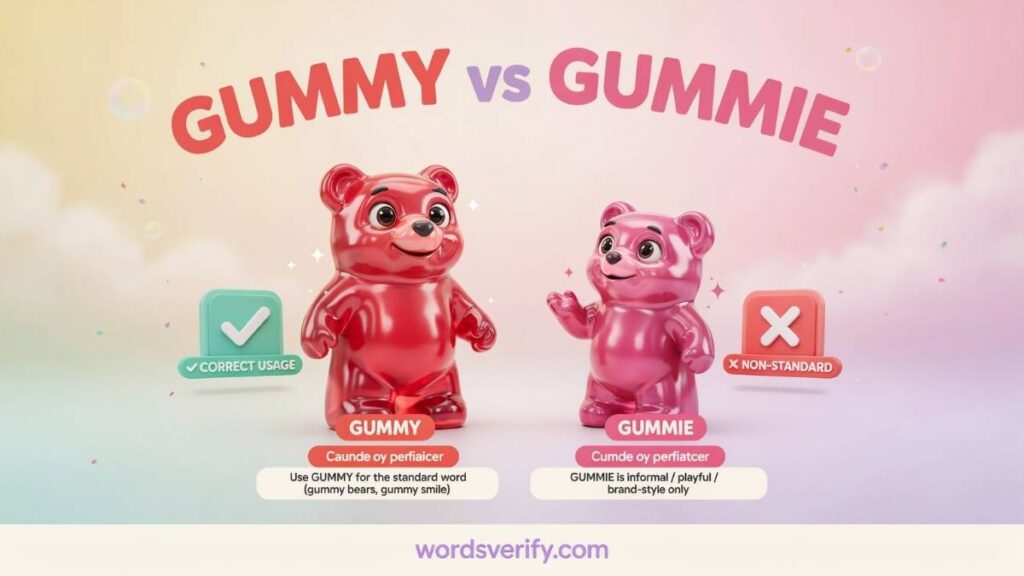
Ever wondered whether it’s Gummy vs Gummie? You’re not alone! The Gummy vs Gummie spelling confusion can trip up even careful writers. These words look almost identical, sound alike, and seem as interchangeable as candies in a mixed bag. But there’s a catch: choosing the wrong spelling can leave your writing with a sticky little mistake. Gummy is the standard English spelling, gummi appears in certain candy names, and gummie is generally nonstandard. So, before you bite into another spelling blunder, let’s explore the differences, clear up common mistakes, and make the correct choice a piece of cake.
The Quick Answer
Here’s the simplest way to distinguish these three spellings:
| Spelling | Meaning and usage | Example |
|---|---|---|
| Gummy | The standard English spelling for something sticky or chewy; also used for chewy candy | She bought a bag of gummy bears. |
| Gummi | A recognized variant used in certain candy names; also related to the German word for rubber | The package says Gummi Bears. |
| Gummie | Generally a nonstandard spelling of the English word gummy, though it may appear in brand names | Gummy candy is the usual spelling. |
| Gummies | The standard plural of gummy when referring to chewy candies | The children shared their gummies. |
For ordinary English writing, choose gummy. When referring to a product or brand that uses gummi, preserve its official spelling. Avoid gummie unless it’s part of a specific name or an intentional stylistic choice.
Learn how to use confusing more words correctly
Flys vs Flies which one is correct?
What Does Gummy Mean?
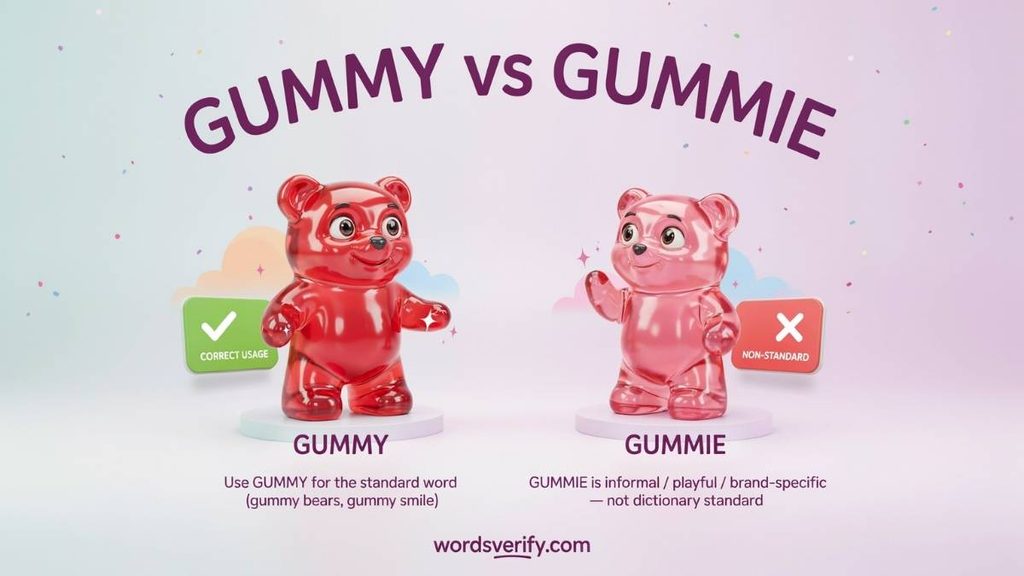
Gummy is an adjective that describes something sticky, soft, or chewy. It can also function as a noun when referring to a type of chewy candy.
The word often brings gummy bears, gummy worms, and other colorful sweets to mind. However, its meaning extends beyond candy.
For example, a substance that sticks to your fingers might have a gummy texture. Similarly, something soft and chewy may be described as gummy even if it isn’t sweet.
Here are a few examples:
- The melted candy left a gummy residue on the table.
- He bought a bag of gummy bears for the road trip.
- The caramel became gummy after sitting in the heat.
- She prefers gummy candy to hard sweets.
- The old adhesive had turned into a thick, gummy mess.
In each sentence, gummy describes stickiness or chewiness, or it identifies a kind of candy.
Gummy as an Adjective
As an adjective, gummy describes the texture or consistency of something. It can refer to food, substances, or other materials that feel sticky, soft, or chewy.
Examples:
- The dough became gummy after too much water was added.
- These gummy candies are soft enough to chew easily.
- A gummy layer covered the surface of the old sticker.
The word doesn’t automatically mean something tastes sweet. A gummy substance might be unpleasant, sticky, or difficult to remove.
Gummy as a Noun
Gummy can also refer to a small piece of chewy candy. In everyday conversation, people commonly use the plural form gummies.
Examples:
- Would you like a gummy?
- She packed some gummies for the children.
- These fruit gummies have a strong strawberry flavor.
Although gummy is widely associated with candy, context determines its exact meaning.
Learn how to use confusing more words correctly
Envision vs Invision which one is correct?
Gummy vs Gummi What’s the Difference?
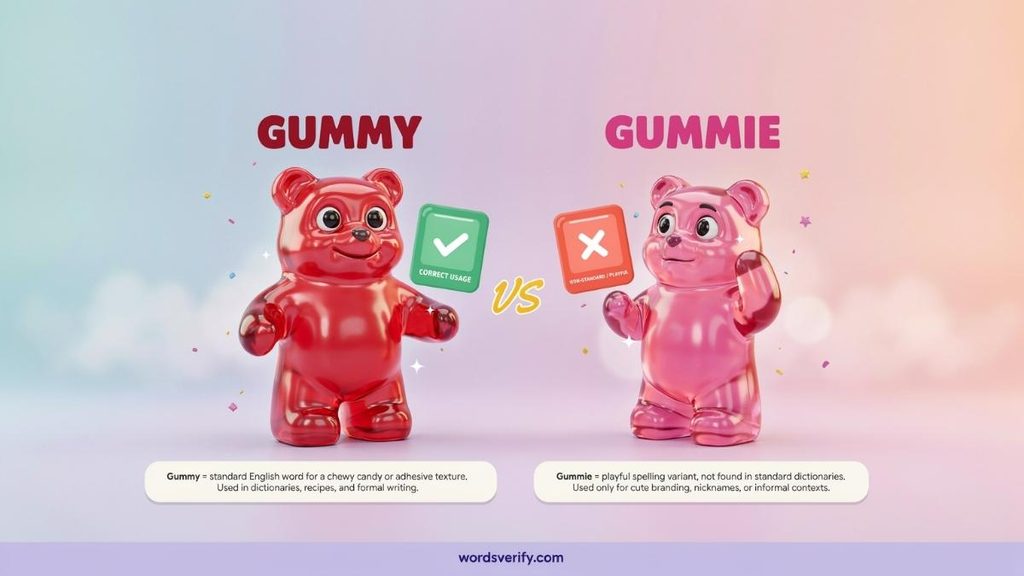
The main difference between gummy and gummi comes down to spelling conventions and context.
Gummy is the standard English spelling used to describe a sticky or chewy texture and to name chewy candies. Gummi is a recognized alternative that appears in certain established candy names and product labels.
You might see a package labeled “Gummy Bears” while another uses “Gummi Bears.” Both expressions can refer to the familiar chewy sweets shaped like little bears.
Why do the spellings differ? Product naming, language influences, and established branding all play a part.
When Should You Use Gummy?
Use gummy in everyday English when you describe something sticky or chewy or refer to chewy candy.
Examples:
- My favorite candy is gummy bears.
- The mixture became gummy during cooking.
- She bought several bags of fruit gummies.
- The candy has a soft, gummy texture.
If you’re unsure which spelling to choose in an essay, school assignment, email, or general article, gummy is the safest option.
When Should You Use Gummi?
Use gummi when it appears in an established product name, brand name, or expression that follows that spelling.
For example, some candy products use the name “Gummi Bears.” The spelling is also connected to German, where Gummi means rubber.
Examples:
- The shop sells a brand of Gummi Bears.
- The package uses the spelling Gummi in its product name.
- The German word Gummi refers to rubber.
Remember that a product’s spelling doesn’t automatically establish the preferred spelling for every other context. Brand names often follow their own conventions.
Learn how to use confusing more words correctly
Bespectacled vs Bespeckled What’s the Difference?
Gummy vs Gummie Is Gummie a Word?
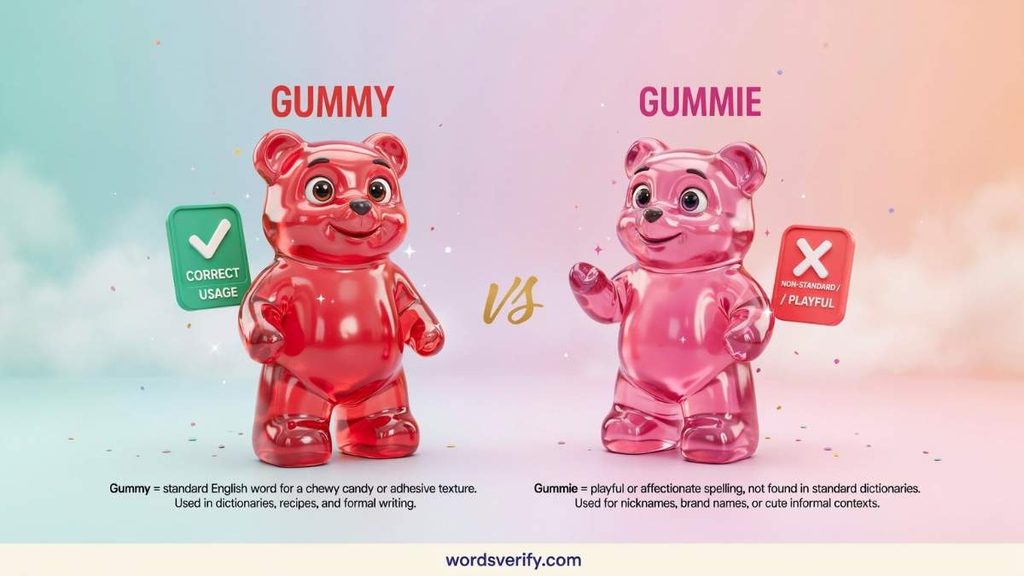
Gummie is generally considered a nonstandard spelling of gummy in ordinary English. You may encounter it online, in casual messages, or in informal product descriptions, but gummy remains the conventional choice.
The confusion is understandable. English has plenty of words that end in -ie, and some words change their spelling when they become plural. However, that doesn’t mean every word ending in -y should be rewritten with -ie.
For example, the standard spelling is gummy, not gummie. The plural is gummies, not gummys.
Compare these sentences:
- Correct: I bought a bag of gummy bears.
- Nonstandard: I bought a bag of gummie bears.
- Correct: The children ate their gummies.
- Nonstandard: The children ate their gummys.
Although a business or product may deliberately use Gummie as part of its name, that doesn’t make it the standard spelling of the everyday English word.
Why Do People Write Gummie?
Several factors can explain the confusion.
1. The spelling looks familiar. English contains words such as cookie and brownie, which may encourage people to assume that gummie follows the same pattern.
2. Informal writing spreads quickly. Social media posts, messages, and online listings often contain unconventional spellings. Repeated exposure can make them look correct.
3. Brand names create exceptions. Companies sometimes choose unusual spellings to make a product stand out. Those choices don’t necessarily follow standard spelling rules.
4. The plural causes confusion. Because the plural of gummy is gummies, some people mistakenly assume that the singular should be gummie.
The easiest solution is to remember the standard pair: gummy vs gummie.
Learn how to use confusing more words correctly
Visible vs Visable Which one Is Correct?
Why Do Some Candy Brands Use Gummi Instead of Gummy?
Candy brands don’t always follow the spelling used in general English. Some retain gummi because of established product names, branding choices, or connections to German-language terminology.
The spelling has become familiar to candy lovers through products such as Gummi Bears. When shoppers see it on packaging, they may reasonably assume that gummi is the only correct form.
However, both gummy vs gummie appear in candy-related English. The right choice depends on the context.
Consider these examples:
- A general description: The store sells gummy bears.
- A product name: The package is labeled Gummi Bears.
- A texture description: The candy has a gummy consistency.
In the first and third examples, gummy is the natural choice. In the second, keep the product’s established spelling.
This distinction matters beyond candy. Companies often use unusual capitalization, punctuation, or spelling in their names. When writing about a brand, accuracy means preserving its name rather than automatically correcting it to match ordinary usage.
Gummi and Its German Connection
The spelling gummi has a connection to German, where the word means rubber. This helps explain why it appears in certain candy names and other expressions influenced by German.
However, the connection shouldn’t lead to the assumption that every English use of gummi is German or that gummy is incorrect. English borrows words and adapts spellings in different ways. The same spelling can also become established through branding.
For example, a German text might use Gummi when discussing a rubber material. An English candy package might use Gummi as part of a product name.
The surrounding words make the meaning clear.
Examples:
- The German word Gummi means rubber.
- The candy package uses Gummi in its name.
- The chewy sweets have a gummy texture.
Although these examples look similar, each uses the word in a different context. Pay attention to the language and purpose rather than judging the spelling in isolation.
Learn how to use confusing more words correctly
Heros vs Heroes Which one Is Correct?
A Brief History of Gummy Bears
Gummy bears are among the best-known chewy candies in the world. Their history is closely associated with HARIBO, the German confectionery company founded by Hans Riegel in Bonn in 1920.
In 1922, the company introduced a bear-shaped candy known as the Dancing Bear. The early product helped establish the foundation for the bear-shaped sweets that would later become famous around the world.
HARIBO introduced its Goldbears in 1960. Over time, these colorful candies became one of the company’s best-known products.
The history of gummy bears also helps explain why people encounter different spellings. German confectionery traditions and international product names have influenced how these candies are described in different markets.
Today, gummy bears come in many colors, flavors, sizes, and textures. Some use gelatin to create their familiar chewy consistency, while others rely on plant-based gelling ingredients such as pectin.
Despite these variations, the everyday English spelling remains gummy bears unless you’re referring to a product or brand that uses another form.
What Are Gummy Candies Made Of?
Gummy candies get their chewy texture from a combination of ingredients. The exact recipe varies by manufacturer, but many products contain sweeteners, gelling agents, flavorings, and coloring ingredients.
Common ingredients include:
- Sugar: Adds sweetness and contributes to the candy’s overall texture.
- Glucose syrup: Helps create a smooth consistency and can reduce unwanted sugar crystallization.
- Gelatin: Gives many traditional gummies their elastic, chewy texture.
- Pectin: A plant-derived gelling agent used in some gummies, including certain vegetarian or vegan products.
- Flavorings: Provide fruit, citrus, berry, or other tastes.
- Coloring ingredients: Give the candy its bright appearance.
Not every gummy candy contains gelatin. Some manufacturers use pectin or other alternatives to produce a chewy texture without animal-derived gelatin.
The ingredients also affect how the candy feels. One product might be firm and springy, while another is soft and easy to bite. Both can still qualify as gummy candy.
Learn how to use confusing more words correctly
Minuscule vs Miniscule which one is correct?
Gummy Bears vs Gummi Bears Is There a Difference?
In general usage, gummy bears and gummi bears refer to the same type of candy: small, bear-shaped sweets with a chewy texture.
The spelling difference usually reflects branding or naming conventions rather than a different candy category.
For example:
- She bought a bag of gummy bears at the supermarket.
- The candy shop sells Gummi Bears from a particular brand.
- Both packages contain chewy, bear-shaped candy.
If you’re describing the candy in general, gummy bears is the standard choice. If the product uses Gummi Bears as its official name, preserve that spelling when referring to it specifically.
The same principle applies to other gummy sweets. Gummy worms, gummy rings, and fruit gummies are common descriptive terms. A manufacturer may use a different spelling in a product name, but that doesn’t change the general spelling convention.
Learn how to use confusing more words correctly
Indure vs Endure Which one Is Correct?
Gummy vs Gummie Common Mistakes
These spellings are easy to mix up, especially when you see different versions on packaging or online. A few simple rules can help you avoid the most common errors.
Assuming Gummie Is the Standard Spelling
Gummie may look familiar, but it isn’t the conventional spelling for the everyday English word.
Incorrect: I bought some gummie candy.
Correct: I bought some gummy candy.
Treating Gummy and Gummi as Completely Different Candies
The spelling alone doesn’t indicate a different recipe, shape, or flavor. Both forms can appear in names for chewy candy.
Incorrect assumption: Gummy bears and Gummi Bears must be two different kinds of sweets.
Better understanding: They generally refer to the same candy type, although specific brands may use their own names.
Changing a Brand’s Official Spelling
If a product uses Gummi in its established name, don’t automatically rewrite it as Gummy when referring to that product.
For example, you can write “The store sells gummy bears” as a general statement. When naming a product officially labeled Gummi Bears, keep the spelling used by the brand.
Writing the Plural as Gummys
The standard plural of gummy is gummies. The final y changes to i before the plural ending -es.
Correct examples:
- One gummy, several gummies.
- One berry, several berries.
- One puppy, several puppies.
The pattern is common in English. Remembering it will help you avoid the nonstandard plural gummys.
Gummy vs Gummie A Simple Memory Trick
If these spellings still seem interchangeable, use this quick reminder:
- Gummy: Use it in ordinary English for sticky textures and chewy candy.
- Gummi: Keep it when it belongs to a recognized product name or when the German word is intended.
- Gummie: Avoid it as the standard spelling of the everyday English word.
- Gummies: Use this as the usual plural when talking about chewy candies.
Here’s an easy way to remember the most important pair: one gummy becomes several gummies.
You don’t need to memorize every brand name or language connection to spell the everyday word correctly. Just use gummy unless the context gives you a reason to do otherwise.
Learn how to use confusing more words correctly
Scary vs Scarry which one is correct?
American English vs British English
Gummy is widely used in American English and is also understood in British English. Gummi may appear in product names or particular expressions in either variety.
The main difference isn’t a strict American-versus-British spelling rule. Instead, the choice often depends on the product name, the context, or the writer’s intended meaning.
Examples:
- American English: The children shared a bag of gummy bears.
- British English: The children shared a bag of gummy sweets.
- Product name: The package uses the spelling Gummi Bears.
British speakers may use sweets where Americans commonly say candy. However, that vocabulary difference doesn’t make gummie the standard spelling in either variety of English.
When writing for a broad audience, gummy is a clear and reliable choice for the ordinary English word.
Learn how to use confusing more words correctly
Breeched vs Breached which one is correct ?
practice session Gummy vs Gummie
Test your knowledge of gummy, gummi, and gummie with these 25 practice questions. Complete each sentence using the correct word. The answer key is provided in a separate section so you can test yourself first.
Fill in the Blanks
1. The correct standard English spelling for chewy candy is ______.
2. She bought a bag of ______ bears for her little brother.
3. The plural form of gummy is ______.
4. The sticky mixture left a ______ residue on the spoon.
5. Some candy brands use the spelling ______ in their product names.
6. In German, the word Gummi means ______.
7. The children shared their fruit ______ during the movie.
8. The spelling ______ is generally nonstandard in everyday English.
9. These candies have a soft and ______ texture.
10. I ate one gummy bear and saved the other ______ for later.
11. The candy package uses the name ______ Bears.
12. When describing something sticky or chewy, use the word ______.
13. Some gummy candies use pectin instead of ______.
14. My favorite type of candy is ______ worms.
15. She bought several bags of fruit ______ at the store.
16. The German word Gummi is associated with ______.
17. When referring to chewy candy in general, write ______ bears.
18. When mentioning a brand, preserve its official ______.
19. One gummy becomes two ______.
20. The children ate several ______ before dinner.
21. Gummy bears are named after their chewy texture and bear-shaped ______.
22. The standard plural of gummy ends in ______.
23. In British English, candy is commonly called ______.
24. Some gummy candies use plant-based ______ as a gelling agent.
25. For ordinary English writing, the safest spelling is usually ______.
Answers
- Gummy
- Gummy
- Gummies
- Gummy
- Gummi
- Rubber
- Gummies
- Gummie
- Chewy
- Bears
- Gummi
- Gummy
- Gelatin
- Gummy
- Gummies
- Rubber
- Gummy
- Spelling
- Gummies
- Gummies
- Shape
- -ies
- Sweets
- Pectin
- Gummy
Here’s a trusted source for clear word meanings:
FAQs
What is the correct spelling of gummy in everyday English?
Gummy is the standard spelling in everyday English. It describes something sticky or chewy and commonly refers to chewy candies such as gummy bears and gummy worms.
What does gummy mean in slang?
The meaning depends on the context. Gummy can describe something sticky or chewy, while informal slang uses may vary by community. It doesn’t have one universal slang meaning.
How do you pronounce gummy?
Gummy is pronounced with two syllables, with the stress on the first syllable. The final sound is the same as the ending in words such as funny and sunny.
What does gummi mean in German?
In German, Gummi means rubber. The word can also appear in candy names, including product names that use the spelling Gummi rather than gummy.
Why are gummy bears called gummy bears?
They’re called gummy bears because they have a soft, chewy texture and a bear-shaped design. The word gummy describes their texture, while bears identifies their shape.
What is the difference between gummy vs gummie?
Gummy is the singular form when referring to one piece of chewy candy. Gummies is the standard plural form for multiple pieces. For example, you might eat one gummy or share a bag of gummies.
Is gummie ever an acceptable spelling?
Gummie may appear in a brand name, product name, or creative spelling. However, it’s generally considered nonstandard when used as a substitute for the ordinary English word gummy.
What do British people call gummy candy?
British English commonly uses the word sweets for candy in general. People may also say gummy sweets or refer to specific products by names such as jelly babies. The exact term depends on the type of candy.
Are gummy bears and jelly babies the same?
No. Both are chewy sweets, but they differ in shape, texture, and traditional recipes. Gummy bears are shaped like bears, while jelly babies are small, soft candies shaped like people.
Are Skittles considered gummy candy?
No. Skittles are generally classified as chewy, sugar-coated candies rather than gummy candies. Gummies typically have a softer, more elastic texture created by ingredients such as gelatin or pectin.
What is the history behind gummy bears?
Gummy bears trace their origins to German confectionery maker HARIBO. Hans Riegel founded the company in 1920, and it introduced its Dancing Bear candy in 1922. HARIBO later introduced Goldbears in 1960, helping popularize the familiar bear-shaped candy.
Why do bodybuilders eat gummy bears?
Some bodybuilders eat gummy bears around workouts because the candy provides quickly digestible carbohydrates. These carbohydrates can help replenish energy stores, especially during demanding training. However, gummy bears aren’t a complete sports nutrition option because they provide little protein and few other essential nutrients.
Can Muslims eat gummy bears?
It depends on the ingredients and how the candy is produced. Some gummy bears contain gelatin derived from pork or other sources that may not meet halal requirements. Muslims who follow halal dietary rules can look for products with reliable halal certification or verify the gelatin source and other ingredients.
Why might gelatin make gummy candy unsuitable for some Muslims?
Gelatin can come from pork, cattle, fish, or other sources. Pork-derived gelatin is not permissible under Islamic dietary rules, while the status of other gelatin depends on its source and processing and the religious guidance being followed. Checking the ingredients and halal certification can help consumers make an informed choice.
What ingredients should you check when buying gummy candy?
Check the ingredient list for gelatin, flavorings, colorings, and any other ingredients relevant to your dietary needs. If you require halal or vegan candy, look for suitable certification or clearly labeled alternatives, such as pectin-based gummies.
What is the plural of gummi?
The plural depends on the language and context. In English, gummies is the standard plural of gummy. In German, the plural of Gummi is commonly Gummis when referring to rubber items.
Learn how to use confusing more words correctly
Shiney vs Shiny which one is correct?
conclusion
Gummy vs gummie? This tiny spelling puzzle doesn’t have to leave you in a sticky situation! Remember, gummy is the standard English spelling for something sticky or chewy and for chewy candy. Gummi appears in certain established candy names and is also the German word for rubber. Gummie, on the other hand, is generally a nonstandard spelling unless it’s part of a specific name. And when one gummy becomes many, the correct plural is gummies, not gummys. Keep these simple rules in mind, and you’ll avoid a spelling blunder sweeter than a sugar rush. After all, candy can be chewy, but your grammar should be smooth!

Lisa AJS is an experienced blogger and language enthusiast at Words Verify, dedicated to making grammar simple, practical, and enjoyable. She writes engaging content on commonly confused words, grammar mistakes, word meanings, and everyday language challenges.