
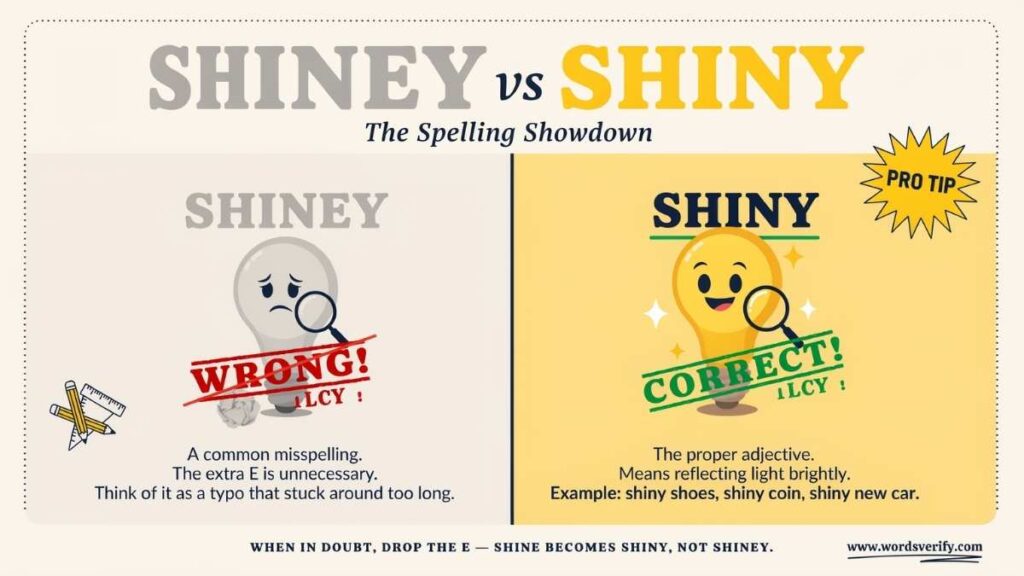
Shiney vs shiny? One extra letter can turn a simple word into a sneaky spelling mistake! If you’ve ever hesitated over these two versions, you’re not alone. English spelling has plenty of little traps, and this one catches more writers than you might expect. So, which spelling is correct, and what makes the other one wrong? The answer comes down to a simple spelling rule that’s easy to remember. In this guide, you’ll learn why shiny is correct, discover how the word is formed, and explore practical examples to help you write clearly and confidently without letting an unnecessary letter steal your sparkle.
Quick Answer Shiney vs Shiny
Shiny is the correct spelling. It describes something that reflects light, looks glossy, or appears bright and polished. Shiney is a common spelling mistake and should generally be avoided in formal and professional writing.
| Word | Correct? | Meaning | Example |
|---|---|---|---|
| Shiny | Yes | Reflective, glossy, bright, or polished | The shiny shoes looked brand-new. |
| Shiney | Generally no | Usually a misspelling of shiny | The shiney shoes looked brand-new. |
Remember this simple rule: if you want to describe something that shines, write shiny without the extra letter e in Shiney vs Shiny.
What Does Shiny Mean?
The word shiny is an adjective that describes something with a bright, reflective, or glossy surface. It often refers to objects that reflect light, although it can also describe something that looks new, attractive, or exciting.
Think of a freshly polished car, a silver coin, or a pair of shoes that have just been cleaned. These objects can all be shiny.
Here are the most common meanings of shiny.
Shiny Means Reflective or Glossy
The most common meaning of shiny relates to the way a surface reflects light. A shiny object may have a smooth finish that creates a noticeable reflection or bright appearance.
Examples:
- The shiny mirror reflected the sunlight.
- She wore shiny black shoes to the wedding.
- The kitchen counter looked shiny after cleaning.
- A shiny silver coin lay on the table.
- His new watch had a shiny metal surface.
In these examples, shiny describes the appearance of an object.
Shiny Can Mean Bright or Gleaming
Shiny can also describe something that looks bright or catches your attention because of its appearance. The object does not always need to produce a clear reflection.
For example:
- The child’s shiny eyes sparkled with excitement.
- The shiny decorations made the room look festive.
- Sunlight fell across the shiny leaves after the rain.
- She admired the shiny finish on the wooden table.
The word adds a visual detail that helps readers picture what you mean.
Shiny Can Suggest Something New or Attractive
In casual speech, shiny can describe something that looks new, impressive, or appealing. People sometimes use it figuratively to describe a new product, gadget, or opportunity.
Examples:
- He bought a shiny new laptop for work.
- The company introduced a shiny new feature.
- She was excited about her shiny new bicycle.
In these sentences, shiny suggests freshness or attractiveness. The item may be physically reflective, but the word also conveys enthusiasm about something new.
Learn the difference between tricky more English words
Performed vs Preformed which one is correct?
Why Is Shiny Correct and Shiney Incorrect?
The difference comes down to English spelling conventions. The adjective shiny forms from the verb shine and the suffix -y.
When a word ends in a silent e and you add a suffix beginning with a vowel, English often drops the final e. This helps create a more natural spelling.
The process works like this:
- Start with the base word: shine.
- Add the suffix: -y.
- Drop the final silent e.
- Write the result: shiny.
That is why shiny is the standard spelling.
Writing shiney keeps the final e even though it is normally dropped in this word. Although the spelling may look reasonable, it is not the standard form used in edited English.
A Simple Way to Remember the Rule
Think of shine as the action and shiny as the description.
- The sun can shine.
- The surface can look shiny.
- The shiny surface reflects the light.
The spelling changes slightly when you turn the verb into an adjective. Once you remember that the final e disappears, the correct form becomes easier to recognize.
Shiney vs Shiny The Main Differences
The most important difference is spelling rather than meaning. Shiny is the accepted adjective, while shiney is generally an error.
| Feature | Shiny | Shiney |
|---|---|---|
| Standard spelling | Yes | No |
| Dictionary usage | Established adjective | Generally treated as a misspelling |
| Meaning | Glossy, reflective, bright, or attractive | Usually intended to mean shiny |
| Formal writing | Recommended | Avoid |
| Professional documents | Appropriate | Likely to be marked as an error |
| Example | The shiny floor looked clean. | The shiney floor looked clean. |
If you see shiney in a sentence, the writer probably means shiny. In ordinary writing, correcting the spelling is the best choice.
There are exceptions in names, usernames, product names, and creative branding. A person or business may deliberately use Shiney as a unique name. In that case, the spelling serves as a proper name rather than the standard adjective.
Learn the difference between tricky more English words
Puting vs Putting Which one Is Correct?
Is Shiny the Same in American and British English?
Yes. Shiny is the standard spelling in both American and British English.
Some English words have different spellings depending on where they are used. For example, American English typically uses color while British English uses colour. The word shiny does not follow that pattern.
Here are examples that work in both varieties of English:
- The shiny car stood outside the house.
- She polished her shiny shoes before the interview.
- The shiny surface reflected the afternoon sun.
- He bought a shiny new phone.
You do not need to change shiny to shiney when writing for a British audience. The correct spelling remains the same.
Learn the difference between tricky more English words
Panic vs Panick Which one Is Correct?
Why Do People Write Shiney Instead of Shiny?
The mistake is understandable. English spelling can be inconsistent, and many words look as though they should follow a rule even when they do not.
Several factors may explain why people write shiney.
The Base Word Contains an E
The word shine ends with an e. When people add a suffix, they may assume the original spelling should remain unchanged.
That assumption sometimes works in English, but it does not work here. The final e disappears in shiny.
The Spelling Looks Familiar
English contains many words ending in -ey, including money, honey, and donkey. Seeing those familiar patterns can make shiney look plausible.
However, spelling patterns do not apply equally to every word. Shiny follows a different pattern.
Pronunciation Does Not Reveal the Difference
Shiney vs shiny are often intended to represent the same pronunciation. Because the extra e does not normally change the intended sound, a writer may not notice the mistake when reading the word aloud.
That is why proofreading matters. Your ears may not catch a spelling error that your eyes can identify.
Learn the difference between tricky more English words
Vendor vs Vender which one is correct?
Common Words That Follow the Same Spelling Pattern
Learning a few related examples can help you remember why shiny is correct. English often drops a final silent e before adding a suffix that begins with a vowel.
Consider these words:
| Base word | Correct form | Example |
|---|---|---|
| Shine | Shiny | The shiny surface caught my attention. |
| Ice | Icy | The road became icy overnight. |
| Spice | Spicy | The soup tasted spicy. |
| Noise | Noisy | The classroom became noisy. |
| Grease | Greasy | The greasy plate needed washing. |
| Taste | Tasty | We prepared a tasty meal. |
Notice how the final e disappears in the new form. The base word remains recognizable, but the spelling changes to fit the suffix.
These examples make a useful memory aid. When you see a base word ending in silent e, check whether the final letter should remain before adding a suffix.
English has exceptions and additional spelling patterns, so do not assume every word follows exactly the same rule. For shiny, however, the pattern is straightforward.
Learn the difference between tricky more English words
Worse vs Worst which one is correct?
Shiny Synonyms Words You Can Use Instead
The Shiny is useful, but other adjectives can describe specific kinds of brightness or reflection more precisely. Choosing the right word can make your writing clearer and more vivid.
Glossy
Glossy describes a smooth surface that reflects light. It often applies to magazines, photographs, paint, and polished materials.
Example: The magazine featured a glossy cover.
Gleaming
Gleaming suggests a strong or noticeable shine. It often creates an impression of cleanliness or careful polishing.
Example: The gleaming windows made the building look new.
Sparkling
Sparkling describes something that produces small flashes of light. It often refers to jewelry, water, stars, or bright eyes.
Example: The sparkling diamonds caught everyone’s attention.
Shimmering
Shimmering suggests a soft or wavering light. It works especially well for water, silk, and distant lights.
Example: The shimmering lake reflected the evening sky.
Glistening
Glistening describes a wet or moist surface that reflects light.
Example: Rain left the leaves glistening in the garden.
Lustrous
Lustrous means having a rich, attractive sheen. It often describes hair, fabric, pearls, or other materials with a smooth glow.
Example: Her hair looked lustrous in the sunlight.
Polished
Polished can describe a surface that has been rubbed or treated until it becomes smooth and reflective. It can also describe refined behavior or work.
Example: The polished wooden table looked beautiful.
Although these words share some meaning with shiny, they are not always interchangeable. A wet leaf may be glistening while a satin dress may be lustrous. Selecting a more precise adjective gives your sentence a clearer picture.
Learn the difference between tricky more English words
Piqued vs Peaked which one is correct?
Shiny in Everyday Sentences
The easiest way to understand a word is to see how people use it. The following examples show how shiny fits naturally into different situations.
1.Describing Objects
- The shiny spoon rested beside the bowl.
- She placed the shiny ornament on the shelf.
- His shiny helmet reflected the streetlights.
- The shiny tiles made the bathroom look brighter.
- A shiny button fell off the jacket.
2.Describing Nature
- The shiny leaves sparkled after the rain.
- The river looked shiny beneath the morning sun.
- A shiny beetle crawled across the stone.
- The shiny surface of the pond reflected the clouds.
- Dew made the grass look shiny at sunrise.
3.Describing Appearance
- She wore shiny earrings to the party.
- His shoes looked shiny after he polished them.
- The shiny fabric caught the stage lights.
- The dancer wore a shiny costume.
- Her shiny hair glowed under the studio lights.
4.Describing Something New
- My brother showed me his shiny new bicycle.
- The store displayed a shiny new collection.
- They moved into a shiny new office.
- He was eager to try his shiny new camera.
- The team launched a shiny new website.
Each sentence uses shiny to describe a visible quality or an appealing new item. If you are unsure whether to use shiney vs shiny, try replacing the word with glossy or reflective. If that meaning fits, shiny is probably the form you need.
Learn the difference between tricky more English words
Inclusivity vs Inclusiveness which one is correct?
Shiny in Pokémon
The word shiny also has a familiar meaning in the Pokémon games. A Shiny Pokémon is a special variant of a Pokémon that has a different color scheme from its usual appearance.
For example, a Shiny Pokémon may have a color that differs noticeably from the standard version. These variants are often difficult to find, which makes discovering one exciting for players.
The correct spelling is Shiny Pokémon, not Shiney Pokémon.
Examples:
- She found a Shiny Pokémon while exploring the game.
- He spent hours searching for a Shiny version of his favorite Pokémon.
- The player was thrilled to catch a rare Shiny Pokémon.
In this context, Shiny is part of an established gaming term. The spelling does not change just because the word is used in a game rather than everyday conversation.
Shiney as a Name, Username, or Brand
Although shiney is not the standard spelling of the adjective, it can appear intentionally in names and creative labels.
Someone might choose Shiney as a username, an online handle, a fictional character’s name, or a business name. A brand might also use an unusual spelling to create a distinctive identity.
For example:
- ShineyStar could be a person’s gaming username.
- Shiney Designs could be the chosen name of a small business.
- A fictional character might use Shiney as a nickname.
These examples do not make shiney the correct spelling of the ordinary adjective. They simply show that people can use unusual spellings for proper names.
When writing about a specific person, company, or product, follow its official spelling. When describing an object that reflects light, use shiny.
Learn the difference between tricky more English words
Emaculate vs Immaculate which one is correct?
Shiny in the Disney Movie Moana
Shiny is also the title of a song from Disney’s 2016 animated film Moana. The song is performed by Jemaine Clement as Tamatoa, a giant crab who loves glittering treasures.
In the film, Tamatoa surrounds himself with bright, reflective objects and takes pride in his dazzling appearance. The song’s title fits the character’s obsession with things that sparkle and attract attention.
If you are discussing the song, use its official title, Shiny. Shiney is not the standard spelling of the title.
This example also shows why context matters. Shiny can be an everyday adjective, part of a gaming term, or the title of a creative work. The spelling remains shiny in each case.
Example Correcting Shiney in Product Descriptions
Imagine an online store selling a polished stainless-steel water bottle. The product description reads:
“Our shiney bottle has a smooth finish that reflects light and adds a stylish touch to your everyday routine.”
The meaning is clear, but the spelling is incorrect. A simple correction improves the sentence:
“Our shiny bottle has a smooth finish that reflects light and adds a stylish touch to your everyday routine.”
The corrected version looks more professional and avoids distracting readers with an unnecessary spelling error.
Here are a few more examples of the same correction:
| Incorrect sentence | Correct sentence |
|---|---|
| The shiney shoes looked brand-new. | The shiny shoes looked brand-new. |
| She bought a shiney necklace. | She bought a shiny necklace. |
| The floor became shiney after polishing. | The floor became shiny after polishing. |
| He carried a shiney silver coin. | He carried a shiny silver coin. |
| The shiney paint caught the sunlight. | The shiny paint caught the sunlight. |
The correction is simple in every example. Shiney vs Shiny Replace shiney with shiny and keep the rest of the sentence unchanged unless another error needs attention.
Tips to Remember the Correct Spelling
You do not need to memorize a long list of grammar rules to get this word right. A few simple reminders can do the job.
- Remember the base word. Start with shine, then change it to shiny when describing something that shines.
- Drop the final e. The silent e in shine disappears when you add the suffix -y.
- Think of related words. Words such as icy, spicy, and noisy follow a similar pattern.
- Read your sentence aloud. This may help you notice awkward wording, although it will not always reveal the spelling difference.
- Use a spell-checking tool. Most modern writing tools recognize shiny as the standard form and may flag shiney.
- Proofread names separately. If Shiney is a person’s username or a brand’s official name, verify the spelling rather than automatically changing it.
The most useful reminder is short: shine becomes shiny. Once that pattern sticks, you are less likely to add an unnecessary e.
Why Correct Spelling Matters
A single misspelled word may not ruin a sentence, but frequent spelling mistakes can distract readers and make writing look less polished.
Correct spelling is especially important in professional emails, school assignments, product descriptions, blog posts, reports, and other public-facing material. Readers expect the writing to be clear and accurate.
Consider these two sentences:
- The shiny surface made the product look elegant.
- The shiney surface made the product look elegant.
Both sentences communicate the intended idea. However, the first uses the standard spelling and reads more professionally.
Correct spelling also helps readers find information when they search for a product, term, or topic. Using established spellings makes your writing easier to recognize and understand.
Still, one mistake does not define a writer. English has many confusing patterns, and even experienced writers occasionally make errors. The goal is to recognize common mistakes and correct them before they reach your audience.
Learn the difference between tricky more English words
Vinal vs Vinyl Which one Is Correct?
Practice Session Shiney vs Shiny
Fill in the Blanks
Complete each sentence with the correct spelling of Shiney vs Shiny. Write your answers before checking the answer key.
1. The ______ shoes looked brand-new after polishing.
2. Sunlight reflected off the ______ surface of the lake.
3. She wore a ______ necklace to the wedding.
4. The mechanic cleaned the car until it looked ______.
5. The little girl admired her ______ new toy.
6. The correct spelling of the adjective is ______.
7. The silver coin had a smooth and ______ surface.
8. He polished his watch to make it look ______.
9. The ______ leaves glistened after the rain.
10. She bought a ______ handbag for the party.
11. The spelling rule changes shine to ______ when adding the suffix -y.
12. The kitchen floor looked clean and ______.
13. The jeweler displayed several ______ rings.
14. His new phone had a ______ screen.
15. Which spelling is generally incorrect in standard English: shiny or ______?
16. The dancer wore a ______ costume under the stage lights.
17. After cleaning the windows, they looked bright and ______.
18. The boy showed everyone his ______ new bicycle.
19. A ______ surface often reflects light.
20. She was thrilled to discover a ______ Pokémon in the game.
21. The polished wooden table looked ______ in the sunlight.
22. The adjective ______ describes something glossy or reflective.
23. Her ______ hair looked beautiful under the lights.
24. The company introduced a ______ new product.
25. To spell shiny correctly, remove the final e from shine and add ______.
Answers
- shiny
- shiny
- shiny
- shiny
- shiny
- shiny
- shiny
- shiny
- shiny
- shiny
- shiny
- shiny
- shiny
- shiny
- shiney
- shiny
- shiny
- shiny
- shiny
- Shiny
- shiny
- shiny
- shiny
- shiny
- y
Here’s a trusted source for clear more words Comparison:
FAQs
Why does shiny lose the final e in shine?
Shiny follows a common English spelling pattern in which the final silent e is dropped before adding the suffix -y. This transforms shine into shiny without changing the word’s core meaning.
Can shiny describe materials other than metal?
Yes. Shiny can describe glass, plastic, fabric, leather, hair, water, and many other surfaces. It refers to an appearance that reflects light or looks glossy rather than a specific material.
What is the difference between shiny and sparkling?
Shiny usually describes a bright or reflective surface. Sparkling suggests tiny flashes of light that appear to twinkle. A polished mirror can be shiny while a diamond can be both shiny and sparkling.
What is the comparative form of shiny?
The comparative form is shinier, and the superlative form is shiniest.
- Positive: The floor looks shiny.
- Comparative: This floor looks shinier than the other one.
- Superlative: This is the shiniest floor in the building.
What is the adverb form of shiny?
The related adverb is shiningly, although it is uncommon in everyday English. Writers usually choose a more natural phrase such as “with a bright shine” or “in a shiny manner,” depending on the context.
Is shininess a real word?
Yes. Shininess is a noun that describes the quality or condition of being shiny. For example, “The shininess of the shoes made them look brand-new.”
What is the difference between shiny and glossy?
Shiny is a broad term for something that reflects light. Glossy usually describes a smooth surface with a noticeable sheen. A glossy magazine cover is shiny, but the word glossy emphasizes its smooth finish.
Can shiny describe a person’s personality?
Yes. In figurative language, shiny can suggest that someone seems impressive, promising, or full of potential. However, it is not a standard personality trait, so the intended meaning depends on the context.
What does the phrase “all that glitters is not gold” have to do with shiny?
This expression means that attractive appearances can be misleading. Something may look shiny or valuable without being genuinely worthwhile. It is a useful reminder that appearance and quality are not always the same.
How can I describe a shiny surface more precisely?
Choose an adjective that matches the type of shine you mean:
- Reflective: mirrors or polished glass.
- Gleaming: clean floors or polished silver.
- Shimmering: water or silk catching changing light.
- Glistening: wet leaves or skin covered in moisture.
- Lustrous: hair, pearls, or fabric with a rich sheen.
- Sparkling: diamonds, stars, or objects producing tiny flashes of light.
Does shiny always mean something is clean?
No. Shiny describes appearance rather than cleanliness. A greasy surface can look shiny, just as a clean surface can have a matte finish. The surrounding context helps readers understand what you mean.
What does “the shiny object effect” mean?
The phrase can describe a tendency to become distracted by something new, exciting, or attractive while neglecting an existing goal. For example, a business owner might abandon a successful plan to pursue every shiny new idea.
What is the difference between shine, shiny, and shining?
Shiney vs Shiny, Shine can function as a verb or noun. Shiny is an adjective that describes an object’s appearance. Shining can describe something giving off light or can refer to the ongoing action of shining.
Examples:
- Verb: The sun will shine tomorrow.
- Adjective: The shiny surface reflected the light.
- Present participle: The shining stars filled the sky.
Can I use shiny in formal writing?
Yes. Shiny is a standard English adjective suitable for formal and informal writing. However, a more precise word such as reflective, glossy, or lustrous may be better when you need to describe a specific surface or visual effect.
Why do spell-checkers sometimes miss unusual spellings?
Spell-checking tools can overlook errors when a word resembles a valid name, appears in a specialized dictionary, or forms part of a brand or username. Proofreading remains useful even when you rely on digital writing tools.
What is the easiest way to remember shiny?
Remember this simple transformation: shine becomes shiny. Drop the final silent e before adding -y. You can also connect it with words such as icy and spicy to reinforce the spelling pattern.
Learn the difference between tricky more English words
Encorporate vs Incorporate Which one Is Correct?
conclusion
The difference between shiney vs shiny comes down to one small letter, but getting it right makes your writing clearer and more polished. Shiny is the correct spelling for something glossy, bright, or reflective. In Shiney vs Shiny, Shiney may look tempting, but that extra e is an unwelcome guest in standard English. Remember the simple rule: take shine, drop the final e, and add -y to form shiny. Once you understand this pattern, the mistake becomes much easier to avoid. Whether you’re describing sparkling jewelry, freshly polished shoes, or a shiny new gadget, choose shiny with confidence. After all, your writing should shine for the right reasons—not because an extra letter is stealing the spotlight!

Lisa AJS is an experienced blogger and language enthusiast at Words Verify, dedicated to making grammar simple, practical, and enjoyable. She writes engaging content on commonly confused words, grammar mistakes, word meanings, and everyday language challenges.