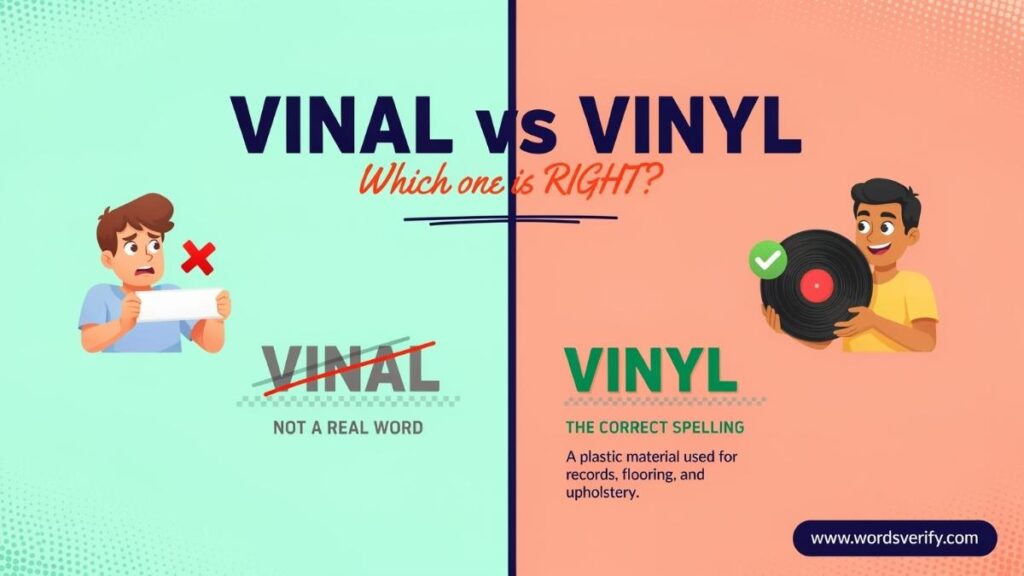
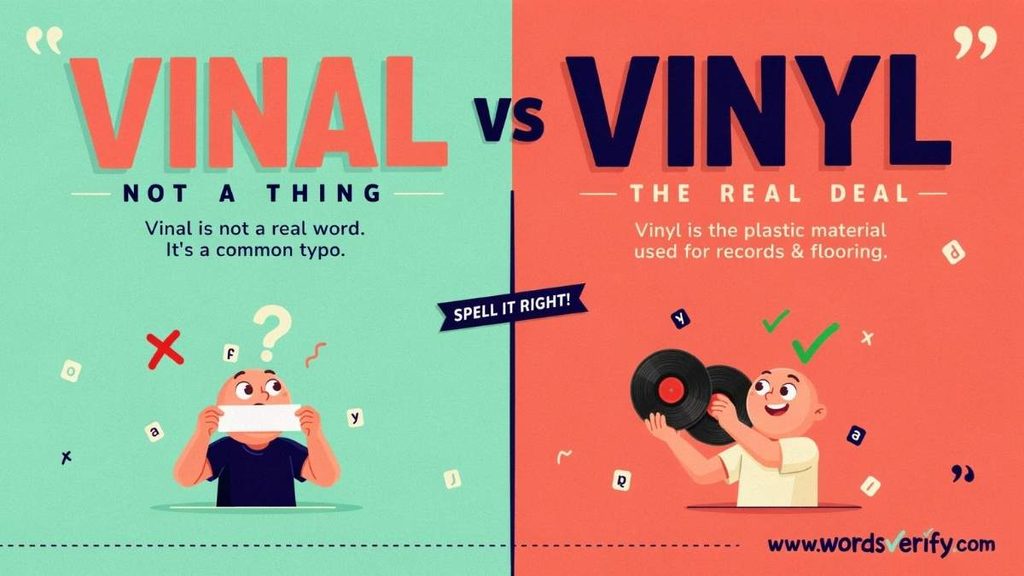
Ever found yourself staring at two spellings and wondering whether English is secretly testing your patience? That’s the problem with vinal vs vinyl. The words look nearly identical and sound much alike, yet they don’t mean the same thing. Vinyl is the familiar word you’ll see when talking about flooring, records, siding, stickers, clothing, and other everyday products. Vinal, on the other hand, is a rare technical term mainly used for a type of synthetic textile fiber. In this guide, we’ll untangle the confusion, explain the meanings, spelling, and pronunciation, and show you exactly when to use each word without second-guessing yourself.
Quick Answer Vinal vs Vinyl?
If you’re talking about flooring, records, siding, stickers, upholstery, or the familiar synthetic material, the correct spelling is “vinyl.”
If you’re talking about a specialized synthetic textile fiber associated with vinyl alcohol, “vinal” can be the correct term.
Here’s the basic distinction:
| Word | Meaning | Typical Use |
|---|---|---|
| Vinyl | A synthetic material and products made from it | Vinyl flooring, vinyl siding, vinyl records |
| Vinal | A specialized synthetic textile fiber | Technical textile and fiber discussions |
The easiest rule is simple: if you’re talking about a floor or a record, you almost certainly want “vinyl.”
What Does Vinyl Mean?
The word “vinyl” has several closely related uses, but they all connect to material science or products made from vinyl-based materials.
In everyday language, vinyl commonly describes a synthetic plastic material. It appears in countless products because manufacturers can produce it in different forms, from flexible surfaces to more rigid materials.
You may see vinyl used for:
- Flooring
- Siding
- Upholstery
- Clothing
- Stickers
- Decals
- Signs
- Furniture coverings
- Wall coverings
- Wire and cable coatings
The word also has a famous connection to music.
A vinyl record is a phonograph record made from a vinyl-based plastic material. Over time, people began shortening “vinyl records” to simply “vinyl.”
For example, someone might say:
“She has hundreds of vinyl records.”
Or more casually:
“She collects vinyl.”
In the second sentence, “vinyl” refers to records rather than flooring or plastic sheets.
Vinyl as a Material
The everyday meaning of vinyl is closely associated with polyvinyl chloride, commonly called PVC.
PVC is a synthetic polymer used to make many different plastic products. Depending on how manufacturers formulate and process it, the material can be rigid, flexible, durable, or lightweight.
That versatility explains why you encounter vinyl in so many parts of everyday life.
Think about a house for a moment. The flooring might be vinyl. The siding might be vinyl. The furniture could have vinyl upholstery. A decorative sign on the wall might use a vinyl decal.
One little word covers a surprisingly wide range of products.
Vinyl as a Music Term
“Vinyl” also has a special place in music culture.
When people talk about vinyl today, they often mean vinyl records. The term has remained popular even though records have competed with cassette tapes, CDs, digital downloads, and streaming services.
For example:
- “I bought a new vinyl record.”
- “He has a large vinyl collection.”
- “She prefers listening to music on vinyl.”
Here, “vinyl” functions as a familiar everyday noun.
Avoid everyday grammar mistakes with simple tips
Encorporate vs Incorporate Which one Is Correct?
What Does Vinal Mean?
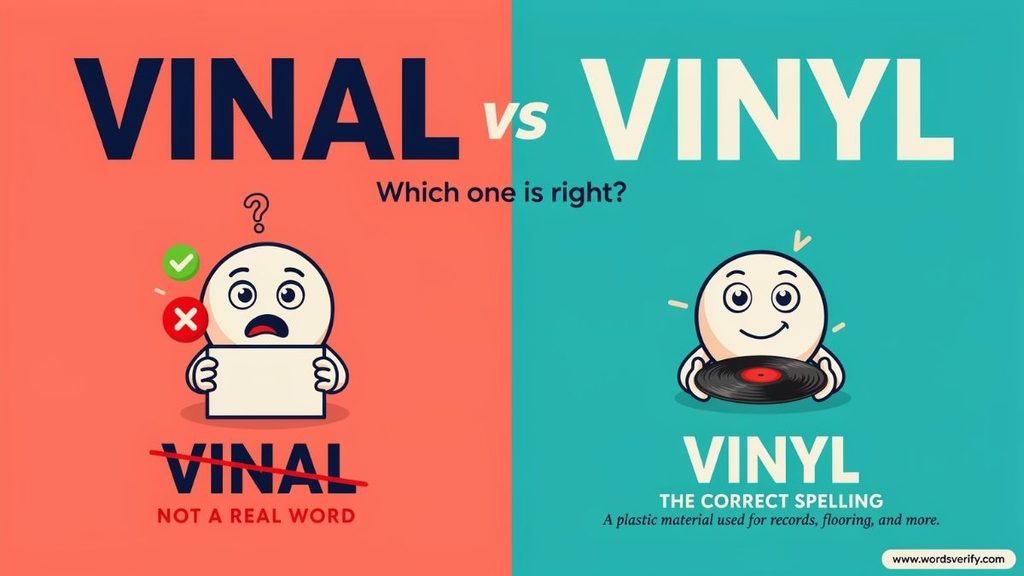
“Vinal” is a real word, but it is much less common than “vinyl.”
In technical textile terminology, vinal refers to a synthetic fiber made from a polymer containing a substantial amount of vinyl alcohol units.
That places “vinal” in a very different category from the everyday uses of “vinyl.”
You’re unlikely to encounter “vinal” while shopping for flooring or talking about your music collection. Instead, you’re more likely to see it in discussions involving:
- Textile science
- Synthetic fibers
- Fiber classification
- Materials research
- Industrial textiles
- Polymer chemistry
- Historical textile manufacturing
The word therefore has a legitimate place in technical writing. It just isn’t the word most people need in everyday conversation.
Vinal Fiber
Vinal fiber is a type of synthetic textile fiber associated with polyvinyl alcohol.
Its history is connected to attempts to develop useful manufactured fibers with properties such as strength, flexibility, and durability.
Technical sources describe vinal fibers as having useful textile and industrial characteristics. Historical applications have included items such as raincoats, jackets, umbrellas, tarpaulins, fishnets, and awnings.
That technical meaning explains why “vinal” deserves to be treated as a real word rather than simply being labeled an error.
Vinal vs Vinyl The Main Difference
The difference between vinal and vinyl is primarily a matter of meaning and context.
“Vinyl” is the common everyday word. It appears in ordinary conversations, product descriptions, construction, home improvement, music, fashion, crafts, and manufacturing.
“Vinal” is much more specialized. Its important technical use refers to a synthetic textile fiber.
The two words share similar letters and sounds, but they aren’t interchangeable.
| Context | Correct Word |
|---|---|
| Flooring | Vinyl |
| Records | Vinyl |
| Siding | Vinyl |
| Stickers | Vinyl |
| Decals | Vinyl |
| Upholstery | Vinyl |
| Common plastic products | Vinyl |
| Specialized synthetic fiber | Vinal |
This is why context matters so much.
If someone writes “vinal flooring,” the writer almost certainly means “vinyl flooring.” If a textile specialist writes “vinal fiber,” changing it automatically to “vinyl fiber” could alter the intended meaning.
Is Vinal a Word?
Yes, “vinal” is a word.
That may come as a surprise because many people only encounter it as an apparent misspelling of “vinyl.”
The important distinction is that a word can be real without being appropriate in every situation.
For example, if you’re writing about a kitchen floor, “vinal flooring” is not the normal expression. The correct phrase is “vinyl flooring.”
On the other hand, a technical discussion about a particular synthetic fiber can legitimately use “vinal.”
So don’t use a dictionary test alone. Ask what the word means in the sentence.
Avoid everyday grammar mistakes with simple tips
Performed vs Preformed which one is correct?
Is Vinal Another Spelling of Vinyl?
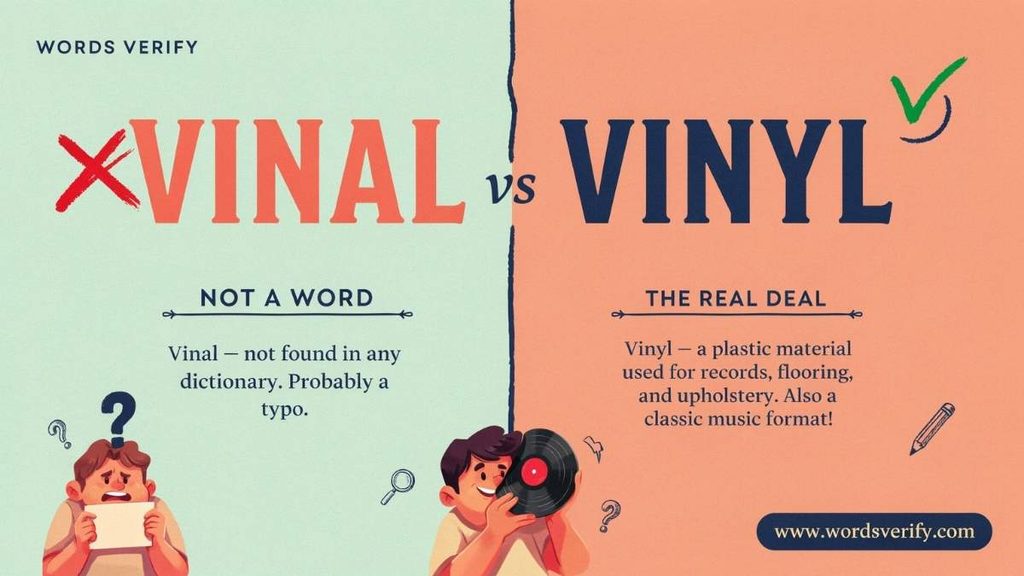
No.
“Vinal” and “vinyl” aren’t simply two accepted spellings of the same everyday word.
When people write “vinal” while talking about flooring, records, siding, or stickers, they’re usually making a spelling mistake.
When “vinal” refers to the specialized synthetic fiber, however, the spelling is intentional.
That distinction is worth remembering because English contains plenty of real words that look or sound similar but have different meanings.
Is Vinal a Misspelling of Vinyl?
Sometimes it is.
Suppose someone writes:
“We need to replace the vinal flooring.”
The intended word is almost certainly “vinyl.”
The same problem can occur with:
- Vinal records → Vinyl records
- Vinal siding → Vinyl siding
- Vinal stickers → Vinyl stickers
- Vinal upholstery → Vinyl upholstery
- Vinal clothing → Vinyl clothing
- Vinal decals → Vinyl decals
In each of these ordinary situations, “vinal” would be a spelling error.
However, you shouldn’t automatically correct every occurrence of “vinal.” A technical writer discussing vinal fiber may have used the word correctly.
Avoid everyday grammar mistakes with simple tips
Offered vs Offerred Which one Is Correct?
Why Do People Confuse Vinal vs Vinyl?
The confusion isn’t difficult to understand.
Similar Sounds
The pronunciation of “vinyl” makes the spelling less obvious than you might expect.
In US English, vinyl is commonly pronounced /ˈvaɪ.nəl/.
The beginning sounds much like what you might expect from “vinal,” which makes the spelling easy to guess incorrectly.
When people learn words mainly through conversation, they may know exactly what the word means but have never paid much attention to how it looks on the page.
The Y Looks Unexpected
The spelling “vinyl” isn’t especially intuitive.
The sequence of letters can make someone stop and wonder whether the word should contain a “y” or an “a.”
That’s particularly common when someone hears the word before seeing it written.
English spelling doesn’t always give you a perfect map of pronunciation. Sometimes you simply have to learn the established spelling.
Both Words Are Real
This makes the situation even trickier.
If “vinal” were completely meaningless, a spellchecker could simply flag it every time. But because “vinal” exists as a legitimate word, software may not always treat it as an error.
That creates an important lesson:
A spelling checker can tell you that a word exists. It can’t always tell you that you’ve chosen the right word.
Autocorrect Can Make Things Worse
Autocorrect and predictive text can introduce unexpected changes, especially with less familiar vocabulary.
A writer may type one form, accept an automatic suggestion, and move on without noticing the change.
That can result in a perfectly spelled word that doesn’t express the intended meaning.
Avoid everyday grammar mistakes with simple tips
Tapping vs Taping which one is correct?
Vinyl Pronunciation vs Vinal Pronunciation
The pronunciation difference isn’t as obvious as the spelling difference.
The standard US pronunciation of “vinyl” is commonly represented as /ˈvaɪ.nəl/.
The pronunciation of “vinal” can depend on the particular meaning and dictionary source. Its technical fiber sense is commonly represented with a pronunciation beginning with the same “vai” sound.
Because the two words can sound so similar, pronunciation isn’t the best way to decide which spelling belongs in your sentence.
When you’re writing, focus on meaning first.
Avoid everyday grammar mistakes with simple tips
Emersion vs Immersion which one is correct?
How to Use Vinyl Correctly
Once you learn a few common combinations, “vinyl” becomes much easier to recognize.
Vinyl Flooring
“Vinyl flooring” is the standard phrase.
For example:
“We installed vinyl flooring in the kitchen.”
Vinyl flooring is popular because manufacturers can produce it in many designs and formats. Modern products can imitate the appearance of wood, stone, tile, and other materials.
Don’t write “vinal flooring” when you mean the ordinary flooring material.
Vinyl Records
The standard phrase is “vinyl records.”
For example:
“My father still listens to vinyl records.”
You can also use “vinyl” by itself:
“She bought three new vinyl records.”
“I love the sound of vinyl.”
Vinyl Siding
“Vinyl siding” is another established expression.
For example:
“The homeowners replaced the old siding with vinyl siding.”
The material is widely used in residential construction because it can provide a durable exterior covering without requiring the same maintenance as some traditional materials.
Vinyl Stickers and Decals
Vinyl is also common in crafts, advertising, signs, and vehicle graphics.
For example:
- “The company ordered vinyl stickers.”
- “She designed a vinyl decal for her car.”
- “The sign uses vinyl lettering.”
In these examples, “vinal” would normally be an incorrect spelling.
Avoid everyday grammar mistakes with simple tips
Conex vs Connex which one is correct?
Vinyl Clothing and Other Everyday Products
Vinyl appears outside construction and music too.
You may see phrases such as:
- Vinyl clothing
- Vinyl jackets
- Vinyl upholstery
- Vinyl furniture
- Vinyl covers
- Vinyl gloves
- Vinyl wall coverings
The material can be manufactured in different ways to create different textures, finishes, and levels of flexibility.
That versatility is one reason the word “vinyl” appears so frequently in product descriptions.
Vinyl vs PVC Are They the Same?
Not exactly.
PVC stands for polyvinyl chloride. It is a specific synthetic polymer.
“Vinyl” is commonly used to describe PVC-based materials and products, but the terms aren’t always perfect substitutes in technical writing.
Think of PVC as a specific chemical material while “vinyl” often works as a broader product or material term.
For example, a manufacturer might describe a product as vinyl flooring. A chemist might discuss the polyvinyl chloride polymer used in that product.
Both statements can refer to the same general product without meaning exactly the same thing.
This distinction becomes particularly useful when reading technical material.
Vinal and Polyvinyl Alcohol
The connection between “vinal” and polyvinyl alcohol helps explain its technical meaning.
Polyvinyl alcohol is a synthetic polymer with applications in areas such as adhesives, coatings, films, and other industrial processes.
Certain polymers containing vinyl alcohol units can also form the basis of manufactured fibers.
That is where “vinal” enters the picture.
So, while ordinary vinyl products are commonly associated with PVC, vinal fiber belongs to a different technical material context associated with polyvinyl alcohol.
This is one of the most important facts behind the vinal vs vinyl distinction.
Vinal Fiber vs Vinyl Material
The difference becomes easier to see when the materials are placed side by side.
| Feature | Vinal Fiber | Vinyl Material |
|---|---|---|
| Main field | Textile and fiber science | Manufacturing and consumer products |
| Material type | Synthetic fiber | Synthetic plastic/material |
| Important chemical association | Polyvinyl alcohol | Often polyvinyl chloride |
| Common everyday use | Rare | Very common |
| Flooring | Not the usual meaning | Common |
| Records | No | Common |
| Siding | No | Common |
| Textile applications | Yes | Yes, in certain products |
| Technical terminology | Yes | Yes |
The similarity in the names can be misleading. Their technical identities are different.
Avoid everyday grammar mistakes with simple tips
Spoiled vs Spoilt Which One Is Correct?
Vinal vs Vinyl Examples
Examples are often the quickest way to settle the issue.
Correct Uses of Vinyl
- We chose vinyl flooring for the bathroom.
- He has hundreds of vinyl records.
- The house has white vinyl siding.
- She bought a vinyl sticker for her laptop.
- The chairs have vinyl upholstery.
- The store sells vinyl clothing.
- The company produces vinyl signs.
Correct Specialized Use of Vinal
- The researcher examined the strength of vinal fiber.
- The textile study discussed the properties of vinal fibers.
- The manufacturer investigated an industrial application involving vinal fiber.
The last examples belong to specialized technical writing.
Incorrect vs Correct Examples
| Incorrect in ordinary usage | Correct | Reason |
|---|---|---|
| Vinal flooring | Vinyl flooring | Common flooring material |
| Vinal records | Vinyl records | Music records |
| Vinal siding | Vinyl siding | Exterior building material |
| Vinal sticker | Vinyl sticker | Adhesive product |
| Vinal upholstery | Vinyl upholstery | Furniture covering |
| Vinal clothing | Vinyl clothing | Material used in clothing |
| Vinal decal | Vinyl decal | Decorative or commercial product |
| Vinal fiber | Vinal fiber | Specialized textile term |
Notice the final example.
That’s the exception that prevents the simple rule “vinal is always wrong” from being accurate.
Common Vinal vs Vinyl Mistakes
A few errors appear more often than others.
“Vinal Flooring”
When discussing flooring, use “vinyl flooring.”
“Vinal Records”
When discussing records, use “vinyl records.”
Treating Vinal as a Universal Misspelling
This is another mistake.
Although “vinal” frequently appears as an incorrect spelling of “vinyl,” the word itself has legitimate technical uses.
Assuming Spellcheck Proves You’re Right
A dictionary or spellchecker can confirm that a word exists. It doesn’t necessarily confirm that you’ve used the word correctly.
That’s why context remains essential.
Avoid everyday grammar mistakes with simple tips
Perfer vs Prefer which one is correct?
Vinal vs Vinyl in Everyday English
For most people, “vinyl” is the word that matters.
You’ll encounter it in:
- Home improvement
- Interior design
- Music
- Crafts
- Advertising
- Fashion
- Manufacturing
- Construction
- Product descriptions
- Everyday conversation
“Vinal,” by comparison, appears far less often.
It’s more likely to show up in specialized discussions involving fibers, textiles, polymers, and industrial materials.
That difference in frequency explains why many people have seen “vinyl” thousands of times but may never have encountered “vinal” before.
Is Vinyl the Correct Spelling?
Yes, when you mean the common material or the records associated with it.
The standard spelling is:
V-I-N-Y-L
If you’re asking how to spell vinyl, remember the Y.
You can connect it with familiar phrases:
- Vinyl flooring
- Vinyl records
- Vinyl siding
- Vinyl stickers
- Vinyl upholstery
Seeing the word in these common combinations makes the spelling easier to remember.
Is Vinal a Correct Word?
Yes, but don’t confuse “correct word” with “correct choice for every sentence.”
“Vinal” is correct when you’re using its specialized meaning.
It is not the standard spelling for the ordinary material used in flooring or the records people collect.
That distinction is similar to many other English words that have narrow technical meanings.
A word can be perfectly legitimate while still being completely wrong for the context in front of you.
How Do You Spell Vinyl?
The common spelling is:
V-I-N-Y-L
Not:
V-I-N-A-L
If you’re describing a floor, record, siding, sticker, or similar product, “vinyl” is the spelling to choose.
How Do You Spell Vinal?
The specialized word is spelled:
V-I-N-A-L
It’s mainly useful when you’re discussing its particular technical or dictionary meaning.
The important point isn’t simply memorizing both spellings. It’s remembering what each word represents.
Avoid everyday grammar mistakes with simple tips
Quiet vs Quite and which one is correct?
The Easiest Way to Remember Vinal vs Vinyl
Here’s a simple memory trick.
Think about the three things most people associate with vinyl:
Floors. Records. Siding.
All three use vinyl.
You can also remember:
Vinyl = the everyday material and records.
Vinal = the uncommon technical fiber term.
If you’re writing about a home renovation, music collection, sticker, or piece of furniture, your answer will almost certainly be “vinyl.”
If you’re reading a technical textile paper and encounter “vinal,” don’t immediately assume someone made a typo.
When to Use Vinyl
Use “vinyl” when you mean:
- A common synthetic plastic material.
- Vinyl flooring.
- Vinyl records.
- Vinyl siding.
- Vinyl upholstery.
- Vinyl clothing.
- Vinyl stickers.
- Vinyl decals.
- Vinyl signs.
- Other everyday vinyl products.
This covers the overwhelming majority of situations in ordinary American English.
When to Use Vinal
Use “vinal” when the context specifically refers to the technical synthetic fiber.
You might encounter the term in:
- Textile science
- Polymer research
- Fiber classification
- Industrial textile discussions
- Materials research
- Historical textile literature
If the context doesn’t involve this specialized meaning, “vinyl” is usually the safer choice.
Avoid everyday grammar mistakes with simple tips
Weiner vs Wiener which one is correct?
A Practical Case Study Flooring
Imagine that a homeowner sends a message to a contractor:
“We’re interested in installing vinal flooring.”
The contractor will probably understand the message immediately. Still, the standard spelling is “vinyl flooring.”
Now imagine a materials researcher writing:
“The study compares the tensile properties of vinal fiber.”
That usage can be correct because the writer is discussing the specialized synthetic fiber.
The spelling changes because the meaning changes.
That’s the heart of the entire vinal vs vinyl issue.
Another Case Study: Music
Imagine someone writing:
“I found several old vinal records at the store.”
The intended meaning is obvious, but the spelling is wrong.
The correct sentence is:
“I found several old vinyl records at the store.”
There’s no reason to use “vinal” here because the sentence has nothing to do with the specialized fiber
Vinal Definition vs Vinyl Definition
The two definitions can be reduced to a simple comparison.
Vinyl definition: a term commonly used for a synthetic material, especially materials associated with PVC, as well as products made from those materials. It also refers to phonograph records commonly known as vinyl records.
Vinal definition: a specialized term for a manufactured synthetic fiber associated with polymers containing vinyl alcohol units.
The meanings overlap in their chemical history, but they describe different things.
Why Context Matters More Than Spelling Alone
At first glance, “vinal” and “vinyl” seem like a classic spelling problem.
In reality, they’re also a vocabulary problem.
Suppose you see:
“The company manufactures vinal.”
You can’t confidently decide whether that sentence contains a spelling mistake until you know what the writer means.
If the company makes flooring, siding, or plastic signs, “vinyl” is probably intended.
If the company manufactures a specialized synthetic fiber, “vinal” might be perfectly appropriate.
That’s why good proofreading goes beyond checking whether every word looks familiar.
The real question is:
Does this word express the intended meaning?
Practice Session vinal vs vinyl
Choose the correct word, “vinal” vs “vinyl,” to complete each sentence.
- We installed ______ flooring in the kitchen.
- She collects classic ______ records from different decades.
- The company produces ______ siding for residential buildings.
- The designer used ______ material to make the waterproof cover.
- A ______ record should be stored away from heat and direct sunlight.
- The standard spelling for the common synthetic material is ______.
- ______ is a rare technical term associated with a type of synthetic textile fiber.
- The word ______ is much more common in everyday English.
- He ordered several ______ stickers for his craft project.
- The museum displayed an old ______ record from the 1970s.
- If you mean the material used for many floors, write ______.
- In specialized textile terminology, ______ can refer to a synthetic fiber.
- “Vinal flooring” is usually a spelling mistake when the intended word is ______ flooring.
- “Vinal record” is normally incorrect when referring to a record made from ______.
- The spelling ______ includes a “y,” while the technical word “vinal” does not.
- The company specializes in materials and synthetic ______ research.
- ______ upholstery is commonly used on furniture because it is durable and easy to clean.
- When discussing common plastic products, ______ is generally the appropriate word.
- A writer discussing a specialized synthetic textile fiber may correctly use ______.
- The phrase “______ siding” is commonly used in home improvement.
- The phrase “______ record player” refers to a player designed for phonograph records.
- If someone writes “vinal records” when discussing music, they probably made a ______ mistake.
- The word ______ can function as a noun when referring to a record or material.
- The main difference between vinal and vinyl is their meaning and ______.
- When talking about records, flooring, or siding, remember to choose ______.
Answers
- vinyl
- vinyl
- vinyl
- vinyl
- vinyl
- vinyl
- vinal
- vinyl
- vinyl
- vinyl
- vinyl
- vinal
- vinyl
- vinyl
- vinyl
- fiber
- vinyl
- vinyl
- vinal
- vinyl
- vinyl
- spelling
- vinyl
- usage
- vinyl
Here’s a trusted source for clear more words Comparison:
FAQs
Is “vinal” an alternative spelling of “vinyl”?
No. “Vinal” and “vinyl” are separate words. Vinyl is the standard spelling for the common material and for products such as flooring, siding, and records. Vinal has a much narrower technical meaning.
Why do people confuse vinal and vinyl?
The words look almost identical and can sound very similar when spoken. Since “vinal” is rare in everyday English, people may also write it when they simply forget the standard spelling of “vinyl.”
Which spelling is correct for vinyl flooring?
“Vinyl flooring” is the correct phrase. “Vinal flooring” is generally a spelling mistake when you mean the common flooring material.
Which spelling is correct for vinyl siding?
The standard phrase is “vinyl siding.” Use “vinal siding” only if a specialized source specifically uses that word for a technical purpose.
Should you write vinyl record or vinal record?
Write “vinyl record.” When you mean a phonograph record made from vinyl-based material, “vinyl record” is the established expression.
Is vinal commonly used in everyday English?
No. Most people rarely encounter “vinal” outside specialized discussions of synthetic fibers, textiles, or materials science. “Vinyl” appears much more often in ordinary writing.
Can vinal and vinyl be used interchangeably?
No. Even though their spellings and sounds are similar, they have different meanings. Replacing one with the other can turn a correct sentence into a misleading one.
What does vinyl mean in chemistry?
In chemistry, “vinyl” refers to a specific chemical group derived from ethene. The term also appears in chemical names and descriptions of compounds containing that group.
What does vinal refer to in materials science?
Vinal refers to a particular manufactured synthetic fiber associated with polymers containing vinyl alcohol units. The word belongs mainly to specialized technical terminology.
Is vinyl a noun or an adjective?
Vinyl can be either. As a noun, it can name the material or refer informally to a record. As an adjective, it describes something made from or related to vinyl, as in “vinyl flooring.”
Is vinal a noun?
Yes. When used as the technical term for a synthetic fiber, “vinal” functions as a noun.
Can “vinyl” describe a material and a record?
Yes. “Vinyl” can refer to the material itself or serve as a shortened reference to a vinyl record when the context makes the meaning clear.
Is vinyl the correct word for synthetic plastic products?
Usually, yes, when the product uses vinyl in the ordinary product sense. Common examples include vinyl flooring, siding, upholstery, decals, and certain types of clothing.
What is the difference between vinyl and polyvinyl chloride?
Polyvinyl chloride, or PVC, is a specific polymer. “Vinyl” has broader everyday and chemical uses. Many products marketed as vinyl use PVC-based materials, but the terms aren’t exact synonyms in every context.
Is vinal related to polyvinyl alcohol?
Yes. The technical term “vinal” relates to synthetic fibers associated with vinyl alcohol or polyvinyl alcohol structures. That connection helps explain why it appears in textile and polymer terminology.
Why does vinyl have a “y”?
The spelling “vinyl” comes from established chemical terminology. English retained the “y” in the word rather than changing it to the more phonetic-looking “vinal.”
Is “vinal” a common spelling mistake?
It can be. When someone writes “vinal” while talking about records, flooring, siding, or another familiar vinyl product, the writer almost certainly intended “vinyl.”
How do you tell whether vinal is intentional or a typo?
Check the context. If the sentence discusses a specialized synthetic fiber or textile material, “vinal” may be intentional. If it mentions records, flooring, siding, stickers, or ordinary plastic products, “vinyl” is usually the intended word.
Does “vinyl” have a different meaning in technical writing?
It can. In everyday language, vinyl often describes a synthetic material. In chemistry, however, vinyl has a more precise meaning connected to a particular molecular group.
Can vinal appear in scientific or technical documents?
Yes. Although rare, “vinal” can appear in specialized writing about synthetic fibers, textiles, polymers, and materials. Its technical use makes it a legitimate word rather than simply a misspelling.
Is “vinyl material” grammatically correct?
Yes. “Vinyl material” is commonly used to describe a material made from or associated with vinyl. Depending on the sentence, simply “vinyl” may sound more natural.
Is “vinyl” a common English word?
Yes. Vinyl is well established in everyday English. You’ll encounter it in home improvement, music, crafts, manufacturing, clothing, furniture, and many other contexts.
What is the easiest way to remember vinal vs vinyl?
Use the everyday-product test. If you’re talking about records, flooring, siding, stickers, upholstery, or similar products, choose “vinyl.” Reserve “vinal” for its specialized technical use.
Can one letter make vinal and vinyl different words?
Yes. The single letter “y” separates the familiar word “vinyl” from the much rarer “vinal.” In this case, that tiny spelling difference also signals a difference in meaning.
conclusion
The vinal vs vinyl confusion may come down to one little letter, but that letter matters. In everyday English, vinyl is the spelling you’ll almost always want. You’ll find it in phrases such as vinyl flooring, vinyl records, vinyl siding, vinyl stickers, and vinyl clothing. Vinal is also a legitimate word, but it’s a rare technical term mainly associated with synthetic textile fibers and materials science.
So, when you’re writing about records, floors, siding, or everyday synthetic materials, go with vinyl. Use vinal only when the technical context calls for it. Once you learn that simple distinction, this confusing pair becomes easy to handle—and you can stop letting one tiny “y” ruin your spelling confidence!

Lisa AJS is an experienced blogger and language enthusiast at Words Verify, dedicated to making grammar simple, practical, and enjoyable. She writes engaging content on commonly confused words, grammar mistakes, word meanings, and everyday language challenges.