
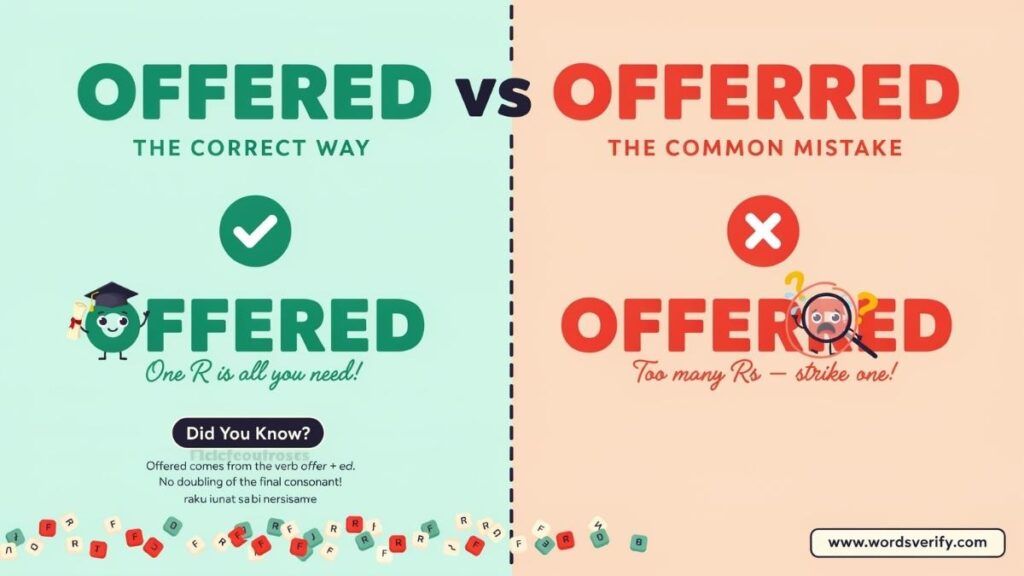
Have you ever written a word, stared at it, and suddenly wondered, “Wait, does that look right?” If you’ve hesitated over offered vs offerred, you’re not alone. This tiny spelling confusion catches plenty of careful writers off guard. The correct form is offered, while offerred is a common misspelling. But why does one r work when words such as preferred and referred seem to invite two? That’s where the confusion begins. In this guide, we’ll make offered vs offerred easy to understand. You’ll learn the correct spelling, discover why the mistake happens, see clear examples, and pick up a simple trick to remember it.
Offered vs Offerred quick answer
If you’re wondering whether to write offered vs offerred, choose offered.
| Spelling | Correct? | Reason |
|---|---|---|
| offered | Yes | Standard English spelling |
| offerred | No | Common misspelling |
| offerd | No | Incorrect formation |
| offering | Yes | Correct present participle |
| offerring | No | Incorrect spelling |
The word offered can function as both the simple past tense and the past participle of offer.
For example:
- The company offered me a position.
- She offered to help with the project.
- They have offered several solutions.
- He was offered a promotion.
In each sentence, offered is spelled with only one r.
If you’re asking, “Is it offered vs offerred?” the answer is simple: offered.
What Does “Offered” Mean?
The meaning of offered depends on the situation, but the central idea is that someone gives, presents, suggests, or makes something available.
For example, if a company says:
The company offered me a job.
It means the company presented you with a job opportunity.
If a friend says:
She offered to drive me home.
It means she volunteered to drive you.
The verb can describe several different actions.
- Giving or providing something
The hotel offered free breakfast. - Making something available
The university offered several evening classes. - Suggesting help
He offered to carry the boxes. - Making a proposal
The buyer offered $300,000 for the house. - Presenting an opportunity
The company offered her a promotion.
Because the verb has so many everyday uses, you’ll see offered in conversations, emails, business documents, academic writing, and ordinary messages.
Is “Offerred” a Word?
If you’re wondering whether offerred is a legitimate form of the verb offer, it isn’t.
In standard English, offered is the correct form.
You might still see offerred online. People make spelling mistakes all the time, and a misspelled word can appear thousands of times without becoming correct.
For example:
Incorrect: The company offerred me a position.
Correct: The company offered me a position.
The first sentence is understandable, but the spelling is wrong.
This distinction matters especially in professional or academic writing. A small spelling error can make an otherwise polished sentence look careless.
Why Is Offered Spelled With One R?
The easiest way to understand the spelling is to start with the base verb.
The base word is:
offer
To form the regular past tense, add:
-ed
That gives you:
offer + ed = offered
You don’t add another r.
This is where many writers go wrong. They remember that English sometimes doubles a final consonant before adding an ending. That’s true in some cases, but it isn’t a rule that applies to every verb.
For example:
- stop → stopped
- plan → planned
- rob → robbed
But:
- offer → offered
- suffer → suffered
- enter → entered
English spelling depends on more than the final letter of a word. Stress, syllable structure, vowel sounds, and the word’s formation can all affect what happens when you add a suffix.
Fix common more word mistakes in English
Tapping vs Taping which one is correct?
Why Not “Offerred”?
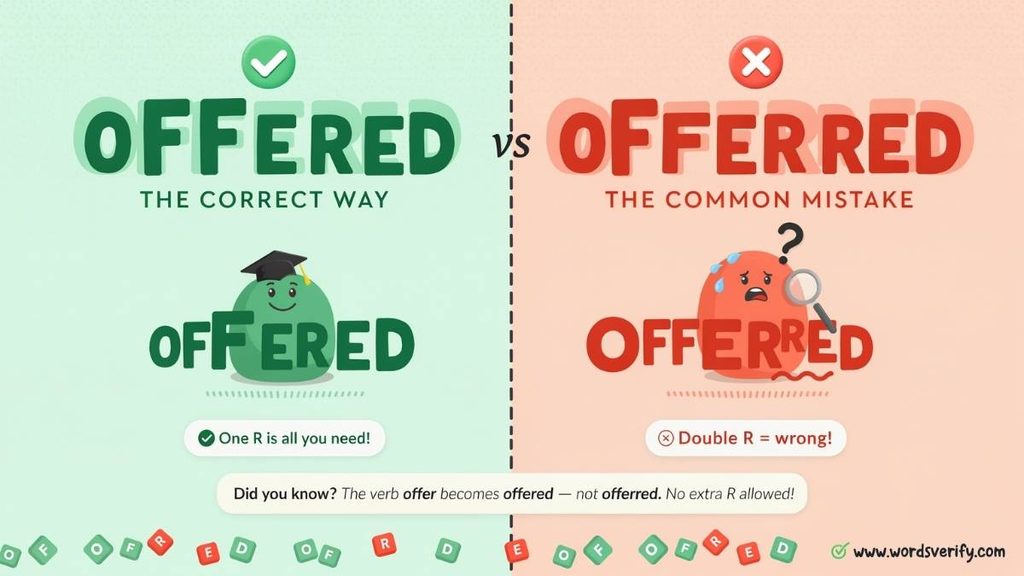
The spelling offerred looks convincing because English contains several familiar verbs that double the final r.
Consider these examples:
- refer → referred
- prefer → preferred
- transfer → transferred
Now compare them with:
- offer → offered
- suffer → suffered
- enter → entered
The words may look similar, but they don’t all follow the same spelling pattern.
One important difference involves stress.
The word offer is normally pronounced with stress on the first syllable:
OF-fer
By contrast, refer and prefer place the main stress on the second syllable:
re-FER
pre-FER
That difference helps explain why refer becomes referred and prefer becomes preferred, while offer becomes offered.
However, stress isn’t a magic formula that lets you predict every English spelling. English has plenty of exceptions and historical patterns. It’s better to use it as part of the explanation rather than treating it as a universal rule.
The Confusion With “Preferred” and “Referred”
This is probably the biggest reason people write offerred.
Look at the three verbs:
| Base verb | Correct past tense |
|---|---|
| offer | offered |
| refer | referred |
| prefer | preferred |
At first glance, offered seems as though it should behave like referred and preferred.
After all, all three verbs end in -er.
But English doesn’t work by simply looking at the last two letters. The structure and stress of the whole word matter.
Think of these as separate patterns rather than forcing them into one rule:
offer → offered
refer → referred
prefer → preferred
Once you memorize that contrast, the spelling becomes much easier.
Fix common more word mistakes in English
Emersion vs Immersion which one is correct?
How to Use Offered Correctly
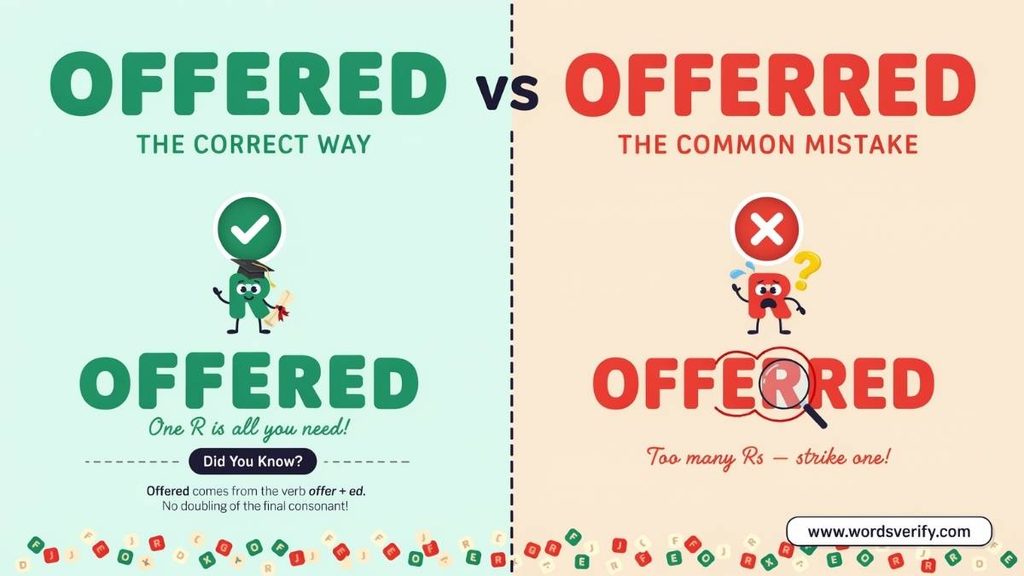
The word offered can appear in several common sentence structures.
Offered as the Simple Past Tense
Use offered when an offer happened in the past.
- The manager offered me a promotion.
- Sarah offered her neighbor a ride.
- The store offered a large discount.
- He offered his opinion during the meeting.
The action happened in the past, so the verb takes its past form.
Offered as a Past Participle
Offered also works as the past participle of offer.
You’ll often find it after has, have, or had.
- The company has offered several solutions.
- They have offered me a new position.
- She had offered to help before I arrived.
- We had already offered our assistance.
It can also appear in passive constructions:
- He was offered a job.
- She was offered a scholarship.
- They were offered a refund.
The form remains offered.
Offered With a Person and a Thing
A common pattern is:
offer + someone + something
For example:
- She offered me some coffee.
- The company offered him a position.
- They offered us a better price.
- The teacher offered the students extra help.
Offered With “To”
Another common pattern is:
offer + to + verb
For example:
- He offered to drive us home.
- She offered to organize the meeting.
- I offered to explain the problem.
- They offered to pay for dinner.
Here, offered to means someone volunteered or proposed to do something.
Fix common more word mistakes in English
Conex vs Connex which one is correct?
Offer vs Offered
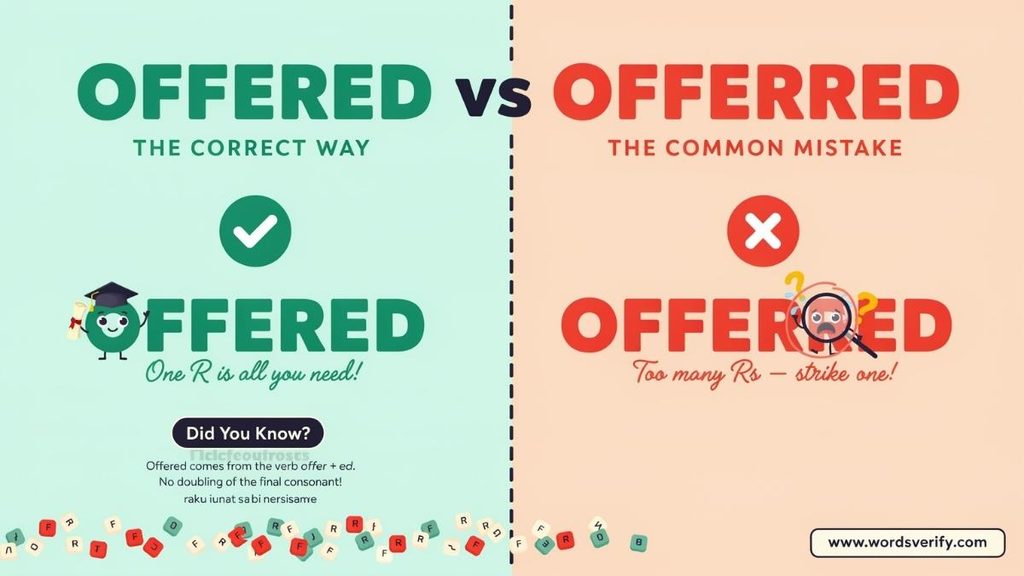
The difference between offer and offered mainly comes down to verb form and time.
Offer is the base form.
Offered is the simple past and past participle.
| Verb form | Example |
|---|---|
| offer | I offer my help. |
| offers | She offers useful advice. |
| offering | They are offering free delivery. |
| offered | He offered me a seat. |
There’s an important detail to remember when did appears in a sentence.
Correct:
I offered my help.
Also correct:
I did offer my help.
Incorrect:
I did offered my help.
Why? Because did already carries the past tense. The main verb returns to its base form.
The same pattern appears in questions:
Correct:
Did she offer you a job?
Incorrect:
Did she offered you a job?
This is a grammar issue rather than a spelling issue, but it’s an easy mistake to avoid once you know the pattern.
Verb Forms of Offer
Here are the main forms of the verb offered vs offerred:
| Form | Correct word | Example |
|---|---|---|
| Base form | offer | I will offer help. |
| Third-person singular | offers | She offers advice. |
| Present participle | offering | They are offering support. |
| Simple past | offered | They offered help. |
| Past participle | offered | They have offered help. |
Notice something important: offering has only one r as well.
The incorrect form is offerring.
So the two useful patterns are:
offer → offered
offer → offering
Neither form doubles the r.
Fix common more word mistakes in English
Spoiled vs Spoilt Which One Is Correct?
Common Mistakes With offered vs offerred
Most errors involving this word are easy to recognize once you know what to look for.
1. Offerred
Incorrect:
The company offerred me a job.
Correct:
The company offered me a job.
The extra r doesn’t belong there.
2. Offerd
Incorrect:
The store offerd a discount.
Correct:
The store offered a discount.
The word needs the complete -ed ending.
3. Offerring
Incorrect:
The company is offerring free delivery.
Correct:
The company is offering free delivery.
The present participle is offering.
4. Did Offered
Incorrect:
Did the manager offered you a promotion?
Correct:
Did the manager offer you a promotion?
After did, use the base form.
5. Offer Instead of Offered
Incorrect:
Yesterday, the company offer me a position.
Correct:
Yesterday, the company offered me a position.
A past-time expression such as yesterday needs the appropriate past-tense form.
Fix common more word mistakes in English
Perfer vs Prefer which one is correct?
Why Do People Spell It “Offerred”?
Spelling mistakes usually have a reason behind them. In this case, several patterns can lead writers in the wrong direction.
Similarity to Preferred
People often know that:
prefer → preferred
That can make this incorrect form seem logical:
offer → offerred
Unfortunately, English doesn’t give us that shortcut.
Similarity to Referred
The same problem happens with:
refer → referred
Because offer, refer, and prefer all end in -er, their past-tense forms can look as though they should follow the same pattern.
They don’t.
Overusing the Doubling Rule
English does double some final consonants.
For example:
- stop → stopped
- plan → planned
- admit → admitted
- occur → occurred
But you can’t simply double the final consonant of every verb before adding -ed.
That’s why offerred is incorrect.
Pronunciation Doesn’t Help Much
When you hear offered, you don’t get a strong clue about whether the spelling contains one r or two.
The spoken word sounds roughly like OFF-erd in everyday American English.
That means you’ll need to remember the spelling rather than trying to reconstruct it from pronunciation.
Fix common more word mistakes in English
Quiet vs Quite and which one is correct?
Offered Pronunciation
The pronunciation of offered can vary slightly across accents, but in standard American English it normally has two syllables.
The ending -ed doesn’t create a separate third syllable.
Compare:
- offered — two syllables
- wanted — two syllables
- needed — two syllables
The pronunciation also explains why listening isn’t a reliable way to settle the spelling question.
If someone asks, “How do you pronounce offered?” the important point is that the word has two syllables and the ending has a /d/ sound.
Offered in Different Situations
The word appears in many everyday situations.
Jobs and Employment
- The company offered Maria a full-time position.
- He was offered a promotion.
- She was offered a higher salary.
- The employer offered him a contract.
Business
- The supplier offered a lower price.
- The company offered several payment options.
- The retailer offered customers a discount.
Education
- The university offered evening classes.
- The teacher offered additional support.
- The school offered students extra tutoring.
Customer Service
- The airline offered passengers a refund.
- The company offered a replacement.
- The store offered free returns.
Everyday Life
- She offered me a cup of coffee.
- He offered to carry the bags.
- They offered us a ride home.
- I offered to help with dinner.
The meaning changes slightly depending on the structure, but the spelling never changes.
Fix common more word mistakes in English
Weiner vs Wiener which one is correct?
Offered Synonyms
The best synonym for offered depends on what you mean.
When offered means “made available,” you might use:
- provided
- supplied
- made available
- presented
if it means “suggested,” you might use:
- proposed
- suggested
- recommended
When it means “volunteered,” you might use:
- volunteered
- agreed
- proposed
For example:
The teacher offered help.
You could say:
The teacher provided help.
But:
She offered to help.
could become:
She volunteered to help.
The words aren’t interchangeable in every sentence. Always choose a synonym that preserves both the meaning and the grammar.
Offered vs Similar Verbs
A closer comparison with similar verbs can help explain the spelling.
| Verb | Past form | What to remember |
|---|---|---|
| offer | offered | One r |
| refer | referred | Double r |
| prefer | preferred | Double r |
| suffer | suffered | One r |
| enter | entered | One r |
| transfer | transferred | Double r |
This table also shows why English spelling can be tricky. Several verbs look similar but behave differently when they take -ed.
Rather than assuming every similar-looking verb follows the same pattern, learn the common forms individually.
Fix common more word mistakes in English
Flaky vs Flakey Which one Is Correct?
Is Offered Correct in American and British English?
Yes.
The spelling is offered in both American and British English.
Unlike words such as color/colour or center/centre, this word doesn’t have a standard US-versus-UK spelling difference.
So whether you’re writing for an American reader or a British reader, use:
offered
You don’t need a separate British spelling.
Is Offered Appropriate in Formal Writing?
Absolutely.
Offered is a standard word that works naturally in formal and informal writing.
You can use it in:
- Academic assignments
- Business emails
- Reports
- Job applications
- Cover letters
- Customer-service communication
- Workplace documents
- Everyday messages
For example:
The company offered the successful candidate a permanent position.
There’s nothing informal about that sentence.
However, replacing offered with offerred would introduce an unnecessary spelling error.
Real Life Example: A Job Offer
Imagine that a hiring manager sends this message:
We are pleased to inform you that we have offered you the position of Marketing Coordinator.
The word offered tells the candidate that the company has made the position available to them.
Now imagine the same message with offerred.
The meaning would still be obvious, but the spelling mistake could make the message look less professional.
That matters in situations where every detail contributes to credibility.
Real Life Example: Customer Service
Imagine a customer has received a damaged product.
A support representative writes:
We have offered you a full refund.
Here, offered is the past participle because it follows have.
Compare it with:
We offered you a refund yesterday.
Both sentences use offered, but the grammar differs.
In the first sentence, have offered forms the present perfect.
In the second, offered stands alone as the simple past.
Real Life Example: Everyday Conversation
Consider this sentence:
I offered to pick you up at the airport.
The person volunteered to perform an action.
Now compare:
I offered you a ride.
Here, the person made transportation available to someone.
The structure changes, but the spelling stays exactly the same.
That’s one reason context matters when learning a verb. Memorizing a word is useful, but understanding how it behaves in a sentence makes it much easier to use correctly.
Fix common more word mistakes in English
Web Site vs Website which one is correct?
A Simple Memory Trick
If you regularly forget whether offered has one r or two, keep the trick simple.
Start with:
offer
Then add:
-ed
You get:
offered
That’s all you need for offered vs offerred.
Another useful reminder is:
Offer has one r. Offered keeps one r.
Don’t let preferred and referred talk you into adding another one.
Quick Reference
| Question | Answer |
|---|---|
| Correct spelling | offered |
| Incorrect spelling | offerred |
| Base verb | offer |
| Past tense | offered |
| Past participle | offered |
| Present participle | offering |
| Third-person singular | offers |
| Number of r’s in offered | One |
| Number of f’s in offered | Two |
| British spelling | offered |
| American spelling | offered |
Fix common more word mistakes in English
Ingrained vs Engrained which one is correct?
Practice Session Offered vs Offerred
Fill in each blank with the correct form of the word Offered vs Offerred
- The company ________ me a new position last week.
- She decided to ________ her friend some helpful advice.
- The restaurant is ________ a special discount this weekend.
- He ________ to drive me home after work.
- They have ________ several solutions to the problem.
- The store ________ free delivery on large orders.
- I want to ________ my guests something to drink.
- The manager ________ him a promotion yesterday.
- She is ________ her assistance to anyone who needs it.
- Our teacher ________ us extra time to finish the assignment.
- The hotel ________ a complimentary breakfast to its guests.
- He has ________ to help with the project.
- The company is ________ flexible working hours.
- I would like to ________ you a simple solution.
- She ________ a reasonable price for the car.
- The school ________ several courses for adult learners.
- They are ________ financial support to new customers.
- He ________ to carry the heavy box for me.
- We have ________ the position to another candidate.
- The salesperson ________ me a better deal.
- Please ________ your guests some refreshments.
- The charity is ________ free meals to families in need.
- She ________ an explanation for the delay.
- The company has ________ him a chance to join the team.
- Never write “offerred” when you mean the past tense of “offer.” The correct form is ________.
Answers
- offered
- offer
- offering
- offered
- offered
- offers
- offer
- offered
- offering
- offered
- offers
- offered
- offering
- offer
- offered
- offers
- offering
- offered
- offered
- offered
- offer
- offering
- offered
- offered
- offered
Here’s a trusted source for clear more words Comparison:
FAQs
What is the correct spelling of offered?
The correct spelling is offered. It contains only one r after the e. The spelling offerred is incorrect in standard English.
What does offered mean?
Offered means that someone presented, provided, suggested, or made something available to another person. For example, “She offered me a seat” means she presented the seat as something the other person could use.
Is offered the past tense of offer?
Yes. Offered is the simple past tense of offer. It also works as the past participle. For example, “He offered his help yesterday” uses the simple past, while “They have offered several solutions” uses the past participle.
Is offerred a correct spelling?
No. Offerred is a common spelling mistake. The correct form is offered, with one r.
Why is offered spelled with one r?
The verb offer already ends with a single r. When you add -ed, the standard spelling becomes offered, not offerred. The extra r often appears because writers compare it with words such as preferred and referred.
Is it offering or offerring?
The correct spelling is offering. You don’t double the r when adding -ing to offer.
- Correct: She is offering help.
- Incorrect: She is offerring help.
What is the difference between offer and offered?
Offer is the base form of the verb, while offered is its past and past participle form.
For example:
- Present: “I offer my assistance.”
- Past: “I offered my assistance yesterday.”
- Past participle: “I have offered my assistance before.”
What does “I offered” mean?
“I offered” means that you presented something, suggested something, or made something available in the past. For example, “I offered to drive her home” means you volunteered to drive her home.
What does being offered mean?
Being offered means having something presented or made available to you. For example, “He was offered a new job” means a company presented him with an opportunity to accept the position.
What is another word for offered?
Depending on the context, you can replace offered with words such as provided, presented, proposed, suggested, supplied, volunteered, or gave.
For example, “The company offered assistance” can become “The company provided assistance.”
What is another way to say “offer to help”?
You can say volunteer to help, provide assistance, lend a hand, or offer assistance. The best choice depends on the tone and situation.
What is another word for offering?
Possible alternatives include proposal, suggestion, contribution, service, opportunity, gift, or product. The right synonym depends on what “offering” refers to.
What are the verb forms of offer?
The main forms are offer, offers, offering, offered, and offered.
For example: “I offer,” “she offers,” “they are offering,” “he offered,” and “we have offered.”
What is the plural form of offer?
The plural form of offer is offers.
For example: “The store has several special offers this week.”
What is a better word than offer?
There isn’t one universal replacement for offer. Depending on the sentence, you might use provide, suggest, propose, present, give, volunteer, or extend.
For example, “The company offered a solution” could become “The company proposed a solution.”
What is it called when you offer something?
The act of offering something is generally called making an offer. Depending on the situation, it can also involve proposing, presenting, providing, or volunteering something.
What does “to offer someone something” mean?
To offer someone something means to present it to them for consideration, acceptance, use, or purchase. For example, “She offered her friend some coffee” means she asked whether her friend wanted coffee.
Can you give examples of sentences using offered?
Certainly. Here are a few natural examples:
- The company offered me a full-time position.
- She offered to help with the project.
- He offered his seat to another passenger.
- The store offered a generous discount.
- They offered several solutions to the problem.
What are two common types of offers?
Two common types are conditional offers and unconditional offers. A conditional offer depends on certain requirements being met, while an unconditional offer doesn’t depend on additional conditions.
How do you spell offered in English?
You spell offered as O-F-F-E-R-E-D. Remember that the word has one r after the e.
How do you pronounce offered?
In standard American English, offered is pronounced with two syllables. The final -ed sounds like a d rather than forming a separate third syllable.
Is offered formal or informal?
Offered works in both formal and informal English. You can use it in everyday conversations, business emails, academic writing, job-related communication, and professional documents.
What is the difference between offered and provided?
Both words can mean that someone gave or made something available. However, offered often emphasizes presenting something as an option, while provided usually emphasizes actually supplying it.
For example, “She offered help” suggests that she made help available. “She provided help” suggests that she actually gave the help.
What is the difference between offered and proposed?
Offered has a broad meaning and can refer to giving something, suggesting help, or presenting an opportunity. Proposed usually means putting forward an idea, plan, or suggestion for consideration.
For example, “The company offered him a job” differs from “The company proposed a new business plan.”
Conclusion
The difference between offered vs offerred may seem like a tiny spelling issue, but that extra “r” can create a surprisingly big headache. The correct spelling is offered. It’s the simple past and past participle form of offer, and it works the same way in sentences such as “She offered to help” and “They have offered a solution.”
If you’ve ever written offerred, don’t beat yourself up. English spelling has a talent for making simple words look suspiciously complicated. Just remember this easy rule: offer has one r, and offered keeps one r when you add -ed.
Once you remember that, you can confidently choose offered every time and leave that unnecessary second r where it belongs: out of your sentence offered vs offerred.

Lisa AJS is an experienced blogger and language enthusiast at Words Verify, dedicated to making grammar simple, practical, and enjoyable. She writes engaging content on commonly confused words, grammar mistakes, word meanings, and everyday language challenges.