

Is it ingrained vs engrained? That tiny spelling difference can make even confident writers stop and wonder if they’ve somehow stepped into a grammar trap. Both forms can be found in English, but they aren’t used in exactly the same way. The confusion usually appears in phrases such as “ingrained habits,” “ingrained beliefs,” and “ingrained behavior.” So, which spelling should you choose? This guide clears up the ingrained vs engrained confusion in simple terms. You’ll learn what each form means, which spelling is preferred, the common mistakes to avoid, and how to use the word naturally in everyday, academic, and professional writing.
The Quick Answer
If you’re wondering, “Is it ingrained vs engrained?” the short answer is ingrained.
Use ingrained when you mean something that has become deeply established or difficult to change.
For example:
- Her habit of checking her work twice is deeply ingrained.
- The tradition is ingrained in the local culture.
- His love of reading became ingrained in his daily routine.
- Years of practice created an ingrained response.
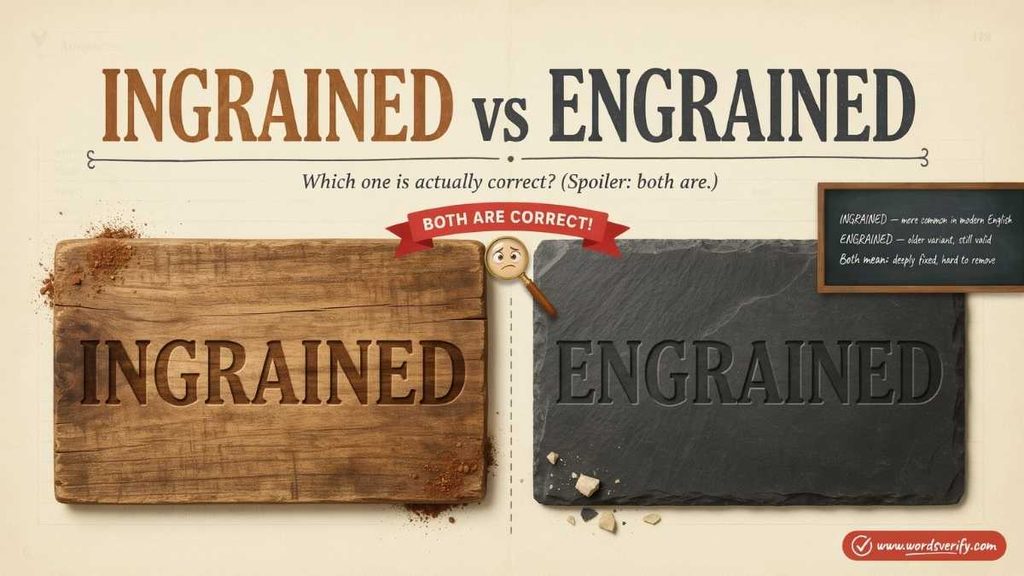
The spelling engrained isn’t simply a made-up word. It appears as a variant of ingrained. Still, ingrained is the more familiar and conventional choice in modern writing.
There is another word worth keeping separate: engraved.
“Engraved” refers to something physically carved or marked into a surface. “Ingrained” usually refers to something deeply established, although it can also describe dirt or a substance that has become deeply embedded in a material.
What Does Ingrained Mean?
The word ingrained describes something that has become deeply fixed over time.
It often refers to a habit, belief, attitude, or behavior that has been repeated or reinforced so much that changing it isn’t easy.
For example:
She has an ingrained habit of making a list before starting work.
The habit isn’t simply something she does occasionally. It has become part of her normal routine.
The same idea applies to beliefs and attitudes:
His belief in hard work was deeply ingrained from childhood.
Here, “ingrained” suggests that the belief became firmly established over a long period.
In simple terms, ingrained means deeply rooted or firmly established.
It can describe:
- Ingrained habits
- Ingrained beliefs
- Ingrained behavior
- Ingrained attitudes
- Ingrained ideas
- Ingrained patterns
- Ingrained knowledge
- Ingrained traditions
- Ingrained practices
- Ingrained values
The word can also describe something physical.
For example:
The dirt was ingrained in the carpet.
In this case, the dirt isn’t just sitting on top. It has worked deeply into the material.
That physical meaning helps explain the figurative one. A habit or belief can become so deeply established that removing it feels almost like trying to remove something stuck inside a material.
What Does Engrained Mean?
So, what does engrained mean?
In the context of habits, beliefs, and behaviors, it has essentially the same meaning as ingrained. It can describe something that has become deeply established or difficult to change.
For example:
The old tradition was deeply engrained in the community.
The meaning is clear. However, most modern writers would normally choose:
The old tradition was deeply ingrained in the community.
That’s the important distinction.
Engrained exists as a variant, but ingrained is the more familiar form.
This means that calling engrained completely wrong isn’t quite accurate. At the same time, using ingrained is usually the better choice if you’re deciding which spelling to put on the page.
Fix common more word mistakes in English
Hanukkah vs Chanukah Which one Is Correct?
Ingrained vs Engrained What’s the Difference?

The difference between ingrained and engrained is mainly about spelling and common usage rather than meaning.
Both forms can describe something that has become deeply established.
| Word | Meaning | General use |
|---|---|---|
| Ingrained | Deeply fixed or firmly established | Preferred modern form |
| Engrained | Variant of ingrained | Less common variant |
| Engraved | Carved or marked into a surface | Different word |
For most situations, the choice is simple: use ingrained.
For example:
Years of practice created an ingrained habit.
That’s the spelling most readers expect.
Why Is Ingrained Spelled With “In”?
This is where the word’s history helps.
The word ingrain is connected with the idea of something becoming deeply fixed or embedded. Over time, that physical idea developed into the figurative meaning we use today.
A habit can become deeply fixed in someone’s behavior.
A belief can become firmly established in someone’s thinking.
A tradition can become deeply rooted in a culture.
That’s why we have:
ingrain → ingrained
The spelling can seem strange because “engrained” looks as though it might be related to “engraved.” The two words, however, serve different purposes.
Compare these sentences:
- The artist engraved the initials on the ring.
- Her habit of checking every detail was ingrained.
The first sentence describes a physical mark. The second describes an established habit.
Ingrain Meaning and Definition
Understanding the verb ingrain makes the adjective ingrained easier to remember.
To ingrain something means to establish it firmly so that it becomes difficult to change.
For example:
Years of practice ingrained the technique in his memory.
The technique became so familiar that he could perform it almost automatically.
Another example is:
Her parents ingrained good study habits in her from an early age.
The habits became firmly established through repeated practice.
The relationship is straightforward:
| Verb | Adjective |
|---|---|
| ingrain | ingrained |
| establish deeply | deeply established |
| teach through repetition | firmly fixed |
So when you see ingrained, you can often think of it as the result of something being ingrained over time.
Engrain vs Ingrain
The same confusion appears with the verbs engrain and ingrain.
In modern standard English, ingrain is the form most writers should use.
For example:
Teachers try to ingrain good reading habits in their students.
After the habit becomes firmly established, you can say:
Good reading habits became ingrained in the students.
This gives you an easy pattern to remember:
Ingrain → ingrained
Keeping these two forms together will help prevent the spelling from becoming mixed up.
Fix common more word mistakes in English
Zeroes vs Zeros Which one is correct?
Ingrained vs Engrained Usage in Everyday Writing
You’ll often see ingrained in sentences about things that develop gradually.
Formal writing
In professional or formal writing, ingrained works well when describing established practices or attitudes.
Attention to detail is ingrained in the company’s work culture.
The organization has an ingrained habit of reviewing documents carefully.
Academic writing
Academic writers often use ingrained when discussing beliefs, assumptions, behaviors, and social patterns.
The study examined how ingrained beliefs influenced people’s decisions.
The researchers explored several ingrained patterns of behavior.
Everyday conversation
You don’t have to use the word only in formal writing.
Getting up early is ingrained in my routine now.
That reaction is so ingrained that I don’t even think about it.
Her love of books is deeply ingrained.
The word sounds natural because it describes something many people experience: repeated behavior eventually becomes automatic.
Fix common more word mistakes in English
Weeped vs Wept and which one is correct?
Ingrained in vs Into Which One Should You Use?
Both ingrained in and ingrained into can appear in English.
The choice depends on what you’re trying to emphasize.
Ingrained in usually describes the place or situation where something has become deeply established.
For example:
- The tradition is ingrained in the community.
- The habit is ingrained in her daily routine.
- The belief is ingrained in his mind.
- The practice is ingrained in the company’s culture.
Ingrained into can emphasize the process of something becoming part of a larger system.
For example:
The procedure was gradually ingrained into the company’s training program.
Both forms can work. In everyday writing, however, ingrained in often sounds more natural.
Ingrained in a Sentence Examples
If you’re learning how to use the word naturally, examples help more than a complicated rule.
Here are several examples:
- Her habit of reading before bed is deeply ingrained.
- The tradition is ingrained in the community.
- His attention to detail is ingrained in his working style.
- The belief became ingrained in their thinking.
- Years of practice created an ingrained response.
- Punctuality is ingrained in his daily routine.
- The team’s careful approach has become ingrained over time.
- The custom is deeply ingrained in local culture.
Notice that ingrained usually works with something that has developed over time.
A brand-new idea isn’t normally described as ingrained. It needs time, repetition, experience, or strong influence to become deeply established.
Fix common more word mistakes in English
Creeped vs Crept Which One Is Correct?
Ingrained vs Engrained in British English
People sometimes wonder whether British English prefers engrained.
The answer isn’t that simple.
Both forms can appear in British English. However, ingrained is the conventional form used in major contemporary dictionaries.
You don’t need to switch to engrained simply because you’re writing for a British audience.
For example:
The belief is deeply ingrained in British culture.
The same spelling works perfectly well in American English.
Ingrained vs Engrained in American English
American English also uses ingrained as the standard form.
You’ll see it in writing about:
- Habits
- Beliefs
- Attitudes
- Behaviors
- Traditions
- Work practices
- Cultural patterns
- Personal values
For American English writing, ingrained is the natural choice.
There’s no need to use engrained to make the sentence sound more American or more casual.
Why Do People Write “Engrained”?
The spelling makes sense at first glance.
English already has words such as:
- engrave
- engraved
- engraving
Because engrained looks similar, writers may naturally assume that it belongs to the same family.
The pronunciation doesn’t help either. Ingrained and engrained sound essentially the same in normal speech.
That creates a classic spelling problem: your ears can’t tell you which version to write.
When that happens, remember the word family:
ingrain → ingrained
If you’re talking about a carved mark, think:
engrave → engraved
That simple distinction solves the problem for most writers.
Fix common more word mistakes in English
Worshiped vs Worshipped Which one Is Correct?
Common Mistakes With Ingrained vs Engrained
Treating engrained as a completely wrong word
This is too absolute.
Engrained is recognized as a variant. The issue is not that nobody uses it. The issue is that ingrained is the more conventional choice.
Confusing ingrained with engraved
These words have different meanings.
The date was engraved on the watch.
Her habit of checking the time was ingrained.
One involves a physical mark. The other describes an established habit.
Assuming every habit is ingrained
The word suggests depth and persistence.
If someone tried a new routine yesterday, calling it an “ingrained habit” would sound exaggerated.
After months or years of repetition, the description makes much more sense.
Using ingrained when you mean simply “common”
Something can be common without being ingrained.
For example:
Coffee is common in many workplaces.
That doesn’t automatically mean coffee drinking is an ingrained habit.
The word ingrained adds the idea of something being deeply established.
Fix common more word mistakes in English
Judgement vs Judgment Which one Is Correct?
Examples of Ingrained Habits
An ingrained habit is a behavior that has become a natural or automatic part of someone’s routine.
Consider these examples:
- Checking your phone immediately after waking up.
- Making a daily to-do list without thinking about it.
- Checking every calculation twice.
- Putting your keys in the same place every day.
- Reading before going to sleep.
- Arriving early because punctuality has become part of your routine.
Some habits are useful. Others may be less helpful.
The word ingrained doesn’t tell you whether a habit is good or bad. It simply tells you that the pattern has become firmly established.
Ingrained Beliefs and Attitudes
Beliefs can become ingrained too.
Imagine someone grows up hearing the same idea repeatedly. Family members repeat it. Teachers reinforce it. Friends share it. Eventually, the person may accept the idea without consciously questioning it.
That belief may become ingrained.
For example:
The belief that success requires constant competition became deeply ingrained in him.
The sentence doesn’t say whether the belief is correct. It only explains that the belief has become deeply established.
The same applies to attitudes:
Her ingrained attitude toward punctuality made her arrive early for every meeting.
Again, ingrained describes the strength and persistence of the attitude.
Ingrained Culture and Traditions
The word can also describe groups and organizations.
A tradition may become ingrained in society after generations of repetition.
A workplace practice may become ingrained in a company’s culture after employees follow it for years.
For example:
Careful record-keeping became ingrained in the organization’s culture.
The practice is no longer just a rule written in a handbook. People have incorporated it into their normal behavior.
That’s one reason ingrained culture is such a useful phrase.
Ingrained Knowledge and Skills
Not everything ingrained involves beliefs or habits.
Skills and knowledge can also become deeply established.
A musician who has practiced a scale thousands of times may have certain movements so well learned that they feel automatic.
A professional editor may recognize common grammar problems almost instantly.
A trained athlete may respond to a situation without consciously thinking through every movement.
In each case, repeated practice creates a deeply established response.
You can describe this as ingrained knowledge, an ingrained skill, or an ingrained response, depending on the context.
Fix common more word mistakes in English
Wich vs Which what’s the difference?
Ingrained Synonyms
If you need another word for ingrained, several options may work.
However, don’t treat every synonym as an exact replacement. Each one emphasizes something slightly different.
| Word | What it emphasizes |
|---|---|
| Deep-rooted | Strong roots and long development |
| Deep-seated | A deeply held feeling or belief |
| Embedded | Something firmly placed within something else |
| Entrenched | Something strongly established and resistant to change |
| Established | Something accepted or firmly developed |
| Habitual | Something done regularly |
| Fixed | Something resistant to change |
| Persistent | Something that continues over time |
For example, deep-rooted tradition and ingrained tradition are close in meaning.
However, habitual behavior focuses more on repeated action, while ingrained behavior emphasizes how firmly that behavior has become established.
Choosing the right synonym depends on the sentence.
Is Ingrained a Word?
Yes. Ingrained is a well-established English word.
It works as an adjective and commonly describes habits, beliefs, attitudes, behaviors, practices, traditions, and patterns that have become deeply established.
For example:
Her ingrained habit of taking notes helped her stay organized.
There is no spelling controversy surrounding ingrained itself.
The confusion comes from the alternative spelling engrained.
Is Engrained a Word?
Yes. Engrained is a recognized variant of ingrained.
That doesn’t mean it is equally common or equally preferred in every context.
When you’re writing your own sentence, ingrained is usually the better option.
If you encounter engrained in a book, article, or online discussion, however, there’s no need to assume the writer invented the word. It has a recognized place in English usage.
Fix common more word mistakes in English
Curtesy vs Courtesy Which one Is Correct?
Is Engrained Accepted in Formal Writing?
It can appear in formal writing because it is a recognized variant. Still, ingrained is the more familiar form and is generally the better choice when you want conventional modern English.
For example:
The practice became deeply ingrained in the organization.
This sounds natural and leaves little room for a reader to question the spelling.
Using engrained isn’t necessarily incomprehensible or meaningless. It simply isn’t the form most writers need when they have the choice.
A Simple Memory Trick
Here’s an easy way to remember the difference.
When you mean deeply established, think:
IN + GRAIN = INGRAINED
When you mean carved into something, think:
ENGRAVE = ENGRAVED
So:
- A habit becomes ingrained.
- A belief becomes ingrained.
- A tradition becomes ingrained.
- A name becomes engraved.
- A message can be engraved on metal.
- Dirt can become ingrained in fabric.
Once you separate those ideas, the spelling becomes much easier.
Fix common more word mistakes in English
Indexes vs Indices which one is correct?
Practice Session Ingrained vs Engrained
Fill in each blank with the correct word: ingrained vs engrained.
Fill in the Blanks
- Her love of reading was deeply ______ in her personality.
- Which spelling is standard: “ingrained” or “______”?
- Good manners were ______ in him from childhood.
- The habit had become so ______ that he rarely noticed he was doing it.
- His belief in hard work was deeply ______.
- The tradition is firmly ______ in the local culture.
- Years of practice had ______ the routine into her daily life.
- Respect for others was ______ in her character.
- The fear of failure was deeply ______ in his thinking.
- Her childhood values remained deeply ______ in her.
- The behavior became ______ through years of repetition.
- His attitude toward work was deeply ______.
- The custom is ______ in the community and difficult to change.
- Patience had become an ______ part of her personality.
- The belief was so deeply ______ that changing it took years.
- His daily routine was firmly ______ after years of repetition.
- The company’s safety practices are deeply ______ in its culture.
- Her determination was ______ in her from an early age.
- The habit became deeply ______ over time.
- His strong sense of responsibility was ______ in his upbringing.
- In formal writing, “______” is the preferred spelling.
- The idea was deeply ______ in the minds of the students.
- Years of experience had ______ the practice into his work habits.
- The family’s values were deeply ______ in their way of life.
- When you mean “deeply established,” choose ______ rather than “engrained.”
Answers
- ingrained
- engrained
- ingrained
- ingrained
- ingrained
- ingrained
- ingrained
- ingrained
- ingrained
- ingrained
- ingrained
- ingrained
- ingrained
- ingrained
- ingrained
- ingrained
- ingrained
- ingrained
- ingrained
- ingrained
- ingrained
- ingrained
- ingrained
- ingrained
- ingrained
Here’s a trusted source for clear more words Comparison:
FAQs
What does “ingrained” mean?
“Ingrained” means deeply fixed or firmly established, especially in your mind, behavior, beliefs, or character. For example, if checking your work has become an ingrained habit, you may do it almost automatically.
Is “ingrained” vs “engrained” correct?
“Ingrained” is the standard spelling. “Engrained” does appear in some writing, but it’s generally treated as a nonstandard variant. In formal or careful writing, choose “ingrained.”
What is the difference between “ingrained” and “engraved”?
“Ingrained” usually describes something that has become deeply established, such as a habit, belief, attitude, or behavior. “Engraved” literally means carved or marked onto a surface. It can also be used figuratively for something that leaves a lasting impression.
What does “ingrained in my mind” mean?
“Ingrained in my mind” means that an idea, belief, memory, or thought has become deeply fixed in your mind. It suggests that changing or forgetting it may be difficult.
Should I say “ingrained in my head” or “engraved in my head”?
Both can work, but they create different meanings. “Ingrained in my head” suggests that something has become deeply established in your thinking. “Engraved in my head” is more figurative and emphasizes a powerful or lasting memory.
What does “ingrained in me” mean?
“Ingrained in me” means that something has become a deeply established part of your personality, behavior, beliefs, or way of thinking. For example, “Respect for others was ingrained in me from childhood.”
What does “deeply ingrained” mean?
“Deeply ingrained” means firmly established and difficult to change or remove. It commonly describes habits, beliefs, attitudes, traditions, and behaviors.
What are ingrained habits?
Ingrained habits are behaviors that have become deeply established through repetition. You may perform them without consciously thinking about them. For example, “Brushing my teeth before bed is an ingrained habit.”
Is “ingrained” the same as “embedded”?
Not always. The two words can overlap, but “ingrained” often describes something firmly established in a person’s mind, behavior, or character. “Embedded” can describe something firmly placed within another thing, as well as ideas or features that have become an integral part of something.
What is the difference between “ingrained” and “entrenched”?
Both words describe something firmly established, but they aren’t used in exactly the same way. “Ingrained” commonly refers to habits, beliefs, attitudes, and characteristics. “Entrenched” often describes something that has become firmly established and resistant to change, such as a system, practice, or viewpoint.
What does “ingrain” mean?
“To ingrain” means to establish something so deeply that it becomes difficult to change or remove. For example, “Years of practice ingrained good study habits.”
How do you use “ingrained” in a sentence?
“Ingrained” can describe something deeply established. Here are a few examples:
- “Her ingrained habits were difficult to break.”
- “The tradition is deeply ingrained in the community.”
- “Patience became an ingrained part of his personality.”
What does “ingrained in my memory” mean?
“Ingrained in my memory” means that a memory has become deeply fixed in your mind. It suggests that the memory is strong and not easily forgotten.
Can you say “engraved in my brain”?
Yes. “Engraved in my brain” is a figurative expression meaning that something is remembered very clearly or has made a powerful impression on you. Nothing is literally being carved into your brain.
What does “engraved in my brain” mean?
It means that something has left such a strong impression that you remember it vividly. For example, “That song is engraved in my brain” suggests that you can’t seem to forget it.
What does “engraved” mean in simple terms?
“Engraved” means carved, cut, or permanently marked onto a surface. Figuratively, it can describe something that has made a lasting impression on someone’s mind or memory.
Should I say “ingrained in my memory” or “engraved in my memory”?
Both are possible, but they emphasize different ideas. “Ingrained in my memory” focuses on a memory being deeply established, while “engraved in my memory” creates the image of something permanently marked in your mind.
What are some synonyms for “ingrained”?
Depending on the context, useful synonyms include:
- deep-rooted
- deep-seated
- established
- fixed
- embedded
- entrenched
- habitual
- firmly established
The best synonym depends on what you are describing.
What is another word for “deeply ingrained”?
You could use “deep-rooted,” “deep-seated,” “entrenched,” “firmly established,” or “embedded.” For example, “a deeply ingrained belief” could become “a deep-seated belief.”
What does “ingrained in you” mean?
It means that something has become a natural and deeply established part of your thoughts, behavior, or character. It often suggests that the person has absorbed something over a long period.
Which is correct: “deeply ingrained” or “deeply engrained”?
“Deeply ingrained” is the standard form. If you’re writing an essay, article, email, or other formal text, “deeply ingrained” is the safer choice.
Is “ingrained” used in Australian English?
Yes. “Ingrained” is the standard spelling in Australian English, just as it is in other major varieties of English. “Engrained” may appear occasionally, but “ingrained” is the conventional choice.
What is the difference between “ingrained” and “engraved” when talking about memory?
“Ingrained” suggests that something has become deeply established in your mind. “Engraved” suggests that something has left a particularly strong and lasting impression. The two can overlap, but the imagery is different.
Can “ingrained” describe a person?
Usually, “ingrained” describes a quality, habit, belief, or behavior associated with a person rather than the person themselves. Natural examples include “an ingrained habit,” “an ingrained belief,” and “an ingrained tendency.”
Can “ingrained” describe a belief?
Yes. For example, “The belief was deeply ingrained in her from childhood.” This means the belief became firmly established over time.
What is the opposite of “ingrained”?
There isn’t one exact opposite in every context. Depending on the sentence, possible opposites include “temporary,” “new,” “unfamiliar,” “unestablished,” or “changeable.” The appropriate opposite depends on what “ingrained” describes.
Fix common more word mistakes in English
Learnt vs Learned What’s the Difference?
conclusion
The ingrained vs engrained debate may seem like a tiny spelling issue, but English has a remarkable talent for turning tiny issues into surprisingly confusing ones. The good news is that the answer is simple: ingrained is the standard spelling when you mean something deeply fixed, firmly established, or difficult to change. Engrained does appear as a variant, but ingrained is the safer choice in careful modern writing.
To remember it, think of ingrained as something that has settled deeply into a habit, belief, attitude, or behavior. Just don’t mix it up with engraved, which usually describes something physically carved or etched onto a surface.
When in doubt, choose ingrained. Your sentence will be clearer, your spelling will stay on track, and one more English mystery can finally be put to rest.

Lisa AJS is an experienced blogger and language enthusiast at Words Verify, dedicated to making grammar simple, practical, and enjoyable. She writes engaging content on commonly confused words, grammar mistakes, word meanings, and everyday language challenges.