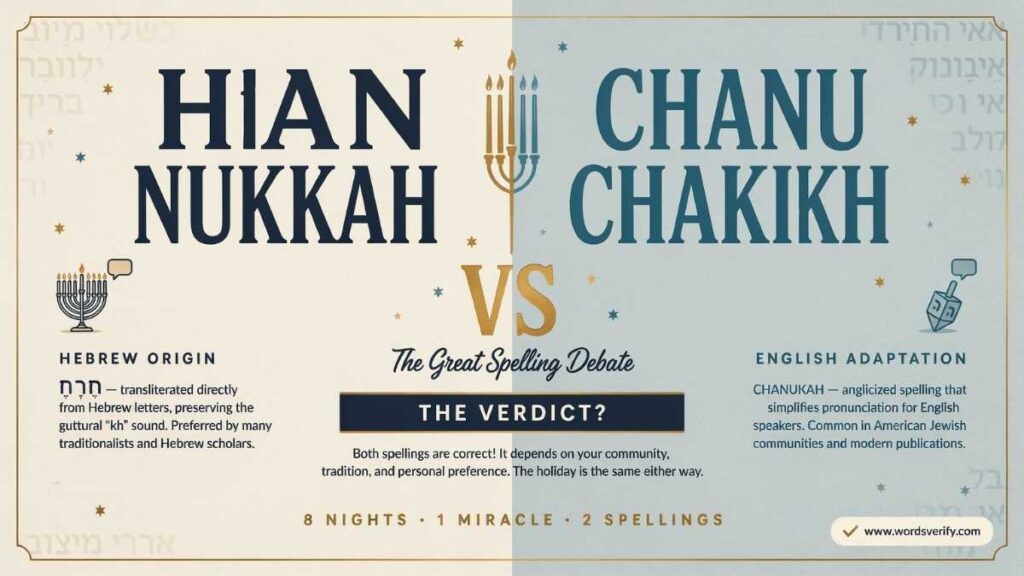
Ever stared at a holiday greeting and wondered, “Wait, is it Hanukkah vs Chanukah?” You’re not alone. This small spelling puzzle has confused plenty of careful writers, and the answer isn’t as simple as picking one form and declaring the other wrong. In fact, Hanukkah and Chanukah are both accepted English spellings for the same Jewish holiday. The difference comes from transliterating the Hebrew word חנוכה into English, where some Hebrew sounds don’t have exact English equivalents. So, before you reach for the eraser, take a breath. This guide explains the spelling difference, pronunciation, meaning, history, and common mistakes, helping you write the word naturally and confidently.
quick answer
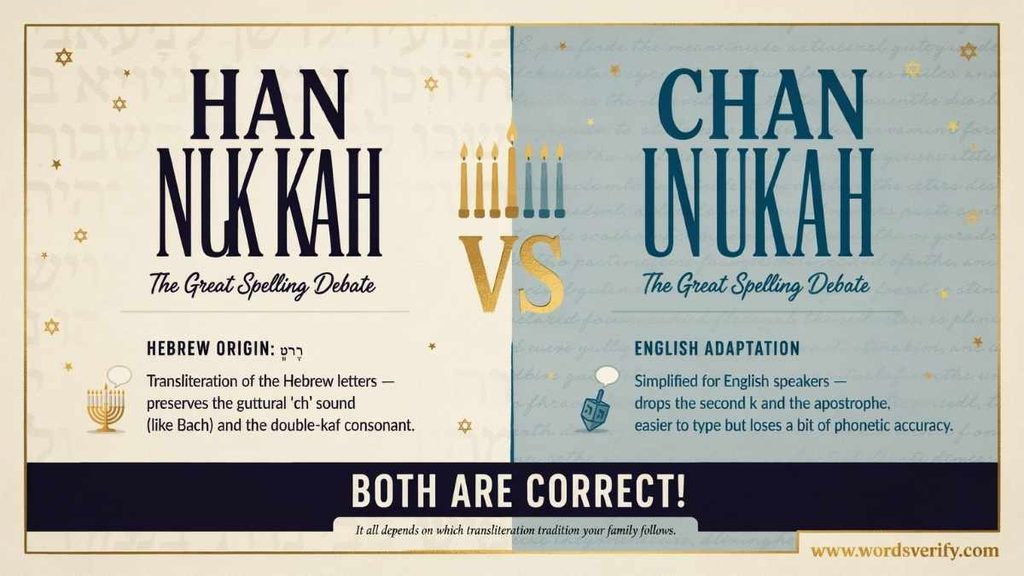
Both Hanukkah vs Chanukah are correct English spellings.
They refer to the same eight-day Jewish holiday, which commemorates the rededication of the Temple in Jerusalem following the Maccabean revolt.
The Hebrew spelling is:
חנוכה
When that Hebrew word moves into English, writers have to decide how to represent its sounds using the Latin alphabet. That’s where the different spellings come from.
| Spelling | Correct? | Refers to |
|---|---|---|
| Hanukkah | Yes | The same Jewish holiday |
| Chanukah | Yes | The same Jewish holiday |
| Hanukka | Yes, as a variant | The same holiday |
| Chanukka | Yes, as a variant | The same holiday |
| Hanukah | Used as a variant | The same holiday |
So if you’re asking, “Is Hanukkah or Chanukah correct?” the answer isn’t that one spelling is right and the other is wrong.
They’re different English ways of writing the same Hebrew name.
For ordinary American English, Hanukkah is a clear and widely recognized choice. However, if a person, family, organization, or publication prefers Chanukah, that spelling is perfectly legitimate too.
Learn the difference between tricky more English words
Creeped vs Crept Which One Is Correct?
What Is the Difference Between Hanukkah vs Chanukah?
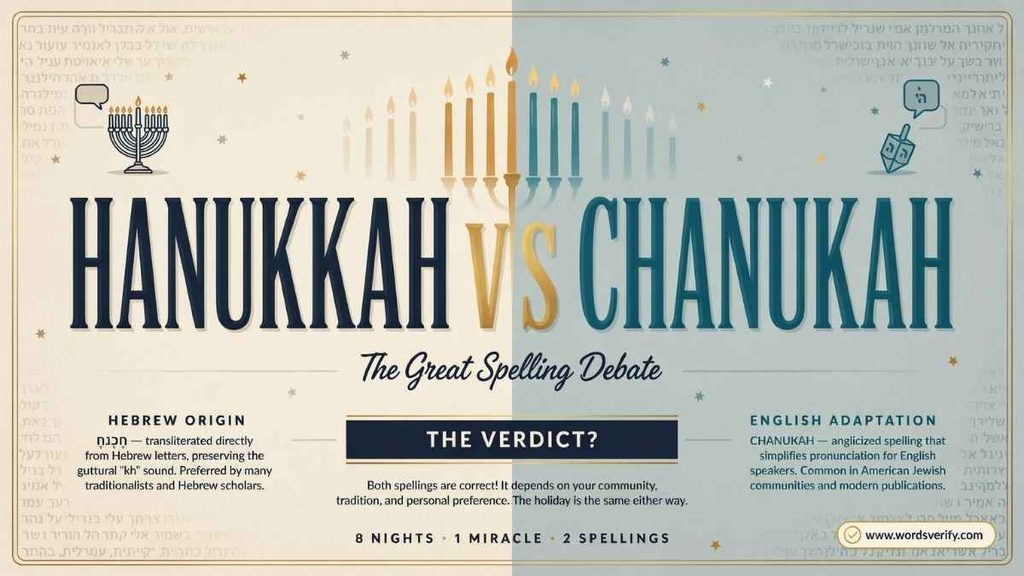
The main difference is transliteration.
Transliteration means representing a word from one writing system in another. It isn’t quite the same as translation.
For example, when a Hebrew word is written with English letters, the goal isn’t necessarily to find an English word with the same meaning. Instead, the writer is trying to represent the original Hebrew letters or sounds.
That’s what happens with חנוכה.
The Hebrew alphabet contains sounds that don’t have exact equivalents in English. One of the most important examples is the first letter:
ח
This letter is known as het or ḥet.
Its traditional sound is a guttural consonant. English doesn’t have a single letter that perfectly represents it.
As a result, different transliteration choices developed.
Some writers use H:
Hanukkah
Others use Ch:
Chanukah
You may also encounter Kh or the more technical Ḥ in specialized transliteration systems.
The holiday hasn’t changed. Only the way its Hebrew name is represented in English has changed.
What Does Hanukkah Mean?
The word Hanukkah comes from Hebrew and is commonly understood to mean dedication or rededication.
That meaning connects directly to the history of the holiday.
Hanukkah commemorates the rededication of the ancient Temple in Jerusalem after Jewish rebels known as the Maccabees regained control of it during the second century BCE.
The name therefore carries more meaning than simply identifying a holiday on the calendar.
It points back to an important event in Jewish history and to the restoration of Jewish religious practice at the Temple.
What Does Chanukah Mean in Hebrew?
Chanukah has the same meaning as Hanukkah because both spellings represent the same Hebrew word:
חנוכה
In English, it is commonly translated as “dedication” or “rededication.”
So the questions “What does Hanukkah mean?” and “What does Chanukah mean?” have essentially the same answer.
The spelling changes. The meaning doesn’t.
Why Is Hanukkah Also Spelled Chanukah?
The biggest reason is the Hebrew letter ח.
This letter doesn’t have an exact equivalent in English. Its traditional pronunciation involves a guttural sound made toward the back of the mouth and throat.
For some English speakers, a rough comparison is the sound found in the Scottish word “loch.” The sounds aren’t identical, but the comparison can help explain why simply using the English letter H doesn’t capture everything about the original pronunciation.
One transliteration system may choose H because it’s easier for English speakers.
Another may choose Ch to show that the original Hebrew contains a sound that differs from an ordinary English H.
That’s why both Hanukkah and Chanukah developed.
The question “Why is Hanukkah spelled Chanukah?” therefore has a linguistic answer. Chanukah isn’t a misspelling of Hanukkah. It reflects a different way of representing the Hebrew word.
Learn the difference between tricky more English words
Worshiped vs Worshipped Which one Is Correct?
Hanukkah vs Chanukah Pronunciation
Spelling and pronunciation can get especially confusing here.
Many English speakers pronounce Hanukkah approximately as “HAH-nuh-kuh.” Others use a pronunciation that preserves more of the original Hebrew guttural sound.
The pronunciation of Chanukah can vary in the same way.
The Ch at the beginning isn’t supposed to sound exactly like the Ch in words such as “chair” or “chocolate.”
Instead, it represents the Hebrew letter ח.
Jewish communities also have different pronunciation traditions. Ashkenazi and Israeli Hebrew pronunciation, for example, don’t always sound identical.
So there’s no need to assume that everyone who writes Chanukah will pronounce the word in precisely the same way.
A simple comparison
| Spelling | Common English pronunciation | Hebrew-oriented pronunciation |
|---|---|---|
| Hanukkah | HAH-nuh-kuh | A pronunciation with a stronger guttural initial sound |
| Chanukah | HAH-nuh-kuh or a guttural initial sound | A pronunciation closer to the Hebrew consonant |
If you’re wondering how to pronounce Hanukkah or how to pronounce Chanukah, listening to speakers of Hebrew or Jewish communities that use the word regularly can be more useful than relying on the English spelling alone.
Learn the difference between tricky more English words
Judgement vs Judgment Which one Is Correct?
Why Does Hanukkah Have Two K’s?
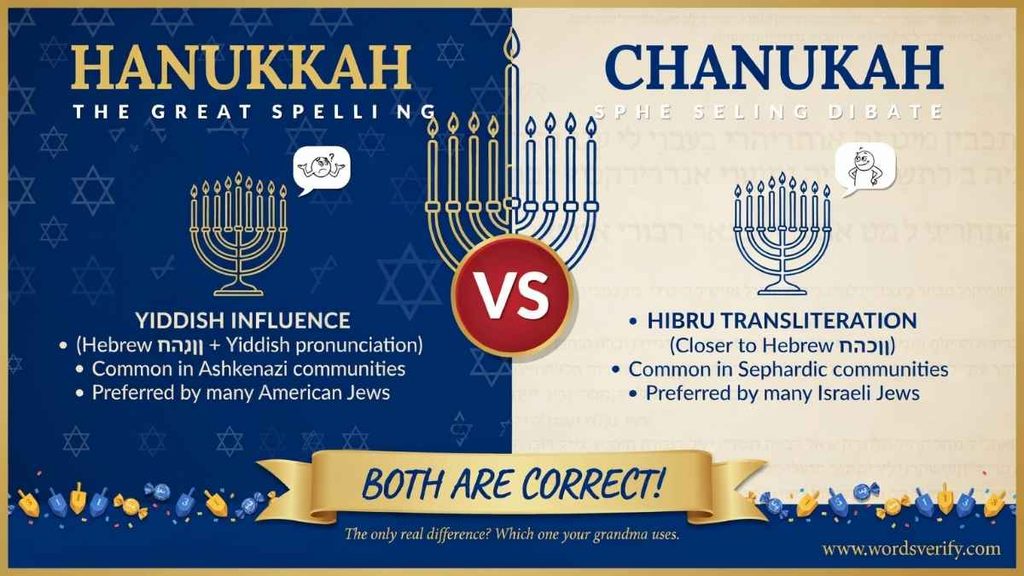
The double K in Hanukkah is another interesting part of the spelling.
The Hebrew word contains the letter kaf, written here as כ. In this particular word, the letter carries a dagesh, a mark that affects its pronunciation and traditionally indicates doubling.
Many English transliterations represent that feature by writing:
kk
That’s why Hanukkah is commonly spelled with two K’s.
You may still encounter Hanukah with one K. Transliteration isn’t governed by one universal English spelling system, so variations exist.
For someone simply trying to remember the common spelling, though, this is useful:
Hanukkah = one N, two K’s, final H.
Hanukkah vs Chanukah in Hebrew
Neither Hanukkah nor Chanukah is the actual Hebrew spelling.
The Hebrew word is:
חנוכה
Both English forms are transliterations.
This distinction matters because transliteration doesn’t always produce one fixed English result.
Consider the Hebrew letter ח again. A technical transliteration may represent it as ḥ. Another system might use ch. A more simplified English spelling may use h.
That gives us forms such as:
- Hanukkah
- Chanukah
- Hanukka
- Chanukka
- Hanukah
They’re all attempts to represent the same Hebrew word.
Hanukkah Spelling Variations Explained
Many people assume that one spelling must be the original and everything else must have appeared because people made mistakes.
That’s not how transliteration works.
Different spelling systems can make different choices about how closely to represent the original language.
Some prioritize pronunciation.
Others focus more closely on the original Hebrew letters.
Still others favor a spelling that English readers will recognize and pronounce easily.
This is why the English spelling of Hanukkah has never settled into one universal form.
The same thing happens with many words that move between languages. English speakers often develop more than one accepted spelling when the original language contains sounds that English doesn’t represent neatly.
Learn the difference between tricky more English words
Wich vs Which what’s the difference?
Is Hanukkah vs Chanukah Correct in American English?
For general American English, Hanukkah is a very familiar choice.
That doesn’t make Chanukah incorrect.
If you’re writing an article, invitation, school paper, greeting card, or general piece of correspondence, Hanukkah is a safe and recognizable form.
However, context matters.
If you’re writing for a Jewish organization that consistently uses Chanukah, use Chanukah.
If a person spells the holiday Chanukah in their own name, invitation, or message, there’s no reason to change it.
The most important thing is consistency.
For example, this looks awkward:
“The Hanukkah celebration begins Friday. During Chanukah, families light candles.”
There’s nothing grammatically wrong with the sentence. However, switching between spellings without a reason makes the writing look careless.
A cleaner version would be:
“The Hanukkah celebration begins Friday. During Hanukkah, families light candles.”
Or:
“The Chanukah celebration begins Friday. During Chanukah, families light candles.”
Both work.
Hanukkah History Why Is Hanukkah Celebrated?
The history of Hanukkah goes back more than 2,000 years.
During the second century BCE, Judea was under the control of the Seleucid Empire. Tensions developed over political control and Jewish religious practice.
A Jewish revolt eventually broke out under the leadership of the Maccabees.
After the Maccabees regained Jerusalem, they reclaimed and rededicated the Temple.
That rededication is at the heart of Hanukkah.
The holiday therefore remembers a period of conflict, religious struggle, restoration, and renewed Jewish worship.
The story of the oil
The familiar story of the oil comes from later rabbinic tradition.
According to the traditional account, there was only enough ritually pure oil to keep the Temple lamp burning for one day. The oil nevertheless lasted for eight days.
That story is closely connected with the eight-day celebration and the custom of lighting candles.
It also explains why oil plays such an important role in Hanukkah traditions and food.
It’s useful to distinguish between the historical story of the Maccabean revolt and the later rabbinic tradition about the oil. Both became important parts of how Hanukkah is understood and observed.
Learn the difference between tricky more English words
Curtesy vs Courtesy Which one Is Correct?
Why Is Hanukkah Called the Festival of Lights?
Hanukkah is often called the Festival of Lights because candle lighting is central to the holiday.
Each night, an additional candle is lit.
On the first night, one candle is lit.
On the second night, two are lit.
The pattern continues until eight candles are lit on the eighth night.
A ninth light, called the shamash, is used to light the other candles.
This gradual increase in light gives Hanukkah one of its most recognizable traditions.
The phrase “Festival of Lights” isn’t simply a modern nickname created because candles look attractive during winter. It has historical roots in Jewish writing and tradition.
Hanukkah Menorah What Does It Mean?
The Hanukkah menorah is one of the best-known symbols of the holiday.
Technically, the nine-branched lamp used for Hanukkah is often called a hanukkiah.
It contains:
- Eight candle holders representing the eight nights.
- One additional holder for the shamash.
- The shamash is used to light the other candles.
The word menorah, however, is commonly used in everyday English when people talk about the Hanukkah lamp.
There’s an important historical distinction.
The menorah used in the ancient Temple had seven branches.
The Hanukkah lamp has nine places.
That difference is easy to miss, especially because both objects are commonly associated with Jewish history and tradition.
Hanukkah Traditions and Celebration
Hanukkah traditions vary from family to family.
Not every Jewish household celebrates in exactly the same way, and some customs are more common in certain communities than others.
Common traditions include:
- Lighting the Hanukkah candles.
- Reciting blessings during candle lighting.
- Playing dreidel.
- Eating foods prepared with oil.
- Eating latkes.
- Eating sufganiyot.
- Singing Hanukkah songs.
- Giving Hanukkah gelt.
- Exchanging gifts in some families.
- Spending time with family and friends.
The role of gifts, in particular, varies widely.
Some families exchange gifts on each night. Others give one larger gift. Some don’t make gift-giving a major part of the holiday at all.
That’s worth remembering when discussing Jewish traditions. There isn’t one universal Hanukkah celebration followed by every Jewish family.
Hanukkah Candles and Menorah Lighting
Candle lighting takes place each night of Hanukkah.
The number of candles increases as the holiday progresses.
| Night | Hanukkah candles |
|---|---|
| First | 1 |
| Second | 2 |
| Third | 3 |
| Fourth | 4 |
| Fifth | 5 |
| Sixth | 6 |
| Seventh | 7 |
| Eighth | 8 |
The shamash is separate from these eight holiday lights.
One traditional practice is to place the candles in the hanukkiah from right to left while lighting them from left to right. This arrangement emphasizes the newest candle each night.
Different Jewish communities can have variations in specific practices, so the exact details may depend on tradition.
Hanukkah Blessings and Prayer
The candle lighting is accompanied by blessings.
On the first night, three blessings are traditionally recited.
On the following nights, two are recited.
The third blessing is known as Shehecheyanu. It expresses gratitude for reaching a special occasion.
Another prayer associated with Hanukkah is Al Hanisim, which is added to certain Jewish prayers during the holiday.
These prayers connect the candle-lighting ritual with the historical and religious meaning of Hanukkah.
The celebration isn’t simply about lighting candles. The ritual recalls the history and traditions connected with the holiday.
Hanukkah Food and the Connection to Oil
Food is another part of the celebration that connects directly with the traditional story of Hanukkah.
Foods cooked in oil are especially associated with the holiday.
Two familiar examples are:
- Latkes, which are commonly made from potatoes and fried in oil.
- Sufganiyot, which are fried doughnuts often filled with jelly or another sweet filling.
The use of oil serves as a reminder of the traditional story about the Temple oil.
Of course, recipes vary from family to family and from one Jewish community to another.
Learn the difference between tricky more English words
Indexes vs Indices which one is correct?
Hanukkah 2026 When Does It Begin?
Hanukkah in 2026 begins at sundown on Friday, December 4, 2026, and ends at nightfall on Saturday, December 12, 2026.
Because Jewish holidays begin at sundown, the first night starts on the evening of December 4 rather than at midnight when the date changes.
| Hanukkah 2026 | Date |
|---|---|
| First night | December 4 |
| Second night | December 5 |
| Third night | December 6 |
| Fourth night | December 7 |
| Fifth night | December 8 |
| Sixth night | December 9 |
| Seventh night | December 10 |
| Eighth night | December 11 |
| End of Hanukkah | December 12 |
The Jewish calendar is lunar-solar, so Hanukkah doesn’t fall on the same Gregorian dates every year.
That’s why its dates move around the December calendar.
Hanukkah vs Christmas Are They the Same?
Hanukkah and Christmas are different religious holidays.
They sometimes occur around the same time of year, which is one reason people often compare them.
Hanukkah is a Jewish holiday connected to the Maccabean revolt, the rededication of the Temple, and the traditions that developed around that event.
Christmas is a Christian holiday associated with the birth of Jesus.
The two holidays have different histories, religious meanings, and traditions.
It’s also worth noting that Hanukkah isn’t one of the most important holidays in Judaism in the way that its visibility in American culture might suggest. Its popularity in the United States has partly been shaped by its proximity to Christmas and the broader cultural attention given to December holidays.
Learn the difference between tricky more English words
Learnt vs Learned What’s the Difference?
Common Hanukkah Spelling Mistakes
Once the reason for the different spellings becomes clear, most mistakes are easy to avoid.
Writing “Hannukah”
A common mistake is adding an extra N.
The familiar spelling is:
Hanukkah
Not:
Hannukah
Assuming Chanukah is wrong
Chanukah is an established spelling.
It isn’t simply a typo for Hanukkah.
Pronouncing “Ch” like “chair”
The Ch in Chanukah represents the Hebrew letter ח.
It doesn’t necessarily have the same sound as the English Ch in “chair.”
Switching spellings without reason
Using Hanukkah in one paragraph and Chanukah in the next can make your writing look inconsistent.
Pick the spelling that suits your context and stay with it.
Assuming there can only be one correct transliteration
This is probably the biggest misunderstanding.
Transliteration doesn’t always produce one fixed English spelling. Different systems can produce different forms.
Learn the difference between tricky more English words
Canceled vs Cancelled Which one Is Correct?
Hanukkah vs Chanukah in Everyday Writing
Choosing between the two spellings becomes much easier when you think about your audience.
In an email
“Happy Hanukkah to you and your family!”
That’s simple and natural.
In a school assignment
If no specific style has been requested, Hanukkah is a familiar choice for American readers.
In a holiday invitation
Follow the spelling preferred by the family, synagogue, school, or organization hosting the event.
In a news article
A publication should follow its own style guide and remain consistent throughout the article.
On social media
Either established spelling can work. If you’re promoting an event, match the spelling used by the organization hosting it.
A Simple Way to Remember Hanukkah vs Chanukah
Here’s the easiest way to keep the issue straight:
Hanukkah and Chanukah are not two different words with two different meanings. They’re two English spellings of the same Hebrew word.
Remember the Hebrew:
חנוכה
Then remember that English has several ways of representing the sounds.
If you prefer the common American English form, use:
Hanukkah
If your audience or community uses:
Chanukah
use that instead.
There’s no need to “correct” someone simply because they chose the other accepted spelling.
Learn the difference between tricky more English words
Finaly vs Finally Which one Is Correct?
Practice Session Hanukkah vs Chanukah
Test your understanding of Hanukkah vs Chanukah by completing each sentence with the correct word or phrase
- Writers commonly use both __________ and Chanukah when they write the name of the Jewish holiday in English.
- Jewish writers spell the holiday in Hebrew as __________.
- Many people call Hanukkah the Festival of __________.
- The Hebrew word for Hanukkah connects with the idea of __________ or rededication.
- The Hebrew letter ח gives Chanukah its initial __________ sound.
- Writers use different forms of __________ when they represent Hebrew words with English letters.
- Jewish families celebrate Hanukkah for __________ nights.
- A Hanukkah menorah, or hanukkiah, holds __________ places for lights.
- The __________ serves as the helper candle and lights the other Hanukkah candles.
- Hanukkah traditions often include foods that people cook in __________.
- A traditional menorah has __________ branches.
- The Maccabees fought to reclaim and rededicate the Second __________ in Jerusalem.
- The story of the Maccabees plays a central role in the history of __________.
- English speakers widely recognize the spelling __________.
- Many writers use __________ to represent the Hebrew ח sound at the beginning of the word.
- Hanukkah, Chanukah, Hanukah, and Chanukka represent different English __________ of the same Hebrew word.
- The spelling __________ contains two Ks.
- The spelling __________ begins with “Ch.”
- “Hanukkah Sameach” means “Happy __________.”
- Hanukkah and Christmas celebrate __________ religious traditions.
- The original word חנוכה comes from the __________ language.
- Families light one additional Hanukkah candle each night until they light __________ holiday candles on the final night.
- Writers often spell “Hannukah” incorrectly because they add an unnecessary __________.
- When you choose between Hanukkah and Chanukah, consider your audience, context, and personal __________.
- Transliteration allows English speakers to represent Hebrew words using English __________.
Answers
- Hanukkah
- חנוכה
- Lights
- dedication
- “Ch”
- transliteration
- eight
- nine
- shamash
- oil
- seven
- Temple
- Hanukkah
- Hanukkah
- Chanukah
- transliterations
- Hanukkah
- Chanukah
- Hanukkah
- different
- Hebrew
- eight
- “n”
- preference
- letters
Here’s a trusted source for clear more words Comparison:
FAQs
Is Hanukkah or Chanukah more common in English?
Hanukkah is generally the more familiar spelling in modern English, especially in American English. Chanukah is also widely used and is not considered a spelling error.
Why does Chanukah start with “Ch”?
The “Ch” represents the Hebrew letter ח, called chet, het, or ḥet. It produces a sound that doesn’t have an exact equivalent in standard English, so “Ch” is one way to represent it when the Hebrew word is written with English letters.
Why does Hanukkah have two Ks?
The double “k” in Hanukkah helps represent the Hebrew pronunciation and the structure of the original Hebrew word. English transliteration systems differ, which is why you may also see Hanukah with only one “k.”
Are Hanukkah and Chanukah pronounced differently?
Usually, no major difference exists in how English speakers pronounce Hanukkah and Chanukah. The spelling mainly reflects different approaches to representing the Hebrew sounds in English.
How do you spell Hanukkah correctly?
Hanukkah is a standard and widely accepted English spelling. Chanukah, Hanukah, and Chanukka are also recognized variants, so the context and preferred usage can determine which form you choose.
Is Chanukah an older spelling than Hanukkah?
Not necessarily. Both forms come from transliterations of the Hebrew word חנוכה. Different spelling systems and pronunciation traditions have produced multiple English forms rather than one simple progression from an “old” spelling to a “new” one.
What does Hanukkah mean in Hebrew?
Hanukkah comes from a Hebrew word associated with “dedication.” The name refers to the rededication of the Second Temple in Jerusalem following the Maccabean revolt.
What is the Hebrew spelling of Hanukkah?
The Hebrew spelling is חנוכה. The English forms Hanukkah and Chanukah are transliterations, meaning they use English letters to represent the Hebrew word.
Why are there so many spellings of Hanukkah?
Hebrew and English use different writing systems, and Hebrew sounds don’t always have one exact English equivalent. As a result, different transliteration systems have produced forms such as Hanukkah, Chanukah, Hanukah, and Chanukka.
Is Hanukkah a religious holiday or a cultural celebration?
Hanukkah is a Jewish religious holiday, but it is also observed through cultural and family traditions. Customs can vary among Jewish communities and families.
What is the difference between a menorah and a Hanukkah menorah?
A traditional menorah has seven branches, while the Hanukkah lamp, commonly called a hanukkiah, has nine places for lights. Eight represent the eight nights of Hanukkah, and the ninth holds the shamash, the helper candle used to light the others.
Why does Hanukkah last eight nights?
Hanukkah lasts eight nights in remembrance of the traditional account that a small amount of consecrated oil in the Temple lasted for eight days. The eight-night observance is reflected in the nightly lighting of the Hanukkah candles.
What is the proper greeting for Hanukkah?
Common greetings include “Happy Hanukkah” and “Hanukkah Sameach,” which means “Happy Hanukkah” in Hebrew. “Chag Sameach,” meaning “Happy Holiday,” is another traditional Jewish greeting that can be used during the holiday.
Can you write Chanukah instead of Hanukkah?
Yes. Chanukah is an accepted English spelling of the same Jewish holiday. The choice often depends on personal preference, community tradition, transliteration style, or the publication being followed.
What are common Hanukkah spelling mistakes?
Common errors include forms such as “Hannukah,” “Hanukahh,” or other spellings that add or remove letters inconsistently. The safest approach is to use a recognized form such as Hanukkah or Chanukah and remain consistent throughout your writing.
What is the Festival of Lights?
The Festival of Lights is a common English name for Hanukkah. It refers to the central tradition of lighting the Hanukkah lights over the eight nights of the holiday.
What foods are traditionally eaten during Hanukkah?
Foods cooked in oil are especially associated with Hanukkah because of the holiday’s connection with the traditional story of the Temple oil. Latkes and sufganiyot are two well-known examples.
Why do people give gifts during Hanukkah?
Gift-giving is a popular modern Hanukkah custom, particularly in some families and communities. Traditions vary, and gifts aren’t the central religious requirement of the holiday.
What is the shamash candle used for?
The shamash is the “helper” or “servant” light on a Hanukkah menorah. It is used to light the other Hanukkah candles rather than being counted as one of the eight holiday lights.
Is Hanukkah the same holiday as Christmas?
No. Hanukkah and Christmas are different religious holidays with different histories, traditions, and meanings. Hanukkah is a Jewish holiday, while Christmas is a Christian holiday commemorating the birth of Jesus.
Why is Hanukkah sometimes spelled Chanukah?
Chanukah is a transliteration that attempts to represent the initial Hebrew ח sound more closely. Since English doesn’t have an exact equivalent for that sound, “Ch” is commonly used to approximate it.
Which spelling should I use Hanukkah vs Chanukah?
Either is acceptable. If you’re writing for a general English-speaking audience, Hanukkah is a familiar choice. If a person, organization, publication, or community prefers Chanukah, it’s appropriate to follow that preference.
Learn the difference between tricky more English words
Aide vs Aid which one is correct?
Conclusion
So, is it Hanukkah vs Chanukah? Fortunately, this isn’t a spelling battle where one word walks away as the winner. Both Hanukkah vs Chanukah are accepted English spellings for the same Jewish holiday.
The reason for the difference goes back to the Hebrew word חנוכה and the challenges of writing Hebrew sounds with English letters. Since some Hebrew sounds don’t have an exact English equivalent, different transliterations developed over time. That’s also why you may come across forms such as Hanukah vs Chanukka.
For everyday English writing, Hanukkah is a familiar and widely recognized choice. However, if someone writes Chanukah, there’s no need to grab a red pen and circle it as a mistake. The spelling is simply a different way of representing the same Hebrew word.
Once you understand the reason behind the variations, the confusion disappears. You’re not dealing with a right spelling versus a wrong spelling. You’re seeing how language adapts when one alphabet tries to capture the sounds of another. So write the holiday name with confidence, choose the spelling that fits your context, and save your spelling panic for words that actually deserve it.

Lisa AJS is an experienced blogger and language enthusiast at Words Verify, dedicated to making grammar simple, practical, and enjoyable. She writes engaging content on commonly confused words, grammar mistakes, word meanings, and everyday language challenges.