
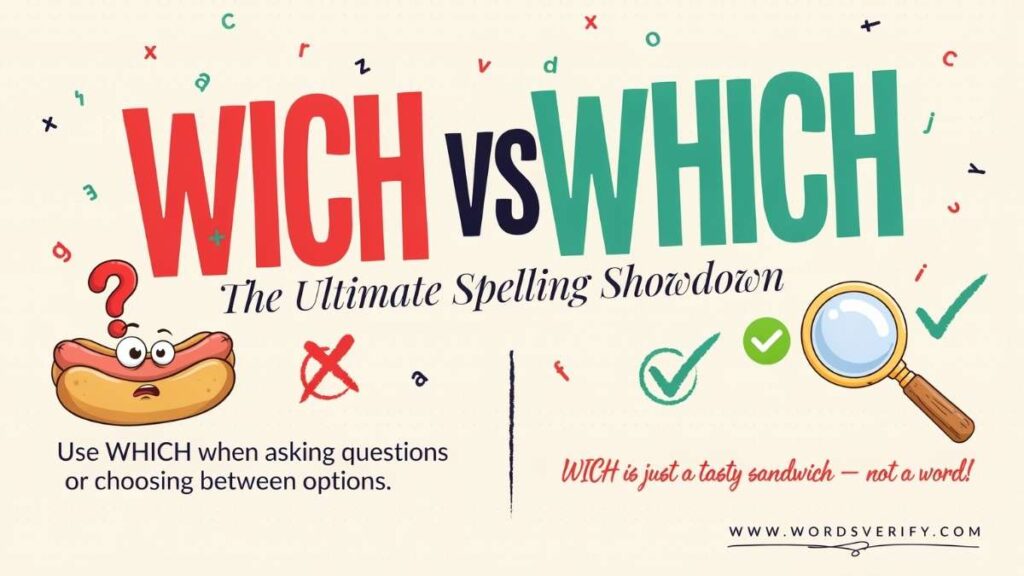
Have you ever typed “wich” instead of “which” and wondered if English had decided to drop a letter without telling anyone? It’s an easy mistake to make, especially when you’re typing fast or writing the word from memory. The confusion around wich vs which is common because the words look and sound so similar. In everyday English, which is the correct spelling when you’re asking about a choice, as in “Which book should I read?” But there’s a twist: “wich” does exist in historical and specialized uses. And then there’s “witch,” which belongs to an entirely different world. Let’s clear up the confusion once and for all.
The Quick Answer
If you mean the common question word, the correct spelling is which.
For example:
- Which book should I read?
- Which color do you like?
- Which one is yours?
- I don’t know which answer is correct.
Writing “wich” in these sentences is a spelling mistake.
However, wich has a few specialized uses. It can refer to a salt-producing place in historical or dialect English, and you’ll also see it in names such as Droitwich, Middlewich, and Sandwich.
So the answer depends on what you mean.
| Word | Meaning | Example |
|---|---|---|
| which | Used to ask about a choice or introduce information about something | Which book do you want? |
| wich | A historical or dialect word; also found in place names | Droitwich |
| witch | A person traditionally associated with magic or witchcraft | The witch lived in the forest. |
For everyday writing, remember this simple rule:
If you mean “which one,” spell it which.
What Does Which Mean?
The word which is used when you want to identify one person, thing, or option from a group.
For example:
Which movie do you want to watch?
The question assumes that there are several possible movies. You want to know which particular one the person has chosen.
You can also use which without mentioning the noun:
Which do you prefer?
Here, the word “which” stands on its own because the choices are already understood.
Some common expressions include:
- Which one
- Which book
- Which person
- Which way
- Which option
- Which answer
- Which color
- Which choice
- Which of these
- Which of the following
The meaning stays closely connected to selection or identification.
Which as a Question Word
One of the most common uses of which is in questions.
You use it when you’re asking someone to identify a particular choice.
Consider these examples:
- Which restaurant should we visit?
- Which shirt looks better?
- Which train are you taking?
- Which answer did you choose?
- Which road leads to the airport?
- Which phone belongs to you?
In each sentence, which helps narrow down the possibilities.
For instance, “What should we eat?” is an open question. “Which restaurant should we visit?” suggests that there are particular restaurants under consideration.
That distinction isn’t always strict. In everyday English, what and which can sometimes overlap. Context tells you which one sounds natural.
Which as a Pronoun
The word which can also work as a pronoun.
A pronoun replaces or represents a noun. When which appears without a noun after it, it can fill that role.
Compare these two sentences:
Which book do you want?
Which do you want?
In the first sentence, “which” comes before the noun “book.” In the second, the noun isn’t stated because everyone already understands what the choices are.
Other examples include:
- Which is yours?
- Which do you prefer?
- Which should we choose?
- Which belongs to Sarah?
- Which would you recommend?
This is why which is a pronoun can be answered with yes. Its exact grammatical role depends on how it appears in the sentence.
Fix common more word mistakes in English
Curtesy vs Courtesy Which one Is Correct?
Which as a Relative Pronoun
There’s another important use of which. It can introduce a relative clause.
For example:
The car, which I bought last year, still runs perfectly.
The words “which I bought last year” provide extra information about the car.
Here are a few more examples:
- The house, which was built in 1920, needs repairs.
- She bought a laptop which has a larger screen.
- We visited the museum, which was surprisingly quiet.
- He showed me the photo which he had taken earlier.
- I found the book which you were looking for.
In these examples, which connects additional information to something already mentioned.
Which for Extra Information
A particularly common construction uses which to add information about an entire situation.
For example:
She missed the train, which made her late for work.
Here, “which” refers to the situation described before it rather than simply naming one object.
This use can make writing smoother because you don’t have to repeat the entire idea.
Fix common more word mistakes in English
Indexes vs Indices which one is correct?
Wich vs Which Difference?
The wich vs which difference is mainly a matter of meaning and usage.
Which is an everyday English word. You’ll find it in questions, relative clauses, and many common expressions.
Wich is much less common. It has historical and dialect meanings and appears in some place names.
That means these sentences aren’t equivalent:
Which book are you reading?
Wich book are you reading?
The first sentence is correct when you’re asking about a book.
The second contains an incorrect spelling of which.
A Simple Comparison
| Situation | Word to use |
|---|---|
| Asking about a choice | Which |
| Asking “which one?” | Which |
| Introducing a relative clause | Which |
| Adding information about something | Which |
| Referring to a historical saltworks | Wich |
| Part of certain place names | Wich |
| A person associated with magic | Witch |
So when comparing wich vs which, don’t simply think “one is right and one is wrong.” Think about what each word actually means.
Fix common more word mistakes in English
Learnt vs Learned What’s the Difference?
What Does Wich Mean?
The word wich has a real history in English.
In British dialect usage, wich can refer to a saltworks or a place associated with salt production. The word also appears in historical place names.
This explains why you may see wich in names such as:
- Droitwich
- Middlewich
- Nantwich
- Northwich
- Sandwich
- Ipswich
- Greenwich
- Norwich
The spelling doesn’t mean that these names contain a mistake.
Place names often preserve very old forms of language. Some elements have changed in meaning over hundreds of years while remaining in the names of towns and cities.
Wich in Place Names
This is an important point if you’re wondering, “Is wich a word?”
Yes, it can be.
But that doesn’t mean you can use it as a replacement for which.
Think of it this way:
Which = an ordinary modern English word used in grammar.
Wich = a specialized word or historical name element found in particular contexts.
The two shouldn’t be treated as interchangeable.
Is Wich a Word?
Yes, but the answer needs some context.
If someone asks:
Is “wich” a real word?
The accurate answer is that wich is a recorded English word with specialized uses. It also appears in proper names.
However, if someone asks:
Wich one should I choose?
The writer almost certainly intended which.
That makes wich an incorrect spelling in that sentence.
English contains many words that have specialized meanings. A word can be legitimate in one context and completely wrong in another.
That’s exactly what’s happening here.
Fix common more word mistakes in English
Canceled vs Cancelled Which one Is Correct?
Wich vs Which Grammar
When you’re writing ordinary English, the grammar is straightforward.
Use which when you’re asking about a particular choice.
Asking About a Choice
- Which dress should I wear?
- Which restaurant do you recommend?
- Which route is faster?
- Which answer is correct?
- Which computer belongs to you?
Using Which Before a Noun
Here, which comes directly before a noun.
- Which book?
- Which house?
- Which car?
- Which person?
- Which answer?
For example:
Which book are you reading?
The word “which” helps identify the specific book.
Using Which Alone
You can also use which without a noun.
1.Which is yours?
2.Which should I choose?
3.Which do you prefer?
The listener understands the missing noun from the context.
Using Which of
Another common structure is which of.
- Which of these is yours?
- Which of the two options is cheaper?
- Which of them called you?
- Which of the following answers is correct?
This construction is especially common in questions involving several known choices.
Fix common more word mistakes in English
Finaly vs Finally Which one Is Correct?
Which in a Sentence Examples
If you’re still unsure about which in a sentence, these examples show how naturally the word fits into everyday English.
Everyday Questions
- Which coffee do you want?
- Which bus goes downtown?
- Which movie should we watch?
- Which shoes belong to you?
- Which restaurant is open tonight?
- Which way should we go?
- Which option costs less?
- Which person sent this message?
Relative-Clause Examples
- The phone, which I bought last month, is already damaged.
- The book which you gave me was fascinating.
- The house, which stands near the river, is over a century old.
- She chose the dress which had the simplest design.
- We visited the park, which was crowded that afternoon.
Examples With Prepositions
You may also see which after a preposition.
- The room in which we met was small.
- The company for which she works is expanding.
- The problem with which they struggled was complicated.
- The method by which the results were calculated was reliable.
- The reason for which he left remains unclear.
In everyday conversation, English speakers often move the preposition to the end:
The room which we met in was small.
That version sounds more conversational.
Wich in a Sentence
The phrase wich in a sentence can be confusing because the answer depends on the intended meaning.
If you mean the word which, don’t write wich.
Incorrect:
I don’t know wich one she selected.
Correct:
I don’t know which one she selected.
However, wich can appear in writing when it has its specialized meaning or forms part of a name.
For example:
Droitwich is a town in Worcestershire, England.
Here, wich isn’t an attempt to spell “which.” It’s part of the proper name.
That distinction is easy to miss if you’re only looking at the letters.
Fix common more word mistakes in English
Aide vs Aid which one is correct?
Wich vs Which Spelling
The wich spelling and which spelling differ by just one letter, but that letter matters.
Correct:
W-H-I-C-H
Incorrect when intended to mean “which”:
W-I-C-H
A useful way to remember the spelling is to connect which with other familiar wh- words:
- What
- When
- Where
- Who
- Why
- Which
The spelling pattern won’t solve every English spelling problem, but it gives you a useful visual reminder.
Why Is Which Spelled With “Wh”?
The spelling of which comes from the history of English.
English has preserved wh in a group of question words even though pronunciation has changed over time.
That gives us familiar words such as:
- what
- when
- where
- who
- why
- which
For many modern speakers, the h in which isn’t heard as a separate sound. That can make wich look like a reasonable spelling when you’re writing quickly.
But English spelling often preserves older forms that pronunciation no longer makes obvious.
That’s one reason English can be frustrating for learners.
Fix common more word mistakes in English
Crier vs Cryer Which one Is Correct?
Wich vs Which Pronunciation
The pronunciation creates another layer of confusion.
For many American English speakers, which and witch have the same pronunciation: /wɪtʃ/.
That means the following pair may sound identical:
Which one?
Witch won?
The meanings are obviously different once you see the words written down.
Some English speakers distinguish which from witch by using a different initial sound for which. This is part of a pronunciation distinction sometimes called the wine-whine distinction.
So pronunciation can vary by speaker and region.
The spelling, however, remains clear:
which for the question word.
witch for the person associated with magic.
Witch vs Which meanings
The witch vs which confusion comes from pronunciation rather than meaning.
A witch is a noun.
A which is usually a question word, determiner, or relative pronoun.
Compare these sentences:
Which book should I buy?
The witch appeared in the story.
One asks about a choice.
The other describes a character associated with magic.
Witch Meaning
A witch traditionally refers to a person believed to practice magic or witchcraft. In modern writing, the word can also appear in folklore, fantasy, history, and popular culture.
Examples:
- The witch lived in a small cottage.
- The children dressed as witches for Halloween.
- The novel features a powerful witch.
- The story describes a witch who can cast spells.
Which Meaning
Which has nothing to do with magic.
Examples:
- Which book should I read?
- Which answer is correct?
- Which road leads to the station?
- Which one belongs to you?
The spelling tells you what role the word plays.
Witch vs Which
Both witch and which are correct English words. The right one depends entirely on meaning.
Use which when you’re asking about a choice:
Which movie should we watch?
Use witch when you’re talking about a person associated with magic:
The witch flew across the night sky.
The words can sound identical for many speakers, but they aren’t interchangeable.
Which vs Witch Examples
| Sentence | Correct word | Why |
|---|---|---|
| ___ book should I buy? | Which | Asking about a choice |
| The ___ cast a spell. | Witch | A person associated with magic |
| ___ color do you prefer? | Which | Asking about a choice |
| The story was about a ___ . | Witch | Refers to a magic practitioner |
| ___ one is yours? | Which | Asking for identification |
| The children dressed as ___es. | Witches | Refers to people associated with magic |
This is one of those cases where context beats pronunciation.
Fix common more word mistakes in English
Labelling vs Labeling Which one Is Correct?
Common Wich Spelling Mistakes
The most common error happens when someone types wich because that’s how the word sounds.
Forgetting the H
Incorrect:
Wich movie are you watching?
Correct:
Which movie are you watching?
Typing Too Quickly
A missing letter is easy to overlook when you’re writing a message, comment, or email.
For example:
Can you tell me wich file you need?
The error doesn’t change the pronunciation, so it can slip past you during proofreading.
Confusing Which With Witch
Incorrect:
Witch restaurant should we choose?
Correct:
Which restaurant should we choose?
The first sentence sounds like you’re asking about a magical restaurant.
Relying Only on Pronunciation
English contains many words whose spelling can’t be predicted perfectly from sound.
If you hear /wɪtʃ/, don’t automatically write wich or witch.
Ask yourself what the word means.
Are you asking about a choice?
Use which.
Are you talking about magic?
Use witch.
Are you dealing with a historical name or specialized term?
Wich may be appropriate.
Fix common more word mistakes in English
Potatoes vs Potatos Which one Is Correct?
Which vs What Another Common Confusion
The difference between which and what can help you understand why which is so useful.
Generally, which works well when you’re choosing from a limited or known group.
For example:
Which dessert do you want, cake or pie?
The choices are known.
With what, the possibilities can be more open:
What do you want for dessert?
That doesn’t mean the distinction works perfectly in every situation. Native speakers use both words in different contexts.
Still, the comparison provides a useful rule of thumb:
Which often points toward a particular set of choices. What often opens the question more broadly.
Which vs That
Another grammar question involves which and that.
Both can introduce certain relative clauses.
For example:
The book which I bought was expensive.
The book that I bought was expensive.
Both sentences can be correct.
However, which has uses that that doesn’t share.
For example:
My car, which I bought last year, is already having problems.
Here, which introduces additional information separated by commas.
You can’t simply replace it with that in the same construction:
My car, that I bought last year, is already having problems.
That isn’t standard usage.
The choice between which and that depends on the type of relative clause and the intended meaning.
A Simple Trick for Remembering wich vs Which
If wich keeps appearing in your writing, try this little memory trick:
Which has WH because it’s a WH-question word.
Think of:
What → When → Where → Who → Why → Which
Now connect it to the question:
Which one?
The h belongs there.
Another useful trick is to remember the three words together:
Which = choice
Witch = magic
Wich = specialized/historical use
Three spellings. Three different jobs..
Fix common more word mistakes in English
Moulding vs Molding which one is correct?
Practice Session Wich vs Which
Fill in each blank with the correct word wich vs which
- ______ book would you like to borrow from the library?
- The children dressed as a ______ for the Halloween party.
- I can’t decide ______ color looks better.
- The story was about a ______ who lived in an old castle.
- ______ of these answers is correct?
- Droit______ is a historic town in Worcestershire, England.
- Can you tell me ______ train we need to take?
- The ______ in the fairy tale could cast powerful spells.
- She bought a new laptop, ______ came with a two-year warranty.
- ______ restaurant should we choose for dinner?
- The company, ______ was founded in 1995, has expanded worldwide.
- The word “______” appears in several English place names.
- ______ one of these jackets belongs to you?
- The novel features a mysterious ______ who lives in the forest.
- I don’t know ______ answer the teacher expects.
- ______ road should we take to reach the airport?
- The room ______ we met was surprisingly small.
- The children were fascinated by the story of the ______.
- ______ of the two options would you prefer?
- Middle______ is another English place name containing “wich.”
- She missed the bus, ______ made her late for work.
- ______ movie are you planning to watch tonight?
- The ______ appeared in the story wearing a long black cloak.
- Do you remember ______ day the meeting is scheduled for?
- If you’re asking about a choice, remember to spell the word ______.
Answers
- Which
- Witch
- Which
- Witch
- Which
- Wich
- Which
- Witch
- Which
- Which
- Which
- Wich
- Which
- Witch
- Which
- Which
- Which
- Witch
- Which
- Wich
- Which
- Which
- Witch
- Which
- Which
Here’s a trusted source for clear more words Comparison:
FAQs
Is it spelled “wich” vs “which”?
The correct spelling is which when you’re asking about a choice or referring to something in a sentence. “Wich” has specialized historical and dialect uses but isn’t the standard spelling of “which.”
What does “wich” mean in English?
“Wich” is a historical or dialect word associated with a salt-producing place or saltworks. It also appears in several English place names, such as Droitwich and Middlewich.
When should I use “which”?
Use which when you’re identifying or choosing something from a particular group. For example: “Which jacket do you want?”
Is “wich” ever correct?
wich vs which : Yes Wich can be correct in historical, dialectal, or place-name contexts. It’s incorrect when you use it as a spelling of the everyday word which.
What does “which” mean?
Which is used to ask about or identify a particular person, thing, or choice. It can also introduce a relative clause, as in “The book, which I bought yesterday, is excellent.”
How do you pronounce “wich”?
When “wich” appears as part of an English place name or historical term, its pronunciation can vary depending on the name and regional usage. It shouldn’t automatically be treated as another spelling of which.
What is the difference between “which” and “witch”?
Which is used for choices or identification, while witch refers to a person traditionally associated with magic or witchcraft. For example, “Which dress should I wear?” versus “The witch appeared in the story.”
Which is correct: “which day” or “what day”?
Both can be correct, but they’re used slightly differently. Which day usually suggests a specific set of days or known options, while what day can ask more generally about the day.
What is the difference between “what” and “which”?
What often asks about an open range of possibilities, while which commonly asks someone to choose or identify something from a known or limited set. For example, “What do you want to eat?” versus “Which dessert do you want, cake or pie?”
Can “which” be used for a company?
Yes. A company is generally treated as an entity or organization, so which can refer to it when introducing additional information: “The company, which opened in 1995, now has offices worldwide.”
Can “which” be used without a noun?
Yes. Which can stand alone when the noun is already understood. For example: “Which is yours?” or “Which should we choose?”
Can “which” begin a sentence?
Yes. Which can naturally begin a question or a sentence containing a relative clause. For example: “Which option would you choose?”
Why do people accidentally spell “which” as “wich”?
The mistake usually happens because the h isn’t strongly heard in pronunciation, especially for speakers who pronounce which and witch alike. Fast typing and familiarity with similar-looking words can also contribute to the error.
Is “wich” a shortened form of “which”?
No. Wich isn’t a standard shortened form of which. If you mean the common question word, you should spell it which.
Are “which” and “witch” pronounced the same?
For many American English speakers, which and witch are pronounced the same. Some speakers distinguish them by using a different initial sound for which.
How can I remember the spelling of “which”?
Remember that which belongs to the familiar wh- question-word group: what, when, where, who, why, which. If you’re asking about a choice, the spelling you need is which.
Is “which” a pronoun or a determiner?
It can be both, depending on how it functions in a sentence. In “Which book did you choose?” it determines the noun “book.” In “Which did you choose?” it functions as a pronoun.
Can “which” introduce a relative clause?
Yes. Which can introduce a relative clause that provides information about a noun or, in some constructions, an entire preceding situation. For example: “She missed the bus, which made her late.”
What is the difference between “which” and “that”?
Both can introduce certain restrictive relative clauses, but which has additional uses. For example, which can introduce nonrestrictive information: “My car, which is five years old, still runs well.”
Is “wich” used in English place names?
Yes. Wich appears in several English place names, including Droitwich, Middlewich, Nantwich, Northwich, and Sandwich. In these names, it reflects historical language rather than being a misspelling of which.
conclusion
The wich vs which confusion may involve just one missing letter, but that little “h” can make a big difference. In everyday English, which is the correct word when you’re asking about a choice, identifying something, or introducing additional information. Wich isn’t simply a misspelling in every situation; it has historical and specialized uses and appears in some place names. Then there’s witch, an entirely different word associated with magic and folklore.
So, when you’re choosing between two options, don’t let that missing “h” cast a spell on your sentence. Just remember: which is for choices, witch is for magic, and wich belongs to its own specialized corners of English.

Lisa AJS is an experienced blogger and language enthusiast at Words Verify, dedicated to making grammar simple, practical, and enjoyable. She writes engaging content on commonly confused words, grammar mistakes, word meanings, and everyday language challenges.