

If you’ve ever wondered about crier vs cryer, you’re not alone. At first glance, cryer seems like the obvious choice because it follows the word cry. So why does crier usually appear in modern English? That small spelling difference can cause a surprising amount of confusion. Both forms have a history, but they don’t have the same role today. Whether you’re describing someone who cries easily, talking about a traditional town crier, or wondering whether Cryer is simply a spelling mistake, the answer depends on context. Let’s clear up the confusion, explore the meanings, and make this tricky little spelling choice much easier to remember.
The Quick Answer
Crier is the standard spelling in modern English when you mean a person who cries or a public announcer.
Cryer is found mainly as an older spelling, a historical form, or a surname.
| Word | Meaning or use | Modern use |
|---|---|---|
| Crier | A person who cries | Common |
| Crier | A public announcer | Common in phrases such as town crier |
| Cryer | Historical or older form | Uncommon |
| Cryer | Family name | Used as a surname |
For everyday writing, crier is the form to choose.
What Does Crier Mean?
A crier is most commonly a person who cries.
You might use the word to describe someone who tends to cry easily or often. It can also describe someone who becomes tearful during emotional situations.
For example:
She’s a real crier when she watches sad movies.
Or:
I’m not usually a crier, but that ending got me.
The word doesn’t automatically carry a negative meaning. It can simply describe someone’s tendency to cry.
However, crier has another meaning that might surprise you. It can also refer to a person who makes announcements publicly.
That’s where the familiar expression town crier comes in.
Crier as a Person Who Cries
When crier refers to someone who cries, it works as a noun.
You could describe someone as a crier if they:
- Cry easily.
- Cry frequently.
- Become tearful during emotional moments.
- Often cry during sad movies or books.
- Tend to express strong emotions through tears.
For example:
My brother is a crier during sentimental movies.
She became a crier after hearing the touching story.
He’s always been an emotional crier.
The word is fairly neutral. It doesn’t have the mocking tone that words such as crybaby can have.
That difference matters.
Calling someone a crier can simply describe them. Calling someone a crybaby usually adds criticism or teasing.
Crier as a Public Announcer
A crier can also mean someone who makes public announcements.
This use comes from an older sense of the verb cry. In earlier English, cry could mean to call out loudly or proclaim something to other people.
A town crier, for example, would announce important information to people in a town.
Imagine a time before newspapers, radio, television, websites, and smartphones. If local officials wanted everyone to hear an important announcement, someone had to deliver the message in person.
That person could be a town crier.
For example:
The town crier announced the new market rules.
The town crier called out the news in the village square.
The crier wasn’t crying tears. The person was calling out information.
That’s an important part of the word’s history.
Labelling vs Labeling Which one Is Correct?
What Does Cryer Mean?
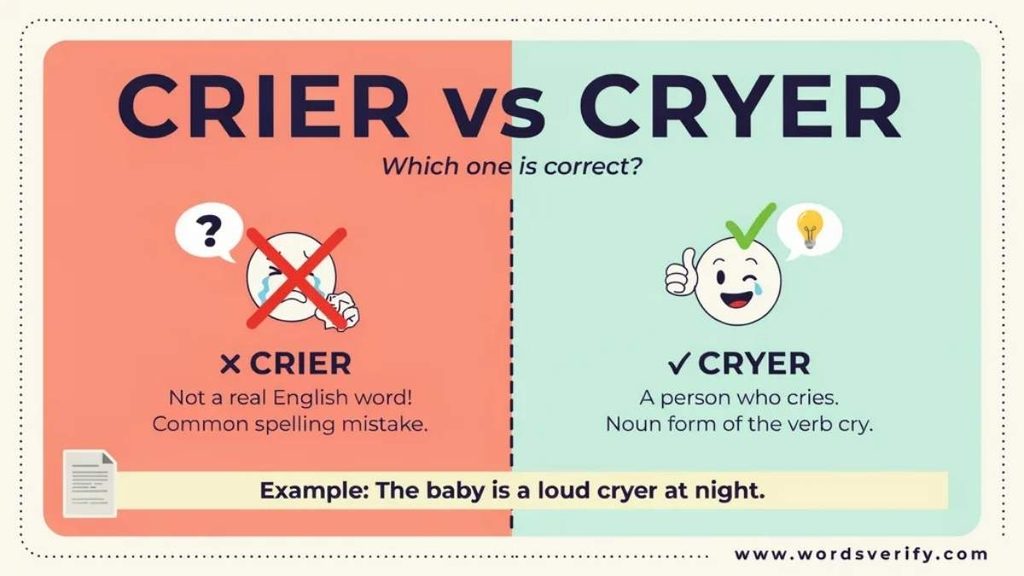
Cryer is not simply a meaningless misspelling.
The form has appeared in English historically and can be found in older writing. It also survives as a surname.
However, cryer isn’t the usual spelling for the ordinary modern noun.
If you’re writing a sentence about someone who cries, use crier:
She is a crier.
Not:
She is a cryer.
On the other hand, if Cryer is someone’s family name, keep the spelling exactly as it is.
For example:
Jon Cryer is an American actor.
Here, Cryer is a proper name. It shouldn’t be changed to Crier.
Potatoes vs Potatos Which one Is Correct?
Crier vs Cryer What’s the Difference?
The main difference comes down to modern usage and context.
Crier is the normal modern spelling when you’re talking about someone who cries or a person who makes public announcements.
Cryer appears in historical contexts and as a surname.
| Situation | Correct choice |
|---|---|
| A person who cries | Crier |
| Someone who cries easily | Crier |
| A town announcer | Crier |
| A town crier | Crier |
| A historical spelling | Cryer may appear |
| A family surname | Cryer, if that’s the person’s name |
This is why saying simply “cryer is wrong” doesn’t tell the whole story. The spelling has existed, but its modern use is much more limited.
Why Is It Crier Instead of Cryer?
This is where English spelling gets a little less predictable.
It seems logical to take cry and add -er:
cry + er = cryer
Yet the established modern noun is crier.
English contains plenty of words whose spellings reflect their development over time rather than a simple rule that we can apply today.
You don’t need to work out the spelling from the verb every time you use it. Treat crier as the established noun.
A useful way to remember it is through the phrase:
town crier
Once that spelling sticks in your mind, the person-who-cries meaning becomes easier to remember too.
Crier vs Cryer for Someone Who Cries?
If you’re asking how to spell the word for someone who cries, use crier.
For example:
She’s a crier whenever she watches a sad movie.
I’m a bit of a crier at weddings.
He wasn’t much of a crier as a child.
My sister cries easily, so she’s definitely a crier.
You could also use phrases such as:
- Someone who cries easily.
- A person who cries often.
- Someone who weeps.
- An emotional person.
- A frequent crier.
The best choice depends on the sentence and the tone you want.
The Meaning of Town Crier
The phrase town crier has a long history.
A town crier was traditionally responsible for making public announcements. The person would often call out information in a public place so that people nearby could hear it.
These announcements could concern:
- Government proclamations.
- Local events.
- Public notices.
- Important community news.
- Changes affecting local residents.
The role became less important as newspapers and later forms of mass communication became widespread.
Today, town crier is often used in historical settings, ceremonies, festivals, and discussions of traditional civic life.
For example:
The historical festival featured a town crier dressed in traditional clothing.
The word crier therefore has a much broader history than its connection with tears might suggest.
Crier and Court Announcements
The word crier has also been connected with public announcements in legal and civic settings.
A court crier could serve as someone who called out announcements or helped communicate information during court proceedings.
This makes sense when you consider the older meaning of cry as calling out loudly.
Today, court procedures usually rely on microphones, written notices, electronic systems, and other forms of communication. The older use of crier therefore feels more historical than everyday.
Still, it helps explain why the word has more than one meaning.
Manuel vs Manual which one is correct?
Crier vs Cryer in American English
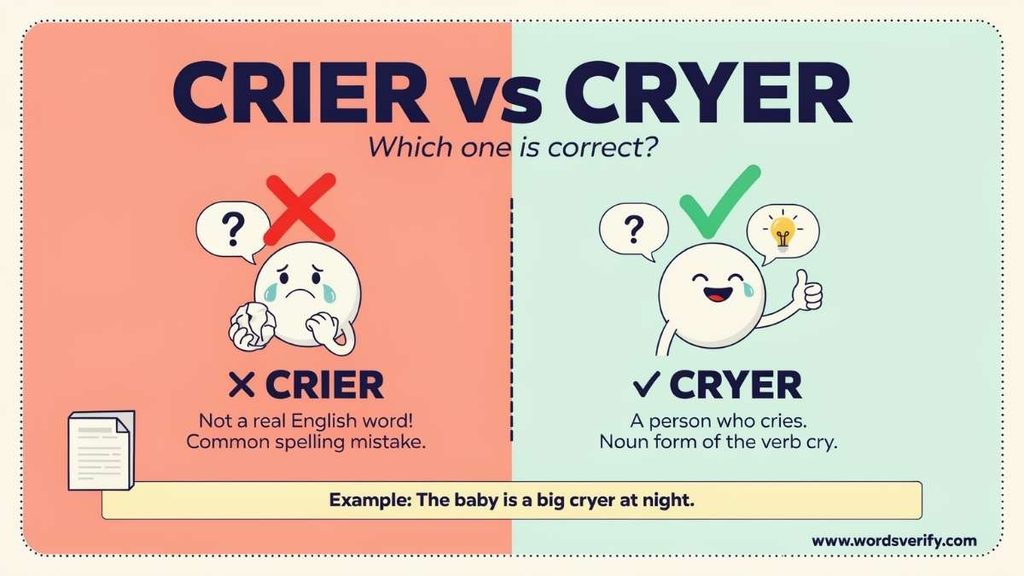
In American English, crier is the normal spelling for the noun.
This isn’t primarily a difference between American and British spelling.
Some English words have clear regional spelling differences, such as color and colour. Crier and cryer don’t work quite that way.
Instead, the distinction involves standard modern usage, historical forms, and proper names.
So, in a school paper, article, email, or other ordinary piece of writing, crier is the natural choice.
Crier vs Cryer Pronunciation
The pronunciation can add to the confusion because crier and Cryer can sound very similar.
Crier is commonly pronounced roughly like “CRY-er.”
That means hearing the word doesn’t necessarily tell you which spelling you’re looking at.
This is especially important with surnames. Someone named Cryer may pronounce the name similarly to crier, but the written form remains Cryer because it is their family name.
When you’re writing the ordinary noun, remember the spelling:
crier
Sneek vs Sneak Which one is Correct?
Common Crier and Cryer Mistakes
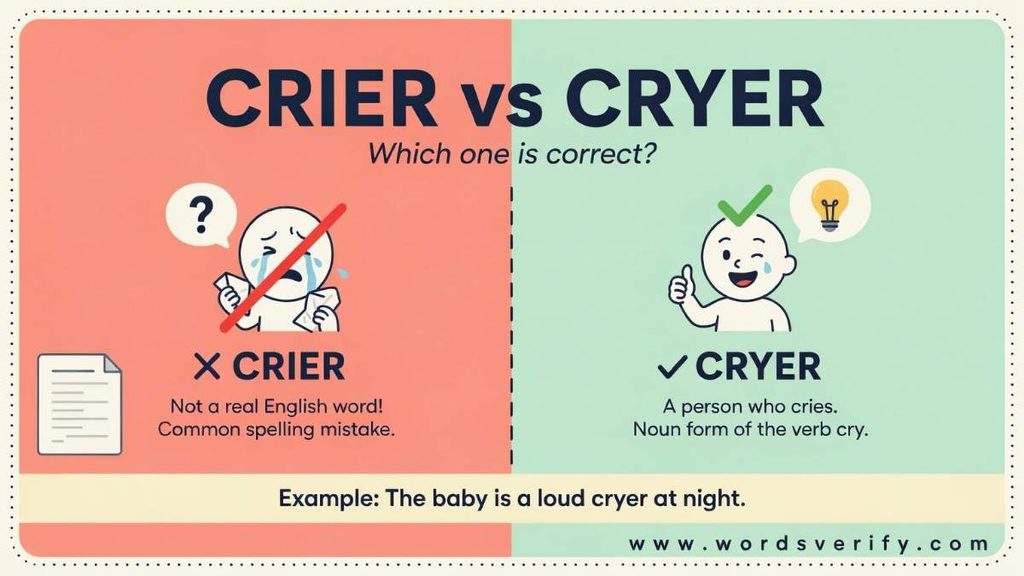
The confusion usually comes from a few simple assumptions.
Writing Cryer Because It Looks Logical
The spelling cryer seems natural because it appears to combine cry and -er.
However, the established modern noun is crier.
English has many words where the obvious spelling isn’t the standard one. This is one of them.
Treating Cryer as a Completely Fake Word
That’s also misleading.
Cryer has historical use, and the surname Cryer is well established.
So, the better explanation is that crier is the normal modern noun, while cryer has more limited uses.
Changing a Person’s Name
Names don’t follow ordinary spelling corrections.
If someone’s surname is Cryer, don’t change it to Crier.
For example:
Jon Cryer appeared in the television series Two and a Half Men.
The spelling Cryer is part of his name.
Assuming Every Crier Is Someone Who Is Sad
A crier doesn’t necessarily cry because they’re sad.
People cry for many reasons. They may cry from happiness, grief, relief, frustration, laughter, or emotional overwhelm.
And remember, a town crier doesn’t mean a person who sheds tears at all. It means a person who makes public announcements.
Laid Down vs Lied Down which one is correct?
Crier vs Cryer in Sentences
Seeing the words in context makes the distinction much easier.
| Sentence | What it means |
|---|---|
| She’s a crier during emotional movies. | She cries easily during emotional films. |
| I’m not much of a crier. | I don’t cry very often. |
| The town crier announced the news. | A public announcer delivered the message. |
| The historical document used the spelling cryer. | The older form appeared in the document. |
| Jon Cryer starred in the television series. | Cryer is the person’s surname. |
These examples show why context matters.
When Should You Use Crier?
Use crier when you’re writing about someone who cries.
For example:
She’s a crier.
He’s an easy crier.
I’m becoming more of a crier as I get older.
You should also use crier in expressions such as:
town crier
and in historical or civic references where the person makes public announcements.
When Should You Use Cryer?
Use cryer only when the context calls for that particular spelling.
That usually means one of the following:
- You’re discussing an older or historical form.
- You’re reproducing a historical document.
- You’re discussing the spelling itself.
- You’re referring to someone whose surname is Cryer.
For normal modern writing about a person who cries, choose crier instead.
Is Crier a Word?
Yes. Crier is an established English word.
It has two main uses.
The first describes a person who cries:
She’s a crier.
The second refers to a person who makes public announcements:
The town crier announced the proclamation.
So if you’ve ever wondered, “Is crier a word?” the answer is clearly yes.
It’s a normal noun with both modern and historical uses.
Is Cryer a Word?
Cryer has a more complicated history.
It has appeared as a spelling in English and can still be found as a surname. However, it isn’t the standard choice for the ordinary modern noun meaning someone who cries.
So both forms have a place in English, but they don’t have the same everyday role.
For modern writing:
crier
For a surname:
Cryer, if that’s the person’s actual name.
For a historical text:
Preserve cryer if that is the spelling used in the original source.
Lieing vs Lying Which one Is Correct?
Crier vs Cryer in Casual Speech
In casual conversation, you may hear people describe themselves as a crier.
For example:
I’m such a crier during wedding videos.
She’s a total crier when she watches old movies.
This use is informal but perfectly natural.
It also doesn’t necessarily mean anything negative.
Compare:
I’m a crier.
with:
I’m a crybaby.
The first statement simply describes a tendency to cry. The second can sound teasing or insulting.
What About “Pretty Crier”?
The phrase pretty crier can describe someone who still looks attractive while crying.
It’s not a fixed grammatical term. Its meaning depends heavily on context.
For example:
She’s a pretty crier.
could be a casual comment about someone’s appearance while they’re crying.
If you’re looking for a general word for someone who cries, however, crier is the useful word.
Sergeant vs Sargeant which one is correct?
A Simple Trick to Remember the Spelling
Here’s an easy way to keep the two forms straight:
Crier = the ordinary modern noun.
Cryer = historical form or surname.
You can also connect crier with town crier.
Once you remember town crier, you have a useful visual reminder of the spelling.
So when you’re tempted to write:
cryer
pause for a second and ask:
Am I writing about a modern noun or someone’s surname?
If it’s a modern noun meaning someone who cries, choose:
crier
Affect vs Effect which one is correct?
Practice Session Crier vs Cryer
Fill in each blank with crier vs cryer.
- Sarah is a real ______ when she watches emotional movies.
- The town ______ announced the news to the crowd.
- If you mean a person who cries, ______ is the usual modern spelling.
- The actor’s last name is ______.
- I’m not much of a ______, even during sad films.
- The historical document used the older spelling ______.
- The ______ called out the official announcement in the village square.
- My sister is an emotional ______ who tears up easily.
- In modern English, ______ is the preferred spelling for someone who cries.
- Jon ______ is a well-known American actor.
- The child became a frequent ______ after the sad event.
- The old record contains the spelling ______ instead of the modern form.
- The ______ announced the arrival of the royal visitors.
- She’s such a ______ that even happy endings make her tear up.
- When referring to a person’s surname, keep the spelling ______ if that is their actual family name.
- The village ______ made several public announcements.
- If you’re writing about someone who cries easily, choose ______ rather than cryer.
- The historian found the word ______ in an old English document.
- He describes himself as a proud ______ who isn’t afraid to show emotion.
- The traditional town ______ stood in the marketplace and announced the news.
- The spelling ______ may appear in historical sources.
- Maria is a natural ______ and often tears up during weddings.
- The modern sentence should use ______ rather than cryer.
- The family’s surname is ______, so its spelling should not be changed.
- After watching the heartbreaking scene, everyone knew he was a ______.
Answers
- crier
- crier
- crier
- Cryer
- crier
- cryer
- crier
- crier
- crier
- Cryer
- crier
- cryer
- crier
- crier
- Cryer
- crier
- crier
- cryer
- crier
- crier
- cryer
- crier
- crier
- Cryer
- crier
Here’s a trusted source for clear more words Comparison:
FAQs
Is it someone who cries, cryer or crier?
Crier is the standard modern spelling for a person who cries. Cryer can appear as an older spelling or surname.
What does crier mean?
A crier can mean a person who cries, especially someone who cries easily or often. It can also mean a public announcer, as in town crier.
What is a cryer?
Cryer is a historical or less common spelling related to crier. Today, it is also used as a surname. For a person who cries, crier is the usual modern form.
What do you call a person who cries a lot?
You can call such a person a frequent crier or simply a crier. Crybaby is another word, but it often sounds teasing or insulting.
What do you call a girl who cries easily?
There isn’t a special word based on gender. Crier, frequent crier, or someone who cries easily can describe anyone.
What is another word for crier?
Depending on the context, alternatives include weeper, crybaby, or tearful person. For a public announcer, town crier or announcer may fit better.
What is the difference between cryer and crier?
Crier is the standard modern spelling for someone who cries. Cryer appears mainly in historical usage and as a surname.
Is cryer a valid word?
Cryer has historical use in English and remains a recognized surname. However, crier is the usual spelling when referring to someone who cries in modern writing.
Is crier a valid English word?
Yes. Crier is an established English noun. It can refer to someone who cries or to a person who makes public announcements.
What is a town crier?
A town crier was traditionally a person who announced important news, proclamations, and public information aloud in a community.
Why is it spelled crier instead of cryer?
Crier is the established modern spelling. Although cry + er might suggest cryer, English spelling doesn’t always follow that simple pattern.
Can Cryer be a last name?
Yes. Cryer is an established family surname. When it is someone’s name, its spelling should remain Cryer rather than being changed to Crier.
What is a fancy word for crying?
Depending on the context, weeping, sobbing, lamenting, and tearing up can describe forms or degrees of crying. The best choice depends on the situation.
What is a pretty crier?
A pretty crier is an informal expression for someone who is considered attractive even while crying. It isn’t a formal English term.
What is speaking while crying called?
There isn’t one specific English word for speaking while crying. You might describe it as speaking through tears, speaking while sobbing, or speaking tearfully.
Is sobbing different from crying?
Yes. Crying is the general term for shedding tears or expressing emotion through tears. Sobbing usually describes crying more intensely, often with broken breaths or audible sounds.
What is a happy cry called?
A happy cry can be described as tears of joy or tears of happiness. People may cry when they feel overwhelming joy, relief, gratitude, or excitement.
Further vs Farther which one is correct?
conclusion
The difference between crier vs cryer may seem like a tiny spelling issue, but it can easily trip you up. If you’re talking about a person who cries, crier is the standard modern spelling. It also appears in town crier, where it refers to someone who makes public announcements.
Cryer has a place in English too. You may find it in historical writing or as a surname, such as Jon Cryer. So, it isn’t simply a random misspelling that should be crossed out with a red pen.
The easiest rule is simple: use crier when you mean someone who cries, and keep Cryer when the historical context or a person’s name calls for it.
Now that the spelling mystery is settled, there’s no need to shed a tear over it. Just remember: crier is the usual modern choice.

Lisa AJS is an experienced blogger and language enthusiast at Words Verify, dedicated to making grammar simple, practical, and enjoyable. She writes engaging content on commonly confused words, grammar mistakes, word meanings, and everyday language challenges.