
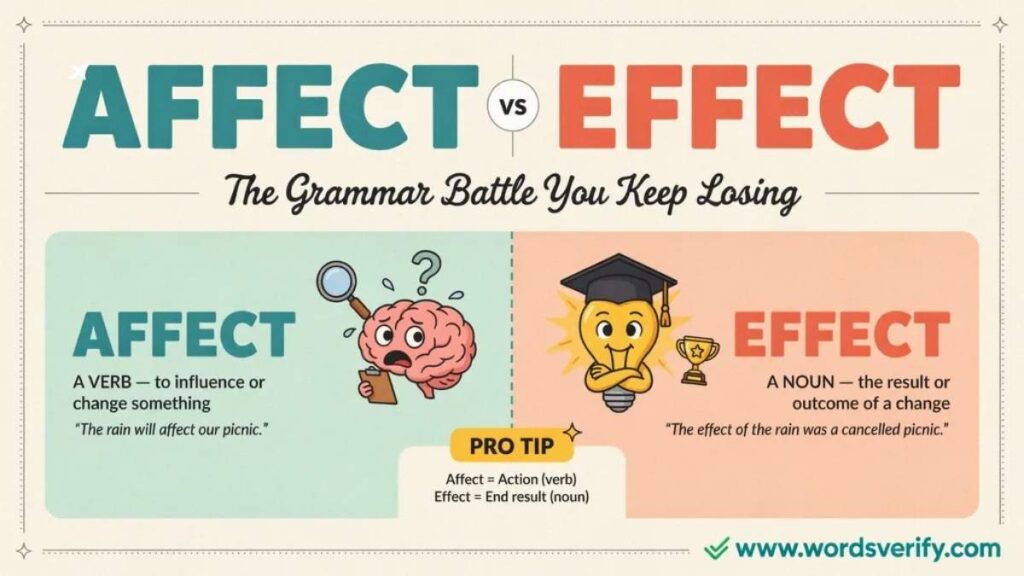
Some grammar mix-ups have a talent for making you stop mid-sentence, and affect vs effect is one of the biggest troublemakers. These words look and sound remarkably similar, yet they usually serve different purposes. One generally describes an influence or change, while the other refers to a result or consequence. Mixing them up can turn a perfectly good sentence into a small grammar puzzle. Luckily, you don’t need a dictionary the size of a brick to tell them apart. In this guide, you’ll discover the difference between affect and effect, common mistakes, practical examples, and simple memory tricks to help you choose the right word with confidence.
Quick Answer
In standard English, affect is usually a verb, while effect is usually a noun.
- Affect means to influence or change something.
- Effect means the result or consequence of something.
For example:
- Lack of sleep can affect your concentration.
- Lack of sleep can have a negative effect on your concentration.
Think of it this way:
Affect = action or influence
Effect = end result
That’s the basic affect vs effect rule. However, both words have less common uses that are worth understanding.
Affect Definition and Meaning
Affect most commonly works as a verb. It means to influence something or someone.
When something affects you, it changes your thoughts, feelings, behavior, condition, or experience in some way.
For example:
- Loud noise can affect your concentration.
- The weather may affect our travel plans.
- The decision could affect thousands of people.
- Stress can affect your sleep.
- The news deeply affected her.
In each sentence, affect describes an influence or action.
Affect as a Verb
The most common use of affect is as a verb.
You can replace it with words such as:
- Influence
- Change
- Alter
- Modify
- Have an impact on
For example:
The new schedule affected my routine.
This means the new schedule changed or influenced the routine.
Another example:
The storm affected several communities.
Here, the storm had an impact on those communities.
Affect Someone or Something
Affect can be followed by a person, thing, situation, or condition.
For example:
- The problem affected everyone.
- The noise affected my concentration.
- The decision affected the company.
- The accident affected traffic.
- The experience affected his confidence.
Notice that you don’t normally need the word “on” after affect.
You say:
The decision affected me.
Not:
The decision affected on me.
However, when you use effect as a noun, the structure changes:
The decision had an effect on me.
That small difference causes plenty of confusion.
Learn the difference between tricky grammar more words
Steer vs Stear difference and Correct usage
Effect Definition and Meaning
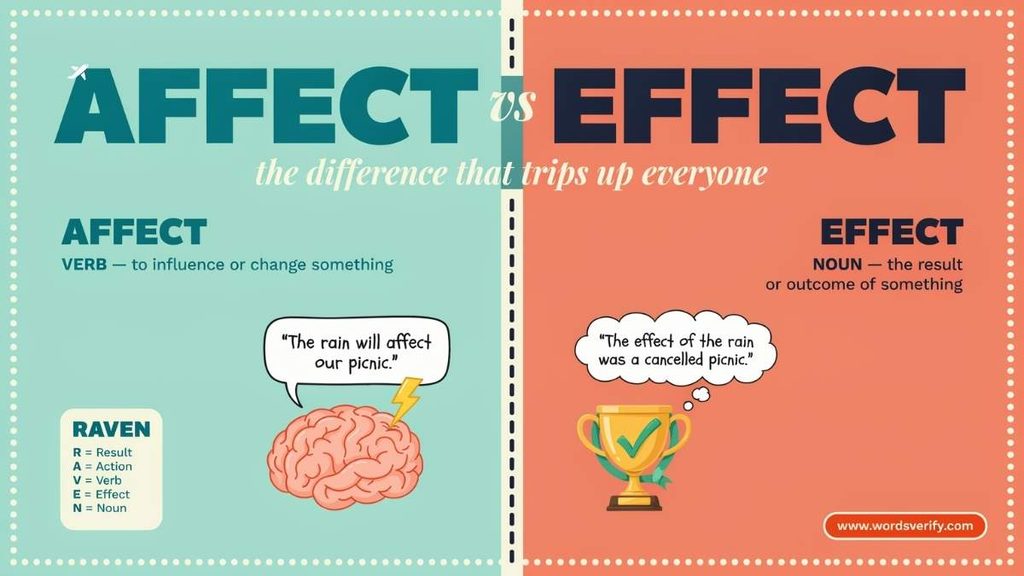
The Effect is most commonly a noun. It refers to a result, consequence, or outcome caused by an action or event.
For example:
- The medicine had a positive effect.
- The storm had a serious effect on transportation.
- The new rule had little effect on customers.
- The decision had an unexpected effect.
- Exercise can have a positive effect on your mood.
In these examples, effect refers to what happened because of something else.
Effect as a Noun
When you see phrases such as the effect of, an effect on, or have an effect, you’re usually dealing with the noun effect.
Examples:
- What was the effect of the new policy?
- The change had a major effect on sales.
- Lack of sleep can have an effect on memory.
- The medication produced a noticeable effect.
- The speech had a powerful effect on the audience.
A useful question is:
What happened as a result?
If you’re talking about the result, effect is often the word you need.
Learn the difference between tricky grammar more words
Tying vs Tieing difference and Correct usage
Affect vs Effect The Main Difference
The easiest way to understand the difference between affect and effect is to think about action and result.
| Word | Usual part of speech | Basic meaning | Example |
|---|---|---|---|
| Affect | Verb | Influence or change | Noise can affect your sleep. |
| Effect | Noun | Result or consequence | Noise can have an effect on your sleep. |
Here’s another simple comparison:
Affect: What does something do?
Effect: What happens because of it?
Consider this sentence:
Heavy rain affected the match.
The rain influenced or changed the match.
Now look at this:
The rain had an effect on the match.
The effect is the result of the rain.
The two words can appear in nearly the same sentence, but their grammatical jobs differ.
Affect vs Effect Grammar Rule
The most useful grammar rule is simple:
Affect is usually a verb. Effect is usually a noun.
For example:
The heat affected the workers.
Affect describes what the heat did.
The heat had an effect on the workers.
Effect describes the result.
You can use this test when you’re unsure:
- Look at the word you’re trying to replace.
- Ask whether you’re describing an action or influence.
- If yes, affect is usually correct.
- Ask whether you’re describing a result or consequence.
- If yes, effect is usually correct.
This won’t solve every unusual use of the words, but it handles most everyday English.
Learn the difference between tricky grammar more words
Cudos vs Kudos difference and Correct usage
Affect vs Effect Examples in Everyday English
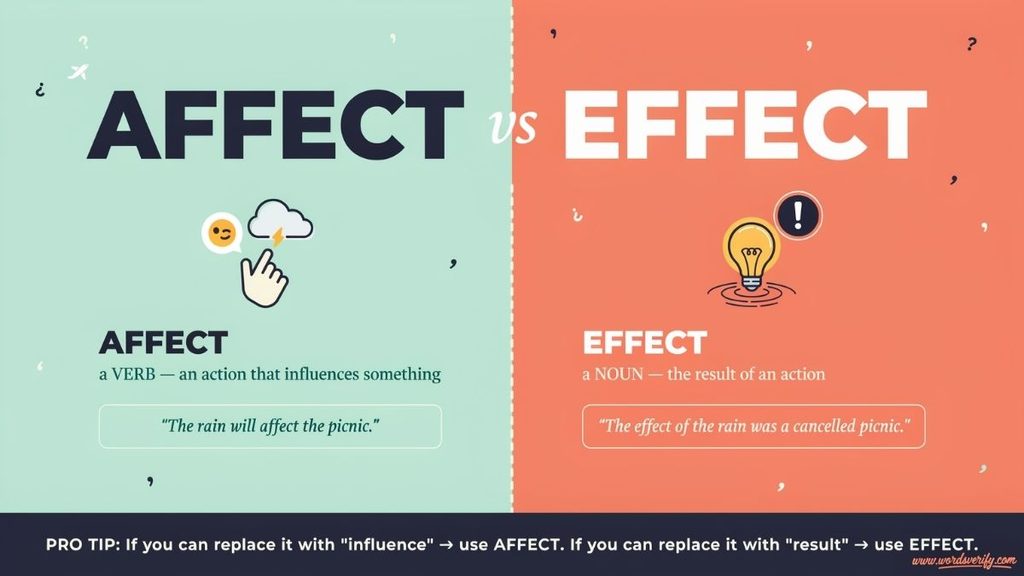
Here are some common examples that show the difference naturally:
- Lack of sleep can affect your mood.
- Lack of sleep can have a negative effect on your mood.
- The weather affected our plans.
- The weather had an unexpected effect on our plans.
- Social media can affect how people communicate.
- Social media can have a significant effect on communication.
- The noise affected my ability to study.
- The noise had a distracting effect on my study session.
- The teacher’s advice affected my decision.
- The teacher’s advice had a lasting effect on my decision.
The pattern becomes easier when you stop treating affect and effect as interchangeable words.
Will It Affect Me or Effect Me?
The correct sentence is usually:
Will it affect me?
Here, affect is a verb meaning “influence.”
Using effect as a verb in these sentences would be incorrect if you simply mean “influence.”
However, effect can be used as a verb in a different context. That’s a more advanced use and doesn’t mean exactly the same thing.
This Does Not Affect vs Effect
If you’re trying to say that something doesn’t influence or change something, use affect.
Correct:
This does not affect my decision.
Correct:
The problem doesn’t affect our plans.
Correct:
The change won’t affect customers.
Here, affect is a verb.
You would generally not use effect in these sentences when you mean “influence.”
Negatively Affect vs Effect?
The correct phrase is usually:
Negatively affect
For example:
Lack of sleep can negatively affect your concentration.
Why?
Because negatively affect describes an action. Something is influencing or changing something in a negative way.
You can also say:
Lack of sleep can have a negative effect on your concentration.
Here, effect is a noun.
Compare the structures:
Negatively affect your health
Have a negative effect on your health
Both are correct. The grammar is different.
Is It Affect vs Effect on People?
The correct choice depends on the sentence structure.
Use affect when the word acts as a verb:
The decision affected many people.
Use effect when you use it as a noun:
The decision had an effect on many people.
This is one of the easiest ways to distinguish the two.
Don’t automatically choose one word simply because the sentence mentions people. Look at the grammatical role of the word.
How Will This Affect vs Effect Me?
The natural sentence is:
How will this affect me?
Here, affect means “How will this influence or change me?”
For example:
- How will this affect my career?
- How will this affect my family?
- How will this affect our plans?
- How will this affect the environment?
- How will this affect customers?
You could also rewrite these sentences using effect:
What effect will this have on me?
Notice how the sentence structure changes.
Learn the difference between tricky grammar more words
Seel vs Seal Difference and correct usage
Can Effect Be a Verb?
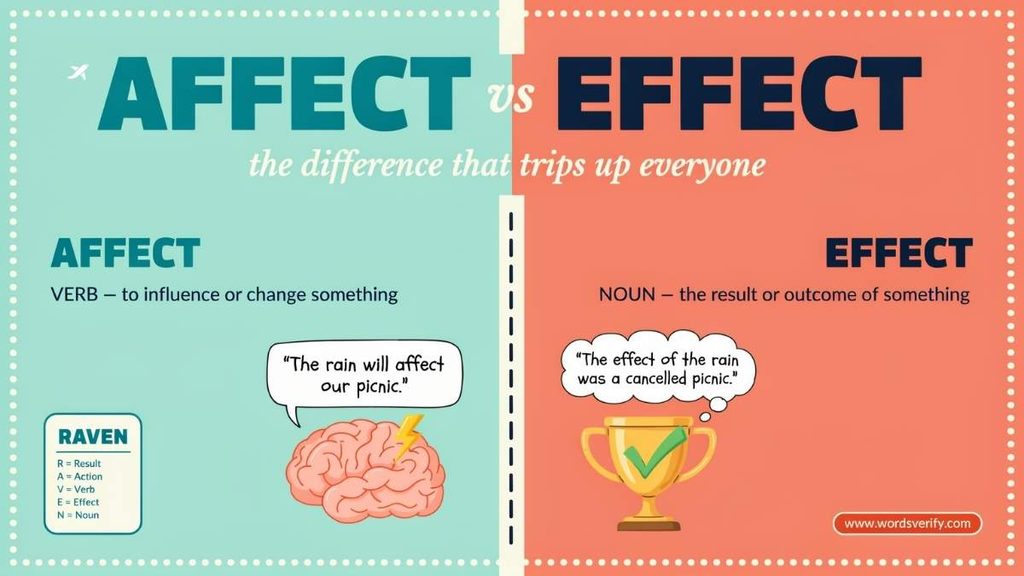
Yes. Effect can function as a verb, although this use is less common in everyday conversation.
As a verb, effect means to bring about or cause something to happen.
For example:
The new policy effected major changes in the organization.
Here, effect doesn’t mean “influence.” It means that the policy brought about the changes.
This distinction matters:
Affect = influence or change something
Effect = bring something about
In ordinary writing, affect is far more common as a verb.
Can Affect Be a Noun?
Yes, but this use is uncommon outside specialized contexts.
In psychology and related fields, affect can refer to the observable expression of emotion.
For example:
The patient displayed a flat affect.
This technical meaning is different from the everyday verb affect.
For most everyday writing, you can remember:
Affect = verb
Effect = noun
That rule will cover the vast majority of situations you encounter.
Learn the difference between tricky grammar more words
Peices vs Pieces difference and correct usage
Affect vs Effect Memory Trick
A simple memory trick can save you from second-guessing yourself.
A for Action
Think:
A = Affect = Action
Affect usually describes something doing something to something else.
The cold affected my hands.
The cold influenced the condition of my hands.
E for End Result
Think:
E = Effect = End result
Effect usually describes what happened afterward.
The cold had an effect on my hands.
The effect is the resulting condition.
This isn’t a perfect rule for every possible use of the words, but it’s an excellent starting point for everyday English.
Affect vs Effect Spelling and Pronunciation
Spelling can make these words tricky because only one letter separates them.
Affect is spelled A-F-F-E-C-T.
Effect is spelled E-F-F-E-C-T.
Their common pronunciations are also very similar.
In everyday use, the verb affect usually begins with a short “uh” sound, while effect commonly begins with a clear “ee” sound.
Because pronunciation can vary depending on the word’s use and accent, grammar and sentence structure are usually more reliable clues than sound alone.
Cause and Effect
The phrase cause and effect is one of the most common expressions containing effect.
A cause is something that produces an action or event.
The effect is the result.
For example:
Cause: The company increased prices.
Effect: Some customers bought less.
Another example:
Cause: She stayed up late.
Effect: She felt tired the next morning.
This is why effect is closely connected with words such as:
- Result
- Consequence
- Outcome
- Reaction
- Aftermath
Affect, on the other hand, is closer to:
- Influence
- Change
- Alter
- Impact
- Modify
Learn the difference between tricky grammar more words
Advise vs Advice which one is correct
Common Mistakes With Affect vs Effect
These words often get mixed up in predictable ways.
Using Effect as the Usual Verb
Incorrect:
The weather effected my plans.
If you mean that the weather influenced your plans, use affect.
Correct:
The weather affected my plans.
Using Affect After “An”
Incorrect:
The change had an affect on sales.
Correct:
The change had an effect on sales.
The phrase “an effect” contains the noun effect.
Writing “Effect on” When You Need a Verb
Incorrect:
The noise effected my concentration.
If you mean “influenced,” the correct sentence is:
The noise affected my concentration.
Forgetting “Have an Effect”
Correct:
The decision had an effect on the team.
Not:
The decision had an affect on the team.
The noun is effect.
Learn the difference between tricky grammar more words
Lose vs Loose which one is correct?
Affect and Effect in Professional Writing
Choosing the correct word becomes especially important in professional and academic writing.
Consider this sentence:
The new working hours may affect employee productivity.
This is direct and natural.
You could also write:
The new working hours may have an effect on employee productivity.
Both are correct.
The first version is shorter. The second emphasizes the resulting consequence.
In formal writing, clarity usually matters more than trying to make a sentence sound complicated.
Affect or Effect in Academic Writing
Academic writing often discusses relationships between causes and outcomes.
For example:
Sleep deprivation can affect memory and concentration.
Then:
The effects of sleep deprivation may become more noticeable over time.
Notice how the same topic can use both words naturally.
Another example:
Economic changes can affect household spending. These changes may have a significant effect on consumer behavior.
The first sentence focuses on influence.
The second focuses on the result.
Learn the difference between tricky grammar more words
Attornies vs Attorneys Which one Is Correct?
Common Expressions With Effect
Effect appears in several fixed phrases that are worth learning.
Take Effect
Take effect means to begin producing a result or to become active.
Example:
The new rule will take effect next month.
Come Into Effect
Come into effect means to become officially active or applicable.
Example:
The new regulations came into effect on Monday.
In Effect
In effect can mean “currently operating” or “essentially.”
Example:
The new policy is now in effect.
Side Effect
A side effect is an additional result that occurs alongside the intended result, especially when discussing medicine or treatments.
Example:
Drowsiness can be a side effect of some medications.
Adverse Effect
An adverse effect is an unwanted or harmful result.
Example:
The treatment may cause adverse effects in some people.
Positive Effect
A positive effect is a beneficial result.
Example:
Regular exercise can have a positive effect on your mood.
Negative Effect
A negative effect is an unwanted or harmful result.
Example:
Too much screen time may have a negative effect on sleep.
Affect vs Effect A Side-by-Side Comparison
| Situation | Correct word | Example |
|---|---|---|
| Influence something | Affect | Noise can affect your focus. |
| Change something | Affect | The delay affected our schedule. |
| Result of an action | Effect | The delay had an effect on our schedule. |
| Consequence | Effect | The decision had unexpected effects. |
| Influence a person | Affect | The news affected him deeply. |
| Result experienced by a person | Effect | The news had a strong effect on him. |
| Bring about a change | Effect as a verb | The reform effected major changes. |
| Observable emotional expression | Affect as a noun | The patient showed a flat affect. |
Affect, Effect, Impact, and Influence
You may also wonder how affect differs from words such as impact and influence.
Affect is normally a verb.
Influence can be a noun or a verb.
Impact can also work as a noun or verb.
Effect is different because it usually names the result:
The decision had a major effect on sales.
A simple way to remember the relationship is:
Affect = influence
Effect = result
Learn the difference between tricky grammar more words
Treck vs Trek Which one Is Correct?
How to Use Affect and Effect Correctly
When you’re stuck between the two words, don’t guess. Walk through the sentence.
Step 1: Look at the word’s job
Ask:
Am I describing an action or influence?
If yes, affect is probably correct.
Step 2: Look for a result
Ask:
Am I talking about the outcome or consequence?
If yes, effect is probably correct.
Step 3: Check the structure
If the sentence says:
have an ___ on
The answer is usually effect.
Example:
Exercise has an effect on your health.
If the sentence says:
something ___ something
You probably need affect.
Example:
Exercise affects your health.
Step 4: Read the sentence aloud
Sometimes hearing the sentence helps you notice which structure sounds natural.
Compare:
The change affected me.
The change had an effect on me.
Both work. The grammar simply takes a different path.
Affect vs Effect Quick Reference
Keep this short guide handy:
Affect
- Usually a verb
- Means influence or change
- Example: The news affected her mood.
Effect
- Usually a noun
- Means result or consequence
- Example: The news had an effect on her mood.
Effect as a verb
- Means bring about
- Example: The reform effected major changes.
Affect as a noun
- Refers to observable emotional expression in specialized contexts
- Example: The patient displayed a flat affect.
Learn the difference between tricky grammar more words
Further vs Farther which one is correct?
Practice Session Affect vs Effect
Fill in each blank with the correct form of affect vs effect.
- The sudden noise may ______ your ability to concentrate.
- The new policy had a noticeable ______ on employee morale.
- Heavy rain ______ traffic throughout the city.
- The medicine produced a positive ______.
- How will the decision ______ your future plans?
- The experience had a lasting ______ on her confidence.
- Lack of sleep can ______ your judgment.
- The new rules will take ______ next month.
- The teacher’s comments ______ his attitude toward writing.
- The changes had little ______ on the final results.
- Too much screen time may negatively ______ your sleep.
- The storm ______ several local businesses.
- The company hopes the new strategy will ______ meaningful change.
- The announcement had an unexpected ______ on customers.
- Stress can ______ both your mood and concentration.
- The effects of the treatment may ______ each person differently.
- The new law could have a significant ______ on small businesses.
- The delay ______ our travel arrangements.
- The policy came into ______ at the beginning of the year.
- The criticism did not ______ her confidence.
- Researchers studied the long-term ______ of the change.
- The poor weather ______ attendance at the event.
- The program was designed to ______ positive changes in the community.
- The noise had a distracting ______ on the students.
- Regular exercise can positively ______ your physical and emotional well-being.
Answers
- affect
- effect
- affected
- effect
- affect
- effect
- affect
- effect
- affected
- effect
- affect
- affected
- effect
- effect
- affect
- affect
- effect
- affected
- effect
- affect
- effects
- affected
- effect
- effect
- affect
Here’s a trusted source for clear more words Comparison:
FAQs
Can affect and effect be used in the same sentence?
Yes. They can appear together when one describes an influence and the other describes a result. For example, “The storm affected travel and had a major effect on flights.”
Is “effect” always a noun?
No. Effect is usually a noun, but it can also be a verb meaning to bring about or cause something to happen. For example, “The new law effected major changes.”
Is “affect” ever a noun?
Yes. In psychology and related fields, affect is a noun that refers to a person’s observable emotional expression. This is a specialized use rather than the everyday meaning of affect.
What is the difference between “affected” and “effected”?
Affected usually means influenced or changed. Effected usually means brought about or caused something to happen. For example, “The storm affected the town” means the storm influenced it, while “The reform effected change” means the reform brought about change.
Why is “have an effect on” correct?
Effect is a noun in the phrase “have an effect on.” The phrase describes a result or influence produced by something. For example, “Exercise can have a positive effect on your health.”
Why do people confuse affect and effect?
They are commonly confused because they look and sound very similar. Their meanings also overlap around ideas such as influence, change, and results. Their grammatical roles provide the clearest clue in most sentences.
What is the plural of effect?
The plural of effect is effects. For example, “The effects of the storm lasted several days.” Effects refers to multiple results or consequences.
What is the past tense of affect?
The past tense of affect is affected. For example, “The unexpected delay affected our plans.”
What is the past tense of effect?
When effect is used as a verb, its past tense is effected. For example, “The organization effected several important changes.”
Is “effect” used in the phrase “cause and effect”?
Yes. In cause and effect, effect means the result or consequence produced by a cause. For example, heavy rain can be the cause, while flooding may be the effect.
What does “take effect” mean?
“Take effect” means to begin working, operating, or producing a result. For example, “The new rules will take effect next month.”
What does “come into effect” mean?
“Come into effect” means that a rule, law, agreement, or policy becomes active or officially applies. For example, “The new regulations came into effect on January 1.”
What does “in effect” mean?
“In effect” commonly means that something is currently active or operating. For example, “The new policy is now in effect.”
Is “effect on” grammatically correct?
Yes. “Effect on” is correct when effect functions as a noun. For example, “The change had a noticeable effect on productivity.”
Can “affect” mean “pretend”?
Yes, but this is an uncommon or specialized use. As a verb, affect can also mean to pretend or adopt a particular manner. For example, someone might affect a formal manner of speaking.
Can affect and effect have similar meanings?
Sometimes their meanings can overlap because both can relate to influence or change. However, affect normally functions as a verb meaning to influence, while effect usually functions as a noun meaning a result.
How can context help you choose between affect and effect?
Look at what the sentence is describing. If you’re talking about something influencing or changing something else, affect is usually appropriate. If you’re naming the resulting consequence, effect is usually appropriate.
Is “effect” related to the word “effective”?
Yes. Both words are related to the idea of producing a result. Effective is an adjective meaning successful in producing the desired result, while effect is generally a noun meaning the result itself.
What is the easiest way to check affect and effect in a sentence?
Try replacing the word with influence. If the sentence still makes sense, affect is probably correct. If you’re describing the resulting outcome, effect is usually the better choice.
conclusion
Affect vs effect may look like grammar twins, but they don’t quite share the same job. When you mean influence or change, affect is usually the right choice. When you mean a result or consequence, effect is generally what you need. The easiest way to avoid confusion is to focus on the role each word plays in your sentence rather than how similar they look. Remember the handy rule: affect usually describes the action, while effect usually names the result. Once this pattern becomes familiar, these two tricky words won’t keep sending you back to the dictionary every five minutes. A little practice is all it takes to use them naturally and confidently.

Lisa AJS is an experienced blogger and language enthusiast at Words Verify, dedicated to making grammar simple, practical, and enjoyable. She writes engaging content on commonly confused words, grammar mistakes, word meanings, and everyday language challenges.