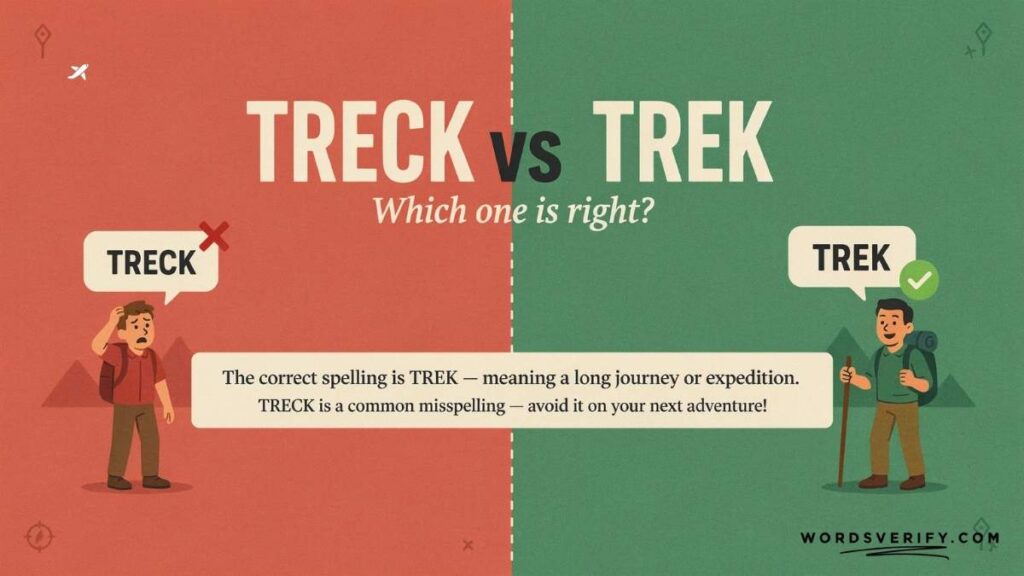
Have you ever written “treck” and then paused, wondering whether that extra “c” is actually supposed to be there? It’s an easy mistake to make. English has plenty of familiar words ending in “-eck,” so “treck” can look perfectly reasonable at first glance. However, when you mean a long, difficult, or tiring journey, the correct spelling is “trek.” This Treck vs Trek confusion also gets trickier with words like “trekked” and “trekking.” Understanding the spelling, meaning, and word forms will help you avoid these mistakes in everyday writing. Once you learn the pattern, “treck” becomes much easier to spot and correct.
Quick Answer
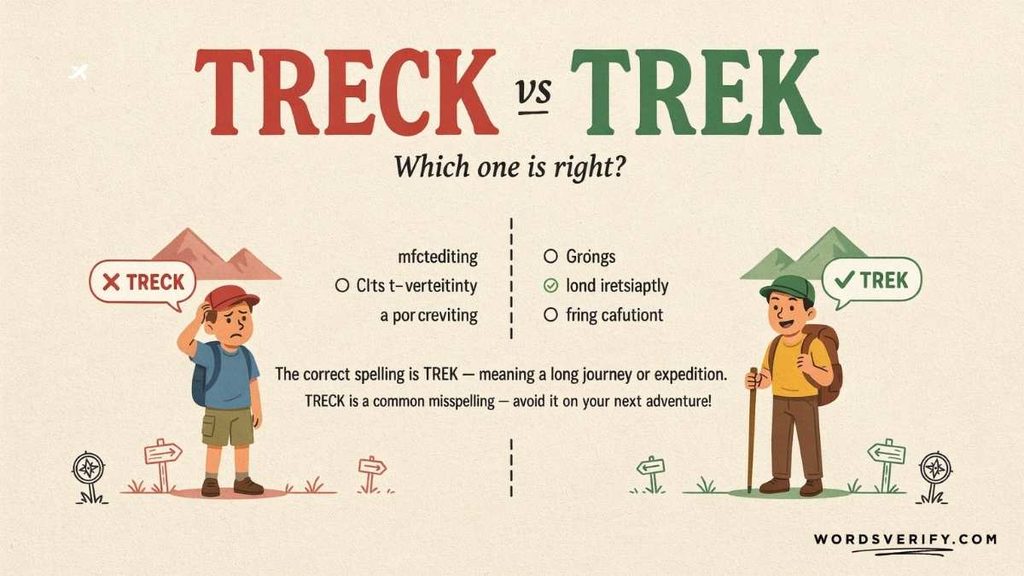
If you’re wondering, “Is it treck vs trek?” the answer is trek.
“Trek” refers to a long, difficult, or tiring journey. It can also mean to travel a long distance, especially through challenging terrain.
For example:
- We went on a long trek through the mountains.
- They trekked across the valley.
- She enjoys trekking in the mountains.
- We went on a long treck through the mountains. Incorrect.
Here’s the difference at a glance:
| Word | Standard modern spelling? | Meaning |
|---|---|---|
| Trek | Yes | A long or difficult journey; to make such a journey |
| Treck | No | Historical variant, not normally used today |
| Trekked | Yes | Past tense of trek |
| Trekking | Yes | The -ing form of trek |
| Treks | Yes | Plural noun or third-person singular verb |
So if you’re writing in modern standard English, “trek” is the form you want.
Learn how to use confusing more words correctly
Ballot vs Bullet difference and correct usage
What Does Trek Mean?
The word “trek” generally describes a long or difficult journey. It often makes people think of mountains, hiking boots, backpacks, and rough trails. However, you don’t have to be climbing a mountain to use it.
You might call a journey a trek simply because it takes a lot of time or effort.
For example:
- The hikers began their three-day trek before sunrise.
- We had a difficult trek through the forest.
- The village was reached after a long trek.
- Getting to the new office is quite a trek.
In the first three examples, “trek” refers to a physical journey. In the last one, it’s used more casually. The speaker simply wants to emphasize that getting to the office is a long or inconvenient trip.
So when you ask, “What does trek mean?” think of a journey that requires noticeable time, distance, or effort.
What Is a Trek?
A trek is a long or challenging journey, often involving walking through natural or difficult terrain.
A trek might take place in:
- Mountains
- Forests
- Deserts
- Hills
- Valleys
- Remote areas
- Rough terrain
- Long-distance trails
A quick walk around your neighborhood usually wouldn’t be called a trek. On the other hand, spending an entire day walking across a mountain trail could easily be described as a trek.
The main idea is that the journey involves some degree of distance or effort.
That’s also why you might hear someone say, “It’s quite a trek from here.” They don’t necessarily mean they’re going hiking. They may simply mean the destination is far away.
Learn how to use confusing more words correctly
Honor vs Honour difference and Correct usage
Treck vs Trek What’s the Difference?
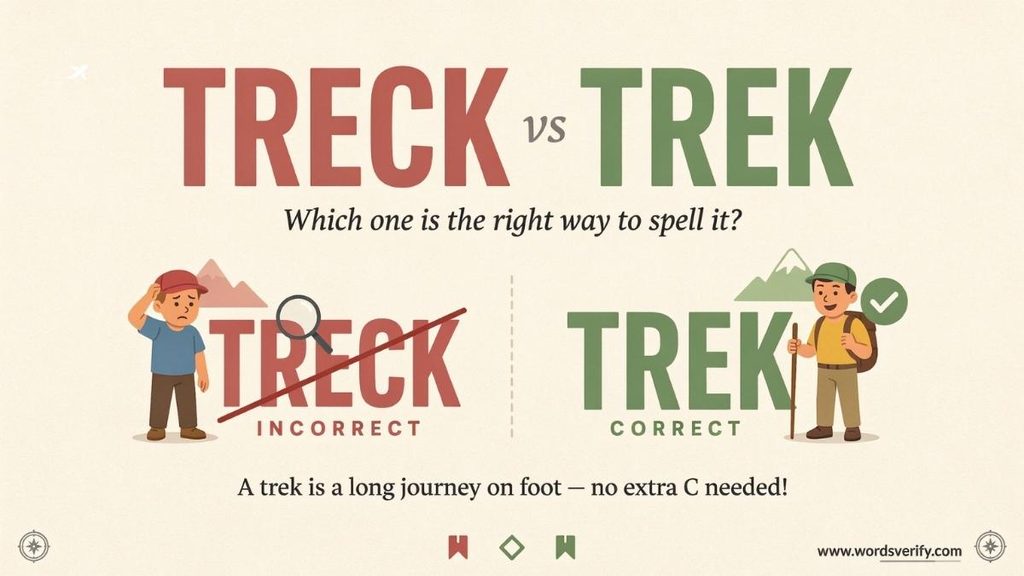
The difference between treck and trek is simple in modern English.
Trek is the standard spelling.
“Treck” isn’t the standard modern spelling for a long or difficult journey.
There is a small historical detail worth knowing. “Treck” has been recorded as an older spelling of “trek.” That means the form isn’t completely unknown in historical English. Still, that doesn’t make it the normal spelling today.
For everyday modern writing, use “trek.”
| Feature | Trek | Treck |
|---|---|---|
| Standard modern English | Yes | No |
| Used as a noun | Yes | Not normally |
| Used as a verb | Yes | Not normally |
| Refers to a long journey | Yes | Historical use |
| Common in modern writing | Yes | No |
| Common spelling mistake | No | Yes |
This is one of those cases where knowing the modern standard form saves you from a very small but common spelling mistake.
Is Treck a Word?
This question doesn’t have quite as simple an answer as “yes” or “no.”
“Treck” has appeared historically as a spelling variant of “trek.” However, it isn’t the standard modern spelling of the English word used for a long journey.
For modern writing, use “trek.”
For example:
Incorrect: We planned a mountain treck.
Correct: We planned a mountain trek.
The important thing to remember is that a word can appear in historical records without being the form people normally use today.
Is Trek a Word?
Yes. “Trek” is a standard English word.
It can work as both a noun and a verb.
As a noun:
The trek lasted three days.
As a verb:
The hikers trekked through the mountains.
“Trek” is used in both American and British English. The spelling remains the same in both varieties.
So you don’t need to wonder whether American English uses “trek” while British English uses “treck.” It doesn’t. The standard spelling is “trek.”
Learn how to use confusing more words correctly
Steer vs Stear difference and Correct usage
Trek Meaning in English
The meaning of “trek” centers on the idea of a long or difficult journey.
Trek as a Noun
As a noun, “trek” refers to the journey itself.
For example:
The expedition included a demanding trek through the mountains.
Here are a few more examples:
- The trek lasted three days.
- We planned a mountain trek.
- The long trek exhausted everyone.
- The hikers prepared for a difficult trek.
- Their trek through the forest took most of the day.
Trek as a Verb
As a verb, “trek” means to make a long or difficult journey.
For example:
The climbers trekked across the valley.
You can also use “trek” with words that show direction or location:
- Trek through the forest
- Trek across the desert
- Trek into the mountains
- Trek up the hill
- Trek down the trail
- Trek along the path
The meaning stays the same at its core. Someone is making a journey that takes time, distance, or effort.
Trek Spelling Why Isn’t It “Treck”?
The spelling of “trek” can look strange if you’re used to English words that end in “-eck.”
Consider:
- Check
- Deck
- Neck
- Wreck
- Speck
Because “trek” has the same short “e” sound and ends with a /k/ sound, writing “treck” can feel natural.
English spelling, however, doesn’t always follow the pattern we expect.
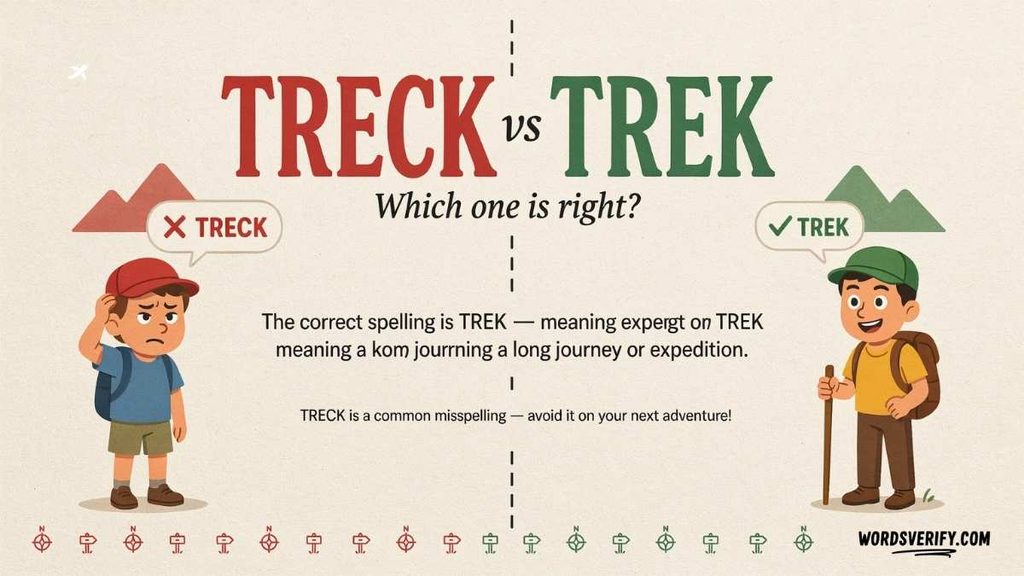
The correct spelling is:
T-R-E-K
The word came into English through Afrikaans, which helps explain why its spelling doesn’t follow the same pattern as words such as “check” or “wreck.”
There isn’t a missing “c.” The “k” is simply part of the established spelling.
Trek Word Origin
The history of “trek” is interesting because the word didn’t originally develop from the same spelling patterns as many familiar English words.
English adopted “trek” from Afrikaans trek. It is related to the Dutch word trekken, which carries meanings connected with pulling, moving, and traveling.
The word became strongly associated with long-distance movement in southern Africa. During the nineteenth century, it was especially associated with the movement of Boer settlers by ox wagon.
Over time, English speakers began using “trek” more broadly.
Today, it can describe:
- A mountain journey
- A long walk
- A difficult journey
- An outdoor expedition
- A tiring trip
- A figurative journey or lengthy process
Knowing the history isn’t necessary to spell the word correctly, but it does explain why “trek” looks a little different from what you might expect.
Learn how to use confusing more words correctly
Tying vs Tieing difference and Correct usage
Trek Pronunciation
The “Trek” is pronounced /trɛk/.
It’s a short, one-syllable word.
The vowel has the short “e” sound you hear in words such as “bed” and “head.” It ends with a clear /k/ sound.
You might pronounce it similarly to:
- Deck
- Neck
- Check
- Wreck
- Speck
The similar sound may be one reason people accidentally write “treck.” The pronunciation makes the spelling feel familiar.
Even so, the standard spelling is “trek.”
Trek vs Trekking
The difference between “trek” and “trekking” is mainly grammatical.
“Trek” is the base form.
“Trekking” is the present participle. It can also work as a noun when you’re talking about the activity itself.
Compare these sentences:
- We trek through the mountains every summer.
- We are trekking through the mountains this week.
- Trekking is popular in this region.
The first sentence uses “trek” as a verb. The second uses “trekking” as part of the present progressive tense. The third treats “trekking” as the name of an activity.
Trecking vs Trekking
If you’re asking, “Is it trecking or trekking?” the correct spelling is trekking.
The word follows this pattern:
trek → trekking
The final “k” is doubled before “-ing.”
So:
- Trekking — correct
- Trecking — incorrect
- Treking — incorrect
For example:
Correct: They went trekking in the mountains.
Incorrect: They went trecking in the mountains.
Once you learn the word family, this spelling becomes much easier to remember.
Trecked vs Trekked
The correct past tense is trekked.
If you’re asking, “Is it trecked or trekked?” choose “trekked.”
Examples:
- We trekked through the snow.
- They trekked across the valley.
- She trekked for hours before reaching the camp.
- The group had trekked through difficult terrain all day.
The spelling pattern is:
trek → trekked
Not:
treck → trecked
Learn how to use confusing more words correctly
Cudos vs Kudos difference and Correct usage
What Is the Past Tense of Trek?
The past tense of “trek” is trekked.
| Form | Word | Example |
|---|---|---|
| Base form | trek | We trek through the hills. |
| Third-person singular | treks | He treks regularly. |
| Past tense | trekked | They trekked yesterday. |
| Past participle | trekked | They have trekked across the valley. |
| Present participle | trekking | They are trekking now. |
The doubled “k” is important in both “trekked” and “trekking.”
What Is the Plural of Trek?
The plural of “trek” is treks.
You simply add “-s”:
trek → treks
For example:
- We completed several treks during our vacation.
- The guide organizes mountain treks.
- Their previous treks took them through remote regions.
- The company offers short and long treks.
There’s no “c” in the plural form either.
Trek vs Track Don’t Confuse These Words
Another common mix-up is “trek” and “track.”
The two words have very different meanings.
| Word | Meaning | Example |
|---|---|---|
| Trek | A long or difficult journey | We went on a mountain trek. |
| Track | A path, route, mark, or course | We followed a forest track. |
Compare these:
“We went on a trek through the mountains.”
Here, “trek” describes the journey.
“We followed a track through the mountains.”
Here, “track” describes the path.
The words may look similar, but they aren’t interchangeable.
Is Trek the Same as Hiking?
Hiking and trekking are closely related, but they don’t always mean exactly the same thing.
Hiking is a broad term for walking outdoors, often for recreation. Trekking often suggests a longer or more demanding journey.
| Hiking | Trekking |
|---|---|
| Can be short or long | Often suggests a longer journey |
| Usually involves outdoor walking | Often involves extended outdoor travel |
| Can last a few hours | Can last several days |
| May be easy or difficult | Often suggests greater effort |
| Often takes place on trails | Can involve longer routes and remote areas |
These aren’t strict rules. People sometimes use “hiking” and “trekking” interchangeably.
A difficult mountain hike, for example, could easily be called a trek.
The main difference is the impression the word creates. “Trekking” often puts more emphasis on distance, effort, or adventure.
Learn how to use confusing more words correctly
Seel vs Seal Difference and correct usage
Common Mistakes With Treck
The most common mistake is adding a “c” where it doesn’t belong Treck vs Trek.
Treck Instead of Trek
Incorrect: We planned a mountain treck.
Correct: We planned a mountain trek.
Trecking Instead of Trekking
Incorrect: They went trecking in the mountains.
Correct: They went trekking in the mountains.
Trecked Instead of Trekked
Incorrect: We trecked across the valley.
Correct: We trekked across the valley.
Trek Instead of Track
If you’re talking about the journey itself, “trek” may be the word you need.
If you’re talking about a path, route, or mark, “track” may be correct.
Adding a C Because of Similar Words
Words such as “check,” “deck,” and “neck” can make “treck” look convincing.
Unfortunately, English spelling doesn’t always work by visual patterns.
“Trek” has its own established spelling, so the safest approach is simply to remember it as a separate word.
How to Use Trek in Everyday English
You don’t have to be hiking through the Himalayas to use the word “trek.”
People often use it casually when a journey feels long, tiring, or inconvenient.
For example:
It’s quite a trek from my apartment to the new office.
The speaker doesn’t necessarily mean they’re walking. They simply want to emphasize that getting there takes some effort.
Here are some other natural examples:
- It’s a long trek from the parking lot to the stadium.
- Getting to the office is quite a trek.
- We made the trek back home after dinner.
- The store is a bit of a trek from here.
- The campsite was a long trek from the main road.
This casual use gives the word a little more character than simply saying “trip” or “walk.”
Trek in Travel and Adventure Writing
Travel writers often use “trek” because it gives readers a stronger sense of distance and effort.
Compare:
We walked through the mountains.
We trekked through the mountains.
Both sentences are correct. However, “trekked” makes the journey sound more substantial.
The same idea applies to:
They went on a long trek through the forest.
The word “trek” suggests that this wasn’t just a quick walk. It was a journey that required time or effort.
Learn how to use confusing more words correctly
Peices vs Pieces difference and correct usage
Common Phrases With Trek
Learning common phrases can make the word easier to use naturally.
Nouns Used With Trek
- Mountain trek
- Desert trek
- Forest trek
- Jungle trek
- Adventure trek
- Long trek
- Difficult trek
- Challenging trek
- Multi-day trek
- High-altitude trek
- Guided trek
- Hiking trek
Common Verb Combinations
- Trek through the forest
- Trek across the desert
- Trek into the mountains
- Trek up the hill
- Trek down the trail
- Trek along the path
- Go on a trek
- Make a trek
- Take a trek
For example:
The group planned a multi-day trek through the mountains.
They had to trek through the forest to reach the village.
The hikers prepared for a difficult trek across rough terrain.
Can Trek Be Used Figuratively?
Yes. “Trek” can describe something other than a literal journey.
For example:
Getting through all that paperwork was a trek.
The project became a long trek toward completion.
Here, nobody is necessarily walking anywhere. The word is being used as a metaphor for something that takes a lot of time or effort.
It’s easy to understand why this use became popular. A long project can sometimes feel like a long hike. You start with a destination in mind, keep moving forward, and occasionally wonder how much farther you have to go.
Is Trek Formal or Informal?
“Trek” works in both formal and informal English.
For example:
The expedition involved a demanding trek through the mountains.
This sounds perfectly suitable for informative or formal writing.
Now consider:
It’s quite a trek from here to the station.
That’s more conversational.
The word itself isn’t strictly formal or informal. The context determines the tone.
Learn how to use confusing more words correctly
Advise vs Advice which one is correct
Is Trek Used in American English?
Yes. “Trek” is commonly used in American English.
The standard spelling is:
trek
There isn’t an American spelling such as “treck.”
The spelling also stays the same across several major varieties of English.
| Variety | Standard spelling |
|---|---|
| American English | trek |
| British English | trek |
| Canadian English | trek |
| Australian English | trek |
So there’s no need to change the spelling based on your audience.
Is Treck vs Trek the Correct Spelling?
If you’re looking for the treck or trek correct spelling, choose “trek.”
That’s the standard modern form.
Whether you’re describing a mountain journey, a difficult hike, a long walk, or a tiring trip across town, “trek” is the spelling to use.
Its main forms are:
- Trek
- Treks
- Trekked
- Trekking
- Trekker
The extra “c” in “treck” isn’t part of the standard modern spelling.
A Simple Way to Remember Trek
Here’s an easy trick for Treck vs Trek.
Think of trek as a short word for a long journey.
Then remember the word family:
trek → treks → trekked → trekking → trekker
If you catch yourself typing “treck,” stop for a moment and check the spelling.
The correct pattern always starts with:
T-R-E-K
Once that base form is familiar, “trekked” and “trekking” become much easier to spell.
Learn how to use confusing more words correctly
Lose vs Loose which one is correct?
Trek Word Forms at a Glance
| Grammatical form | Word | Example |
|---|---|---|
| Base verb | trek | We trek through the hills. |
| Noun | trek | The trek was challenging. |
| Plural noun | treks | They organize several treks. |
| Third-person verb | treks | She treks every summer. |
| Past tense | trekked | We trekked across the valley. |
| Past participle | trekked | They have trekked through the region. |
| Present participle | trekking | They are trekking today. |
| Person noun | trekker | Each trekker carried water. |
Treck vs Trek Examples in Context
Seeing the correct and incorrect forms together can make the difference easier to remember.
| Incorrect | Correct |
|---|---|
| We planned a mountain treck. | We planned a mountain trek. |
| They went trecking in the mountains. | They went trekking in the mountains. |
| We trecked across the valley. | We trekked across the valley. |
| The treck lasted three days. | The trek lasted three days. |
| She enjoys trecking through forests. | She enjoys trekking through forests. |
The pattern is simple:
trek → treks → trekked → trekking → trekker
Practice Session Treck vs Trek
Test your understanding of the correct spelling, meaning, and word forms of “Treck vs Trek.” Fill in each blank with the most appropriate answer.
- We went on a long mountain ______ during our vacation.
- The hikers ______ through the forest for several hours.
- She enjoys ______ in the mountains during the summer.
- The journey to the village was quite a ______.
- He completed several difficult ______ last year.
- They decided to ______ across the valley before sunset.
- The group spent the morning ______ through rough terrain.
- The correct spelling is ______, not “treck.”
- We ______ up the steep trail before taking a break.
- The three-day ______ required careful preparation.
- They are ______ through the forest today.
- The hikers have ______ across the valley.
- A mountain ______ can be physically demanding.
- She regularly goes on long ______ with her friends.
- It was a tiring ______ from the station to the hotel.
- The travelers had to ______ through the desert.
- He is an experienced ______ who enjoys exploring remote areas.
- The team spent two days ______ through the mountains.
- They ______ along the trail until they reached the campsite.
- The guide organizes adventure ______ for visitors.
- “Trekking” is formed from the base word ______.
- The past tense of “trek” is ______.
- The plural form of “trek” is ______.
- A person who takes part in trekking can be called a ______.
- When you mean a long or difficult journey, use “trek,” not ______.
Answers
- trek
- trekked
- trekking
- trek
- treks
- trek
- trekking
- trek
- trekked
- trek
- trekking
- trekked
- trek
- treks
- trek
- trek
- trekker
- trekking
- trekked
- treks
- trek
- trekked
- treks
- trekker
- treck
Here’s a trusted source for clear more words Comparison:
FAQs
What is the correct spelling Treck vs Trek?
The correct modern spelling is “trek.” Use it when referring to a long, difficult, or tiring journey.
Why is “treck” commonly misspelled?
“Treck” can look correct because English has many familiar words ending in “-eck,” such as “check” and “wreck.” However, the standard spelling of this word is “trek.”
What does “trek” mean in a sentence?
“Trek” refers to a long or challenging journey. For example, “The hikers went on a trek through the mountains.”
Can “trek” describe a long car journey?
Yes. In informal English, “trek” can describe any long or tiring journey, including a trip by car. For example, “It was a three-hour trek to the coast.”
What is the difference between a trek and a journey?
A journey is a general term for traveling from one place to another. A trek usually suggests that the journey is long, difficult, tiring, or physically demanding.
Does “trek” always mean hiking?
No. “Trek” is often associated with walking or hiking, but it can also describe a long or tiring trip more generally, especially in informal English.
What is the adjective form of trek?
There isn’t a common everyday adjective formed directly from “trek.” Words such as “trekking,” “trekked,” or phrases such as “trekking journey” are more natural depending on the sentence.
What is someone who goes on a trek called?
A person who goes on a trek can be called a “trekker.” The word is commonly used for someone who enjoys or takes part in trekking.
Is “trekker” spelled with a c?
No. The correct spelling is “trekker,” which comes from “trek.” It does not contain a “c.”
Why does “trekked” have two k’s?
The final consonant is doubled before the “-ed” ending in “trekked.” The same pattern appears in “trekking,” which also has two k’s.
Is “treking” a correct spelling?
No. The standard spelling is “trekking,” with two k’s.
What is the third-person singular form of trek?
The third-person singular form is “treks.” For example, “He treks through the mountains every summer.”
Can “trek” be used in a formal sentence?
Yes. “Trek” can be used in both formal and informal writing. For example, “The expedition included a challenging trek through the region.”
What is the difference between trekking and hiking?
Both involve walking outdoors, but trekking often suggests a longer or more demanding journey. The distinction isn’t strict, and the two words can overlap in everyday English.
Can “trek” refer to a difficult walk across a city?
Yes. In casual English, someone might call a long walk across a city a “trek,” especially when the distance makes the journey feel tiring.
Is “trek” used in both American and British English?
Yes. “Trek” is used in both American and British English, and the standard spelling remains the same.
Does “trek” have a plural form?
Yes. The plural form is “treks.” For example, “The guide has organized several mountain treks.”
What words commonly go with trek?
Common combinations include “mountain trek,” “long trek,” “difficult trek,” “desert trek,” “forest trek,” and “multi-day trek.”
Can “trek” be used as a metaphor?
Yes. “Trek” can describe something that feels like a long or difficult journey. For example, someone might call a lengthy project “a long trek toward completion.”
Is “treck” acceptable in modern formal writing?
Generally, no. Although “treck” has appeared as a historical spelling variant, “trek” is the standard modern spelling and is the safer choice for formal writing.
What is the easiest way to remember the spelling of trek?
Remember the four-letter base word: “trek.” Then build the other forms from it: “treks,” “trekked,” and “trekking.”
Is “trek” a noun or a verb?
“Trek” can be both. As a noun, it means a long or difficult journey. As a verb, it means to make such a journey.
What prepositions are commonly used with trek?
Common combinations include “trek through,” “trek across,” “trek into,” “trek along,” and “trek up.” The correct choice depends on the route being described.
Is “trek through the mountains” grammatically correct?
Yes. “Trek through the mountains” is grammatically correct and means to make a journey through mountainous terrain.
Learn how to use confusing more words correctly
Attornies vs Attorneys Which one Is Correct?
conclusion
The treck vs trek confusion may seem like a tiny spelling problem, but that extra “c” can easily sneak into your writing. When you mean a long, challenging, or tiring journey, “trek” is the correct modern spelling. It can work as both a noun and a verb, giving us forms such as “treks,” “trekked,” and “trekking.” While “treck” has appeared as a historical spelling variant, it isn’t the standard form used today. So, the next time you’re writing about a mountain adventure or a long trip, remember one simple rule: trek is spelled with a “k.” Keep the “c” out of your trek, and your spelling will stay on the right path!

Lisa AJS is an experienced blogger and language enthusiast at Words Verify, dedicated to making grammar simple, practical, and enjoyable. She writes engaging content on commonly confused words, grammar mistakes, word meanings, and everyday language challenges.