
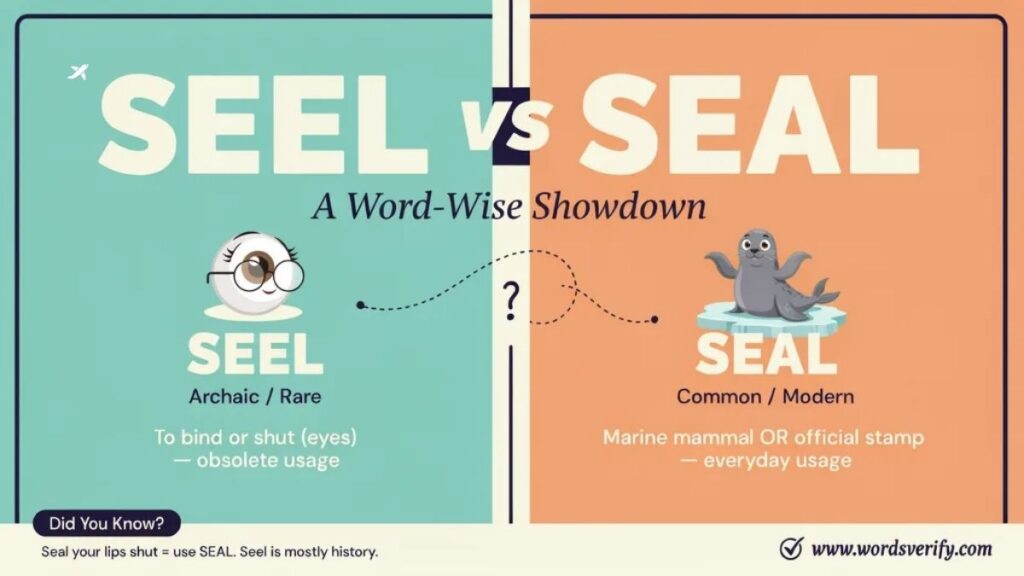
Have you ever typed a word confidently only to stop and wonder, “Wait, is that really the right spelling?” That’s exactly what happens with seel vs seal. These words look almost identical and can easily cause a spelling mix-up, but they don’t share the same everyday meaning. Seal is the word you’ll commonly use for closing a package, finalizing an agreement, marking a document, or naming the familiar marine mammal. Seel is much rarer and belongs mainly to historical falconry. Once you understand what each word means and where it belongs, this confusing pair becomes surprisingly easy to tell apart.
Quick Answer
The easiest way to separate these two words is to look at their meanings.
| Word | Meaning | Typical use |
|---|---|---|
| Seal | To close, secure, or make something airtight | Seal an envelope |
| Seal | To finalize something | Seal the deal |
| Seal | An official mark or emblem | Official seal |
| Seal | A marine mammal | A seal swimming in the ocean |
| Seel | A specialized historical falconry term | Seel a hawk or falcon |
For normal modern writing, seal is the word you want in almost every situation.
Seel has a legitimate place in English, but it belongs to a much narrower vocabulary.
What Does “Seal” Mean?
The word seal has several meanings. That’s one reason it’s much more common than seel.
As a verb, seal generally means to close or secure something. It can also describe making something final or preventing something from getting through.
As a noun, seal can refer to a physical closure, an official mark, or a marine mammal.
Let’s look at each use more closely.
Seal as a Verb
When you seal something, you close it securely.
For example:
- Please seal the envelope before mailing it.
- She sealed the package with strong tape.
- The workers sealed the container to keep moisture out.
- The plumber sealed the crack in the pipe.
The word can also describe making something final.
For example:
The two companies signed the agreement to seal the deal.
Nobody is physically closing anything in that sentence. Instead, seal has a figurative meaning. It suggests that an agreement or decision has become final or secure.
You can use the same idea in expressions such as:
- Seal the deal
- Seal an agreement
- Seal someone’s fate
- Seal a victory
- Seal a commitment
Seal can also mean to close an area so that people cannot enter or leave.
For example:
The police sealed off the entrance.
Here, sealed off means blocked or closed to access.
Seal as a Noun
Seal also works as a noun.
One meaning refers to something that closes an opening and prevents air, water, dust, or another substance from passing through.
For example:
The rubber seal around the door keeps water out.
A seal can also be an official mark or emblem. Governments, universities, companies, and other organizations may have official seals that identify their authority or identity.
You might see:
- An official seal
- A government seal
- A company seal
- A university seal
- A wax seal
The word also appears in the familiar expression seal of approval. This means that someone or an organization has formally or strongly approved something.
Then there’s the animal:
We saw a seal resting on the rocks near the coast.
In this sentence, seal refers to the marine mammal.
Learn the difference between confusing more English words
Cudos vs Kudos difference and Correct usage
What Does “Seel” Mean?
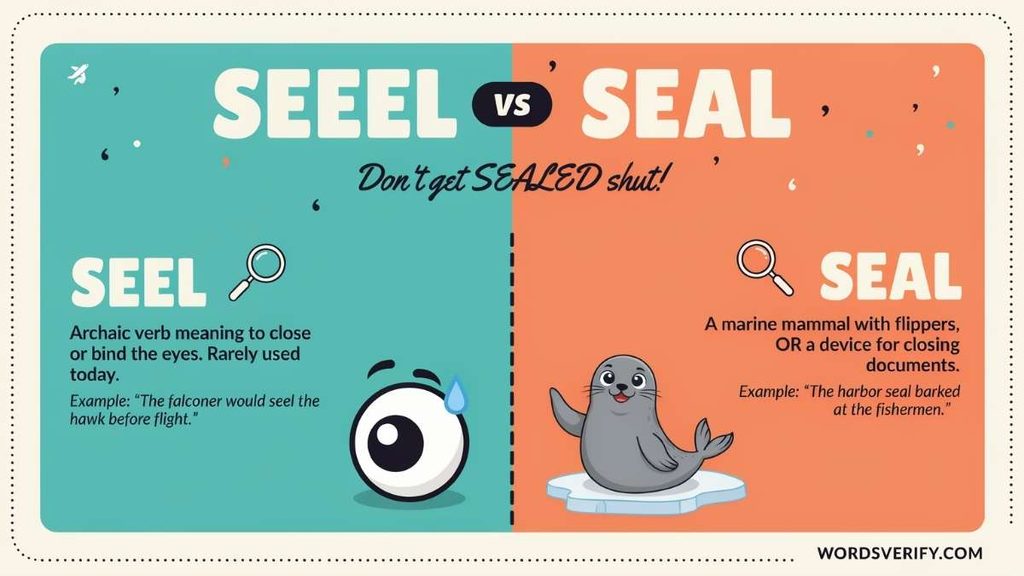
Seel is a much less familiar word.
Yes, it is a real English word. However, you won’t normally see it in everyday conversations, emails, school assignments, or ordinary business writing.
The best-known meaning of seel comes from traditional falconry. It referred to sewing or stitching a bird’s eyelids shut as part of an old falcon-training practice.
The word is therefore closely connected with:
- Falconry
- Falcons
- Hawks
- A bird’s eyelids
- Historical bird training
- Older literary and historical writing
That specialized meaning is completely different from the everyday meaning of seal.
Seel in Historical Falconry
Falconry has a long history, and older texts contain terminology that has almost disappeared from ordinary English.
Seel is one example.
Historical falconers used the word for a practice involving the eyelids of a hawk or falcon. The term can therefore appear in books or historical material discussing traditional falconry.
This is why it would be misleading to say that seel is simply a misspelling.
It isn’t.
Seel is a real word. It’s just an extremely uncommon one today.
Learn the difference between confusing more English words
Tying vs Tieing difference and Correct usage
Seel vs Seal The Main Difference
The difference between seel and seal is mainly a difference in meaning and usage.
Seal is part of ordinary modern English. Seel is a specialized historical term.
| Feature | Seal | Seel |
|---|---|---|
| Common in everyday English | Yes | No |
| Used as a verb | Yes | Yes |
| Used as a noun | Yes | Very limited |
| Means “close securely” | Yes | No |
| Means “finalize” | Yes | No |
| Refers to an official mark | Yes | No |
| Refers to a marine mammal | Yes | No |
| Connected with historical falconry | No | Yes |
| Common in modern writing | Yes | No |
The spelling differs by only one vowel, but the meanings are far apart.
Learn the difference between confusing more English words
Steer vs Stear difference and Correct usage
Seel vs Seal Which One Should You Use?

For most writing, use seal.
If you’re talking about closing something, securing something, making something final, or referring to the marine animal, seal is the correct choice.
Use seel only when you’re deliberately using its specialized historical meaning.
A quick way to decide is to ask yourself what you’re describing.
- Closing an envelope? Use seal.
- Securing a package? Use seal.
- Closing a container? Use seal.
- Preventing a leak? Use seal.
- Finalizing an agreement? Use seal.
- Referring to an official mark? Use seal.
- Talking about the marine mammal? Use seal.
- Discussing the historical falconry practice involving a bird’s eyelids? Seel may be appropriate.
This is the practical answer to “which is correct seel or seal?” The answer depends on the meaning, but seal is overwhelmingly the right choice in everyday English.
Seal vs Seel an Envelope?
If you’re wondering whether you should seal or seel an envelope, the answer is clear:
Seal an envelope.
When you close the flap of an envelope, you seal it.
For example:
- Please seal the envelope before putting it in the mailbox.
- She sealed the envelope with adhesive.
- The letter was sealed inside the envelope.
- Make sure the envelope is properly sealed.
Writing “seel an envelope” would be incorrect for this meaning.
Seal vs Seel a Package?
The correct phrase is seal a package.
For example:
- Please seal the package before shipping it.
- She sealed the box with packing tape.
- The package must remain sealed during transportation.
- Make sure the box is securely sealed.
The word seal works because you’re closing or securing the package.
Seal vs Seel the Deal?
This expression is always seal the deal.
The phrase means to make an agreement final or secure.
For example:
The final contract sealed the deal.
You could also say:
Their agreement finally sealed the deal.
Here, seal is being used figuratively. There’s no physical lid or opening involved. The action simply makes the agreement definite.
So if you’re deciding between “seal the deal” and “seel the deal,” choose seal.
Seal vs Seel a Document?
Use seal.
A document can have an official seal placed on it to represent an organization or authority.
For example:
The document carries the official seal of the university.
The word can also be used as a verb in contexts involving closing, securing, or formally finalizing something.
The important point is that seel isn’t the ordinary spelling for these meanings.
Seal vs Seel of Approval?
The correct expression is seal of approval.
A seal of approval indicates that something has received approval or acceptance.
For example:
The organization gave the new program its seal of approval.
The expression can be literal when an organization has a formal emblem or mark. It can also be figurative when someone simply gives strong approval.
“Seel of approval” is not the standard expression.
Learn the difference between confusing more English words
Honor vs Honour difference and Correct usage
Why Are Seel and Seal Confused?
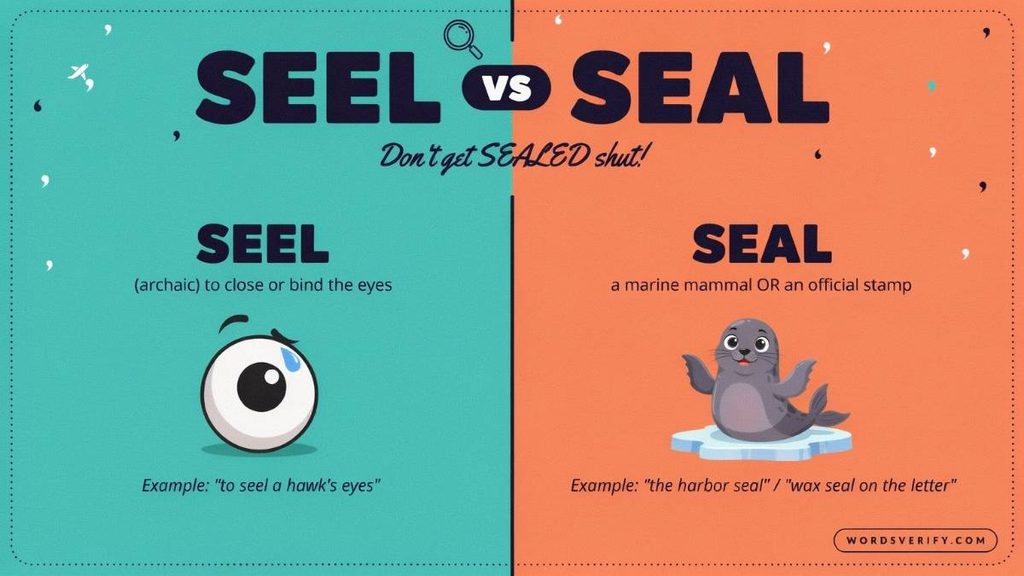
The confusion makes sense because the two words are visually similar and can sound the same.
When you hear someone say the word, you don’t necessarily know which spelling they intend.
That’s where context becomes important.
Similar Pronunciation
Seal has the long “e” sound heard in words such as feel, meal, and wheel.
Seel can have the same basic pronunciation.
As a result, the two can function as homophones. A homophone is a word that sounds the same as another word while having a different spelling or meaning.
This creates a simple problem: your ears can’t always tell you which spelling to write.
Your understanding of the sentence has to do that job.
Similar Spelling
The words differ by just one vowel:
Seal = S-E-A-L
Seel = S-E-E-L
That tiny difference can easily lead to a spelling mistake.
If you’re trying to remember how to spell seal, connect it with familiar words such as deal, meal, real, and clean. The “ea” spelling is common in these words.
A particularly useful memory trick is:
Seal the deal.
Both words contain “ea,” which makes the phrase an easy spelling reminder.
How to Spell Seal
If you mean “to close or secure,” the spelling is:
S-E-A-L
Common forms include:
- Seal
- Seals
- Sealed
- Sealing
- Sealer
- Reseal
Examples:
She will seal the package.
He seals the envelopes every morning.
They sealed the container yesterday.
The workers are sealing the opening.
The machine is a heat sealer.
You can reseal the bag after opening it.
Notice how the base spelling remains connected to seal throughout these forms.
How to Spell Seel
If you’re using the rare falconry word, the spelling is:
S-E-E-L
Its forms can include:
- Seel
- Seels
- Seeled
- Seeling
Because the word is so uncommon, most readers won’t encounter it often.
That’s another reason not to use it as a casual alternative to seal.
Learn the difference between confusing more English words
Ballot vs Bullet difference and correct usage
Seal vs Seel Pronunciation
Pronunciation is one of the main reasons these words cause trouble.
How Do You Pronounce Seal?
Seal has a long “e” sound followed by the “l” sound.
It rhymes with familiar words such as:
- Feel
- Heel
- Meal
- Wheel
How Do You Pronounce Seel?
The specialized word seel is generally pronounced like seal.
That means seal vs seel pronunciation doesn’t provide a reliable spelling clue.
If you’re writing the word rather than speaking it, focus on meaning.
Closing something? Seal.
Historical falconry terminology? Seel.
Learn the difference between confusing more English words
Insite vs Insight difference and Correct usage
Is Seel a Word?
Yes.
If you’ve ever searched “is seel a word” and wondered whether the dictionary is playing a prank, it isn’t.
Seel is a legitimate English word.
The catch is that it’s rare.
It doesn’t function as a general alternative to seal. Its most recognizable dictionary sense belongs to specialized falconry terminology.
So the answer to “is seel a real word?” is yes. The answer to “can I use seel instead of seal?” is generally no.
Those are two different questions.
Is Seel Correct?
Seel can be correct when the context calls for its specialized meaning.
For example, a historical discussion of falconry may legitimately use seel.
However, these sentences require seal:
- Please seal the envelope.
- Seal the package before shipping it.
- They sealed the deal.
- The container was tightly sealed.
- We saw a seal near the shore.
Using seel in those sentences would be a spelling and word-choice error.
Is Seal Correct?
Yes, when you’re using one of its ordinary meanings.
Seal is correct when you mean:
- Close something.
- Secure something.
- Prevent something from leaking.
- Finalize an agreement.
- Mark something officially.
- Refer to the marine mammal.
That’s why seal appears so often in everyday English.
Learn the difference between confusing more English words
Humour vs Humor Difference and Correct usage
Is Seel Another Spelling of Seal?
No.
This is worth remembering because the similar pronunciation can create the impression that one is simply an alternative spelling of the other.
They’re not.
Seel has its own meaning and history. Seal has a much broader range of modern meanings.
So although the words may sound alike, you shouldn’t swap one for the other.
Are Seal and Seel Homophones?
They can be.
Because seal and seel can have the same pronunciation, they fit the practical definition of homophones when pronounced alike.
This is similar to many other English word pairs where the sound doesn’t tell you the spelling.
For example, when you hear “seal,” context tells you whether you’re thinking about closing something or an animal. The spelling then follows the meaning.
Different Meanings of Seal
Seal is a versatile word.
| Meaning | Example |
|---|---|
| Close something | Seal the envelope. |
| Secure something | Seal the package tightly. |
| Prevent leakage | Seal the crack. |
| Make airtight | Create an airtight seal. |
| Finalize an agreement | Seal the deal. |
| Official mark | The document has an official seal. |
| Approval | The product received a seal of approval. |
| Marine mammal | A seal swam near the boat. |
| Close off an area | Police sealed off the entrance. |
This variety explains why you’ll encounter seal in everyday conversations, business documents, technical writing, government materials, and discussions about wildlife.
Learn the difference between confusing more English words
Eying vs Eyeing difference and Correct usage
The Historical Meaning of Seel
The history of seel gives the word its unusual place in English.
Traditional falconry developed its own specialized vocabulary because falconers needed words for specific techniques involving birds, equipment, training, and behavior.
Seel became associated with a practice involving a hawk’s or falcon’s eyelids.
Historical sources also record related uses involving shutting or closing the eyes.
Today, this terminology is mostly encountered when people study historical falconry or read older texts.
That’s why the word can feel strange to a modern reader.
It hasn’t necessarily disappeared from the dictionary simply because it disappeared from everyday conversation.
Seel in Historical Writing
If you’re reading an old book and come across seel, don’t immediately assume you’ve found a typo.
Older English contains many words that modern readers rarely encounter.
Seel is a good example.
Its historical use can appear in writing about:
- Falconry
- Hawks
- Falcons
- Bird training
- Closed or covered eyes
- Older literary language
Context is especially important with historical vocabulary.
A sentence written hundreds of years ago may use a word differently from the way a modern writer would.
Learn the difference between confusing more English words
Naive vs Nieve difference and Correct usage
Common Mistakes With Seel and Seal
Here are some of the mistakes readers commonly make.
Seel the Envelope
Incorrect for the ordinary meaning.
Correct:
Seal the envelope.
Seel the Deal
Incorrect.
Correct:
Seal the deal.
Seel the Package
Incorrect when you mean to close or secure it.
Correct:
Seal the package.
A Seel Swam in the Ocean
Incorrect if you’re talking about the animal.
Correct:
A seal swam in the ocean.
Assuming Seel Doesn’t Exist
This is also inaccurate.
Seel is a real word. It’s simply rare and specialized.
The better rule isn’t “seel is always wrong.”
The better rule is use the word that matches the meaning.
Learn the difference between confusing more English words
Carmel vs Caramel difference and Correct usage
Seal vs Seel in a Sentence
Seeing the words in context makes the difference much easier to remember.
Everyday Use of Seal
- Please seal the envelope before mailing it.
- The workers sealed the container.
- She sealed the package with tape.
- The plumber sealed the leak.
- The company sealed the agreement.
- The final goal sealed the team’s victory.
- The document bears an official seal.
- We saw a seal swimming near the coast.
Specialized Use of Seel
- The historical account describes the falcon as seeled during training.
The last example is deliberately different because it represents the rare historical meaning.
Seal Word Forms
The most useful forms of seal are easy to recognize.
| Word form | Meaning or use | Example |
|---|---|---|
| Seal | Base verb | Seal the box. |
| Seals | Present tense or plural noun | She seals the letters. |
| Sealed | Past tense or past participle | He sealed the package. |
| Sealing | Present participle or gerund | They are sealing the container. |
| Sealer | Person or device that seals | The heat sealer is working. |
| Reseal | Seal again | Reseal the bag after opening it. |
These forms appear regularly in modern English.
The forms of seel are far less common because the word itself is rarely used.
A Simple Memory Trick
When you’re unsure about seel spelling or seal spelling, remember:
Seal the deal.
The two words use the same “ea” spelling.
You can also remember that a seal can be something you close:
- Seal an envelope.
- Seal a package.
- Seal a container.
- Seal a crack.
- Seal a deal.
Then reserve seel for the unusual historical falconry context.
It turns a confusing spelling problem into a simple meaning check.
Practice session Seel vs Seal
Fill in each blank with seal vs seel. Pay attention to the meaning and context of each sentence.
- Please ______ the envelope before putting it in the mailbox.
- The company hopes to ______ the deal by Friday.
- She used tape to ______ the package securely.
- The official ______ appeared on the document.
- The marine ______ rested on the rocks near the shore.
- The workers need to ______ the crack to prevent water from entering.
- The agreement was finally ______ after several meetings.
- In historical falconry, a bird’s eyelids could be ______ed as part of an old practice.
- Make sure you ______ the container tightly before storing it.
- The university placed its ______ on the certificate.
- The plumber applied a material to ______ the leaking pipe.
- The manager said the contract would ______ the agreement between the two companies.
- Historians may encounter the word ______ in writings about traditional falconry.
- The box was carefully ______ed to protect its contents.
- A broken window can be ______ed temporarily with suitable material.
- The company added an official ______ to the document.
- The historical term ______ has a very different meaning from the modern verb “seal.”
- Please ______ the opening after you finish filling the container.
- The negotiations helped ______ the final agreement.
- The old falconry text described how a bird might be ______ed.
- The technician checked the door to make sure its rubber ______ was intact.
- The letter was placed inside a ______ed envelope.
- Modern readers rarely encounter the word ______ outside historical or specialized writing.
- The workers will ______ the entrance to prevent anyone from entering.
- Before sending the package, remember to ______ it properly.
Answers
- seal
- seal
- seal
- seal
- seal
- seal
- sealed
- seel
- seal
- seal
- seal
- seal
- seel
- sealed
- sealed
- seal
- seel
- seal
- seal
- seeled
- seal
- sealed
- seel
- seal
- seal
Here’s a trusted source for clear more words Comparison:
FAQs
Can “seel” be used in modern English?
“Seel” exists in English but is extremely uncommon in modern everyday writing. It is mainly found in historical or specialized discussions of falconry.
What does “seel” mean in falconry?
In historical falconry, “seel” referred to sewing or closing a trained bird’s eyelids. It’s an old term that you’re unlikely to encounter in ordinary modern English.
Is “seel” an archaic spelling of “seal”?
No. Although the two words look and sound similar, “seel” is not simply an old spelling of the modern word “seal.” They have different meanings and historical uses.
Can “seel” mean to close something?
Not in the ordinary modern sense. When you mean to close, secure, or make something airtight or watertight, use “seal.”
Is “seel” used as a noun or a verb?
“Seel” is primarily encountered as a historical verb connected with falconry. Its rare usage makes it very different from the common noun and verb “seal.”
What does “sealed” mean?
“Sealed” is the past tense and past participle of “seal.” It can mean that something has been closed or secured, or that an agreement or decision has been finalized.
What is the difference between “sealed” and “sealing”?
“Sealed” describes something that has already been closed or secured, while “sealing” describes the action of closing or securing it.
Is “sealing” the correct spelling?
Yes. “Sealing” is the correct form when you mean the act of closing or securing something. For example, “She is sealing the envelope.”
Is “seeling” ever correct?
“Seeling” can appear as a form of the rare historical verb “seel,” but it is not the spelling you want when you mean closing or securing something. In that everyday context, “sealing” is correct.
Can “seal” be used as both a noun and a verb?
Yes. As a verb, “seal” can mean to close, secure, or finalize something. As a noun, it can refer to a physical closure, an official mark, or a marine mammal.
Why does “seal” have so many meanings?
“Seal” developed several related and unrelated senses over the history of English. Context usually makes the intended meaning clear, whether you’re discussing a package, an official emblem, an agreement, or an animal.
What does “seal off” mean?
“Seal off” means to close an area or opening so that people, air, water, or other things cannot pass through it. For example, “Police sealed off the entrance.”
What does “seal up” mean?
“Seal up” means to close something completely or securely. You might seal up a box, container, crack, or opening.
Can “seal” refer to an official symbol?
Yes. A seal can be an official emblem or mark used by a government, institution, organization, or other authority to authenticate or identify something.
What is a seal impression?
A seal impression is a mark or design pressed onto a surface to represent an official authority, organization, person, or document.
Is “seal” pronounced differently from “seel”?
In many varieties of English, “seal” and “seel” can have the same pronunciation. This similarity in sound is one reason the two spellings can be confusing.
Are “seel” and “seal” homophones?
They can be homophones when pronounced the same way. However, they are different words with different meanings and uses.
Which spelling should I use in everyday writing?
Use “seal” when you mean to close, secure, finalize, authenticate, or refer to the marine mammal. “Seel” is generally limited to rare historical or specialized contexts.
Why might I see “seel” in an old book?
Older books may use “seel” because it was a recognized term in historical falconry. Its appearance in an old text does not mean it is the normal modern spelling of “seal.”
Is “seal” always related to closing something?
No. “Seal” has several meanings. It can describe closing or securing something, an official mark, or the marine mammal. The surrounding sentence tells you which meaning is intended.
What does “seal” mean in a legal or formal context?
In formal or legal contexts, “seal” can refer to an official mark or to the act of formally confirming or finalizing something. Its exact meaning depends on the context.
How can I remember the difference between “seel” and “seal”?
A simple memory trick is to associate “seal” with things you commonly close or secure. Think “seal the envelope,” “seal the package,” and “seal the deal.” Save “seel” for its rare historical falconry meaning.
Can replacing “seal” with “seel” change the meaning of a sentence?
Yes. Because “seel” and “seal” are different words, substituting one for the other can make a sentence incorrect or give it an entirely different meaning. When you mean “close” or “secure,” choose “seal.”
Conclusion
The seel vs seal confusion may look like a tiny spelling problem, but it can easily make you pause mid-sentence and wonder which word you actually need. Thankfully, the difference is simple once you know what each word means.
Seal is the word you’ll use in everyday English when you close a package, secure an opening, finalize a deal, authenticate a document, or talk about the familiar marine animal. Seel is a much rarer historical term associated with falconry. It has its place in older writing, but it rarely appears in modern everyday English.
So when you’re ready to seal an envelope or seal the deal, don’t let seel sneak into the sentence. Remember the simple rule: seal is the everyday word, while seel belongs mainly to history and specialized writing. Once that distinction clicks, this tricky pair is no longer a spelling mystery.

Lisa AJS is an experienced blogger and language enthusiast at Words Verify, dedicated to making grammar simple, practical, and enjoyable. She writes engaging content on commonly confused words, grammar mistakes, word meanings, and everyday language challenges.