
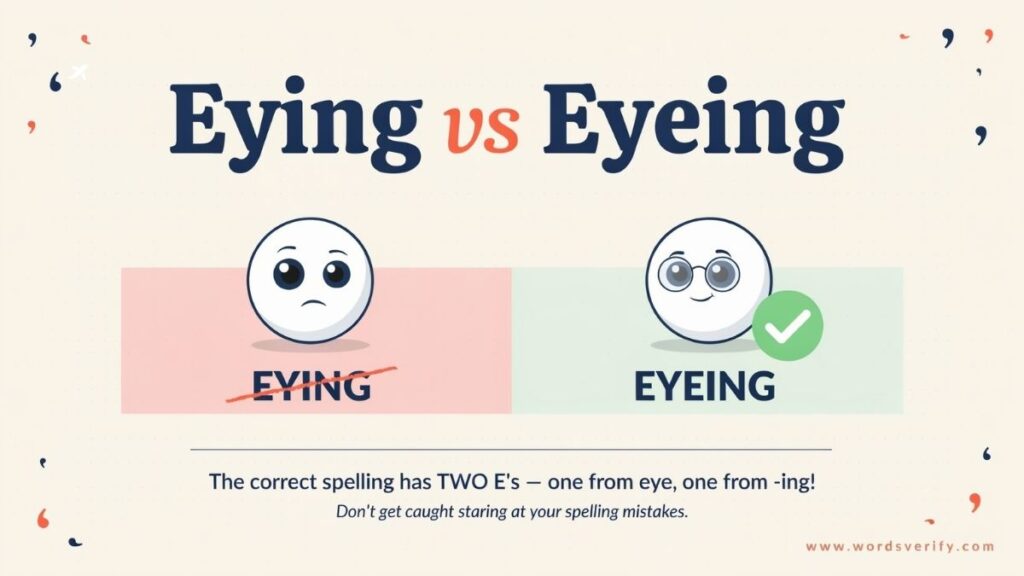
Have you ever looked at “eying” vs “eyeing” and thought, “Surely English could make this easier”? You’re not alone. These two spellings can cause a surprising amount of confusion, especially because the word “eye” doesn’t behave quite like other words when you add “-ing.” So, in the debate over eying or eyeing, which spelling should you use? Both forms are accepted, but they aren’t equally familiar to every reader. In this guide, you’ll learn what each spelling means, how it’s pronounced, where the confusion comes from, and how to use it correctly, so you can write with confidence instead of second-guessing yourself.
Quick Answer
Both eyeing and eying are correct spellings.
The two forms come from the verb eye, which can mean to look at someone or something carefully, watch closely, or consider something with interest.
The main difference is spelling preference rather than meaning.
| Word | Status | Meaning | Pronunciation |
|---|---|---|---|
| eyeing | Standard and widely familiar | Looking at, watching, or considering closely | EYE-ing |
| eying | Accepted variant | Same meaning | EYE-ing |
If you’re writing for a general American audience, eyeing is usually the safest choice.
That doesn’t make eying incorrect. It simply means that eyeing is more immediately recognizable to many readers.
What Does Eyeing Mean?
Eyeing is the present participle of the verb eye. It describes looking at someone or something with particular attention.
The word can suggest several related ideas depending on the context. Someone may be eyeing an object because they want it, watching another person because they are suspicious, or considering an opportunity because they are interested in it.
For example:
- The customer was eyeing the expensive watch.
- The dog was eyeing the food on the table.
- The manager was eyeing several candidates for the position.
- The security guard was eyeing the stranger carefully.
- The company is eyeing a new market.
Although these sentences describe different situations, they all involve focused attention.
Eyeing is therefore stronger than simply saying that someone saw something. It often tells the reader that the person deliberately directed their attention toward it.
Eyeing as Looking Closely
The most direct use of eyeing involves careful or deliberate looking.
Consider this sentence:
1.The detective was eyeing the suspect carefully.
2.The detective isn’t merely aware of the suspect.
3.The detective is watching the person closely and paying attention to their behavior.
The word works in much the same way when describing an object:
She was eyeing the painting from across the room.
This suggests that the painting has caught her attention.
Eyeing as Showing Interest
Eyeing can also suggest that someone wants something or is considering it.
For example:
The child was eyeing the last piece of cake.
The child has obviously noticed the cake. More importantly, the sentence suggests that the child is interested in having it.
The same meaning appears in professional and business contexts:
The company is eyeing expansion into a new market.
Here, eyeing doesn’t mean literally looking at the market. It means considering or targeting the opportunity.
Eyeing as Watching With Suspicion
The word can also describe a cautious or suspicious look.
For example:
The guard was eyeing the visitor near the entrance.
The sentence suggests that the guard was paying close attention because something about the visitor had raised concern.
Context determines whether eyeing sounds curious, interested, cautious, competitive, or suspicious.
Learn the difference between confusing word pairs
Pleaded vs Pled Which One Is Correct?
What Does Eying Mean?
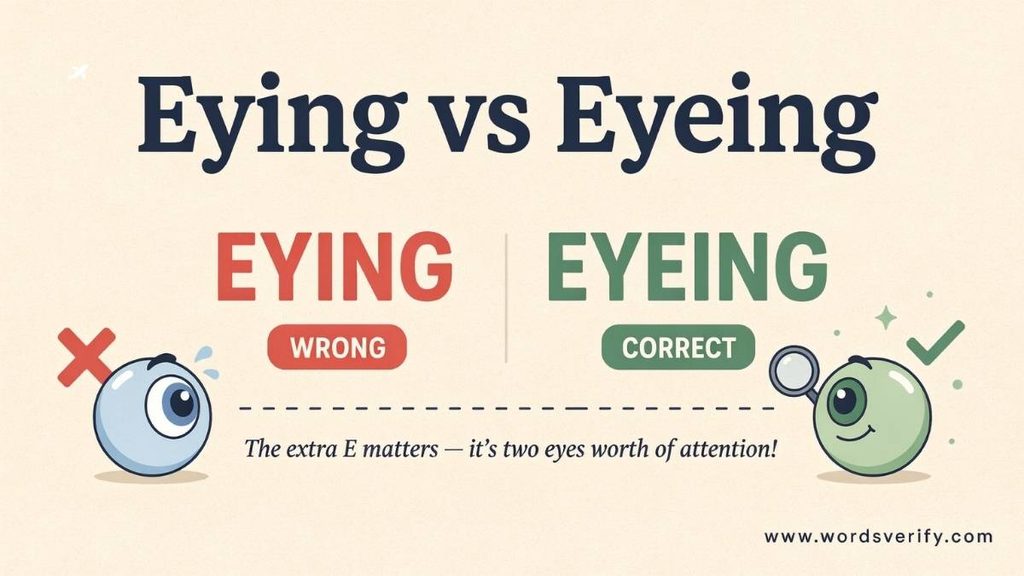
Eying has the same basic meaning as eyeing.
It is an accepted spelling variant of the present participle of eye. The word can be used in the same grammatical situations as eyeing.
For example:
The customer was eying the red jacket.
This sentence means exactly the same thing as:
The customer was eyeing the red jacket.
There is no difference in the action being described.
The difference lies only in the spelling.
This is why eying should not automatically be treated as a misspelling. It may look unusual to some readers, but it is a recognized variant in English.
Why Are There Two Spellings?
The confusion comes from the unusual spelling of the base word eye.
English has a common spelling pattern in which a final silent e disappears before -ing.
For example:
- hope → hoping
- take → taking
- write → writing
- make → making
Following that pattern, eye → eying might seem perfectly natural.
At the same time, keeping the original spelling produces eyeing.
Both forms have developed in English usage.
There is also a practical reason why eyeing remains popular: it makes the relationship between the verb and the base word immediately obvious.
When readers see eyeing, they can instantly identify eye within the word.
When they see eying, the connection is less obvious at first glance.
English spelling contains many such irregularities and variations. Not every word follows a single rule perfectly.
Learn the difference between confusing word pairs
The vs Thee Meaning, Difference and Pronunciation
Is Eyeing vs Eying Correct?
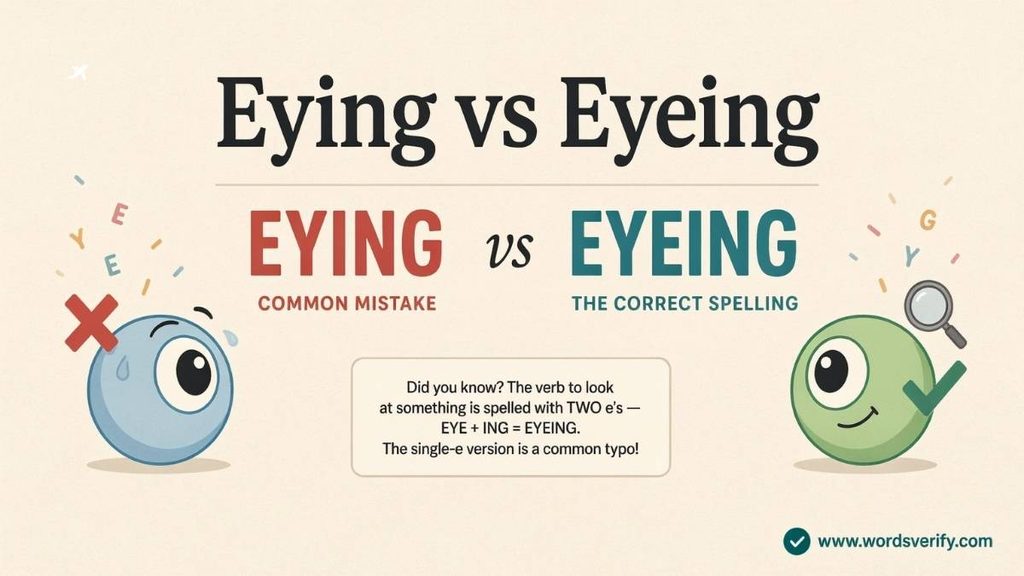
Both are correct.
This is an important distinction because an unfamiliar spelling isn’t necessarily an incorrect spelling.
Eying is recognized as a variant of eyeing. Major English dictionaries document the form, so it shouldn’t be described simply as a mistake.
However, correctness and preference aren’t always the same thing.
A spelling can be accepted while another spelling is more common or more familiar to readers.
For general American English writing, eyeing is usually the more practical choice.
If you’re writing an article, report, email, essay, or other public-facing material, eyeing will generally look more natural to a broad audience.
Learn the difference between confusing word pairs
Copys vs Copies Which one Is Correct?
Eyeing vs Eying in American English
Both forms occur in American English.
The spelling eyeing is particularly useful when clarity and familiarity are priorities. Because the word visibly contains eye, most readers understand it immediately.
Eying is also accepted, so using it doesn’t automatically make a sentence grammatically or orthographically wrong.
Consider these examples:
- The company is eyeing a larger office.
- The company is eying a larger office.
Both sentences mean that the company is considering or interested in a larger office.
For most American English writing, the first version is the stronger choice simply because it is more familiar.
Which Form Should You Use?
For everyday American English, use eyeing unless you have a specific reason to use the variant.
It is a sensible choice for:
- Academic writing
- Professional communication
- Business documents
- School assignments
- Articles and essays
- General nonfiction
- Websites and educational material
Eying can still be used when it matches a publication’s established spelling preference or when you are reproducing wording from another source.
Learn the difference between confusing word pairs
Descision vs Decision Meaning, and Usage
Eyeing vs Eying in British English
It is tempting to describe eyeing and eying as a simple American-versus-British spelling difference. That isn’t accurate.
Both forms can be found in English usage, and major dictionaries recognize the variant.
Individual publishers and style guides may have their own preferences. Therefore, British writers should follow the conventions of the publication or organization they are writing for rather than assuming that one form is exclusively British.
The important point is that eying isn’t automatically wrong in British English, just as eyeing isn’t restricted to American English.
Eyeing vs Eying Pronunciation
There is no meaningful pronunciation difference between eyeing and eying.
Both are pronounced approximately:
EYE-ing
The first part sounds like the word eye, followed by the -ing ending.
Because both spellings have the same pronunciation, the distinction becomes noticeable mainly in written English.
This also explains why the two forms can coexist without causing much difficulty in everyday conversation. When someone says the word aloud, you don’t know which spelling they would choose.
Eyeing vs Eying Grammar
From a grammatical perspective, both forms come from the verb eye.
The main forms of the verb are:
| Verb form | Example |
|---|---|
| eye | I eye the situation carefully. |
| eyes | She eyes the door. |
| eyed | He eyed the stranger suspiciously. |
| eyeing | She is eyeing the cake. |
| eying | She is eying the cake. |
The -ing form can function as a present participle in continuous verb constructions.
For example:
She is eyeing the new apartment.
It can also appear in a participial phrase:
He entered the room, eyeing everyone carefully.
The form can also function as a gerund:
Eyeing the competition requires careful observation.
In all of these examples, the spelling variation doesn’t change the grammatical role.
Learn the difference between confusing word pairs
Grately vs Greatly Meaning, Difference and Usage
Eyeing vs Looking What’s the Difference?
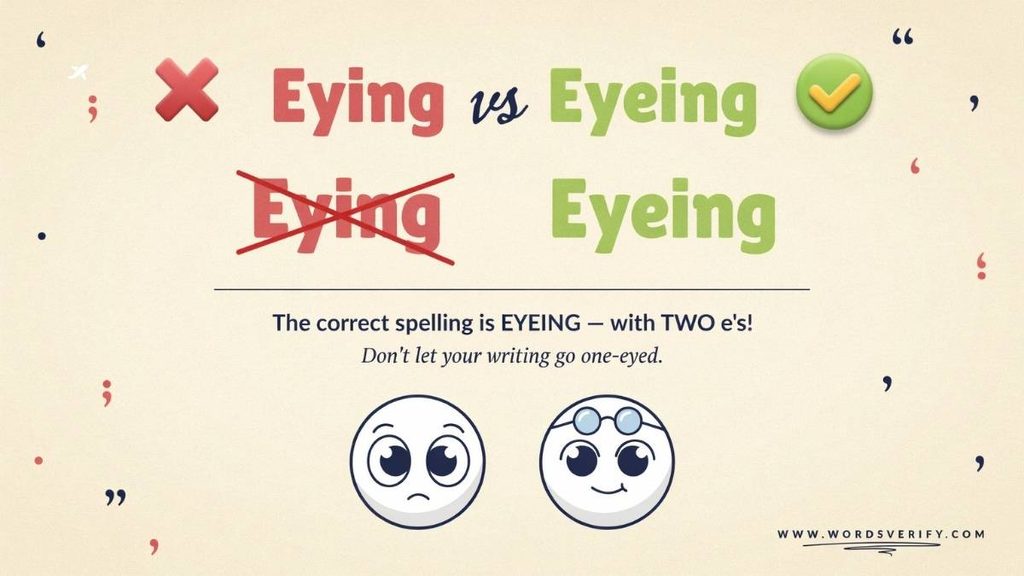
The concepts of Eyeing and looking are related, but they don’t always communicate the same idea.
Looking is a broad term. It simply describes directing your eyes toward something.
Eyeing usually suggests a more deliberate form of attention.
Compare:
She looked at the dress.
She was eyeing the dress.
The first sentence gives a basic description of what she did.
The second suggests that the dress caught her attention. She may have been considering buying it, admiring it, or deciding whether she wanted it.
Other words describe different kinds of visual attention.
| Word | Meaning or usual implication |
|---|---|
| looking | Directing your eyes toward something |
| eyeing | Looking closely or with particular interest |
| glancing | Looking briefly |
| staring | Looking for an extended or noticeable period |
| gazing | Looking steadily, often with admiration or thought |
| watching | Observing something over time |
| inspecting | Examining something carefully |
| monitoring | Watching something systematically |
Choosing the right word helps communicate the exact kind of attention you want the reader to understand.
Learn the difference between confusing word pairs
Neice vs Niece Which one Is Correct?
Eyeing vs Eying Examples
Context makes the meaning of these words much easier to understand.
Showing Interest
The customer was eyeing the new phone.
The sentence suggests that the phone has caught the customer’s attention and may be under consideration.
Considering a Purchase
She was eyeing the blue dress in the window.
The sentence suggests interest rather than a casual glance.
Watching Someone
The security officer was eyeing the visitor.
The officer is paying close attention to the visitor.
Considering an Opportunity
The company is eyeing a move into international markets.
Here, eyeing means considering or pursuing a possibility.
Wanting Food
The puppy was eyeing the bowl of food.
The context suggests that the puppy wants the food.
Watching a Competitor
The two teams were eyeing each other before the match.
This suggests focused attention with a competitive element.
Using Eying
He was eying the empty seat near the window.
This sentence is also correct. Replacing eying with eyeing doesn’t change its meaning.
Learn the difference between confusing word pairs
Principal vs Principle Difference and Correct usage
Eyeing vs Eying in a Sentence
If you’re trying to learn how to use the word naturally, pay attention to the relationship between the person and the thing being observed.
Here are several examples:
- The child was eyeing the cookies on the counter.
- She kept eyeing the clock during the meeting.
- The company is eyeing a new location.
- He was eyeing the empty table near the window.
- The cat sat quietly, eyeing the bird outside.
- The coach was eyeing several talented players.
- She was eyeing the dress but hadn’t decided whether to buy it.
- The detective was eyeing the suspect carefully.
- Investors are eyeing the company’s latest product.
- He walked into the room, eyeing everyone suspiciously.
Notice that the word works with people, objects, opportunities, and situations.
Learn the difference between confusing word pairs
Inquire vs Enquire Difference and Usage
Common Expressions With Eyeing
Eyeing appears in several common expressions.
Eyeing an Opportunity
To eye an opportunity means to consider it or show interest in it.
The company is eyeing an opportunity to expand overseas.
Eyeing the Competition
This means paying close attention to competitors.
The team is eyeing the competition ahead of the final.
Eyeing a Position
This expression often suggests that someone wants or hopes to obtain a particular role.
She is eyeing a management position.
Eyeing the Prize
This expression describes someone who remains focused on a desired result.
After months of training, the athlete is eyeing the championship.
Eyeing Something Up
Eye something up is an informal expression meaning to look closely at something because you are interested in it.
For example:
I saw you eyeing up that cake.
When eye someone up refers to looking at a person, it can sometimes suggest flirtatious or sexual interest. The surrounding context determines how the expression is understood.
Learn the difference between confusing word pairs
Carmel vs Caramel difference and Correct usage
Common Mistakes With Eying vs Eyeing
Assuming Eying Is Wrong
The unusual appearance of eying often leads people to mark it as a spelling error.
That isn’t justified.
Eying is an accepted spelling variant. It may be less familiar to some readers, but unfamiliarity doesn’t make it incorrect.
Assuming the Two Spellings Have Different Meanings
They don’t.
These sentences have the same basic meaning:
She was eyeing the cake.
She was eying the cake.
The spelling is different, but the action being described is the same.
Adding a Hyphen
Another occasional mistake is writing eye-ing.
That isn’t the normal spelling in standard prose.
Use eyeing or eying instead.
Confusing Eyeing With Seeing
Seeing simply means perceiving something visually.
Eyeing suggests deliberate attention.
Compare:
I saw a new car outside.
I was eyeing the new car outside.
The first sentence tells us that the speaker noticed the car.
The second suggests that the speaker was paying particular attention to it.
Learn the difference between confusing word pairs
Naive vs Nieve difference and Correct usage
How to Remember the Correct Spelling of Eyeing
The easiest way to remember the preferred spelling is to keep the base word in mind.
The base word is eye.
From there:
eye + ing = eyeing
The spelling may look unusual, but it has one useful advantage: you can immediately see the original word inside it.
If you’re writing for a broad audience and don’t want your reader to pause over the spelling, eyeing is the most straightforward choice.
At the same time, remember that eying is a legitimate variant.
Why Is Eyeing Spelled With Two E’s?
The spelling can seem strange because the word contains the sequence eyeing.
The confusion comes from applying the usual silent-e pattern too strictly.
Many English verbs drop a final e before -ing. However, spelling conventions don’t work identically for every word.
Eye is an unusual base word, and the form eyeing preserves its original spelling.
The alternative form eying reflects the more familiar idea of removing the final e.
Both forms have therefore remained in use.
There isn’t a separate meaning hidden in the extra e. The two spellings refer to the same grammatical form.
Is Eying a Word?
Yes.
Eying is an accepted English word form. It is the present participle of eye and can be used in the same situations as eyeing.
For example:
He was eying the new car.
The sentence is grammatically sound.
Still, readers vary in how familiar they are with the spelling. Someone who has mostly encountered eyeing may initially assume that eying is a typo.
That’s why eyeing is often the better choice when you’re writing for a broad audience.
Is Eyeing a Word?
Yes. Eyeing is the present participle of the verb eye.
The verb eye has several closely related meanings, including looking at something carefully, watching someone closely, and considering something as a possibility.
For example:
The manager is eyeing several candidates.
Here, the manager is considering the candidates.
In another sentence:
The dog is eyeing the food.
Here, the dog is looking at the food with interest.
The surrounding context determines the precise sense.
Eyeing vs Eying Synonyms
There isn’t one perfect synonym for eyeing because the word can express several shades of meaning.
Depending on the sentence, you could use:
- Looking at
- Watching
- Observing
- Examining
- Inspecting
- Studying
- Monitoring
- Gazing at
- Staring at
- Considering
The best alternative depends on the intended meaning.
For instance, inspecting suggests a careful examination. Gazing can suggest admiration or thoughtfulness. Monitoring implies continued or systematic observation.
Eyeing is more flexible and often carries a sense of interest or focused attention.
Eyeing vs Eying in Formal Writing
When you’re writing formally, the clearest familiar form is usually the best choice.
Eyeing works well in professional and academic contexts because readers can immediately connect it to the verb eye.
For example:
The company is eyeing further expansion.
This sentence is concise and natural.
The alternative:
The company is eying further expansion.
is still acceptable, but some readers may briefly question the spelling.
That small interruption is easy to avoid. If no particular style requires eying, eyeing is generally the stronger choice.
A Practical Example Choosing the Better Form
Imagine writing this sentence for a business report:
The company is ___ a new location in Chicago.
Both versions work:
The company is eyeing a new location in Chicago.
The company is eying a new location in Chicago.
The meaning remains unchanged.
For a general American audience, the first version is usually preferable because it is more familiar.
Now imagine that you’re quoting a historical document or reproducing a source exactly. In that situation, preserving the original spelling may be more important than choosing the form that is most common today.
The right choice therefore depends not only on grammar but also on context and editorial purpose.
Practice Session Eying vs Eyeing
Fill in each blank with the correct form: “eyeing” vs “eying.”
- Maria was ______ the last piece of chocolate cake.
- The manager is ______ a promotion for next year.
- He kept ______ the expensive watch in the shop window.
- The dog was ______ the food on the kitchen counter.
- Sarah has been ______ that apartment for several weeks.
- The security guard was ______ the stranger suspiciously.
- Tom is ______ a new position at the company.
- We noticed the cat ______ the bird through the window.
- She was ______ the blue dress but decided not to buy it.
- The team is ______ a place in the championship.
- He sat quietly, ______ the unfamiliar object on the table.
- I’ve been ______ that laptop for months.
- The child was ______ the colorful balloons at the party.
- The company is ______ opportunities to expand its business.
- She caught her friend ______ the dessert before dinner.
- The customer was ______ the newest phone in the display case.
- The detective spent several minutes ______ the suspect carefully.
- Jake is ______ a chance to join the professional team.
- The tourists were ______ the tall buildings around them.
- She has been ______ a new car since last summer.
- The player was ______ the goal before taking the shot.
- The puppy sat near the table, ______ the food.
- He was ______ the vacant office because he wanted to move upstairs.
- The students were ______ the science experiment with curiosity.
- After seeing the menu, I was immediately ______ the chocolate dessert.
Answers
- Eyeing
- Eyeing
- Eyeing
- Eyeing
- Eyeing
- Eyeing
- Eyeing
- Eyeing
- Eyeing
- Eyeing
- Eyeing
- Eyeing
- Eyeing
- Eyeing
- Eyeing
- Eyeing
- Eyeing
- Eyeing
- Eyeing
- Eyeing
- Eyeing
- Eyeing
- Eyeing
- Eyeing
- Eyeing
Here’s a trusted source for clear more words Comparison:
FAQs
Does eyeing mean looking carefully?
Yes. Eyeing means looking at someone or something closely, often because you’re interested, curious, suspicious, or considering it.
Can eyeing describe wanting something?
Yes. If you’re eyeing something, you may be considering getting, choosing, or taking it. For example, “She’s eyeing the last piece of cake.”
Is eying acceptable in formal writing?
Yes. Eying is an accepted spelling of the present participle of “eye.” However, eyeing may look more familiar to many readers, so it can be a practical choice in general writing.
Why does eyeing keep the letter e?
The spelling comes from the noun and verb “eye.” Although many verbs drop a final silent e before adding “-ing,” eyeing is commonly written with the e retained to make the connection with “eye” clear.
Is eyeing pronounced differently from eying?
No. Eyeing and eying are pronounced the same way: “EYE-ing.” The difference is in spelling, not pronunciation.
Can eyeing describe a suspicious look?
Yes. Eyeing can suggest that someone is watching another person or thing carefully because they’re unsure, doubtful, or suspicious. For example, “The guard was eyeing the unfamiliar package.”
Can you use eyeing for future plans?
Yes. Eyeing can describe something you’re considering for the future. For example, “He’s eyeing a promotion at work.”
What is the past tense of eye?
The past tense of eye is “eyed.” For example, “She eyed the unfamiliar machine carefully.”
What is the present tense of eye?
The present-tense forms are “eye” and “eyes.” For example, “I eye the situation carefully” and “She eyes the door.”
Can eyeing be used for people?
Yes. You can use eyeing when someone is looking at another person with interest, curiosity, suspicion, or attention. The intended meaning depends on the context.
Does eyeing always have a negative meaning?
No. Eyeing can be neutral, positive, or negative. Someone might eye a delicious dessert with interest, eye a new job with ambition, or eye a stranger with suspicion.
Can you say “eyeing an opportunity”?
Yes. “Eyeing an opportunity” means considering or hoping to take advantage of an opportunity. For example, “The company is eyeing an opportunity to expand overseas.”
What is the difference between eyeing and staring?
Eyeing usually suggests purposeful attention or interest, while staring often describes looking for a longer period without looking away. The two words can overlap, but their emphasis is different.
Can eyeing mean watching?
Yes. In some contexts, eyeing can mean watching or observing something closely, especially when the person is paying careful attention to what happens next.
Is “eyeing” used as a verb?
Yes. Eyeing is the present participle and gerund form of the verb “eye.” It can appear after forms of “be,” as in “She is eyeing the new apartment.”
Can eyeing be used in a sentence without “someone” or “something”?
Yes. The object can sometimes be understood from the context. For example, “He’s been eyeing the position for months” clearly identifies what he wants, but informal conversation may leave the object unstated when it is already obvious.
Does “eyeing” have anything to do with eyesight?
Not directly. Eyeing comes from the verb “eye,” which means to look at something carefully. It describes an action or manner of looking rather than a person’s ability to see.
Can eyeing describe shopping?
Yes. It’s common to use eyeing when someone is considering buying something. For example, “I’ve been eyeing that jacket for weeks.”
Is “eying” considered a misspelling?
No. Eying is an accepted spelling, so it shouldn’t automatically be treated as an error. Eyeing is simply the spelling many readers are more accustomed to seeing.
What is the easiest way to remember eyeing?
Think of the word “eye” first. Since the action comes from eye, writing “eyeing” makes the connection easy to recognize. This can help you avoid second-guessing the spelling.
conclusion
The confusion between eying vs eyeing may seem small, but English has a talent for turning tiny spelling choices into full-blown puzzles. The good news is that both spellings are accepted and carry the same meaning. They describe looking at someone or something with attention, interest, curiosity, or even suspicion.
For most readers, however, eyeing is the more familiar and instantly recognizable form. If you’re writing an email, article, essay, or any other general text, eyeing is a reliable choice that keeps your meaning clear. So, the next time you pause over that extra “e,” don’t let it stare you down. Choose eyeing, use it confidently, and move on to the next spelling mystery.

Lisa AJS is an experienced blogger and language enthusiast at Words Verify, dedicated to making grammar simple, practical, and enjoyable. She writes engaging content on commonly confused words, grammar mistakes, word meanings, and everyday language challenges.