
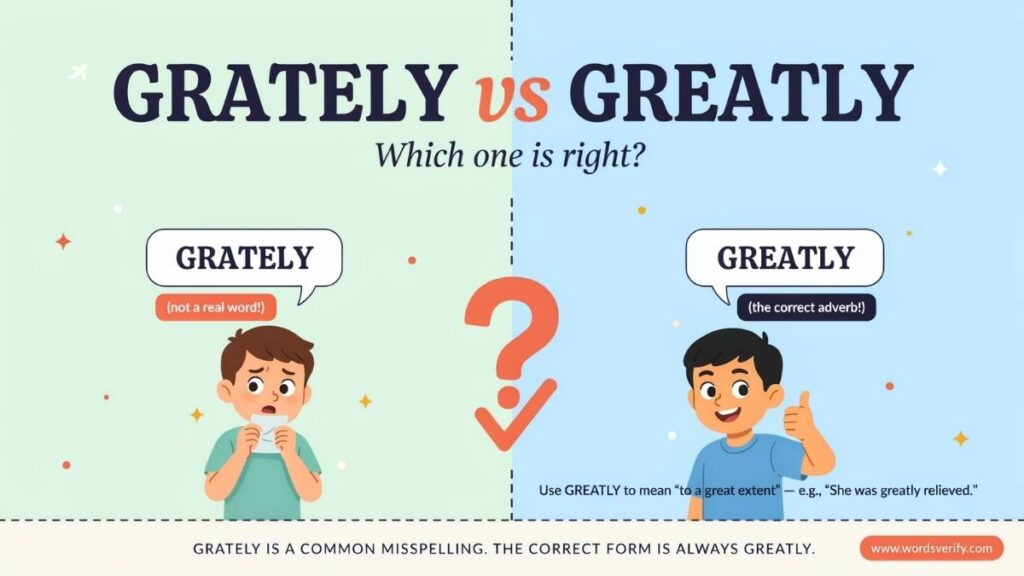
Have you ever written a word with complete confidence only to discover that one little letter has betrayed you? “Grately” is a common spelling mistake that can easily slip into emails, essays, and everyday writing. The correct spelling is “greatly,” an adverb used to express a high degree or significant extent. In this guide to Grately vs Greatly, you’ll learn the difference between these confusing forms, understand the meaning and proper use of “greatly,” and explore clear examples that make the distinction easy to remember. By the end, you’ll know exactly which word belongs in polished writing and which one should be left behind
Grately vs Greatly The Quick Answer
Greatly is the correct spelling. Grately is incorrect in standard English when you mean “very much” or “to a great extent.”
| Word | Correct spelling? | Meaning | Example |
|---|---|---|---|
| Greatly | Yes | Very much; considerably; to a great extent | Your help is greatly appreciated. |
| Grately | No, in this usage | A misspelling of greatly | Use “greatly” instead. |
Is Grately vs Greatly Correct?
If you’re asking, “Is grately or greatly correct?” the answer is greatly.
The easiest way to remember the spelling is:
Great + ly = greatly
The word keeps the spelling of “great” when we add the suffix “-ly.”
Is Grately a Word?
The question “Is grately a word?” needs a little clarification. You may occasionally see “grately” in informal writing, online posts, or spelling mistakes. However, it isn’t the standard English spelling of the adverb that means “very much.”
For ordinary writing, use greatly.
Greatly Meaning What Does “Greatly” Mean?
Greatly means “very much,” “considerably,” or “to a great extent.”
The word describes the degree or extent of something. It can show how strongly someone feels, how much something changes, or how significantly an action affects a situation.
Greatly Definition
The greatly definition is:
Greatly is an adverb that means to a great extent, very much, or considerably.
For example:
- Your advice greatly helped me.
This means your advice helped me very much. - The new system greatly improved efficiency.
This means the new system improved efficiency to a large extent. - She was greatly surprised by the news.
This means the news surprised her very much. - The decision greatly affected the community.
This means the decision affected the community considerably.
The Meaning of Greatly in Simple English
Think of greatly as a word that adds strength to an action or feeling.
Compare these sentences:
- Your advice helped me.
- Your advice greatly helped me.
Both sentences say the advice helped. However, the second sentence emphasizes that the help was substantial.
That is the central meaning of greatly: it shows a high degree of something.
Is Greatly a Word in English?
Yes. Greatly is a standard English word and a commonly used adverb.
It comes from the adjective great, which can mean large, important, excellent, or impressive, depending on the context. When we add the suffix “-ly,” we form the adverb greatly.
Greatly as an Adverb
An adverb can modify a verb, adjective, or another adverb. Greatly often modifies a verb to show how strongly or extensively an action happens.
| Sentence | What “greatly” tells us |
|---|---|
| The news greatly surprised me. | How strongly the news surprised me |
| The project greatly benefited the community. | How much the project benefited the community |
| Her confidence improved greatly. | How much her confidence improved |
| We greatly admire her work. | How strongly we admire her work |
Greatly and the Adjective Great
The adjective great describes a noun:
- A great opportunity
- A great achievement
- A great improvement
The adverb greatly describes the degree of an action or feeling:
- The opportunity greatly benefited the company.
- The achievement greatly impressed the judges.
- The situation greatly improved.
This distinction helps explain why greatly is the correct form. The word is built from great, not from a shortened version of it.
Learn the difference between often confused words
Descision vs Decision Meaning, and Usage
Greatly Pronunciation and Spelling
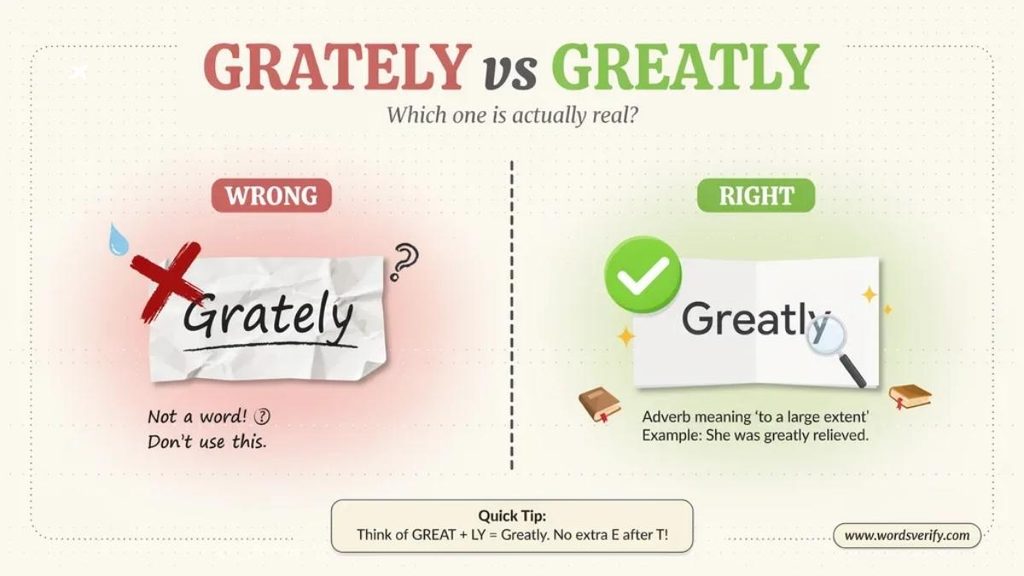
The greatly pronunciation is commonly written as GRAYT-lee.
The word sounds like:
great + lee
That sound can sometimes make the spelling harder to remember. However, the word still contains the full spelling of great.
How to Spell Greatly
If you’re asking, “How to spell greatly?” the answer is:
G-R-E-A-T-L-Y
Correct Spelling of Greatly
The correct spelling of greatly is:
greatly
The word contains:
- Great — the base word
- -ly — the suffix that forms the adverb
So the spelling is:
great + ly = greatly
Greatly Spelling vs Grately Spelling
The difference is only one letter, but that letter matters.
| Incorrect | Correct |
|---|---|
| grately | greatly |
| greatley | greatly |
| grately appreciated | greatly appreciated |
| grately missed | greatly missed |
The grately spelling is a common mistake because the word may look as though it should lose the final “e” before adding “-ly.” In this case, it doesn’t.
Learn the difference between often confused words
Copys vs Copies Which one Is Correct?
Why Do People Spell Greatly as Grately?
The mistake usually comes from a reasonable but incorrect spelling assumption.
The “Great + Ly” Confusion
Someone may think:
The word is great. Add -ly, and it becomes grately.
That looks logical at first. However, English spelling doesn’t always work by removing letters before adding a suffix.
For greatly, the spelling remains:
great + ly = greatly
The “e” stays.
A Similar Spelling Pattern
Compare these words:
- Great → greatly
- Complete → completely
- Polite → politely
- Immediate → immediately
In each case, the adjective keeps its spelling when it takes “-ly.”
However, not every word follows the same pattern. English has many spelling rules and exceptions, so it’s better to learn the correct form of each word than to assume every adjective behaves identically.
Why Pronunciation Doesn’t Always Help
The pronunciation of greatly sounds like GRAYT-lee. It doesn’t clearly remind you that the word contains great.
That’s why spelling the word from sound alone can lead to grately.
A better approach is to connect the spelling to the base word:
great → greatly
Learn the difference between often confused words
The vs Thee Meaning, Difference and Pronunciation
Grately vs Greatly Difference
The grately vs greatly difference is straightforward:
- Greatly is a correct English adverb.
- Grately is a misspelling of greatly.
There isn’t a meaningful difference in definition because grately doesn’t function as the standard word people intend to use.
Grately vs Greatly Meaning
The grately vs greatly meaning question often suggests that both words might have separate definitions. In ordinary English, they don’t.
| Question | Answer |
|---|---|
| Does greatly have a meaning? | Yes. It means very much or to a great extent. |
| Does grately have a standard meaning in this comparison? | No. It’s a misspelling. |
| Can I use grately in formal writing? | No. Use greatly. |
| Is greatly a word in English? | Yes. |
Is Grately a Correct Word?
If you’re asking, “Is grately a correct word?” the answer is no when you mean the standard adverb greatly.
The correct English usage is:
- Greatly appreciated
- Greatly missed
- Greatly improved
- Greatly affected
Not:
- Grately appreciated
- Grately missed
- Grately improved
- Grately affected
Learn the difference between often confused words
Pleaded vs Pled Which One Is Correct?
Greatly vs Grately Appreciated Which Is Correct?
The correct phrase is greatly appreciated.
If you’re asking, “Greatly or grately appreciated?” choose greatly appreciated.
Greatly Appreciated Meaning
The greatly appreciated meaning is “appreciated very much.”
For example:
Your support is greatly appreciated.
This means:
Your support is appreciated very much.
The phrase is common in professional emails, polite requests, thank-you messages, and formal notices.
Greatly Appreciated Examples
- Your patience is greatly appreciated.
- Your assistance is greatly appreciated.
- Your feedback is greatly appreciated.
- Your understanding is greatly appreciated.
- Any help would be greatly appreciated.
Greatly Appreciated in Professional Writing
The phrase works well when you want to sound polite and respectful.
For example:
Your cooperation is greatly appreciated during this transition.
However, you don’t need to use it in every thank-you message. Sometimes a more direct sentence sounds warmer:
Thank you. I really appreciate your help.
Both are correct. The choice depends on the tone you want.
Learn the difference between often confused words
Speach vs Speech Which one Is Correct?
Greatly Missed vs Grately Missed?
The correct phrase is greatly missed.
If you’re asking, “Greatly missed or grately missed?” choose greatly missed.
Greatly Missed Meaning
The greatly missed meaning is “missed very much.”
For example:
You are greatly missed.
This means:
You are missed very much.
Greatly Missed Examples
- Her kindness is greatly missed.
- You are greatly missed by your friends.
- The old neighborhood is greatly missed.
- His presence is greatly missed at family gatherings.
The phrase often appears in messages about someone who is absent or no longer present.
Learn the difference between often confused words
Glueing vs Gluing Which one Is Correct?
Greatly vs Very What’s the Difference?
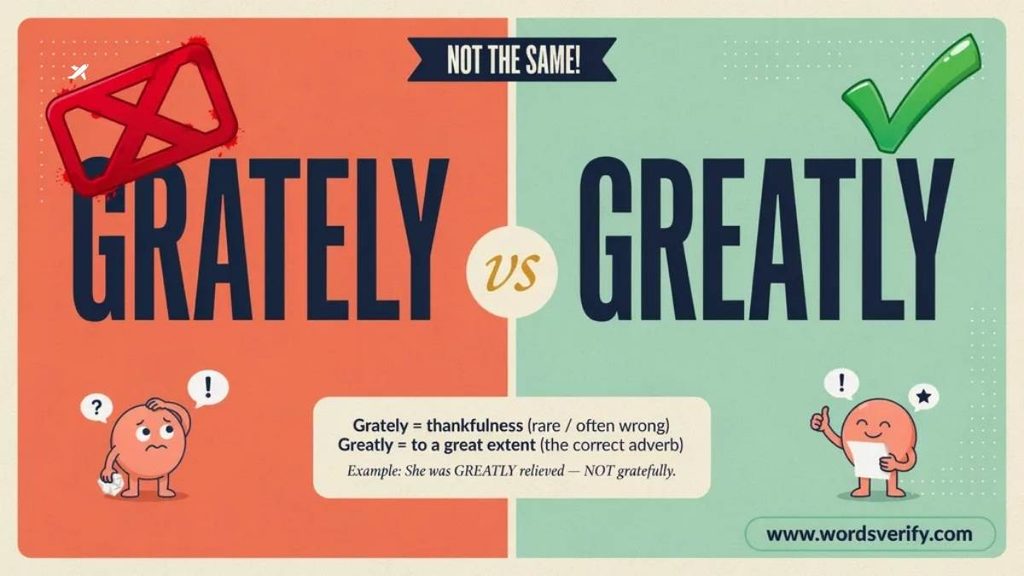
At a high degree ,both Greatly and very can both express a high degree, but they don’t always work in the same sentence.
Very Much Meaning
Very much means “to a high degree” or “a great deal.”
For example:
- I appreciate your help very much.
- I miss you very much.
- She enjoyed the experience very much.
These sentences are similar in meaning to:
- I greatly appreciate your help.
- You are greatly missed.
- She greatly enjoyed the experience.
Greatly and Very in Comparison
| Sentence | Meaning |
|---|---|
| I greatly appreciate your help. | I appreciate your help very much. |
| I am very happy. | I am happy to a high degree. |
| The results improved greatly. | The results improved to a large extent. |
| The results improved significantly. | The results improved in a meaningful or important way. |
When to Use Greatly
Greatly often works naturally with verbs such as:
- Appreciate
- Improve
- Increase
- Reduce
- Influence
- Affect
- Benefit
- Admire
- Value
- Regret
For example:
- We greatly appreciate your support.
- The changes greatly improved the process.
- The new policy greatly reduced costs.
- Her work greatly influenced the field.
When to Use Very
Very commonly modifies adjectives and adverbs:
- Very happy
- Very tired
- Very important
- Very quickly
- Very carefully
Greatly Synonyms and Their Meanings
The grately vs greatly synonyms question is really about finding alternatives to greatly.
Here are some useful greatly synonyms:
| Synonym | Meaning | Example |
|---|---|---|
| Very much | To a high degree | I appreciate it very much. |
| Considerably | By a large amount | Costs have increased considerably. |
| Significantly | In an important or meaningful way | The results improved significantly. |
| Substantially | By a large amount | The company reduced expenses substantially. |
| Deeply | With strong feeling | She was deeply moved. |
| Extensively | Over a wide range or to a large extent | The topic has been extensively studied. |
Greatly Antonyms
The greatly antonyms depend on the context.
Possible opposites include:
- Slightly
- Minimally
- Barely
- Hardly
- A little
For example:
- The situation greatly improved.
- The situation improved slightly.
The first sentence describes a large improvement. The second describes a small one.
Greatly Used in a Sentence
The phrase “greatly used in a sentence” is a common search for learners who want to see the word in context.
Here are several greatly example sentences.
Everyday Examples
- I greatly enjoyed the concert.
- Your advice greatly helped me.
- She greatly values her family.
- We greatly appreciate your kindness.
- The experience greatly influenced my decision.
Professional Examples
- We greatly appreciate your patience.
- The new system greatly improved efficiency.
- This decision could greatly affect the company.
- Your contribution greatly benefited the project.
- The changes greatly reduced processing time.
Academic Examples
- The study greatly increased our understanding of the issue.
- These findings greatly influenced later research.
- The new method greatly reduced errors.
- The results greatly differed from the original prediction.
- The research greatly expanded our knowledge of the subject.
Greatly Usage Patterns That Sound Natural
Understanding the meaning of greatly is useful, but knowing how to place it in a sentence makes your writing stronger.
Greatly + Verb
This is one of the most common patterns.
- The news greatly surprised me.
- The new policy greatly improved safety.
- Her work greatly influenced the industry.
Verb + Greatly
You can also place greatly after the verb.
- His confidence improved greatly.
- The situation changed greatly.
- The results varied greatly.
Greatly + Past Participle
This pattern often appears in formal writing.
- We were greatly relieved.
- She was greatly concerned.
- Your help is greatly appreciated.
- His work is greatly admired.
Greatly with Common Verbs
| Phrase | Meaning |
|---|---|
| Greatly appreciate | Appreciate very much |
| Greatly admire | Admire very much |
| Greatly affected | Affected to a large extent |
| Greatly improved | Improved considerably |
| Greatly reduced | Reduced by a large amount |
| Greatly increased | Increased by a large amount |
| Greatly influenced | Influenced strongly |
| Greatly valued | Valued very much |
| Greatly concerned | Very concerned |
| Greatly enjoyed | Enjoyed very much |
Common Spelling Mistakes Like Grately vs Greatly
The grately vs greatly confusion is one example of a broader issue in English word formation.
Common English Spelling Errors
Some mistakes happen because writers spell a word the way it sounds. Others happen because they apply a spelling rule that doesn’t fit the word.
For example:
- Definitely, not definately
- Separate, not seperate
- Necessary, not neccessary
- Greatly, not grately
The lesson isn’t that English spelling is impossible. It’s that some words need a little extra attention.
A Useful Spelling Habit
When you’re unsure about a word, connect it to its base word.
For greatly, think:
great → greatly
This is more reliable than trying to spell the word from pronunciation alone.
How to Use Greatly Correctly in Writing
If you’re asking, “How to use greatly in a sentence?” start by identifying the action or feeling you want to emphasize.
1.Use Greatly to Show a Large Degree
- The new policy greatly improved safety.
- The experience greatly influenced her career.
- The decision greatly affected the community.
2.Use Greatly to Show Strong Feelings
- I greatly admire her work.
- We greatly appreciate your support.
- She was greatly concerned about the situation.
3.Use Greatly to Describe a Large Change
- The company greatly reduced costs.
- The number of visitors greatly increased.
- His confidence improved greatly.
Quick Usage Checklist
| Question | Answer |
|---|---|
| Am I spelling the word correctly? | Use greatly. |
| Am I expressing “very much”? | Greatly may fit. |
| Am I describing a large change? | Greatly may fit. |
| Am I using “very” with a verb? | Consider greatly instead. |
| Am I writing “grately appreciated”? | Change it to greatly appreciated. |
Practice Session Grately vs Greatly
Fill in the Blanks
Here’s a practice session based on “Grately vs. Greatly” to help you master the correct spelling and usage.
- Your support has ______ improved my confidence.
- We ______ appreciate your kindness.
- The new system has ______ reduced waiting times.
- She was ______ affected by the sudden news.
- I ______ enjoyed the concert last night.
- His advice ______ influenced my decision.
- The team’s performance has ______ improved this season.
- We are ______ concerned about the rising costs.
- The teacher’s guidance was ______ valued by her students.
- The number of errors has ______ decreased.
- I ______ admire people who remain calm under pressure.
- Your generous donation is ______ appreciated.
- The experience ______ changed the way I think.
- Their efforts have ______ increased public awareness.
- He was ______ missed after he moved away.
- The medicine ______ reduced her pain.
- We ______ appreciate your patience.
- The project was ______ influenced by customer feedback.
- She has ______ improved her writing skills.
- The event was ______ enjoyed by everyone.
- His absence was ______ noticed by the entire team.
- The company has ______ increased its online presence.
- I am ______ thankful for your help.
- The new policy has ______ affected local businesses.
- Your hard work is ______ appreciated by the whole group.
Answers
- greatly
- greatly
- greatly
- greatly
- greatly
- greatly
- greatly
- greatly
- greatly
- greatly
- greatly
- greatly
- greatly
- greatly
- greatly
- greatly
- greatly
- greatly
- greatly
- greatly
- greatly
- greatly
- greatly
- greatly
- greatly
Here’s a trusted source for clear more words Comparison:
FAQs
Is it “grately” or “greatly appreciated”?
“Greatly appreciated” is correct. “Grately appreciated” is a spelling mistake. The phrase means that something is deeply valued or sincerely welcomed.
Is “grately” a correct word?
No. “Grately” is not the standard English spelling. The correct word is “greatly.”
What does “greatly” mean?
“Greatly” means to a considerable degree, very much, or significantly. For example, “Your support greatly helped me” means your support helped me a lot.
Is “I greatly appreciate it” grammatically correct?
Yes. “I greatly appreciate it” is grammatically correct and expresses strong gratitude. It is suitable for both professional and personal communication.
Is “greatly appreciated” proper grammar?
Yes. “Greatly appreciated” is grammatically correct. It is often used in emails, notices, and professional messages to express sincere thanks.
What is a professional alternative to “greatly appreciated”?
You can use “sincerely appreciated,” “deeply appreciated,” “highly valued,” or “truly appreciated.” The best choice depends on the level of gratitude you want to express.
How can I use “greatly” in a sentence?
You can use “greatly” before a verb or adjective to show a high degree. For example, “The new policy greatly improved workplace safety.”
What is the difference between “greatly” and “very”?
“Very” usually strengthens an adjective or adverb, as in “very helpful.” “Greatly” often strengthens a verb or describes the extent of an action, as in “greatly improved.”
How do you pronounce “greatly”?
“Greatly” is pronounced “GRAYT-lee.” It has two syllables and sounds like “great” followed by “lee.”
What are some alternatives to “greatly enjoyed”?
You can say “thoroughly enjoyed,” “deeply enjoyed,” “really enjoyed,” or “very much enjoyed.” “Thoroughly enjoyed” sounds especially natural in polished writing.
What is another word for “greatly important”?
“Extremely important,” “highly significant,” “critically important,” and “vitally important” are useful alternatives. “Critically important” is common in professional and academic writing.
What is the opposite of “greatly”?
The opposite depends on the context. Possible alternatives include “slightly,” “minimally,” “barely,” or “to a small degree.”
What is a stronger word than “appreciated”?
“Valued,” “cherished,” “admired,” and “esteemed” can express stronger appreciation. For example, “Your guidance is highly valued” sounds professional and sincere.
Is “very grateful” grammatically correct?
Yes. “Very grateful” is grammatically correct and means extremely thankful. For example, “I’m very grateful for your assistance.”
How do you spell “grateful”?
The correct spelling is “grateful.” It contains “grate” followed by “ful,” not “great” followed by “ful.”
Why is “grateful” spelled with “grate” instead of “great”?
“Grateful” comes from “grate,” meaning thankful or appreciative. Although it is related to the idea of goodness, it is not spelled “greatful.”
What is a stronger word for “grateful”?
“Deeply grateful,” “profoundly thankful,” and “extremely appreciative” express stronger gratitude. “Deeply grateful” is natural and suitable for formal writing.
How can I use “greatly appreciated” in an email?
You can write, “Your assistance would be greatly appreciated.” This polite expression is useful when making a professional request.
What can I say instead of “I really appreciate it”?
You can say, “I sincerely appreciate it,” “I’m very grateful,” “Thank you for your valuable help,” or “Your support means a great deal to me.”
Is “greatly” a formal word?
“Greatly” is suitable for formal, academic, and everyday writing. It often sounds more polished than “a lot,” especially in professional communication.
Conclusion
The difference between “grately” vs “greatly” may seem minor, but a single misplaced letter can weaken otherwise polished writing. Remember that “greatly” is the correct spelling. It means “to a great extent” or “very much” and appears in expressions such as “greatly appreciated,” “greatly improved,” and “greatly missed.”
Although “grately” may look convincing, it is simply a common spelling mistake. With a little practice and careful proofreading, you can avoid this error and make your writing clearer, more accurate, and more professional. After all, your words should make a great impression—not create a spelling mystery.

Lisa AJS is an experienced blogger and language enthusiast at Words Verify, dedicated to making grammar simple, practical, and enjoyable. She writes engaging content on commonly confused words, grammar mistakes, word meanings, and everyday language challenges.