
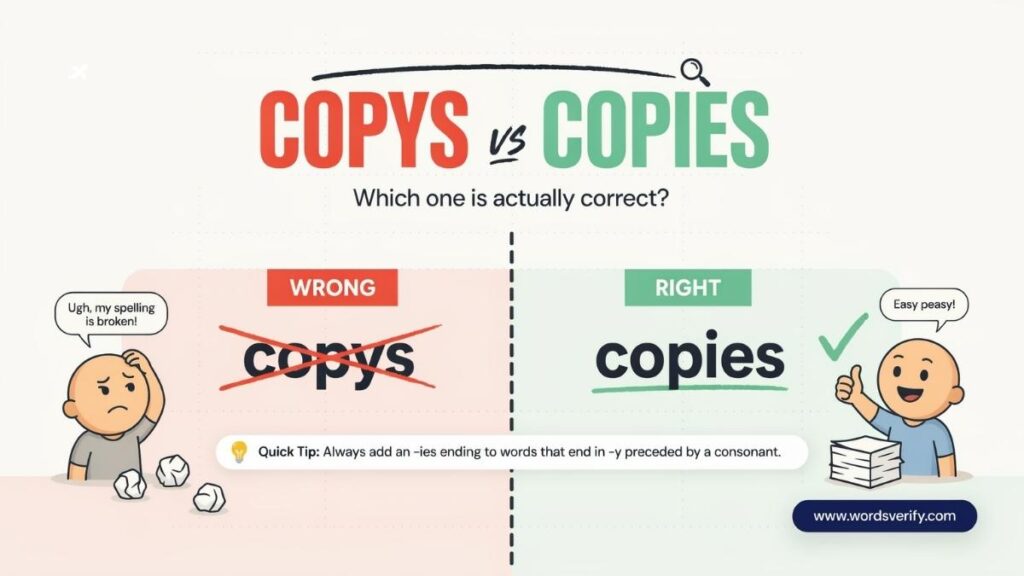
English spelling can turn a simple word into a surprisingly tricky puzzle. The confusion surrounding “copys vs copies” is a perfect example. Adding s to copy may seem logical, but English has other plans. When a word ends in a consonant followed by y, the y usually changes to i before es is added. That is why copies is correct, while copys is not. This article explains the spelling rule in clear, practical language. You will also discover how to use copy vs copies correctly, recognize common mistakes, and remember the difference without turning every sentence into a spelling emergency .
What Does Copy Mean?
The word copy can be used as both a noun and a verb. Its meaning depends on the way it appears in a sentence.
As a noun, copy usually means a duplicate or reproduction of something. It may refer to a document, book, photograph, file, or another item.
For example:
- I need a copy of your receipt.
- She purchased a copy of the magazine.
- Please keep a copy of the contract.
- The student received a copy of the assignment.
- The library has a copy of the book.
Copy can also refer to written material prepared for advertising, marketing, publishing, or communication.
For example:
- The editor reviewed the copy before publication.
- The writer prepared copy for the company website.
- The advertisement contains short and effective copy.
As a verb, copy means to reproduce, imitate, or write the same information.
For example:
- Please copy this paragraph into your notebook.
- He copied the answer from the board.
- She copied the file to her computer.
- The artist copied the design for practice.
- The student copied the information carefully.
Learn the difference between commonly mixed-up more words
The vs Thee Meaning, Difference and Pronunciation
What Does Copies Mean?
Copies is the plural form of the noun copy. It refers to more than one copy.
For example:
- The office printed five copies of the form.
- The library has several copies of the novel.
- We need two copies of the application.
- The manager distributed copies of the schedule.
- Please make copies of these documents.
Copies can also be the third-person singular form of the verb copy. This form is used with he, she, it, or a singular noun.
For example:
- She copies the notes carefully.
- He copies the files every morning.
- The machine copies documents quickly.
- The student copies the diagram.
- My brother copies my handwriting.
The meaning depends on the sentence. In “three copies,” copies is a noun. In “she copies the notes,” copies is a verb.
Why Does Copy Become Copies?
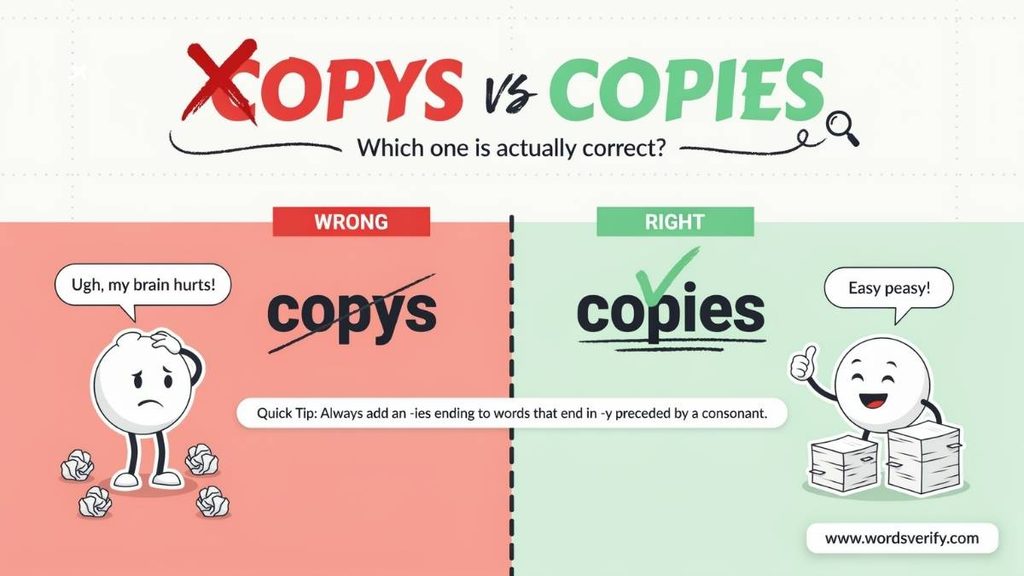
Copy becomes copies because of a common English spelling rule copys vs copies.
When a word ends in a consonant followed by y, the y usually changes to i before es is added. Since copy has p before y, it follows this rule.
The process is:
- Start with copy.
- Remove the final y.
- Change y to i.
- Add es.
- The result is copies.
The rule can be written as:
Consonant + y → ies
Several other words follow the same pattern:
- Baby becomes babies.
- City becomes cities.
- Family becomes families.
- Story becomes stories.
- Party becomes parties.
- Country becomes countries.
- Company becomes companies.
- Library becomes libraries.
- Fly becomes flies.
- Reply becomes replies.
This is why copies is correct while copys is not.
Consonant + Y Versus Vowel + Y
Not every word ending in y changes to ies. The letter immediately before y determines which spelling rule applies copys vs copies.
When a word ends in a consonant followed by y, change y to i and add es.
Examples include:
- Copy becomes copies.
- Baby becomes babies.
- Cry becomes cries.
- Study becomes studies.
- Try becomes tries.
- Reply becomes replies.
However, when a word ends in a vowel followed by y, keep the y and add s.
Examples include:
- Boy becomes boys.
- Toy becomes toys.
- Day becomes days.
- Key becomes keys.
- Play becomes plays.
- Enjoy becomes enjoys.
Compare the following examples:
- Copy becomes copies because p is a consonant.
- Boy becomes boys because o is a vowel.
- City becomes cities because t is a consonant.
- Toy becomes toys because o is a vowel.
- Story becomes stories because r is a consonant.
- Day becomes days because a is a vowel.
A practical way to remember the rule is to look at the letter before y. If it is a consonant, the y usually changes to i. If it is a vowel, the y remains unchanged.
Copy as a Noun
A noun names a person, place, thing, or idea. When copy is used as a noun, it refers to one duplicate or version of something.
For example:
- I made a copy of the document.
- She kept a copy of the invoice.
- This copy is missing a page.
- The editor reviewed the copy before publication.
- He requested a copy of the receipt.
When you refer to more than one, use copies.
For example:
- I made three copies of the document.
- She kept several copies of the invoice.
- These copies are missing pages.
- The editor reviewed all the copies.
- They requested copies of the receipts.
The singular and plural forms are:
- One copy
- Two copies
- A single copy
- Several copies
- One printed copy
- Multiple printed copies
- A digital copy
- Several digital copies
Copy as a Verb
Copy can also function as a verb. It means to reproduce, imitate, or transfer something.
For example:
- Please copy the information carefully.
- I will copy the files to the new folder.
- She copied the sentence into her notebook.
- The student copied the diagram from the board.
- He copied the address into his phone.
When the subject is he, she, or it, the verb becomes copies.
For example:
- She copies the information carefully.
- He copies the files every morning.
- The student copies the diagram.
- The machine copies the document.
- The software copies the files automatically.
The present-tense forms are:
- I copy.
- You copy.
- We copy.
- They copy.
- He copies.
- She copies.
- It copies.
The form copies is used because the subject is singular and third person.
Learn the difference between commonly mixed-up more words
Pleaded vs Pled Which One Is Correct?
Copy and Copies in Everyday Sentences

The difference between copy and copies becomes clearer when both forms appear in ordinary sentences.
- I need one copy of the form.
- I need four copies of the form.
- She will copy the information later.
- She copies the information every day.
- The office printed one copy.
- The office printed twenty copies.
- Please copy this page.
- He copies every page into his notebook.
- We saved a copy of the file.
- We saved several copies of the file.
Copy refers to one item or the base form of the verb. Copies refers to more than one item or an action performed by a singular third-person subject.
Using Copies for Documents
copys vs copies , Copies is frequently used when discussing forms, applications, receipts, contracts, reports, and official records.
For example:
- Please submit two copies of your application.
- The office requested three copies of the agreement.
- Keep copies of all important documents.
- The teacher handed out copies of the test.
- We need printed copies for the meeting.
- She made digital copies of the certificates.
- The manager asked for copies of the invoices.
When a number greater than one appears before the noun, the noun must be plural.
Correct phrases include:
- Two copies
- Five copies
- Ten copies
- Several copies
- Many copies
- A few copies
- Numerous copies
Incorrect phrases include:
- Two copys
- Five copys
- Ten copys
- Several copys
The spelling remains copies regardless of the number.
Is “Two Copys” Correct?
No. The correct phrase is two copies.
The word two indicates that you are referring to more than one item. Therefore, you must use the plural form of copy, which is copies.
Correct examples:
- I need two copies of the receipt.
- She printed two copies of the letter.
- Please bring two copies of the form.
- The office requested two copies of the contract.
Incorrect examples:
- I need two copys of the receipt.
- She printed two copys of the letter.
- Please bring two copys of the form.
- The office requested two copys of the contract.
The same rule applies to every number greater than one:
- One copy
- Two copies
- Three copies
- Four copies
- Twenty copies
- One hundred copies
Learn the difference between commonly mixed-up more words
Speach vs Speech Which one Is Correct?
Common Expressions with Copies
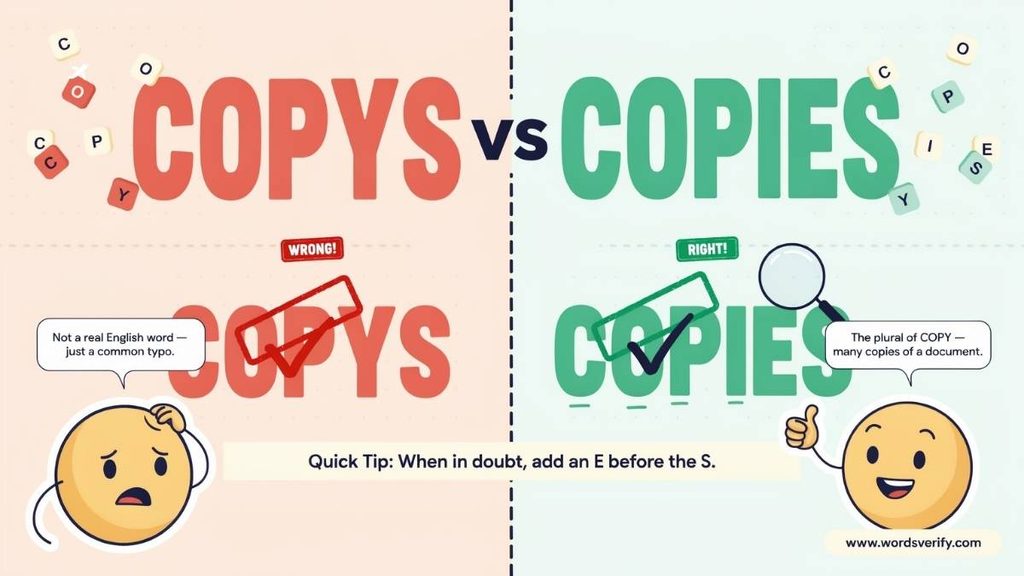
The word copies appears in several common expressions used in everyday and professional English copys vs copies.
Make Copies
This means to produce duplicate versions of something.
Example: Please make copies of this document.
Print Copies
This means to produce paper versions of a document or file.
Example: The assistant printed copies for everyone.
Keep Copies
This means to save duplicate versions for future use.
Example: Always keep copies of your important records.
Distribute Copies
This means to give duplicate documents to several people.
Example: The teacher distributed copies of the worksheet.
Multiple Copies
This refers to more than one duplicate.
Example: The office stored multiple copies of the report.
Extra Copies
This means additional duplicates beyond the number originally required.
Example: We prepared extra copies in case more people attended.
Hard Copies
This refers to printed versions of documents.
Example: The company requested hard copies of the forms.
Digital Copies
This refers to electronic versions of documents or files.
Example: I saved digital copies on my computer.
Learn the difference between commonly mixed-up more words
Glueing vs Gluing Which one Is Correct?
Copies in Business Writing
In professional settings copys vs copies, copies are often mentioned when discussing paperwork, reports, contracts, invoices, and presentations.
For example:
- Please send copies of the signed contract.
- The team prepared copies of the presentation.
- Keep copies of every submitted form.
- The receptionist made copies for the visitors.
- We need additional copies of the meeting agenda.
- The department requested copies of the financial report.
Correct spelling is important in professional communication. A small spelling error may distract the reader or make a message appear less carefully prepared.
Instead of writing:
“Please send three copys.”
Write:
“Please send three copies.”
The correction is simple, but the second sentence is accurate and professional.
Copies in Writing and Marketing
Copy can also refer to written material used in advertising, marketing, brochures, websites, and promotional content.
For example, a marketing team may create copy for:
- Advertisements
- Websites
- Product descriptions
- Email campaigns
- Brochures
- Social media posts
- Sales pages
- Promotional materials
When there is more than one version of the written material, use copies.
For example:
- The writer created several copies for the advertisement.
- The team tested different copies for the campaign.
- The editor reviewed the copies before publication.
- The marketing department prepared copies for different audiences.
In this context, copy does not always mean a duplicate. It can also mean written content created for a particular purpose.
Copywriting and Copies
Copywriting is the process of creating written content for advertising, marketing, or promotion.
A copywriter may prepare several versions of the same message. These versions can be called copies.
For example:
- The copywriter created three copies of the advertisement.
- The team compared different copies of the sales message.
- The company approved one copy and rejected the others.
- The writer prepared several copies of the product description.
The plural spelling remains copies because the same spelling rule applies.
Copy, Copies, Copied, and Copying
These forms are related, but they serve different grammatical purposes.
Copy is the base form of the word.
Examples:
- I copy the notes.
- Please copy this page.
- We need a copy of the form.
Copies is used as a plural noun or as a present-tense verb with he, she, or it.
Examples:
- I printed two copies.
- She copies the notes.
- The machine copies the document.
Copied is the past-tense and past-participle form.
Examples:
- I copied the information yesterday.
- She copied the file.
- The document was copied successfully.
Copying is the present participle or gerund form.
Examples:
- He is copying the document.
- She is copying the notes.
- Copying information by hand takes time.
The forms can be summarized as follows:
- Copy: base form
- Copies: plural noun or third-person singular verb
- Copied: past tense and past participle
- Copying: present participle or gerund
A Simple Way to Remember Copies
Think of the word city.
City becomes cities.
Copy follows the same pattern:
Copy becomes copies.
You can remember the rule with this sentence:
A consonant before y changes y to i before adding es.
The word copy has p before y. Since p is a consonant, the final y changes to i.
Copy → copies
By contrast, boy has o before y. Since o is a vowel, the y stays in place.
Boy → boys
This comparison makes the spelling rule easier to remember.
Practice Session Copys vs Copies
Fill in each blank with the correct word: copy, copies, copied, or copying.
- I need one ______ of the report.
- Please print three ______ of this document.
- She ______ the notes into her notebook every morning.
- He ______ the file to his computer yesterday.
- The machine ______ documents quickly.
- We saved several ______ of the important files.
- Please make a ______ of your receipt.
- The students are ______ the sentences from the board.
- I ______ the information into my notebook yesterday.
- The office requested two ______ of the contract.
- She always keeps a ______ of her application.
- The teacher ______ the worksheet for the entire class.
- He ______ the instructions carefully.
- We need extra ______ for the meeting.
- The assistant is ______ the documents now.
- I made a digital ______ of the photograph.
- The company distributed ______ of the annual report.
- She ______ the address into her phone.
- Please keep ______ of all important records.
- He is ______ the data into a new file.
- The printer produced five ______ of the letter.
- I ______ the paragraph from the textbook.
- The editor reviewed the ______ before publication.
- She ______ the information accurately.
- The library has several ______ of this book.
Answers
- copy
- copies
- copies
- copied
- copies
- copies
- copy
- copying
- copied
- copies
- copy
- copied
- copies
- copies
- copying
- copy
- copies
- copied
- copies
- copying
- copies
- copied
- copy
- copies
- copies
Here’s a trusted source for clear more words Comparison:
FAQs
Why is “copys” incorrect?
“Copys” is incorrect because copy ends in a consonant followed by y. The y changes to i before es is added, making the correct form copies.
When should you use “copies” in a sentence?
Use copies when referring to more than one duplicate or when using copy as a verb with he, she, or it.
Examples:
- She printed several copies.
- He copies the information carefully.
What is the spelling rule for words ending in consonant plus y?
When a word ends in a consonant followed by y, change the y to i and add es to form the plural.
Examples:
- Copy becomes copies.
- Baby becomes babies.
- City becomes cities.
Why does “copy” become “copies” instead of “copys”?
The spelling changes because copy ends in consonant plus y. English changes the y to i before adding es, so the correct plural is copies.
Is “copies” used for more than one document?
Yes. Copies can refer to more than one document, book, photograph, file, or other duplicate item.
Example: Please send three copies of the contract.
Can “copies” be used as a verb?
Yes. Copies is the present-tense verb form used with he, she, it, or a singular noun.
Example: The machine copies the document quickly.
What is the difference between “copy” and “copies” in a sentence?
Copy refers to one item or the base form of the verb. Copies refers to more than one item or the present-tense verb used with a singular third-person subject.
Is “a copies” grammatically correct?
No. The article a is used with a singular noun. The correct phrase is “a copy.” The plural phrase is “copies” or “several copies.”
Is “many copy” correct?
No. Many is used with plural countable nouns. The correct phrase is “many copies.”
Is “a lot of copies” correct?
Yes. “A lot of copies” is grammatically correct because a lot of can be used with plural countable nouns.
Is “copying” related to “copies”?
Yes. Copying is the -ing form of copy, while copies is its plural noun form or third-person singular verb form.
Examples:
- She is copying the notes.
- She has two copies of the notes.
What is the correct past form of “copies”?
The past form of copies is copied when the verb is used in the past tense.
Example: She copied the information yesterday.
Is “copyies” a correct spelling?
No. The correct spelling is copies. The word does not require an extra y or i.
Can “copies” refer to digital files?
Yes. Copies can refer to electronic versions of documents, photographs, videos, or other files.
Example: I saved backup copies of the presentation.
What is the difference between “copies” and “duplicates”?
Both words can refer to more than one version of something. Copies is the more general term, while duplicates often emphasizes that the items are identical.
Is “printed copies” grammatically correct?
Yes. Printed copies refers to paper versions of a document or other material.
Example: The manager requested printed copies of the report.
Is “copy of” followed by a singular or plural noun?
The noun after “copy of” can be singular or plural depending on the meaning.
Examples:
- A copy of the report.
- A copy of the documents.
- Several copies of the report.
What is the correct phrase: “copies of documents” or “copy of documents”?
copys vs copies Both can be correct. Use “copy of documents” for one duplicate containing or representing multiple documents. Use “copies of documents” for more than one duplicate.
How can you remember the spelling of copies?
Remember the pattern used in words such as cities and stories. When a word ends in a consonant plus y, change y to i and add es.
Copy → copies.
What is the easiest way to avoid writing “copys”?
Check the letter before y. Because p is a consonant, copy changes to copies. Reading the sentence aloud and checking the plural form can also help you catch the mistake.
conclusion
When it comes to “copys vs copies,” the correct spelling is copies. Although adding s to copy may seem logical, English has a slightly different rule for words ending in a consonant followed by y. The y changes to i before es is added, giving us copy vs copies.
Remember this pattern by comparing copy with city and story. Just as city becomes cities and story becomes stories, copy becomes copies. Use copy for one item or as the base form of the verb. Use copies for more than one item or with he, she, or it in the present tense.
Once you understand this simple rule, the confusion disappears. Your writing becomes clearer, your spelling becomes more accurate, and “copys” can finally retire from your vocabulary copys vs copies.

Lisa AJS is an experienced blogger and language enthusiast at Words Verify, dedicated to making grammar simple, practical, and enjoyable. She writes engaging content on commonly confused words, grammar mistakes, word meanings, and everyday language challenges.