

English can turn a simple sentence into a courtroom mystery, especially when two words appear to compete for the same job. “Pleaded” vs “pled” often leave writers wondering which one is correct and whether the other deserves a grammar penalty. Fortunately, both forms are accepted. The real confusion lies in knowing when each one sounds natural and how it works in everyday and legal writing. In this article, we’ll explore the difference between pleaded vs pled, explain their meanings, and examine clear examples. By the end, this common grammar mix-up will be settled without a judge, jury, or dramatic objection.
Quick Answers
| Word | Meaning | Example |
|---|---|---|
| Pleaded | The regular past-tense form of plead | She pleaded for another chance. |
| Pled | A shorter past-tense form of plead | The defendant pled guilty. |
Neither word is automatically wrong. You can use either one when the context allows it.
What Does “Plead” Mean?
The verb “plead” has several related meanings. It can mean asking for something sincerely, making an emotional request, or presenting a case in court.
For example:
- He pleaded with his parents to let him go.
- She pleaded for more time.
- The defendant pled guilty in court.
- The lawyer pleaded the case before the judge.
The past-tense forms are “pleaded” and “pled.”
What Is the Past Tense of “Plead”?
The past tense of “plead” can be either “pleaded” or “pled.”
Pleaded
“Pleaded” is formed by adding “-ed” to the verb “plead.” It follows the regular pattern used with many English verbs.
Examples:
- She pleaded for forgiveness.
- He pleaded with his friend to stay.
- The child pleaded for another piece of cake.
- They pleaded their case before the committee.
Pled
“Pled” is a shorter form of the past tense. It is especially common in legal expressions such as “pled guilty” and “pled not guilty.”
Examples:
- The defendant pled guilty.
- He pled not guilty to the charges.
- The accused pled for mercy.
- She pled her case before the judge.
Both forms are grammatically correct.
Pleaded vs Pled The Main Difference

The main difference is not meaning. Both words describe something that happened in the past.
The difference is mainly one of form and usage.
“Pleaded” is the regular form and often sounds more natural in everyday writing. “Pled” is shorter and appears frequently in legal language.
Compare these examples:
- She pleaded with him to reconsider.
- She pled with him to reconsider.
Both sentences are correct. However, the first may sound more familiar in everyday conversation.
Now consider a legal sentence:
- The defendant pleaded guilty.
- The defendant pled guilty.
Both are widely accepted. The second is especially common in legal reporting and courtroom language.
When Should You Use “Pleaded”?
Use “pleaded” when you want the regular and widely understood form of the verb. It works well in everyday conversation, formal writing, storytelling, and emotional situations.
Examples:
- The woman pleaded for help.
- He pleaded with his brother to keep the secret.
- The students pleaded for more time to finish the project.
- She pleaded for a second opportunity.
- The child pleaded not to go home.
“Pleaded” often fits naturally when someone makes an emotional or urgent request.
When Should You Use “Pled”?
Use “pled” when you want the shorter form, especially in legal contexts. It is commonly used with “guilty” and “not guilty.”
Examples:
- The defendant pled guilty to the charge.
- The accused pled not guilty.
- He pled for leniency.
- The suspect pled guilty during the hearing.
- The defendant pled his case before the court.
Although “pled” is strongly associated with legal language, it is not limited to courtroom situations.
Learn how to use confusing more words correctly
Glueing vs Gluing Which one Is Correct?
Is “Pleaded Guilty” Correct?
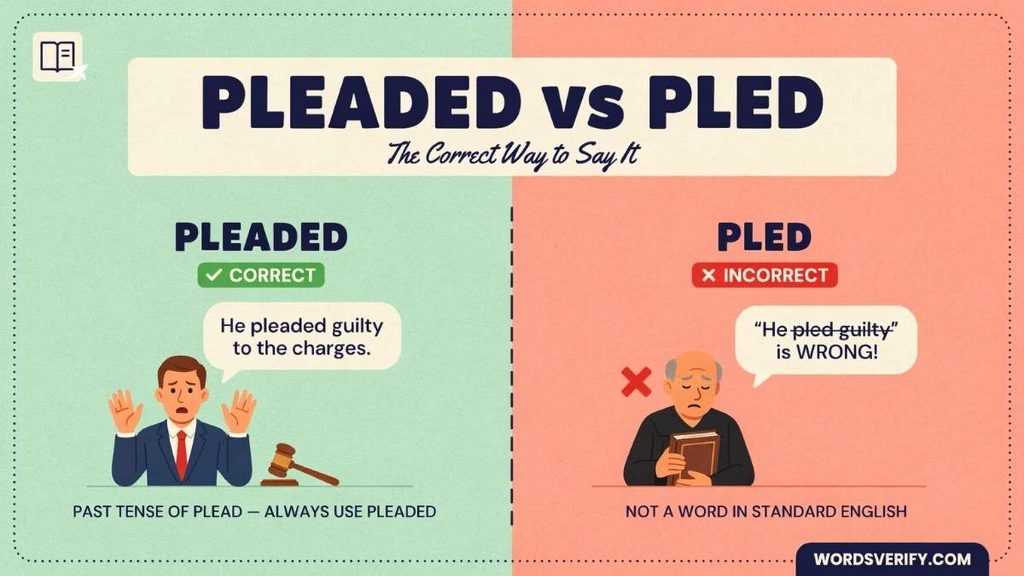
Yes. “Pleaded guilty” is completely correct.
Example:
The defendant pleaded guilty to the charges.
This sentence follows the regular past-tense form of “plead.”
You may also see:
The defendant pled guilty to the charges.
This sentence is also correct. Both forms are accepted in standard English.
Is “Pled Guilty” Correct?
Yes. “Pled guilty” is also correct.
The expression is common in legal writing, news reports, and courtroom discussions.
Examples:
- The driver pled guilty to reckless driving.
- The accused pled guilty during the trial.
- The defendant pled guilty after speaking with his lawyer.
You should not assume that “pled” is incorrect simply because it does not end in “-ed.”
Is “Pleaded Not Guilty” Correct?
Yes. “Pleaded not guilty” is correct.
Example:
The defendant pleaded not guilty to the charges.
The shorter form is also correct:
The defendant pled not guilty to the charges.
Both sentences communicate the same meaning.
Is “Pled” More Formal Than “Pleaded”?
Not necessarily. Neither word is automatically more formal than the other.
However, “pled” appears often in legal expressions. This frequent use can make it sound more connected to courtroom language.
“Pleaded” is common in both formal and informal writing. It may also feel more familiar to readers because it follows the regular “-ed” pattern.
The best choice depends on the sentence and the style you want to follow.
Are “Pleaded” and “Pled” Interchangeable?
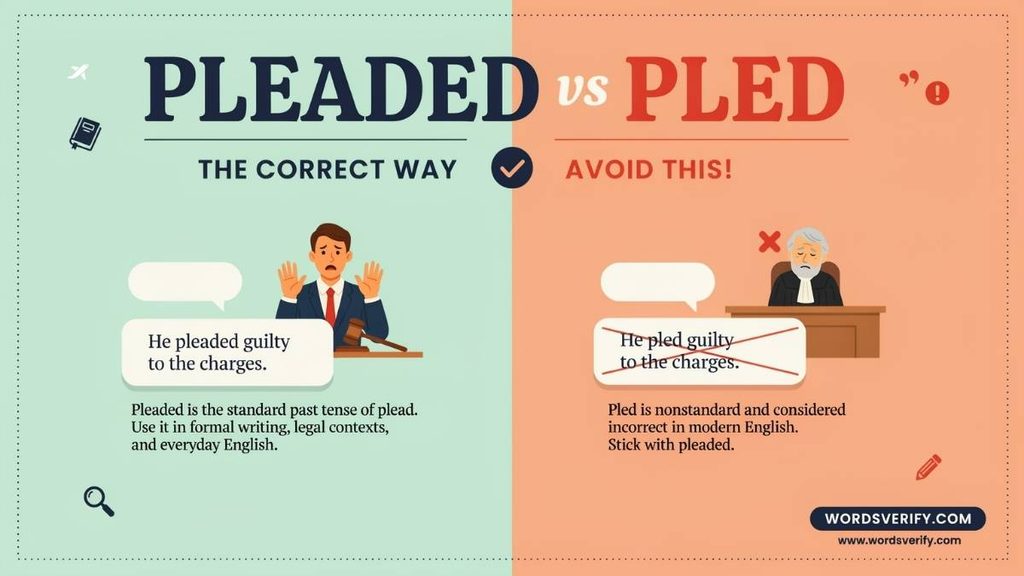
In many sentences, yes. Both forms can describe a past request or a past legal plea.
For example:
- She pleaded for another chance.
- She pled for another chance.
Both sentences are correct.
However, some publications, courts, and style guides may prefer one form. If you are writing for a particular organization, follow its preferred style.
Pleaded vs Pled in American English
American English uses both “pleaded” and “pled.”
The form “pled” is especially common in phrases such as:
- Pled guilty
- Pled not guilty
- Pled for mercy
“Pleaded” is also common and remains a safe choice in most situations.
Examples:
- The defendant pled guilty.
- The defendant pleaded guilty.
- She pleaded for help.
- She pled for help.
All four sentences are grammatically acceptable.
Pleaded vs Pled in British English
British English also accepts both “pleaded” and “pled.”
The regular form “pleaded” is common in general writing. The shorter form “pled” may appear in legal contexts or in certain publications.
Examples:
- He pleaded for another opportunity.
- He pled for another opportunity.
- The accused pleaded guilty.
- The accused pled guilty.
Neither form is restricted to only one variety of English.
Common Mistakes
Many people think that only one form can be correct. That is the most common mistake.
Here are a few other errors to avoid.
Assuming “Pled” Is Wrong
Incorrect assumption:
“Pled” is not a real word because it does not end in “-ed.”
Correction:
“Pled” is an accepted past-tense and past-participle form of “plead.”
Using “Pleaded” and “Pled” as Different Tenses
Some writers believe that “pleaded” is past tense while “pled” is present tense. That is incorrect.
Both words can function as the past tense and past participle.
Examples:
- She pleaded for help.
- She pled for help.
- He has pleaded for forgiveness.
- He has pled for forgiveness.
Writing “Plead” for a Past Event
The word “plead” is the present form.
Incorrect:
Yesterday, he plead guilty.
Correct:
- Yesterday, he pleaded guilty.
- Yesterday, he pled guilty.
Choosing a Form Without Considering the Audience
Both forms are correct, but your readers may be more familiar with one than the other. In general writing, “pleaded” may sound more natural to many readers. In legal writing, “pled” is very common.
Real world Examples
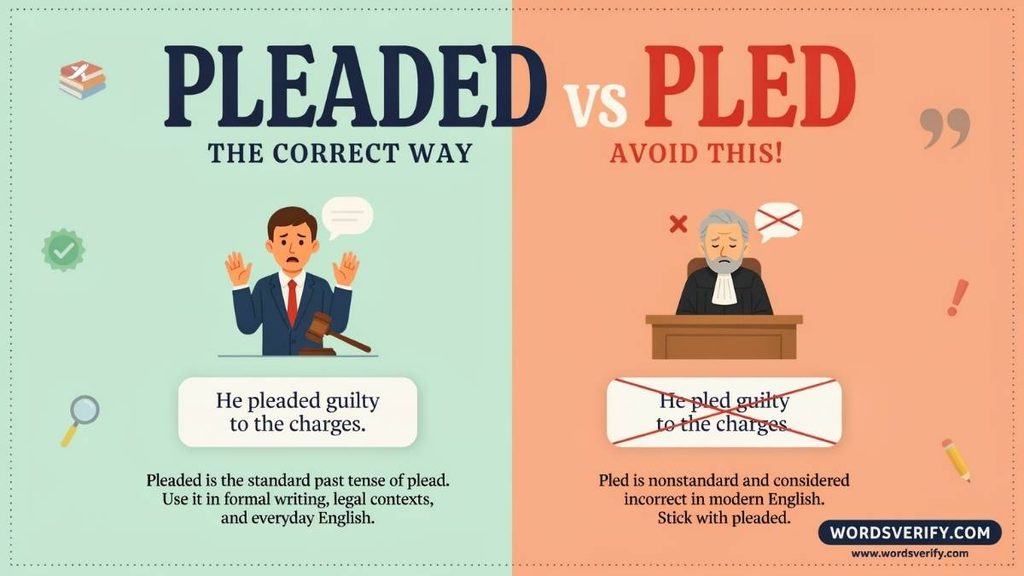
Everyday Requests
- She pleaded with her parents to let her attend the concert.
- He pled with his friend to keep the information private.
- The child pleaded for one more story.
- The child pled for one more story.
- They pleaded for a chance to explain.
Legal Situations
- The defendant pleaded guilty.
- The defendant pled guilty.
- The accused pleaded not guilty.
- The accused pled not guilty.
- The suspect has pleaded guilty to the charge.
- The suspect has pled guilty to the charge.
Emotional Situations
- She pleaded for forgiveness.
- He pled for mercy.
- They pleaded with the manager to reconsider.
- The injured man pleaded for assistance.
- The witness pleaded for protection.
Learn how to use confusing more words correctly
Speach vs Speech Which one Is Correct?
Which Form Should You Use?
Choose “pleaded” when you want the regular form that works naturally in almost any type of writing.
Choose “pled” when you prefer the shorter form or when you are using a familiar legal expression such as “pled guilty.”
A simple guide can help:
- For everyday writing, “pleaded” is a reliable choice.
- For legal writing, both forms are acceptable.
- For “guilty” and “not guilty,” both “pleaded” and “pled” are correct.
- For a formal document, follow the style preferred by the organization or publication.
- When in doubt, use “pleaded.” It is clear, standard, and widely understood.
Here’s a trusted source for clear more words Comparison:
More Related Articles You May Find Helpful
Practice Session Pleaded vs Pled
Fill in the Blanks
- The defendant ______ guilty to the charges yesterday.
- She ______ with her parents to let her attend the concert.
- The lawyer is ______ for a fair decision.
- He will ______ his case before the committee tomorrow.
- The accused ______ not guilty during the hearing.
- The child ______ for another piece of cake.
- They have ______ for more time to complete the project.
- The woman began ______ for help when the storm became stronger.
- The defendant chose to ______ not guilty.
- He ______ with his friend to keep the secret.
- She has ______ for forgiveness many times.
- The lawyer will ______ with the judge for a lighter sentence.
- The suspect ______ guilty after speaking with his lawyer.
- The students were ______ for an extension.
- He had ______ with his manager before the final decision.
- The injured man ______ for medical assistance.
- The accused has ______ not guilty to the charges.
- She continued ______ for another opportunity.
- The defendant decided to ______ guilty.
- The boy ______ with his teacher to explain the situation.
- They ______ for mercy during the difficult situation.
- The lawyer is ______ the defendant’s case in court.
- He has ______ with his parents to reconsider their decision.
- The suspect will ______ guilty at the next hearing.
- She ______ for help when she realized she was lost.
Answers
- pleaded or pled
- pleaded or pled
- pleading
- plead
- pleaded or pled
- pleaded or pled
- pleaded or pled
- pleading
- plead
- pleaded or pled
- pleaded or pled
- plead
- pleaded or pled
- pleading
- pleaded or pled
- pleaded or pled
- pleaded or pled
- pleading
- plead
- pleaded or pled
- pleaded or pled
- pleading
- pleaded or pled
- plead
- pleaded or pled
FAQs
Can “pleaded” and “pled” be used in the same sentence?
Yes. Both forms can appear in the same sentence when they refer to different situations.
Example: The defendant pled guilty after the witness pleaded for mercy.
Does “plead” have the same meaning as “beg”?
Sometimes. When someone pleads, they make a serious or emotional request. However, “plead” can also refer to making a legal statement in court.
Can “plead” be followed by “with”?
Yes. Use “plead with” when someone makes an urgent request to another person.
Example: She pleaded with her brother to keep the secret.
Can “plead” be followed by “for”?
Yes. Use “plead for” when someone asks for something.
Example: The residents pleaded for clean drinking water.
Can “plead” be followed by “to”?
Yes. Use “plead to” when someone makes a request directed toward a person or authority.
Example: He pleaded to the judge for a lighter sentence.
What is the difference between “plead for” and “plead with”?
“Plead for” focuses on what someone wants. “Plead with” focuses on the person being asked.
Examples:
- She pleaded for another chance.
- She pleaded with her teacher for another chance.
Can “plead” describe an emotional expression?
Yes. The word can describe an emotional request made through words, facial expressions, or body language.
Example: His eyes seemed to plead for help.
Is “pleading” the present participle of “plead”?
Yes. “Pleading” is the present participle and gerund form of “plead.”
Examples:
- She is pleading for forgiveness.
- Pleading will not change the decision.
What is the difference between “pleading” and “pleaded”?
“Pleading” usually describes an action happening now or functions as a noun. “Pleaded” describes an action completed in the past.
Examples:
- He is pleading for another opportunity.
- He pleaded for another opportunity.
Can “plead” be used without an object?
Yes. The verb can stand alone when the meaning is clear.
Example:
The defendant chose to plead.
However, writers often add words such as “guilty,” “not guilty,” “for help,” or “with the judge” to make the meaning more specific.
Is “plead” a regular or irregular verb?
“Plead” has both a regular and an irregular past-tense form. “Pleaded” follows the regular pattern, while “pled” is the shorter irregular form.
Can “pleaded” be used with “has” or “had”?
Yes. “Pleaded” can function as a past participle after helping verbs.
Examples:
- She has pleaded for forgiveness.
- He had pleaded with the manager before the decision was made.
Can “pled” be used with “has” or “had”?
Yes. “Pled” can also function as a past participle.
Examples:
- The defendant has pled guilty.
- The accused had pled not guilty before the trial began.
Does the meaning change when you use “pled” instead of “pleaded”?
Usually, no. The meaning remains the same. The difference is mainly related to form and style.
Example:
- She pleaded for help.
- She pled for help.
Both sentences describe the same action.
Why does English have two past forms of “plead”?
English has developed many verbs with more than one accepted past-tense form. Over time, “pleaded” became the regular form, while “pled” remained in use as a shorter alternative.
Should students use “pleaded” or “pled” in school assignments?
Students can use either form when the sentence is correct. “Pleaded” may be the safer choice in general writing because it clearly follows the regular past-tense pattern.
Should legal writers use “pled” or “pleaded”?
Legal writers should use the form preferred by their court, organization, or publication. Both forms are accepted, but consistency is important in formal documents.
Is “plead” connected to the word “plea”?
Yes. A “plea” is a noun that can describe a serious request or a formal response to a criminal charge. The verb “plead” describes the action of making that request or response.
conclusion
English sometimes gives us two correct words and then leaves us wondering which one will survive the grammar test. “Pleaded” vs “pled” are a perfect example. Both are correct forms of “plead.” The difference lies mainly in usage and style, not correctness.
Use “pleaded” as the regular form in everyday and formal writing. Choose “pled” when you prefer the shorter form or when using familiar legal expressions such as “pled guilty” and “pled not guilty.”
The important thing is to remember that neither word is a grammar mistake. Whether someone pleaded for forgiveness or pled for mercy, the sentence can still be perfectly correct. So, there’s no need to put either word on trial. Choose the form that best suits your sentence, use it consistently, and move on with confidence.

Lisa AJS is an experienced blogger and language enthusiast at Words Verify, dedicated to making grammar simple, practical, and enjoyable. She writes engaging content on commonly confused words, grammar mistakes, word meanings, and everyday language challenges.